
At a glance
Where Japan’s hot-spring water comes from, how farmers’ cures became a national pastime, the most famous spa towns, and exactly how to bathe.
- As of March 2025, Japan had more than 27,000 registered hot-spring sources.
- Under the 1948 Hot Springs Act, water counts as an onsen if it emerges at 25°C or above, or carries enough of any one of 19 listed substances.
- The Nihon shoki records Emperor Jomei visiting the springs of Arima in 631.
- Edo-period farmers took tōji cures in seven-day units, usually three of them: twenty-one days.
- Pour water over yourself and wash seated before entering; the small towel stays out of the bath, which is usually 40 to 42°C.
Japan sits on top of one of the most restless pieces of crust on Earth, and the reward for living with earthquakes and volcanoes is hot water. As of March 2025 there were more than 27,000 registered hot-spring sources in the country, and soaking in them is one of the few pleasures that every Japanese person, from schoolchildren to retired executives, seems to share. This is a guide to the onsen: where the water comes from and why it smells and feels so different from town to town, how a habit of emperors and monks became a national pastime, which hot-spring towns are worth the trip, and exactly what to do once you have walked through the curtain and taken your clothes off.
01Water from Below
Most hot-spring water begins as rain and snow. It soaks into the mountains and works its way down through cracks in the rock, getting warmer the deeper it goes; temperatures in the crust rise by roughly 3°C for every hundred meters of depth. Near a volcano the process is far more dramatic. A few kilometers down sits a body of magma, and groundwater circulating close to it is heated directly and picks up gases and minerals on the way: hydrogen sulfide, carbon dioxide, chlorides, sulfates, iron. Hot water is lighter than cold, so it rises again along faults and fractures and emerges in a valley floor, a riverbank, or a field. Some springs gush on their own; others are reached by drilling. The water may have been underground for a few years or for many centuries before it reaches the bath.
The reason Japan has so much of it is plate tectonics. The Pacific and Philippine Sea plates dive beneath the Japanese islands, and the subduction zones feed long chains of volcanoes. As of 2026 Japan has 111 active volcanoes, some 7 to 8 percent of the world’s total, and the most famous onsen towns, Kusatsu, Beppu, Hakone, and Noboribetsu among them, sit in their shadow.
- 1
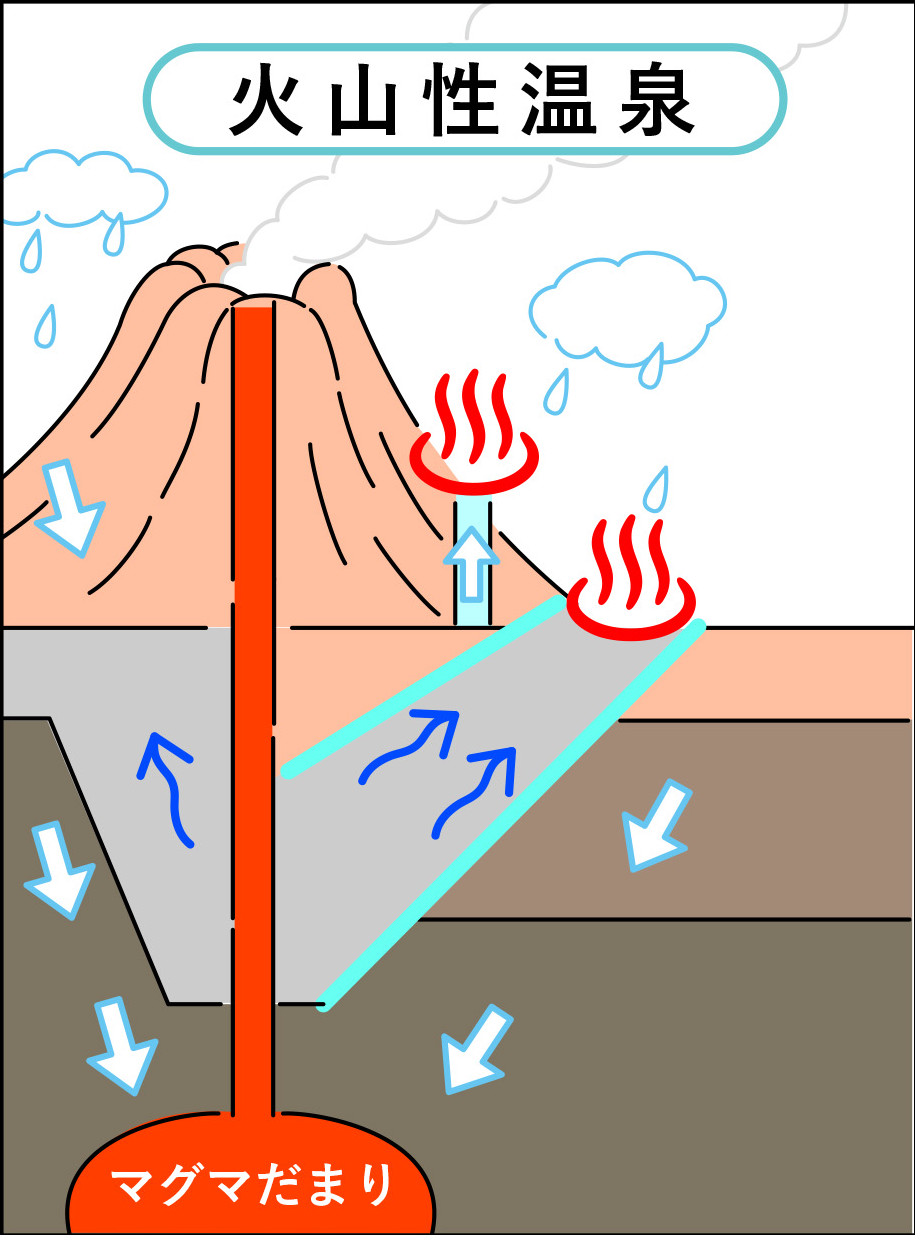 Volcanic type: rain and snow seep underground, are heated by the magma chamber (labeled マグマだまり) and rise along faults.
- 2
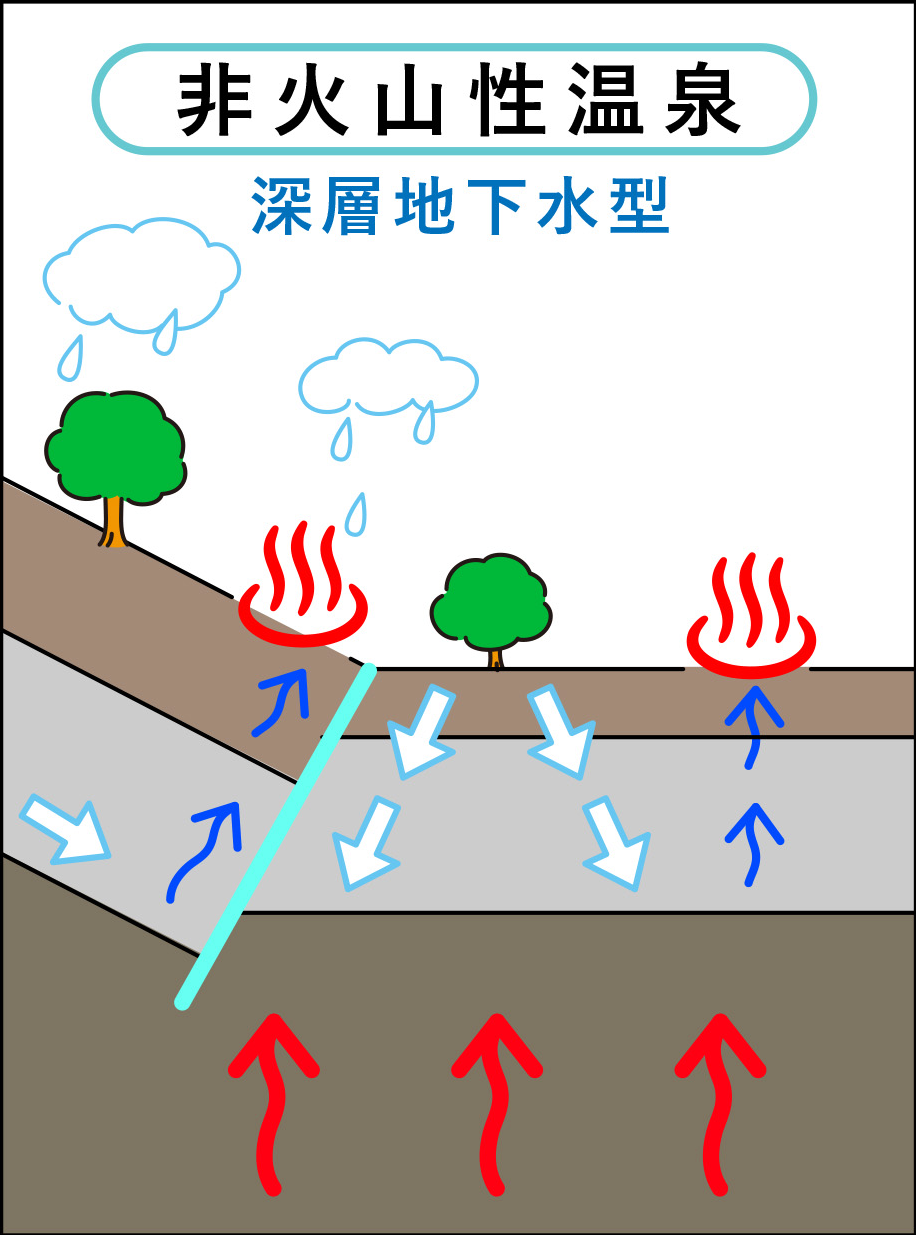 One non-volcanic type: with no magma nearby, seeping water is warmed by heat from deep below and rises along faults.
Ministry of the Environment, Ecojin, "How hot springs form" (January 28, 2026), diagram (adapted) · Terms of use
Not every hot spring is volcanic, though. Arima, in the hills behind Kōbe, has no volcano nearby. Its water is thought to come from very deep down, squeezed out of the sinking Philippine Sea plate itself. It is very salty and heavy with iron, and it rusts to a cloudy reddish brown the moment it meets the air. In the great plains around Tokyo and Ōsaka, drilling a thousand meters or more will usually hit warm groundwater, which is why so many urban bathhouses can call themselves onsen. Along Tokyo Bay there is even a type known as kuro-yu, "black water," the color of strong tea, stained by organic matter from ancient buried plants.
What counts as an onsen is defined by law. The Hot Springs Act of 1948 says that water, mineral water, or steam and other gases coming from underground qualify if they are at least 25°C at the source, or if they contain at least the specified amount of any one of 19 listed substances. That means a cold spring with enough metasilicic acid or sodium bicarbonate is legally a hot spring, while hot water needs no special chemistry at all.
A second, stricter standard defines "therapeutic springs" (ryōsen), and these are sorted into ten spring types by their chemistry: simple springs, chloride springs, bicarbonate springs, sulfate springs, carbon dioxide springs, iron springs, acidic springs, iodine springs, sulfur springs, and radioactive (radon) springs. Every bathhouse posts an analysis chart, usually in the changing room, listing the source temperature, pH, main components, and the conditions the water is said to help. With a little practice you can read it before you get in and know what to expect.
Simple springs, low in minerals and gentle on the skin, are the most common in Japan. Chloride springs, essentially salt water, leave a thin film on the body that keeps you warm long after you get out, and are often called "hot baths" in the sense of baths that keep you hot. Springs high in sodium bicarbonate feel slippery, almost soapy, and are sold as bijin-no-yu, "beauty baths." Sulfur springs have the rotten-egg smell that many Japanese associate with the very idea of an onsen; the water is often milky white, and it will turn silver jewelry black. Acidic springs can sting. Kusatsu’s water has a pH of around 2, close to lemon juice, and any small cut on your skin will let you know. Carbon dioxide springs are rare in Japan; at Nagayu in Ōita Prefecture, bathers come out covered in tiny bubbles.
How the water is used matters as much as what is in it. The ideal is gensen kake-nagashi, "free-flowing from the source": spring water pours straight into the bath and overflows away, never reused. Many facilities do not have enough water for that, so they filter, chlorinate, reheat, and recirculate it. That is safe and clean, but it dulls the smell and texture that make each spring distinctive. A spring that is too hot may be cooled with tap water; one that is too cool may be heated. These things are supposed to be posted at the entrance, and seasoned bathers read the notices first. A sign saying no added water, no heating, and no recirculation is the one they are hoping for.
02Gods, Monks, and Farmers
Hot springs appear in Japan’s earliest histories. The Nihon shoki, compiled in 720, records that Emperor Jomei traveled to the hot spring at Arima in 631 and stayed for months. Later sovereigns made similar trips: Empress Saimei went to the springs of Kii Province in 658, today’s Shirahama in Wakayama. Dōgo, on the island of Shikoku, has a tradition preserved in fragments of an ancient provincial gazetteer that Prince Shōtoku bathed there in 596 and set up an inscribed stone; the stone has never been found, and the story should be taken as legend. Arima, Dōgo, and Shirahama are known today as the three ancient springs of Japan, and none of the three is volcanic.
The Izumo fudoki, a provincial record finished in 733, describes the spring at Tamatsukuri in what is now Shimane Prefecture. Bathe once, it says, and your looks become fair; bathe twice, and every illness is cured. Men and women, old and young, crowded the riverbank as if at a market, and locals called it the water of the gods. That sense of hot water as a divine gift never went away. Many onsen towns have a shrine to the spring’s guardian deities, usually Ōnamuchi and Sukunahikona, the gods who in myth shaped the land and taught people medicine.
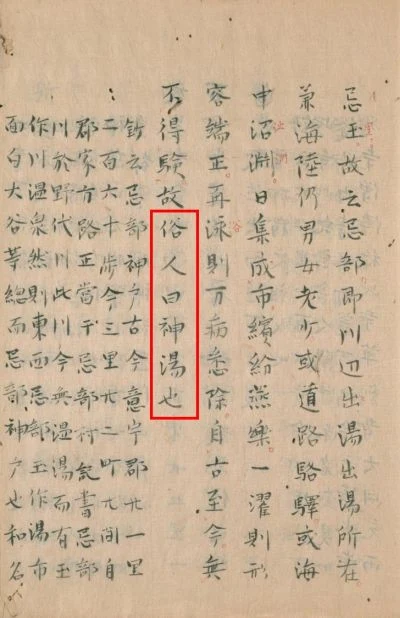
A later copy of the Izumo fudoki; the red box marks the line saying locals called the Tamatsukuri spring the water of the gods.National Diet Library, Izumo fudoki (later copy)
Buddhism added its own layer. Temples regarded bathing as an act of merit and offered free baths to the poor and sick. Many hot springs have founding legends involving famous monks. The eighth-century monk Gyōki is said to have restored the neglected springs of Arima, and a monk named Ninsai is credited with reviving them again in the twelfth century. Shuzenji, on the Izu Peninsula, claims that Kūkai struck the rock with a ritual implement and released the water. These are legends, but they show how closely bathing, religion, and healing were tied together. Warlords of the sixteenth century used hot springs to treat wounds; several springs in the mountains of Kai and Shinano are still called Shingen’s hidden baths, after the warlord Takeda Shingen. Toyotomi Hideyoshi visited Arima repeatedly and held tea gatherings there, and the town still honors him as a patron.
The great change came in the Edo period, when hot springs became part of ordinary rural life through the practice of tōji, therapeutic bathing stays. Farmers would set off in the slack season after planting or after the harvest, carrying their own rice and cooking pots, and stay at a hot spring for weeks. A standard course was measured in seven-day units, a custom already in place in medieval times, and three of them, twenty-one days, was considered a proper cure. The inns were bare: a room, some bedding, a shared kitchen. A few of these self-catering tōji inns survive in the Tōhoku region of northern Honshū. Physicians took an interest too. The Kyoto physician Kagawa Shūtoku compared springs around the country in a 1738 work on materia medica, and he is said to have ranked one of Kinosaki’s baths the best in the land; it was renamed Ichi-no-yu, "Number One Bath," in his honor. Kusatsu became famous for treating stubborn ailments, and a folk song boasts that its water cures every sickness except lovesickness.
After 1868 hot springs took on a scientific and then a recreational face. Erwin von Bälz, a German physician who arrived in 1876 and spent twenty-nine years in Japan, most of them teaching medicine at what became the University of Tokyo, went to Kusatsu almost every year. He studied its water and its traditional regimen of timed baths, wrote about it for European colleagues, and bought land there for a spa sanatorium, a plan that local opposition stopped. Kusatsu’s own accounts say he argued it could become a spa resort of world rank. Railways turned the onsen from a place to be cured into a place to have fun. Atami and Hakone became weekend playgrounds for Tokyo. Beppu, reachable by steamship and rail, drew crowds from the Ōsaka region, helped along by Aburaya Kumahachi, a businessman from Ehime who spent his own fortune promoting the town in the 1920s and founded the Kamenoi hotel and bus company, whose sightseeing buses took visitors around its boiling "hells." From 1928, it is said, young women guides narrated the tours, often described as the first female bus guides in Japan.
In the high-growth decades after the Second World War, company trips and banquet tours carried hot-spring resorts like Atami and Kinugawa to their peak. Concrete hotels a dozen stories high lined the river valleys, and nights were spent in banquet halls with karaoke and hired entertainers. When the bubble economy burst around 1990, the group tours dried up, many of the big hotels went bankrupt, and some still stand empty.
The model that replaced them came from a small village in the mountains of Kumamoto Prefecture in Kyūshū. From the 1980s the innkeepers of Kurokawa Onsen dug outdoor baths into the hillsides, planted native trees, toned down their signs to plain wood, and in 1986 began selling a wooden pass, the nyūtō tegata, that let visitors try the outdoor baths at three different inns. Kurokawa’s success showed that what people now wanted was a rustic setting, a quiet bath under the trees, and a trip with family or a partner rather than the whole office. That is still the shape of the onsen trip today.
03Why Japan Soaks
The simplest reason is the cold. Japanese winters are damp and chilly, and traditional wooden houses were drafty and unheated apart from a charcoal brazier or a kotatsu, a low table with a heater underneath. A long soak warmed the body through for the rest of the evening. Japanese bathtubs, deep and short, are built for sitting up to your shoulders in hot water rather than lying down to wash. In Japan you wash first, outside the tub, and then soak in clean water, and that order is the same at home as at a hot spring. The onsen simply turns an everyday routine into something worth traveling for.
There is also an old idea of purity. Shinto treats pollution as something to be washed away, and ritual cleansing in water, misogi, is among its oldest rites. Bathing still carries a faint sense of rinsing off fatigue and starting fresh. People getting out of a hot spring will often sigh ikikaeru, "I’ve come back to life."
Then there is company. The Japanese phrase hadaka no tsukiai, literally "naked association," expresses the idea that people who soak together, stripped of suits and titles, talk more honestly. Colleagues, university clubs, and extended families take hot-spring trips together, eat dinner in matching cotton robes, and drink late into the night, and that shared ease is part of the point.
And there is the scenery. People go to an onsen for the setting as much as the water: cherry blossoms in spring, a river gorge in summer, maple leaves in autumn, and above all snow. Sitting in an outdoor bath, a rotenburo, while snow falls on your head and the rest of you is hot is, for many Japanese, the best moment of the year. A hot-spring trip usually means an overnight stay with an elaborate dinner and a futon on tatami, and the customs of the ryokan, the traditional inn, have rules of their own (see also: Ryokan: A Night at a Japanese Inn, From Green Tea to Futon).
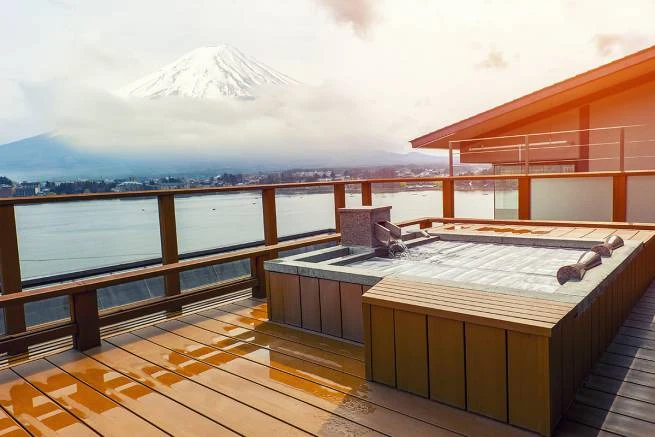
An inn’s outdoor bath, with Mount Fuji and a lake in view from the water.
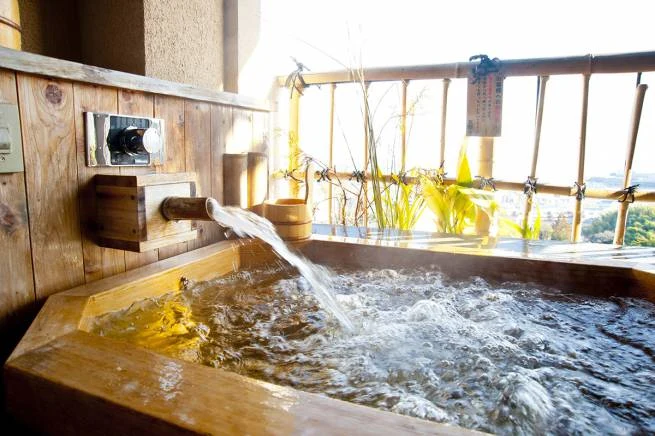
A room’s own outdoor bath: hot water keeps pouring into the wooden tub, to be enjoyed in private.
Japan Tourism Agency, shared and private baths at ryokan (English Q&A) · Terms of use
Hot springs are also part of everyday life far from the famous resorts. Day-trip onsen (higaeri onsen) ring every city, as do "super sentō," large bathhouses with a dozen pools, saunas, and restaurants. Free footbaths sit outside railway stations and along shopping streets for anyone who wants to take off their shoes for ten minutes. As of fiscal 2024 Japan’s Ministry of the Environment counted more than 2,800 hot-spring areas with lodging. Before the pandemic overnight stays at them ran to more than 120 million a year, and by fiscal 2024 they were back to about 125 million.
04A Few Famous Springs
Almost every prefecture has a hot spring it is proud of. Here are a few of the best known.
Kusatsu, in Gunma Prefecture, lies at about 1,200 meters at the foot of Mount Kusatsu-Shirane and has the largest natural flow of any hot spring in Japan, over 32,000 liters a minute. The center of town is the yubatake, the "hot-water field," where the source boils up and runs through rows of long wooden channels in clouds of steam, leaving yellow-white mineral deposits behind and filling the air with sulfur. The water at the yubatake comes out at around 55°C, too hot to bathe in, and rather than dilute it the people of Kusatsu developed yumomi: bathers stir the bath with long wooden paddles in rhythm, singing the Kusatsu folk song, until the water cools. Today it is a show at the Netsu-no-yu hall facing the yubatake, and visitors can have a go.
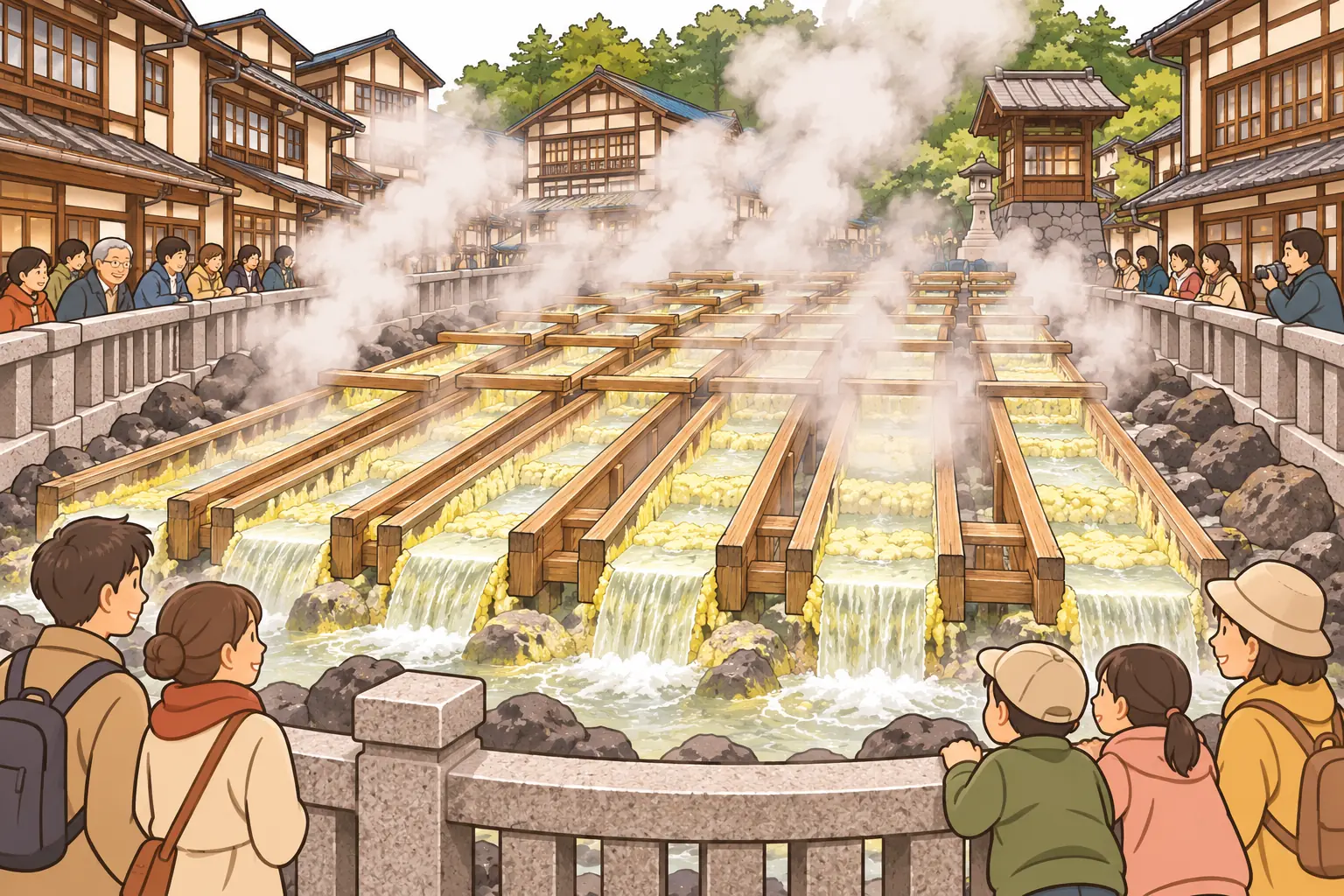
Kusatsu's Yubatake: spring water flows through rows of steaming wooden channels lined with yellow-white yu no hana (illustration).
Beppu, in Ōita Prefecture on Kyūshū, has more hot-spring sources and a greater total flow than anywhere else in Japan. The city is divided into eight hot-spring districts, the Beppu Hattō, and from the hills above it the whole town seems to be smoking. Its most famous sights are the jigoku, or "hells": springs too hot to bathe in, shown off as attractions. Umi Jigoku is a startling cobalt blue; Chinoike Jigoku is blood red; at Oniishibōzu Jigoku, gray mud bubbles up in round domes that look like shaved monks’ heads. Locals cook with the steam, a method called jigoku-mushi, putting vegetables, seafood, and eggs in baskets over the vents. Beppu is also known for sand baths, where you lie down in a robe and an attendant shovels geothermally heated sand over you up to the neck.
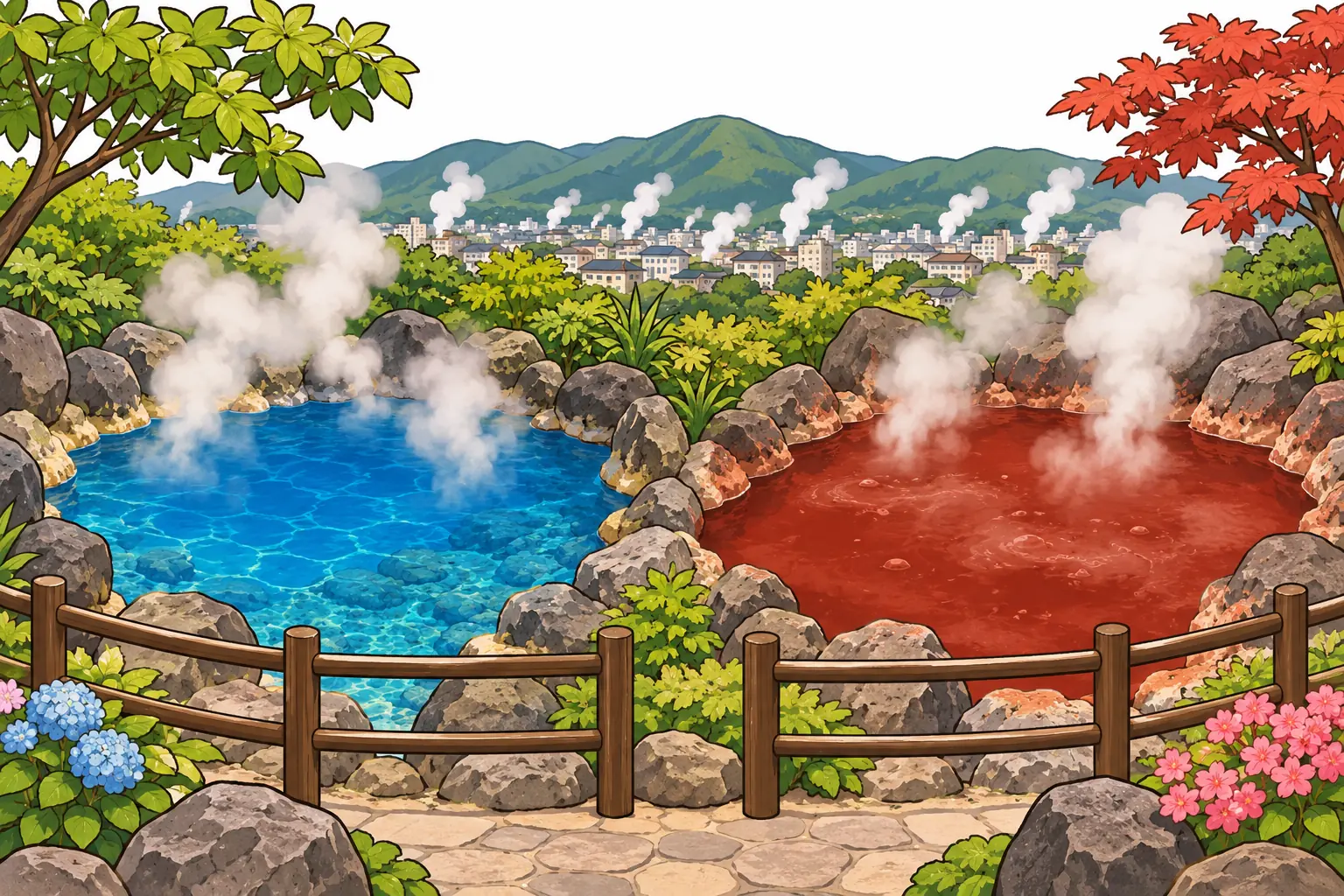
Beppu's hells: the cobalt-blue Umi Jigoku at left, the blood-red Chinoike Jigoku at right (illustration).
Arima, on the edge of Kōbe, offers two waters. Kinsen, "gold spring," is the iron-rich brine, over 90°C and clear at the source, that turns reddish brown in the air, and is said locally to be saltier than seawater; ginsen, "silver spring," is clear, cool, carbonated or radon-bearing water that has to be heated. Arima is the Kansai region’s backyard spa, and its streets sell thin, crisp crackers made with the carbonated water.
Dōgo Onsen Honkan, in Matsuyama on Shikoku, is a three-story wooden public bathhouse built in 1894, topped by a small tower, the Shinrōkaku, from which a drum is beaten three times a day, at 6 a.m., noon, and 6 p.m. In 1994 it became the first public bathhouse in Japan to be designated an Important Cultural Property. The novelist Natsume Sōseki taught school in Matsuyama, and the hero of his novel Botchan goes to the Dōgo baths every day; there is still a "Botchan room." Many people say the bathhouse in Miyazaki Hayao’s Spirited Away was modeled on it, though that is popular belief rather than anything the studio has confirmed. The building underwent a long restoration, carried out in stages from 2019 and completed in July 2024.
Kinosaki, in northern Hyōgo, is the classic town for sotoyu meguri, making the rounds of the town’s public baths. The inns traditionally had no large baths of their own, so guests put on a cotton yukata and wooden clogs and walk between the town’s seven public bathhouses along a willow-lined river (one of them, Sato-no-yu by the station, closed at the end of March 2024 and, as of 2026, was still awaiting rebuilding), and in the evening the streets clatter with geta. The writer Shiga Naoya came here to recover after being hit by a Yamanote Line train in Tokyo in 1913, and his story At Kinosaki, published in 1917, made the town a literary destination.
There are many others worth naming. Ginzan Onsen in Yamagata Prefecture is a single lane of three- and four-story wooden inns from the Taishō era facing each other across a small river, lit by gas lamps on snowy nights. Tsurunoyu, in the Nyūtō Onsen group in Akita, is a thatched old tōji inn with a milky outdoor bath. Hakone, about an hour and a half from Tokyo, has more than a dozen spring areas and the steaming valley of Ōwakudani, where eggs boiled black in the volcanic water are said to add seven years to your life. Noboribetsu, in Hokkaidō, has its own Hell Valley, a gray crater of steam vents. And Gero, in Gifu Prefecture, is counted with Arima and Kusatsu as one of the three finest springs in the land, a ranking first made by the Zen monk Banri Shūku around 1500 and repeated by the seventeenth-century Confucian scholar Hayashi Razan.
05Going In: A Step-by-Step Soak
For a first-time visitor the hardest part is undressing in front of strangers. Once you know the order of things, it quickly feels normal.
The entrance to the baths is marked by two curtains, called noren. The blue one, marked 男 or 殿, is for men; the red one, marked 女 or 姫, is for women. Some inns swap the men’s and women’s baths overnight so that every guest can try both, so check the curtain each time. Inside is the changing room, with baskets or lockers. Take everything off and lock up your valuables. You will usually have two towels: a large bath towel, which stays in the changing room for drying off afterward, and a small thin one, which you take with you.
In the bathing area, do not get straight into the water. First scoop hot water from the bath with a small basin and pour it over yourself, starting with your feet, to get used to the heat; this is kakeyu. Then go to the washing stations along the wall, sit on the low stool, and wash your whole body and hair thoroughly with the soap and shampoo provided, rinsing off every bit of foam. You sit to avoid splashing your neighbors. When you finish, rinse the stool and basin and put them back. Tie up long hair so it does not touch the water. The small towel never goes into the bath; Japanese bathers fold it and rest it on their heads or on the edge. The bath is shared, so there is no swimming, no diving, no scrubbing yourself in the pool, and no loud conversation.
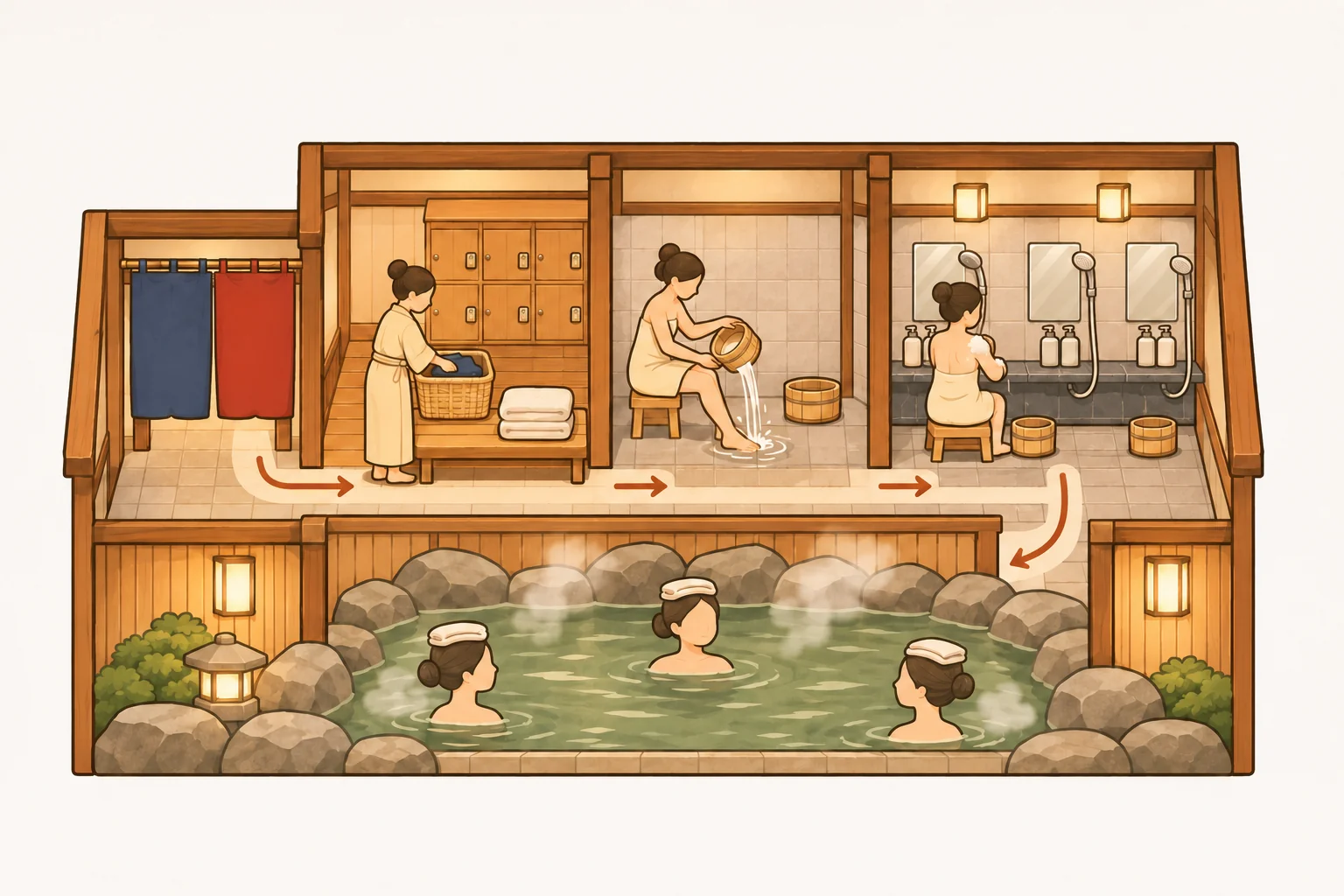
The route through an onsen: curtains, changing room, kakeyu, washing stations, and only then the bath.
Japanese hot-spring baths are typically between 40 and 42°C, hotter than many visitors expect. Lower yourself slowly, first to your chest and then to your shoulders. Do not stay in too long; five to ten minutes, a rest on the edge, then back in. Bathing on an empty stomach, right after a big meal, or after drinking can make you dizzy or faint, a condition the Japanese call yuatari. Bathing after alcohol is genuinely dangerous, and drownings and collapses happen every year. Drink water before and after; many baths have a cooler of water or tea by the door. Whether to rinse off afterward is up to you. Gentle springs can be rinsed or not, and many bathers prefer to leave the minerals on their skin, but sulfur and acidic springs are harsh, and people with sensitive skin should shower them off. Before going back into the changing room, wipe yourself down with the small towel so you do not drip on the floor.
- 1
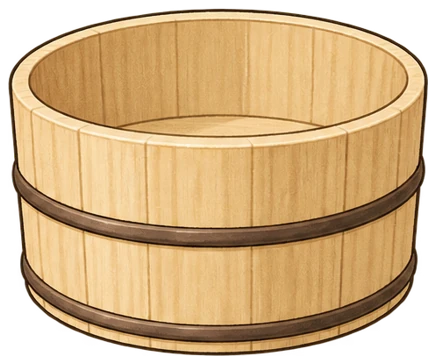 Scoop hot water with a small basin and pour it over yourself from the feet up: kakeyu.
- 2
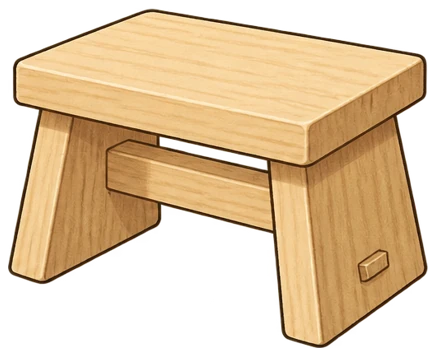 Sit on the low stool and wash your whole body, rinsing off all the foam, before getting in.
- 3
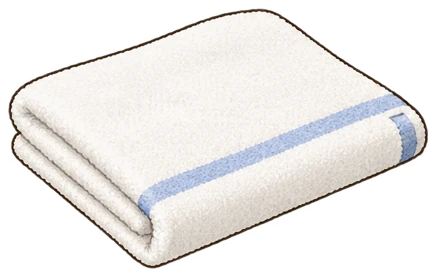 The small towel never goes in the water; fold it on your head or on the edge.
- 4
 Drink water before and after bathing.
Tattoos are the issue foreign visitors most often run into. In Japan they have long been associated with organized crime, and many onsen and bathhouses post signs refusing entry to anyone with them. With the rise in overseas tourism, the Japan Tourism Agency issued guidance in March 2016 stating that refusing a bather solely for having a tattoo was inappropriate, and encouraging facilities to be flexible. More places now accept small tattoos covered with a sticker, and some have no restrictions at all. Private baths, kashikiri-buro, which you can book by the hour, and rooms with their own outdoor bath avoid the question entirely.
Mixed bathing was common in the Edo period. The Meiji government found it indecent and banned it again and again, and today it survives only at a handful of old rural springs, most of which now allow women to wear a towel or a special bathing wrap. If you are not comfortable with communal nudity, a family bath or private bath solves it.
After the bath comes one of the small rituals of Japanese life. Inn corridors have massage chairs and a refrigerator of glass bottles of milk and coffee milk; older inns have a ping-pong table. Standing in your yukata, face flushed, hand on hip, and drinking a cold bottle of milk in one go is how many Japanese remember a night at an onsen. When you put on the yukata, wrap the left side over the right. Right over left is how the dead are dressed, and the staff will gently correct you if you get it wrong.
06Onsen Today
Hot springs are thriving, but they have their troubles. In 2004, Shirahone Onsen in Nagano, famous for its milky water, was found to have been adding commercial bath powder to keep the color up after the natural cloudiness had faded. Other resorts were soon caught in similar scandals; according to press reports, some inns had been heating tap water and passing it off as hot-spring water, and others recirculated their baths without saying so. The Ministry of the Environment tightened the rules from May 2005, requiring facilities to post whether and why they add water, heat it, recirculate it, add bath agents, or disinfect it, and kake-nagashi became an even more prized label.
Geothermal power is another flashpoint. Japan has some of the largest geothermal resources in the world but generates very little electricity from them. Part of the reason is that many of the best sites lie in national parks; part is that hot-spring towns fear deep wells will drain their sources. Balancing renewable energy against springs that have flowed for a thousand years is an argument that has not been settled.
Even the onsen symbol caused a stir. The mark ♨, an oval with three wavy lines of steam, is instantly recognizable in Japan and appears on maps and signs everywhere. In 2016 the government proposed replacing it with an international pictogram showing three people sitting in a bath, so that foreign tourists would understand it. Beppu, Kusatsu, and others protested loudly, and the final decision was to allow both. Isobe Onsen in Gunma claims to be the birthplace of the symbol, citing a map from 1661, though the mark in its modern form dates from the Meiji period.
Finally, not every bather is human. At Jigokudani Monkey Park in Yamanouchi, Nagano Prefecture, wild Japanese macaques climb into an outdoor hot pool in winter to keep warm, snow settling on their red faces. The image is better known abroad than most of Japan’s hot-spring towns.
Whether you are at the steaming channels of Kusatsu or a day-trip bathhouse in a Tokyo suburb, the routine is the same: wash carefully, ease yourself down, sink to the shoulders, and listen to the water running from the bamboo spout.