
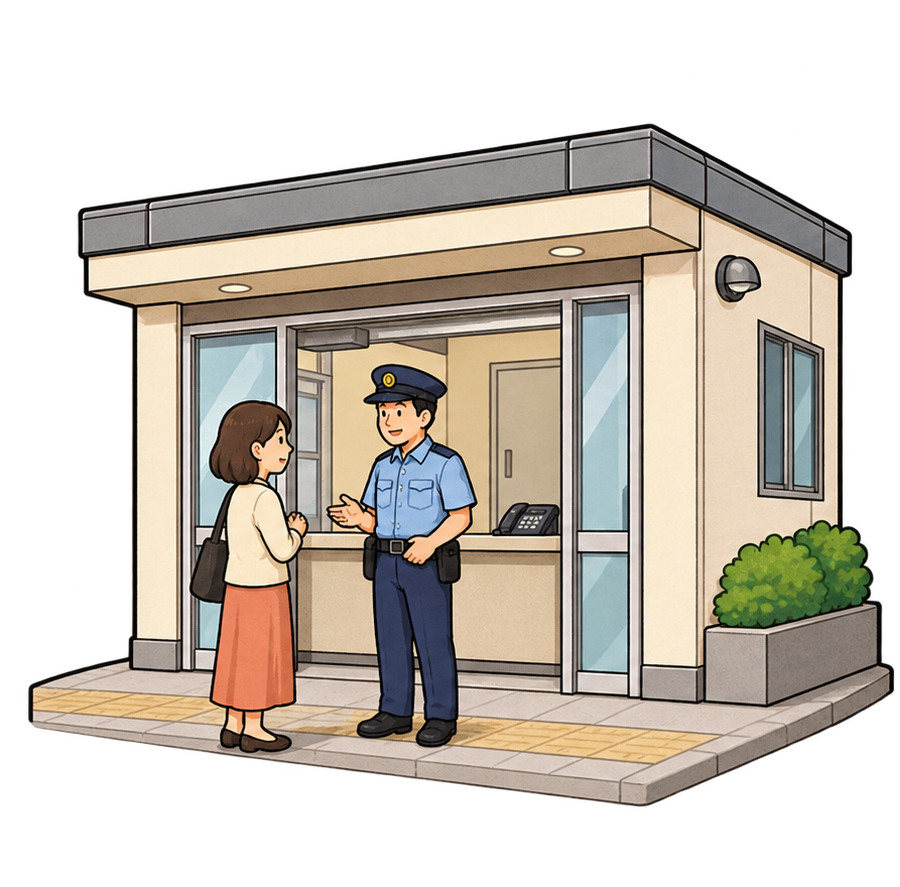
At a glance
How the small police box on Japanese street corners grew out of Meiji Tokyo, what its officers do all day, and why other countries copied it.
- The kōban is the smallest unit of Japanese policing, marked by a red lamp and staffed around the clock in shifts.
- Kōban began in 1874 with the founding of the Tokyo Metropolitan Police; the name means standing watch (ban) in turns (kō).
- In 1881 they were renamed hashutsujo; a 1994 amendment to the Police Law made kōban the official name again.
- As of April 2026 Japan had 6,132 kōban and 5,718 chūzaisho, residential posts where the officer lives.
- Singapore and the Brazilian state of São Paulo adopted kōban-style community policing, and koban entered English.
Step out of almost any train station in Japan and you will find, somewhere near the exit, a small building with a red lamp over the door and the word KOBAN on its front. Inside sit one or two uniformed officers behind a desk, a wall map of the neighborhood, and a stack of forms. These police boxes, kōban, are the smallest unit of Japanese policing and the place where most people in Japan actually meet a police officer: to ask the way, to hand in a wallet found on the pavement, to report a stolen bicycle, or to collect a lost child. They began on the streets of Tokyo in the 1870s, and they have since been studied and copied from Singapore to São Paulo. For a visitor, they are also one of the most useful doors in the country to know about.
01What a Kōban Looks Like and What Happens Inside
A kōban is easy to recognize once you know the signs. It is usually a one- or two-story structure on a corner or beside a station plaza, with a glass front, a round red lamp above the entrance, and the characters 交番 alongside the romanized KOBAN and often the English word POLICE. The front room holds a counter or desk, a few chairs for visitors, a large local map, and notices about wanted suspects, missing persons, traffic accidents, and the phone scams that target elderly residents. Behind it there is usually a small back room where officers on long shifts eat and rest.
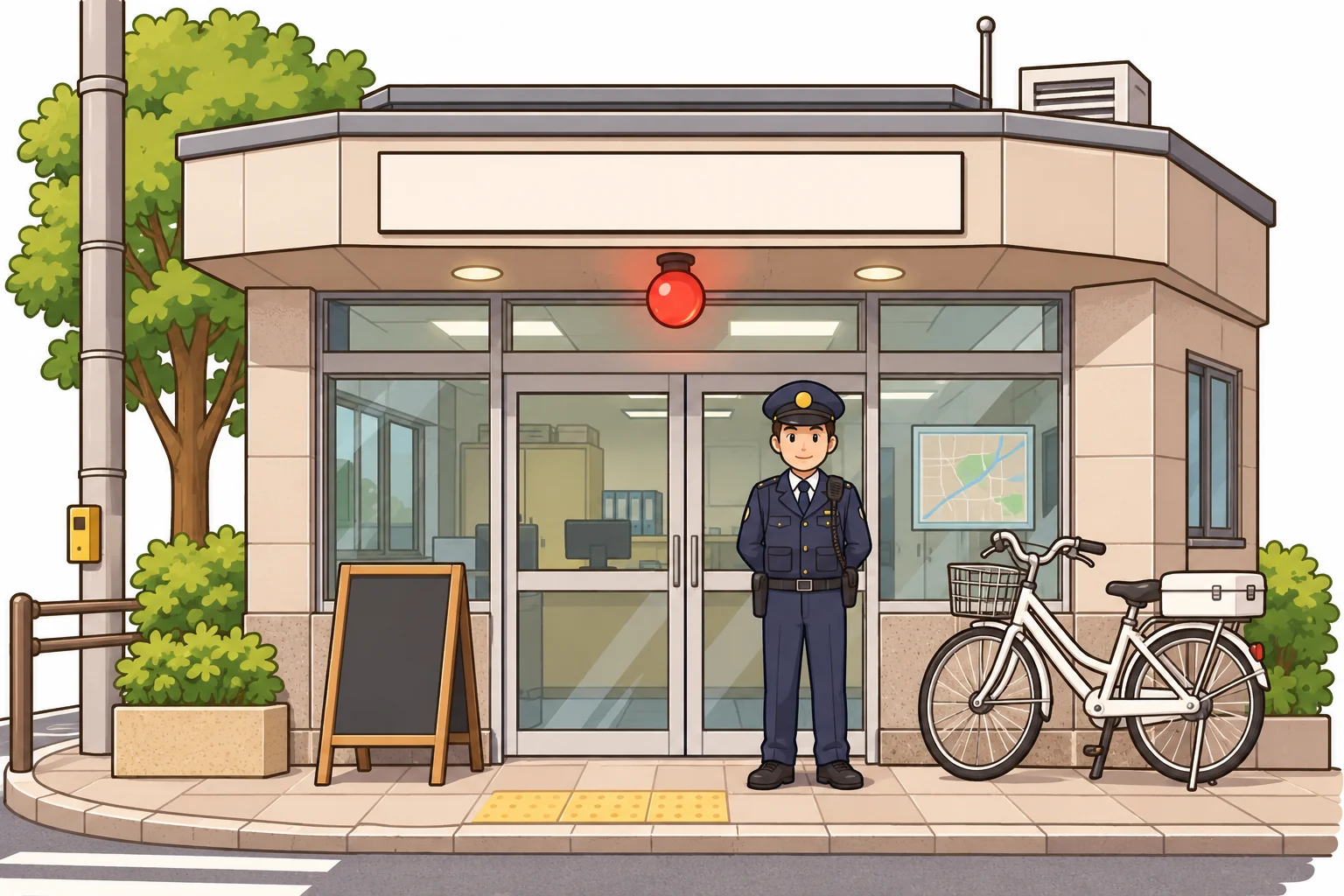
A city kōban: glass door, red round lamp above, an officer standing watch out front (illustration).
The officers in a kōban, known affectionately as omawari-san ("Mr. Walkabout," roughly the equivalent of "bobby"), do three kinds of work. The first is tachiban, standing watch at the door and simply being visible. An officer standing outside facing the street deters some trouble and invites people to come up and ask questions. The second is patrol, on foot or on the white police bicycles that are a fixture of Japanese streets. Officers stop cyclists to check bicycle registration numbers, a routine way of finding stolen bikes. The third is the steady flow of visitors through the door. By some accounts, police figures show that the most common reasons people walk into a kōban are not crimes but requests for directions and matters of lost property.
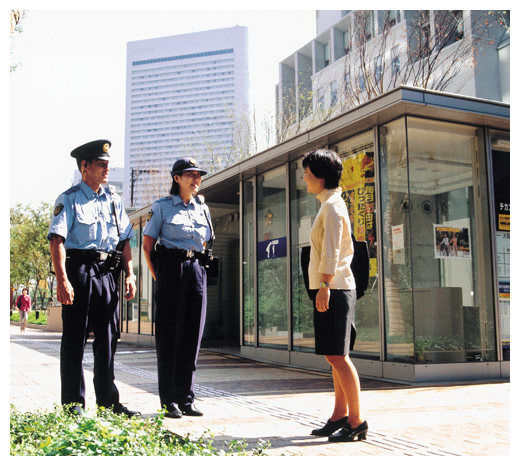
Two officers talk with a visitor outside a glass-fronted kōban (from the 2004 police white paper).National Police Agency, White Paper on Police 2004, "History of kōban and chūzaisho" · Terms of use
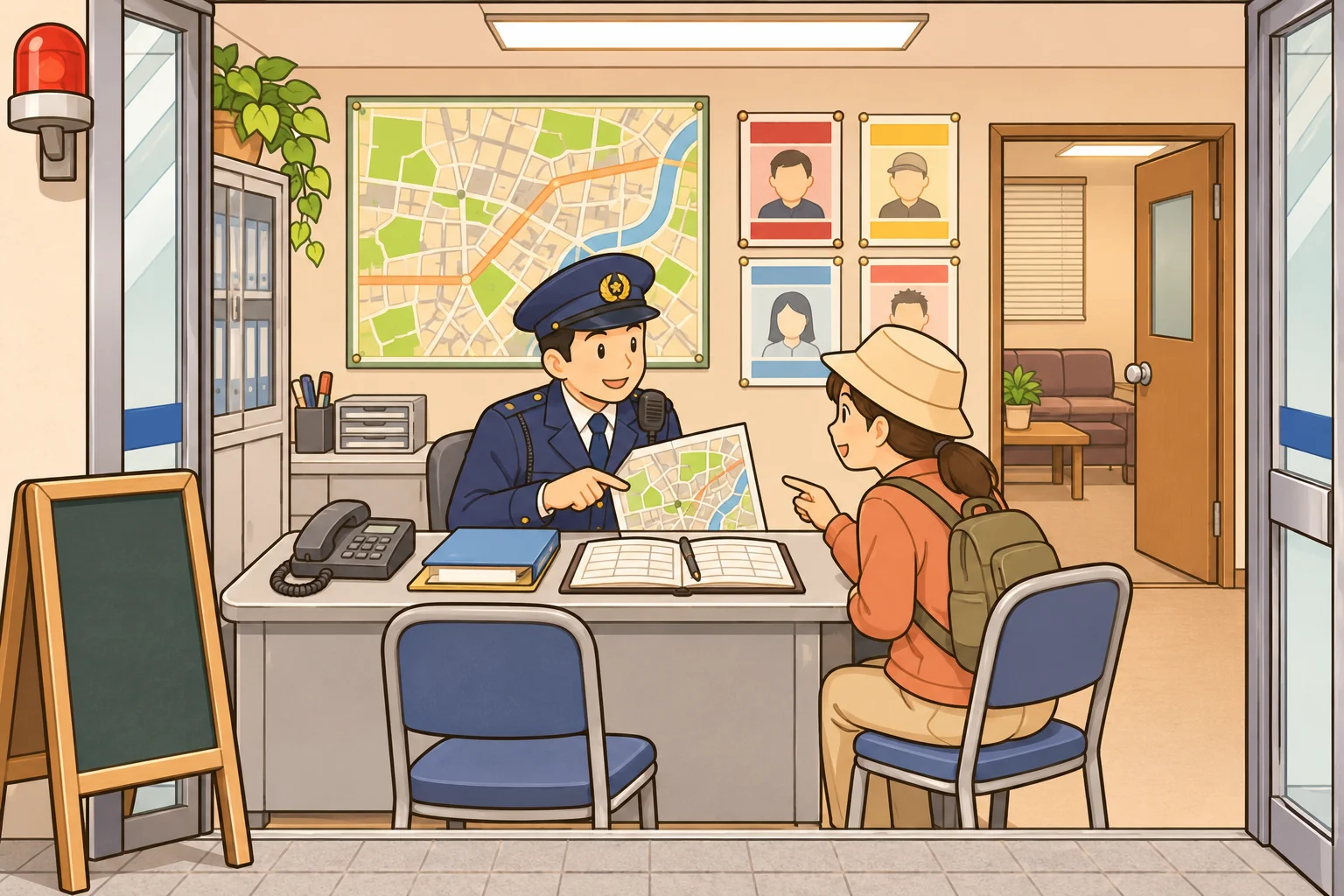
Inside a kōban: area map and notices on the wall, an officer giving directions at the desk (illustration).
Lost property is where the kōban shows its place in daily life most clearly. Under Japan’s Lost Property Act, anyone who finds something should hand it to the police or to the manager of the premises where it was found. If the owner reclaims it, the finder is entitled to a reward of 5 to 20 percent of its value, and if no one claims it within three months, the finder may keep it. Law and habit together produce remarkable results. Tokyo’s police receive billions of yen in cash each year (about 4.5 billion yen in 2025) from people who found it on the street or in taxis, and most of it is returned to its owners. The image of a small child solemnly delivering a single 100-yen coin to a kōban, and an officer just as solemnly filling in the paperwork, is a familiar one in Japan. So is the 1960 children’s song "Inu no Omawari-san" (The Dog Policeman), in which a police dog is at a loss when a lost kitten can only cry and cannot say where it lives.
A less visible part of the job is junkai renraku, or residential liaison visits. Officers call on households in their area, ask residents to fill in a voluntary card with family members and emergency contacts, and listen to local worries. Some people welcome the visits; others find them intrusive. Either way, they mean that the officers in a kōban know the neighborhood in a way a passing patrol car cannot.
02Origins: Standing Watch in Turns
The kōban dates from 1874, when the new Meiji government created the Tokyo Metropolitan Police Department, modeled largely on French policing, and placed officers at fixed posts across the capital. These posts were called kōban-sho. The word combines kō (交, alternating, taking turns) and ban (番, watch or guard): officers took turns standing guard at a fixed spot. At first a post was just that, a spot on the street. Small shelters were soon built at them, and the shelters became the boxes.
In 1881 the Tokyo posts were renamed hashutsujo, "branch stations," emphasizing that officers were dispatched from a parent police station. In 1888 the Home Ministry extended the system nationwide, with hashutsujo in towns and cities and chūzaisho, residential police posts, in rural areas. The logic was that of a centralizing state. The Meiji government wanted a visible police presence on every street and in every village, and prewar police powers were broad: officers dealt with household registration, public health, and public morals as well as crime. To neighbors, the local patrolman was not only a crime fighter but a representative of government authority.
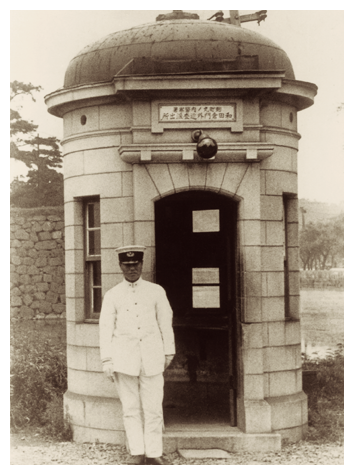
A police box of the Taishō era (1912–1926): a small stone booth with the officer standing at the door.National Police Agency, White Paper on Police 2004, "History of kōban and chūzaisho" · Terms of use
After 1945 the police were reorganized and their powers narrowed, but the boxes stayed, and their role shifted toward service and prevention. People had never stopped calling them kōban, and in 1994 an amendment to the Police Law made kōban the official name again. The older term survives in the title of one of Japan’s longest-running manga, Akimoto Osamu’s Kochira Katsushika-ku Kameari Kōen-mae Hashutsujo (This Is the Police Box in Front of Kameari Park, Katsushika Ward), usually shortened to Kochikame, which ran from 1976 to 2016 and followed the misadventures of the scheming, warm-hearted officer Ryōtsu Kankichi.
03A Day in the Box
Kōban are staffed around the clock, every day of the year, through shift rotation. Officers are divided into groups, usually three, though Tokyo’s Metropolitan Police uses four. A group works a long shift of roughly 24 hours, taking turns to sleep in the back room, then has a day off, then returns for a day shift or training before the cycle starts again. One account puts the usual complement of a box at a dozen or more officers, but at any one time only two or three are on duty in a given box.
The handover in the morning covers what happened overnight: items handed in, a drunken argument, an elderly man with dementia found wandering and taken home. During the day, officers stand at crossings as children walk to and from school, make residential visits, take reports of stolen bicycles, and return to the door when the shopping street fills in the late afternoon. Nights bring drunks, quarrels, traffic accidents, and people who have missed the last train. Many kōban officers are in their twenties; a posting to a box is the standard first assignment after police academy, and it is regarded as basic training in the most important skill of the job, dealing with people on the street.
Kōban officers are armed, most often carrying revolvers on their belts, but police shootings in Japan are rare; some reports put them in single figures nationwide in a year. The tools they actually use every day are a map, a radio, a bicycle, and a great many forms.
04Chūzaisho: The Officer Who Lives on the Beat
In the countryside, the counterpart of the kōban is the chūzaisho, and the difference is that the officer lives there. The front of the building is an office; the back is family housing. One officer, usually with a spouse and children, is posted for several years at a time. Japan has roughly as many chūzaisho as kōban: as of April 2026 there were 6,132 kōban and 5,718 chūzaisho.
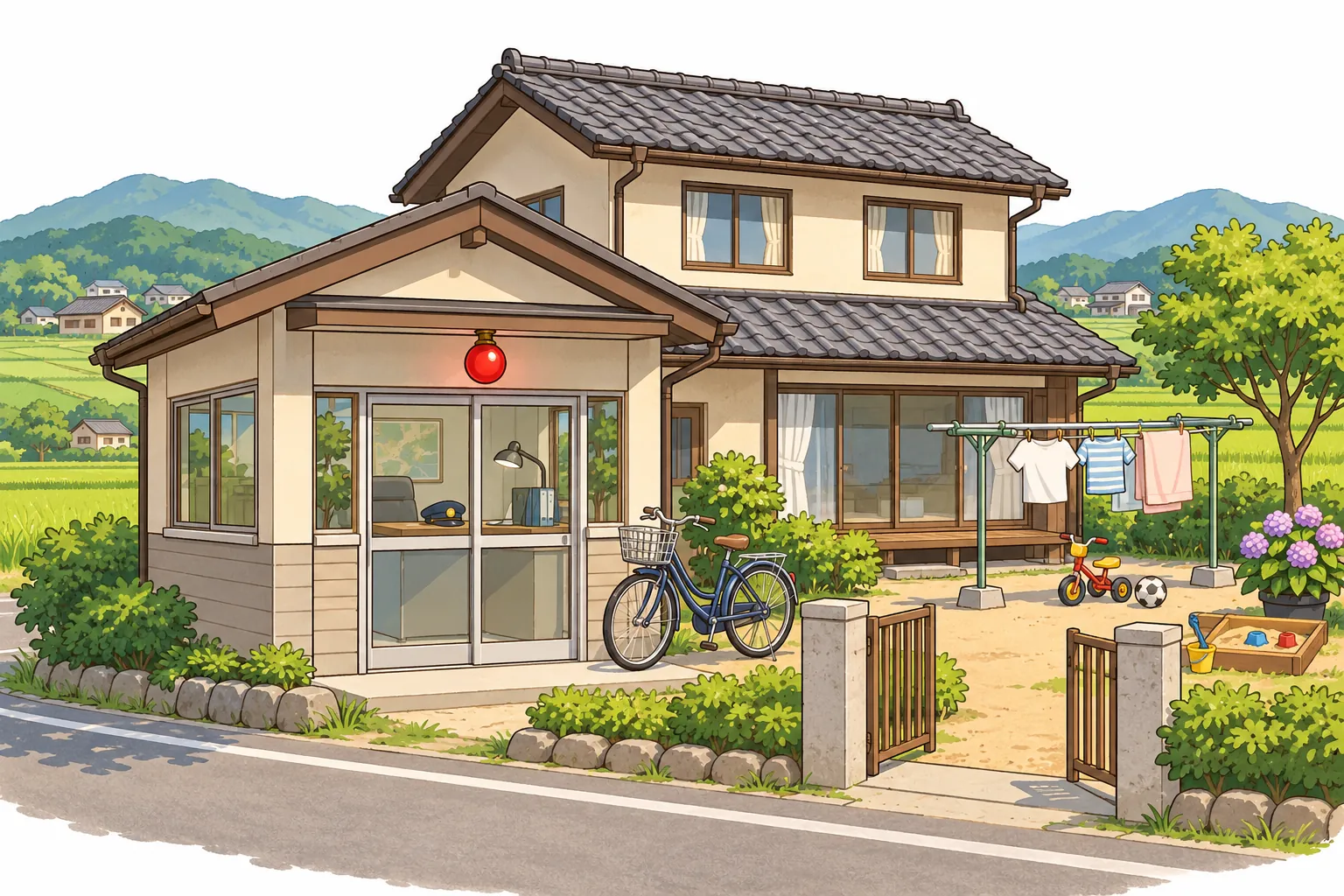
A rural chūzaisho: a small office with red lamp in front, the officer's family home behind (illustration).
A chūzaisho officer does not rotate shifts. He is the police for the area. He patrols, attends village meetings, festivals, and school sports days, and gets up at night when someone knocks. When he is out, the person answering the phone and greeting visitors is often his wife, who receives a small allowance for it. The husband-and-wife chūzaisho has long been held up in Japan as an ideal of community service, and also criticized for quietly placing public duties on a family member. The rural officer tends to know which elderly residents live alone, which mountain road ices over in winter, and which teenager has been in trouble lately. As rural populations shrink, chūzaisho are being consolidated and closed, and this kind of officer is becoming rarer.
05Why Kōban Matter
Kōban are often cited as one reason Japan’s crime rates are so low. That is partly right. A police box does not make crime disappear, but it puts an officer within a few minutes’ walk of most urban residents and keeps the same officers in the same neighborhood long enough for them to know it. Small problems come to someone’s attention before they grow. Criminologists abroad came to call this community policing; in Japan it is simply chiiki keisatsu, local-area policing.
From the 1970s, American and other foreign researchers wrote admiringly about the system, and several countries adapted it. Singapore set up Neighbourhood Police Posts modeled on kōban in the 1980s. In Brazil, the state of São Paulo began building kōban-style community police bases around 2000 with help from the Japan International Cooperation Agency (JICA), and the model later spread to parts of Central America. Indonesia and other countries have run similar programs. The word koban now appears without translation in English-language policing literature.
At home, the system has its own strains. The most common complaint is the akikōban, the empty kōban: officers are out on patrol or dealing with an incident, and a visitor finds the door open but nobody inside, with only a phone connected to the local station. Since the 1990s, prefectural police have hired civilian kōban counselors, mostly retired officers, to sit in boxes and handle directions and lost property, and their numbers grew sharply in the mid-2000s as part of a drive to eliminate empty boxes. The map of kōban also shifts as people move from old downtowns to new suburbs, with some boxes merged and new ones built. Attacks on kōban to seize officers’ guns, including a fatal one in Toyama in 2018, have led to reviews of how the boxes are protected.
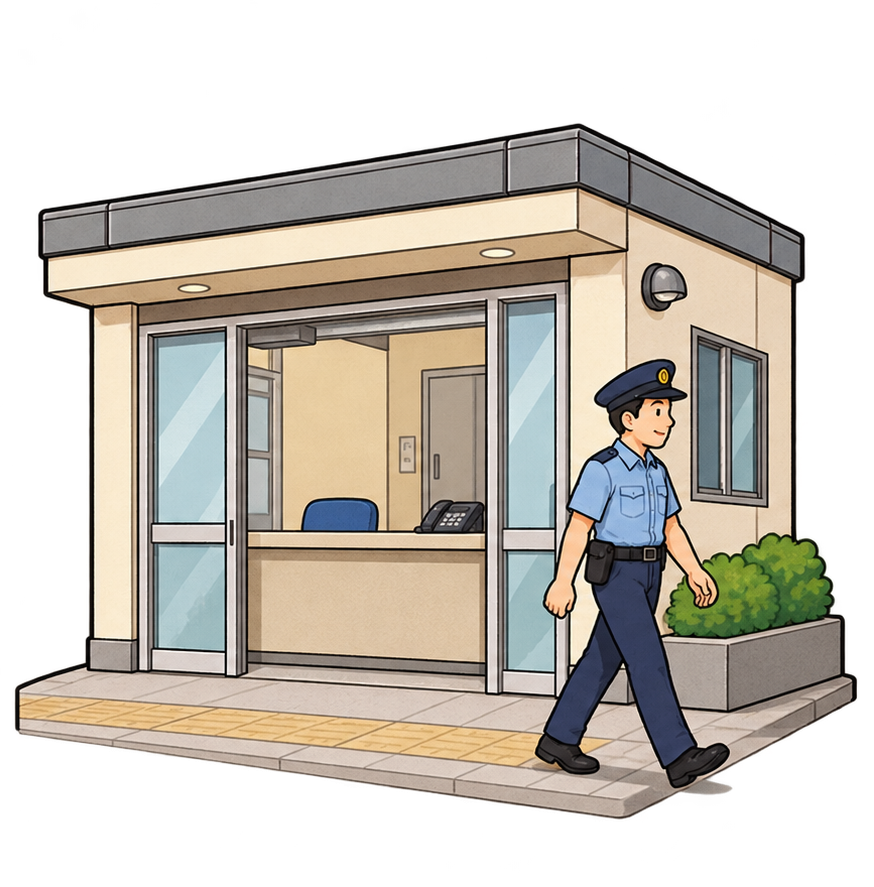
When the officer goes out on patrol, the box can be left with nobody inside: an akikōban (illustration).
06Small Buildings, Distinct Designs
Most kōban are plain, but not all. From the 1980s, Tokyo and other cities began commissioning architects to design distinctive police boxes as small landmarks. The kōban at Sukiyabashi in Ginza looks like a little storybook house; the boxes outside Shibuya Station’s Hachikō exit and at the entrance to Ueno Park have their own recognizable shapes; the Ueno box is said to be designed to echo the park and museums around it. Elsewhere there are kōban built to echo a castle in a castle town, and timber kōban with tiled roofs in hot-spring resorts, and by some descriptions boxes shaped like a lighthouse, a shrine, or a thatched farmhouse. Whatever the shape, the red lamp over the door identifies it.
07Using a Kōban as a Visitor
For travelers, a kōban is a place you can walk into without hesitation. The commonest reason is directions. Officers have detailed local maps, often better for finding a small inn or a back-street restaurant than a phone app, and they will mark the route on paper or sometimes walk you to the corner. Boxes in busy tourist areas of Tokyo, Kyoto, and Ōsaka usually have English signage, some officers speak basic English, and most have translation apps or multilingual phrase cards.
If you lose something, report it at a kōban. Say where and when you lost it and describe it, and the officer will record it and give you a receipt number for later inquiries. For items left on a train or in a taxi, contacting the railway or taxi company first is faster, but unclaimed items eventually pass to the police. If you lose your passport, report it to the police as well as visiting your embassy or consulate; most consulates will ask for the police report number when issuing a replacement. And if you have lost all your cash and cannot get back to your hotel, officers can in some cases lend you a small amount for the fare, to be repaid later.
There is no special etiquette. Open the door, say sumimasen (excuse me), and explain what you need. If the officers are busy with someone else, wait outside for a moment. If the box is empty, use the phone by the door. In a real emergency, do not go looking for a kōban: dial 110 for police, or 119 for fire and ambulance.