
At a glance
Walks through a ryokan night from welcome tea to futon, explains the room and its etiquette, and traces the inn back to Edo post towns and spa cures.
- Ryokan price per person, usually ippaku nishoku: one night with dinner and breakfast.
- Check-in is usually at 3 p.m., check-out around 10 a.m., and dinner is set for a slot between 6 and 7:30.
- Wear the yukata left side over right; right over left is how the dead are dressed.
- The two-meal stay goes back to the hatago inns of Edo-period post towns; Keiunkan in Yamanashi traces its founding to 705.
- Japan had about 83,000 ryokan in 1980 and about 39,000 by fiscal 2017.
A hotel rents you a room. A ryokan, a traditional Japanese inn, takes charge of your evening. You arrive in the middle of the afternoon, leave your shoes at the door, and are shown to a room floored with tatami mats, where someone kneels to pour you tea. You change into a cotton robe, soak in a hot spring, come back to a dinner of a dozen small courses, and return from it to find your bed laid out on the floor. For many Japanese people this sequence is what a holiday feels like. This piece explains what a ryokan is, why it works the way it does, where it came from, and how to stay in one without feeling lost.
01What Makes a Ryokan a Ryokan
In everyday Japanese, ryokan means lodging in the Japanese style: rooms with tatami floors, bedding spread on the floor rather than a raised bed, guests padding around in a yukata (a light cotton robe), and, in most cases, dinner and breakfast included. The law no longer draws a hard line. The Hotel Business Act of 1948 once treated "ryokan business" and "hotel business" as separate categories, the first built around Japanese-style rooms and the second around Western-style ones, each with its own minimum room count and construction rules. A 2018 revision merged them into a single category, so today the difference is one of custom rather than regulation.
The most obvious difference is how you pay. A hotel prices the room; two people sharing pay roughly what one person would. A ryokan prices the guest. The standard plan is ippaku nishoku, "one night, two meals," and the rate is quoted per person. At mid-2020s prices, an ordinary hot-spring inn might charge ¥15,000 to ¥25,000 a head; at a famous old house or a luxury property it can run to ¥50,000 and well past ¥100,000. Solo travelers often pay more per person than a couple would, and some inns do not take single guests at all. A room, a multi-course dinner, and the time of a staff member cost the same whether one person or two are using them.
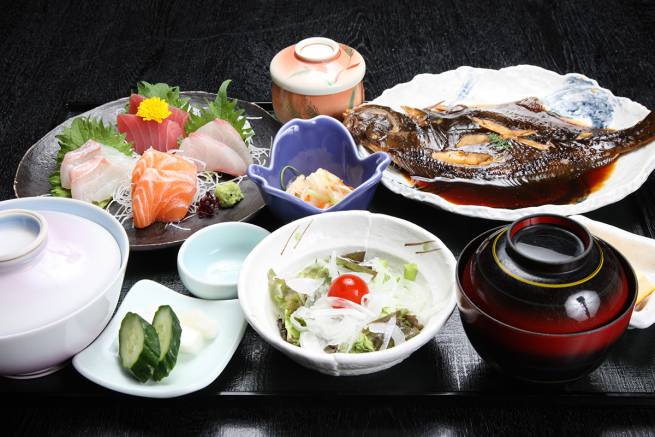
A ryokan meal: sashimi, simmered fish, rice, miso soup and pickles filling the table.Japan Tourism Agency, guide to staying at a ryokan · Terms of use
The second difference is time. Check-in is usually at three in the afternoon and checkout around ten in the morning. Dinner is served in set sittings, typically starting somewhere between six and seven-thirty, and breakfast between seven and nine. The schedule exists because the kitchen cooks course by course for a known number of guests at a known hour, and because staff need to come into your room while you eat to lay out the bedding. A hotel lets you arrive at midnight and slip out at dawn. A ryokan works best if you fit its rhythm, and if you arrive too late you may simply miss dinner.
The third difference is how much is done for you. Hotel service mostly responds to requests. Ryokan service is planned in advance, from the tea on arrival to the futon at bedtime, and you are not expected to ask for any of it. The Japanese word for this kind of anticipatory hospitality is omotenashi, and the ryokan is the place most often held up as its model.
02The Shape of a Stay
You take off your shoes in the genkan, the entrance hall, and step up onto the raised floor of the inn proper. Someone puts your shoes away; you continue in slippers or socks. At some inns you check in at a front desk. At others you are led straight to your room and fill in the register sitting at the low table there. The person guiding you is usually a nakai, a room attendant, traditionally a woman, who at an old-fashioned inn will look after the same handful of rooms from your arrival to your departure.
In the room, the nakai kneels at the table and makes green tea, served with a small sweet, often a local specialty: a bean-paste bun, a slice of yōkan jelly, a rice cracker. The usual explanation is practical. After a day of travel, a little sugar before a hot bath keeps you from feeling faint in the water. She then tells you when dinner and breakfast will be, where the baths are and when they open, and whether you would like to book the private bath, before bowing and leaving you alone.
In the closet you will find yukata in a few sizes, and in colder months a padded over-robe called a tanzen or a short jacket to wear on top. The yukata is the house uniform. You can wear it anywhere in the building, to the baths, to the dining room, to the gift shop, and in hot-spring towns you can wear it out on the street in the evening without anyone looking twice. There is one rule that matters: the left side of the robe goes over the right. Looking down at yourself, the right panel lies against your body and the left one crosses over it. The reverse is how the dead are dressed for burial, and Japanese people will notice. The sash goes around the waist, a little lower on men, a little higher on women.
- 1
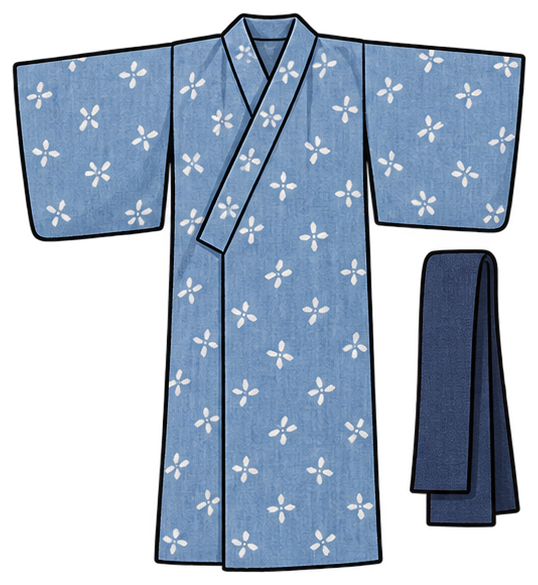 The yukata and sash waiting in the room’s closet.
- 2
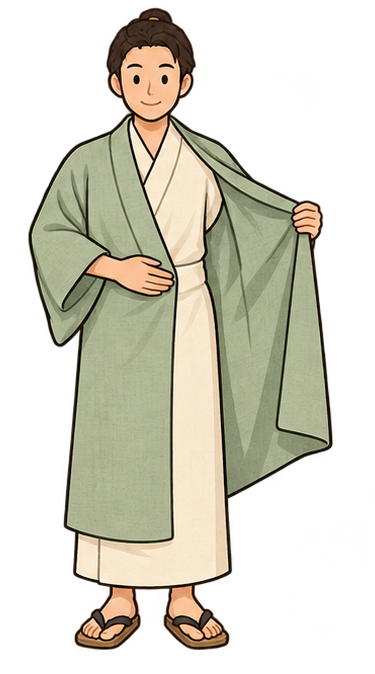 First wrap the right-hand panel against your body.
- 3
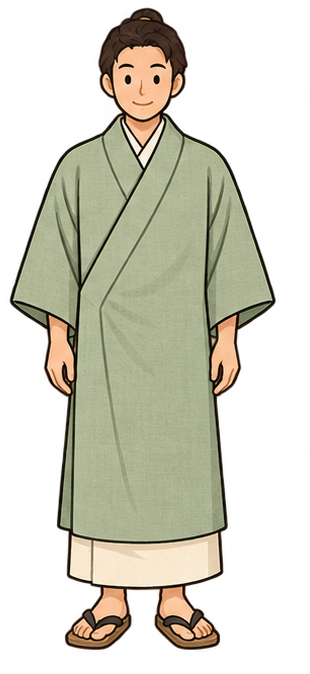 Then lay the left panel over it and tie the sash.
Most people go to the bath before dinner. The etiquette of bathing deserves its own explanation, but the essentials are simple: wash thoroughly at the shower stations before you get into the water, and keep your towel out of the pool. Afterward you come back to the room, drink a glass of cold water, and sit by the window while the light goes.
Dinner is the center of the stay, and often the reason people choose one inn over another. The traditional arrangement is heya-shoku, dinner in your room, with the nakai bringing course after course to the low table. More and more inns now serve in a dining room or a private dining space instead. The menu follows the outline of a kaiseki banquet: a few small appetizers, sashimi, a simmered dish, something grilled, something fried or steamed, then rice, miso soup and pickles, and finally fruit or a sweet. Inns by the sea serve the day’s catch; inns in the mountains serve river fish, wild greens, and local beef. Often a little pot sits over a blue cube of solid fuel at your place, and you wait until it bubbles before eating what is inside. A dinner of an hour and a half to two hours is normal.
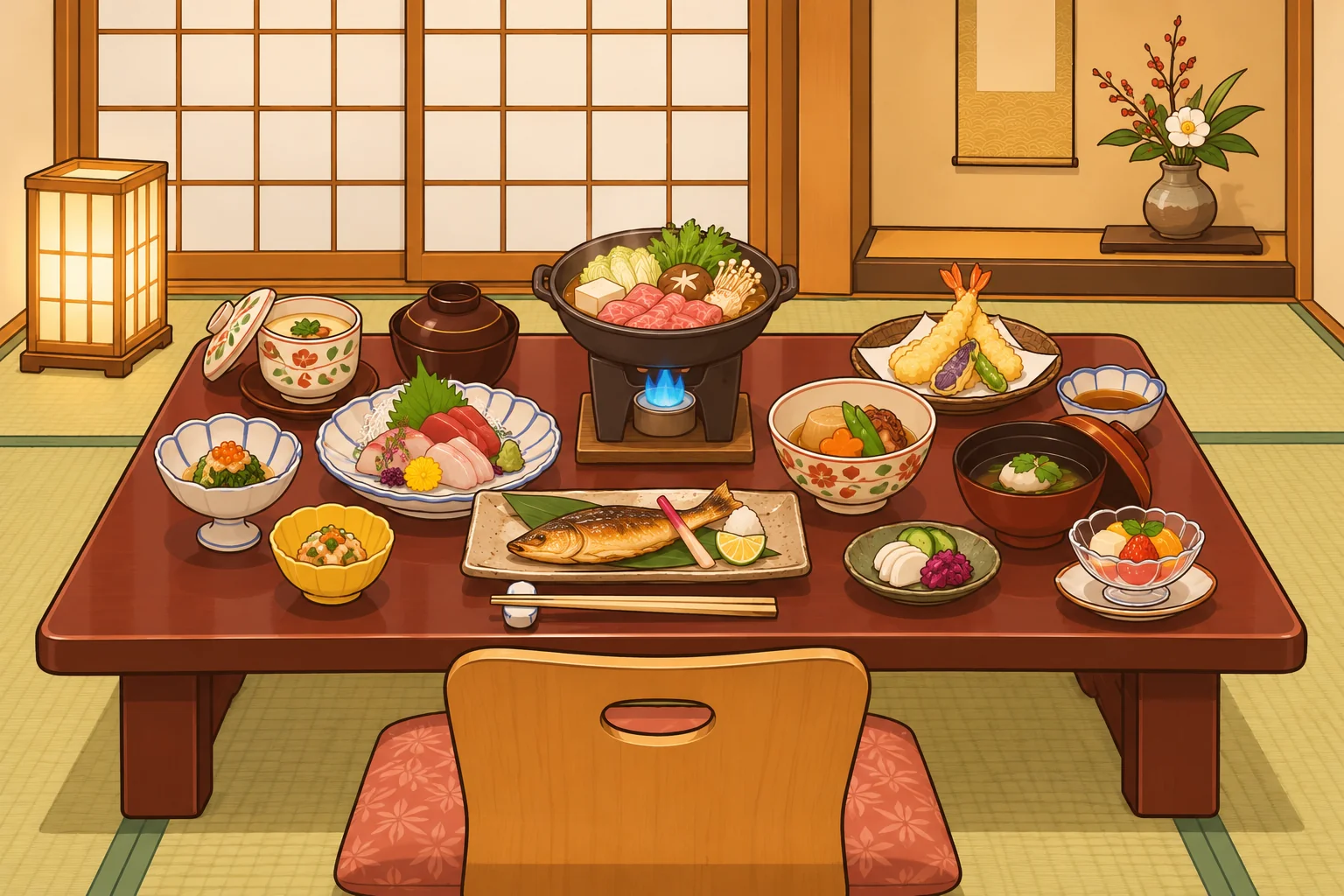
An in-room ryokan dinner: a low table of kaiseki-style dishes and a small hotpot over a fuel tablet (illustration).
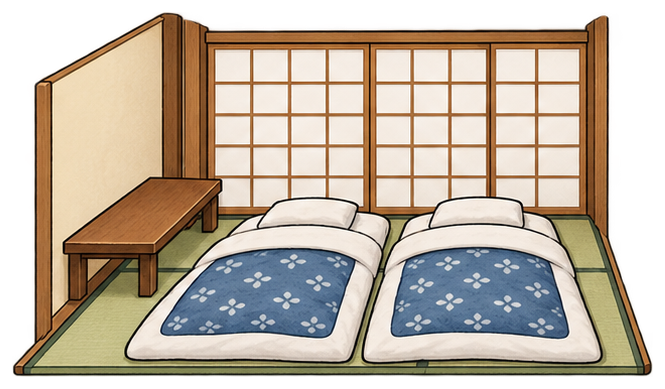
While you eat, someone else comes into your room, pushes the table to one side, and takes the bedding from the closet. When you return, the sitting room has become a bedroom: a thick mattress on the tatami, a crisp white sheet, a quilt, and a pillow filled with buckwheat husks or small plastic beads that crunch when you lie on them. This is how a Japanese room has always worked. The same space is a living room by day, a dining room at dinner, and a bedroom at night, because the furniture is low and the bedding folds away.
In the morning many guests bathe again before breakfast, when the baths are quiet and the view from the window has changed. Breakfast is the classic Japanese set: rice, miso soup, a piece of grilled fish such as salmon or dried horse mackerel, an onsen tamago (an egg slow-cooked in hot water so the white stays soft), seaweed, nattō fermented soybeans, pickles, and sometimes tofu warming in a small pot. When you get back to the room the futon is gone and the table is back in the middle. You check out around ten, paying at the desk for the beer you drank from the room fridge the night before.
03Reading the Room
Japanese rooms are measured in tatami mats. A room listed as eight or ten jō is one that eight or ten mats would cover, each mat roughly 1.6 square meters. Just inside the door is a small entry floored in stone or wood, the fumikomi, where you take off your slippers before stepping up onto the tatami. On the mats you go in socks or bare feet. That is the oldest rule of the Japanese house, and it is why the slippers stay at the edge.
Along one wall is a shallow alcove with a slightly raised floor, the tokonoma. It holds a hanging scroll of painting or calligraphy and an arrangement of flowers or a single object. It is the most honored spot in the room; the seat nearest it is the place of honor, given to a guest. The alcove itself is for looking at. You do not sit in it or put your suitcase there. A good inn changes the scroll and the flowers with the season, cherry blossom or fresh green leaves in spring, maple and pampas grass in autumn, and this is one of the quieter ways it shows care.
In the middle of the room is a low table with zaisu, legless chairs that have a back but sit directly on the mat, which makes kneeling or cross-legged sitting much easier. Between the room and the window there is often a narrow strip with a wooden floor, furnished with two armchairs and a small table. This is the hiroen. Foreign guests are often puzzled by it, and Japanese people joke about it online as "the mysterious space." It descends from the veranda of the traditional house, a strip between the paper screens and the outer windows that was neither fully indoors nor out. After a bath it is exactly the place to sit with a beer and watch the river or the sea.
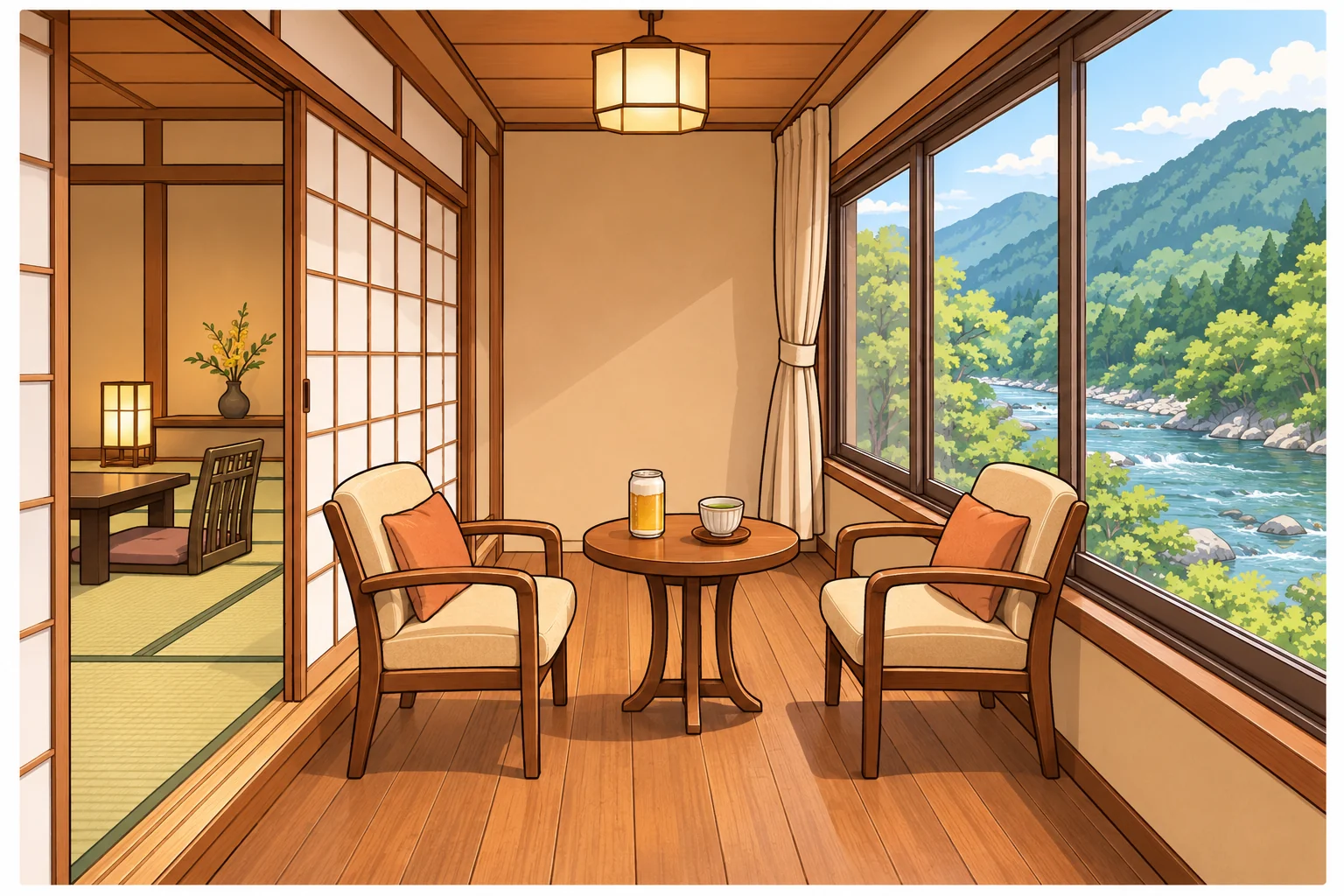
A ryokan room's hiroen: two armchairs and a small table on a wooden strip by the window, river and hills beyond (illustration).
The room is usually separated from the hiroen by shōji, sliding screens of white paper on a wooden lattice that turn daylight soft and even. Between the room and the corridor are fusuma, opaque sliding panels. Both are thin. In an older inn you can hear voices from next door, which is one reason Japanese guests tend to speak quietly and walk softly.
- 1Fumikomistone or wood; slippers off, step up
- 2Tatami roomlow table and zaisu; tokonoma along one wall, the seat nearest it is the place of honor
- 3Shōjipaper screens on a wooden lattice
- 4Hiroenwooden floor, two armchairs and a small table
- 5Window
Slippers off at the entry, up onto the mats; shōji separate the room from the hiroen, which runs along the window. Fusuma face the corridor.
Newer inns and renovated old ones often have wa-yōshitsu, "Japanese-Western rooms," with beds, a sofa, and sometimes a balcony with a private open-air bath. If you dread sleeping on the floor, you can book one of these. But the classic experience is a purely Japanese room, lying on a futon at night with the faint grassy smell of the rush mats around you.
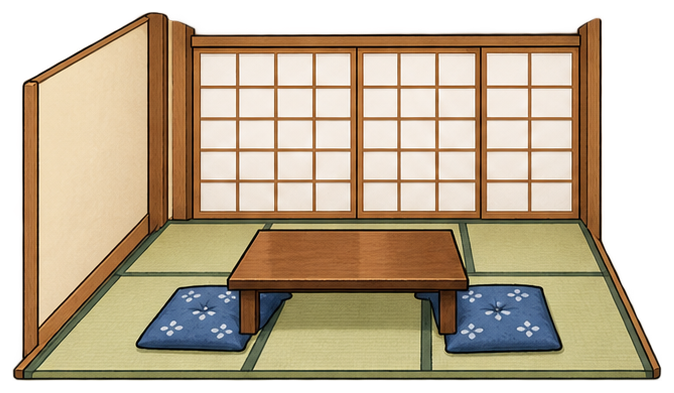
The room by day: paper-and-lattice shoji soften the light, with a low table in the middle.
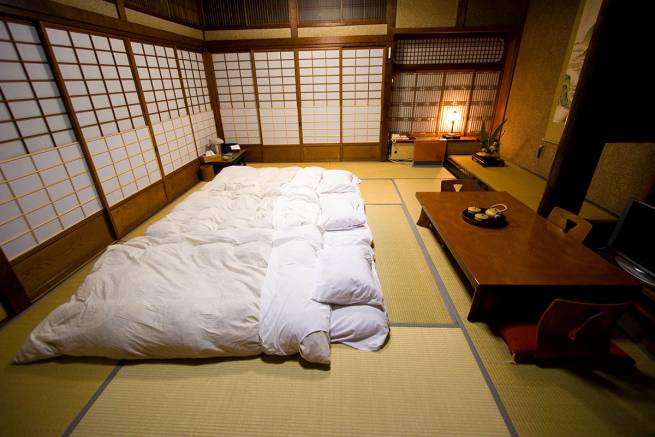
A real room: shoji all round, the low table moved aside and futon laid on the tatami.Japan Tourism Agency, guide to staying at a ryokan · Terms of use
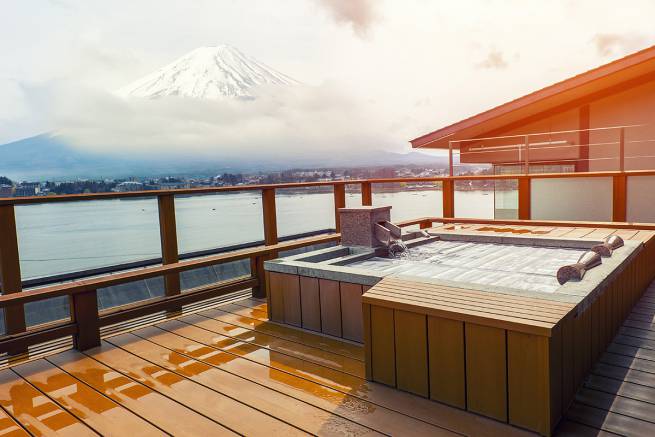
An outdoor bath at a ryokan, with Mount Fuji in view from the water.Japan Tourism Agency, guide to staying at a ryokan · Terms of use
04Post Towns, Pilgrims and Healing Waters
Most of what defines a ryokan took shape in the Edo period (1603–1868). In 1601 Tokugawa Ieyasu set up a system of relay stations along the Tōkaidō, the highway between Edo and Kyoto, and by about 1624 there were fifty-three stations between Edo and Kyoto, the "Fifty-Three Stations" of later fame. Together with the Nakasendō and three other trunk roads, the Five Highways, these post towns became the framework of travel across the country. Each one had a honjin, an official inn for traveling lords and court nobles, and a secondary waki-honjin, alongside lodgings for everyone else. The cheapest were kichin-yado, where you brought your own rice and paid a small fee for firewood to cook it; kichin means "firewood money." A step up was the hatago, which fed you. A night at a hatago meant supper and breakfast, and that is the direct ancestor of the modern one-night, two-meal plan.
From the eighteenth century onward, ordinary people traveled in growing numbers, usually with a pilgrimage as the reason. Roughly every sixty years a mass pilgrimage to the Grand Shrine at Ise swept the country; in 1830, by most accounts, several million people made the trip within a few months, and pilgrimages to Mount Fuji, Zenkō-ji, and Konpira drew steady crowds who took in the sights along the way. Utagawa Hiroshige’s woodblock series The Fifty-Three Stations of the Tōkaidō, published around 1833–34, is full of hatago. In the print of Goyu, women touting for an inn grab travelers by their bags and collars and haul them toward the door. In the next print, Akasaka, you look across an inn’s courtyard into its rooms, where a traveler at rest, a maid carrying in trays of food, and women making themselves up for the evening share the same frame; common descriptions of the print also point out a guest fresh from the bath, a towel over his shoulder, walking back to his room. Many hatago also employed meshimori onna, "rice-serving women," who in practice often worked as prostitutes, and they were part of the economy of the post towns.
The other root of the ryokan is the hot spring. The Japanese have long believed that mineral waters heal, and a long stay at a spring for the sake of one’s health was called tōji, bath cure. By the medieval period a cure was counted in seven-day rounds, and three rounds, twenty-one days, were thought the minimum. Farmers traditionally went in the slack season and stayed a week or two. Tōji guests usually cooked for themselves, bringing their own rice and miso; the inn rented them a room and a place to cook. As late as the 1960s most guests at the remote baths of Nyūtō Onsen in Akita still did their own cooking, and Ōsawa Onsen near Hanamaki in Iwate keeps a self-catering wing, the jisui-bu, in a building more than two hundred years old. The modern hot-spring ryokan is what you get when you combine the waters of the bath-cure town with the meals and hospitality of the highway inn.
Japan also has the oldest inns in the world. Keiunkan, at Nishiyama Onsen in Yamanashi Prefecture, traces its founding to 705 and was recognized by Guinness World Records in 2011 as the oldest hotel in operation. Hōshi, at Awazu Onsen in Ishikawa Prefecture, gives its founding date as 718 and has been run by the same family for more than forty generations. These dates come from the families’ own traditions rather than from contemporary documents, but an inn that has stood beside the same spring for something like a thousand years says a great deal about what hot water means in Japan.
After the Meiji Restoration of 1868, railways changed everything. Trains let city people reach the springs for a weekend, and well-connected spa towns such as Hakone, Atami, Itō, and Beppu grew quickly. Writers took to staying at inns to work. Kawabata Yasunari, then a student, traveled alone on the Izu Peninsula in 1918 and fell in with a troupe of itinerant performers at Yugashima. In 1922, at the Yumoto-kan inn there, he wrote a long draft of memories of that trip, and in 1926 he reworked the part about the young dancer into The Izu Dancer. In the years after university he stayed at the Yumoto-kan for six months or more at a stretch. Shiga Naoya, hit by a Yamanote Line train in Tokyo in 1913, convalesced at Kinosaki Onsen at an inn called Mikiya, and the visit became his short story At Kinosaki. Several of these "writers’ inns" are still open, and some keep the rooms where the authors stayed.
After the Second World War came the era of group travel. From the 1960s through the 1980s, companies sent their staff on annual trips and neighborhood associations and farm cooperatives organized tours; buses unloaded at hot-spring towns, and guests drank and sang in vast banquet halls. Inns grew into concrete towers with hundreds of rooms. When group travel faded, many of those buildings became a burden their owners could not carry.
05The Okami and the Art of Being Looked After
No account of the ryokan can leave out the okami, the proprietress. She is usually the owner’s wife, or a daughter or daughter-in-law who has inherited the house. She does not cook and she does not keep the books. Her work is to receive guests: to greet you at the door, to visit each room during dinner to ask whether everything is to your liking, and to see you off the next morning, bowing until your car is out of sight. At an established inn she also decides how the house is dressed for the season, chooses the scrolls and flowers, and remembers what regulars like to drink and what they talked about last time.
The role matters because what a ryokan sells is hard to standardize. A meal, a room, a bath: another inn can offer those. What guests remember is that someone recalled their preferred sake, that umbrellas appeared at the door when it began to rain, or that a child’s birthday brought an extra plate to the table. Omotenashi, in the Japanese sense, means thinking ahead for someone without making them feel watched. The industry has long treated this as its signature. Kagaya, at Wakura Onsen on the Noto Peninsula, built its reputation on exactly this kind of detailed service and was ranked first for more than thirty consecutive years in the travel trade’s annual poll of the country’s best hotels and inns. The Noto Peninsula earthquake of January 1, 2024, badly damaged Wakura, and Kagaya closed; as of 2026 it is still rebuilding, and the town as a whole is aiming to have all its inns open again around 2028.
Not every part of this suits every visitor. Staff come in and out of the room to serve tea, lay the futon, and clear dinner, so there is less privacy than in a hotel. Dinner is at a fixed time, and if you miss it there is no room service. Some inns restrict tattooed guests in the shared baths. People used to the freedom of hotels can feel hemmed in the first time. Most come round once they see the point: the pleasure of a ryokan lies in handing yourself over. You do not have to decide where to eat or what to do next. You bathe, eat, and sleep.
There is no tipping in Japan, and ryokan are no exception. An older custom called kokorozuke had guests hand the nakai a ¥1,000 or ¥2,000 note folded in paper or a small envelope when she first came to the room, as a way of saying thank you in advance for the evening’s trouble. It is old-fashioned now and entirely optional; most inns build a service charge into the rate, and pressing loose cash on a member of staff can embarrass them.
06The Ryokan Today
The number of ryokan has fallen sharply. Government figures put the peak at about 83,000 in 1980; by fiscal 2017 there were about 39,000. After the 2018 legal change merged ryokan and hotels into one category, separate counts stopped. The reasons pile up. Group travel declined and younger people prefer to travel independently. Family-run inns cannot find heirs. Large inns are still paying off loans for expansions built during the bubble economy. And it is hard to hire people for demanding work like that of a nakai. In many hot-spring towns you can see shuttered inn buildings standing empty.
At the same time, new models have appeared. Hoshino Resorts, which grew out of a single hot-spring inn in Karuizawa, has bought and rebuilt struggling inns across the country, and under its KAI brand runs a chain of small hot-spring ryokan, each designed around the crafts and food of its region. Some towns promote hakushoku bunri, "separating lodging from meals," so that guests can stay without dinner and eat at restaurants in town, spreading the business along the whole street. Kinosaki Onsen in Hyōgo has worked this way for a long time: the town has seven public bathhouses, and guests at any inn get a pass to all of them, so in the evening people wander in yukata and wooden sandals along the willow-lined canal from one bath to the next, as if the whole town were one large inn. More inns now take solo guests or offer sudomari, a room-only plan.
Foreign visitors have changed the ryokan too. Since the 2010s, as tourism to Japan surged, foreign guests have sometimes made up half or more of the clientele at inns in Kyoto, Hakone, Takayama, and Kanazawa. Many inns now have English guides; some let tattooed guests use private baths; some have put beds into tatami rooms. In Kyoto, three old houses, Tawaraya, Hiiragiya, and Sumiya, are often named together as the city’s classic inns, and they have long hosted celebrities and heads of state.
There are relatives of the ryokan worth knowing. A minshuku is a smaller, cheaper guesthouse, usually run by a family, with plain home cooking and bedding you lay out yourself; it feels like staying in someone’s home. In the cities there are capsule hotels, which are an entirely different Japanese answer to the problem of a night’s sleep.
07Your First Stay
Start by deciding what you want. If it is the bath, choose an inn in a hot-spring town and check whether rooms have their own open-air bath or whether there is a private bath you can reserve. If it is the food, look at what people say about dinner and whether it is served in the room. If money is tight, look for breakfast-only plans or a minshuku. Booking sites list plans as ippaku nishoku (dinner and breakfast), chōshoku-tsuki (breakfast only), and sudomari (room only), and the price difference can be large. A washitsu is a pure tatami room; a wa-yōshitsu has beds.
Aim to arrive between three and five in the afternoon. Dinner is planned around your arrival, and if you turn up late the kitchen cannot cope; some inns state that the last dinner sitting starts at six-thirty, and guests arriving after seven get a bed but no meal. If you are delayed, phone ahead. Many hot-spring inns run a free shuttle from the nearest station, so ask when you book.
In the room, take off your slippers before stepping on the tatami, and put your luggage in a corner or on the hiroen, not in the tokonoma. Eat the welcome sweet; it is there for you. Go to the baths in your yukata and take the towels from the room: the small one goes into the bathing area with you, the large one is for drying off afterward. The bath entrances are marked by curtains, usually blue for men and red for women, with the characters 男 (men) and 女 (women). Many inns swap the men’s and women’s baths between evening and morning so that each guest can try both, so check the curtain every time.
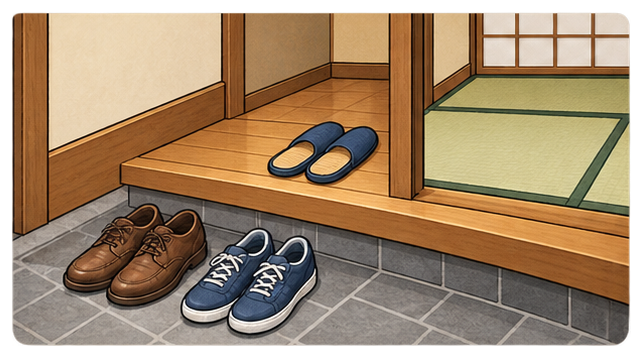
Shoes stay on the lower floor, slippers on the wood, and only socks or bare feet on the tatami.
If you have dietary restrictions, say so when you book; the kitchen has little room to change things on the night. After dinner, put on the wooden geta sandals the inn provides and walk out into town. In Kinosaki, Ginzan, Kusatsu, or Yufuin, the streets fill in the evening with people in yukata, and the shooting galleries, small bars, and souvenir shops stay open late. Back at the inn, watch for one last thing. The toilet has its own pair of slippers. Change back into the house slippers when you come out. Walking onto the tatami in toilet slippers is a mistake every Japanese person will spot.
At checkout, leave the yukata loosely folded on the bedding; you do not need to put the futon away, as the staff will do it. The okami or your nakai will usually see you to the door, and if you drive, they will stand and watch until the car turns the corner. A nod back from the window is all that is expected.