
At a glance
Why Japanese travelers bring sweets back for coworkers, how summer and year-end gifts work, and what the paper cords and wrappers on a gift box signal.
- Omiyage are meant for other people first, and are usually individually wrapped sweets printed with a place name.
- The custom is tied to Edo-period pilgrimages to Ise: those who received send-off money brought back amulets to share.
- Gifts call for return gifts, often by the "half return" rule: roughly a third to a half of what was received.
- Ochūgen in summer and oseibo at year’s end both thank people who looked after you over the past half year.
- A bow-knot mizuhiki suits happy events worth repeating; tight knots and awabi knots are for once-only occasions such as weddings and funerals.
Walk through the basement concourse of Tokyo Station on a Sunday evening and you will see travelers doing quiet arithmetic in front of the sweet counters. Twelve people in the office, plus the boss, so the twenty-piece box. In Japan, coming back from a trip without something for the people you left behind is close to unthinkable, and an entire industry of individually wrapped regional cookies exists to make sure nobody has to. This piece explains what omiyage are, where the habit comes from, how it connects to the twice-yearly gift seasons of ochūgen and oseibo, what the paper cords and printed wrappers on Japanese gifts actually mean, and how to take part without second-guessing yourself.
01Not a Souvenir
Omiyage is usually translated as "souvenir," and the translation gets it backwards. A souvenir is something you buy for yourself to remember a place. Omiyage are bought for other people, and most of the time they are food. From Hokkaidō you bring back Shiroi Koibito, thin butter cookies sandwiching white chocolate. From Kyoto you bring yatsuhashi, cinnamon-scented rice-flour sweets. From Ise you bring Akafuku, soft rice cake under a blanket of sweet red bean paste. The recipients are family, neighbors and, above all, coworkers.
The office ritual is precise. On your first morning back from vacation, you set a box on the counter in the break room or on the corner of your desk, sometimes with a little note: "I went to Okinawa — please help yourselves." Colleagues drift by, take one piece each, thank you, and ask how the trip went. As of 2026 the box probably cost between 1,000 and 2,000 yen. Its job is not to impress. It says: I was away, the rest of you covered for me, here is a small acknowledgment, and I am back.
That job explains why omiyage sweets look the way they do. Each piece is individually wrapped so it can be taken by hand and eaten later. Boxes come in counts that match office sizes: 8, 12, 20, 30. Shelf life runs to a couple of weeks or more, because you may not hand them out until several days after you buy them. And the box names the place, loudly. The most prized are chiiki gentei, "regionally limited" items you cannot buy anywhere else, which prove you actually went. Confectioners have spent decades designing for these requirements, and the result is a national map in which nearly every prefecture, and every major station, has a signature sweet.
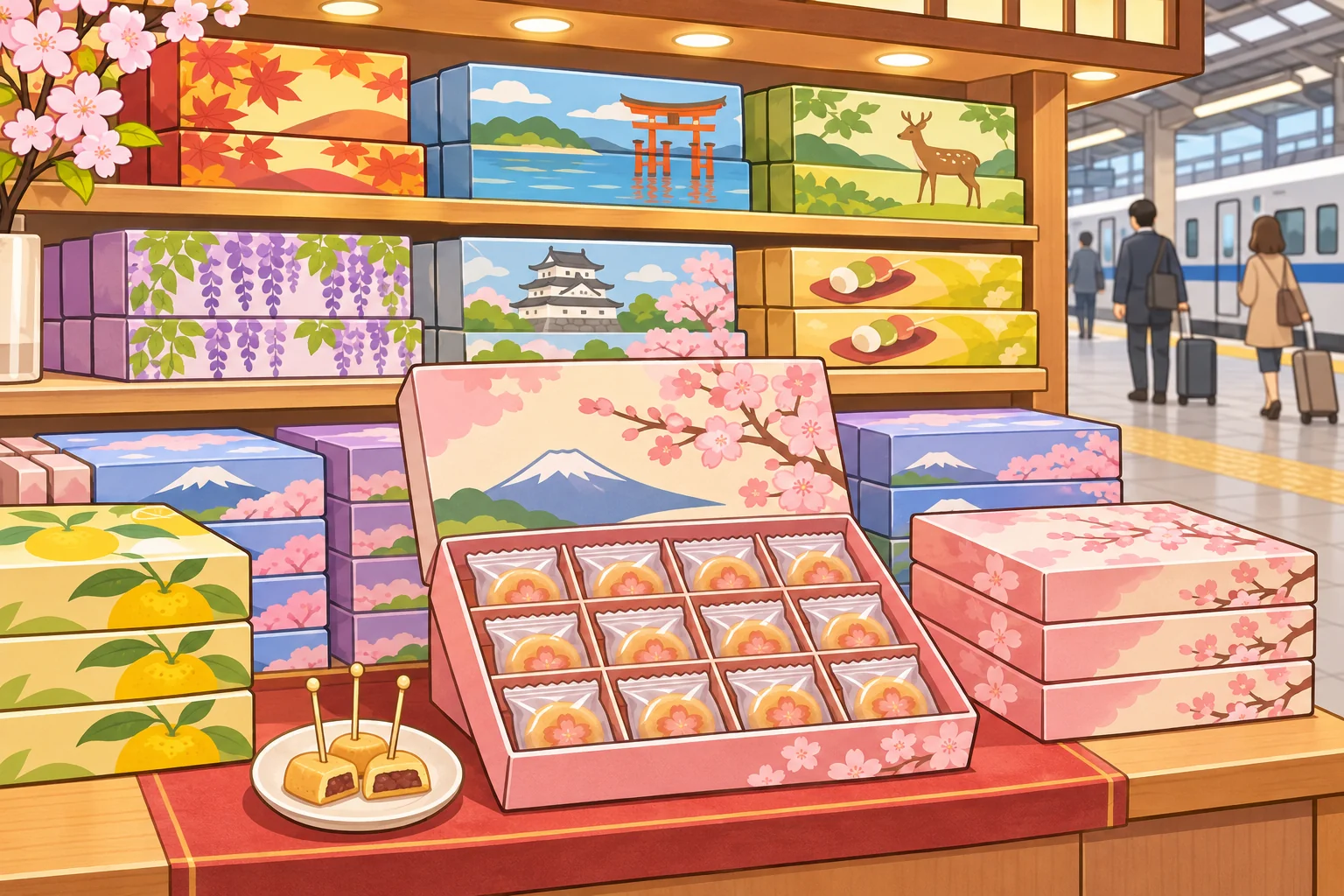
Station-shop shelves of omiyage sweet boxes, one opened to show individually wrapped treats (illustration).
02From Pilgrimage to Platform
The origin of the word miyage is unsettled. The most widely repeated theory links it to miyake, "shrine vessel," something received from a shrine, by some explanations the container that held a talisman; another reads it as miage, "something looked over carefully" before being given. Whatever the etymology, the custom grows out of travel, and travel in premodern Japan meant religion.
During the Edo period (1603–1868), ordinary people could not wander the country at will, but a pilgrimage to a shrine or temple was a respectable reason to go. The most famous was Ise mairi, the journey to Ise Jingū, the great shrine of the sun goddess Amaterasu. The trip was expensive, so villages formed savings associations called Ise-kō. Members paid in, and each year a few were chosen by lot to make the journey on behalf of the group. They left with gifts of travel money, called senbetsu, and came home obliged to bring back talismans from the shrine for everyone who had contributed. Light, durable local goods such as fans, combs and medicines came back too. What returned with the pilgrim was a share of the trip for those who could not make it, and a repayment of the money they had chipped in.
That logic survives almost unchanged. Japanese people heading off on a long trip still sometimes receive senbetsu from relatives or colleagues, and the expectation that they will return with omiyage follows naturally.
Akafuku, the red-bean rice cake sold outside Ise Jingū, dates its founding to the early 18th century, and its three ridges of bean paste are said to represent the flowing waters of the Isuzu River beside the shrine. But fresh sweets like Akafuku do not keep, and what turned omiyage into a mass habit was the railway. From the Meiji period on, as lines spread across the country, stations began selling local specialties on the platforms, and travelers could buy a town’s famous product through the train window. Later, the shinkansen and domestic flights shrank journeys to a few hours, and the omiyage box became an object of careful engineering.
Many of today’s best-known omiyage are not ancient at all. Ishiya Seika in Sapporo launched Shiroi Koibito in 1976, and it became the defining gift of Hokkaidō. Tokyo Banana, a banana-custard sponge cake, appeared in 1991 and gave the capital, which had no single obvious traditional sweet, a gift of its own. On the shelves of a station shop, these modern inventions sit right next to confectioners with three hundred years of history, and buyers do not much mind which is which. What matters is that the person receiving the box knows at a glance where you have been.
03The Ledger of Obligation
To understand Japanese gift-giving more broadly, start with okaeshi, the return gift. Receiving something creates a debt of feeling that should eventually be repaid. Wedding guests give cash and go home with hikidemono, return gifts from the couple. When a baby is born and friends send gifts, the family responds with uchi-iwai. Mourners give condolence money, kōden, at a funeral, and the family later sends kōdengaeshi. There is even a rule of thumb, hangaeshi, "half return": the return gift is worth roughly a third to a half of what was received. Return the full amount and it can be read as a sign that you would rather not stay in the other person’s debt, or in touch, at all; return too little and you look careless.
This sounds transactional, but in practice it is closer to maintenance. The traditional word is giri, the obligations that come with a relationship, and a gift turns those obligations into something you can hold. That is why the classic Japanese gift is consumable: sweets, tea, sake, cooking oil, soy sauce, towels, laundry detergent. It gets used up, takes no shelf space and imposes nothing. The thing disappears and the relationship is reaffirmed.
Visiting gifts form their own category, temiyage, "hand gifts." You bring one when you go to someone’s home for dinner, call on a client or go to apologize. The old formula when handing it over was tsumaranai mono desu ga, "it’s nothing much, but…" Many people now find that too self-deprecating and say kokoro bakari desu ga, "just a small token of my feelings," or simply suggest everyone share it. A gift is usually carried in the shop’s paper bag, but the bag is only for transport. Once you are inside and settled, you take the box out, turn it so the front faces the recipient, and offer it with both hands. A boxed gift of sweets is called a kashiori, and one is all but required when you go to apologize in person; the more formal the box, the more serious the apology.
04Ochūgen and Oseibo: The Two Gift Seasons
The most institutional form of Japanese giving happens twice a year: ochūgen in summer and oseibo at year’s end.
Chūgen began as a Chinese Daoist observance. The Daoist calendar marked three "origins": the 15th of the first, seventh and tenth lunar months. The middle one, zhongyuan, coincided with the Buddhist Ullambana festival for the dead, which in Japan became Obon. Families exchanged offerings around Obon, and in the Edo period merchants settled their accounts twice a year, at Obon and at year’s end, which is generally thought to be why those became the moments to thank good customers. Ochūgen as a nationwide gift habit took hold after the Meiji era, as urban social circles widened and department stores promoted it. By the modern era the meaning had settled: ochūgen and oseibo are thank-you gifts to the people who have looked after you over the past half year.
Timing depends on region. In eastern Japan, especially around Tokyo, ochūgen is sent from early July to around July 15. In much of western Japan it runs from mid-July to mid-August. Miss the window and the gift is relabeled shochū omimai, a midsummer greeting. Oseibo goes out from early December to around the 20th; anything later waits until after New Year’s Day and goes out as o-nenga, a New Year gift.
Traditionally, the list of recipients was long: your boss, the go-between who arranged your marriage, your children’s teachers, the family doctor, important clients, relatives far away. The gifts themselves follow the season. Summer means beer, juice, chilled sōmen noodles, fruit jellies, peaches and melons. Winter means ham, crab, salmon, sake, coffee and that old reliable, premium laundry detergent. As of 2026 a typical gift costs 3,000 to 5,000 yen, more for someone especially important.
Department stores turned the two seasons into national events. Each June and November, the big stores open dedicated gift centers and print thick catalogs. You choose a gift at the counter, fill in the address, and the store wraps it, attaches the correct paper label and delivers it straight to the recipient’s door, a job that Japan’s efficient home-delivery networks made easy. The wrapping paper itself carries meaning: the same ham arrives with more weight in the paper of Takashimaya or Mitsukoshi.
For several decades now the tide has been going out. Many companies have formally abolished kyorei, "empty courtesies," including gifts between staff and to superiors. Younger people maintain fewer of the relationships that once required ochūgen and oseibo, and prefer to send thank-you gifts when the occasion arises. Catalog gifts, where the recipient picks an item from a booklet, have spread, and online shopping has loosened the rituals further. Many shoppers now buy discounted gift sets during the seasons for their own households. Still, the June gift halls in department stores remain busy, and for many Japanese the first sign that summer has arrived is the ochūgen display.
05Noshi and Mizuhiki: The Language of Wrapping
A formal Japanese gift wears a sheet of paper over its wrapping called a noshi-gami. In the upper right corner is a small, elongated hexagonal emblem: the noshi itself. It began as noshi-awabi, abalone sliced into long thin strips, stretched and dried, which was a precious offering to the gods and a celebratory gift. Abalone stood for long life, and the stretching for things that last. Over time the real abalone was replaced by a folded-paper version, and later by a printed picture. Ise Jingū still offers dried abalone in its rituals. Because the noshi represents seafood, it is left off gifts of fish or meat and off anything connected with mourning.
Across the middle of the sheet runs the mizuhiki: cords made of twisted washi paper, stiffened with starch and dyed. On most noshi-gami today the mizuhiki is printed, but for formal occasions, especially cash envelopes for weddings, real cords are tied. Their color and their knot tell the recipient what kind of gift this is.
Red and white is for ordinary celebrations and thank-yous, including ochūgen, oseibo and everyday gifts. Gold and silver are for grand celebrations such as weddings. Black and white, or in parts of western Japan yellow and white, are for funerals and memorial services. The knots fall into two families. Chō-musubi, the butterfly or bow knot, looks like a tied shoelace and can be undone and retied, so it is used for happy events you would gladly see repeated: births, school admissions, seasonal gifts. Musubi-kiri, a knot tied tight with the ends cut off, and awaji-musubi, an interlocking knot whose shape echoes an abalone, cannot be undone, so they are for things that should happen only once: weddings, get-well gifts and funerals. Sending a get-well gift tied with a bow knot, implying the illness should recur, is a genuine blunder.
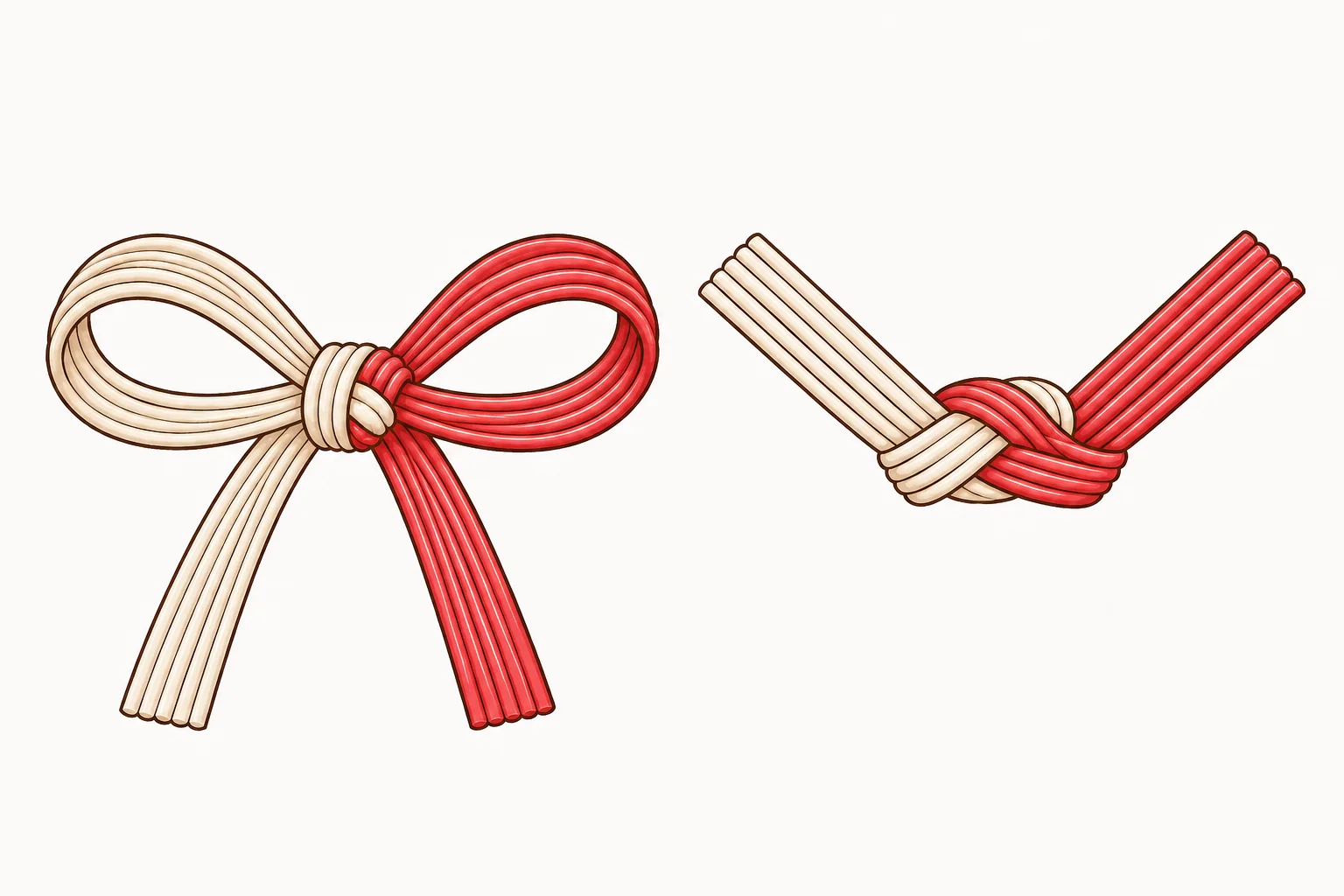
Two mizuhiki knots: chō-musubi, a bow that can be undone and retied, and musubi-kiri, tied tight with the ends cut off.
| Knot | Feature | Used for |
|---|---|---|
| Chō-musubi (bow) | can be undone and retied | births, school admissions, seasonal gifts |
| Musubi-kiri | tied tight, ends cut off | weddings, get-well gifts, funerals |
| Awaji-musubi | echoes an abalone, cannot be undone | weddings, get-well gifts, funerals |
The knot that can be retied is for events worth repeating; the two that cannot are for once-only occasions, so a bow knot on a get-well gift is a blunder.
The number of strands is usually odd, with five the standard and seven more formal. Wedding cords use ten, read as two families of five joined together. The city of Iida in Nagano Prefecture produced about 70 percent of Japan’s mizuhiki as of 2025, and in Kanazawa, Kaga mizuhiki craftsmen shape the cords into three-dimensional cranes, tortoises and pine branches for wedding envelopes.
On the upper half of the noshi-gami goes the omotegaki, the purpose of the gift, brushed or printed: Ochūgen, Oseibo, Orei (thanks), Oiwai (congratulations). Below the cords goes the giver’s name. Placed under the wrapping paper, the sheet is called uchi-noshi, a modest choice common for return gifts and mailed items; placed over the wrapping, it is soto-noshi, used when handing a gift over in person. You do not need to memorize any of this. When you buy a gift at a department store, the clerk will ask what it is for, and that is all she needs to know.
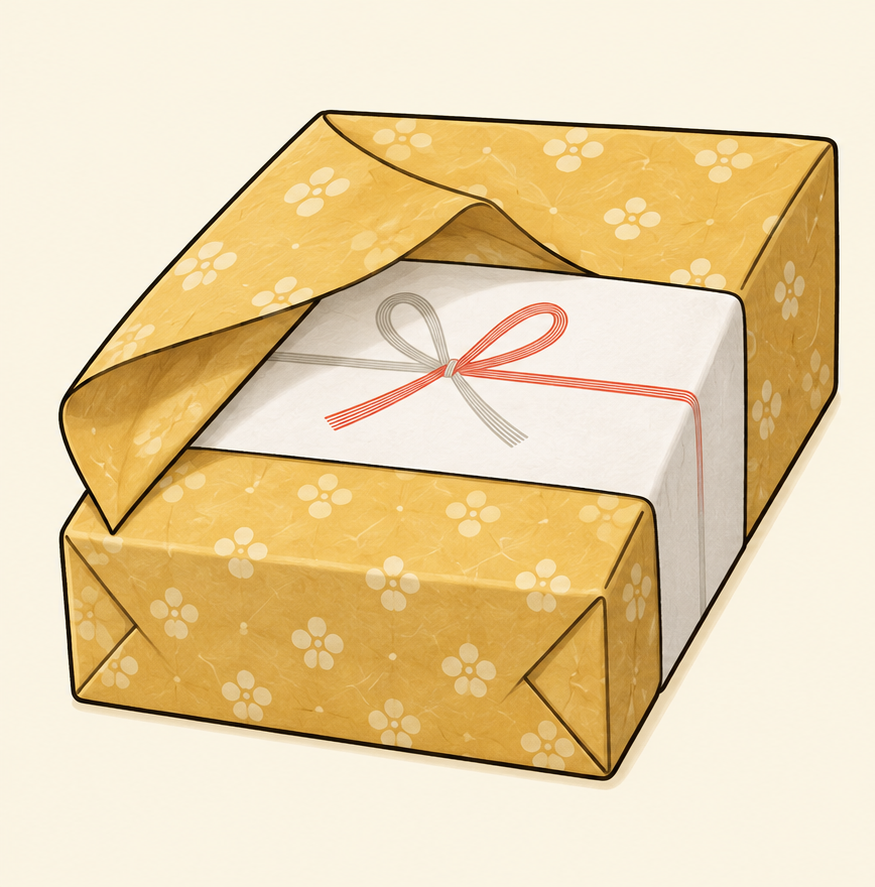
Uchi-noshi: the noshi sheet goes under the wrapping paper, a low-key choice common for return gifts and mailed gifts.
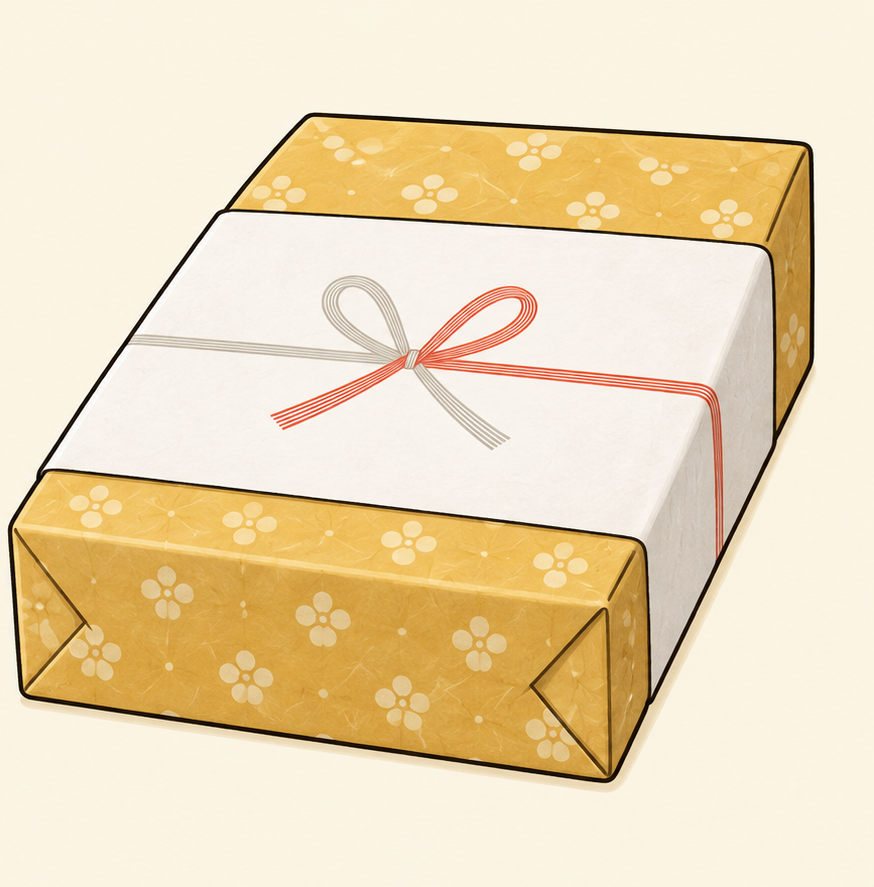
Soto-noshi: the sheet goes outside the wrapping so the purpose shows at a glance, common when handing a gift over in person.
06Buying and Giving as a Visitor
The easiest places to buy omiyage are big stations and airports. Tokyo Station has hundreds of sweets from all over the country in its underground malls and inside the ticket gates, and plenty of travelers do all their shopping there before boarding the shinkansen. The departure floors of Haneda, Narita, Kansai and especially Hokkaidō’s New Chitose Airport are omiyage supermarkets in their own right. Department store food halls, the depachika, are better for taking your time, with old confectioners and fashionable patisseries side by side and free samples on offer. Shopping streets and long-established local shops are where you find what residents themselves eat.
Japanese buyers think practically. Count heads and round up. Check the best-before date against when you will hand things out; fresh sweets and anything refrigerated suit only people you will see the same day. Choose individual wrapping for groups. Make sure the place name is on the box. Cookies, rice crackers and baumkuchen are the safe choice for coworkers; for family and close friends, local fresh sweets, pickles, sake or a regional seasoning make a more personal gift.
If you are visiting a Japanese home, a box of sweets from your own country or city makes an excellent temiyage. People are especially touched by something carried from far away, and foreign writing on the box is part of the appeal. Hand it over with both hands and a short sentence: "This is from my hometown — I hope you enjoy it." Your hosts will thank you, but they may not open it in front of you, which is not a slight. Very often they will mention later, or at your next meeting, how good it was. That mention is the reply.
The same applies in reverse. If a Japanese friend gives you something, thank them on the spot and bring it up again later. For a more formal gift, a postcard after you get home, or a small present from your own country the next time you meet, keeps the exchange going.