
At a glance
From the 1872 line to the Shinkansen, IC cards and station stamps: why Japan’s trains run on time and how they shape city life.
- Japan’s first railway opened in 1872, running about 29 km between Shinbashi and Yokohama.
- The Tōkaidō Shinkansen opened on October 1, 1964, nine days before the Tokyo Olympics.
- The Tōkaidō Shinkansen runs over 300 trains a day, with average delays usually under a minute.
- Suica launched in 2001; since 2013 the ten major IC cards work nationwide.
- Station stamps are said to have begun at Fukui Station in 1931 and spread with the 1970 Discover Japan campaign.
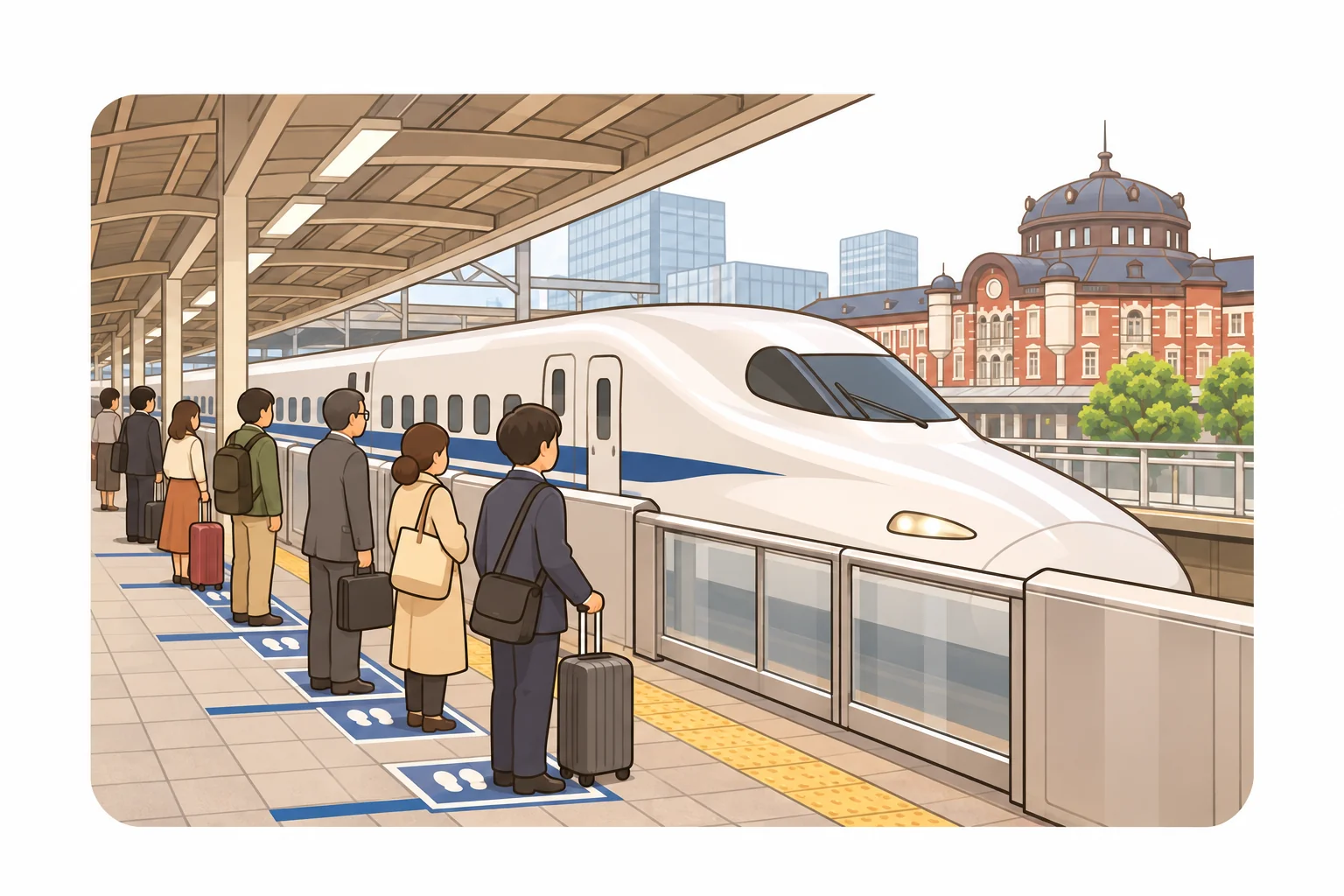
Japan is one of the few countries where the train is not a nostalgic or second-best way to travel but the main way most people get around. A visitor’s first impressions of the country are often formed on a platform: the queue lines painted on the floor, the short melody that plays before the doors close, the bow of a conductor as he leaves the car, the soft beep of a fare card at the gate. This piece explains how Japan came to depend on rail, why the Shinkansen, the "bullet train," was such a leap in 1964, where the famous punctuality comes from, and how stations became the centers of town life. It also covers two small things every traveler handles: the IC fare card and the station stamp. It ends on board a Shinkansen, with what you need to know to ride one.
01A Country That Runs on Rails
Ride the Tokyo trains at rush hour and the scale is the first thing that strikes you. On the Yamanote Line, the loop that circles central Tokyo, trains come every two or three minutes at peak times. JR lines, private railways, and two subway systems tangle together on the map. Shinjuku Station handled more than three million passenger entries and exits a day before the pandemic and has long been listed as the busiest station in the world. An often-cited ranking holds that most of the world’s 50 busiest stations are in Japan.
Geography explains part of this. Japan is long and narrow, and mountains cover roughly 70 percent of it. Most people live on coastal plains along the Pacific side, and more than half the population sits in the corridor from Tokyo through Nagoya to Ōsaka. The cities are dense and the distances between them are a few hundred kilometers, exactly the range where rail beats both flying and driving.
The other part is that Japanese cities grew along railway lines. From the early twentieth century, private railway companies built suburbs, department stores, and amusement parks along their tracks, so that people commuted into the city on the company’s trains and spent their weekends at the company’s resort at the end of the line. Apartments are still advertised by how many minutes’ walk they are from the nearest station, and employers routinely pay their workers’ commuter passes. Rail in Japan is not only transport; it decides where people live.
02From Shinbashi to Yokohama
Japan’s first railway opened in 1872, running about 29 kilometers between Shinbashi in Tokyo and Yokohama. The new Meiji government built it with British help: the chief engineer was Edmund Morel, and the locomotives and rails came from Britain. The Emperor Meiji rode the train on opening day, and the scene at Shinbashi was reproduced in brightly colored woodblock prints that sold briskly.
The line was built to a gauge of 1,067 millimeters (3 feet 6 inches), narrower than the 1,435-millimeter standard gauge of Europe and North America. No clear record explains the choice, but narrow gauge is generally thought to have been picked because it was cheaper and handled mountain curves better, sensible considerations for a government in a hurry and short of money. But it also capped speeds and the size of trains, and the limitation stayed with Japanese railways for almost a century, until the Shinkansen sidestepped it by being built new, on standard gauge.
The network spread quickly. By 1889 the Tōkaidō Line ran all the way from Shinbashi to Kōbe, linking Tokyo and the Kansai region by rail for the first time. Much early mileage was built by private capital, including the Nippon Railway Company’s line north from Tokyo, the ancestor of today’s Tōhoku Main Line. In 1906 the Railway Nationalization Act brought the main private trunk lines under state ownership, creating the backbone of what would become Japanese National Railways (JNR).
Short electric lines around the big cities, however, were left to private enterprise, and that produced a distinctly Japanese business model. Its best-known architect was Kobayashi Ichizō, who ran the Minoo-Arima Electric Railway outside Ōsaka, the forerunner of today’s Hankyu. Before his line even opened, he bought land along it at Ikeda and built houses, selling them to salaried families on installment plans. At the terminus, Takarazuka, he opened a hot-spring resort and founded the all-female Takarazuka Revue, still one of Japan’s most popular theater companies. In 1929 he opened the Hankyu Department Store inside the company’s terminal building at Umeda in Ōsaka, generally considered Japan’s first department store built into a railway terminal. His commuters’ home payments, shopping, and weekend entertainment all flowed back to the railway. Tokyu, Seibu, Tobu, Kintetsu, and other large private railways followed similar paths, which is why so many big Japanese stations sit beneath a department store bearing the railway company’s name.
031964: The Bullet Train
By the late 1950s the Tōkaidō Line, the spine of Japan’s booming postwar economy, was full. Sogō Shinji, the president of JNR, pushed for an entirely new high-speed line, and the engineering was led by his chief engineer, Shima Hideo. Many people at the time thought railways were a declining industry that would lose out to cars and airplanes. To raise money and secure political backing, JNR borrowed 80 million dollars from the World Bank, and the budget presented to the Diet is widely said to have been deliberately understated so the project would be approved. When costs overran, Sogō took the blame and left his post in 1963, before the line opened.
The Tōkaidō Shinkansen opened between Tokyo and Shin-Ōsaka on October 1, 1964, nine days before the opening of the Tokyo Olympics. Its trains ran at up to 210 kilometers per hour and initially took four hours for the trip, cut to 3 hours 10 minutes the following year. The white-and-blue 0 Series, with its rounded nose, became a symbol of Japan’s recovery from the war, and English gained the phrase "bullet train."
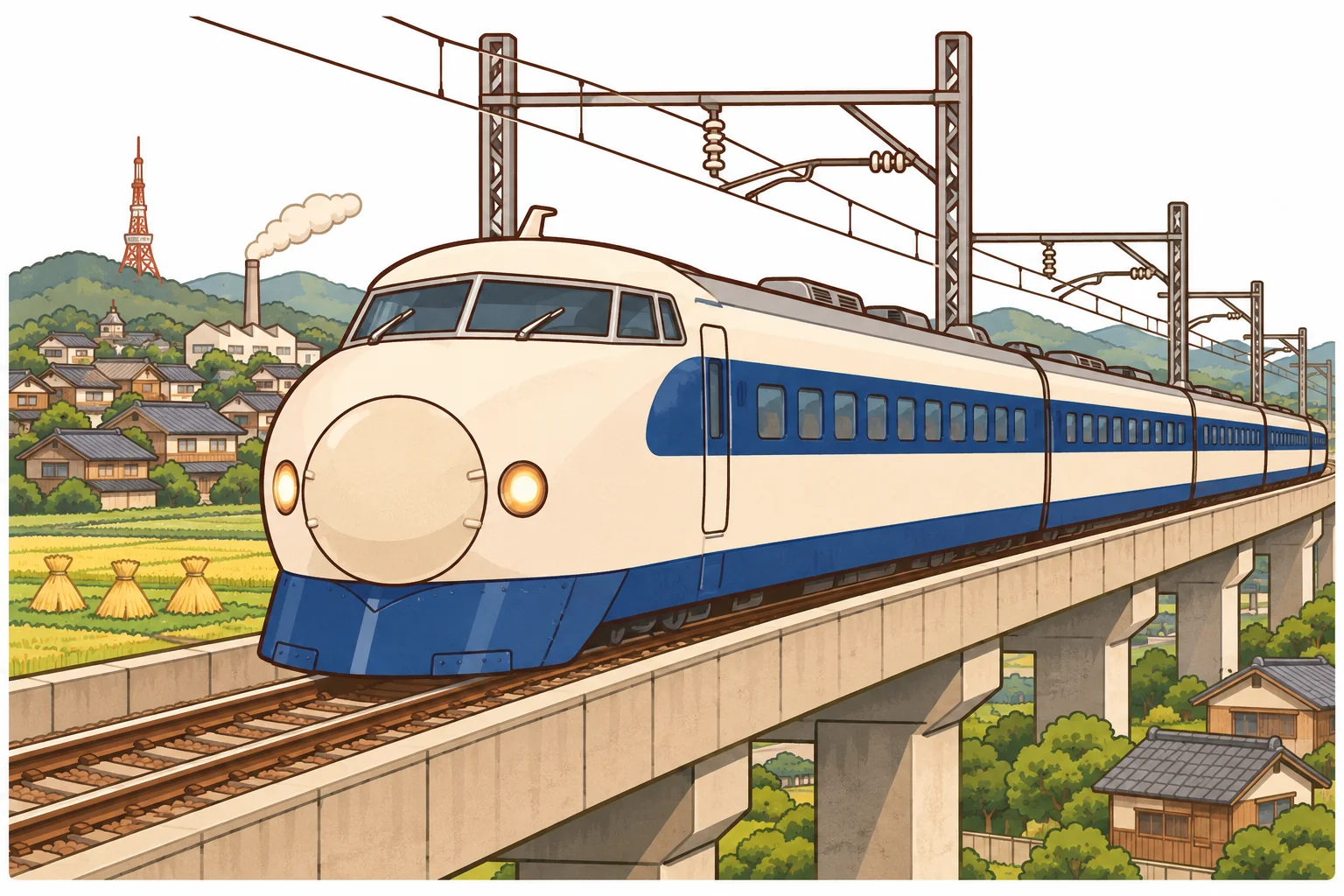
A blue-and-white, round-nosed 0 Series Tōkaidō Shinkansen of 1964 running on a viaduct (illustration).
What made the Shinkansen work was not any single dramatic invention but a whole system built for speed. The track was standard gauge, laid out with gentle curves and gradients. There were no level crossings with roads anywhere on the line. Instead of a locomotive pulling unpowered coaches, motors were spread along the train, giving smoother acceleration and braking. In the cab, an automatic train control system (ATC) displayed and enforced speed limits, so drivers no longer had to read signals at the trackside at 200 kilometers per hour. In more than sixty years since, there has not been a single passenger death caused by a Shinkansen derailment or collision.
The network spread outward. The San’yō Shinkansen reached Okayama in 1972 and Hakata in Fukuoka in 1975. The Tōhoku and Jōetsu Shinkansen opened in 1982. The Nozomi service, introduced in 1992, brought Tokyo to Shin-Ōsaka down to about two and a half hours; as of 2026 the fastest trains do it in about 2 hours 21 minutes. The Kyūshū Shinkansen was completed to Kagoshima-Chūō in 2011, the Hokkaidō Shinkansen reached Shin-Hakodate-Hokuto in 2016, and the Nishi-Kyūshū Shinkansen opened between Takeo-Onsen and Nagasaki in 2022. The Hokuriku Shinkansen reached Kanazawa in 2015 and Tsuruga in Fukui Prefecture in 2024. On the Tōhoku line, E5 Series trains run at up to 320 kilometers per hour.
The next step is the Chūō Shinkansen, a superconducting maglev line designed for 500 kilometers per hour, whose first stage would link Shinagawa in Tokyo with Nagoya in about forty minutes. It was meant to open in 2027, but Shizuoka Prefecture, worried that a tunnel would drain water from the Ōi River, long refused to let work start on its section. The prefecture finally agreed in 2026; as of November 2026 JR Central had not announced an official opening date, and the opening is expected no earlier than 2036.
04The Breakup of JNR
Japanese National Railways was enormous, but by the 1970s it was in deep trouble. Cars and planes were taking its passengers and freight, rural lines lost money, labor disputes were constant, and politicians kept demanding new lines in their districts that would never pay. By the 1980s its long-term debt had grown to tens of trillions of yen. On April 1, 1987, JNR was broken up and privatized. Passenger services were divided into six regional companies, JR Hokkaidō, JR East, JR Central, JR West, JR Shikoku, and JR Kyūshū, plus a nationwide freight company, JR Freight.
The result is today’s mixed system. The JR companies run the Shinkansen and the national trunk lines. JR East, JR Central, JR West, and JR Kyūshū are listed on the stock market, and the Tōkaidō Shinkansen is JR Central’s money machine. JR Hokkaidō and JR Shikoku, with long lines and thin populations, have struggled ever since. In the big cities, large private railways such as Tokyu, Odakyu, Keio, Hankyu, Hanshin, Kintetsu, and Meitetsu each dominate a sector of suburbs. Tokyo Metro and the Toei Subway run beneath Tokyo. Across the country there are small local railways, "third-sector" lines jointly owned by local governments and businesses, and streetcar systems, many kept alive by tourist trains and subsidies.
For a visitor, the practical consequence is that one station may hold several companies, each with its own ticket gates. Changing trains can mean leaving one company’s gates and entering another’s. A large part of the appeal of an IC card, as later sections show, is that it hides this complexity.
05Punctuality and Order
The thing Japanese railways are most famous for is being on time. The Tōkaidō Shinkansen runs well over three hundred trains a day, and its average delay per train over a year is usually under a minute, a figure that includes delays from typhoons, snow, and earthquakes. On Tokyo’s commuter lines, where trains run about two minutes apart at peak, a delay of thirty seconds ripples down the line, so punctuality is less a point of pride than a condition for moving so many people at all.
In 2017 the Tsukuba Express, which runs from Akihabara in Tokyo to Tsukuba, issued a public apology because a train had left a station 20 seconds early. The next year JR West apologized after a train departed 25 seconds ahead of time. Overseas these stories were passed around as curiosities. In Japan they were mostly seen as ordinary good service: the timetable is a promise to passengers, and a train that leaves early can make someone miss it just as surely as one that leaves late.
The punctuality rests on small routines. Drivers and station staff point at signals, gauges, and the platform and call out what they see, a practice called shisa kanko, "pointing and calling." It looks theatrical, but a 1994 experiment by the Railway Technical Research Institute found that pointing and calling together cut errors to about a sixth of the rate when neither was done. At Tokyo Station, the cleaning crews who service Shinkansen trains have about seven minutes while a train turns around to clean every seat, aisle, and toilet on the train and, according to reports, to turn all the seats to face the direction of travel. They line up and bow to the train as it arrives, and their "seven-minute miracle" has been the subject of documentaries and a Harvard Business School case study. On the platform, painted markings show where each door will stop; passengers queue on either side and let people off before boarding.
Order has its costs. Tokyo rush-hour trains are so packed that staff sometimes help push passengers in, and the man’in densha, the "full train," is part of every office worker’s day. Groping on crowded trains has been a long-standing problem, and since the early 2000s many lines have set aside women-only cars during peak hours. The last train shapes nightlife: people drinking in an izakaya keep an eye on the clock, and anyone who misses the last train home faces a taxi fare, a night in an internet café, or a bunk in a capsule hotel near the station.
There is also the quiet. Talking on the phone in a Japanese train is considered rude; phones are set to "manner mode," meaning silent, and loud conversation draws looks. It is part of a broader etiquette of not imposing on others in public, and the train is where visitors feel it most directly.
06Stations: From the Ticket Gate to the Local Town
A big Japanese station is a town in itself. Tokyo, Shinjuku, Ōsaka-Umeda, and Nagoya stations have department stores and office towers above and miles of underground shopping and dining below; you could spend a whole day without leaving. The red-brick Marunouchi side of Tokyo Station was designed by the architect Tatsuno Kingo and completed in 1914. Its domes were destroyed in the bombing of 1945, and it was restored to its original appearance in 2012, making the station a sight in its own right.
Over the past two decades the railway companies have built up ekinaka, "inside the station," shopping: shops and restaurants located inside the ticket gates. During a few minutes’ transfer you can buy a bento, sweets, coffee, a book, or cosmetics. At Tokyo Station, the shopping areas inside the gates are packed with regional specialties and Tokyo-only sweets, where business travelers and people heading home for the holidays pick up souvenirs, the gifts Japanese travelers are expected to bring back for colleagues and family. On platforms and beside the gates stand tachigui soba counters, where you eat buckwheat noodles standing up: a bowl for a few hundred yen, ordered, eaten, and finished in five minutes. They are the breakfast and late-night snack of commuters.
The railway lunch box, the ekiben, is one of the great pleasures of train travel in Japan. It is generally said to have started in 1885 at Utsunomiya Station, north of Tokyo, with rice balls wrapped in bamboo sheath, though other stations have their own claims. Ekiben are built around local ingredients and often come in distinctive containers. Kiyoken’s shūmai bento from Yokohama, the Tōge no Kamameshi from Yokokawa in Gunma, a rice dish sold in a small earthenware pot, and the squid stuffed with rice from Mori in Hokkaidō have all been sold for decades. Vendors once walked the platforms with trays slung from their necks, selling through the open train windows. Shinkansen windows do not open, so today people buy their ekiben at dedicated shops in the station before boarding.
Stations have their own sounds too. Many JR East stations replaced harsh departure bells with hassha merodi, departure melodies a few seconds long, and some chose tunes with local connections. Ebisu Station plays the theme from the film The Third Man, which a beer company had used in its Yebisu advertising. Takadanobaba plays the theme from Astro Boy, because in the story Astro Boy was "born" in Takadanobaba, where Tezuka Osamu’s production company also has its office. Regular riders know where they are by the tune alone.
Away from the cities, stations look different. Many rural stops are unstaffed: a shelter, a few benches, perhaps a ticket machine. On some local lines you take a numbered ticket when you board and pay the driver in a fare box as you get off. A station is often the center of a small town, with a shopping street, a police box, a bus terminal, and a taxi rank out front; people wait, meet, and say goodbye there. As rural populations shrink, many station-front shopping streets have gone quiet, and on some lines local residents, cooperatives, or even cafés now look after stations, selling tickets and keeping them clean.
The most famous example is Kishi Station on the Wakayama Electric Railway’s Kishigawa Line. The line was nearly closed in the mid-2000s. In 2007 a calico cat named Tama, who lived at the station, was appointed stationmaster and sat by the ticket gate in a specially made cap. She drew so many visitors that the company rebuilt the station building in the shape of a cat’s face. After Tama died in 2015 she was given the title of honorary eternal stationmaster, and another cat took over the job. It is a joke, in a way, but a revealing one: in rural Japan, a station can carry a great deal of local affection.
07IC Cards: One Card, Several Jobs
The easiest way to ride trains in Japan is with an IC fare card. You touch it to the reader on the gate as you enter, it beeps, and when you leave, the fare is deducted automatically; a single gate can pass dozens of people a minute. Japanese gates are commonly said to stay open by default and to close only when a card is short of funds or fails to read, though the arrangement varies by region and company.
- 1
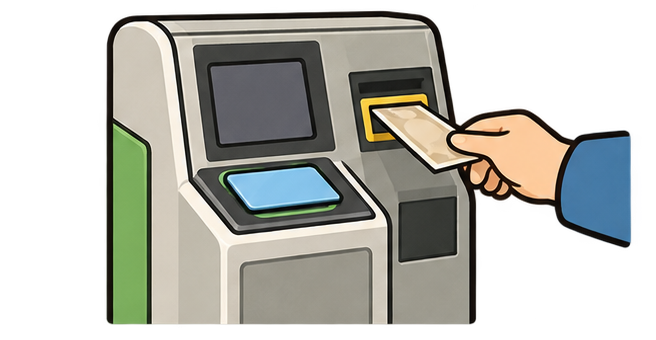 Top up the card with cash at a station machine.
- 2
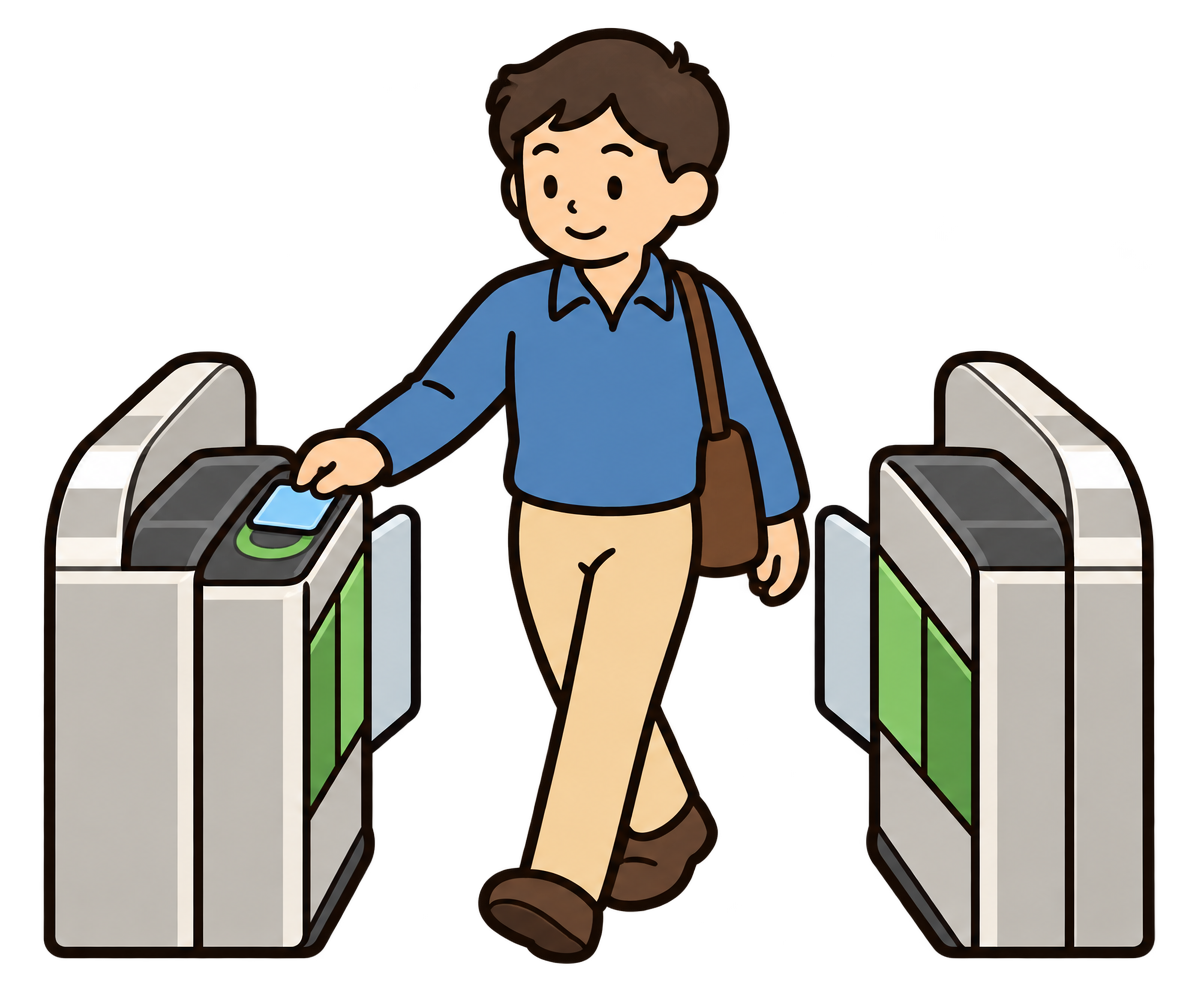 Touch the card to the gate reader as you enter; it beeps and you walk through.
- 3
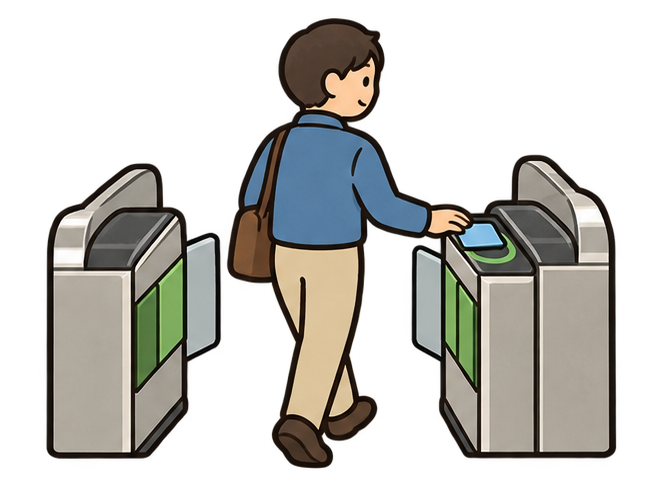 Touch it again on the way out, and the fare is deducted automatically.
JR East launched Suica in November 2001. The name stands for "Super Urban Intelligent Card," and it also plays on suisui, Japanese for moving along smoothly, and sounds like the word for watermelon. Its mascot, though, is a penguin. Suica uses FeliCa, a contactless chip technology developed by Sony that reads and writes in about a tenth of a second, which is why the gates can move people so fast. Other regions followed: ICOCA from JR West in Kansai, PASMO from Tokyo’s private railways and subways in 2007, manaca and TOICA around Nagoya, Kitaca in Hokkaidō, SUGOCA, nimoca, and Hayakaken in Fukuoka, and PiTaPa, a postpaid card used by Kansai private railways. Since 2013 these ten major cards have been interoperable nationwide, so a Suica bought in Tokyo works on the Ōsaka subway or a Fukuoka bus.
The card does several things. First, it is a ticket: a stored-value card charged per ride, or a commuter pass for a fixed route loaded onto the same card, or, on the Shinkansen, a reservation linked to the card so you can tap straight through. Second, it is an electronic wallet. Convenience stores, station shops, lockers, and many vending machines accept it, as do some restaurants and stores; tapping a card on a station vending machine for a bottle of tea is about as everyday as Japanese life gets. Third, it carries identity: a registered card can be replaced if lost, and a commuter pass prints the holder’s name and route, which employers use to reimburse travel.
The card has also moved into phones. Mobile Suica appeared in 2006, Apple added Suica to the iPhone in 2016, and Android phones and smartwatches followed, so many people no longer carry a physical card. For foreign visitors, JR East introduced Welcome Suica in 2023, a card valid for a limited period. The same year, a global chip shortage forced JR East to suspend sales of unregistered plastic Suica cards for a time; normal sales resumed in 2025.
There are limits. Some rural lines and stations still do not accept IC cards, and JR journeys that cross from one regional card area into another often cannot be completed on a card; in that case you settle the fare at the fare adjustment counter at your destination. As of 2026, a new card usually requires a 500-yen deposit, and most top-up machines in stations take cash only.
08Station Stamps: Carrying a Place Home
In many Japanese stations, near the gates or in a corner of the waiting room, there is a small table with a rubber stamp, an ink pad, and a sign inviting you to help yourself. This is the eki sutanpu, the station stamp. Each design is different, usually the station name with a local landmark, specialty, or festival: a castle, a mountain, a hot spring, a fishing harbor, a festival float, sometimes a local mascot. Travelers carry dedicated stamp books and collect station after station, and when they get home the book is a picture record of their trip.
Each stamp has its own design; travelers collect them station by station in a dedicated book.
Station stamps are generally said to have begun at Fukui Station in 1931 as a souvenir for passengers. What made them a national habit was Discover Japan, the campaign JNR launched in October 1970, for which stamps were reportedly set up at well over a thousand stations (some accounts say about 1,400, others 1,500). After the Ōsaka Expo, JNR wanted to steer the new wave of domestic tourists out across the country and encouraged young travelers, stamp book in hand, to visit places they had never heard of. A stamp tied each station to an image of its place and gave people a reason to get off the train.
Stamps remain popular. JR East and other companies hold stamp rallies almost every year, in which passengers who collect a set number of stamps at designated stations can claim a prize, and tie-ins with anime or railway themes draw large crowds of fans. Adults take it as seriously as children: the stamp should be straight, the ink even, and a smudged one gets a second try beside it. Station stamps can look like the goshuin collected at temples and shrines, but they are quite different. A goshuin is a handwritten record of a visit made by a priest or monk, for a fee. A station stamp is free, do-it-yourself, and open to anyone.
The same delight in collecting a set runs through Japanese domestic travel, from station stamps to sightseeing stamps and the stamps at roadside rest stops, to cards printed with the designs of local manhole covers. What matters is not the stamp itself but the moment of pressing it, proof that you were really there.
09Riding the Shinkansen
If you take only one train in Japan, make it the Tōkaidō Shinkansen from Tokyo to Kyoto or Ōsaka. You can buy tickets at a staffed JR ticket office, the midori no madoguchi ("green window"), at a ticket machine, or through an online reservation service. A Shinkansen journey on paper tickets usually involves two parts, a basic fare ticket and a limited-express ticket; the machine issues both, you feed them into the gate together, and the gate returns both, so remember to take them.
There are reserved and non-reserved cars. Reserved seats come with a car and seat number and are worth booking ahead at weekends and holidays. Non-reserved cars are near the front of the train and first come, first served; at busy times people stand. First class is the Green Car, with wider seats and a quieter atmosphere. Heading from Tokyo toward Ōsaka, Mount Fuji appears on the right, the side with two seats per row, so the window seat is E. On a clear day the best view is around Shin-Fuji Station in Shizuoka.
On the platform, the stopping point of each car is marked on the floor, and people queue there. When a train terminates at Tokyo, the cleaning crew goes in as soon as passengers are off, and boarding begins a few minutes later. Inside, the rows of seats can be swiveled, so a group can turn one row to face another. Since 2020 the Tōkaidō, San’yō, and Kyūshū Shinkansen have required passengers with luggage whose length, width, and height add up to more than 160 centimeters to reserve a seat with an oversized-baggage area at the back of the car, or pay an extra charge. Many visitors avoid the problem by sending big suitcases ahead from hotel to hotel by takkyūbin, Japan’s door-to-door delivery service, and riding with just a daypack.
The rules on board are few. Take phone calls in the vestibule between cars, keep your voice down, and carry trash to the bins by the doors. Eating on the Shinkansen is perfectly normal; opening an ekiben with a can of beer is one of the moments Japanese business travelers look forward to most. On ordinary commuter trains, eating is considered poor form.
The Japan Rail Pass, sold to foreign visitors, gives unlimited travel on JR lines, including most Shinkansen, for a fixed number of days. Its price rose sharply in October 2023, with the seven-day pass going from about 30,000 yen to 50,000 yen, so for a simple Tokyo–Kyoto–Ōsaka trip it is worth adding up regular fares first. At the other end of the scale is the Seishun 18 Kippu, a seasonal ticket much loved by Japanese travelers that allows unlimited rides on JR local and rapid trains during school holidays. On slow trains you can work your way along the coast and through the rice fields, get off at a station you have never heard of, press its stamp into your book, soak in a hot spring by the station, and eat a bowl of local soba. Some of the best of Japanese rail lies on the lines the Shinkansen never reaches.