
At a glance
The ideas behind Japanese manners, from not causing trouble to the line between insiders and outsiders, and how they shape bowing, shoes, dining, honorific speech, seals, and visitor behavior.
- Two ideas underlie Japanese etiquette: not being a bother to others (meiwaku), and the line between insiders and outsiders.
- Bows usually come in three levels: about 15 degrees (eshaku), 30 degrees (keirei) and 45 degrees (saikeirei).
- Government guidelines issued in 2007 refined the three categories of keigo into five.
- A jitsuin is registered with the local government; in 2020 the state announced over 99% of seal-requiring procedures would drop the seal.
- For visitors, speaking with desu and masu is polite enough; nobody expects full keigo.
Within an hour of landing in Japan, most visitors have already been handled with a kind of care they are not used to. The convenience-store clerk returns change with both hands and a small bow. The taxi door swings open by itself. A train carriage packed with commuters is quieter than a library. Japanese etiquette can look like an endless list of rules, but most of it grows from a few simple ideas about other people, and once you see those ideas the rules start to make sense. This piece explains where Japanese manners come from, walks through bowing, shoes, meals and public transport, looks at the honorific language called keigo and at the personal seals, or hanko, that still stamp Japanese paperwork, and ends with what a visitor actually needs to do.
01The Ideas Underneath
The word you hear most often when Japanese people talk about manners is meiwaku, trouble or inconvenience caused to others. Japanese parents rarely tell children to "be good" in the abstract; they tell them hito ni meiwaku o kakenai yō ni, "don’t cause trouble for people." Not talking on the train, queuing in tidy lines, carrying your trash home, keeping your voice down in a restaurant: almost all of it can be traced back to the wish not to impose on the people around you.
The second idea is the distinction between uchi and soto, inside and outside. Your family, your company and your club are uchi; customers, neighbors and strangers are soto. You are relaxed with insiders and formal with outsiders, and when speaking to outsiders about insiders you humble them along with yourself. The line moves with the situation. Your section chief is someone you speak to deferentially inside the office, but when a client calls, he becomes one of "us", and you speak of him modestly. This is the key to understanding the honorific language discussed below.
The third idea is the value placed on form, kata. The tea ceremony, the martial arts and flower arranging are all taught by first copying a set form, and manners work the same way. How far to bow, how to hand over a business card, where the guest of honor sits: all of this is settled in advance. The advantage of fixed forms is that nobody has to improvise or guess what the other person wants. Japanese has a phrase, kūki o yomu, "to read the air", meaning to sense what a situation requires. Shared forms of etiquette reduce how much air-reading anyone has to do.
Not all of this is ancient. Warrior etiquette was systematized in the Muromachi period (1336–1573); tradition credits Ogasawara Nagahide, who served the shogun Ashikaga Yoshimitsu, and the resulting Ogasawara-ryū school codified bowing, sitting, serving and eating, along with archery and horsemanship. In the Edo period these rules filtered down through samurai households and wealthy merchant families. After the Meiji Restoration, schools taught sahō, formal manners, as a subject, especially at girls’ schools, and many of the bowing angles and postures familiar today were fixed in those classrooms. In the postwar decades, corporate training took over. For many young Japanese the first serious lesson in etiquette comes in the weeks after joining a company, practicing bows in front of a mirror and rehearsing telephone phrases.
A cautionary tale: in recent decades a set of supposedly traditional courtesies called Edo shigusa, "Edo gestures", was widely promoted, including tilting your umbrella away from passers-by on a narrow street, and in 2014 even appeared in moral education materials issued by the Ministry of Education. Researchers such as the historian of pseudo-history Harada Minoru have shown that it was invented in the 1970s and 1980s by a single writer and has no basis in Edo-period sources. Its popularity says something real, though: people like to believe their politeness has an old and elegant pedigree.
02Bowing and Greeting
The bow, ojigi, is the most visible gesture in Japanese etiquette. Manners guides usually distinguish three levels. A light bow of about 15 degrees, eshaku, is for passing an acquaintance in the corridor or entering a room. A bow of about 30 degrees, keirei, is the standard respectful bow for greeting customers or guests. A deep bow of about 45 degrees, saikeirei, expresses strong gratitude or apology. You bend from the waist with a straight back, let your eyes fall to the floor ahead, pause, and come up slowly. Men usually keep their hands at their sides; women often fold them in front.
- Eshakupassing an acquaintance, entering a room
- Keireigreeting customers or guests
- Saikeireistrong gratitude or apology
Back straight, bend from the waist, eyes on the floor ahead. The angles are the usual guide-book figures.
Bows also measure emotion. When a company is caught in a scandal, its executives line up at a press conference and bow deeply for several seconds while the cameras roll, and commentators will judge whether the bow was deep enough and long enough. Department-store staff line up at the doors at opening time to bow to the first customers of the day. The cleaning crews who turn Shinkansen trains around at Tokyo Station in about seven minutes line up and bow as the train pulls in, greeting the passengers as they step off. Many Japanese people bow while talking on the phone, to no one at all, simply because the body has learned it.
Bowing comes with a set of fixed phrases. Before eating, people say itadakimasu, "I humbly receive", and afterwards gochisōsama deshita, "it was a feast", thanking both the cook and the food. Leaving the house you say ittekimasu, "I’ll go and come back", and your family replies itterasshai; returning, you say tadaima, "I’m home", and are greeted with okaeri. Coworkers say otsukaresama deshita, roughly "you must be tired", as a greeting, a farewell and a sign-off at the end of meetings. The all-purpose phrase is yoroshiku onegaishimasu, used when meeting someone, asking a favor or greeting the New Year; it means something like "I am in your hands, please treat me well", and resists neat translation.
Japanese people generally do not hug and handshakes are mostly reserved for foreigners or business. In business, the exchange of cards, meishi kōkan, serves as a greeting ritual of its own. You stand, offer your card with both hands, text facing the recipient, and state your company and name. Receive the other person’s card with both hands, look at it, and say chōdai shimasu. Once seated, place the cards on the table in front of you, in seating order if there are several, and leave them there until the meeting ends. Writing on a card in front of its owner or stuffing it into a back pocket is a real faux pas. The junior person is supposed to hold his card slightly lower than the senior’s, which leads to the comic spectacle of two people each trying to go lower than the other.
03Shoes Off: The Line at the Door
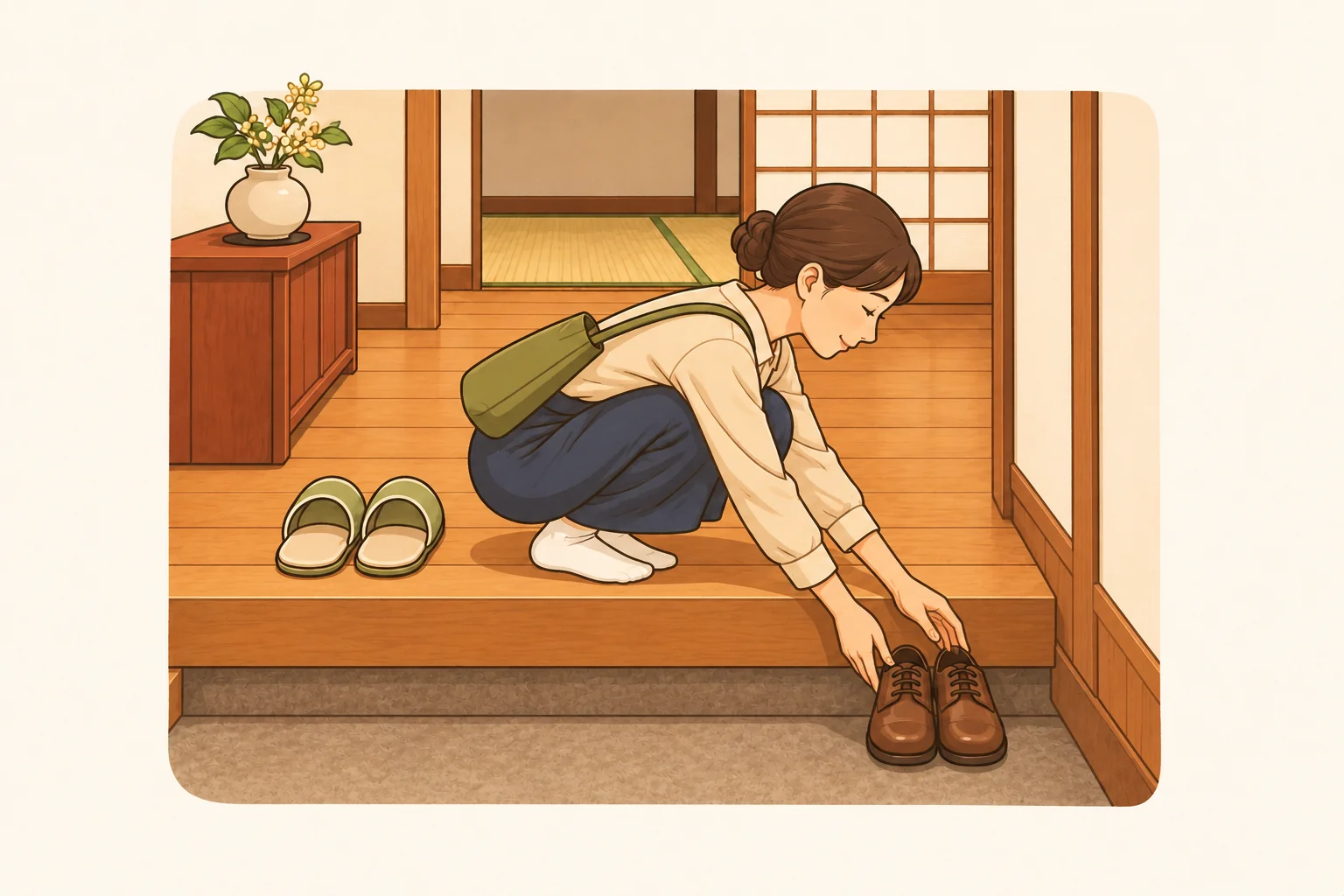
Japanese homes have an entrance area called the genkan, set a step lower than the rest of the house. You take off your shoes there and step up into the house proper. That single step is the boundary between outside and inside: street dirt stays in the genkan, and beyond it are wooden floors or tatami mats walked on in socks or bare feet. Traditionally Japanese people sat on the floor and slept on futons laid on the tatami, so the floor served as chair and bed, and nobody wanted it dirty.
There is a correct way to do it. Step out of your shoes facing into the house, step up, then turn, crouch and set your shoes neatly to one side with the toes pointing toward the door, ready to slip on when you leave. Your host will usually offer slippers. Slippers come off, though, before you step onto tatami; you enter a tatami room in socks. The toilet often has its own pair of plastic toilet slippers waiting at the door, which you change into and out of. The classic foreigner’s mistake is to walk back into the living room still wearing them.
The same line appears outside private homes. At a traditional inn, or ryokan, you remove your shoes at the entrance and staff may store them for you. Many traditional restaurants with tatami rooms, temple halls, some schools and clinics also require it. Japanese schoolchildren change into indoor shoes called uwabaki at a bank of lockers by the school entrance every morning from first grade to graduation. For a traveler, the most useful preparation is a pair of shoes that come off and on easily, and socks without holes.
04At the Table
When you sit down at a Japanese restaurant you will usually be handed an oshibori, a moist towel, hot in winter and cold in summer. It is for your hands. Wiping your face and neck with it is common enough among older men in casual places but looks crude in a refined one.
Most chopstick taboos are tied to funerals. After a cremation, relatives use chopsticks, two people at a time, to lift the bones into the urn, so passing food from one pair of chopsticks to another, hashi-watashi, is strongly avoided at the table. Sticking chopsticks upright in a bowl of rice, tate-bashi, recalls the bowl of rice placed before the dead and is also taboo. Other bad habits include hovering indecisively over dishes (mayoi-bashi), spearing food, dragging dishes toward you with chopsticks and licking them. When you are not using them, lay them across a chopstick rest or on the paper sleeve.
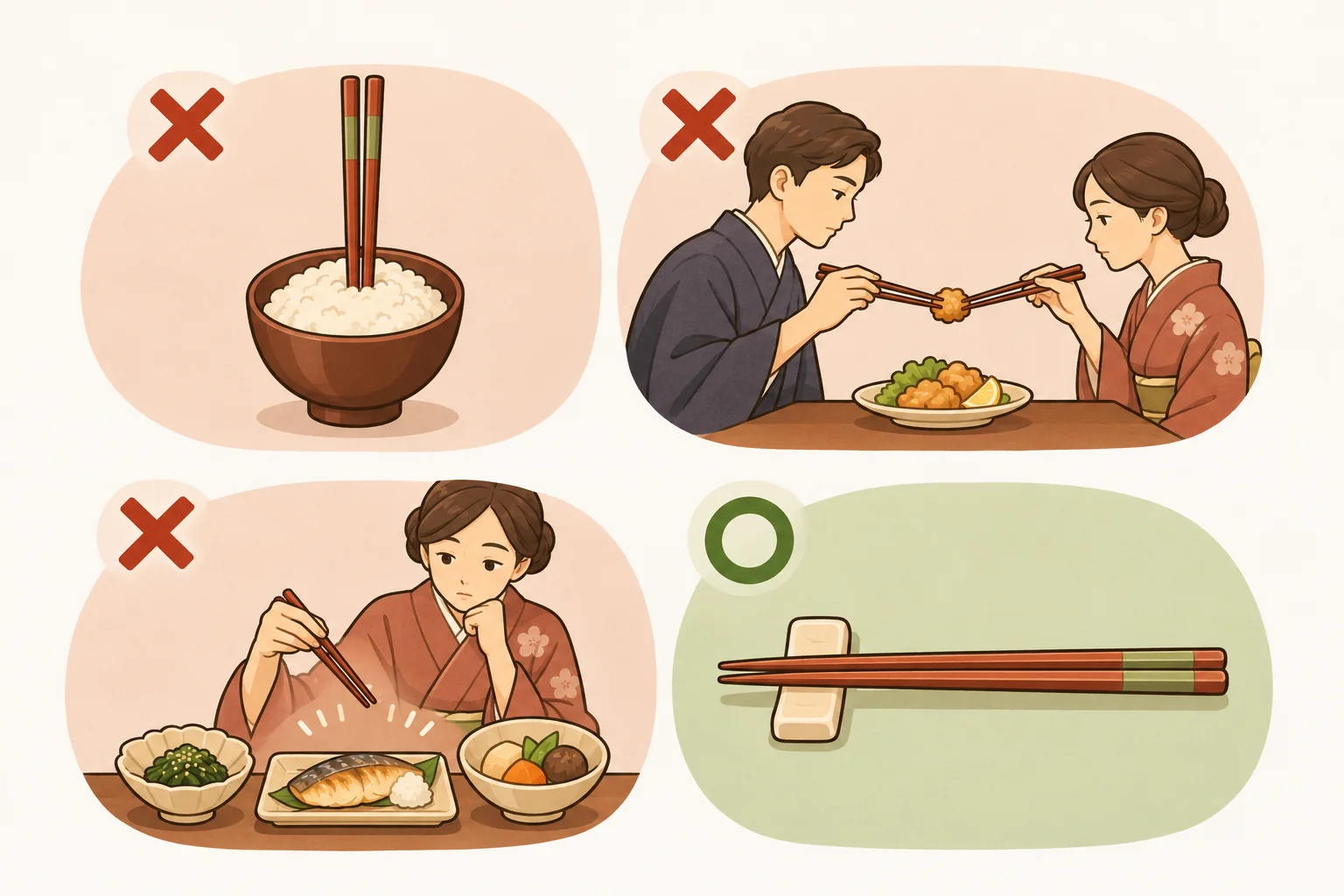
Chopstick taboos tate-bashi, hashi-watashi and mayoi-bashi, and the right way: laid across a chopstick rest.
Unlike in many countries, you are expected to lift your bowl. Rice bowls and soup bowls are held in the hand and brought toward the mouth; leaning down over a bowl left on the table looks sloppy. Miso soup is drunk straight from the bowl. Slurping noodles is fine and even shows appreciation: drawing in air cools hot noodles and, with soba, carries the aroma of the buckwheat. That license applies to noodles, not to everything.
Sushi can be eaten with fingers or chopsticks. Dip it fish side down, so the rice does not soak up too much soy sauce and fall apart, and eat each piece in one bite rather than biting it in half and putting the remainder back. When drinking with others, you do not pour your own drink. Watch your companions’ glasses and top them up; when someone pours for you, lift your glass with both hands. Nobody drinks until everyone has raised a glass for the first kanpai.
There is no tipping. Service is included in the price, and pressing money on a waiter will embarrass them; there are stories of staff chasing customers down the street to return change they thought had been forgotten. Some high-end ryokan preserve an old custom of giving the room attendant a kokorozuke, a small gift of money in an envelope, but it is increasingly rare. A sincere gochisōsama deshita on your way out is the thanks that matters.
05Trains, Streets and Shared Spaces
Japanese public space is famously quiet, and the train carriage is the clearest example. Announcements ask passengers to switch their phones to "manner mode", the Japanese term for silent mode, and not to make calls; near the priority seats, passengers are asked to switch phones off when the car is crowded, a rule that applied at all times until the Kansai railways relaxed it in 2014 and the Tokyo-area operators followed in 2015. People sleep, read and look at their phones; few talk loudly. Large backpacks are worn on the front or put on the luggage rack.
Queuing is a quiet agreement. Platform floors are marked where the train doors will stop, and passengers line up in two columns on either side, waiting for everyone to get off before boarding. Escalator etiquette varies by region: in Tokyo people stand on the left and leave the right for walkers, while in Ōsaka it is the other way round. In recent years railway companies have campaigned for people to stand on both sides and not walk at all, and Saitama Prefecture and the city of Nagoya have passed ordinances to that effect, though habit has been slow to change.
Visitors are often surprised by how few public trash bins there are. Many bins were removed from stations after the 1995 sarin gas attack on the Tokyo subway. Some came back in reduced numbers, only to be removed again after the train bombings in Madrid in 2004 and London in 2005, and the pandemic thinned them further. The expectation is that you carry trash home and sort it there, according to municipal rules that can divide waste into a dozen categories. Recycling bins for bottles and cans stand beside vending machines and at convenience stores. Eating while walking is frowned on in many places; the polite thing is to finish your snack beside the shop where you bought it.
On long-distance trains such as the Shinkansen, a few further courtesies apply: glance back or say a word to the person behind before reclining your seat, avoid strong-smelling food (though eating a boxed lunch, an ekiben, is perfectly normal), and take phone calls in the vestibule between cars. Hot springs and public baths have their own detailed etiquette, above all washing thoroughly before entering the water and keeping your towel out of it.
06Keigo: Politeness Built into Grammar
Much of Japanese politeness is written into the grammar itself. Keigo, honorific language, means that the same idea is expressed with different verbs and endings depending on whom you are talking to and about. Native speakers find it hard, too: bookstores carry shelves of guides to correct keigo, and companies drill it into new employees.
Traditionally keigo is divided into three kinds. Sonkeigo, respectful language, elevates the actions of the person you are talking to or about. The plain verb "to say", iu, becomes ossharu when your boss is the one speaking; "to go", "to come" and "to be", iku, kuru and iru, all become irassharu; "to eat", taberu, becomes meshiagaru. There is also a regular pattern, o- plus the verb stem plus ni naru, as in o-yomi ni naru, "you read". Kenjōgo, humble language, lowers your own actions and so raises the other person by contrast: "to say" becomes mōsu or mōshiageru, "to go" becomes mairu or ukagau, "to eat" becomes itadaku, "to see" becomes haiken suru. Teineigo, polite language, is the desu and masu endings that make any sentence courteous regardless of who is involved. It is the first layer foreign learners meet.
In 2007 the Council for Cultural Affairs, an advisory body to the government, issued guidelines that refined these three categories into five: respectful language; humble language of the first type, such as ukagau and mōshiageru, which lowers you in relation to the person your action is directed at; humble language of the second type, also called teichōgo, courteous language, such as mairu and mōsu, which lowers you before your listener in general; polite language; and bikago, "beautifying" language, the honorific prefixes o- and go- in words such as o-cha (tea), o-sake and go-han (rice, or a meal), which make speech more refined without honoring anyone in particular.
What makes keigo difficult is that you have to judge two things at once: the other person’s status, and whether they are inside or outside your group. Status decides whether to use honorifics; the inside-outside line decides which way they point. The classic example is a telephone call. A client rings and asks for Section Chief Tanaka. The junior employee who answers may be deferential to Tanaka all day long, but to the client she must say Tanaka wa ima seki o hazushite orimasu, "Tanaka is away from his desk", dropping the honorific -san and using the humble orimasu. To the client, Tanaka and the junior employee are both "our company", and both must be lowered together. Saying Tanaka-san wa irasshaimasen, with respectful forms, would elevate one’s own side in front of an outsider, an obvious lapse.
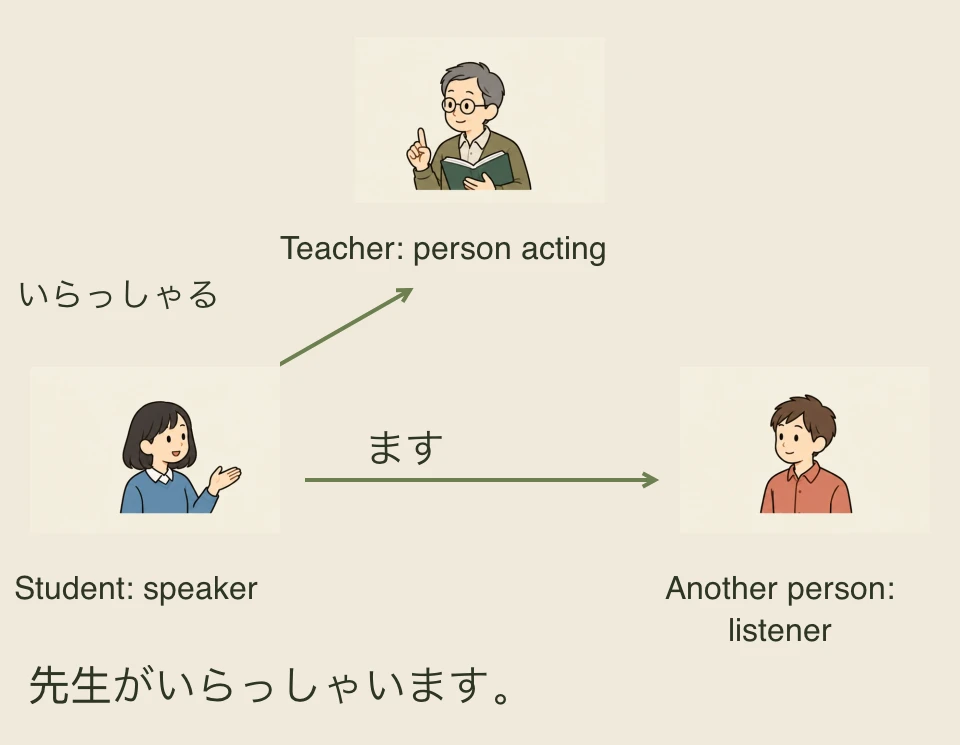
The respectful irassharu raises the teacher who is acting; masu is politeness toward the listener.
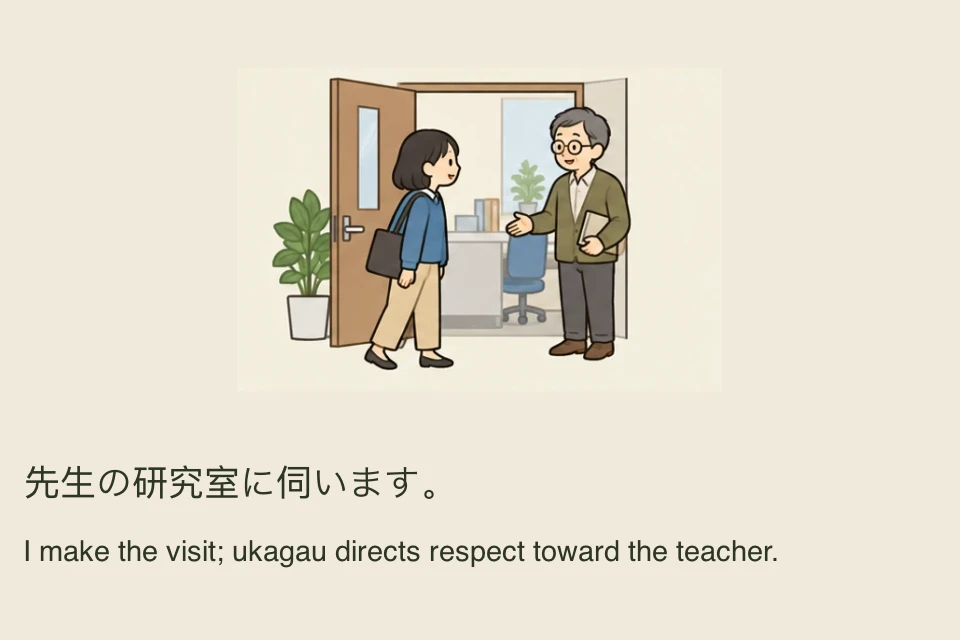
Visiting a teacher’s office, one says ukagaimasu: humble language lowers one’s own visit and so raises the teacher.
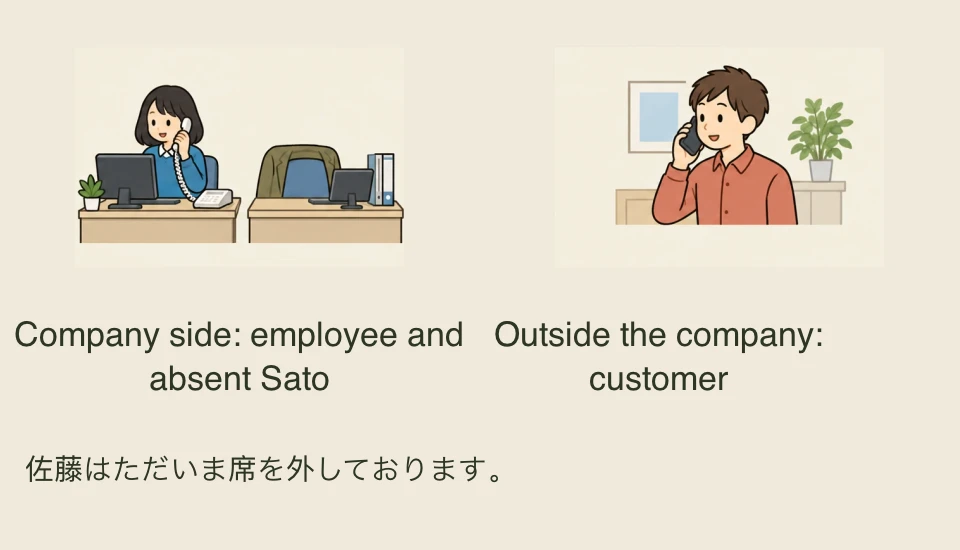
Speaking to an outside customer, staff refer to a colleague by bare surname with the humble orimasu.
Keigo can also be overdone. O-meshiagari ni naru piles two respectful forms on top of one another, a "double honorific". Double honorifics are generally considered improper, but the 2007 government guidelines list o-meshiagari ni naru as one that custom has made acceptable, and it is heard in restaurants every day. Convenience stores and fast-food chains have produced a style sometimes mocked as baito keigo, "part-timer keigo", with phrases like kochira kōhī ni narimasu, literally "this becomes coffee", or yoroshikatta deshō ka, "was that all right?", oddly in the past tense. These phrases are grammatically strange but sound soft and indirect, which is why they spread, and why language columnists love to complain about them. The episode shows that, for many speakers, sounding suitably polite matters more than being grammatically correct.
A visitor needs very little of this. Plain desu/masu Japanese is already polite, and sumimasen ("excuse me", "sorry" and even "thank you") plus arigatō gozaimasu will carry you through almost any encounter. Japanese people rarely expect foreigners to use keigo. You will hear a great deal of it addressed to you, though. Irasshaimase, the cry that greets you in every shop, is the imperative of the respectful verb irassharu: "please come in." A nod in return is all that is expected.
07Hanko: The Seal That Signs Your Name
In much of the world a signature stands for the person. In Japan, for most of the modern era, a seal did. Most adults own several. The most important is the jitsuin, the registered seal. You register its impression at your local municipal office, and can then obtain a certificate of seal registration, inkan tōroku shōmeisho, which is required to buy or sell property or a car, sign major contracts or settle an inheritance. The second is the ginkō-in, the bank seal, whose impression is kept on file when you open an account and must match when you make certain transactions. For everyday purposes, such as signing for a parcel or marking an internal document as read, people use a mitome-in, an unregistered seal. Cheap wooden or plastic ones, arranged by surname on a rack in any stationery shop and costing a few hundred yen or less (as of 2026 they are also sold in 100-yen shops), are nicknamed sanmon-ban, "three-penny seals".
There is also a self-inking rubber stamp widely known by the maker’s name, Shachihata. It is convenient, but because the rubber face can deform, it is usually not accepted for formal documents. "Shachihata fuka", "Shachihata not accepted", on a form means you must use a real seal with red ink paste.
- 1
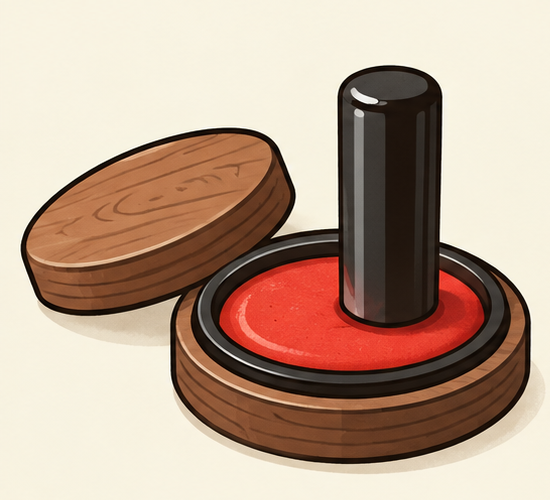 Touch the seal face to a separate ink pad.
- 2
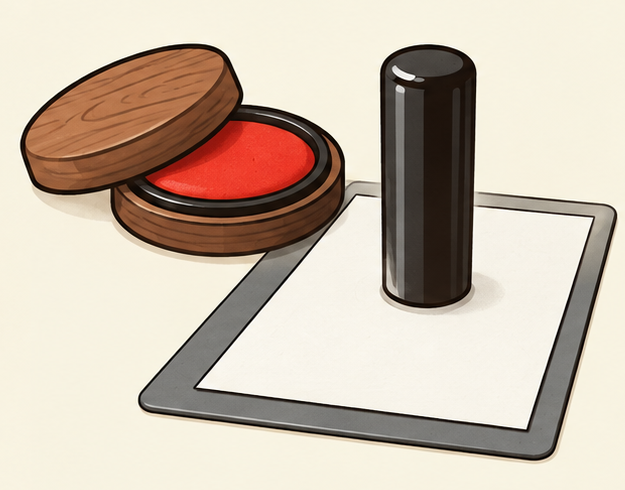 Press the seal straight down onto the paper.
- 3
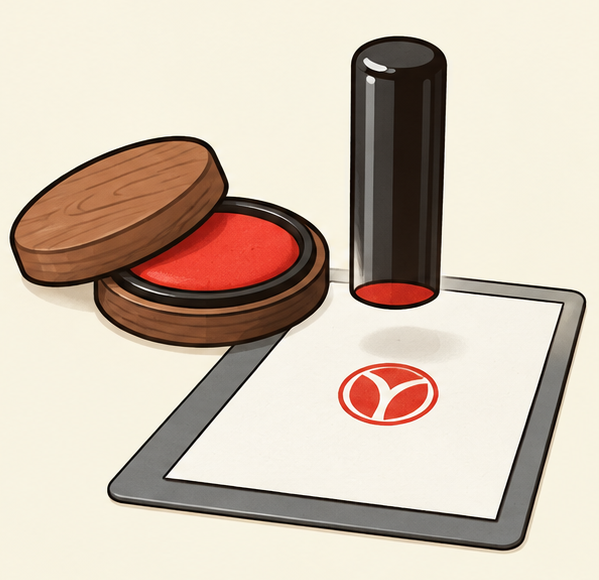 Lift it away, leaving a red impression.
Seals in Japan go back a long way. The gold seal inscribed "King of Na of Wa, vassal of Han", found on Shikanoshima island near Fukuoka in the Edo period, is generally identified with the seal that the Book of the Later Han says Emperor Guangwu granted to an envoy from Wa in AD 57. It is now a National Treasure held by Fukuoka City Museum. The ancient Japanese state adopted Chinese-style official seals to authenticate documents. From the mid-Heian period a stylized handwritten monogram called a kaō increasingly took the place of seals, but in the Sengoku era warlords influenced by Zen practice turned back to stamping their documents; Oda Nobunaga’s seal reading tenka fubu, often glossed as "the realm under military rule", which he began using after taking Mino province in 1567, is a well-known example. By the Edo period ordinary villagers were routinely pressing seals onto village documents, though only in black ink: red seals were not permitted to commoners until 1868.
The modern system took shape in the early Meiji period. The new government required registered seals, rather than the kaō, on formal certificates. The seal industry dates the relevant decree of the Council of State to October 1, 1873, and has made that date Hanko Day. For more than a century afterwards, birth, school, employment, marriage and home ownership all came with stamping. Companies developed the ringi system, in which a proposal circulates upward and each manager stamps a box to signal approval. Some offices, especially in finance and government, practice the "bowing seal", ojigi hanko, in which junior staff tilt their seals slightly to the left, as if bowing toward their superior’s. It is an unwritten custom of unknown origin, and it is now more often mocked online as a symbol of pointless office deference.
The pressure to change came in 2020. During the COVID-19 pandemic, people forced to go into the office just to stamp documents became a symbol of everything wrong with Japanese bureaucracy. That autumn Kōno Tarō, then minister for administrative reform, launched a campaign to abolish seals in government procedures, announcing that more than 99 percent of the roughly 15,000 procedures in which citizens had to stamp documents submitted to the government would no longer need a seal. Electronic contracts spread, internal approvals moved online, and the seal box quietly disappeared from many official forms.
Registered seals and seal certificates have not gone away, however. Property registration, car registration and inheritance still rely on them. Many people still have a good seal carved when they come of age or start their first job, in boxwood, buffalo horn, ivory or titanium, with their surname in seal script, kept in a little case. For a visitor, the most enjoyable contact with this culture of marks comes elsewhere: the calligraphed red temple and shrine seals called goshuin, collected in a special book, or the free commemorative rubber stamps at railway stations and tourist sites that Japanese travelers of all ages hunt down.
08Visiting and Giving
If you are invited to a Japanese home, arrive on time rather than early; arriving early can catch your host unprepared. Bring a small gift, typically sweets or fruit, and hand it over with a modest phrase. The traditional one, tsumaranai mono desu ga, "it’s nothing much, but…", is now considered by some to be excessively self-deprecating, and hon no kimochi desu, "just a small token", is increasingly common. Gifts are usually not opened in front of the giver.
Japan has an elaborate gift economy: ochūgen in summer and oseibo at year’s end for people who have helped you, omiyage souvenirs brought back from a trip for coworkers, and hangaeshi, the custom of returning a gift worth about half of one received. Money gifts go in special envelopes, crisp new notes for weddings and used notes for funerals, and amounts avoid the numbers four and nine, which can be read as shi (death) and ku (suffering). The principle behind all of it is balance: gifts and return gifts keep relationships even, so that nobody is left too deeply in anyone’s debt.
09What a Visitor Actually Needs to Do
Japanese people are generally tolerant of foreigners and do not expect them to know every rule. The few that matter most all come back to meiwaku, not causing trouble for others.
On trains, keep quiet and do not make calls. Queue on the platform and let passengers off first. On escalators, watch which side the locals stand on. Take off your shoes when entering homes, ryokan, tatami rooms and some restaurants, line them up with the toes facing out, and do not wander out of the toilet in the toilet slippers. At the table, never stand your chopsticks in rice or pass food chopstick to chopstick, and do not tip. In a hot spring, wash before you get in. Carry your trash with you. Look out for no-photography signs in temples and restaurants, and in districts like Gion in Kyoto, do not block the path of geiko and maiko to take their picture.
At a Shinto shrine, bow lightly before passing under the torii gate and walk to the side of the approach, since the center is said to be the path of the gods. At the purification basin, the temizuya, take the ladle in your right hand and rinse your left hand, then switch and rinse your right, pour a little water into your cupped left hand to rinse your mouth, and finally tip the ladle upright so the remaining water runs down the handle. At the hall, drop a coin in the offering box, then bow twice, clap twice and bow once more. At Buddhist temples, put your palms together quietly; there is no clapping.
Learn a handful of words: sumimasen for getting attention, apologizing and thanking; arigatō gozaimasu for every kind of thanks; itadakimasu and gochisōsama deshita at meals. Say them with a small nod and a slight bow, and people will notice.