
At a glance
Why the capsule hotel, born in Ōsaka in 1979 for salarymen who missed the last train, took root in Japan and how to spend your first night.
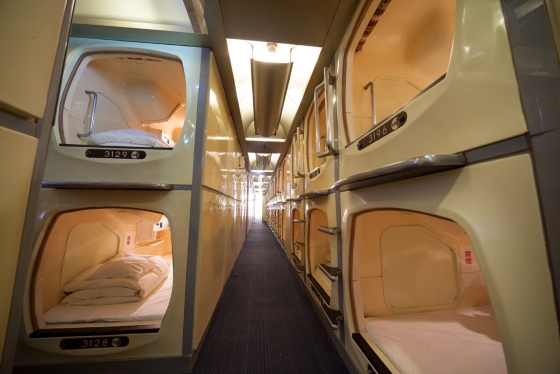
- A capsule is about a meter wide, a meter high and two meters long, usually stacked two high.
- The first capsule hotel is generally credited to Capsule Inn Ōsaka, opened in Umeda in 1979.
- Its pods were designed by Kurokawa Kishō’s office, growing out of his 1972 Nakagin Capsule Tower.
- As of 2025, a night costs about 2,000 to 5,000 yen, roughly half the price of a business hotel.
- In 2009, 9h in Kyoto changed the image of capsule hotels with minimalist design.
A capsule hotel rents you a bed and very little else. Your room is a fiberglass or plastic pod about a meter wide, a meter high and two meters long, stacked two high along a corridor with dozens of others, closed off by a roll-down blind instead of a door. The idea began in Ōsaka in 1979 as a cheap place for office workers who had missed the last train home, and it has since become one of the things visitors to Japan want to try at least once. This piece explains why the capsule hotel appeared in Japan rather than anywhere else, what a night in one is actually like, how the format reinvented itself for travelers, and how to get through your first stay without embarrassment.
01A Bed Instead of a Room
Walk down a corridor in a capsule hotel and it looks a bit like a morgue drawer cabinet crossed with a sleeper train. Two rows of rounded openings, one above the other, run along each wall. The upper bunks are reached by a small step or ladder. Each opening leads into a pod you crawl into rather than walk into. Inside you can sit up, just, and lie down comfortably. There is a mattress, a pillow, a light blanket or duvet, and a small control panel set into the wall.
That panel is where the capsule hotel shows its age. Older pods had a built-in radio, an alarm clock, a reading light with a dimmer, and a tiny television you watched through headphones. Newer ones have swapped the television for power outlets and USB ports, a shelf for your phone and glasses, and sometimes a small mirror. Air is fed in through vents from the floor’s central system. The entrance is a blind or curtain, not a lockable door, which shapes almost every rule of the place.
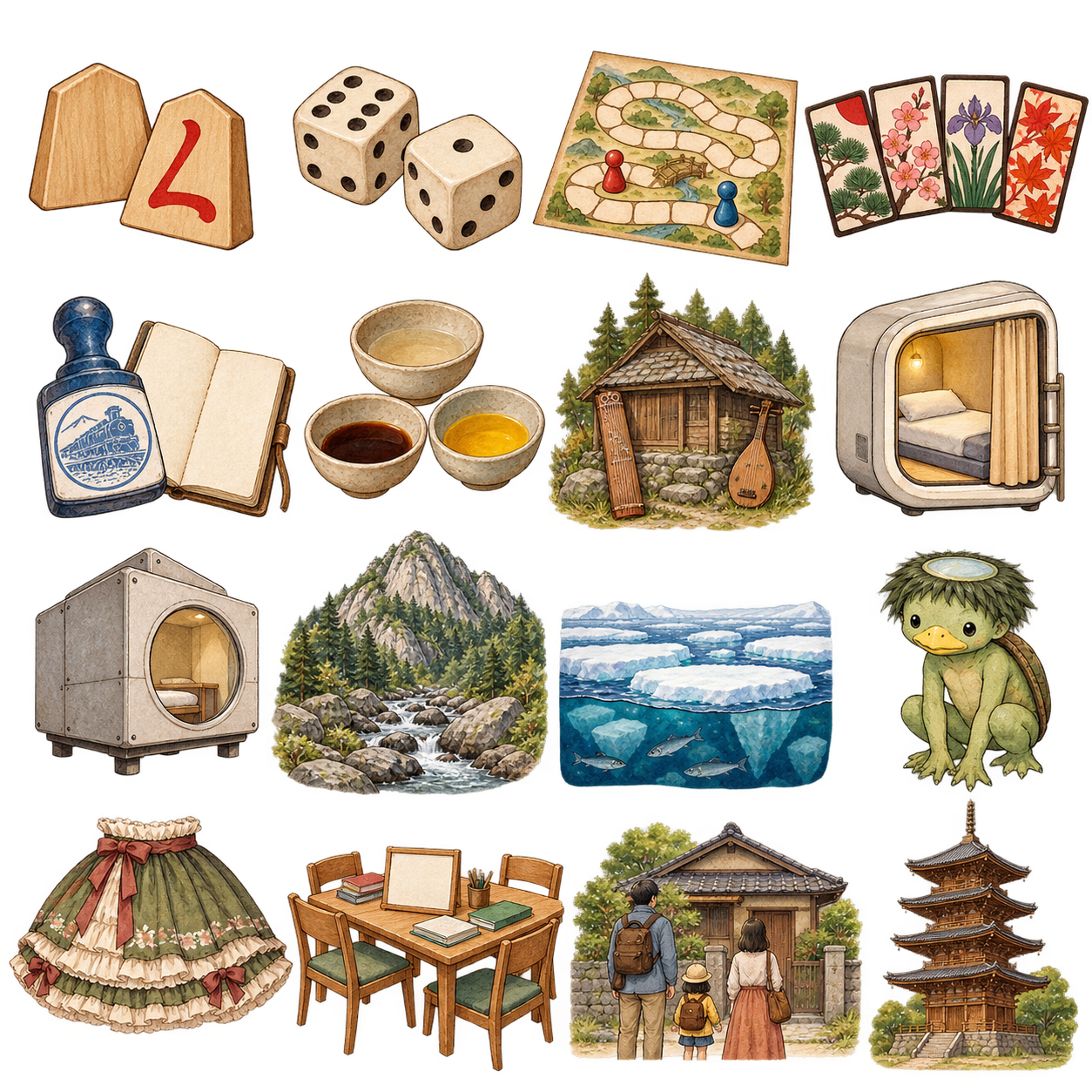
There is no door, only a curtain; inside are a mattress, a pillow and a light.
Because the pod is only for sleeping, everything else happens elsewhere in the building. Luggage and valuables go into a locker. You wash in a shared bathroom, often a large communal bath or sauna. You eat, read and watch television in a lounge. A capsule hotel is really a small public bathhouse and common room with a dormitory of private beds attached.
Legally, Japan’s Hotel Business Act classes capsule hotels as kan’i shukusho, "simple lodging," the same category as hostels and mountain huts, where guests share sleeping space rather than renting individual rooms. Prices reflect that. Near the big stations there are also hourly plans that let you use the bath and lounge without a pod, for people who only want to wash and doze until the first train. As of 2025, a night usually costs somewhere between 2,000 and 5,000 yen, most often around 4,000 to 5,000, roughly half the price of a basic business hotel.
02Ōsaka, 1979
The first capsule hotel is generally credited to Capsule Inn Ōsaka, which opened in 1979 in Umeda, the station district at the heart of the city’s nightlife and office life.
The customer it had in mind was the sarariman, the salaried company employee. In the 1970s, drinking after work with colleagues and clients was an expected part of the job. Many of these men lived in suburbs an hour or more away by train, and Japanese commuter railways stop running around midnight. Once the last train had gone, the choices were a long and expensive taxi ride, a business hotel room that cost more than it was worth for a few hours of sleep, or a night dozing in a sauna’s rest room. The capsule hotel offered a fourth option: a bath, a private place to lie flat, and a first train home or to the office in the morning.
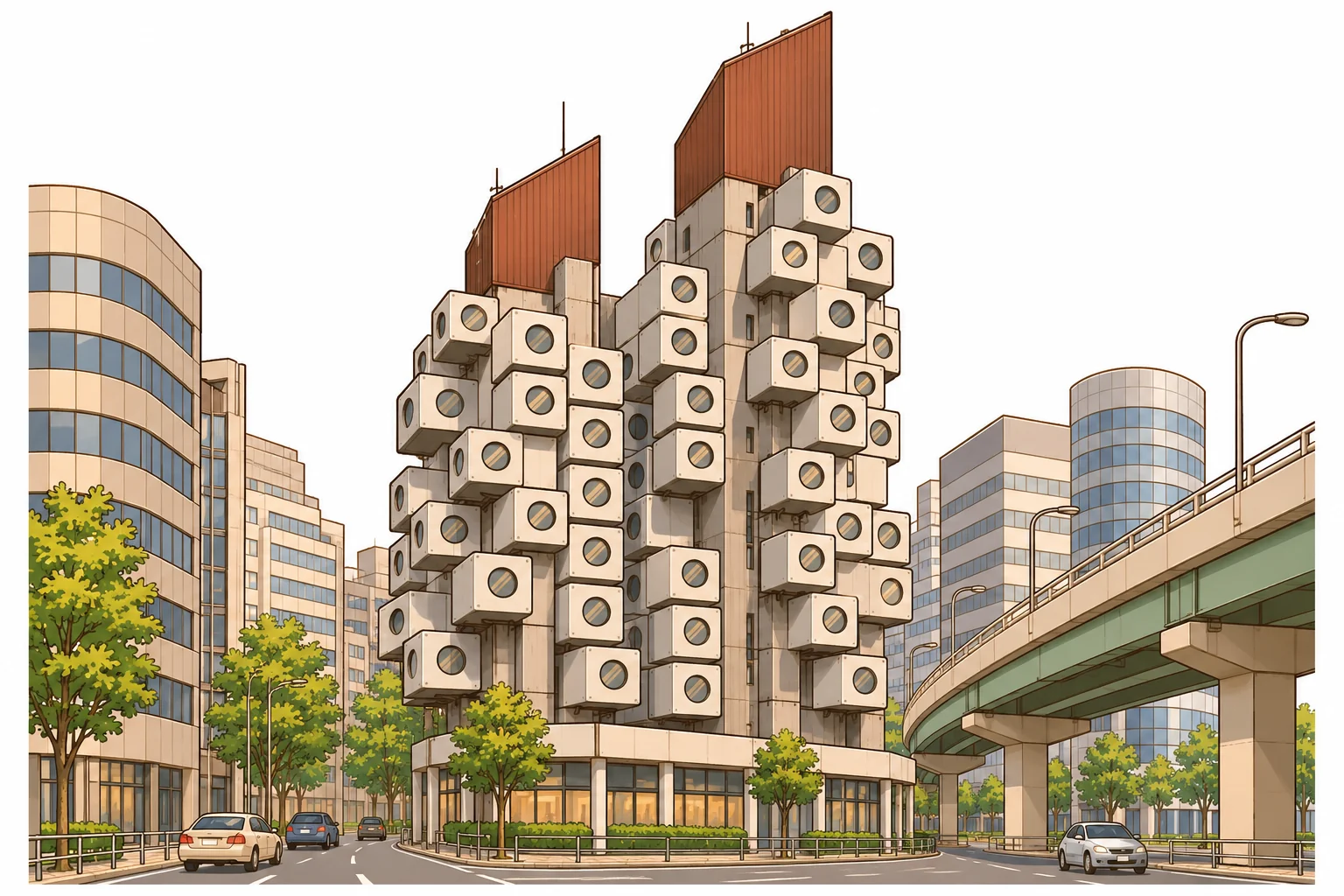
Ginza's Nakagin Capsule Tower: boxy capsules with round windows clustered on concrete cores (illustration).
The pods themselves came out of architecture. The architect Kurokawa Kishō, a leading figure in the Metabolist movement, had completed the Nakagin Capsule Tower in Tokyo’s Ginza district in 1972. It was a pair of concrete cores with prefabricated capsule apartments bolted onto them, each meant to be detachable and replaceable like a part in a machine. The Metabolists imagined cities that grew and renewed themselves in modular units. Kurokawa’s office designed the capsule units for the Ōsaka hotel, which were molded in fiberglass-reinforced plastic by a manufacturer of seating and public furnishings, and their molded, rounded shape owes a lot to the space-age look of his earlier work. The Nakagin tower itself was dismantled in 2022 after decades of decay, with some of its capsules removed for preservation. The capsule hotel, its humbler offshoot, has outlived it.
The format spread around the big terminal stations of Ōsaka and Tokyo, quickly by most accounts. The bubble economy of the late 1980s, when nightlife was at its peak, is generally seen as the capsule hotel’s heyday. By then the classic layout was set: a front desk and shoe lockers on the ground floor, a sauna and large bath, a lounge with reclining chairs, manga and a big television, and floors of pods above. The clientele was almost entirely male.
03Why Japan
Several features of Japanese city life lined up to make the capsule hotel work.
The first is the railway. Japan’s large cities depend on commuter trains, and the gap between the last train around midnight and the first train around five in the morning strands a steady population of people in the center. Capsule hotels cluster around the big stations where those people find themselves.
The second is the bath. Japanese people grow up bathing with strangers, at public bathhouses (sentō), hot springs (onsen) and saunas. A place with a tiny bed but a generous communal bath does not feel like a hardship; the bath is part of the appeal.
The third is a shared understanding about noise and order. Dozens of people sleeping behind fabric blinds, with no locks and no soundproofing, only works if almost everyone keeps quiet without being told. In Japan that mostly holds.
The fourth is land. Floor space around a major station is very expensive. A single ordinary hotel room can hold several pods, so the capsule hotel lets an operator put the largest number of paying sleepers into the smallest and most expensive footprint.
04Decline and Reinvention
When the bubble burst in the early 1990s, the late-night drinking culture that fed capsule hotels thinned out, and company expense accounts shrank. In the 2000s, around-the-clock internet and manga cafés began offering cheap private booths with reclining chairs, taking more of the stranded-commuter market. Japanese media coined the term "net café refugees" for people with no fixed address who lived in such booths, and capsule hotels came to share some of that image of poverty and drift. Older capsule hotels could feel tired: cigarette smoke, worn carpets, a lounge full of middle-aged men.
The revival came from design and from tourism. In 2009 a capsule hotel called 9h (nine hours) opened in Kyoto. The name refers to the ideal stay: one hour to wash, seven to sleep, one to get ready. Everything was white, gray and black, with clean minimalist pods and clear signage, and separate areas for men and women. It looked less like a flophouse than a piece of product design, and it made capsules appealing to people who would never have walked into an old sauna capsule. Around the same time, First Cabin opened with an airline theme, offering "cabins" large enough to stand up in, somewhere between a capsule and a small room. In 2015 Book and Bed Tokyo opened in Ikebukuro with bunks set into the back of floor-to-ceiling bookshelves, so guests fall asleep inside a library; it became a tourist attraction in its own right.
The tourism boom of the 2010s did the rest. As foreign arrivals surged and hotel rooms in Tokyo, Ōsaka and Kyoto became scarce and expensive, capsule hotels offered a cheap bed with a story attached. Many began accepting women, adding women-only floors or opening women-only buildings. Signage went multilingual, front desks switched to English, lounges were refitted to look like cafés, and some added coworking spaces. Today the two kinds coexist. Near any big station you can still find an old-school sauna capsule full of late-night salarymen, a few doors from a stylish new place that feels like a boutique hostel.
The format has spread abroad too, to China, South Korea, Singapore, Europe and North America, as well as to airports, where sleeping pods serve travelers between flights. Outside Japan, though, without the last-train timetable, the bath culture and the habit of collective quiet, it tends to be a novelty budget option rather than a working part of city life.
05Your First Night
Your stay begins at the door, where you take off your shoes. There will be a wall of small shoe lockers; put your shoes in one, take the wooden or plastic key, and bring it to the front desk. After you pay, staff will usually exchange the shoe key for a locker key, often on an elastic wristband, and hand you a towel set, a toothbrush and the in-house clothing. At an old-style place that may be a yukata, a light cotton robe; at newer ones it is more often a T-shirt and shorts or loose pajamas.
- 1
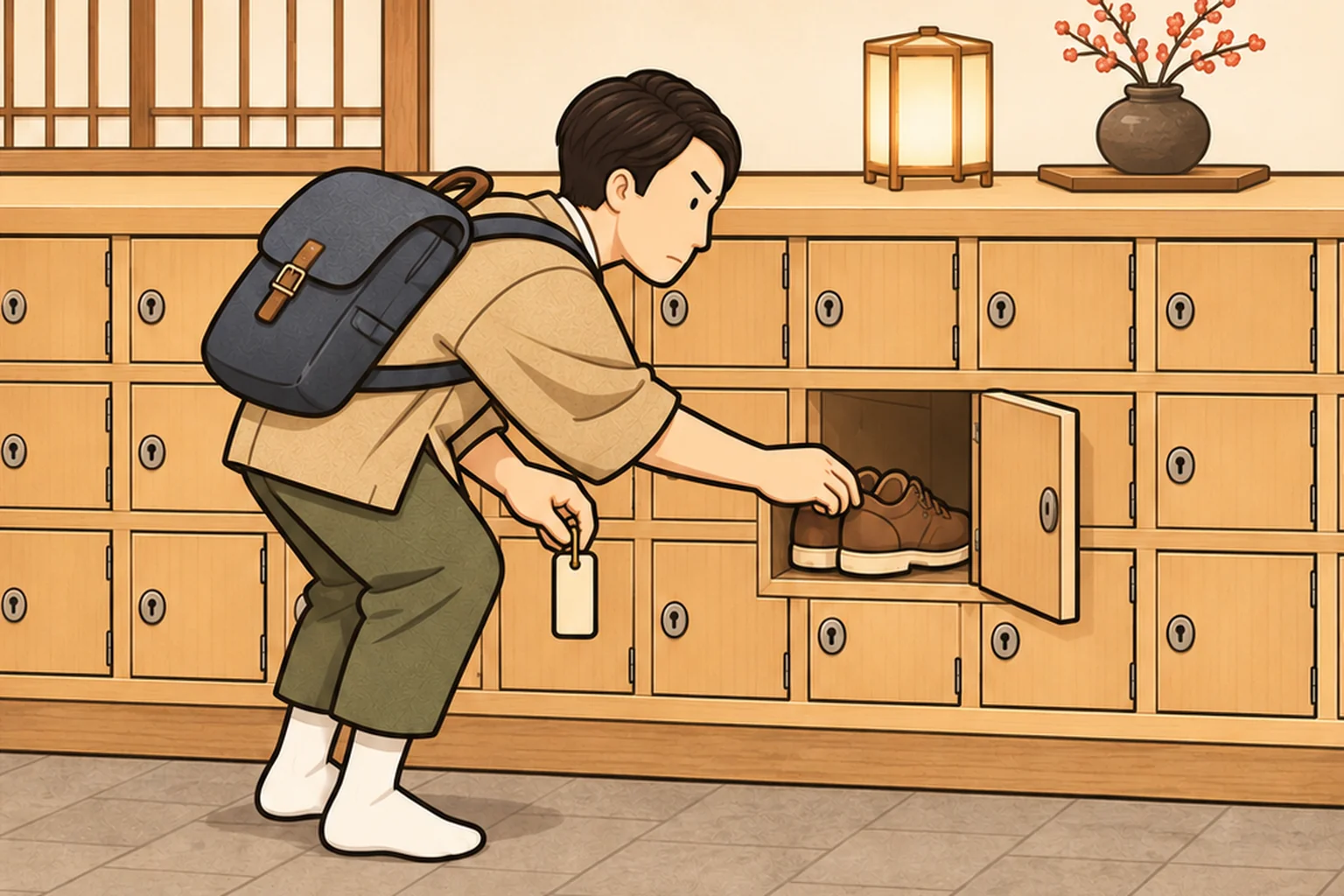 Shoes come off at the door and go into a shoe locker; the key goes with you to the front desk.
- 2
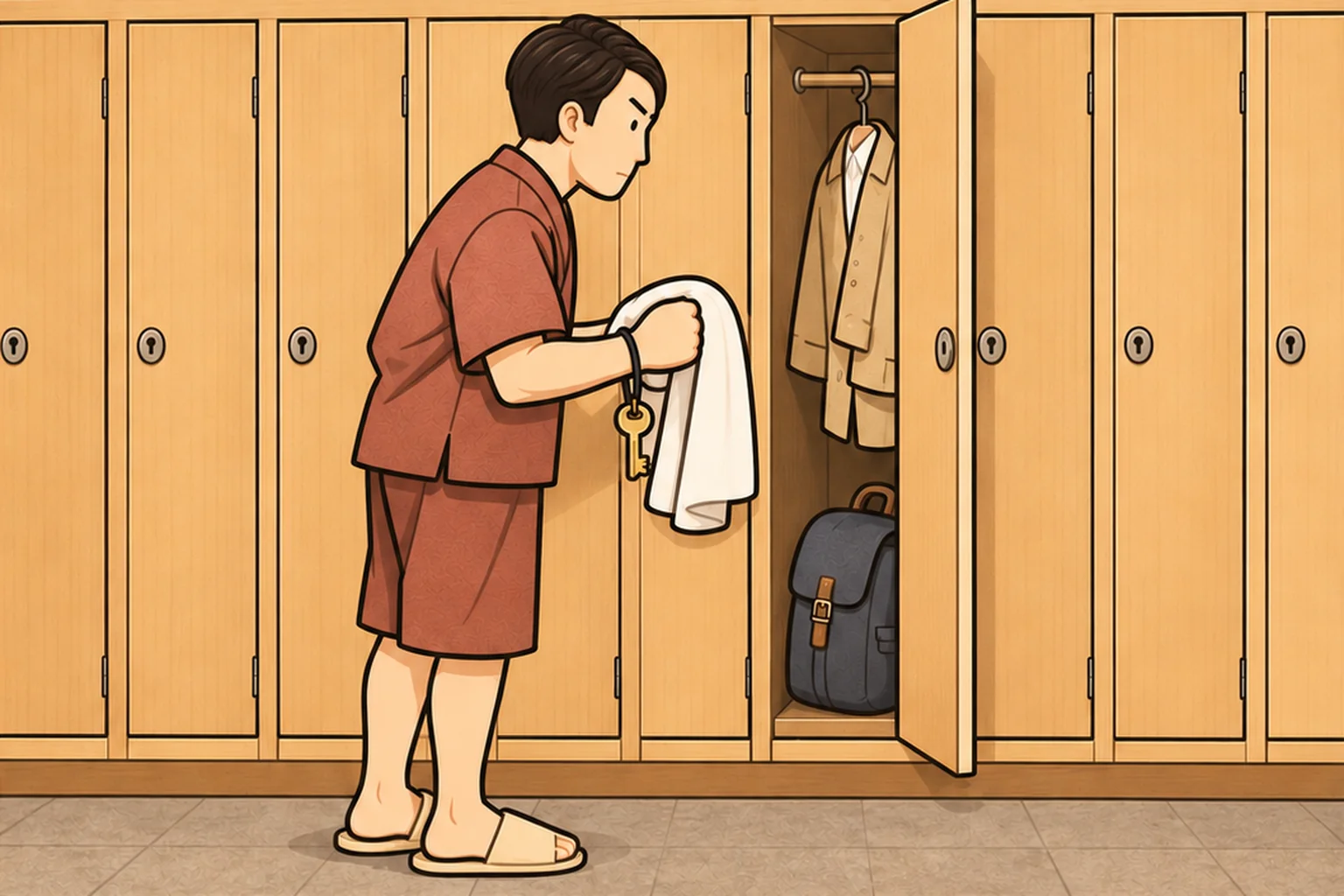 After check-in, the bag goes into a locker and you change into in-house clothing; the key is often on a wristband.
At your locker, stow your bag and change. You will wear those clothes everywhere inside, barefoot or in house slippers. Large suitcases often do not fit in lockers and are left at the front desk. If there is a bath, follow the usual Japanese bathing etiquette: wash thoroughly at the shower stations before getting into the tub, and keep your towel out of the water. Note that, as of 2026, many capsule hotels with large baths do not admit guests with tattoos, while design-led capsules that only have showers tend to be more relaxed, and some are said not to restrict tattoos at all.
The pod is for sleeping, and the blind blocks sight but not sound. Take phone calls and video chats in the lounge or a designated call area, set your phone to silent, and use a vibrating alarm if you can. Eating inside the pod is usually not allowed; snacks and drinks belong in the lounge. Climb in and out of upper bunks quietly at night. Snoring is the one thing nobody can control, which is why many places hand out free earplugs at the front desk. Take a pair.
One surprise for first-timers is that many capsule hotels work on a strictly nightly basis. Even if you book several nights, you may have to check out each morning, clear the pod, and check in again in the afternoon or evening after cleaning, leaving your luggage with the front desk in between. Check-out is usually around ten in the morning. You hand back the locker key, towels and clothes, collect your shoes, and you are done.
If you only stay once, it does not have to be at the trendiest place. A slightly worn sauna capsule near a big station, late on a weeknight, with men in matching robes drinking beer in the lounge and watching a baseball game, may tell you more about why these hotels exist than any design pod.