
At a glance
Forty-eight cards for twelve months of flowers: reading the pictures, surviving shogunate bans, launching Nintendo, and learning to play koi-koi.
- A hanafuda deck has 48 cards in twelve monthly groups of four, identified by the plants they show.
- Cards fall into four ranks, brights, animals, ribbons and plain cards, and there are only five brights.
- The leading theory holds that hanafuda were devised as a substitute after the shogunate banned gambling cards in the late 18th century.
- In 1889 Yamauchi Fusajirō began making hanafuda in Kyoto; his business became Nintendo.
- The most popular game today is two-player koi-koi: once you score a combination, you either stop or press on.
Hanafuda, "flower cards," are a Japanese deck of 48 small, stiff cards with no numbers and no suits. Instead there are twelve months, each represented by a plant: pine for January, plum for February, cherry for March, and so on to paulownia in December. The cards are thick enough to snap down on a table with a satisfying crack, and their imagery draws on centuries of Japanese poetry and painting. They were also, for most of their history, gambling equipment, banned and tolerated by turns. Nintendo began as a hanafuda maker in Kyoto, and the yakuza may owe their name to a hanafuda game. This is a guide to reading the cards, where they came from, how the two classic games work, and how to pick up a deck and play.
01Twelve Months, Four Cards Each
A hanafuda deck is easiest to understand as a calendar. Each month has four cards, all showing the same plant, and in most games the basic move is to match a card from your hand with a card of the same month on the table. You do not need to read Japanese to play; you only need to recognize the plants.
The months run like this. January is pine (matsu), the tree Japanese families set beside their gates at New Year. February is plum blossom (ume), the first flower of the lunar spring. March is cherry (sakura). April is wisteria (fuji), May iris (ayame or kakitsubata), June peony (botan), July bush clover (hagi), and August pampas grass (susuki), the tall silver grass that is placed in a vase for the autumn moon-viewing. September is chrysanthemum (kiku), October maple (momiji), November willow (yanagi), and December paulownia (kiri). The sequence follows the old lunar calendar loosely; willow and paulownia sit awkwardly in their months and seem to have been placed there to round out the set.
- 5Bright (hikari)
- 9Animal (tane)
- 10Ribbon (tanzaku)
- 24Dregs (kasu)
One square per card: four per month, 48 in all. The precious brights number only five; the plain dregs are the most numerous.
Within each month the four cards are not equal. There are four ranks. The most valuable are the five "bright" cards, or hikari: the crane under the pine, the curtain beneath the cherry blossoms, the full moon over the pampas grass, the man with an umbrella beneath the willow, and the phoenix in the paulownia. Next come nine "animal" cards, or tane, which show a creature or object: the bush warbler in the plum, the cuckoo by the wisteria, the plank bridge among the irises, the butterflies with the peony, the boar in the bush clover, the geese crossing the August sky (on some decks, a red one), the sake cup with the chrysanthemum, the deer under the maple, and the swallow in the willow. Then there are ten "ribbon" cards, or tanzaku, each showing a long, narrow strip of paper of the kind poems were written on and hung from branches. The remaining 24 cards are kasu, "dregs," which show only the plant.
The ribbons repay a closer look. The red ribbons of pine and plum carry the inscription akayoroshi, and the red ribbon of cherry says miyoshino, a poetic name for Mount Yoshino, the most celebrated cherry-viewing site in Japan. Together these three are the "poetry ribbons," akatan. The ribbons of peony, chrysanthemum, and maple are blue, and form the aotan. The other four ribbons are plain red. What akayoroshi means is still argued over. One common view is that the middle character is an old cursive form of no, so the phrase is really ano yoroshi, roughly "how splendid"; others read it differently. Players simply call it akayoroshi and move on.
02Poems in Pictures
The pictures look naive at first, flat colors and bold outlines, but nearly every card borrows from classical poetry. Wisteria with the cuckoo is a stock pairing of early summer in waka verse. The May card with its zigzag plank bridge refers to an episode in The Tales of Ise, in which a courtier traveling east stops at a place called Yatsuhashi, "Eight Bridges," sees irises blooming in the marsh, and composes a poem of homesickness. Deer under autumn maples, boars sleeping in bush clover, and geese against the moon were all established subjects in painting long before they appeared on cards.
The August bright card is one of the deck’s great designs: a huge white moon on a red sky above a black hill covered in grass. The September cup, inscribed with the character for "long life," recalls the custom of drinking sake with chrysanthemum petals on the ninth day of the ninth month, a festival imported from China.
November is the oddest month. Its bright card shows a man in court dress holding an umbrella, with a frog leaping at his feet beneath trailing willow branches. He is usually identified as Ono no Michikaze, a tenth-century calligrapher. According to a later legend, Michikaze had grown discouraged with his art when he saw a frog trying again and again to jump onto a willow branch in the rain, until at last it succeeded; he took the lesson and returned to his brush. The story is a later tradition, and the figure on the card is said to have been identified as Michikaze only from the Meiji period onward. The other willow cards show a swallow, a red ribbon, and a strange design of black background, a red shape, and jagged strokes, often called "thunder"; the red shape is read by some as the thunder god’s drum and by others as "the demon’s hand."
December’s phoenix in the paulownia comes from courtly heraldry. In Chinese lore the phoenix perches only in the paulownia, and in Japan the paulownia crest became an emblem of imperial and government authority. Since the Meiji period the 5-7 paulownia has served by custom as the emblem of the cabinet, and it still hangs on the prime minister’s press-conference podium. That such an emblem ended up on a gambling deck says something about how many layers of culture went into these cards.
03From Portuguese Cards to Flower Cards
Playing cards arrived in Japan with Portuguese traders in the second half of the sixteenth century. The Japanese word for cards, karuta, comes from the Portuguese carta. The earliest Japanese-made deck, known as Tenshō karuta from the words "Tenshō" inscribed on one of its cards and popular in the Tenshō era (1573–1592), copied the Portuguese pattern of four suits, swords, cups, batons, and coins, with twelve cards each. A surviving card signed by a maker "Sadatsugu of Miike" suggests it was produced around Miike in Kyūshū.
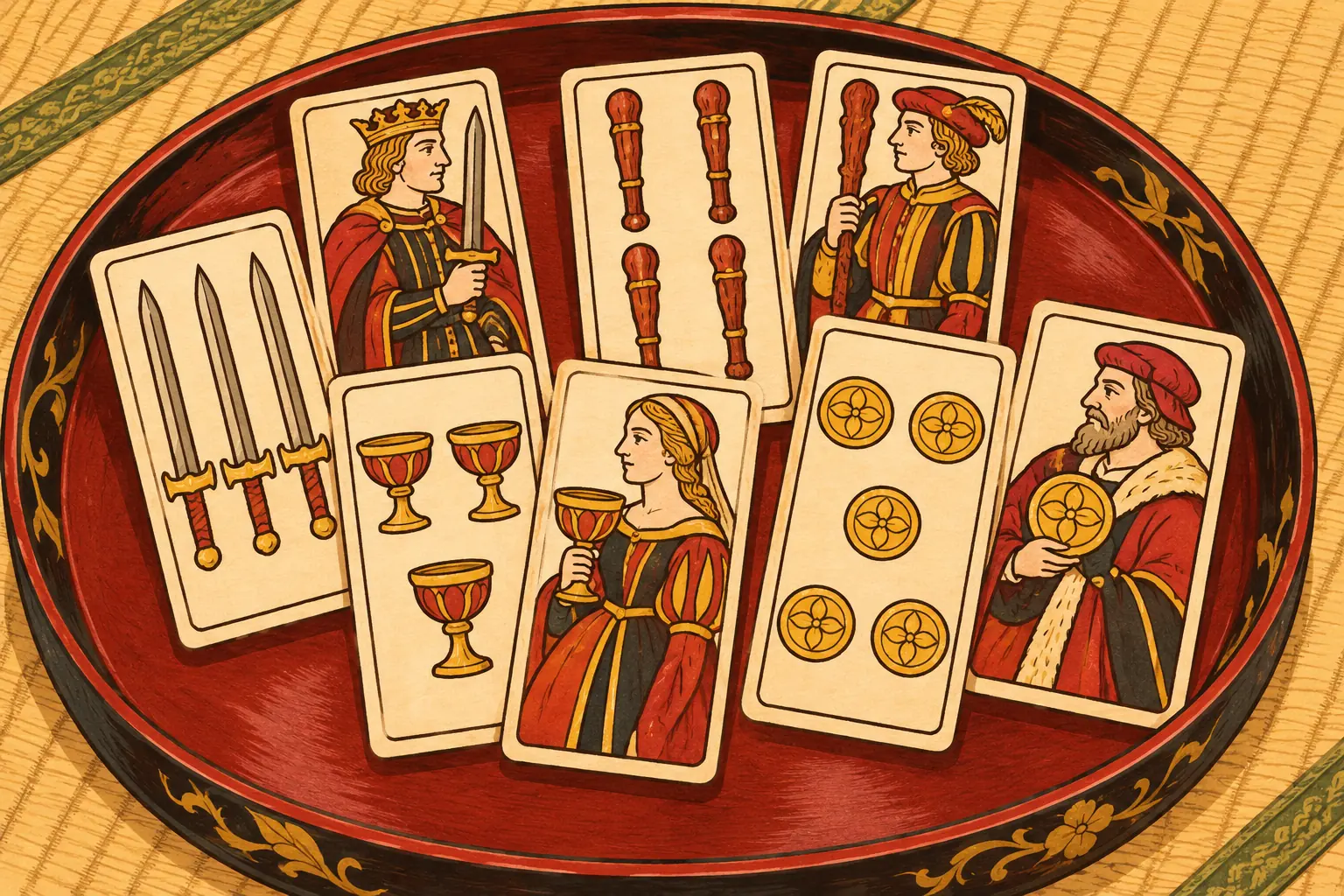
Tenshō karuta cards on a table showing the four suits: swords, cups, batons and coins (illustration).
Under the Tokugawa shogunate, cards became tied to gambling almost at once, and the authorities banned them repeatedly. Each ban was met by card makers changing their designs: replacing Western images with Japanese ones, dropping numbers, inventing new kinds of decks. The Kansei Reforms of the late eighteenth century banned gambling cards outright, and the leading theory is that hanafuda was devised in their wake as a substitute; estimates of its exact date range from the mid-Edo period to the early nineteenth century. It drew on an older courtly pastime called hana-awase, a refined competition in which participants matched flowers or poems about flowers, and on the painting tradition of birds and flowers of the twelve months. A deck without numbers or suits looked like a set of pretty seasonal pictures rather than a gambling tool, which was much of the point. In time hanafuda were banned too, and sold under the counter. Ōishi Tengudō, an old card maker in Kyoto, tells a story that customers asked for cards by rubbing their noses, which is how the long-nosed mountain goblin, the tengu, became the shop’s emblem.
The Meiji government at first kept the ban, but once Western playing cards were allowed on open sale the prohibition lapsed; hanafuda went on public sale in Tokyo in 1886 and spread across the country. A tax on playing cards introduced in 1902 required a stamp on every deck, which is said to have driven many small makers out of business and concentrated the trade in a few larger firms.
04How to Play: Hana-awase and Koi-koi
Nearly every hanafuda game is built on the same move. You play a card from your hand. If a card of the same month is lying face up on the table, you capture both and place them in front of you; if not, your card stays on the table. Then you turn over the top card of the stock pile and do the same with it. The cards you capture count for points and can form scoring combinations called yaku.
Hana-awase, "flower matching," which takes its name from the courtly pastime, is the classic game of the Meiji era and after. It is usually played by three people, and in this form is also called hachi-hachi, "eighty-eight." Each receives seven cards, six go face up on the table, and the remaining twenty-one form the stock. Players take turns matching until their hands are empty. The cards have fixed values: brights 20 points, animals 10, ribbons 5, and dregs 1. The whole deck totals exactly 264, which divided by three is 88, the source of the name hachi-hachi. At the end of a hand, each player adds up their captured cards and subtracts 88; the difference is what they win or lose. On top of that are the yaku. Capturing all three poetry ribbons, all three blue ribbons, or the boar, deer, and butterflies (inoshikachō) earns a payment from each of the other players. Some yaku are based on the hand you are dealt rather than the cards you capture: holding all four cards of one month at the start, for instance, lets you show your hand and collect at once. If four or more people are present, the extra players drop out voluntarily after the deal, or the group decides who plays by rock-paper-scissors or a similar method. Scoring details vary widely from region to region and household to household, so it is worth agreeing on the rules before the first card is played.
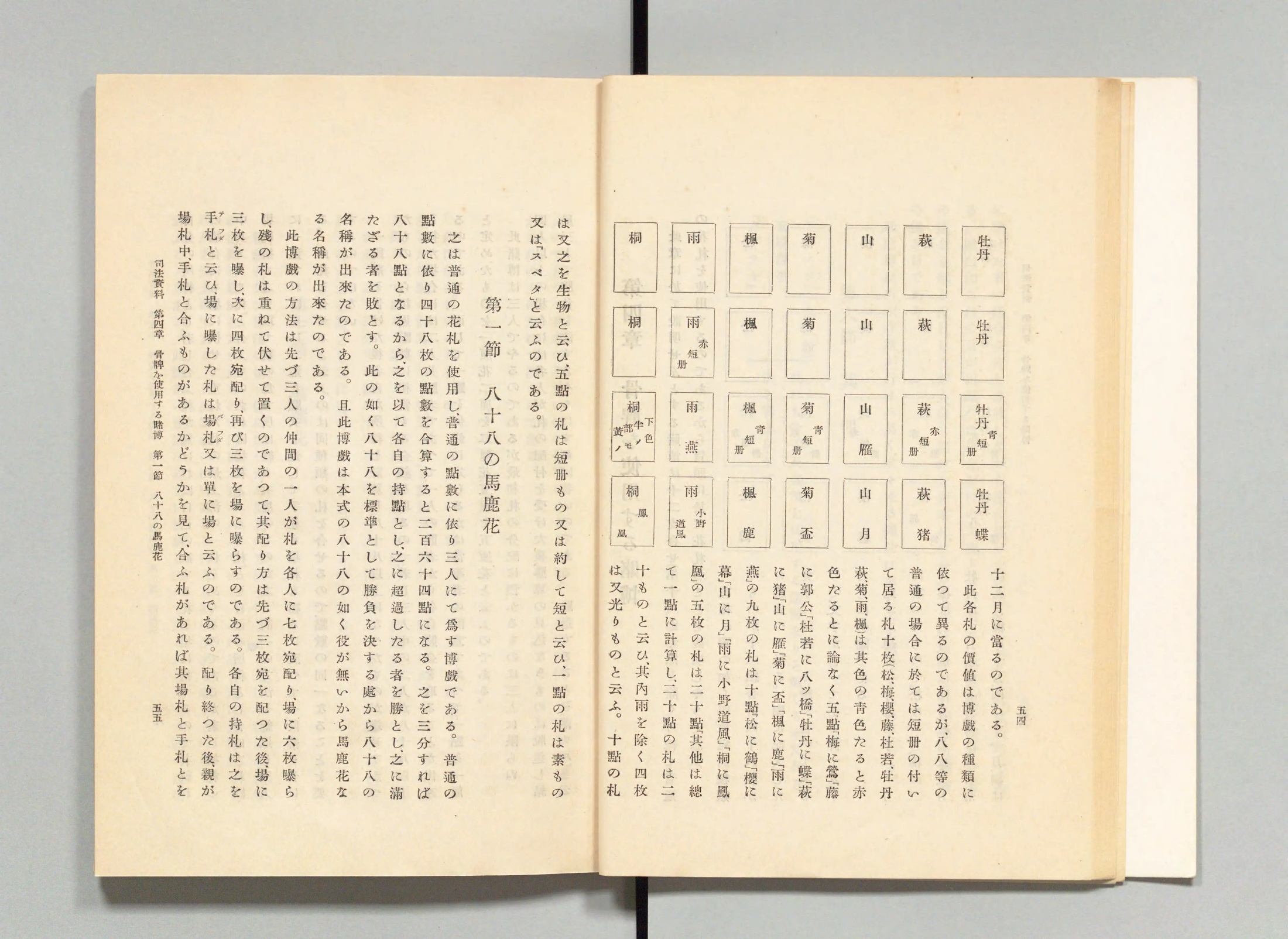
A 1921 Ministry of Justice report on gambling: a table of the hana-awase cards and a section on the three-player game scored against 88 points.National Diet Library: Ministry of Justice Research Section, study of typical crimes: gambling (1921), pp. 54–55
The most popular game today is koi-koi, a two-player game. Each player gets eight cards and eight go face up on the table. Unlike hana-awase, koi-koi ignores the point total of the cards and counts only yaku. The moment you complete a yaku you face a decision. You can call shōbu, "showdown," end the round, and collect. Or you can call koi-koi, "come on," and keep playing in the hope of building something bigger, at the risk that your opponent completes a yaku first and you get nothing. The game is named for that call.
| Yaku | Cards |
|---|---|
| Gokō | All five brights; scores the most |
| Shikō | Four brights without the rain man |
| Ame-shikō | Four brights including the rain man; a little less |
| Sankō | Three brights, not counting the rain man |
| Hanami-zake | Cherry curtain + chrysanthemum cup |
| Tsukimi-zake | Full moon + chrysanthemum cup |
| Inoshikachō | Boar, deer and butterflies |
| Akatan | Red ribbons of pine, plum and cherry |
| Aotan | Blue ribbons of peony, chrysanthemum and maple |
| Animals, ribbons, dregs | Five animals, five ribbons or ten dregs: a point each |
Koi-koi counts only yaku. The first four are built from brights, and whether the rain man is among them changes the name and the score.
The main yaku in koi-koi are worth learning by sight. All five brights, gokō, scores the most. Four brights without the rain man, shikō, comes next, and four brights including him, ame-shikō, a little less. Three brights, not counting the rain man, make sankō. The cherry curtain with the chrysanthemum cup is hanami-zake, "drinking under the blossoms," and the full moon with the cup is tsukimi-zake, "drinking under the moon." Boar, deer, and butterflies make inoshikachō, and the poetry ribbons and blue ribbons each count. Collecting any five animals, any five ribbons, or ten dregs also scores a point, with extra points for each additional card. A full game usually runs twelve rounds, one for each month.
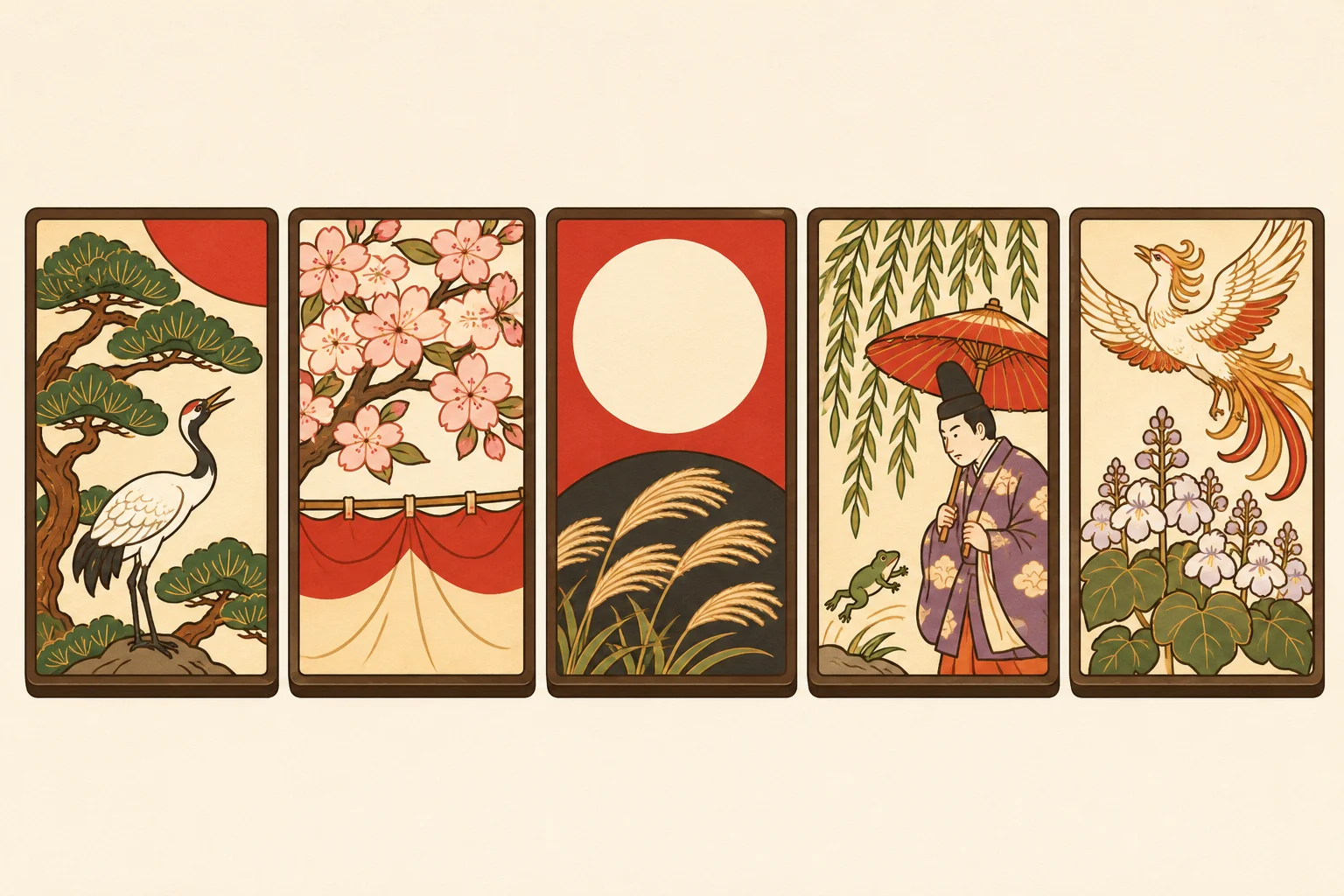
The five bright cards, or hikari; collecting all five makes gokō, the highest-scoring yaku in koi-koi.
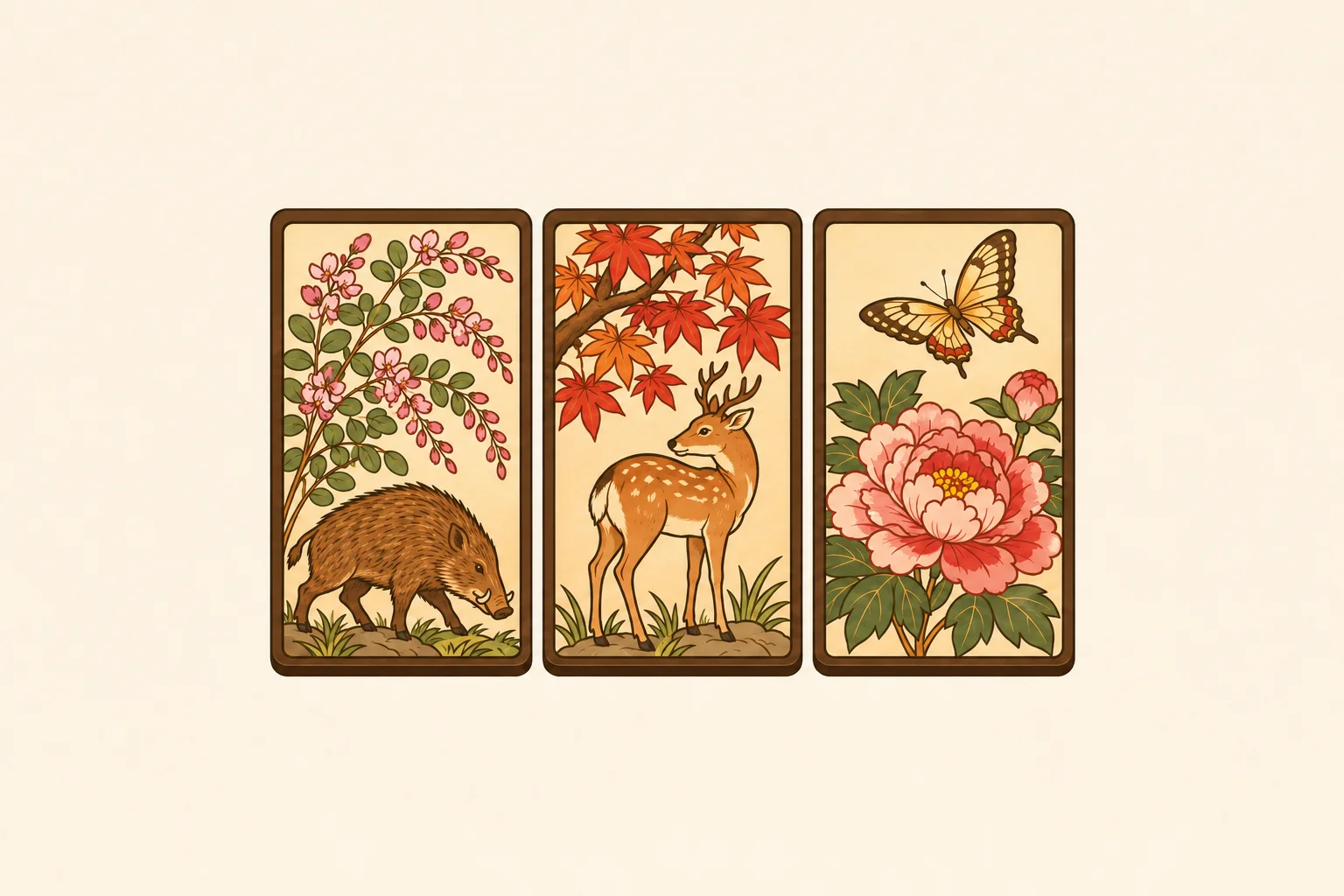
Inoshikachō: the boar in the bush clover, the deer under the maple and the butterflies with the peony.
The appeal of koi-koi lies in that moment of decision. Everything on the table is visible, and you can see exactly what your opponent has captured, so whether to push on depends on your reading of what is left in the stock and on your nerve. The rules take ten minutes to learn, which is why it is the game families play at New Year. There is also oicho-kabu, a betting game that uses only the cards of January through October and treats them purely as numbers by their month and has nothing to do with the poetry; the aim is to get a total whose last digit is as close to nine as possible.
05Nintendo, the Yakuza, and a Few Words of Slang
In 1889 Yamauchi Fusajirō began making hanafuda in Kyoto’s Shimogyō ward; this was the start of Nintendo. The company’s early success rested on gambling houses in Kyoto and Ōsaka, some of which are said to have used a fresh deck for every game. Nintendo still makes hanafuda. Its best-known brand, Daitōryō, "President," has a portrait of Napoleon on the box. Ōishi Tengudō in Kyoto’s Fushimi district, founded in 1800, still makes decks by hand, pasting thick and thin paper together card by card.
The link with gambling left marks on the Japanese language. The most famous is yakuza. A common explanation traces it to kabu-type gambling games such as three-card karuta and oicho-kabu: a hand of eight, nine, and three, ya-ku-sa, totals twenty, whose last digit is zero, the worst possible score. A "893" came to mean a good-for-nothing. Pikaichi, meaning "the very best," originally described a dealt hand in hana-awase in which one of the seven cards is a bright and the rest are dregs. Shikato, slang for deliberately ignoring someone, is said to come from the October card, where the deer turns its head away from the viewer: shika (deer) plus tō (ten). These etymologies are folk explanations, but they are widely repeated.
Hanafuda also traveled. The cards are generally thought to have reached Korea in the late nineteenth century and became hwatu, which is today arguably more popular there than hanafuda is in Japan; a family game of go-stop is a fixture of Korean holidays. Japanese immigrants took the cards to Hawaii, where local versions of the game are still played. In Japan, the 2009 animated film Summer Wars made a game of koi-koi the climax of its story, and some younger Japanese first met the rules through that film or through video games.
06Buying a Deck and Playing a Hand
Hanafuda are easy to find in Japan. Large toy shops, the games corner of bookstores, variety stores such as Hands (formerly Tokyu Hands), and a few traditional game shops in Kyoto all carry them. Nintendo’s Daitōryō comes in black or red; the faces are identical and only the backs differ, usually explained as a way to tell two decks apart when they are used alternately. The cards are made by pasting a printed sheet over a core of stiff board and folding its edges around to the back, so they feel heavier than Western playing cards and their corners tend to curl slightly. Many decks include a rules sheet with diagrams that are clear enough to follow without Japanese.
Playing properly takes a little wrist. Japanese players often lay a floor cushion on the tatami and slap the cards down onto it: the card is held between the fingers and brought down hard from a short height onto the matching card, with a sharp smack. Good players play quickly and cleanly, and that sound is part of the game. You can still hear it in the common room of a hot-spring inn or around the low table during a New Year visit to relatives.
For a first game, start with koi-koi. You do not need to memorize every yaku at once. Learn the five brights, the boar-deer-butterfly set, and the two kinds of ribbons, and watch the September sake cup closely: it counts toward both drinking yaku and is the most contested card in the deck. Once koi-koi feels comfortable, try hana-awase and its old-fashioned arithmetic of subtracting 88. And between turns, look at what is in your hand. The crane on the pine, the umbrella in the rain, the deer turning away under the maples: laid out together, the forty-eight cards make up a whole year.