
At a glance
How to use a Japanese public bathhouse, why Japanese wash before soaking, and how sentō grew from temple baths and Edo bathhouses to today’s dwindling neighborhood institutions.
- A sentō is a paid neighborhood public bath; it usually heats ordinary tap or well water in a boiler and is not a hot spring.
- Each prefecture caps the admission price; as of November 2026, Tokyo’s adult cap is 600 yen.
- The core rule: wash thoroughly at the washing area before getting into the bath, and keep your towel out of the water.
- A steam bathhouse opened in Edo by Ise Yoichi in 1591 is usually cited as the first sentō in what became Tokyo.
- Tokyo had 2,687 sentō in 1968; by 2025 it was down to 417.
A sentō is a public bathhouse, the kind found on ordinary residential streets all over urban Japan. You pay a few hundred yen at the door, wash yourself on a low stool, and then sink up to your shoulders in a big tiled pool of very hot water, often beneath a painting of Mount Fuji. Sentō are not hot springs and not spas. For centuries they were simply where city people bathed, and although almost every Japanese home now has its own bathroom, around 1,500 of these bathhouses still open their doors every afternoon. This article explains how to use one, why Japanese people bathe the way they do at home and in public, where the sentō came from, and what it has become.
01What a Sentō Is
The word is written with the characters for "money" and "hot water": a bath you pay for. On a side street in an older Tokyo neighborhood you might spot one by its chimney, a tall brick or steel stack rising over the rooftops, and by the cloth curtain (noren) hanging over the entrance, marked with the single hiragana character ゆ (yu, hot water). When the curtain is out, the bath is open. Sentō are busiest from early evening into the night, when people are coming home from work.
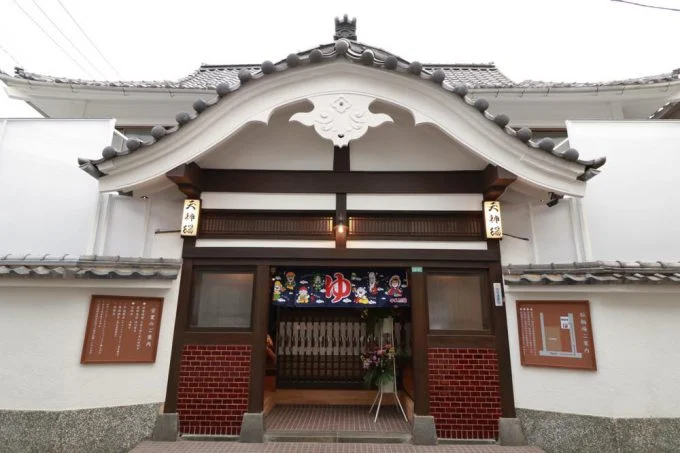
The curved karahafu entrance of Tenjin-yu in Tokyo, with the yu curtain at the door.
Admission is cheap and, unusually, regulated. Each prefecture sets a maximum price for ordinary sentō, a system that survives from postwar price controls, because bathing was considered a basic necessity of daily life. As of November 2026, Tokyo’s adult cap is 600 yen, raised in August 2026; Ōsaka’s has been 600 yen since April 2025, and in most other prefectures it is around 500 yen. You can bring your own towel, soap and shampoo, or buy or rent them at the counter.
It helps to be clear about what a sentō is not. An onsen is a hot spring, defined by naturally heated mineral water from the ground, and going to one usually means a trip. A sentō typically heats ordinary tap or well water in a boiler, and its whole point is that it is around the corner. A few Tokyo sentō happen to sit on top of naturally occurring mineral water and serve dark, tea-colored kuro-yu ("black water"), but they remain neighborhood baths. The large suburban complexes with a dozen pools, saunas, restaurants and parking lots are called sūpā sentō ("super sentō"); they are not bound by the price cap and feel more like leisure centers.
02Inside: How to Use a Sentō
The first thing you do is take off your shoes. Just inside the entrance is a wall of small wooden lockers (getabako), each locked with a flat wooden key that you pull out and keep. Regulars sometimes pick a favorite number, and some are said to prefer the lockers marked with the auspicious pine, bamboo and plum (shō-chiku-bai).
Men’s and women’s sides are separate, usually marked with otoko (男, men) and onna (女, women) on blue and red curtains. In the traditional layout, a raised booth called the bandai sits between the two entrances, high enough that the attendant, often the owner’s wife, can see into both changing rooms. She takes your money, sells you soap and makes change. Visitors from abroad are often startled by this, but the person on the bandai has seen thousands of bathers and pays no attention. Many sentō have since replaced the bandai with a front desk in the lobby, so the changing rooms are fully private.
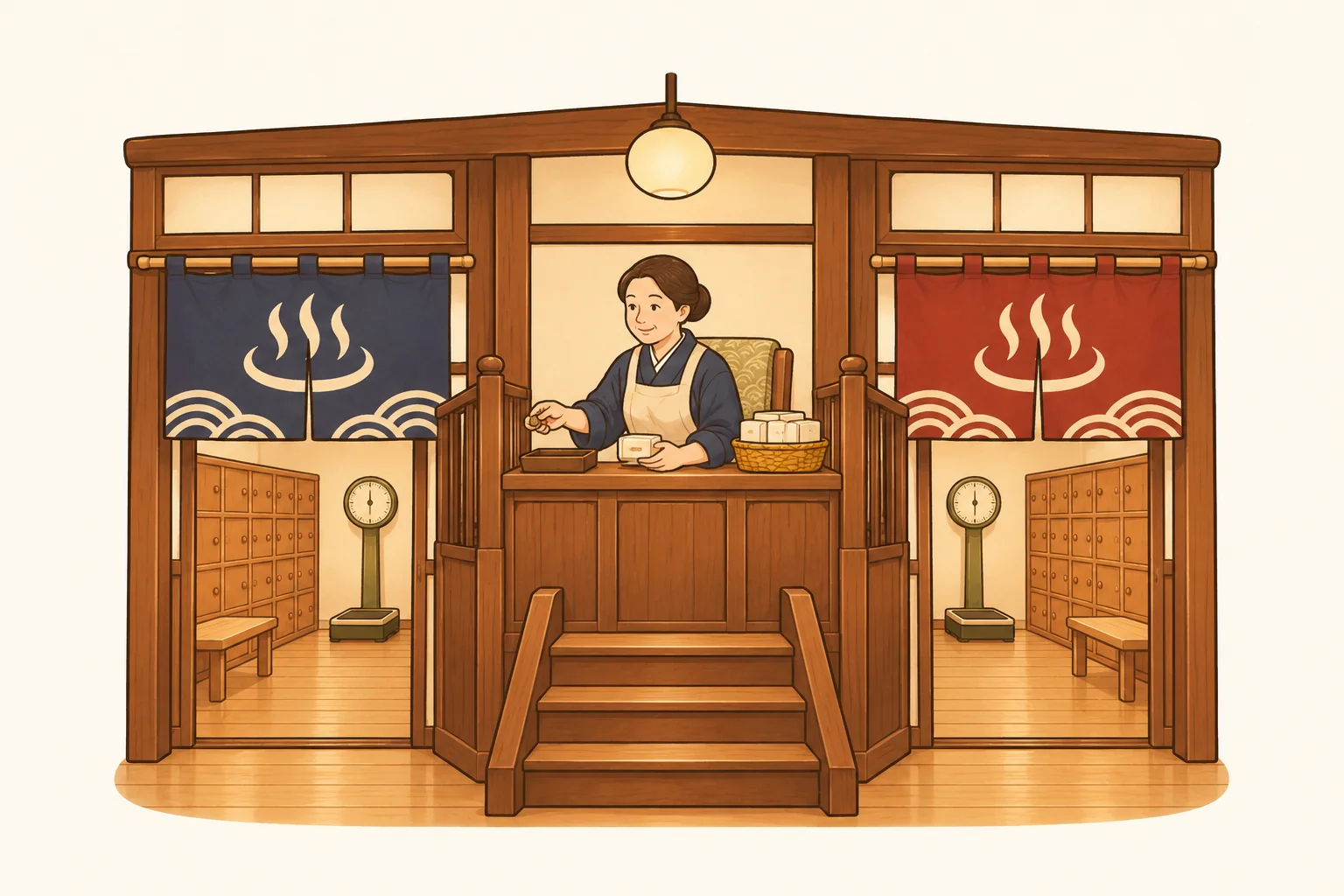
The raised bandai of an old sentō, between the men's and women's entrances.
The changing room is bright and roomy, with woven mats or wooden floorboards, rows of lockers, an old-fashioned weighing scale, and perhaps a coin-operated hair dryer that runs for a few minutes on one or two ten-yen coins. You undress completely, lock away your clothes, and carry only a small towel and your toiletries through the sliding glass door into the bathing room.
Inside it is warm, humid and loud with echoes; plastic basins clatter on the tiles under a high ceiling. The room has two zones. Nearest the door is the washing area, rows of low faucets along the walls, each with a small stool, a basin, a hot tap, a cold tap and usually a shower head. At the far end, against the back wall, are the baths.
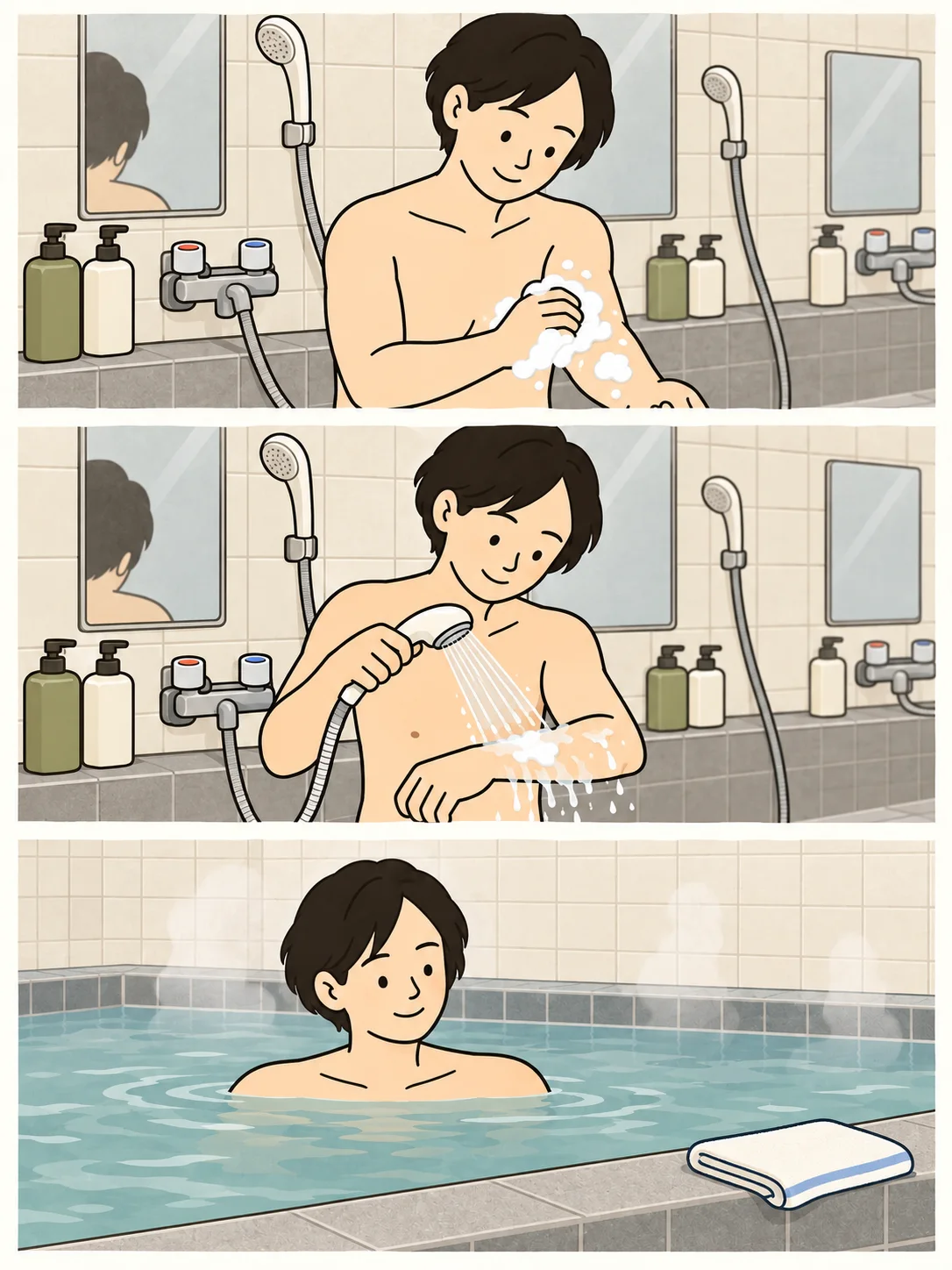
Everything else follows from one rule: you wash thoroughly before you get into the bath. Sit on the stool, rinse yourself with water from the basin, soap up, wash your hair, rinse completely. Then, before stepping into the pool, scoop a few basins of bath water over your body to adjust to the heat, a step called kakeyu. Because everyone shares the same water, your towel stays out of it; people fold it on their heads or leave it on the edge. Long hair should be tied up. You don’t scrub or wash in the bath, and you don’t swim. Before going back into the changing room, wring out your towel and wipe yourself down so you don’t drip on the floor.
- 1
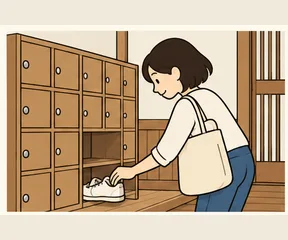 Take off your shoes at the entrance and lock them in a shoe box.
- 2
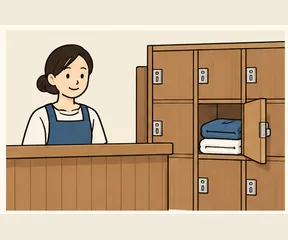 Pay, then lock your clothes in a changing-room locker.
- 3
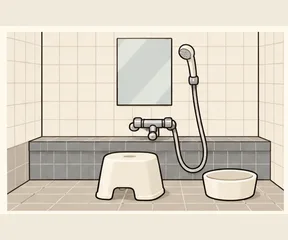 Sit on a low stool at the washing area and wash and rinse completely.
- 4
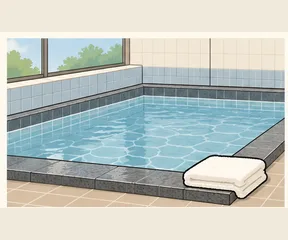 Pour a few basins of bath water over yourself, then get in; the towel stays out.
The water is hot. The main bath at an old Tokyo sentō is often around 42°C (about 108°F) or hotter, with some old places said to run as high as 44°C, and the oldest regulars like it hotter still, lowering themselves in slowly with a long exhale. Many sentō offer a few kinds of bath: a jet bath, a bubbling bath, a herbal or citron "medicine bath" (kusuri-yu), a small cold plunge pool, sometimes a sauna, and the curious denki-buro, an electric bath in which a mild current runs through the water and makes your muscles tingle. Regulars cycle between hot and cold.
Tattoos, which can get you turned away from many hot springs, gyms and pools, are generally accepted at sentō, which are treated as public hygiene facilities. The courtesies that matter more are practical: don’t hog a washing station, don’t splash your neighbors, and rinse your stool and basin and put them back when you leave.
The classic finish is in the changing room. A refrigerator case holds glass bottles of milk, coffee milk and fruit milk. Drinking a bottle of cold coffee milk in one go, one hand on your hip, is the gesture every Japanese person recognizes as the proper end to a bath.
03Washing Outside the Tub: The Japanese Bath at Home
The sentō rules are not just public manners. They come from the same idea that shapes the bathroom in a Japanese house: the tub is for soaking and warming up, not for getting clean. You get clean outside it, so the water in it stays clean.
A typical Japanese home bathroom is built around that idea. It is a small, fully waterproofed room whose floor is itself the washing area, with a shower, a stool and a basin. You sit outside the tub to wash. The tub is short and deep, so you can sit with water up to your shoulders. The toilet is almost always in a separate room, and between the hallway and the bathroom there is usually a small dressing room with the washbasin and the washing machine.
Because everyone washes before getting in, the whole family uses the same tub of water in turn. In the evening someone runs the bath, and the household takes turns soaking; the last person in still finds clean water. Traditionally the head of the household, or a guest, went first as a mark of respect; today it is whoever is free. If the water cools, a button on the control panel reheats it by circulating it through the water heater, a function called oidaki that is standard on Japanese home systems. Many of those panels also announce in a cheerful recorded voice that the bath is ready. Plenty of households keep the leftover water and pump it into the washing machine the next day.
All of this is more recent than it looks. In the 1950s many urban households, by some accounts most, still had no bath at all, and people went to the sentō. During the rapid growth of the following decades, large public housing estates (danchi) were built with a bathroom in every unit, and private homes followed with tubs and gas water heaters. By the 1970s a home bath was becoming the norm. Later came the prefabricated "unit bath," a single molded module installed in one piece, which is what most Japanese apartments have today.
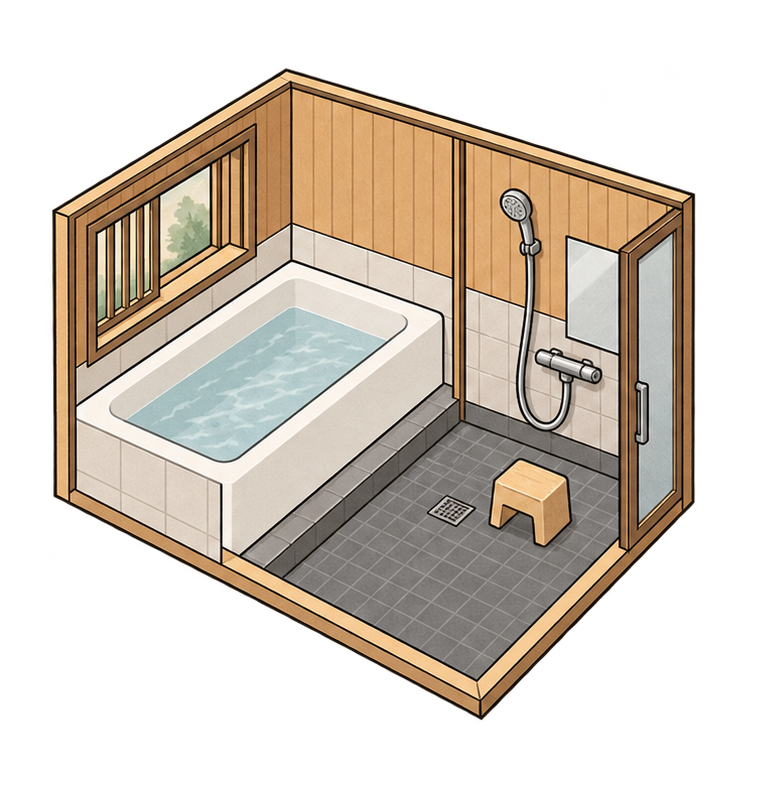
The bathroom floor is the washing area, with a stool and shower; the deep, short tub is only for soaking.
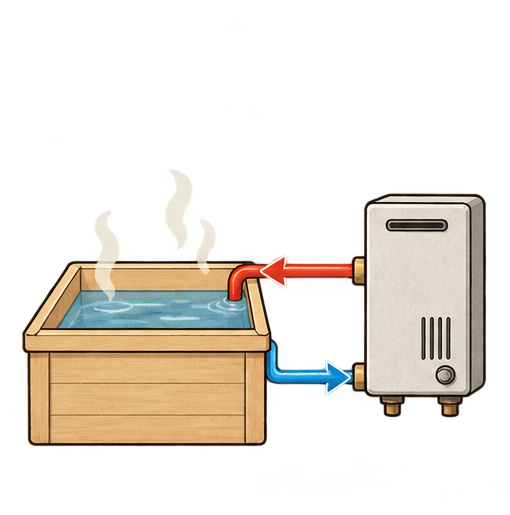
Oidaki: bath water is drawn through the water heater, reheated and returned to the tub.
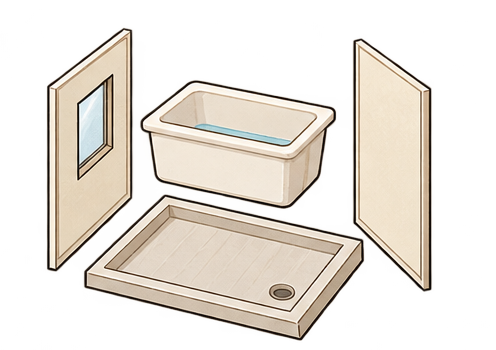
A unit bath is assembled on site from a factory-made tub, floor pan and wall panels.
In older rural homes you might have found a goemon-buro: a large iron cauldron set over a wood fire, which you stood in on a round wooden board to keep your feet off the hot metal. It is named, with dark humor, after Ishikawa Goemon, a legendary sixteenth-century thief said to have been boiled alive.
04From Temple Baths to Edo Bathhouses
Japan’s volcanic landscape and abundant hot springs gave people a taste for hot water early, but the public bathhouse has its roots in Buddhist temples. Large temples had bathhouses where monks bathed as a form of purification, and they opened them to the poor and sick as an act of charity, called seyoku. Tōdai-ji in Nara still has its great bathhouse, rebuilt in the medieval period. A well-known legend says Empress Kōmyō, in the eighth century, vowed to wash a thousand sick people with her own hands. Most early baths were steam baths: you sweated in a small closed room and then rinsed off, quite different from soaking in a pool.
Commercial bathhouses grew with the cities. An Edo-period account says that in 1591, a man named Ise Yoichi opened a steam bathhouse near Zenigame Bridge in the new castle town of Edo, charging one coin, and this is usually cited as the first sentō in what would become Tokyo. As Edo grew into one of the largest cities in the world, its crowded wooden row houses had no baths, and fire was a constant fear, so nearly every neighborhood had its bathhouse.
Edo-period baths were dim, steamy places. The bath itself was in a back room, closed off by a low wooden partition called the zakuroguchi ("pomegranate entrance") that you had to stoop to pass under; it kept the steam in. The name is usually explained as a pun: mirrors were polished with pomegranate juice, so a pomegranate was something "a mirror needs" (kagami iru), which sounds like "stooping to enter" (kagami iru). Inside, in near darkness, bathers announced themselves with a polite word as they climbed in.
Mixed bathing was common in Edo for long stretches, despite repeated bans by the shogunate. In the early Edo period some bathhouses employed yuna, women who scrubbed customers’ backs and increasingly offered more than that, until they were prohibited. Bathhouses often had a second-floor lounge where male customers drank tea, played go or shogi, and gossiped; the bathhouse was a social club for townspeople. Shikitei Sanba’s comic novel Ukiyoburo (The Bathhouse of the Floating World, 1809–13) is set entirely in one and is made up of the chatter of the people who pass through.
The Meiji government, citing hygiene and public morals (and, it is generally thought, eager to appear modern to Western eyes), banned mixed bathing in its first years and outlawed the dark zakuroguchi design in 1879, though the rules took decades to stick. The new kairyō-buro ("improved baths") had high ceilings, large windows and open pools you stepped into directly after washing. That is essentially the sentō layout that survives today.
05Temple Roofs and Mount Fuji
The image most Japanese people have of the classic sentō took shape in the early twentieth century. After the Great Kantō Earthquake of 1923 destroyed much of Tokyo, many bathhouses were rebuilt in what is called the miyazukuri (shrine-style) manner, with heavy, curving karahafu gables and carved woodwork across the front, so that a bathhouse looks a little like a shrine. Many Tokyo sentō owners are said to have come from the Hokuriku region on the Sea of Japan coast, especially Ishikawa, Toyama and Niigata, and the trade passed through networks of relatives and people from the same villages.
The Mount Fuji mural began in the same era. The usual story is that in 1912 a sentō in Kanda, Tokyo, called Kikai-yu, had the painter Kawagoe Kōshirō paint Fuji on its wall, and the idea caught on. Fuji is auspicious, and in the Kantō region it is the mountain people actually see on clear days; painted across the back wall, it gives a cramped bath a wide-open view. Murals are a Tokyo-area tradition; sentō in western Japan rarely have them. The paintings are done in house paint directly on the wall and redone every few years, and an experienced painter can finish an entire wall in a day. The veteran painter Maruyama Kiyoto has retired, and as of 2026 only a handful of painters reportedly still paint sentō murals for a living, the best known being Nakajima Morio and his former apprentice Tanaka Mizuki, who trained under him from 2004 and went independent in 2013.
The sentō was also the neighborhood’s living room. Ads for local shops hung in the changing room. Children met adults there, older people caught up on news, and newcomers to a street got to know it there.
The peak came in the 1960s. Tokyo had 2,687 sentō in 1968, and the national total peaked the same year at nearly 18,000. As home baths spread, the numbers fell steadily: Tokyo was down to 417 in 2025, and the whole country had about 1,500 in 2026. Most boilers now burn gas, but a few owners still fire theirs with wood, insisting that the water comes out softer.
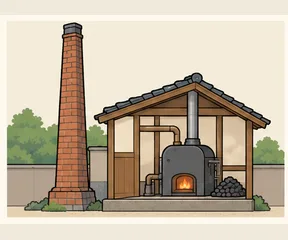
The water is heated in a boiler room outside the baths; most now burn gas, a few still use wood.
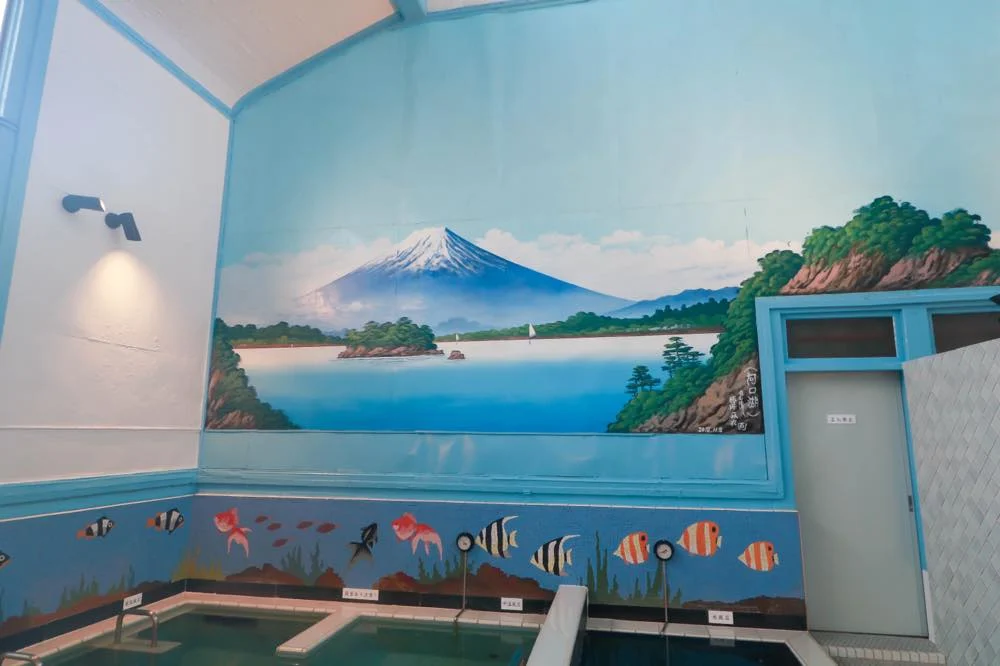
A Mount Fuji mural above the bath, with a fish mosaic and the tubs below.
06The Sentō Today
The decline looks permanent, but over the last fifteen years or so the sentō has found a new audience. Younger owners have taken over old bathhouses and renovated them, keeping the shrine-style roofs and the Fuji murals while adding design-conscious lobbies, coffee and craft beer. Kosugi-yu in Tokyo’s Kōenji is the example most often mentioned; it has kept its old building and opened a space next door for working and relaxing. Japan’s recent sauna boom has also brought crowds back to sentō with good saunas and cold plunges.
For a traveler, the sentō is the cheapest way to see ordinary Japanese life up close. Find one near where you are staying and go in the early evening. Watch the neighbors arrive with their little plastic baskets of toiletries, the old men toweling off slowly on the bench, the owner at the counter trading a few words with each regular. Then walk out into the night air with your skin still burning and a cold bottle of coffee milk in your hand.