
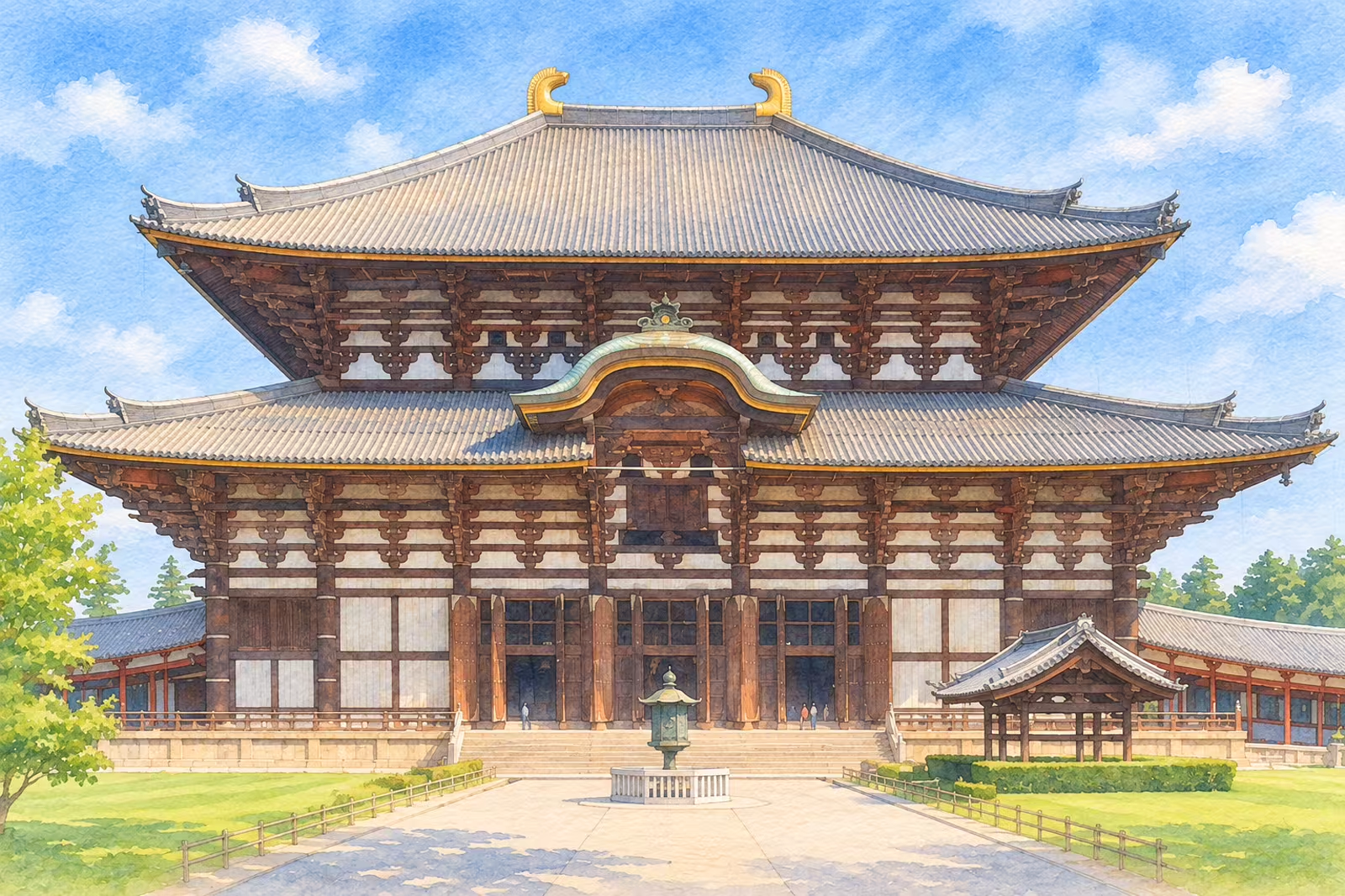
Tōdai-ji, in the city of Nara, Nara Prefecture, is the head temple of the Kegon school, founded in the eighth century at the wish of Emperor Shōmu and famous for the Great Buddha (Rushana Buddha) in its Great Buddha Hall. It was the head of the network of provincial temples (kokubunji) across the country and the center of state Buddhism in the Nara period. Twice burned in war and twice rebuilt, the temple today has buildings from three periods: Nara, Kamakura and Edo.
01Foundation and the Great Buddha
In 743 Emperor Shōmu issued an edict at the Shigaraki palace to build a great Buddha; the project was later moved to the eastern edge of the capital, Heijō-kyō. Casting began around 747 and was finished in 749, and the eye-opening ceremony was held in 752, led by the Indian monk Bodhisena. Rōben served as the first chief administrator (bettō) of Tōdai-ji, and the monk Gyōki was asked by the court to raise funds and labor from the people. In 754 Ganjin (Jianzhen in Chinese) set up an ordination platform in front of the Great Buddha Hall and ordained the retired emperor Shōmu and others; the Kaidan-in ordination hall was built afterward.
02Two Fires and Two Rebuildings
In 1180 Taira no Shigehira, on the orders of the Taira, attacked Nara; much of Tōdai-ji and Kōfuku-ji burned, and the Great Buddha was badly damaged. The monk Chōgen was appointed to lead the rebuilding, raising funds across the country and using building techniques from Song China, later called the Daibutsuyō style. The Buddha was reconsecrated in 1185, the hall completed in 1195, and the Nandaimon gate with its guardian figures by Unkei, Kaikei and others in 1203. In 1567 fighting in Nara between Matsunaga Hisahide and the Miyoshi Triumvirate burned the Great Buddha Hall again. The Buddha stood in the open for more than a century until the Edo-period monk Kōkei raised funds for its repair; it was reconsecrated in 1692 and the hall finished in 1709. With limited funds, the new hall’s front was reduced to about two-thirds of its former width.
03What Can Be Seen Today
The present Great Buddha Hall, an Edo-period rebuilding, is still one of the largest wooden buildings in the world. The Buddha is about 15 meters tall; parts such as the pedestal survive from the Nara period, while the head was recast in the Edo period. The Nandaimon and its guardian figures date from the Kamakura period, and the Hokkedō (Sangatsudō) and the Tegaimon gate survive from the Nara period. The Shuni-e (popularly called Omizutori) held each spring at the Nigatsudō is said to have been performed every year without a break since 752. The Great Buddha Hall, the Buddha, the Nandaimon, the Hokkedō and the Nigatsudō are among the temple’s National Treasures. In 1998 Tōdai-ji was inscribed as part of the World Heritage site "Historic Monuments of Ancient Nara".
Tōdai-ji
01What You Are Looking At
Tōdai-ji, the "Great Eastern Temple," sits on the eastern edge of Nara, at the foot of the wooded hills that once marked the edge of the eighth-century capital, Heijō-kyō. Most visitors come for one thing: the colossal seated bronze Buddha inside the Daibutsuden, the Great Buddha Hall. The statue represents Vairocana, called Roshana in Japanese, the cosmic Buddha of the Flower Garland Sutra (Kegon-kyō). It is about 15 meters tall seated, and the hall around it is one of the largest wooden buildings in the world.
Almost nothing here is exactly as the temple’s founder saw it. The hall you are standing in was completed in 1709 and is the third on this spot. It is about 57 meters wide, about two-thirds of the width of the eighth-century original, which was over 85 meters wide. The Buddha’s head was cast in the late seventeenth century; much of the body was patched in the twelfth. Only parts of the body around the belly and knees, and part of the great lotus pedestal, go back to the 740s. Tōdai-ji is a site that has been destroyed by fire twice and rebuilt twice, and each rebuilding left its own layer. Knowing which layer is which makes the visit far more interesting.
02An Emperor in Trouble
The man behind the Great Buddha was Emperor Shōmu, who reigned from 724 to 749. His era, the Tenpyō period, is remembered as a high point of court culture, but Shōmu’s own reign was a string of disasters.
In 727 his consort Kōmyō bore him a son, who was named crown prince as an infant and died before his second birthday in 728. To pray for the boy, Shōmu founded a small mountain temple in the hills east of the capital. That temple, later known as Kinshō-ji, is one of the roots of Tōdai-ji.
Worse followed. Between 735 and 737 a smallpox epidemic swept from Kyūshū to the capital and killed a large part of the population, including all four Fujiwara brothers who dominated the government. In 740 a member of the same family, Fujiwara no Hirotsugu, rebelled in Kyūshū. The revolt was crushed within months, but Shōmu left Nara during the crisis and for five years moved the court restlessly between new palaces at Kuni, Naniwa and Shigaraki. Famine and earthquakes added to the sense that the realm was out of joint.
In the Buddhist thinking of the court, such calamities reflected on the ruler’s virtue, and the remedy was to strengthen the protection the Buddhist teachings offered the state. In 741 Shōmu ordered every province to build an official monastery and nunnery, the kokubunji system. The monastery for Yamato province, where the capital stood, grew out of the hillside temple east of the city. It became the head of the whole provincial network, and it would become Tōdai-ji.
03The Edict of 743
According to tradition, the spark came in 740, when Shōmu visited a temple called Chishiki-ji in Kawachi province and worshipped a statue of Vairocana that local believers had paid for together. "Chishiki" means a group of lay donors joined in a pious project, and the idea of a Buddha made by the contributions of many stayed with him.
In the tenth month of 743, at the Shigaraki palace, Shōmu issued his edict ordering the casting of a giant gilt-bronze Vairocana. It is one of the most quoted documents of Japanese history. He would use all the copper in the land to cast the image and cut down great mountains to build its hall. He observed that the wealth and power of the realm were his, and that with them a statue could easily be made, but that this would miss the point. Instead, anyone who wished to help, even by bringing a single blade of grass or a handful of earth, should be allowed to do so.
Vairocana suited the project. In the Flower Garland Sutra, this Buddha sits on a lotus of a thousand petals; each petal is a world with its own Buddha, and each of those worlds contains countless more. A single great Buddha presiding over a network of worlds mirrored an emperor presiding over provinces, each with its own official temple.
Work began at Shigaraki, where a core framework for the statue was erected in 744. When the court returned to Nara in 745, the project moved with it, to the site where you are now.
04Gyōki, the People’s Monk
To make the appeal to ordinary people work, the court turned to an unlikely partner. Gyōki was a monk who had spent decades leading followers around the capital region building bridges, irrigation ponds and rest houses for travelers. Earlier the government had condemned his preaching to commoners as a breach of the rules for clergy. Now it needed his following.
Gyōki and his disciples traveled to raise donations for the Buddha, and in 745 he was named daisōjō, the highest rank in the Buddhist hierarchy and the first time anyone in Japan had held it. He died in 749, at about eighty, before the statue was dedicated. A statue of him stands at Kintetsu Nara Station, and he is honored at Tōdai-ji as one of its "four sages," together with Shōmu, the founding monk Rōben and the Indian monk Bodhisena.
Temple records later counted hundreds of thousands of donors and over two million workdays for the project. These figures come from later temple tradition and should be taken as an indication of scale rather than an exact count.
05Casting the Giant
The casting was directed by Kuninaka no Kimimaro, the grandson of an immigrant from the Korean kingdom of Paekche. Over a core of wood and clay modeled in the shape of the Buddha, workers built an outer mold, shaved the core back by the thickness of the bronze wall, and poured molten metal into the gap. Then they buried the finished section in earth to make a platform for the next. From 747 to 749 the statue rose in eight tiers from the base to the head. The curls of hair were cast separately, nearly a thousand of them. Tradition puts the copper used at around 500 tonnes.
The statue was to be gilded, but gold had not been found in Japan. In 749 the governor of Mutsu province in the far northeast, Kudara no Konikishi Kyōfuku, a descendant of the Paekche royal house, reported a discovery of gold and sent 900 ryō to the capital. Shōmu went in person before the unfinished Buddha, called himself a servant of the Three Treasures, and reported the news to it. He changed the era name to celebrate. Later that same year he abdicated in favor of his daughter, who reigned as Empress Kōken.
Gilding was done with a mercury amalgam brushed onto the bronze and heated until the mercury evaporated. The work went on for years, and it is commonly thought that the fumes poisoned many workers.
06Opening the Eyes, 752
On the ninth day of the fourth month of 752, the statue was formally dedicated in an "eye-opening" ceremony, in which the pupils are painted in to bring the image to life. The gilding was not finished and the hall was not complete, but the court would not wait: the year was counted as the two hundredth anniversary of Buddhism’s arrival in Japan.
The retired emperor Shōmu, Empress Dowager Kōmyō and Empress Kōken all attended. The brush was held by Bodhisena, a monk from India who had come to Japan in 736. A long cord was tied to the brush, and guests holding the cord could share in the act. Some 10,000 monks took part, and dancers performed music from China, Korea and Southeast Asia. The official chronicle Shoku Nihongi wrote that nothing so magnificent had been seen since Buddhism came east. The brush and the cord are still preserved in the Shōsōin.
07Rōben, Jianzhen and the Shōsōin
The temple’s first administrator was the monk Rōben, who had practiced in the hillside temple from which Tōdai-ji grew. A popular legend says he was carried off by an eagle as a baby and found in a cedar tree in Nara; a cedar in front of Nigatsu-dō is still called Rōben’s Cedar.
In 753 the Chinese monk Jianzhen, known in Japan as Ganjin, reached Japan after five failed attempts and the loss of his sight. In 754 he set up an ordination platform in front of the Great Buddha and gave the bodhisattva precepts to Shōmu, Kōmyō and Kōken. A permanent ordination hall, the Kaidan-in, was built the following year, giving Japan its first properly constituted place to ordain monks.
Shōmu died in 756. On the forty-ninth day after his death, Kōmyō dedicated more than 600 of his possessions to the Great Buddha, listing them in a document known as the Kokka Chinpō-chō. They were placed in the temple’s storehouse, the Shōsōin, and together with later additions they form one of the world’s great collections of eighth-century objects: musical instruments, mirrors, glass, textiles and incense woods from China, Central Asia and Persia. The storehouse, a log building raised on stilts, stands northwest of the Great Buddha Hall and is now managed by the Imperial Household Agency. The treasures are shown in rotation each autumn at the Nara National Museum.
Eighth-century Tōdai-ji was enormous. Two seven-story pagodas, each said to be close to 100 meters tall, stood east and west of the main approach. Both were later lost; only their sites remain.
08The Fire of 1180 and the Monk Chōgen
By the late twelfth century the great Nara temples were landholders with armed monks of their own, and they sided against the Taira clan in the war that broke out with the Minamoto in 1180. At the end of that year Taira no Kiyomori sent his son Shigehira against Nara. During the fighting a fire spread through the city. Tōdai-ji and its neighbor Kōfuku-ji were largely destroyed, many people who had fled into the Great Buddha Hall died, and the Buddha’s head melted and fell.
The court put the rebuilding in the hands of Chōgen, a monk then about sixty who claimed to have traveled three times to Song China. With the Chinese caster Chen Heqing, he repaired the statue, and in 1185 Retired Emperor Go-Shirakawa himself held the brush at the second eye-opening. For the hall, Chōgen went to the mountains of Suō province, in present Yamaguchi Prefecture, to find timbers large enough and floated them down to the sea. The new hall was dedicated in 1195 in the presence of Minamoto no Yoritomo, the first shogun, who brought a large escort of warriors and supported the work.
Chōgen built in a style from southern China, now called daibutsuyō, "Great Buddha style." It uses massive columns tied together by horizontal through-beams and brackets inserted directly into the columns, with the structure left exposed. The best surviving example is the Nandaimon, the Great South Gate, raised in 1199. Its two guardian kings, each over eight meters tall, were carved in 1203 by teams led by the sculptors Unkei and Kaikei, in about 69 days. Chōgen died in 1206. A portrait statue of him in old age is kept in the Shunjō-dō hall.
09The Fire of 1567 and a Century in the Open
In 1567, during the civil wars of the Sengoku period, the warlord Matsunaga Hisahide fought the rival Miyoshi faction in Nara, and the Miyoshi forces camped at Tōdai-ji. On the night of the tenth day of the tenth month, the Great Buddha Hall caught fire and burned down, and the Buddha’s head fell again. Matsunaga has usually been blamed, though some accounts suggest the fire started accidentally in the Miyoshi camp.
The head was given a makeshift repair, and a simple shelter was put up, but it was later blown down by a storm. For more than a century the Great Buddha sat in the open.
The revival came from a monk named Kōkei, who from 1684 traveled the country collecting donations from ordinary people. The statue was restored by 1691 and rededicated in 1692. The hall was a far larger undertaking. Kōkei won the support of the shogun Tokugawa Tsunayoshi and his mother Keishōin, and the shogunate helped raise funds. Kōkei died in 1705; the hall was dedicated in 1709.
Large timbers were now scarce, so the new hall was built seven bays wide instead of eleven, and many of its columns are bundles of smaller timbers bound with iron. The great curved beam under the roof came from Hyūga province in Kyūshū. The cusped gable over the front, with a window that can open so that the Buddha’s face can be seen from outside, belongs to this Edo-period design.
10Repairs, Treasures and World Heritage
By the late nineteenth century the roof was sagging badly. A major restoration from 1906 to 1912 reinforced it with steel beams imported from Britain. Another restoration from 1973 to 1980 replaced the roof tiles. The hall is a National Treasure, and in 1998 Tōdai-ji was inscribed as part of the UNESCO World Heritage site "Historic Monuments of Ancient Nara."
11A Walk Around the Temple
Start at the Nandaimon. Look up at the columns that run from the ground to the roof and the stacked through-beams; this is Chōgen’s style at full scale. The guardian with an open mouth stands on the west side and the one with a closed mouth on the east, the reverse of the usual arrangement.
In front of the Great Buddha Hall stands a bronze octagonal lantern from the eighth century, with musician bodhisattvas in relief on its panels. It is a National Treasure.
Inside, look at the lotus petals of the pedestal. Engraved on them in fine lines are Buddhas, bodhisattvas and layered worlds, the cosmos of the Flower Garland Sutra; the petals that survive from the first casting carry eighth-century drawing. The statue is flanked by the bodhisattvas Kokūzō and Nyoirin Kannon, and two of the Four Heavenly Kings stand in the rear corners; all are Edo-period works. Behind the Buddha, one pillar has a rectangular hole at its base said to be the size of the Buddha’s nostril. Crawling through it is believed to bring good luck. Outside, on the porch, sits a red-lacquered figure of Binzuru, a disciple of the Buddha; people rub the part of the statue that matches their own ailment.
East of the hall, up a flight of steps, a bell tower holds a huge eighth-century bronze bell, also a National Treasure. Further up the slope is the Hokke-dō, also called Sangatsu-dō, the oldest building at Tōdai-ji, with a main section from the Nara period. Its standing Fukūkenjaku Kannon is a masterpiece of eighth-century sculpture. Next to it is the Nigatsu-dō, where the Shuni-e ritual, popularly called Omizutori, has been held every spring since, by tradition, 752, without a single year missed. The present building replaced one that burned during the ritual in 1667. Its veranda gives one of the best views over the roof of the Great Buddha Hall and the city.
On the way back, the Kaidan-in to the west of the main hall marks Jianzhen’s ordination hall. To the north you can see the outside of the Shōsōin, and the Tegai-mon, one of the few gates left from the Nara period.