
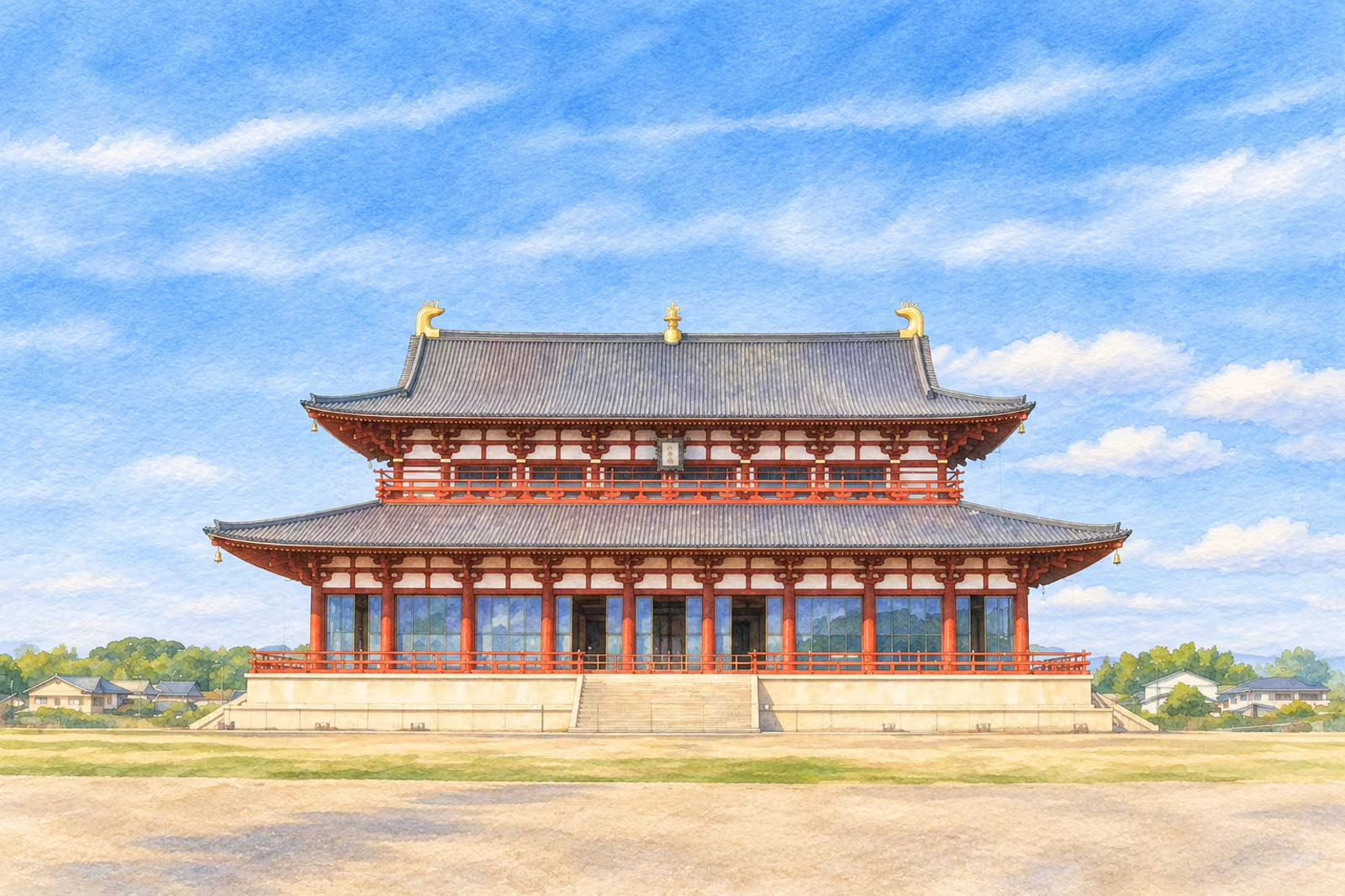
The Heijō Palace Site in the northwest of Nara City, Nara Prefecture, is where the emperors of the Nara period lived and ruled. From the move of the capital to Heijō-kyō in 710 until the court left for Nagaoka-kyō in 784, this compound held the emperor’s residence, the halls of state ceremony and the offices of the government. Its timber buildings have long vanished, but the remains below ground survive unusually well, making it one of the key places for understanding how Japan’s early centralized state worked.
01The palace of the Nara court
In 710 Empress Genmei moved the capital from Fujiwara-kyō to Heijō-kyō. The palace sat at the center of the northern edge of the grid city. Its main south gate, the Suzaku Gate, faced Suzaku Avenue, the broad street that ran through the capital. The compound was roughly one kilometer square, with an extension on its eastern side, for a total of about 120 hectares. Inside were the Daigokuden, the great hall used for enthronements and New Year audiences; the Chōdō-in, where officials gathered for state business; the Dairi, the emperor’s private quarters; and the compounds of the ministries.
In the 740s Emperor Shōmu moved the court to Kuni-kyō, Shigaraki and Naniwa before returning to Heijō in 745, after which a second Daigokuden was built further east. After Emperor Kanmu moved the capital to Nagaoka-kyō in 784, the palace fell out of use. Retired Emperor Heizei later lived here for a time, and the Kusuko Incident of 810, his confrontation with Emperor Saga, is tied to this place. The site eventually became farmland.
02Rediscovery and protection
In the late Edo period the scholar Kitaura Sadamasa worked out where the palace had stood. In the late Meiji period the architectural historian Sekino Tadashi identified the platform of the Daigokuden, and local figures such as Tanada Kajūrō campaigned for its preservation. The site was designated a Historic Site in 1922 and a Special Historic Site in 1952. Systematic excavation by the national research institute for cultural properties began in 1959 and continues today. In the early 1960s a railway company’s plan to build a depot on the site set off a preservation campaign, and the state bought the land. In 1998 the site was inscribed as part of the World Heritage property Historic Monuments of Ancient Nara.
03What can be seen today
Today the site is a wide open field, with column positions and building platforms marked by planting and stone. All standing buildings are modern reconstructions based on excavation and research: the Suzaku Gate and the Tōin Garden were completed in 1998, the First Daigokuden in 2010 for the 1,300th anniversary of the capital, and the Daigoku Gate in front of it around 2022. They show likely forms and scale rather than ancient fabric. Large numbers of mokkan, inscribed wooden tablets recording tribute goods, officials’ names and routine documents, have been excavated here, and a group of them has been designated a National Treasure. A Kintetsu railway line still runs straight across the palace grounds.
Heijō Palace Site
01A Field Where a Palace Stood
Most visitors arrive at the Heijō Palace Site and wonder at first where the palace is. What they find is a field: a broad, flat expanse of grass and reeds in the northwest of Nara city, roughly a kilometer across, with a train line running straight through it. Two large vermilion buildings rise from it, a great hall to the north and a two-storied gate to the south. Both are modern reconstructions. The real palace lies under your feet, in the form of post holes, foundation platforms, drains, wells and discarded wooden tags that archaeologists have been mapping for more than sixty years.
Heijō-kyū, the palace, was the heart of Heijō-kyō, the capital city that gave the Nara period (710–784) its name. For most of those seventy-odd years the emperor lived here, the great state ceremonies were held here, and thousands of officials worked here in ministries that drafted laws, collected taxes from the provinces and organized the building of temples such as Tōdai-ji, the temple of the Great Buddha. Understanding the site means imagining a walled city within a city, its buildings painted red and white and roofed with tile, set on the open ground you now see.
02Why the Court Moved North
Before Nara, the capital was Fujiwara-kyō, in the southern part of the Nara Basin near present-day Kashihara. Fujiwara was Japan’s first large planned capital on the Chinese model, occupied from 694. In 701 the court promulgated the Taihō Code, a body of administrative and penal law modeled on that of Tang China, which set out the structure of a centralized bureaucratic state.
Fujiwara-kyō had a weakness that became apparent within a few years. Its palace stood in the center of the city, whereas in Chang’an, the Tang capital, the palace sat at the northern edge, facing south over the city. In 704 an embassy to China led by Awata no Mahito returned with up-to-date knowledge of Chang’an, and historians generally connect that report with the decision to build a new capital that matched the Chinese model more closely.
In 708 Empress Genmei issued an edict announcing the move. The chosen site was at the northern end of the basin, where low hills closed off the north and the land sloped gently southward. In the third month of 710 the court moved in, although many buildings were unfinished and construction continued for years.
03The Plan of the Palace
The capital was laid out as a grid of broad avenues and blocks, about 4.3 kilometers east to west and 4.8 kilometers north to south, with an additional eastern extension, the Gekyō or "outer capital," where Kōfuku-ji and later Tōdai-ji stood. The palace occupied the center of the northern edge. Its core was a square of about one kilometer on each side, but excavation in the twentieth century revealed that the palace also had a projection to the east, so its outline was not a simple square. The whole palace area covers more than 120 hectares.
A rammed-earth wall about five meters high surrounded the palace, pierced by gates on every side. The central gate on the south side was Suzakumon, the Gate of the Vermilion Bird, named after the guardian creature of the south in Chinese cosmology. From it the main avenue, Suzaku Ōji, ran south about four kilometers to Rajōmon, the city gate. Suzaku Ōji was some seventy meters wide, much more a ceremonial space than a practical road.
Inside the walls, the northern part of the central axis held the Dairi, the emperor’s private residence. South of it stood the Daigokuden, the Great Audience Hall, and the Chōdō-in, a walled compound of long halls where officials assembled for rituals and court business. The rest of the palace was crowded with ministries and offices: the Ministry of Military Affairs, the Ministry of Ceremonial (which handled appointments of officials), the Ministry of the Imperial Household, and many smaller bureaus, among them the kitchens that fed the court and an office for brewing sake. In the eastern projection lay the Tōin, the "Eastern Palace," used at times as the crown prince’s residence and at others as a place for imperial banquets.
04Two Great Audience Halls
One of the most interesting discoveries of the excavations is that the palace had two Great Audience Halls, built at different times on different axes.
The first stood directly north of Suzakumon. Archaeologists call it the First Daigokuden. Here emperors were enthroned, received New Year’s greetings from the court and welcomed foreign envoys, seated on the Takamikura, an elevated, canopied throne. In front of it lay an enormous open courtyard enclosed by a roofed corridor.
In 740 a rebellion broke out in Kyūshū led by Fujiwara no Hirotsugu, an aristocrat who demanded the dismissal of two of the emperor’s advisers, the monk Genbō and the scholar Kibi no Makibi. Before it was suppressed, Emperor Shōmu left Heijō-kyō and traveled east. For the next five years the court moved between new capitals at Kuni (in present-day Kizugawa, Kyoto Prefecture), Naniwa (Ōsaka) and Shigaraki (Kōka, Shiga Prefecture). The First Daigokuden was dismantled and re-erected at Kuni. In 745 Shōmu returned to Heijō.
The court did not restore the hall to its old place. Instead a new Great Audience Hall, the Second Daigokuden, was built on a second axis to the east, where an earlier set of buildings had stood. Its foundation platform has been restored and can be seen today southeast of the reconstructed First Daigokuden. The area of the first hall was later rebuilt with other palace buildings. As for the hall carried off to Kuni, it was eventually given to the provincial temple of Yamashiro, and its platform still survives among the fields of Kizugawa.
05Politics Within the Walls
The Nara court was an arena of fierce rivalry, and many of its crises played out inside these walls.
In 729 Prince Nagaya, the Minister of the Left and a grandson of Emperor Tenmu, was accused of practicing sorcery to overthrow the state. Troops surrounded his mansion, and he took his own life together with his wife, Princess Kibi, and their sons. His fall cleared the way for the four sons of Fujiwara no Fuhito, and in the same year their half-sister Kōmyōshi, Shōmu’s consort, was named empress, the first empress not of royal birth. In 737 a smallpox epidemic killed all four brothers, and power passed to Tachibana no Moroe, advised by Genbō and Kibi no Makibi, both recently returned from China.
After Shōmu’s return to Heijō, the project he had announced in 743 to cast a colossal Buddha was carried out at Tōdai-ji on the eastern edge of the capital, and the statue’s eyes were ceremonially opened in 752. Shōmu had abdicated in 749 in favor of his daughter, Empress Kōken. Under her, Fujiwara no Nakamaro rose with the support of the Empress Dowager Kōmyō, crushed a plot against him by Tachibana no Naramaro in 757, and in 758 saw Emperor Junnin, his protégé, enthroned. Nakamaro received the name Emi no Oshikatsu and, in 760, the highest office of state.
The retired Kōken then came under the influence of the monk Dōkyō. In 764 Nakamaro rose in revolt and was killed; Junnin was deposed and exiled to Awaji, and Kōken took the throne again as Empress Shōtoku. Dōkyō was raised to unprecedented ranks, and in 769 an oracle said to come from the Usa Hachiman shrine declared that he should become emperor. The courtier Wake no Kiyomaro was sent to Usa and brought back the opposite answer. When Shōtoku died in 770, Dōkyō was banished and a grandson of Emperor Tenji came to the throne as Emperor Kōnin.
Kōnin’s son, Emperor Kanmu, came to the throne in 781 and in 784 moved the capital to Nagaoka, west of later Kyoto. Historians usually explain the move as an effort to escape the influence of the great Nara temples and to give the new line descended from Tenji a capital of its own. Ten years later the court moved again, to Heian-kyō, modern Kyoto.
06The Retired Emperor Who Came Back
Heijō did not vanish immediately. Emperor Heizei, Kanmu’s son, reigned only from 806 to 809 before abdicating because of illness in favor of his brother, Emperor Saga. The retired Heizei chose to live in the old capital and had a residence built within the former palace.
In 810 Heizei ordered the capital moved back to Heijō, creating what contemporaries called "two courts." Saga acted quickly, sending troops to block Heizei’s route east. Heizei returned to Heijō and took the tonsure. His favorite, Fujiwara no Kusuko, took poison, and her brother Nakanari was killed. The affair was long known as the Kusuko Incident, though historians now often prefer to name it after Heizei himself. Heizei lived on at the old palace until his death in 824, and excavations have found early Heian-period buildings in the area of the First Daigokuden that are thought to belong to his residence.
After that the palace was abandoned. Its buildings decayed or were taken down for materials, and the land turned to rice fields. Only the eastern district of the old city, around Kōfuku-ji and Tōdai-ji, survived as a town, the ancestor of modern Nara.
07Rediscovery
For roughly a thousand years the palace lay under paddy fields. The raised platform of the Second Daigokuden survived as a low mound that local people called Daikoku no Shiba, "Daikoku’s lawn."
In the late Edo period Kitaura Sadamasa, a retainer of the Tōdō domain, studied field boundaries and place names to reconstruct the grid of Heijō-kyō, producing maps that later scholars built on. In 1899 the architectural historian Sekino Tadashi, then working as an architect for Nara Prefecture, visited Daikoku no Shiba and identified it as the platform of the Daigokuden. He announced the finding in a newspaper the following year and later published a full study.
His work inspired Tanada Kajūrō, a local nurseryman, to devote himself to saving the site. Tanada lobbied officials and donors for years and spent his own fortune on the campaign. A commemoration of the 1,200th anniversary of the capital’s founding was held on the site in 1910, a preservation society was formed, and land around the Daigokuden was purchased. In 1922 part of the palace site was designated a national Historic Site. Tanada did not live to see it; he died in 1921, by his own hand according to accounts, after troubles connected with the preservation work.
08The Fight for the Field
The site was raised to the status of Special Historic Site in 1952. In 1959 the Nara National Research Institute for Cultural Properties began continuous systematic excavation, and the work continues today. Even after six decades, only part of the palace has been excavated.
In 1962 the Kintetsu railway company announced a plan to build a train depot on the western part of the site, land that had not yet been designated. Scholars and citizens protested, and the dispute became a national preservation campaign. The government eventually decided to buy the entire palace area, and Kintetsu dropped its plan. In the late 1960s a national highway planned to cross the site was also rerouted. The Kintetsu Nara Line, however, still crosses the southern part of the palace, as it has since the line opened in the early twentieth century.
In 1961 excavators working at the site of the palace kitchens found about forty mokkan, thin wooden strips used for writing. It was the first large find of such tablets in Japan. Mokkan served as official notes, shipping labels for taxes in kind sent from the provinces, and practice boards for scribes. Since then hundreds of thousands have been recovered from the palace and capital, giving historians a direct, unedited view of daily administration. The most famous group came from the mansion of Prince Nagaya in the city south of the palace, where tablets inscribed with the words "Prince Nagaya’s palace" confirmed whose house it was.
In 1998 the Heijō Palace Site was inscribed on the UNESCO World Heritage List as part of the Historic Monuments of Ancient Nara, alongside Tōdai-ji, Kōfuku-ji, Kasuga Taisha, Gangō-ji, Yakushi-ji, Tōshōdai-ji and the Kasugayama Primeval Forest. It is the only archaeological site in the group.
09Rebuilding the Palace
The large buildings on the site today are reconstructions, designed on the basis of excavated post holes, platforms and roof tiles, and on surviving buildings of the period such as those at Hōryū-ji, the East Pagoda of Yakushi-ji and the Golden Hall of Tōshōdai-ji.
Suzakumon was completed first, in 1998. As the main gate, it was where foreign embassies were welcomed and where public events were held. The reconstructed gate is two stories high, about 25 meters wide and 22 meters tall. By the late 1990s the garden of the Tōin had also been restored, with its winding pond shore, stone arrangements and pavilion, and it is often cited as an early ancestor of the Japanese garden.
The reconstructed First Daigokuden was completed in 2010, the 1,300th anniversary of the move to Nara, when a large commemorative exhibition was held on the site. About 44 meters wide, 20 meters deep and 27 meters tall, it is the largest building in the park. A replica of the Takamikura stands inside, and the painted decoration was designed with reference to Nara-period buildings and objects.
The site is now being developed as a national government park. The south gate of the First Daigokuden compound, the Daigokumon, was completed in 2022, and work has continued on the corridor buildings around it, beginning with the east tower. In 2018 a visitor area opened south of Suzakumon, including the Heijō Palace Izanai-kan, an introductory museum, and a full-size replica of a ship of the embassies to Tang China.
10Walking the Site
A good place to begin is the Izanai-kan near Suzakumon, which has a large model of the palace and excavated objects. From Suzakumon, look south and imagine the seventy-meter avenue running to the city gate four kilometers away.
Walking north through the gate, you cross the railway tracks and enter the vast courtyard of the First Daigokuden compound, passing the rebuilt south gate before reaching the hall. From its platform the view south shows what the emperor saw as the court assembled before him; to the north, the low hills mark the palace’s boundary.
Southeast of the hall lie the Second Daigokuden and the eastern Chōdō-in. Here there are no reconstructions, only restored platforms with trees or posts marking column positions. North of them, hedges outline the buildings of the Dairi. Comparing the massive rebuilt hall with these quiet outlines helps you picture both palaces as they once stood.
East of the First Daigokuden, the Excavated Site Exhibition Hall shelters actual excavated remains under a roof, one of the few places where you can see original Nara-period features. To the west, the Heijō Palace Site Museum displays mokkan, roof tiles, pottery and reconstructed office interiors. The Tōin Garden lies in the southeast corner.
The field itself is worth a moment’s thought. Its emptiness, so puzzling at first, is the result of a twentieth-century struggle. Without the purchase of the site in the 1960s, the ground beneath the palace would now be covered by houses and rail yards.