
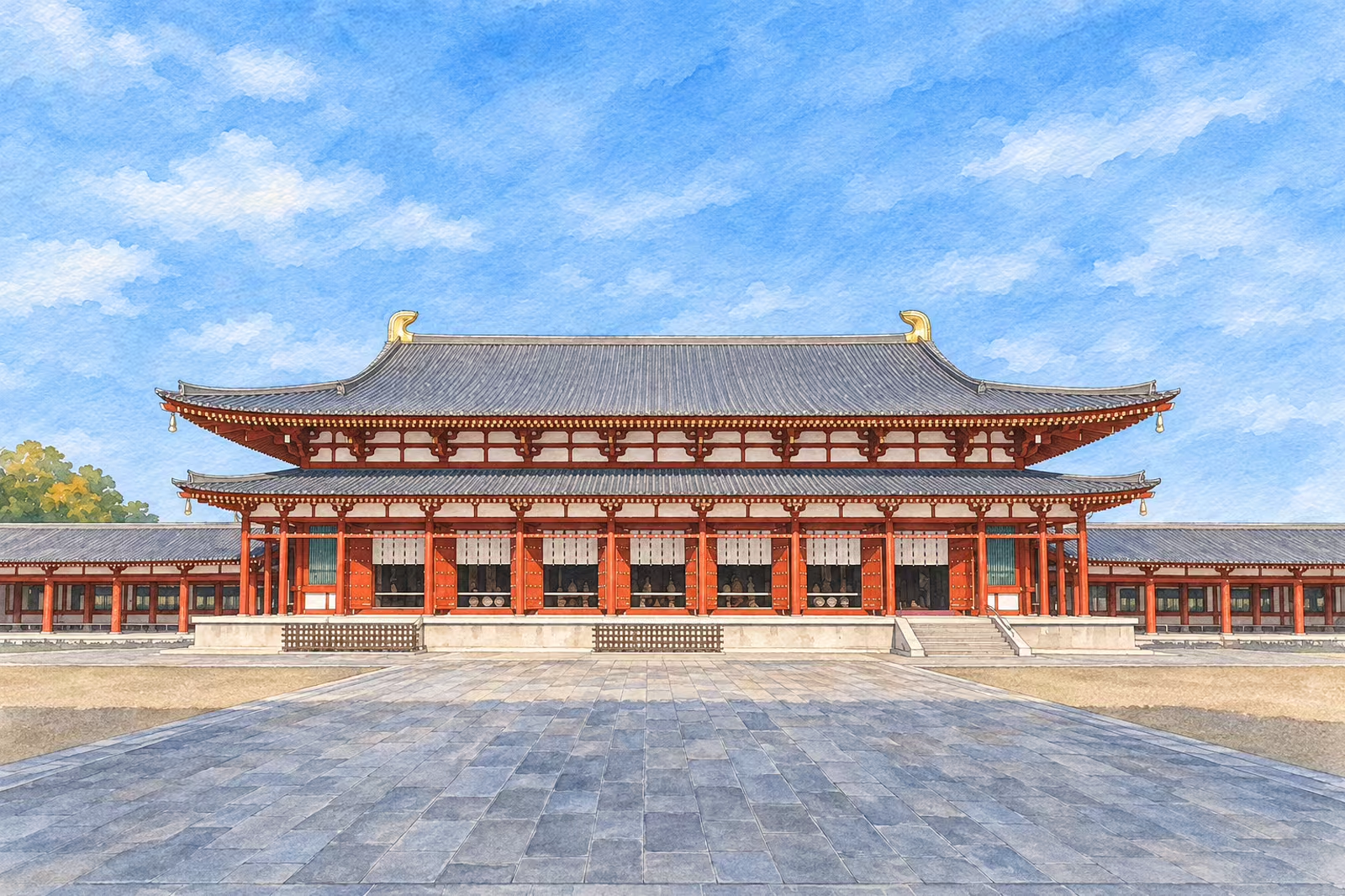
Yakushi-ji, in the Nishinokyō district of Nara City, Nara Prefecture, is a head temple of the Hossō school of Buddhism. It was vowed by Emperor Tenmu and moved from Fujiwara-kyō to Heijō-kyō in the early 8th century, following the shift of the capital. Its East Pagoda is one of the few buildings to survive from the Nara period, and the bronze Yakushi triad in its Main Hall is among the finest early Japanese sculpture. In 1998 the temple was inscribed on the World Heritage List as part of the Historic Monuments of Ancient Nara.
01Founding and the move to Nara
In 680, when his consort, the future Empress Jitō, fell ill, Emperor Tenmu vowed to build a temple to pray for her recovery. Tenmu died in 686, and Jitō carried the project forward; according to the Shoku Nihongi and other records, images were consecrated around 697. The first Yakushi-ji stood in Fujiwara-kyō, at a site in present-day Kashihara now called Moto-Yakushi-ji. After the capital moved to Heijō-kyō in 710, the temple was established at its present location around 718. Scholars still disagree over whether, and when, the images and buildings were moved from the older site to the new one.
The Nara-period layout placed the Main Hall at the center with a three-story pagoda on each side, an arrangement known as the Yakushi-ji style. Disaster struck repeatedly: a fire in 973 destroyed many halls, and fighting in 1528 burned the Main Hall, the West Pagoda and other buildings. The East Pagoda and the Tōindō escaped both.
02Modern reconstruction
From 1968, the abbot Takada Kōin led a fundraising campaign built around sutra copying: believers copied the Heart Sutra and offered it along with a donation, with a goal of one million copies. These funds paid for the reconstruction of the Main Hall in 1976 and the West Pagoda in 1981, followed by the Middle Gate, cloister, Great Lecture Hall (2003) and refectory. The rebuilding drew on excavation and on study of the East Pagoda, and the West Pagoda was painted in vermilion and green, in sharp contrast to the weathered wood of its older twin.
03What can be seen today
The East Pagoda has three stories, but a smaller pent roof under each main roof makes it look like six. Temple tradition dates it to 730, and it is a National Treasure. A full dismantling and repair began in 2009, and a completion ceremony was held around 2023. The gilt-bronze seated Yakushi with the standing Bodhisattvas Nikkō and Gakkō in the Main Hall form the Yakushi triad, also a National Treasure. The Tōindō is thought to be a Kamakura-period rebuilding from the late 13th century; the hall and its bronze standing Shō Kannon are both National Treasures. The Great Lecture Hall houses a Buddha’s footprint stone carved in 753 and a stone tablet inscribed with poems in praise of the footprints, both National Treasures.
Yakushi-ji
01A Temple for a Sick Empress
Yakushi-ji began with an illness. In 680, according to the Nihon shoki (Chronicles of Japan, the official history completed in 720), the consort of Emperor Tenmu fell seriously ill. Tenmu vowed to build a temple dedicated to Yakushi Nyorai, the Buddha of Healing, and ordered a hundred men to take monastic vows on her behalf. The temple took its name from that Buddha: Yakushi-ji means "Temple of the Healing Buddha."
Tenmu was one of the most consequential rulers of early Japan. He had seized the throne in 672 by winning the Jinshin War, a short civil war over the succession, and spent the rest of his reign building the institutions of a centralized state on the Chinese model: law codes, a reorganized court hierarchy, an official history, and plans for a permanent capital. Yakushi-ji was part of this project. It was a state temple, built in the emperor’s name and charged with praying for the ruler and the realm, not the private foundation of a noble clan.
The empress recovered. It was Tenmu who died, in 686, with the temple far from finished. His widow took the throne as Empress Jitō and carried the work forward. A great vegetarian feast for monks was held at the temple in 688, the main image was consecrated in 697, and by 698 the Shoku Nihongi (the continuation of the official history) reports that construction was essentially complete and monks were installed. From vow to completion the project spanned nearly two decades and three reigns.
The founding story is also recorded on the temple itself. An inscription on the metal finial shaft of the East Pagoda recounts Tenmu’s vow for his consort and Jitō’s completion of the work after his death.
02The First Yakushi-ji at Fujiwara
The temple you are standing in is not the original site. The first Yakushi-ji stood about 20 kilometers to the south, in Fujiwara-kyō, the capital Jitō moved into in 694. Fujiwara was Japan’s first large capital laid out on a Chinese-style grid, and Yakushi-ji was one of its principal temples.
In 710 the court moved again, to Heijō-kyō, the city we now call Nara. By the traditional account, Yakushi-ji was transferred to the new capital in 718 and rebuilt on its present site in the western part of the city. The old temple at Fujiwara did not disappear at once. Known as Moto-Yakushi-ji, "the original Yakushi-ji," it continued for some time before falling into decline.
The site of Moto-Yakushi-ji, in the city of Kashihara, is now a Special Historic Site. Foundation stones of its main hall and twin pagodas still sit among the rice fields, and in summer the surrounding fields are planted with water hyacinths that draw photographers. The layout matches the Nara temple closely, which makes it worth a detour if you want to see where the story started.
03Moved or Rebuilt?
When Yakushi-ji came to Nara, were its buildings and statues dismantled and carried north, or was everything made new? This question, the so-called relocation debate, occupied Japanese art and architectural historians for more than a century.
The argument centered on the East Pagoda and the bronze Yakushi triad in the Main Hall. Those who argued for relocation saw in them the style of the late seventh century, the age of Tenmu and Jitō. Those who argued for new construction saw the more mature technique of the Nara period.
Excavation at Moto-Yakushi-ji showed that the Fujiwara temple kept its buildings after the move, which weakened the case for wholesale relocation. The decisive evidence came from the East Pagoda itself. During the full dismantling and repair that began in 2009, tree-ring dating of its timbers showed that some had been felled around 729 and 730. This fits an old written record that the pagoda was built in 730. Most scholars now accept that the East Pagoda was built new in Nara.
The bronze triad is a different matter. Whether it was cast at Fujiwara and moved, or cast fresh in Nara, remains unresolved.
04Two Pagodas and a Main Hall
Look around the central courtyard and you will see the plan that made this temple famous: a Main Hall (Kondō) on the central axis, with two identical three-story pagodas standing to its east and west, all enclosed by a roofed corridor. Architectural historians call this the Yakushi-ji style of temple layout.
Earlier Japanese temples generally had a single pagoda. At Asuka-dera the pagoda stood at the center, surrounded by three halls; at Shitennō-ji the pagoda and hall lined up one behind the other; at Hōryū-ji they stand side by side. At Yakushi-ji the pagoda doubled and stepped aside, and the Main Hall, which houses the Buddha image, took the center. The shift is usually read as a change in emphasis from the pagoda, which held relics of the Buddha, to the hall, which held images for worship. A few decades later, Tōdai-ji also built twin pagodas but placed them outside the corridor altogether.
In the Nara period the temple was much larger than what survives. Besides the Main Hall and pagodas, it had a lecture hall, a refectory, monks’ dormitories, a sutra repository and a bell tower, and it occupied a full block of the city grid.
05The East Pagoda
The East Pagoda (Tōtō) is the only building at Yakushi-ji that survives from the Nara period, and one of very few anywhere from the age of the Heijō capital. It is a National Treasure.
Count the roofs and you will get six. The pagoda has only three stories, but each has a smaller pent roof, called a mokoshi, beneath its main roof. The alternation of large and small eaves gives the tower its distinctive rhythm. It stands about 34 meters tall.
Visitors are often told that Ernest Fenollosa, the American scholar who studied Japanese art in the Meiji period, called it "frozen music." The phrase has stuck to the pagoda for generations, but no one has found it in Fenollosa’s own writings, and it is generally regarded as a later attribution.
At the top of the spire is the suien, an openwork bronze ornament shaped like flames or spray. Yakushi-ji’s version is pierced with celestial beings playing flutes, scattering flowers and flying through the air, and it is counted among the finest metalwork of the period.
Beginning in 2009 the pagoda was taken apart down to its platform and reassembled, its first full dismantling repair in about 110 years; the work was completed in 2021. Archaeologists excavated the platform, timbers that could not be reused were replaced, and the original Nara-period suien was taken down for preservation and replaced on the spire with a faithful new casting. The formal dedication ceremony was delayed by the COVID-19 pandemic and finally held in April 2023.
06The Healing Buddha Triad
Inside the Main Hall is the Yakushi triad, one of the masterpieces of ancient Japanese bronze sculpture and a National Treasure.
The seated Yakushi Nyorai at the center is about two and a half meters tall. He is flanked by two standing bodhisattvas, Nikkō (Sunlight) and Gakkō (Moonlight), each more than three meters tall. The statues were originally gilded, but fire stripped away most of the gold, leaving the dark, glossy bronze you see today. The two bodhisattvas turn slightly toward the center, hips gently swaying, their drapery falling in naturalistic folds. The influence of early Tang Chinese sculpture is plain.
The pedestal of the central figure deserves a close look. It is decorated with grapevine scrolls, the Four Directional Animals (the Azure Dragon, White Tiger, Vermilion Bird and Black Tortoise), and squatting figures often described as foreigners. These motifs came to Japan by way of Tang China and ultimately from Central Asia and beyond, and the pedestal is often cited as a link between Nara and the Silk Road.
07Fire and War
Over its long history Yakushi-ji suffered repeated destruction.
A fire in 973 burned the lecture hall, the monks’ quarters, the south gate and other buildings, though the Main Hall and both pagodas were spared. The temple recovered gradually.
The worst blow came in 1528, during the civil wars of the sixteenth century. Fighting among local warriors in Yamato Province reached the temple, and fire consumed the Main Hall, the West Pagoda, the lecture hall, the middle gate and the monks’ quarters. Of the major buildings, only the Nara-period East Pagoda survived, together with the Kamakura-period East Hall in a separate precinct.
For the next four centuries Yakushi-ji was a fragment. In 1600 the warlord Mashita Nagamori paid for a modest Main Hall on the old site. It served until 1975, when it was moved to Kōfuku-ji to make way for the new hall and became that temple’s temporary Main Hall. The West Pagoda site was marked only by foundation stones. Until the mid-twentieth century, visitors found the East Pagoda standing almost alone among the remains of the old compound.
08The East Hall and Other Treasures
East of the main precinct is the Tōin-dō, the East Hall. It was founded in the Nara period by Princess Kibi, who dedicated it to her mother, Empress Genmei. The present building dates from 1285, in the Kamakura period, and is a National Treasure.
Inside is a standing bronze Shō Kannon, the bodhisattva of compassion, also a National Treasure. Upright and serene, its robe clinging closely to the body, it belongs with the Main Hall’s bodhisattvas among the finest bronzes of the late seventh and eighth centuries, though its exact date is debated.
The temple holds other treasures as well. A Nara-period painting on hemp cloth of Kichijōten, a goddess of good fortune, shows a full-figured woman in rich robes; it is one of the most celebrated ancient paintings in Japan and is usually shown only at the New Year. A stone carved in 753 with the Buddha’s footprints is accompanied by a stele inscribed with twenty-one poems in praise of the footprints, in a verse form named after it. Three early Heian wooden statues of Shinto deities, the Hachiman god in the form of a Buddhist monk with Empress Jingū and Princess Nakatsu, belong to the temple’s guardian shrine, Yasumigaoka Hachimangū. All of these are National Treasures.
The temple also produced a well-known author. Kyōkai, a monk of Yakushi-ji in the early Heian period, compiled the Nihon ryōiki, the oldest collection of Buddhist tales in Japan.
09The Hossō School and the Flower Ceremony
Yakushi-ji belongs to the Hossō school of Buddhism and, together with Kōfuku-ji in Nara, serves as one of its two head temples. Hossō traces its teaching to the Chinese pilgrim Xuanzang and his disciple Kuiji, and centers on the doctrine that all phenomena arise from consciousness. It came to Japan with monks who had studied in Tang China.
The best-known annual rite is the Shuni-e, popularly called Hana-eshiki, the Flower Ceremony. According to temple tradition, in 1107 Emperor Horikawa prayed here for the recovery of his empress, and court ladies afterward offered ten kinds of artificial flowers made of paper and cloth before the Buddha. The ceremony is now held each year from March 25 to 31, when the Main Hall is filled with ten kinds of handmade flowers, among them plum, cherry, peony and chrysanthemum. On the final evening it ends with a demon-chasing rite, the Oni-oi-shiki, in front of the hall.
10A Million Sutras: The Twentieth-Century Revival
The bright buildings around you are the result of one of the most remarkable temple restorations in modern Japan.
It was driven by Takada Kōin, who became chief abbot in 1967 and launched the campaign the following year. He resolved to rebuild the Main Hall lost in 1528, but the temple had no money. He asked ordinary people to hand-copy the Heart Sutra and send it to the temple with an offering of 1,000 yen per copy. This was the Million Sutra Copying Campaign. Takada traveled the country giving talks, and his humor and plain speech drew large audiences; copies arrived from all over Japan.
The Main Hall was completed in 1976, the year the millionth copy arrived. The West Pagoda followed in 1981 and the middle gate in 1984, and the corridors, Great Lecture Hall and Refectory were restored in turn. The Great Lecture Hall was completed in 2003 and the Refectory in 2017. Together these reconstructions in the Nara-period style are called the Hakuhō Garan, after the art-historical name for the late seventh century.
The Main Hall and West Pagoda were built under Nishioka Tsunekazu, a miya-daiku, or master carpenter of temples and shrines, who had worked on the Shōwa-era restoration of Hōryū-ji. He deliberately built the West Pagoda slightly taller than the East, reasoning that the wood would shrink and settle over the centuries until the two stood level. With its fresh vermilion and green paint, the West Pagoda gives a fair idea of how the East Pagoda looked when new.
In 1991 a separate compound dedicated to Xuanzang, enshrining a relic of his skull, was completed north of the main precinct. A hall there houses the Great Tang Western Regions murals by the painter Hirayama Ikuo, depicting landscapes along Xuanzang’s route to India, finished in 2000 and dedicated on New Year’s Day 2001.
In 1998 Yakushi-ji was inscribed on the UNESCO World Heritage List as part of the Historic Monuments of Ancient Nara.
11Walking the Temple
Most visitors enter from the south. Pass through the middle gate and you are inside the corridor, in the heart of the reconstructed compound.
Straight ahead is the Main Hall with the Yakushi triad. Walk around to the side of the central figure for a look at the pedestal, with its grapevines, directional animals and foreign figures.
Back in the courtyard, compare the two pagodas. The East Pagoda, weathered and dark, is the eighth-century original. The West Pagoda, bright vermilion, dates from 1981. They share the same design, separated by about twelve and a half centuries. Look closely and you may see that the West Pagoda is a little taller.
Behind the Main Hall is the Great Lecture Hall, which houses a Maitreya triad. The Buddha’s footprint stone and the poem stele are displayed here.
Leave the corridor on its east side for the East Hall and its Shō Kannon. Its Kamakura architecture stands apart from the reconstructions around it.
The Refectory north of the corridor contains paintings by Tabuchi Toshio, including an Amida triad in the Pure Land. Across the road to the north is the Xuanzang compound with Hirayama’s murals, which are usually open only during set periods such as the New Year.
From the north gate, a walk of about ten minutes brings you to Tōshōdai-ji, the temple founded by the Chinese monk Jianzhen (Ganjin). The two temples of western Nara are often visited on the same day.