
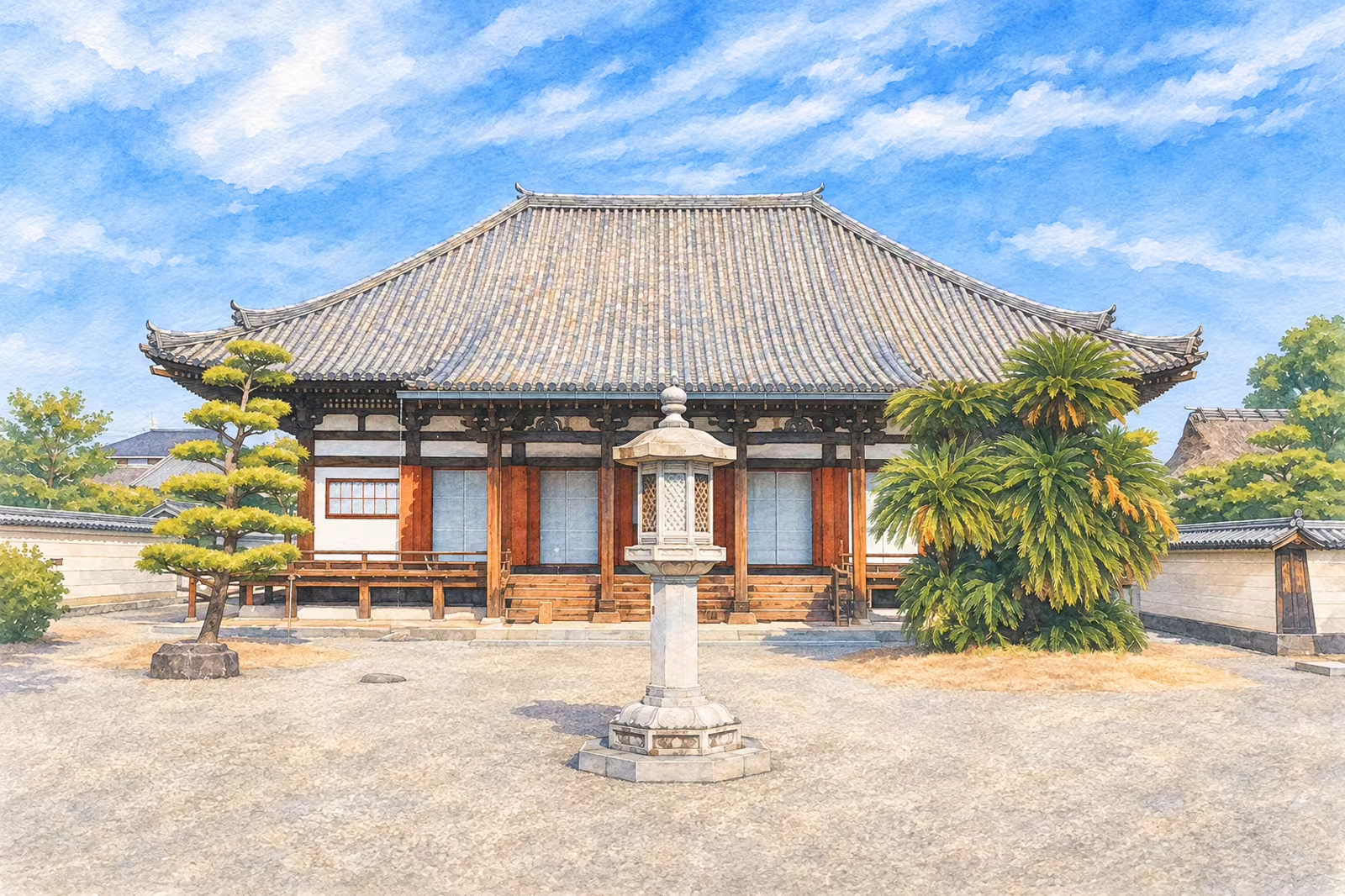
Hokke-ji is a Buddhist convent in Nara City, Nara Prefecture, just east of the Heijō Palace Site. Empress Kōmyō founded it on the former estate of her father, Fujiwara no Fuhito, and in the Nara period it served as the head of the provincial nunneries, the counterpart to Tōdai-ji as head of the provincial monasteries. The present temple is small, but it keeps traces of the religious standing of women in the Nara court and a celebrated National Treasure statue of the Eleven-Headed Kannon.
01Empress Kōmyō and the head nunnery
Kōmyō was Fujiwara no Fuhito’s daughter and Emperor Shōmu’s empress. Fuhito’s residence later became her palace, and around 745 it was converted into a temple. In 741 Shōmu had ordered every province to build a monastery and a nunnery, and Hokke-ji became the center of the nunnery network, with the formal name Hokke Metsuzai no Tera, roughly "temple for the eradication of sins through the Lotus Sutra." In the Nara period the complex was large, with a main hall, a lecture hall and two pagodas.
After the capital moved away in the late eighth century, the temple declined. In the Kamakura period Eison of Saidai-ji, who led a revival of monastic discipline, also restored ordination for nuns at Hokke-ji, which again became an important convent. For centuries afterward it was headed by women of imperial or court-noble birth, giving it the status of a monzeki convent.
02War, earthquake and the rebuilding of 1601
Warfare in the sixteenth century and the great Keichō earthquake of 1596 left the temple badly damaged. Around 1601 Toyotomi Hideyori and his mother Yodo-dono paid for the rebuilding of the main hall, and the south gate and bell tower date to roughly the same period. All three are Important Cultural Properties. The builders are said to have reused some older timber in the main hall.
03What can be seen today
The principal image, a standing Eleven-Headed Kannon, is an early Heian-period sculpture about one meter tall, carved from a single block of kaya (Japanese nutmeg-yew) wood, and is a National Treasure. Temple tradition holds that it was modeled on Empress Kōmyō, a story best read as devotional legend. The statue is normally hidden and shown only during a few periods each year; at other times a replica stands in its place. The temple also holds other National Treasures, including a seated statue of the layman Vimalakīrti, along with Important Cultural Properties.
The precinct’s bathhouse is a steam bath linked to the legend that Empress Kōmyō vowed to bathe the sick and poor with her own hands; the present building dates from 1766. The temple garden is a designated Place of Scenic Beauty, generally thought to date from the early Edo period. Hokke-ji lies within the Nara area covered by the Historic Monuments of Ancient Nara but is not itself one of the World Heritage component sites. As of the 2020s it is the head temple of the Kōmyō sect.