
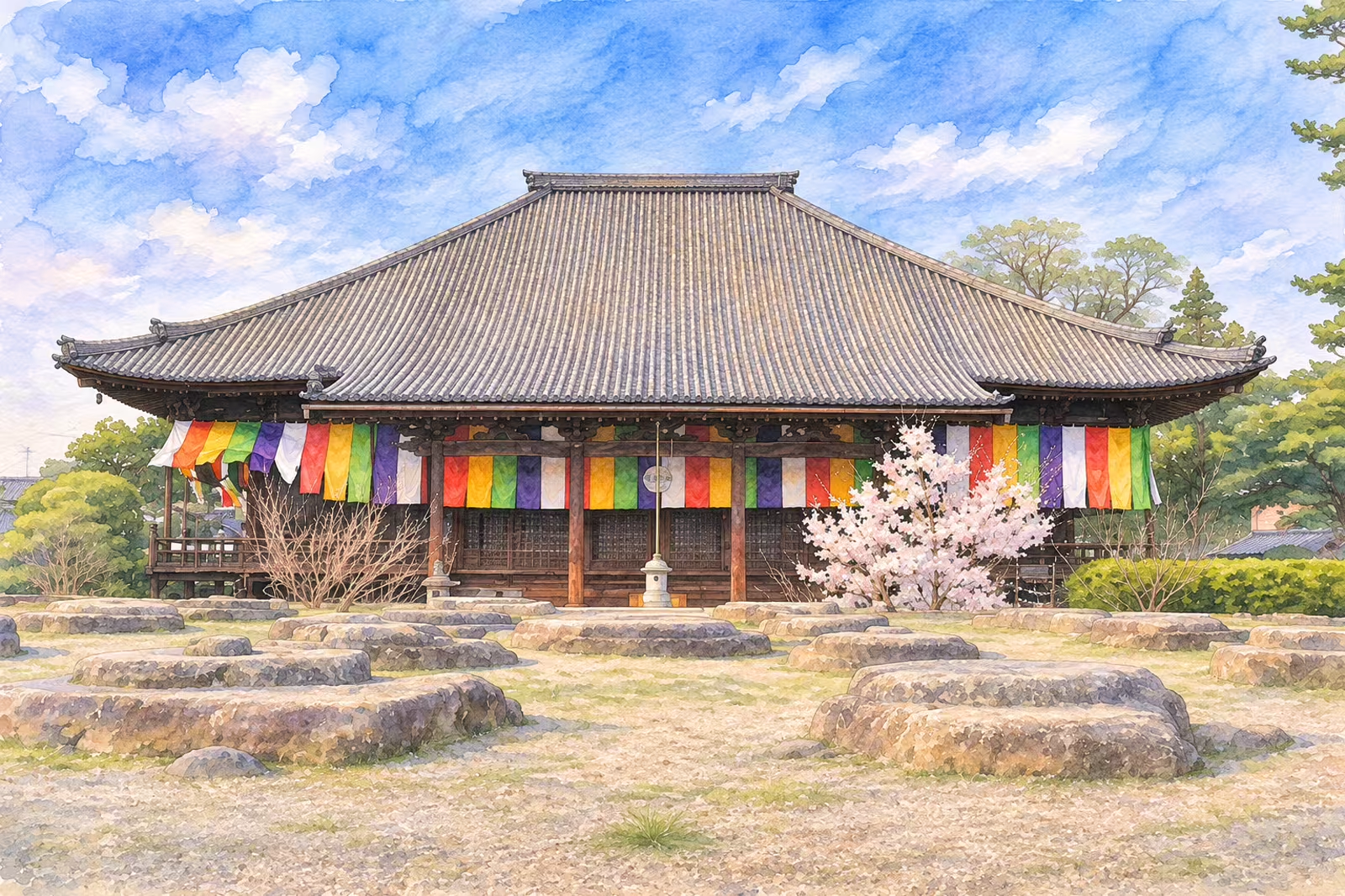
Saidai-ji, in the northwest of Nara City, Nara Prefecture, is the head temple of the Shingon Ritsu school of Buddhism. It was founded in the Nara period by Empress Shōtoku as a great state temple, and its name, "Great Western Temple," was meant as a counterpart to Tōdai-ji, the "Great Eastern Temple." After centuries of decline it was revived in the 13th century by the monk Eison, who made it a center of a movement to restore monastic discipline. The precinct today is much smaller than the original, and most buildings date from the Edo period, but it keeps Nara-period foundations and important Kamakura-period sculpture.
01An imperial foundation and its decline
In 764, during the rebellion of Fujiwara no Nakamaro (Emi no Oshikatsu), the retired sovereign Kōken vowed to cast gilt-bronze images of the Four Heavenly Kings if order were restored. After the revolt was crushed she returned to the throne as Empress Shōtoku, and construction of Saidai-ji began around 765. Later records describe a vast precinct with two main halls dedicated to Yakushi and Miroku, an east and a west pagoda, and more than a hundred buildings. After the empress died in 770, court support dwindled, and fires and storms during the Heian period left the temple greatly reduced.
02Eison’s revival
In 1235 the monk Eison settled at the run-down temple. He insisted that monks return to strict observance of the Vinaya precepts, conferred precepts on clergy and lay people, and led his followers in charitable work for the poor and sick, as well as bridge building and temple repair. His lineage became the Shingon Ritsu school. Eison was also asked by the court to pray for the repulse of the Mongol invasions. The temple’s Ōchamori, in which participants share tea from an enormous bowl, is traditionally traced to a tea offering Eison made in 1239 and is still held today.
03What survives
The present Main Hall is a large building reconstructed in the mid-to-late 18th century. Its principal image, a standing Shaka, was made in 1249 as a copy of the famous Shaka of Seiryō-ji in Kyoto, at Eison’s request. The Shiōdō (Hall of the Four Kings) was rebuilt in 1674 on its Nara-period platform; its guardian figures are later works, though the demons beneath their feet are thought to include fragments of the original statues. The Aizendō, a former residence of the Konoe family moved from Kyoto, houses a seated Aizen Myōō commissioned by Eison and a portrait statue of Eison completed in 1280, both National Treasures. The foundation of the east pagoda can still be seen, and Eison’s stone gorintō grave stands in the inner precinct. The temple grounds are a designated Historic Site, and the Main Hall and other buildings are Important Cultural Properties.