
Kōfuku-ji is a major temple in Nara City, Nara Prefecture, on the western edge of Nara Park near Kintetsu Nara Station, and a head temple of the Hossō school of Buddhism. It began as the family temple of the Fujiwara clan, was long bound up with the neighboring Kasuga Shrine, and in the medieval period effectively governed Yamato Province. Its five-storied pagoda is a landmark of the Nara skyline, and its Nara-period sculptures, above all the statue of Ashura, are among the best known in Japan.
01The Fujiwara family temple
According to temple tradition, in 669 the wife of the ailing Fujiwara no Kamatari, Kagami no Ōkimi, founded a temple at their estate in Yamashina, known as Yamashina-dera. It later moved to Asuka as Umayasaka-dera. When the capital moved to Heijō-kyō in 710, Kamatari’s son Fujiwara no Fuhito moved the temple to the eastern edge of the new city and renamed it Kōfuku-ji. Emperors, empresses and Fujiwara leaders kept adding halls: the Hokuendō in 721 in memory of Fuhito, the Eastern Golden Hall in 726 by Emperor Shōmu, and the five-storied pagoda in 730 by Empress Kōmyō.
In the Heian period Kōfuku-ji grew with the fortunes of the Fujiwara, controlling armed monks and extensive estates; together with Enryaku-ji it was known as one of the two great powers of "the southern capital and the northern peak." In 1180 Taira no Shigehira burned Nara, destroying most of Kōfuku-ji and Tōdai-ji. The temple was rebuilt in the Kamakura period, with sculptors of the Kei school such as Unkei taking part. In the medieval period Kōfuku-ji exercised the functions of provincial constable (shugo) over Yamato. During the separation of Buddhism and Shinto and the anti-Buddhist movement of the early Meiji years, it lost most of its land and clergy and fell into deep neglect; a popular story claims the pagoda was once offered for sale for a trifling sum.
02What can be seen today
Repeated fires mean the surviving buildings come from many periods. The Hokuendō, rebuilt around 1210, is the oldest. The three-storied pagoda dates from the Kamakura period, the Eastern Golden Hall was rebuilt in 1415, and the five-storied pagoda in 1426. At about 50 meters, the pagoda is the second-tallest wooden pagoda in Japan after Tō-ji’s. All four are National Treasures. The Nan’endō, an octagonal hall rebuilt in the late Edo period, is a stop on the Saigoku Thirty-Three Kannon pilgrimage. The Central Golden Hall stood for centuries only as a temporary structure after a fire in 1717, and was reconstructed in 2018 on the basis of excavation and written records.
The National Treasure Museum holds many statues that once stood in the halls, including the dry-lacquer Ashura and the other Eight Guardians, made in 734 for a memorial service for Empress Kōmyō’s mother, statues of the Ten Great Disciples, and a bronze Buddha head that originally belonged to Yamada-dera. Kōfuku-ji was inscribed in 1998 as part of the World Heritage property Historic Monuments of Ancient Nara. As of 2025, the five-storied pagoda is undergoing its first major repair in about 120 years; it is enclosed in scaffolding, with work expected to run into the early 2030s.
Kōfuku-ji
01A Temple Without Walls
Most visitors arrive at Kōfuku-ji without quite realizing they have entered it. Walk east from Kintetsu Nara Station along Noboriōji Avenue and the trees on your right open onto a broad gravel expanse, with deer wandering across it and a cluster of halls and pagodas scattered around the edges. There is no gate to pass, no wall, no ticket booth at the entrance. It feels like part of Nara Park, and in a legal sense it once was.
That openness is the result of a long history of loss. For roughly a thousand years Kōfuku-ji was one of the richest and most powerful institutions in Japan: the clan temple (ujidera, a temple founded and supported by a single aristocratic lineage) of the Fujiwara, the family that dominated the imperial court for centuries. In the Middle Ages it effectively governed the whole province of Yamato, the region around Nara. Its precinct was enclosed, crowded with halls, sub-temples and monks’ quarters. What you see today is the frame of that complex after a series of fires, a nineteenth-century government campaign against Buddhism, and a slow modern recovery that is still going on.
02From Yamashina to Nara
The temple’s story begins with Nakatomi no Kamatari, the courtier who in 645 helped Prince Naka no Ōe assassinate Soga no Iruka, head of the overbearing Soga clan, inside the palace at Asuka. That coup opened the way to the Taika Reforms, the program that remade the Japanese state on the Chinese model. According to temple tradition, Kamatari had vowed before the coup to commission a set of Buddhist images if the plot succeeded.
In 669, when Kamatari lay ill, his wife Kagami no Ōkimi founded a chapel at their residence in Yamashina, on the eastern side of what is now Kyoto, to house that Shaka (the historical Buddha) triad and pray for his recovery. It became known as Yamashina-dera. Kamatari died that year; as he lay dying, Emperor Tenji granted him the new surname Fujiwara, and his descendants carried it from then on.
The temple moved with the capital. After the Jinshin War of 672 it was relocated to Umayasaka in Asuka and called Umayasaka-dera. When Empress Genmei moved the court to the new capital of Heijō-kyō in 710, Kamatari’s son Fujiwara no Fuhito transferred the temple again, to a rise on the eastern edge of the new city, and gave it the name Kōfuku-ji, "temple for the promotion of blessings." The temple counts 710 as its founding year and marked its 1,300th anniversary in 2010.
Fuhito was the most powerful man at court in the early eighth century. He helped compile the Taihō and Yōrō legal codes, and he married his daughters into the imperial line: Miyako became consort to Emperor Monmu and mother of Emperor Shōmu, and Kōmyōshi became Shōmu’s empress. Because of these ties, Kōfuku-ji was never only a private family chapel. Emperors and empresses built halls in it, and it ranked among the Seven Great Temples of Nara alongside Tōdai-ji, Yakushi-ji, Gangō-ji and others.
03A Hall for Every Mourning and Every Illness
Nearly every major building at Kōfuku-ji began as an act of piety by a specific member of the Fujiwara or the imperial house.
The Central Golden Hall (Chūkondō) was Fuhito’s own project and housed the Shaka image inherited from Kamatari. After Fuhito died in 720, Retired Empress Genmei and Empress Genshō built the octagonal Northern Round Hall (Hokuendō) in 721 for the first anniversary of his death. In 726 Emperor Shōmu built the Eastern Golden Hall (Tōkondō) to pray for the recovery of his aunt, the retired Empress Genshō, and installed a Yakushi, the Buddha of healing. In 730 Empress Kōmyō added the five-story pagoda. In 734 she built the Western Golden Hall (Saikondō) in memory of her mother, Agata Inukai no Michiyo, who had died the year before.
A century later, in 813, Fujiwara no Fuyutsugu of the clan’s Northern House built a second octagonal hall, the Southern Round Hall (Nan’endō), in memory of his father Uchimaro, to house an image of Fukūkenjaku Kannon, a form of the bodhisattva of compassion holding a lasso to rescue beings. Fuyutsugu’s descendants became the regents who ran the court through the Heian period, and later family tradition credited that Kannon with the Northern House’s rise. At its height the temple had three golden halls, two octagonal halls, a pagoda, a lecture hall, a refectory, cloisters, and a great south gate.
04Ashura and the Western Golden Hall
The single most famous object at Kōfuku-ji today came from Empress Kōmyō’s memorial hall for her mother. The Western Golden Hall was filled with a large group of sculptures: a central Buddha, attendant deities, the Eight Legions (hachibushū, eight classes of supernatural beings converted to protect Buddhism), and the Ten Great Disciples of the Buddha. Records preserved in the Shōsōin, the imperial storehouse at Tōdai-ji, name the chief sculptor as Shōgun Manpuku.
These statues were made in hollow dry lacquer. Sculptors shaped a clay core, covered it with layers of hemp cloth soaked in lacquer, removed the clay once the shell hardened, and modeled fine details in a paste of lacquer and sawdust over a wooden armature. The method was expensive but produced remarkably light figures. The Western Golden Hall itself burned several times and was never rebuilt after 1717, yet most of the dry-lacquer figures survived, and it is generally thought that their lightness let monks carry them out of burning buildings.
Among the Eight Legions is Ashura. In Indian myth the asuras are warlike demigods; in Buddhist iconography Ashura is often fierce. The Kōfuku-ji Ashura is instead a slender adolescent with three faces and six thin arms, the main face wearing a slight frown that viewers have read as concentration, remorse, or quiet sorrow. Nobody knows what the sculptor intended, and the many interpretations remain just that. The statue has become one of the best-loved images in Japan. When it traveled to the Tokyo National Museum and the Kyushu National Museum in 2009 for exhibitions marking the temple’s 1,300th anniversary, visitors queued for hours to see it.
05A Temple of Scholarship
Kōfuku-ji is the head temple of the Hossō school, which teaches the Yogācāra, or "consciousness-only," philosophy carried from India to China by the pilgrim Xuanzang in the seventh century. Hossō doctrine is famously technical, concerned with the analysis of mind and perception, and the temple was for centuries a place where monks trained in rigorous debate.
Several Japanese monks brought Hossō teaching back from Tang China. The most colorful was Genbō, who spent nearly twenty years there and returned in 735 with the scholar Kibi no Makibi and a large collection of scriptures. He became a favorite of Emperor Shōmu and Empress Kōmyō and wielded real political influence before his rivals had him exiled to Kyūshū, where he died.
The temple’s great annual lecture, the Yuima-e, expounded the Vimalakīrti Sutra. Tradition says it began when a nun from Paekche, on the Korean peninsula, recited from that sutra for the ailing Kamatari and he recovered. In the Heian period it was one of the "Three Lectures of the Southern Capital," and serving as lecturer at these assemblies was a required step toward high office in the Buddhist hierarchy. Kōfuku-ji thus controlled one of the main ladders of clerical promotion.
06The Sacred Branch and the Rule of Yamato
Just east of the temple stands Kasuga Taisha, the shrine of the Fujiwara clan deities, founded around 768. Under the medieval fusion of Buddhist and Shinto belief, the Kasuga deities were understood as manifestations of Buddhas and bodhisattvas, and Kōfuku-ji came to administer the shrine as part of a single religious complex.
By the late Heian period the temple held vast estates and fielded armed monks, and it used the shrine as a political weapon. When the temple wanted to force a decision at court, its monks carried the Kasuga shinboku, a sacred sakaki branch hung with a mirror, in procession to Kyoto. As long as the branch remained in the capital, Fujiwara nobles, descendants of the Kasuga gods, could not attend court, and government ground to a halt. The monks of Enryaku-ji on Mount Hiei did the same with the portable shrines of Hie Shrine; together the two were known as "the Southern Capital and the Northern Peak." Retired Emperor Shirakawa famously listed the Hiei monks among the three things he could not control, along with the waters of the Kamo River and the roll of the dice; the Nara monks were no easier.
Under the Kamakura and Muromachi shogunates, Yamato never had an ordinary military governor. Kōfuku-ji filled that role in practice. Its two leading sub-temples, Ichijō-in and Daijō-in, were headed by sons of the regent families, and local warriors were organized as shuto, attached to the temple, or kokumin, attached to the shrine. The Tsutsui family, which later dominated Yamato, rose from the shuto. The diary of the Daijō-in abbot Jinson, kept through the years around the Ōnin War of 1467–1477, is one of the richest sources for fifteenth-century Japan. The temple’s political power ended only when Oda Nobunaga and Toyotomi Hideyoshi brought Yamato under their control. Hideyoshi’s land survey of 1595 fixed the combined holdings of Kōfuku-ji and Kasuga at about 21,000 koku of rice, still one of the largest religious domains of the Edo period.
07The Night of the Burning
The worst night in the temple’s history came on the twenty-eighth day of the twelfth month of 1180 (in January 1181 by the Western calendar). The Nara temples had sided against Taira no Kiyomori, the warlord who controlled the court, and Kiyomori sent his son Taira no Shigehira to subdue them. During the night fighting the Taira forces set fires, a strong wind spread them, and both Kōfuku-ji and Tōdai-ji were consumed, including Tōdai-ji’s Great Buddha Hall. Many people who had taken refuge in the temples died. Shigehira was later captured, and in 1185 he was handed over to the Nara monks and executed by the Kizu River.
Reconstruction began the following year, funded by the court, the Fujiwara and the temple’s own estates. Kujō Kanezane, who became regent and head of the Fujiwara clan in 1186, was closely involved, and his diary Gyokuyō is a main record of the work, while the monk Chōgen led the fund-raising campaign for Tōdai-ji. The two projects created a generation of work for Nara’s sculptors, above all the Kei school led by Kōkei and his son Unkei.
08Unkei and the Kei School
The Kei school’s work at Kōfuku-ji is among the finest sculpture in Japan. When the rebuilt Southern Round Hall was dedicated in 1189, Kōkei and his workshop supplied its seated Fukūkenjaku Kannon, Four Heavenly Kings, and seated portraits of six Hossō patriarchs; the Kannon and the patriarchs remain in that hall today.
Around 1212 Unkei, now an old man, completed a new image group for the rebuilt Northern Round Hall: a seated Miroku, the Buddha of the future, flanked by standing portraits of Muchaku and Seshin (Asaṅga and Vasubandhu), the fourth-century Indian brothers who founded the consciousness-only philosophy that Hossō follows. The two monks are slightly larger than life, one aged and one in middle age, with inlaid crystal eyes and heavy, convincing robes. They are often cited as the summit of Kamakura-period realism.
Two smaller figures in the museum show the school’s sense of humor. Tentōki and Ryūtōki, demon lantern-bearers originally made for the Western Golden Hall, carry lanterns on their shoulder and head; an inscription inside Ryūtōki dates it to 1215 and names Kōben, Unkei’s third son, as the sculptor. In the Eastern Golden Hall, the seated Yuima (Vimalakīrti), dated 1196 by an inscription naming the sculptor Jōkei, and the facing Monju (Mañjuśrī), attributed to Jōkei or another Kei-school sculptor, are also early Kamakura masterpieces.
09The Head from Yamada-dera
The museum also holds a bronze head about a meter high with a battered left side. It belonged to the Yakushi Buddha of Yamada-dera, a temple in Asuka; the statue was consecrated in 685 and is a key work of the late seventh century. In 1187, needing a main image for their rebuilt Eastern Golden Hall, Kōfuku-ji monks went to Yamada-dera and carried the statue off by force.
When the Eastern Golden Hall burned again in 1411, the body melted and only the head survived. A new main image was cast, and the old head was placed inside its pedestal and forgotten. It was rediscovered in 1937 during repairs to the hall.
10Halls That Survived and Halls That Did Not
Fires struck Kōfuku-ji repeatedly in the Middle Ages, and the buildings that stand today were mostly rebuilt on their old foundations in a deliberately archaic style.
The Northern Round Hall, completed around 1210, and the three-story pagoda share the title of oldest surviving buildings in the temple. The pagoda, first built in 1143 by Empress Kōkamon’in and destroyed in 1180, was rebuilt soon afterward in a light, slender style that preserves Heian-period taste. The Eastern Golden Hall burned in 1411 and was rebuilt in 1415 in a sober, Nara-style form; inside are a Muromachi-period bronze Yakushi with its two attendant bodhisattvas, and Kamakura-period figures of the Twelve Heavenly Generals. The five-story pagoda, lost in the same fire, was rebuilt around 1426. At about 50 meters it is the second-tallest wooden pagoda in Japan, after the pagoda of Tō-ji in Kyoto. A full-scale repair, the first since 1902, was launched in 2020; since 2023 the pagoda has been enclosed in a protective building, and the work is scheduled to finish in 2031.
Then in the first month of 1717 a fire that started in the lecture hall destroyed the Central Golden Hall, the Western Golden Hall, the Southern Round Hall, the middle and south gates and more. Neither the shogunate, the court nor the Fujiwara could fund a full rebuilding. The Southern Round Hall was finally completed again in 1789, and that is the building standing today. A smaller, temporary Central Golden Hall went up in 1819, paid for by Nara townspeople and built largely of pine, which aged quickly. The Western Golden Hall and the south gate were never rebuilt.
11Meiji and the Near Death of the Temple
The heaviest blow came after 1868, when the new Meiji government ordered the separation of Buddhism and Shinto. Kōfuku-ji and Kasuga had operated as one institution for a thousand years. Most of the temple’s monks gave up their vows and became Shinto priests of Kasuga Shrine. The temple’s lands were confiscated, its walls and sub-temples torn down, and much of the precinct became part of Nara Park when it opened in 1880.
A story told in Nara holds that the five-story pagoda was put up for sale for 25 yen, and that the buyer meant to burn it for its metal fittings but was stopped by neighbors afraid of fire. It is widely repeated but rests on later accounts rather than solid contemporary records.
The temple slowly revived. Under the 1897 law for the preservation of old temples and shrines, its halls and statues were designated national treasures. A treasure house, the Kokuhōkan, opened in 1959 to protect Ashura and the other sculptures, and in 1998 Kōfuku-ji was inscribed on the UNESCO World Heritage List as part of the Historic Monuments of Ancient Nara.
12The Central Golden Hall Returns
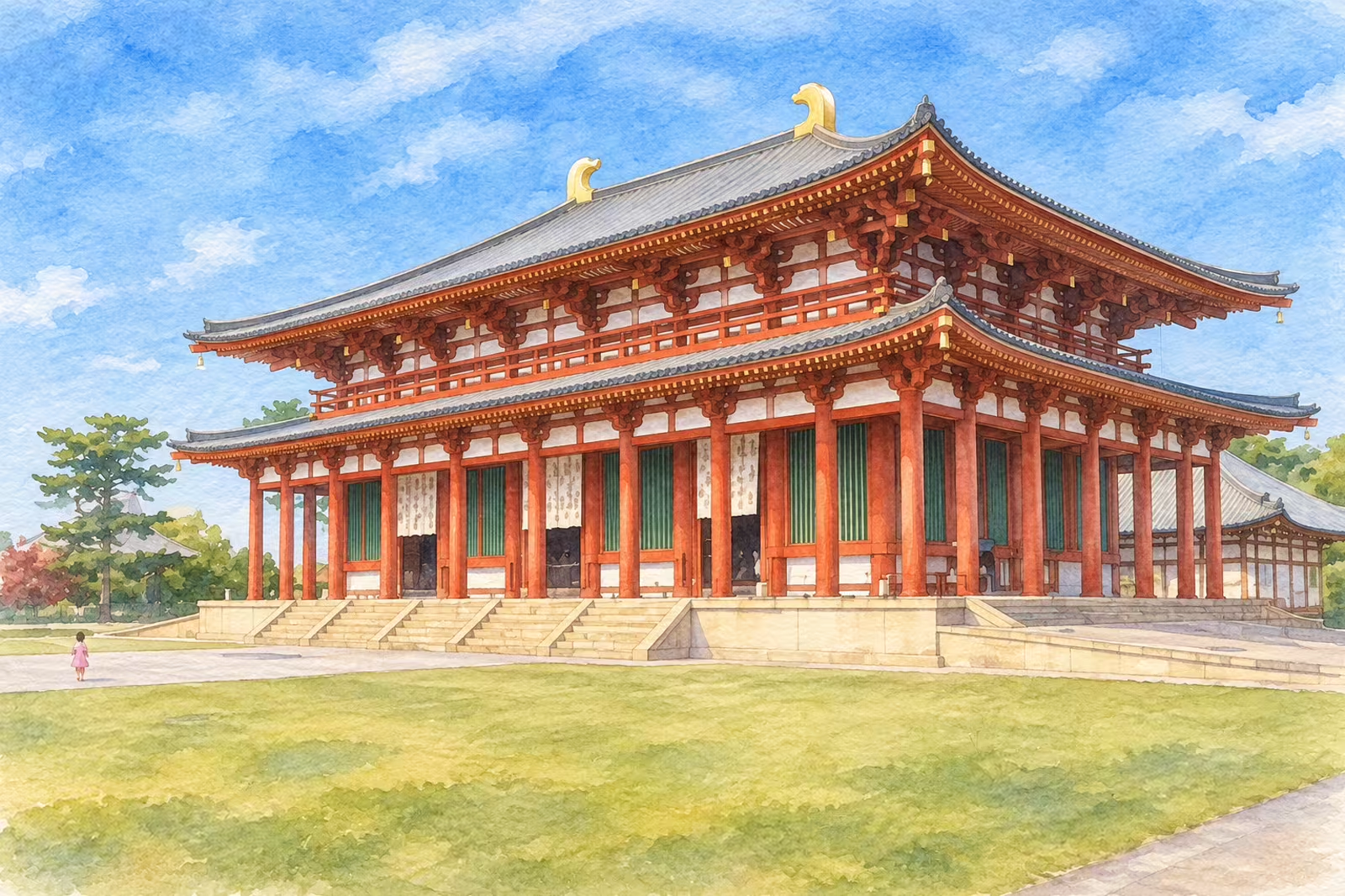
In the 1990s the temple launched a plan to restore the core of its Nara-period layout. The 1819 temporary hall was taken down in 2000, excavations confirmed the original foundation, and a new Central Golden Hall rose on the eighth-century plan. It was completed in 2018, three hundred years after the 1717 fire. It measures about 36.6 by 23 meters including its surrounding pent roof. Japan no longer has trees large enough for its sixty-six pillars, so the timber came from Africa. Inside sits a seated Shaka made around 1811, flanked by the bodhisattvas Yakuō and Yakujō and Kamakura-period figures of the Four Heavenly Kings, which many scholars believe Unkei originally made for the Northern Round Hall. In 1975 the temple had also moved the disused Muromachi-period golden hall of Yakushi-ji onto the site of its lecture hall as a stand-in golden hall; since 2018 it has served as a temporary lecture hall.
13Walking the Precinct
From Sarusawa Pond, climb the fifty-two stone steps on the north side; this was the old approach from the south, and at the top is the site of the south gate. Look north and the vermilion Central Golden Hall fills the view, standing where Fuhito’s hall stood. The open ground in front of it marks where the middle gate and cloisters once enclosed the inner courtyard.
To your left (west) is the bare platform of the Western Golden Hall, and down a slope beyond it the octagonal Southern Round Hall, the ninth stop on the Saigoku pilgrimage to thirty-three Kannon temples, almost always busy with pilgrims. Many visitors miss the three-story pagoda tucked in the trees below it.
North of the Central Golden Hall, on the site of the lecture hall, stands the temporary lecture hall brought from Yakushi-ji, and in the trees to the northwest stands the Northern Round Hall, usually closed except during spring and autumn openings. To the east are the Eastern Golden Hall, normally open, and the five-story pagoda beside it. Behind the Eastern Golden Hall is the National Treasure Museum, built on the site of the old refectory, where Ashura, the Eight Legions, the Ten Disciples, the Yamada-dera head, the lantern-bearing demons and the refectory’s thousand-armed Kannon are displayed. When you come back out, look east past the deer to the wooded hills: Kasuga Taisha lies there, the other half of Kōfuku-ji’s history.