
At a glance
Ghosts reliving their final moments and servants stealing sake: noh masks, Atsumori, Zeami’s idea of the flower, and how to watch a first performance.
- Noh was shaped more than 600 years ago by Kan’ami and his son Zeami, and it has been performed continuously ever since.
- In dream noh, a ghost appears in a traveling monk’s dream and relives the most painful moment of its life; Atsumori is the classic example.
- A noh mask is carved with an in-between expression: tilted up (terasu) it seems to smile, tilted down (kumorasu) it looks sorrowful.
- Kyōgen is the comic half of nohgaku, built on dialogue and movement, with ordinary people such as the servant Tarō Kaja at its center.
- In 2008 nohgaku was inscribed on UNESCO’s Representative List of the Intangible Cultural Heritage of Humanity.
Noh is one of the oldest forms of theater still performed anywhere in the world. Its classic shape was set in the late fourteenth and early fifteenth centuries by an actor named Kan’ami and his son Zeami, and the plays they wrote are still staged, in much the same way, in theaters across Japan. A typical noh play brings a dead warrior or a grieving woman back to the place where their life went wrong, to relive it in front of a wandering monk. Between the noh plays come kyōgen, short comedies about servants stealing their master’s sake. This piece explains what you are looking at when you watch noh, where it came from, how a play like Atsumori works, why a carved wooden face that cannot move seems to change expression, what Zeami meant by the "flower" of a performer, and how to go and see it for yourself.
01A Roofed Stage Inside a Building
The first surprise in a modern noh theater is architectural. Inside an ordinary auditorium stands a wooden stage with its own roof. Noh stages were originally built outdoors in shrine and temple grounds, and when they moved indoors in the late nineteenth century, the roof came along. The main stage is about six meters square, floored with polished Japanese cypress (hinoki), with a pillar at each corner. Across the back wall, the kagami-ita, is painted a single great pine tree. On the audience’s left, a railed bridgeway called the hashigakari runs diagonally offstage to a curtain striped in five colors. Three small pine trees stand in front of the bridge, each a little smaller than the last, so the passage seems to stretch into the distance.
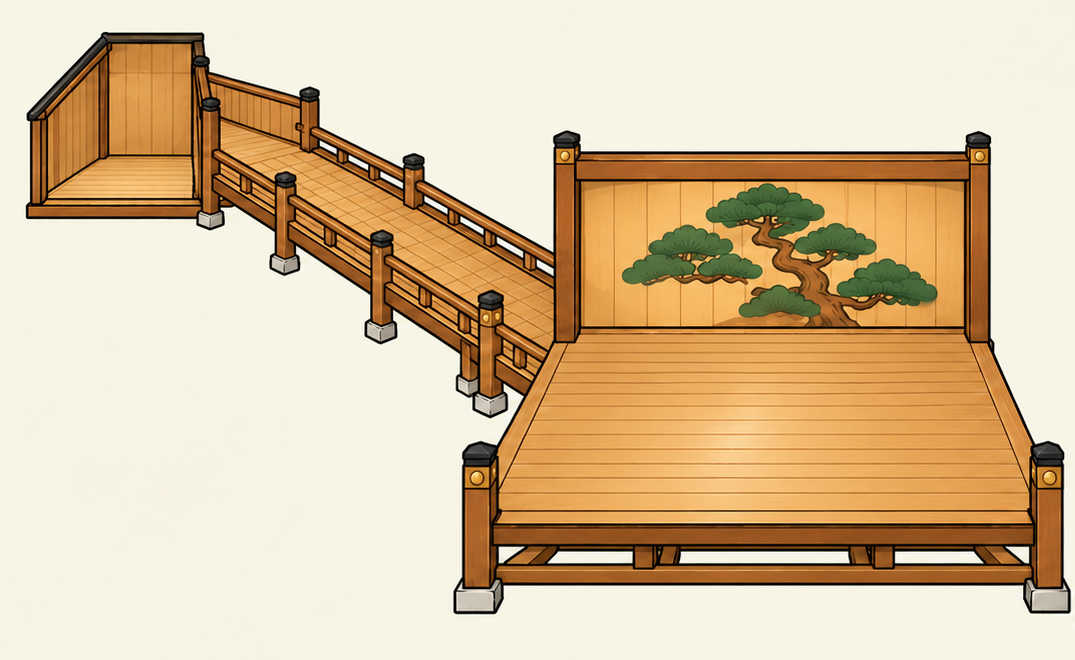
The near-square main stage with a pillar at each corner, an old pine on the back wall, and the hashigakari slanting off to the rear left
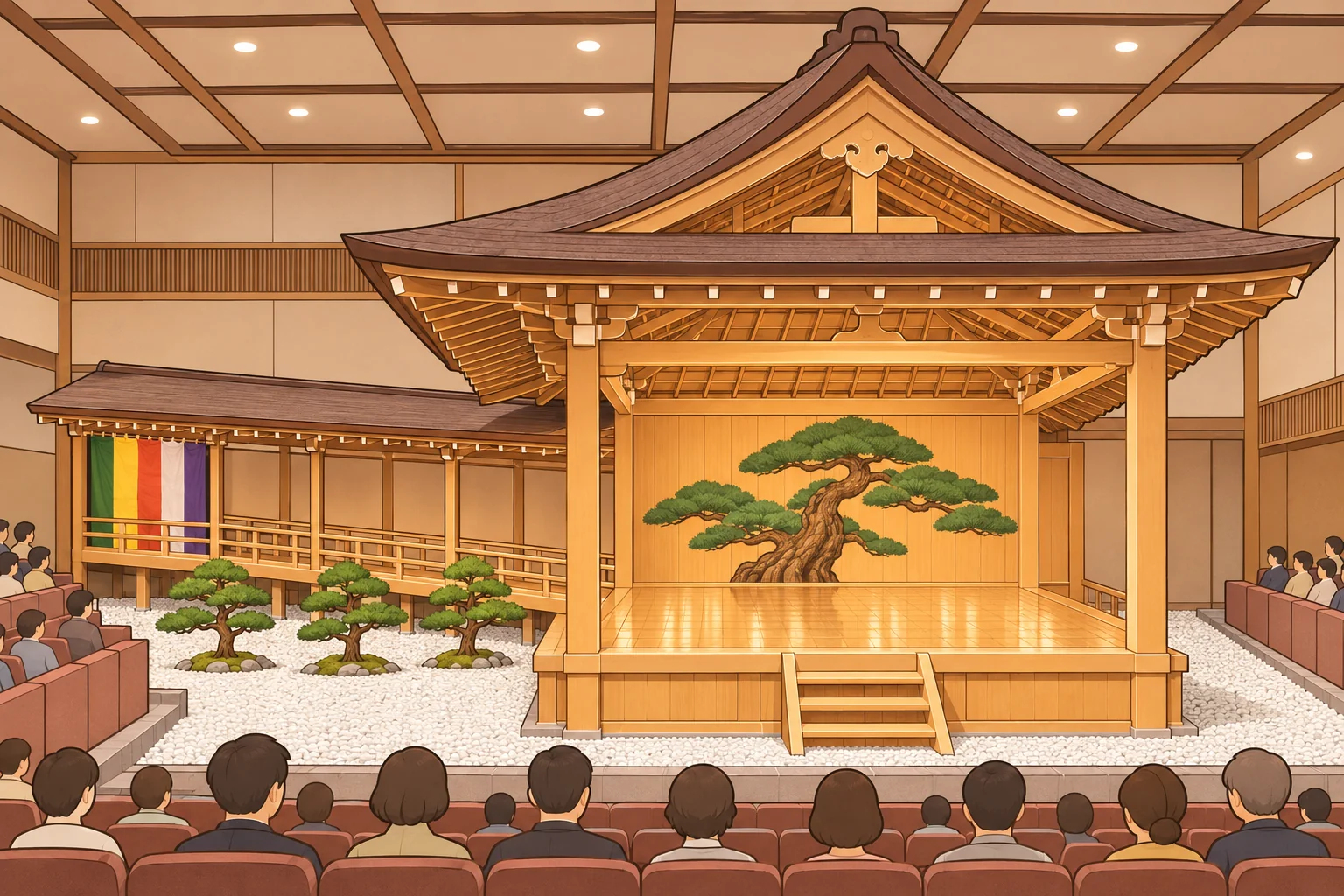
Inside a modern noh theatre: a roofed cypress stage stands within the hall, the hashigakari bridgeway angling off to the left (illustration).
There is almost no scenery. A bamboo frame wrapped in cloth can be a boat, a grave mound, or a hermit’s hut. An actor slowly raising a folding fan may be lifting a sake cup or gazing at the moon. The audience builds the setting from the words and the movement, and that is much of the pleasure: the less there is on stage, the more room is left to the imagination. The painted pine is usually explained as an image of the sacred pine at Kasuga Shrine in Nara, where a deity was said to have descended. In that reading, the actors perform for the god, and the human audience watches from the side.
The roles are strictly divided. The protagonist is the shite (pronounced "shtay"), who usually wears a mask and is often a ghost, a god, a demon, or a woman possessed by some obsession. The secondary actor, the waki, is typically a traveling priest or a warrior. He never wears a mask, because he is a living man in the present, and in a sense he stands in for us: his job is to meet the shite, ask questions, and listen. Seated along the right side of the stage, as the audience sees it, is a chorus of about eight singers, the jiutai, who sing the shite’s thoughts and describe the scenery, sometimes taking over the protagonist’s own lines. At the back sit the musicians, the hayashi: a bamboo flute called the nōkan, two hourglass-shaped hand drums, the small kotsuzumi held on the shoulder and the larger ōtsuzumi held at the hip, and for some plays a stick drum, the taiko. Between strokes the drummers let out long, stylized calls, "yo-o" and "ho-o", which are as much a part of the rhythm as the drumbeats themselves.
- 1Main stage: about six metres square, a pillar at each corner
- 2Kagami-ita: the back wall, painted with a pine
- 3Hashigakari: the railed bridgeway running off to the left
- 4Five-coloured curtain at the end of the bridgeway
- 5Three small pines, each smaller than the last
- 6Jiutai: a chorus of about eight
- 7Hayashi: nōkan flute, kotsuzumi and ōtsuzumi drums, and in some plays a taiko
As the audience sees it: the bridgeway on the left, the chorus on the right, the musicians at the back.
Movement is extremely slow and controlled. Actors glide with the soles of their feet never leaving the boards, a walk called suriashi, the upper body held perfectly still, as if moving across ice. Weeping is shown by raising a cupped hand slowly in front of the mask. At moments of intensity the actor stamps, and the sound booms through the hollow stage. A single play often lasts one to two hours, and there may be long stretches with one figure turning very slowly in place. Newcomers find it slow; regular viewers will tell you the slowness is what gives each gesture its weight.
02From Street Entertainment to Shogunal Ritual
Noh grew out of an older entertainment called sarugaku. Acrobatics, juggling, magic, and comic sketches had come to Japan from China in the Nara and Heian periods, and over the centuries they developed into sarugaku and a related form, dengaku, performed at the festivals of temples and shrines. By the fourteenth century, troupes based around Nara and attached to the great temple Kōfuku-ji and Kasuga Shrine were organized into guilds called za. The leader of one of them, the Yūzaki troupe, was Kan’ami. He brought into sarugaku the rhythms of a popular song-and-dance form called kusemai, borrowed from rival troupes, and turned a variety act into a theater of story, song, and dance.
The turning point is usually dated to 1374, at a performance in the Imagumano district of Kyoto, though no contemporary record of the event survives. In the audience was the young shogun Ashikaga Yoshimitsu. He was impressed by Kan’ami and captivated by the boy performing alongside him, Kan’ami’s son, then about twelve by the traditional Japanese count, who would become Zeami. Yoshimitsu took father and son under his patronage. With the support of the most powerful man in the country, sarugaku’s standing rose sharply. At the shogun’s court Zeami met poets and aristocrats and absorbed classical poetry and the linked-verse form called renga, and his plays are threaded with lines and allusions from The Tale of Genji, The Tales of Ise, and The Tale of the Heike.
Zeami wrote many of the plays still performed today, and more than twenty treatises on the art, which explain its principles with unusual clarity. His later years were bitter. After Yoshimitsu’s death he lost favor, and under the sixth shogun, Ashikaga Yoshinori, he was pushed aside in favor of his nephew On’ami. In 1434, in his seventies, he was exiled to the island of Sado. His son-in-law, Konparu Zenchiku, carried on writing plays and theory.
The warlords of the sixteenth century loved noh. Toyotomi Hideyoshi performed it himself and had new plays written celebrating his own exploits. Under the Tokugawa shogunate, noh became shikigaku, the official ceremonial art of the warrior government. Feudal lords kept troupes, the repertoire was fixed, and performance grew slower, more solemn, and more codified; plays are thought to take considerably longer now than they did in Zeami’s day. Four of today’s five schools of shite actors, Kanze, Hōshō, Konparu, and Kongō, descend from the four Nara troupes, and a fifth, the Kita school, was established in the early seventeenth century.
The Meiji Restoration of 1868 took away noh’s patrons almost overnight. Many actors gave up, and masks and costumes were sold off. The art survived thanks to performers like Umewaka Minoru, who kept staging plays through the hard years, and to statesmen such as Iwakura Tomomi, who had been entertained with opera on his mission to the United States and Europe and believed Japan needed a dignified national theater of its own to show foreign guests. A noh theater opened in Shiba Park, Tokyo, in 1881, and the word nōgaku, covering noh and kyōgen together, came into general use. UNESCO proclaimed nōgaku a Masterpiece of the Oral and Intangible Heritage of Humanity in 2001, and it was inscribed on the Representative List of the Intangible Cultural Heritage in 2008.
03Dream Plays: The Ghost of Atsumori
The best way into noh is through a single play. Zeami perfected a form now called mugen nō, "dream noh", whose structure is almost always the same. A traveling priest, the waki, arrives at a famous place. He meets a local person, the shite in disguise, who tells him the story of what once happened there, tells it with a little too much feeling, hints that they are the person in the story, and vanishes. In the interval a kyōgen actor comes on as a villager and retells the story in plain speech. That night, as the priest prays, the shite returns in their true form, as they were in life, relives the crucial moment, dances, and fades away at dawn. The whole play takes place inside a dead person’s memory; the present is only the door into it.
Atsumori, generally attributed to Zeami, is a model of the form. Its source is The Tale of the Heike, the great war epic of the struggle between the Taira (also called Heike) and Minamoto clans. In 1184, at the battle of Ichi-no-tani on the coast near present-day Kōbe, the Taira were routed and fled toward their ships. A Minamoto warrior, Kumagai Naozane, saw a richly armored rider urging his horse into the sea, called him back to fight, and wrestled him to the ground. When he pulled off the man’s helmet, he found a boy of sixteen or seventeen by the traditional count, his face lightly powdered and his teeth blackened in court fashion, about the age of Kumagai’s own son. Kumagai wanted to let him go, but other Minamoto warriors were closing in, and he knew the boy would die at their hands anyway. Weeping, he took the head himself. In a brocade bag at the boy’s waist he found a flute, and understood that the music he had heard from the Taira camp before dawn had been this boy playing. The youth was Taira no Atsumori, a nephew of the clan’s great leader, Taira no Kiyomori. According to the Heike, the killing turned Kumagai’s heart toward the religious life.
The noh play begins years later. Kumagai has become a monk under the name Rensei and comes back to Ichi-no-tani to pray for Atsumori’s soul. He hears a flute and meets a group of grass-cutters. One stays behind, says he is connected to Atsumori, asks the monk to keep chanting the name of Amida Buddha for him, and disappears. In the night, Atsumori’s ghost appears in armor. He recounts the glory and fall of his clan, and the chorus sings of how prosperity fades like spring blossoms. He describes the last night before the battle, when the Taira nobles played music and recited poetry in their camp, the music Rensei once heard. He dances. As the dance builds he relives the battle, sees his killer in front of him, and raises his sword.
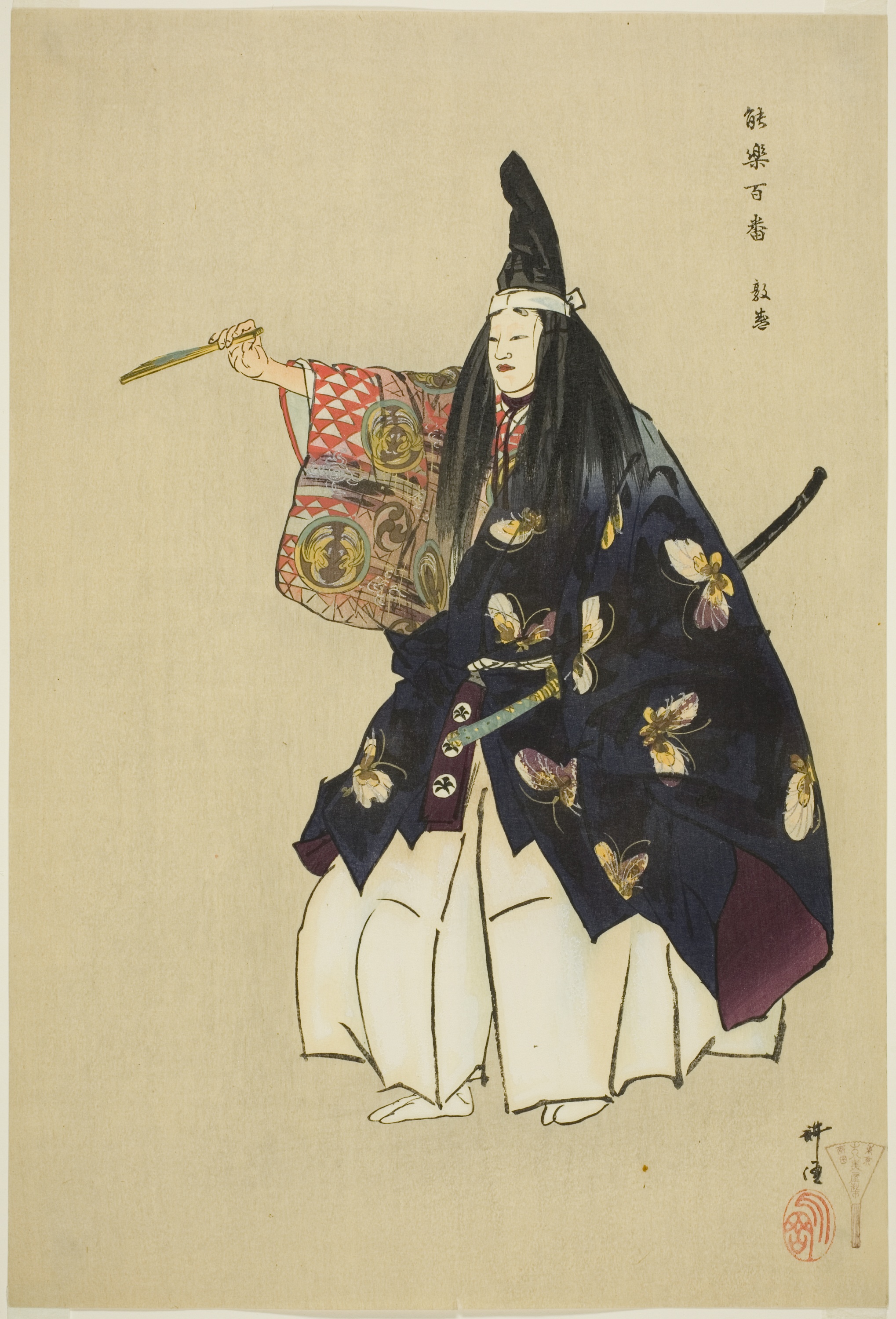
In the second half Atsumori’s ghost appears in warrior’s dress and dances with a fan (woodblock print, not a stage photograph)The Art Institute of Chicago, Tsukioka Kōgyo, One Hundred Noh Plays: Atsumori (Tsukioka Kōgyo, 1869–1927)
The ending is the heart of the play. The sword stops. The chorus sings that this man has repaid hatred with prayer, and that in the next life the two will be born on the same lotus, a play on the monk’s name, Rensei, "lotus-born". He is no enemy after all. He asks the monk to pray for him, and is gone. The hatred is not dissolved by forgiveness in the ordinary sense but by the killer’s long years of devotion, which free both the dead boy and the living man from the moment that bound them.
Part of the play’s power is that it turns a battle into something between two people. The boy’s elegance, the killer’s remorse, the meeting long afterward are all conveyed with very few movements. Atsumori is usually played in a mask called Jūroku, "Sixteen", named for his age at death by the traditional count: a smooth, gentle young man’s face. A footnote for history fans: the famous verse "A man’s life is fifty years" that the warlord Oda Nobunaga is said to have chanted and danced before the battle of Okehazama comes from a different Atsumori, a piece in the kōwakamai ballad-dance tradition, not from the noh play, though the two are often confused.
04Noh Masks: Expression from a Face That Does Not Move
Masks are the most recognizable thing about noh. Each is carved from a single block of hinoki, coated with gofun, a white ground made from crushed shell, then painted in layers, with eyebrows and hairlines drawn on last. A noh mask is smaller than the actor’s face, so the chin often shows beneath it. The eyeholes are tiny. Actors can see very little and find their position by the stage pillars, one of which, at the front corner to the audience’s left, is called the metsuke-bashira, the "eye-fixing pillar".
Masks fall into broad families. Okina, the old man of the ritual play of the same name, is the oldest and most sacred, with a separately carved, hinged jaw. There are old men (jō), men of different ages, women of different ages, and fierce gods and demons with bared teeth and gilded eyes. The most famous demon is hannya, horned and with a mouth split to the ears; it represents a woman transformed by jealousy and resentment, and there is grief in its brows as well as rage. There are usually said to be about sixty basic types and more than two hundred variants, each suited to a category of role, so one mask may appear in many plays.
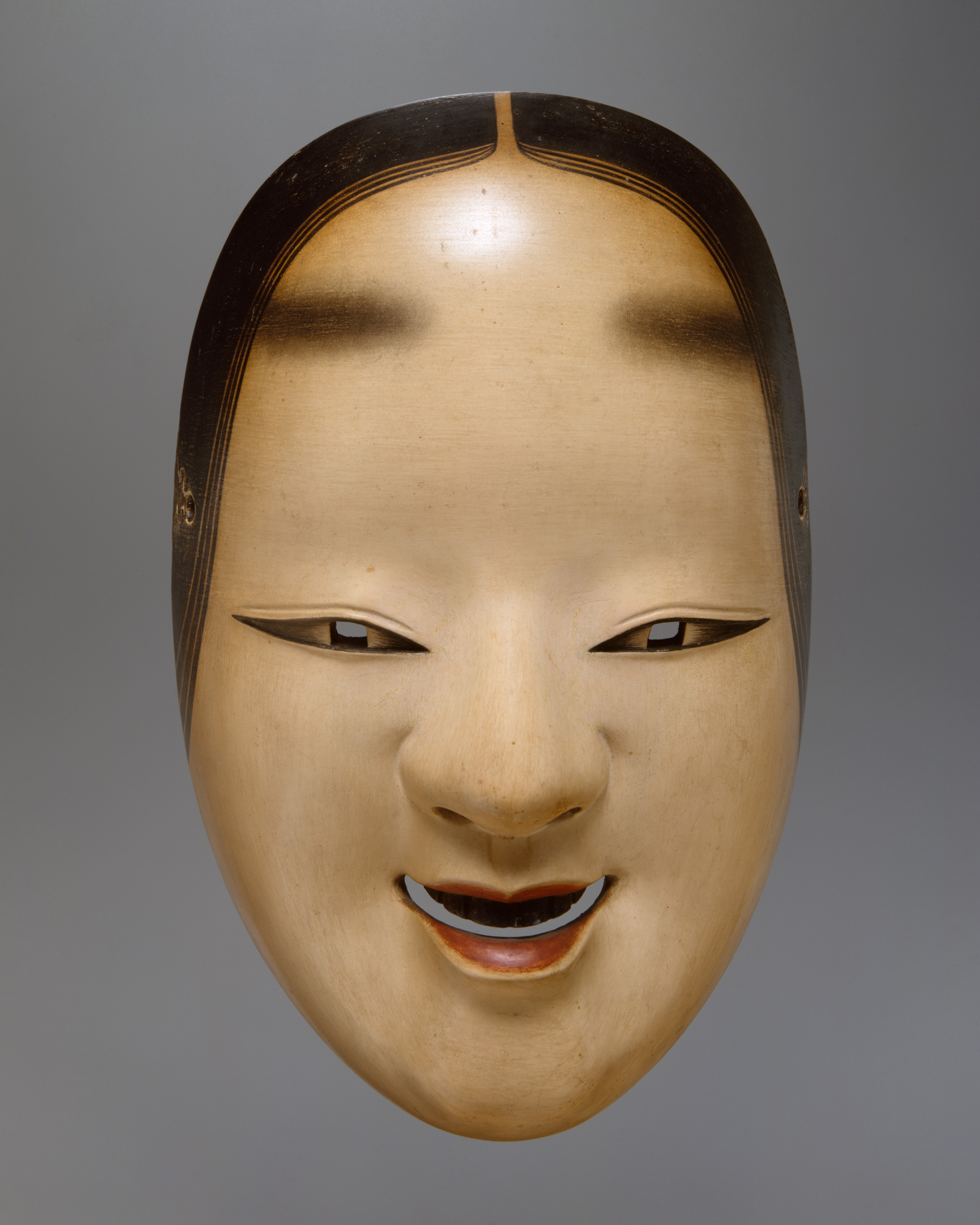
The mask most people picture when they think of noh is ko-omote, the face of a young woman. Ko means small, with a sense of youthful sweetness, and ko-omote is the youngest of the female masks: full cheeks, lips slightly parted over blackened teeth, and a hairline painted on each side in three fine, neat strands, often said to have not a hair out of place, a sign of a girl’s innocence. Each of the other female masks has its own fixed way of drawing the hair; by one account, a slightly older female mask such as zō-onna has a few strands drawn loose. With the middle-aged fukai and the old woman uba, the cheeks grow thinner. The Kanze school generally uses a similar mask called waka-onna where other schools would use ko-omote.
Lying on a table, ko-omote looks almost blank, poised somewhere between a smile and a dream. That is deliberate. The carver gives it an intermediate expression, and the actor completes it on stage. Tilting the mask slightly upward, called terasu, "to brighten", catches the light on the cheeks and lifts the corners of the mouth, and the face seems to smile. Tilting it slightly down, kumorasu, "to cloud", drops the eyes and mouth into shadow, and the face turns sorrowful. A change of a few degrees moves it from joy to grief. Because the audience knows what the character feels, it reads that feeling into the wood, and a face that cannot move appears to change constantly.
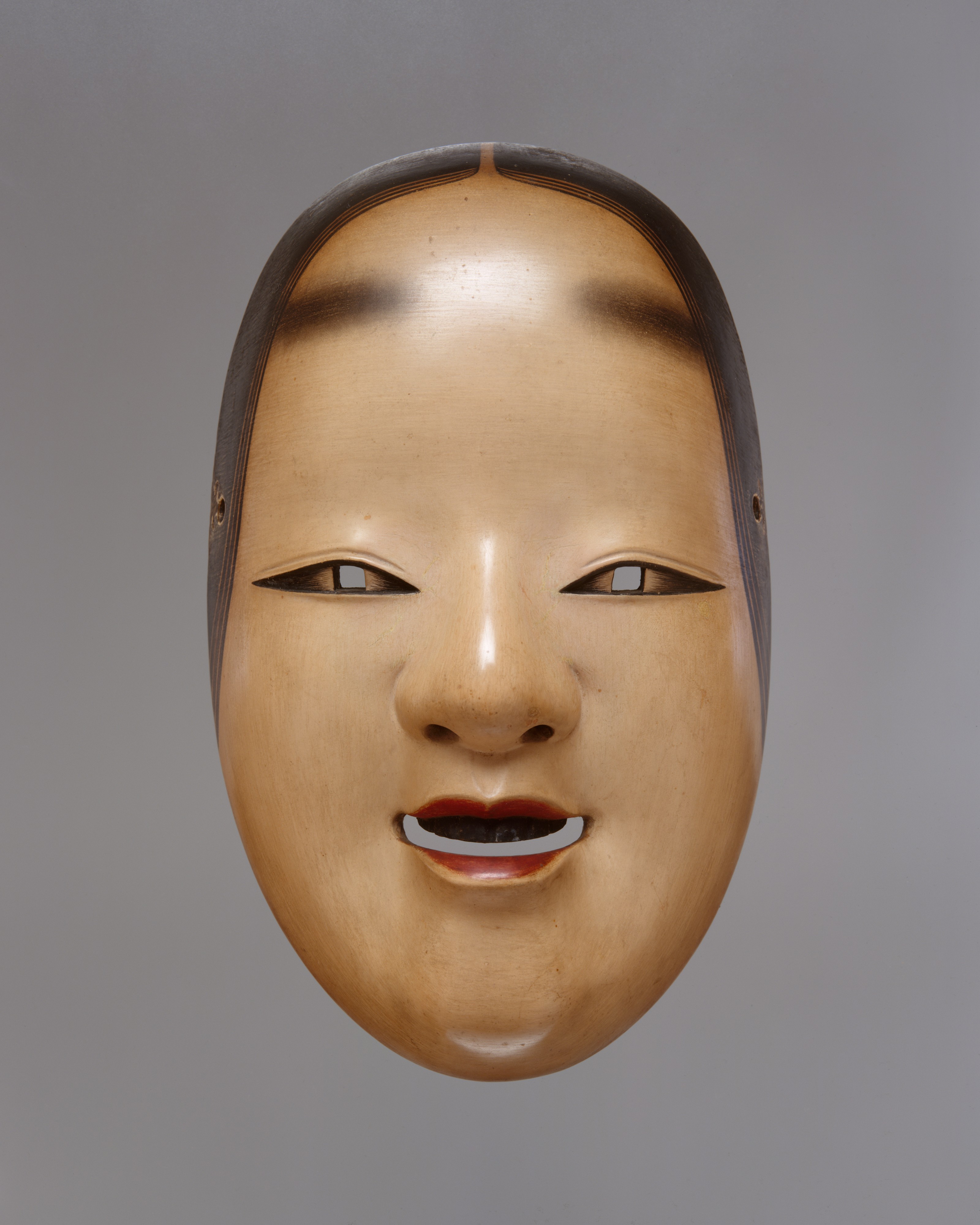
Three fine lines of hair on each side of the brow, full cheeks, and parted lips showing blackened teethThe Metropolitan Museum of Art, Noh mask Ko-omote (18th century, 1993.341.1)
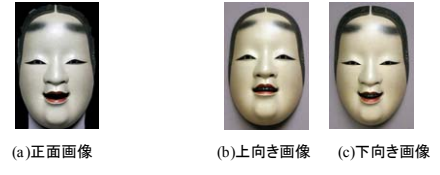
The same woman’s mask, left to right: facing front, tilted up (terasu), tilted down (kumorasu).Miyata H, Nishimura R, Okanoya K, Kawai N, "The Mysterious Noh Mask," Fig. 1, PLOS ONE 7(11): e50280 (2012), CC BY · CC BY
Masks are handed down through utsushi, "copying". Old masks by celebrated carvers are treasured by the head families of the schools as honmen, "original masks". Later carvers reproduce them with extreme fidelity, copying not only the shape but the wear, chips, and stains of centuries, to capture the spirit of the original. In noh, such copying is not forgery but the proper way to learn, and a fine utsushi is a work of art in its own right. In the Edo period hereditary carving families such as the Deme were known for exactly this. Tradition has it that Toyotomi Hideyoshi acquired three ko-omote attributed to the Muromachi-period master Tatsuemon and named them "Snow", "Moon", and "Flower". A Snow ko-omote is still associated with the Kongō school, and the Flower mask, once owned by the Kongō head family, is now in the Mitsui Memorial Museum in Tokyo, designated an Important Cultural Property.
Before going on, the actor dresses in the kagami no ma, the "mirror room" behind the curtain. He sits before a large mirror, bows to the mask, lifts it with both hands by its edges, ties it on, and sits looking at his reflection until he becomes the character. Masks are treated almost as living things; an actor will not touch the painted face with his fingers.
05Zeami’s Flower
Of all Zeami’s writings, the best known is Fūshi kaden, often translated as The Transmission of the Flower through Forms and also known as Kadensho. Its first chapters were written around 1400, setting down the teachings of his father, Kan’ami, and more was added over the following years. These were secret texts, meant only for the heir of the troupe, and for centuries outsiders could not read them. They became widely known only in 1909, when the historian Yoshida Tōgo published a collection of sixteen of Zeami’s treatises. It was read at once as a classic of Japanese aesthetics, and today it is quoted by people writing about acting, teaching, sport, and even business.
The book’s central idea is hana, the flower. Zeami uses it for whatever it is that moves an audience. People love flowers, he says, because they bloom and then scatter; they do not stay in bloom forever, so each time we see them they seem fresh. The flower, the interesting, and the novel, he writes, are one and the same. An actor’s appeal comes down to surprising the audience and making the familiar feel new.
From this follow some very practical lessons. The book opens with a program of training by age, counted in the traditional way. A child starting at about seven should be left to perform naturally and not corrected too strictly. At twelve or thirteen, a boy’s voice and figure are naturally lovely, but this is only the "flower of the moment", a gift of age rather than of skill. At twenty-four or twenty-five, voice and body are settled and a young actor may win sudden fame, which is the most dangerous time, because he may believe he has arrived. Thirty-four or thirty-five is the peak; an actor who has not made his name by then never will. After forty-five, looks fade, and the wise actor holds back and lets younger performers shine. After fifty, the art is almost a matter of not doing. Zeami recalls that his father, Kan’ami, danced at the Sengen Shrine in Suruga a couple of weeks before his death at fifty-two by the traditional count. He performed simply and with restraint, and yet his flower seemed only to grow. That, Zeami says, was the "true flower", the one that does not wither with age.
The flower also changes with the occasion. Zeami writes about reading the time, the place, and the audience: the same play has to be done differently before nobles and at a country festival, and if the audience is still restless when the play begins, the actor must find ways to draw them in. Even competition has its tides. He speaks of "male time" and "female time", periods when fortune is with you or against you, and advises not forcing things when luck is running the other way, but saving your best work for the turn. These lessons come from the real contests in which rival troupes performed against each other for patrons. Zeami was writing about how to survive.
The most quoted line in the book is hisureba hana: "What is hidden is the flower; what is not hidden cannot be the flower." A device that surprises the audience stops working once they expect it, so even the fact that you have a secret must be kept secret. Another phrase often quoted alongside it, shoshin wasuru bekarazu, "never forget the beginner’s mind", actually comes from a later treatise, Kakyō (A Mirror Held to the Flower). Zeami meant something sharper than "remember your original intentions": an actor should never forget the clumsiness of each stage at which he began, at every age.
06Kyōgen: Someone Who Lives Around Here
The other half of nōgaku is kyōgen. If noh is tragedy, song, and the memories of the dead, kyōgen is comedy, dialogue, and ordinary people very much alive. It grew from the comic side of sarugaku and matured alongside noh in the fifteenth century, and the two have always shared a stage. A traditional full-day program alternated noh and kyōgen, a laugh between solemn plays to clear the air. Kyōgen actors also appear inside noh plays: the villager who retells the story in the middle of Atsumori is played by a kyōgen actor, in a role called ai-kyōgen.
Kyōgen’s heroes are nameless little people. The most common is the servant Tarō Kaja, along with his master, a greedy minor lord, a pompous mountain ascetic (yamabushi), a henpecked husband, a con man selling fakes. Gods and demons turn up too, but they are made comic and rather endearing. Characters often walk to the front of the stage and introduce themselves with a stock line: "I am someone who lives around here." That line explains the whole genre: these are things that could happen to anyone.
The best-known plays are easy to follow even without the language. In Busu, a master going out tells his two servants that a tub contains a deadly poison called busu. It is really sugar. They taste it, then finish it off, and to cover themselves they tear the master’s hanging scroll and smash his tea bowl. When he returns they wail that they were so ashamed of breaking his treasures that they tried to kill themselves by eating the poison, but somehow failed to die. In Bōshibari, "Tied to a Pole", a master who suspects his servants of stealing his sake ties Tarō Kaja’s arms to a pole across his shoulders and binds the other servant’s hands behind his back. They get into the sake anyway, each feeding the other with his bound hands, and end up drunk and dancing. In Kaki Yamabushi, a mountain ascetic steals persimmons and hides in the tree when the owner arrives. The owner pretends to wonder aloud whether that is a crow, then a monkey, and the ascetic has to caw and chatter to stay hidden. Finally the owner decides it must be a kite, and kites fly, so the ascetic spreads his arms and leaps.
Kyōgen is mostly speech and action, with little singing. The language is the colloquial Japanese of the late medieval period, rhythmic and clear, and much of it is understandable to modern Japanese audiences. Even laughter is a set pattern, a kata: the actor tilts back his head and laughs in long, measured syllables, "ha-a, ha-a, ha-a", and the very regularity of it is funny. There is a kata for drinking, a kata for sliding open a door, and with them the audience sees the sake and the door although there are no props. Most roles are unmasked; only gods, demons, old men, women, and animal spirits wear kyōgen masks, which are exaggerated and comic.
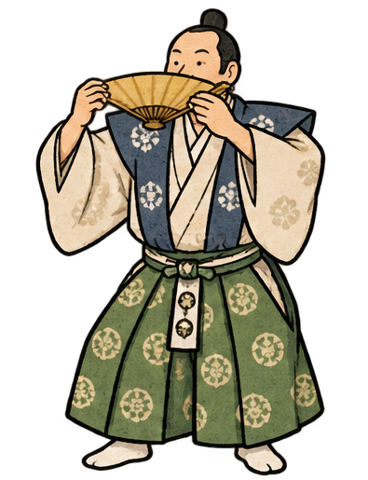
With no cup on stage, an actor raises an open fan to his lips, and the audience sees him drinking
Two schools of kyōgen survive today, Ōkura and Izumi. The Shigeyama family of Kyoto, of the Ōkura school, call their style "tofu kyōgen", as plain and everyday as tofu and fit for anywhere. The Nomura family of Tokyo belong to the Izumi school; Nomura Mansaku and his son Nomura Mansai are the best-known kyōgen actors of the present day, and Mansai’s starring role as the court diviner Abe no Seimei in the 2001 film Onmyōji introduced kyōgen to a younger generation.
07Going to See Noh
For a first visit, the easiest place is the National Noh Theatre in Sendagaya, Tokyo, opened in 1983. It holds regular monthly programs, usually one kyōgen and one noh. Each seat has a small screen on the seatback showing the text in Japanese or English, which makes following the libretto far easier than listening to medieval Japanese unaided. The Kanze Noh Theatre, which moved in 2017 to the basement of the GINZA SIX shopping complex in Ginza, the Kyoto Kanze Kaikan near Heian Shrine, the Ōtsuki Noh Theatre in Ōsaka, and many smaller theaters around the country stage regular performances too, and some put on introductory programs with explanations for beginners.
Read a synopsis of the play before you go. The text is medieval literary Japanese, and many Japanese viewers do not catch every line either. Nobody watches noh for suspense; the pleasure lies in watching a story everyone already knows being performed. The theater is very quiet once the play begins: no photographs, no talking. Dozing off during the slow passages is common enough in noh theaters, and some longtime viewers will tell you that noh seen half-asleep is its own state of grace.
Watch the beginning and the end closely. Before the play, the musicians tune up behind the curtain, a sequence of flute notes and drum calls called oshirabe. Then the five-colored curtain is lifted from below on two bamboo poles, and the shite steps onto the bridgeway and comes slowly forward. The bridge is the road from the other world to this one; the ghosts come along it. At the end the performers leave the same way, in order. Seasoned audiences often wait until the shite has passed through the curtain, or even until the musicians and chorus have also gone, before applauding, or do not applaud at all, letting the silence settle. A first-timer can simply follow the people around them.
On summer evenings there is takigi nō, "firewood noh", performed outdoors by the light of bonfires. Watching masked figures in firelight is the closest you can get to noh as it was first performed in temple and shrine courtyards. The Takigi Onō at Kōfuku-ji in Nara each May has the longest history, and the Kyoto Takigi Noh at Heian Shrine in early June is also well known. Visitors to Miyajima near Hiroshima can see Itsukushima Shrine’s noh stage standing over the sea at high tide, and the north noh stage at Nishi Hongan-ji in Kyoto is considered the oldest surviving noh stage.
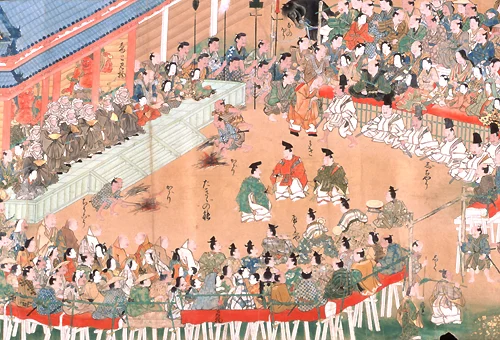
From the Nara Takigi Noh scroll: an outdoor performance in the Kōfuku-ji grounds, with fires burning and crowds all around.
Noh and kyōgen also feed into nearly every Japanese performing art that came after them. The kabuki classic Kanjinchō is adapted from the noh play Ataka, and it is played in front of a painted pine-tree backdrop that deliberately imitates the noh stage. Bunraku puppet theater and classical Japanese dance borrow noh stories freely. After an evening of noh, you will recognize old friends the next time you see kabuki or bunraku.