
At a glance
Japan’s classical dance, from kabuki’s female-role specialists to Kyoto’s spring geisha dances: how one fan, a lowered stance and held stillness tell whole stories, and where to watch.
- Nihon buyō is classical dance that grew out of the kabuki stage; the word buyō itself was coined only in the Meiji era.
- Nakamura Tomijūrō I premiered Kyōganoko Musume Dōjōji in 1753; it remains the supreme test of onnagata dance.
- There are generally said to be over 150 schools; the 'big five' are Hanayagi, Fujima, Wakayagi, Nishikawa and Bandō.
- Three things help you read a dance: what the fan becomes, the lowered hips and sliding step, and the set forms and pauses.
- Gion Kōbu’s Miyako Odori in Kyoto began in 1872 and is usually staged in April.
Nihon buyō is the classical dance of Japan, born on the kabuki stage and kept alive today by more than a hundred schools, thousands of teachers, and the geiko of Kyoto, who dance it every spring for packed theaters. To a first-time viewer it can look slow. There are no leaps, no spins, no feats of athletic display. What there is instead is a dancer with a folding fan who becomes, within a few minutes, a girl in love, a drunken samurai, a heron in the snow. This piece explains where the dance came from, what to watch for, and how a visitor to Japan can see it or try it.
01Two Old Words and a New One
The word buyō is much younger than the art it names. In the Edo period (1603–1868), people spoke of mai and odori, and they meant different things. Mai came from court and shrine ritual: gliding, circling movement that stays close to the ground, calm and contained. The dances inside a noh play are mai. Odori came from the street and the village: stamping, leaping, rhythmic, communal, the kind of movement you see at a summer Bon festival. Kabuki, when it arose, added a third element, furi, mimetic gesture that tells a story through everyday actions such as combing hair, pouring sake, or reading a letter.
In the Meiji era, writers looking for a Japanese equivalent to the Western idea of "dance" as an art form joined the characters for mai and odori into a single compound, buyō. The playwright and translator Tsubouchi Shōyō was among the most influential voices behind it. Later, to distinguish it from ballet and other imported forms, the word Nihon ("Japanese") was put in front.
So "nihon buyō" is a modern umbrella. Under it sit kabuki dance, the quieter kamigata-mai of Kyoto and Ōsaka, and the many new works created since the early twentieth century. Folk dances and Bon dancing are usually not included, and the dance of noh is treated as its own tradition. A single buyō piece often moves between the two older modes, opening with slow, grounded mai-like passages and breaking into a brisk, stamping odori section, and that shift is a large part of its emotional shape.
02From Okuni to the Kabuki Stage
The story usually begins around 1603, when a woman called Okuni, who presented herself as a shrine maiden from Izumo, performed in Kyoto, at Kitano Tenmangū shrine and on the dry riverbed of the Kamo River; the spot most often named is the riverbank near Shijō, though accounts of where she played differ. Dressed as a fashionable young man, she staged scenes of flirtation in a teahouse, and crowds came running. Her style was called kabuki odori, from kabuku, to lean or to act outlandishly. Courtesan troupes copied her, and the shogunate, worried about public morals, banned women from the stage in 1629, then young boys in 1652. Kabuki became an art of adult men, with female roles played by specialists called onnagata.
Dance remained at the heart of kabuki, and the onnagata brought it to a peak in the mid-eighteenth century. In 1753 Nakamura Tomijūrō I premiered Kyōganoko Musume Dōjōji (The Maiden at Dōjōji Temple) in Edo. It draws on the legend of Kiyohime, a woman whose unrequited love turns her into a serpent. On stage, a shirabyōshi dancer comes to a temple where a new bell is being dedicated and dances before it, changing costume again and again: innocent, coquettish, wistful, until at last her true nature breaks through. The piece runs close to an hour and is still regarded as the supreme test for a dancer of female roles.
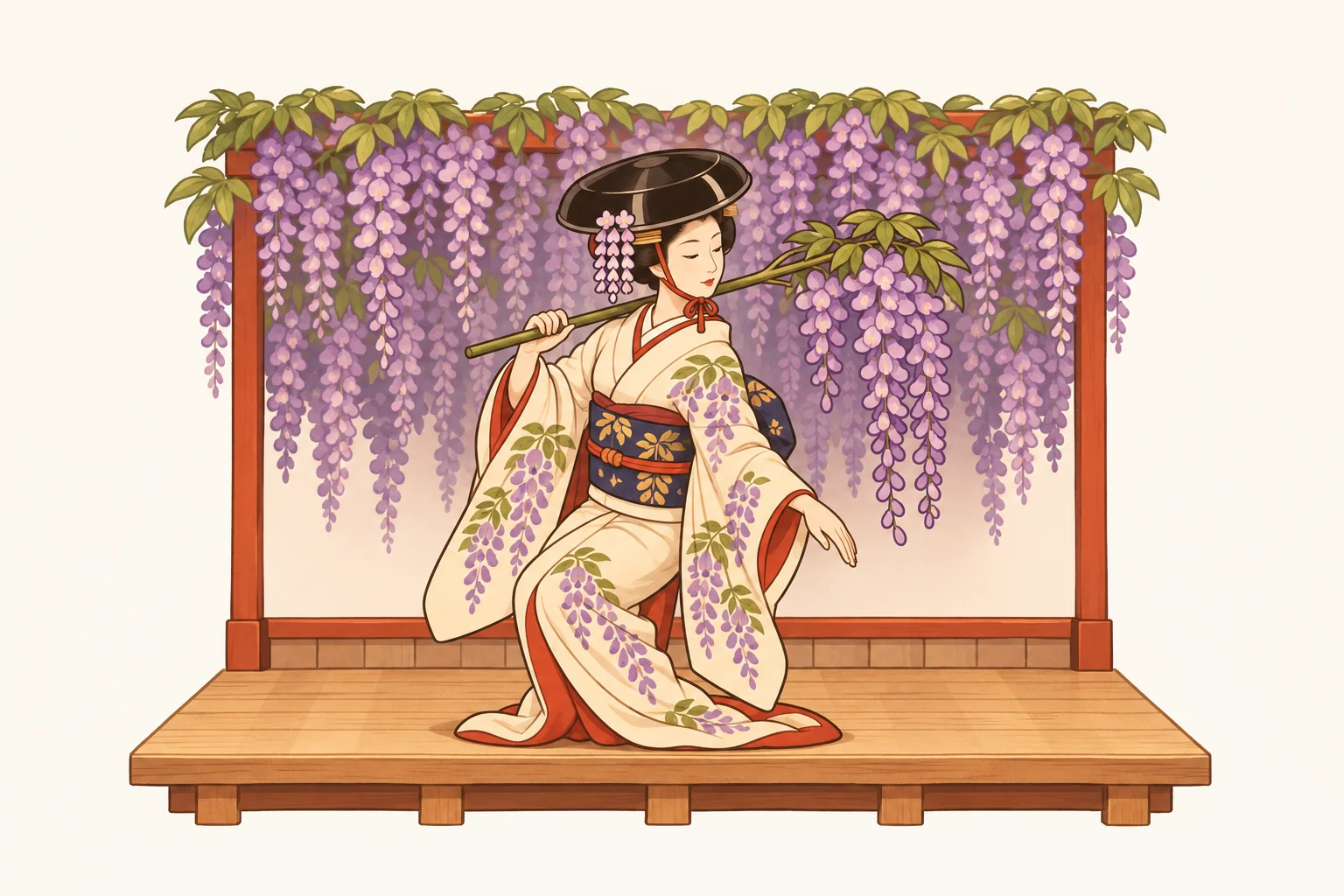
From the late eighteenth century, and above all in the early nineteenth, Edo audiences loved henge-mono, transformation pieces in which one actor played seven or twelve different characters in a row, with lightning costume changes. Several standards of today’s repertoire were originally single episodes from such sets. In Fuji Musume (The Wisteria Maiden), first staged in 1826, a girl steps out of an Ōtsu folk painting (today she is more often played as the spirit of the wisteria) holding a branch of wisteria and dances, a little tipsy, about a faithless lover. In Sagi Musume (The Heron Maiden) a woman in white, standing in falling snow, turns into a heron and dances herself to death over a love that cannot be.
All of this is danced to shamisen music, and the genre matters. Nagauta is bright and showy, the standard sound of kabuki dance. Tokiwazu and Kiyomoto are narrative and lyrical, with high, plaintive vocals. Gidayū, borrowed from the bunraku puppet theater, is dramatic and heavy. Experienced listeners can tell from the first few bars what kind of dance is coming.
Kabuki needed people to set its movement, and so a profession of choreographers, furitsukeshi, grew up around the theaters. They designed dances for actors and also began teaching outside the theater. Wealthy merchant families in Edo sent their daughters to learn; dance was a mark of refinement and could help a girl win a position in service at a samurai household. Women were barred from the kabuki stage, but they became the great majority of buyō’s students and, in time, of its teachers.
03Schools, Headmasters, and Names
Nihon buyō is organized into schools, called ryū or ryūha. Each is led by an iemoto, a hereditary headmaster who controls the school’s repertoire, its correct forms, and the right to grant names. A student who has trained long enough can take an examination to become a natori, a name-holder, and receive a stage name that carries the school’s surname. A pupil of the Hanayagi school becomes Hanayagi something. A higher license, shihan, allows the holder to teach.
Five schools are commonly called the big five. The Nishikawa school is generally regarded as the oldest, and by one account goes back to the Genroku era at the end of the 17th century; its founder, Nishikawa Senzō, was a kabuki musician in mid-Edo who turned to choreography. The Fujima school, founded in the Hōei era (1704–1711), has close ties to kabuki families, and many actors learn from it. The Hanayagi school was founded in 1849 by Hanayagi Jusuke I, a former pupil of Nishikawa Senzō IV, and grew into one of the largest. The Wakayagi school split from Hanayagi in the Meiji era, around 1893, and became strong in the geisha districts. The Bandō school, founded by Bandō Mitsugorō III, is led by that line of kabuki actors.
Counting smaller schools, the total is usually put at more than 150, and over a hundred belong to the national association alone. The iemoto system has kept the forms remarkably stable across generations, but it also makes buyō a serious commitment of money as well as time. Lessons, the fee for receiving a name, costumes, and the cost of renting a hall for recitals all add up. In the postwar decades, studying buyō was common among urban women; numbers have fallen sharply since, and many schools now offer short courses and taster classes for adults and foreign visitors.
04How to Watch: The Fan, the Hips, the Pause
There are three things worth watching for.
The first is the fan. A dance fan, maiōgi, is a little larger and stiffer than an ordinary folding fan, and in a dancer’s hand it can be almost anything. Held open and level, it is a sake cup. Fluttered downward, it is falling snow or cherry petals. Drawn slowly across the body, it is the moon reflected on water. Closed and gripped at one end, it becomes a brush, a sword, a pipe, a letter. Hand towels, umbrellas, and flowering branches also appear as props, but the fan does most of the work. Half the pleasure for the audience is following the dancer’s hand and imagining what the fan has become.
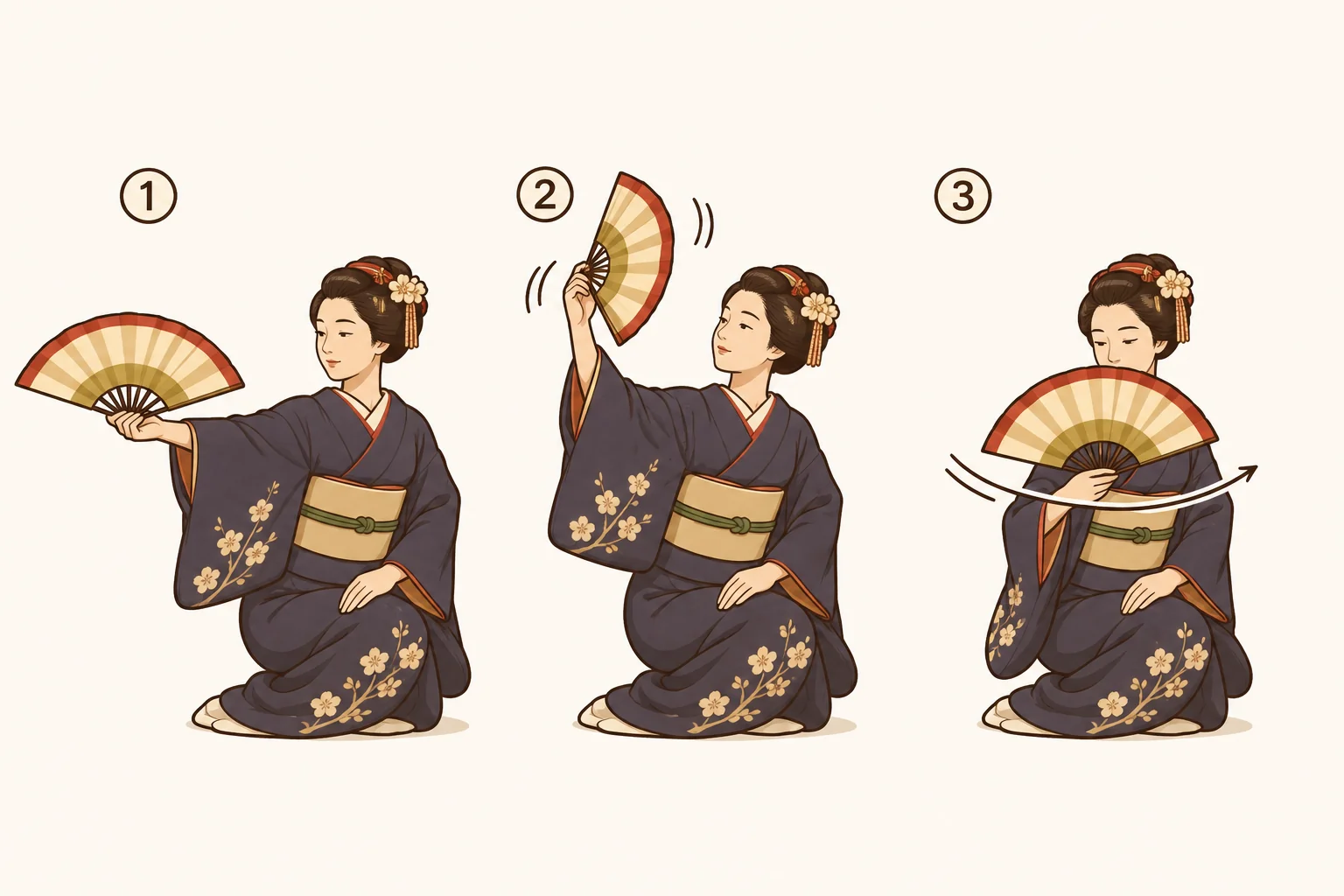
One maiōgi, three meanings: held level, a sake cup; fluttered, falling snow; drawn across, the moon on water.
The second is the body’s center of gravity. The basic stance has the knees slightly bent and the hips lowered, the torso still and upright. Dancers move with suriashi, a sliding step in which the sole never quite leaves the floor. This grounded posture gives the dance its composure, and it makes small movements legible: on a body this steady, a slight tilt of the head or turn of the shoulder reads clearly from the back of the hall. Female roles are danced with the shoulders drawn in and the toes turned slightly inward; male roles take a wider stance and larger gestures. Every dancer, man or woman, learns both, an inheritance from the onnagata tradition.
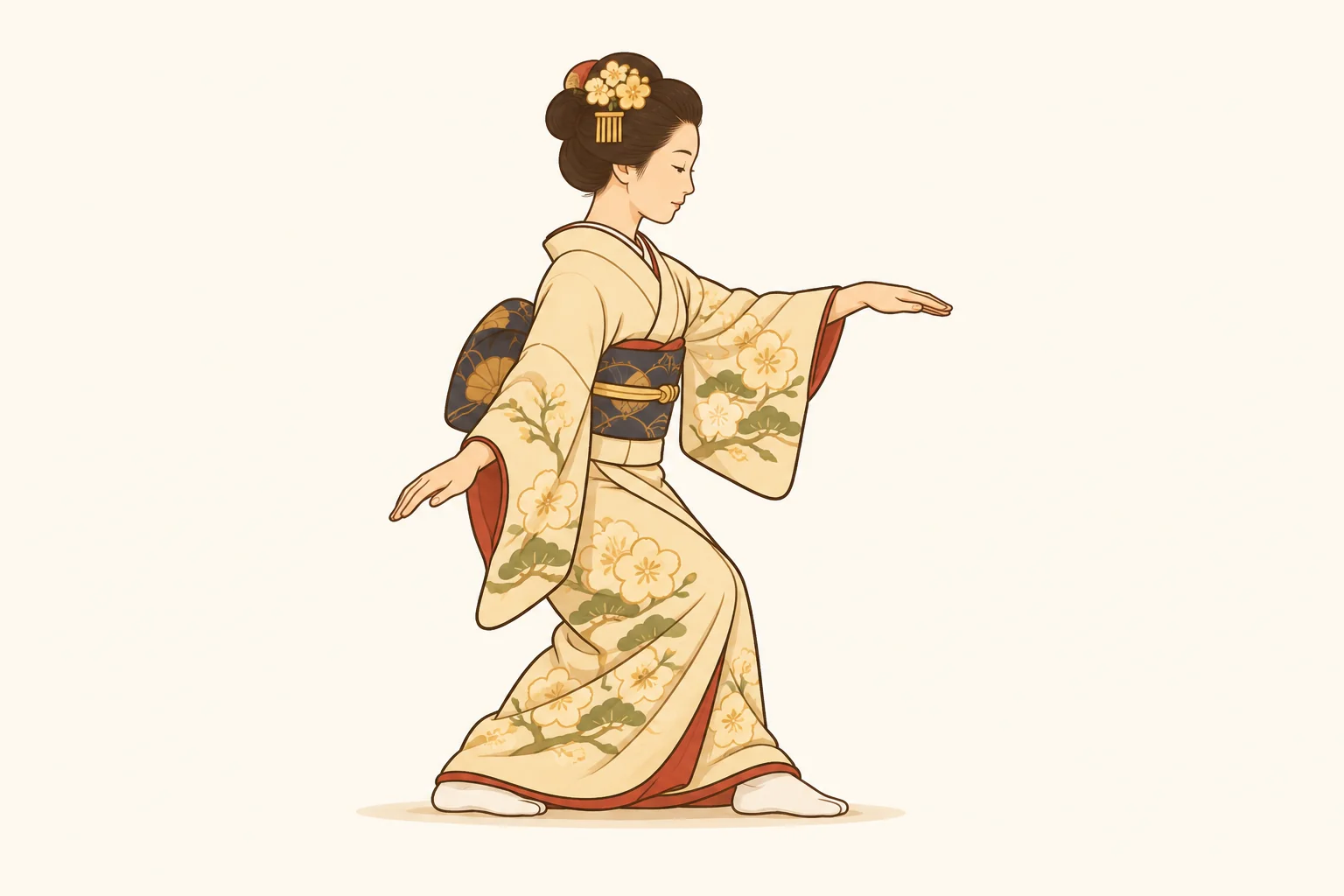
The basic stance of nihon buyō: knees bent, hips lowered, moving in suriashi, a sliding step.
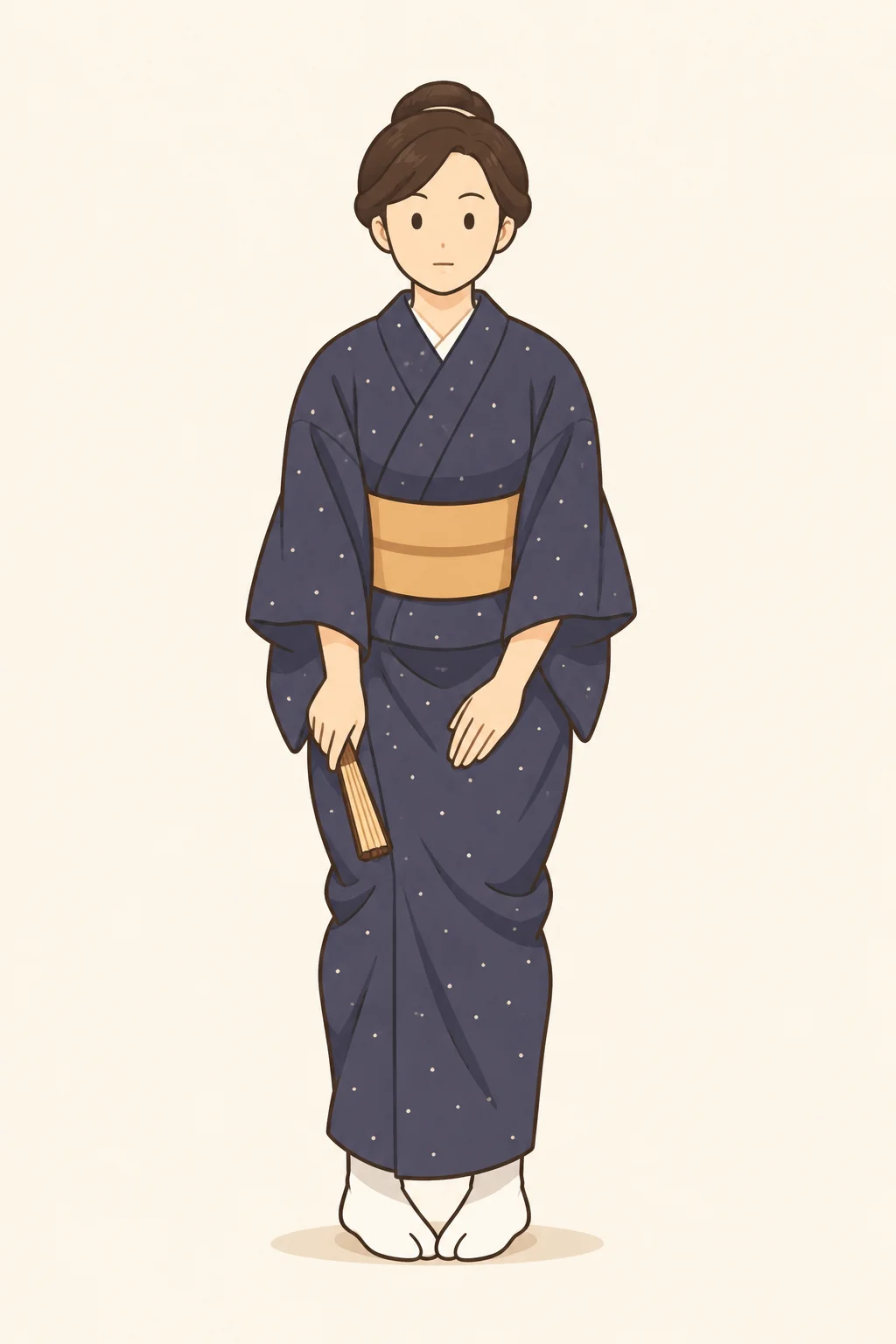
A female role: shoulders drawn in, toes turned slightly inward.
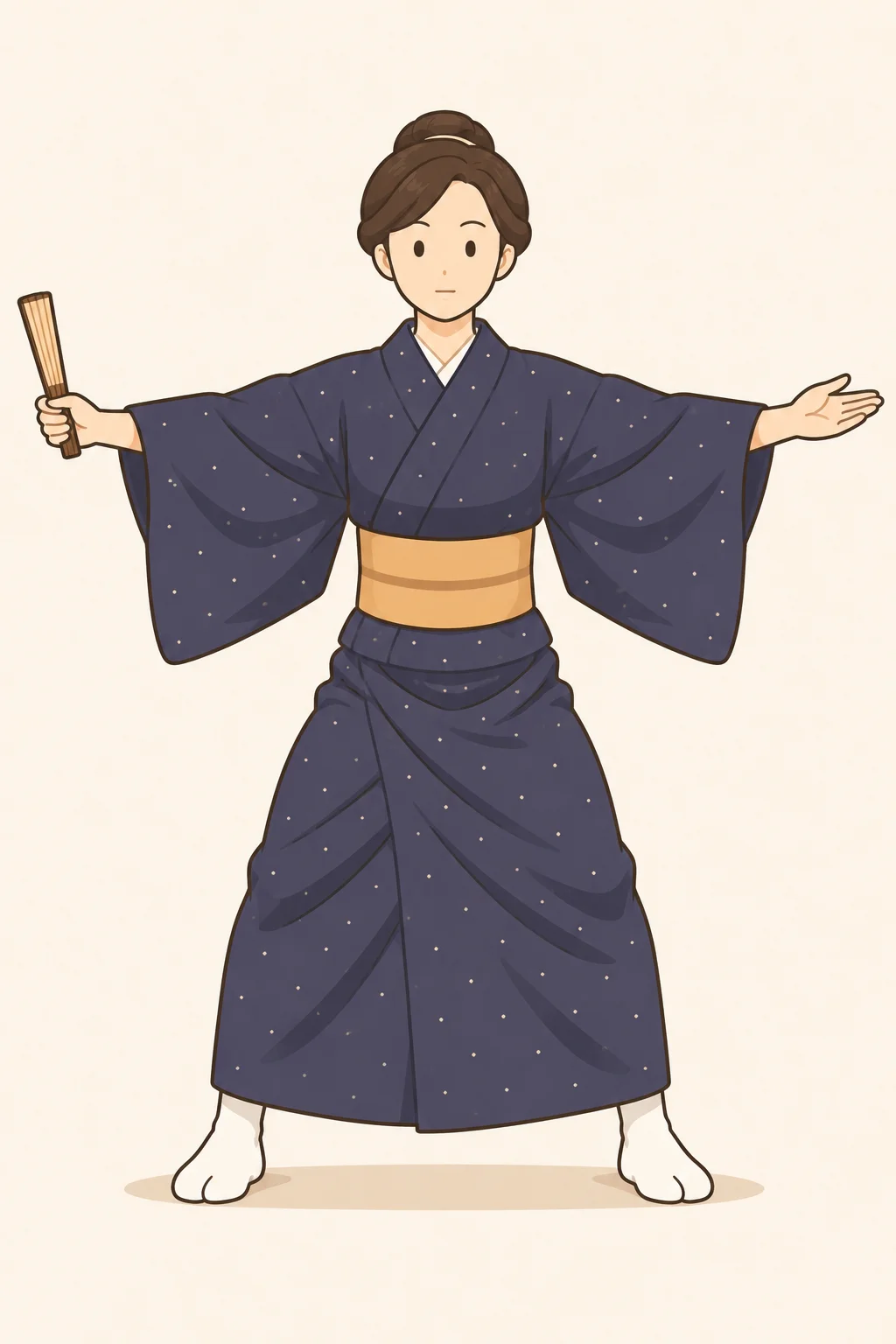
A male role: a wider stance and larger gestures.
The third is form and stillness. Buyō has a large vocabulary of kata, fixed gestures for gazing into the distance, weeping, hiding one’s face in shyness, and they are passed down unchanged. A dancer’s artistry lies less in inventing movement than in giving these shared forms a personal flavor. Between movements there are brief moments of complete stillness, held poses that recall the mie of kabuki actors. Japanese aesthetics calls this interval ma, and in buyō the gaps between sound and movement are often the most expressive moments of all.
There is also a style called su-odori, "plain dancing." The dancer wears no makeup and no wig, only a formal black kimono with family crests and hakama trousers, and performs a piece that would normally call for elaborate costume. With nothing to hide behind, everything depends on the body and the fan, and many connoisseurs consider it the truest test of skill.
05Kamigata-mai: The Dance of Kyoto and Ōsaka
Edo dance grew up in large theaters and had to read from the back row. The dance of the Kamigata region, Kyoto and Ōsaka, developed largely in the zashiki, the tatami rooms of teahouses and private homes, performed for a few guests sitting close by. The result is a different art. Kamigata-mai is slow, inward, and restrained, with something of noh’s stillness. Its core repertoire is danced to jiuta, music for shamisen and koto, and that part of it is called jiuta-mai. Its technique was shaped so that a dance could be performed within the space of a single tatami mat.
The main schools are Yamamura, Umemoto, Yoshimura, and Kyōmai Inoue. The Inoue school is bound up with Gion Kōbu, Kyoto’s largest geisha district; its geiko and maiko all study Inoue style, and the headmaster’s name, Inoue Yachiyo, is passed from one generation to the next. In 1872, with the capital newly moved to Tokyo and Kyoto anxious about its future, the city held an exhibition to attract visitors. The third Inoue Yachiyo choreographed a group dance for the geiko and maiko of Gion, and the Miyako Odori was born. Dancers file in along both aisles of the theater to the call "Miyako Odori wa, yōiyasā!" and it remains one of the sights of a Kyoto spring.
Each of the city’s other districts has its own school and its own season. Pontochō’s Kamogawa Odori is danced in the Onoe style; Kamishichiken’s Kitano Odori in Hanayagi style; Gion Higashi’s Gion Odori in Fujima style; Miyagawachō’s Kyō Odori in Wakayagi style. A visitor who sees several of them has, in effect, toured the major schools of Japanese dance.
06New Dance and the Present Day
After the Meiji Restoration, buyō faced an obvious problem: most of its repertoire came from Edo, and its stories and feelings were growing distant from modern life. In 1904 Tsubouchi Shōyō published his essay on a new music drama together with the dance drama Shinkyoku Urashima, arguing that dance should become an independent art rather than an appendage of kabuki. In the Taishō era (1912–1926) these ideas grew into a "new dance" movement. Fujikage Shizue, who founded the Fujikage-kai in 1917, and other dancers created new works, experimenting with Western music, new subjects, and even abstraction.
Since then the field has widened considerably. The classical repertoire remains the foundation of training, but schools stage new works every year, some in collaboration with contemporary dancers or set to jazz and popular song. The Nihon Buyō Association, founded in 1955, brings together more than a hundred schools and stages large performances every year, including its annual association program and a New Year dance competition.
For most Japanese people today, contact with buyō is occasional: lessons taken as a child (some children reportedly study for a few months before appearing in kimono for Shichi-Go-San or the coming-of-age ceremony), training taken up as a way to learn graceful bearing, a dance piece in a kabuki program, the geisha dances in Kyoto in spring. It is no longer part of everyday life, but it remains bound up with the wider world of kimono, etiquette, and shamisen music. People who have studied it walk, sit, and hand over a teacup differently when they wear kimono, and for many students that is the point.
07Seeing It and Trying It
The easiest place to see nihon buyō is a kabuki theater. The Kabukiza in Ginza, Tokyo, runs programs every month, and almost every program includes a dance piece, listed as a shosagoto or simply by title. Dance pieces have little plot to follow, and with the English audio guide or a quick read of the synopsis, they are among the most accessible things in kabuki.
In spring, Kyoto’s geisha dances are the obvious choice. The Miyako Odori runs through April at the Gion Kōbu Kaburenjō theater, each show about an hour. Before the show there is a tea ceremony, where you can watch geiko and maiko prepare tea (some accounts say a maiko performs the tea ceremony) and drink a bowl of matcha they serve. The Kamogawa Odori is in May, the Kitano Odori from the second half of March into early April, the Kyō Odori in April, and the Gion Odori in autumn.
The schools also hold their own performances, and the Nihon Buyō Association stages programs in Tokyo, at venues such as the Mitsukoshi Theatre; the National Theatre, long a main venue, closed in October 2023 for reconstruction; as of 2026 work had not begun, and the revised plan of 2025 aims to reopen it in fiscal 2033. Student recitals, osaraikai, are often open to the public. The audience is mostly family and friends, the mood is relaxed, and you see dancers from small children to people in their eighties.
To try it yourself, look for taster classes in Kyoto or Tokyo aimed at visitors. In an hour or two a teacher will dress you in a cotton yukata, show you how to hold the fan, how to slide your feet, and how to make a few basic forms, and finish by teaching you a short phrase of dance. Long-term study means finding a teacher from one of the schools; students usually practice in yukata and bring their own white tabi socks and a dance fan. The hardest part for beginners is not remembering the steps but keeping the hips low and the upper body still. After one lesson your thighs will ache, and you will understand how much work lies behind the calm you saw on stage.
When you watch, there is no need to decode every gesture. Listen to the shamisen, follow the fan, and notice the moments when everything stops. At the end the dancer will usually kneel and bow with both hands on the floor. That is your cue to applaud.