
At a glance
How karaoke grew from Kōbe snack bars to station-front boxes, why a reserved society sings so readily, and the etiquette of singing with Japanese friends.
- Karaoke means "empty orchestra": a backing track with the vocal left out.
- In 1971 Kōbe musician Inoue Daisuke built the coin-operated "8 Juke": 100 yen for five minutes of singing.
- The first karaoke box is generally dated to 1985 in Okayama, a converted used shipping container.
- Network karaoke arrived in 1992, sending songs down phone lines from a central server to each machine.
- As of 2026, almost every machine in Japan is either DAM or JOYSOUND.
Karaoke began in Japan, and the rest of the world took it up so thoroughly that many people forget where it came from. In Japan it remains something more layered than a party trick: a ritual in tiny neighborhood bars, the traditional second stop of an office night out, the place teenagers go after school, and, increasingly, a room people rent alone to practice. This piece explains where the word and the machine came from, how a shipping container in Okayama turned into the karaoke box, why a famously reserved society sings so readily, and how to walk into a karaoke box yourself.
01The Empty Orchestra
The word is a hybrid. Kara is Japanese for "empty," and oke is short for ōkesutora, the Japanese borrowing of "orchestra." By the mid-1960s "empty orchestra" was slang among musicians and broadcasters for a backing track with the vocal left out, the tape a singer carried to perform on tour or on air without bringing a band along.
Putting those backing tracks in the hands of ordinary people happened in the Kansai region in the early 1970s. The name most often attached to it is Inoue Daisuke, a musician who had played in bands in Kōbe clubs since around 1960, accompanying customers who wanted to sing. Part of his skill was following amateurs, slowing down when they slowed down; some accounts add that he adjusted to their key as well. In 1971 a regular asked him to come along and play on a hot-spring trip; Inoue could not go, so he recorded the accompaniment to the man’s favorite songs on tape instead. The tape was a hit, other customers asked for the same, and Inoue saw a product. That year he built the "8 Juke," a coin-operated eight-track machine with built-in echo, supplied with 10 tapes holding 40 songs, that charged 100 yen for five minutes of singing, and leased units to snack bars around Kōbe. He never patented it, and he later said cheerfully that he had only combined things that already existed.
Earlier still, in 1967, Negishi Shigeichi of Nichiden Kōgyō in Tokyo had built an eight-track sing-along machine with a microphone mixer and a coin box, which the IEEE recognized in 2025 as the first karaoke machine. Singing in bars was not yet a habit, though, and his device ended up sold as a small background-music jukebox. So the question of who "invented karaoke" has no single clean answer. The usual account is that the machines caught on in Kansai bars and then spread across the country. Inoue’s role earned him unusual honors: Time magazine named him among the 20 most influential Asians of the twentieth century in 1999, and in 2004 he received the Ig Nobel Peace Prize for, as the citation put it, giving people a new way to learn to tolerate each other.
In those first years karaoke was an accessory to drinking. Its home was the sunakku, or "snack bar," a narrow counter bar run by a woman the regulars call mama-san. A handful of customers sat on stools, the machine stood in a corner, and anyone who wanted to sing dropped in a 100-yen coin and performed for a room full of near-strangers, who applauded no matter what. The repertoire was mostly enka (sentimental ballads) and Shōwa-era pop. Lyrics came in thick printed songbooks that singers held in front of them. In 1982 Pioneer brought out laserdisc karaoke, adding video on a screen and lyrics that changed color word by word as the music played, which is the look most people still associate with karaoke.
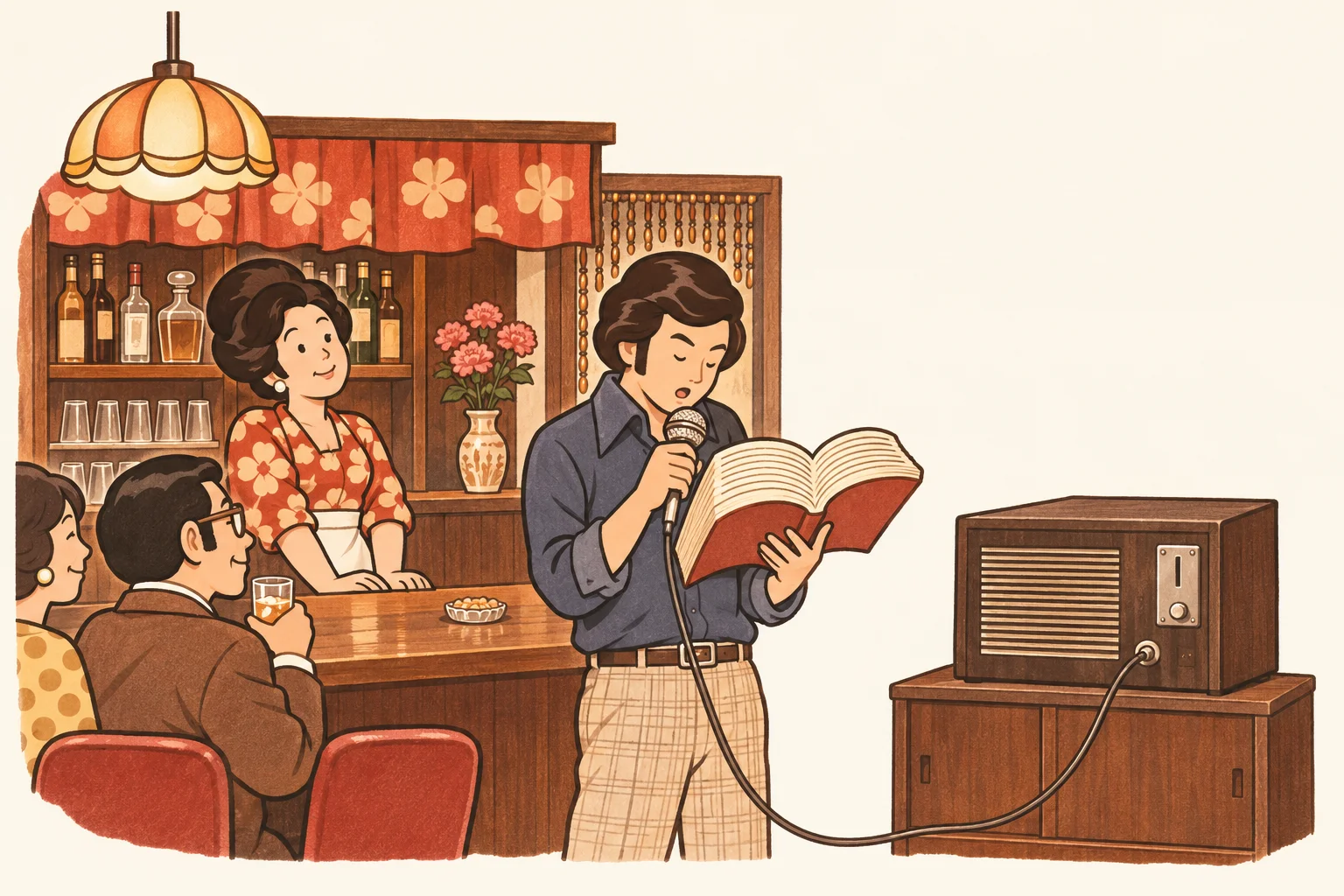
In a 1970s snack bar, singers dropped a coin in the machine and read the lyrics from a thick printed songbook.
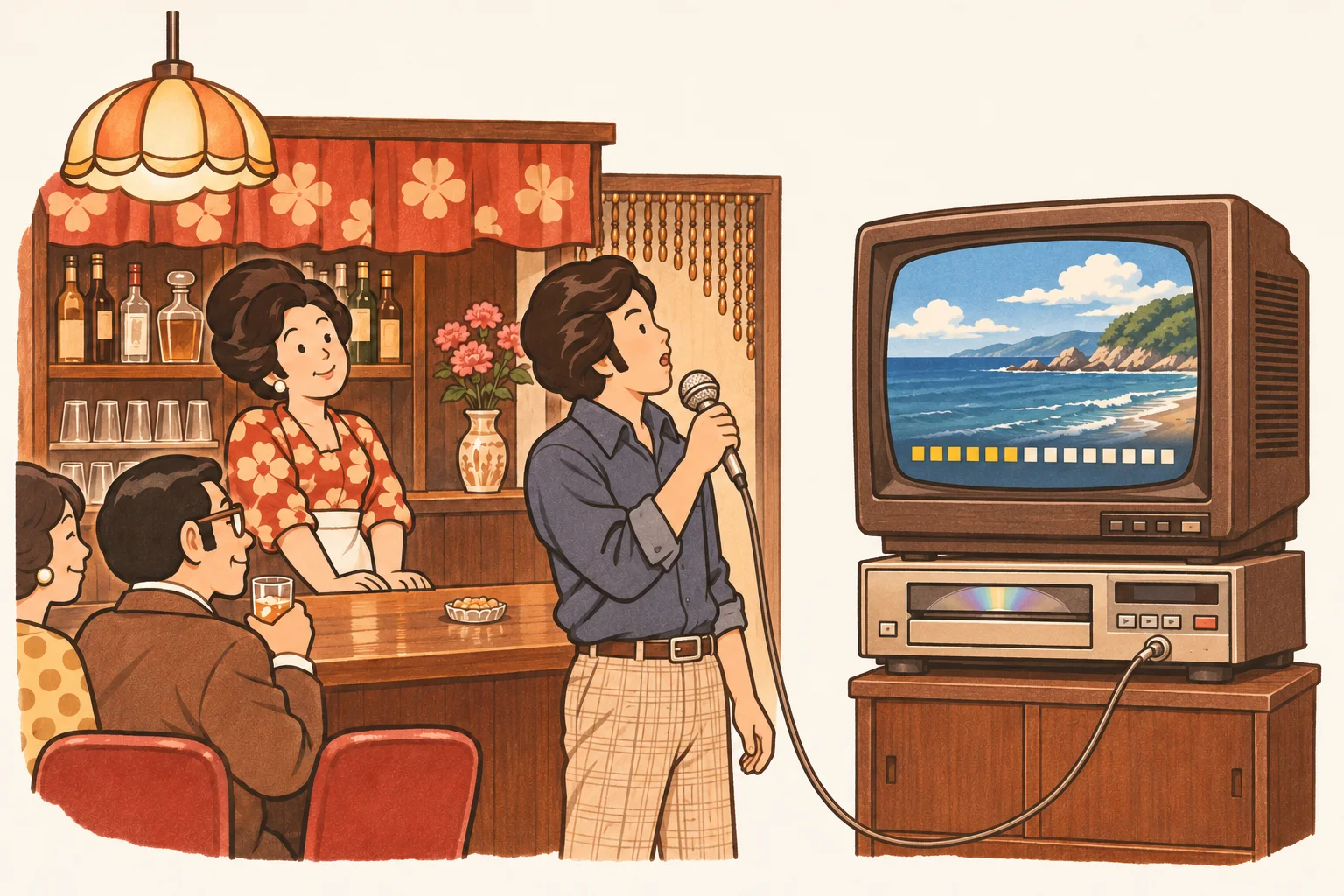
From 1982, laserdisc karaoke put video on a screen, with lyrics that changed color as the music played.
02From a Container in Okayama to the Station Front
Bar karaoke had a built-in limit. You had to drink, and you had to be willing to perform for strangers. The innovation that turned karaoke into a mass pastime was the karaoke bokkusu, the karaoke box.
The first one is generally dated to 1985 in Okayama Prefecture, where an operator converted a used shipping container into a small room with a sofa and a machine, set it on open land, and rented it by the hour. As the box boom took off in the late 1980s, rows of painted metal containers are said to have appeared on vacant lots, beside rice fields and along national highways. The idea separated singing from the bar. A family, a group of classmates or a team of coworkers could close the door and have the stage to themselves.
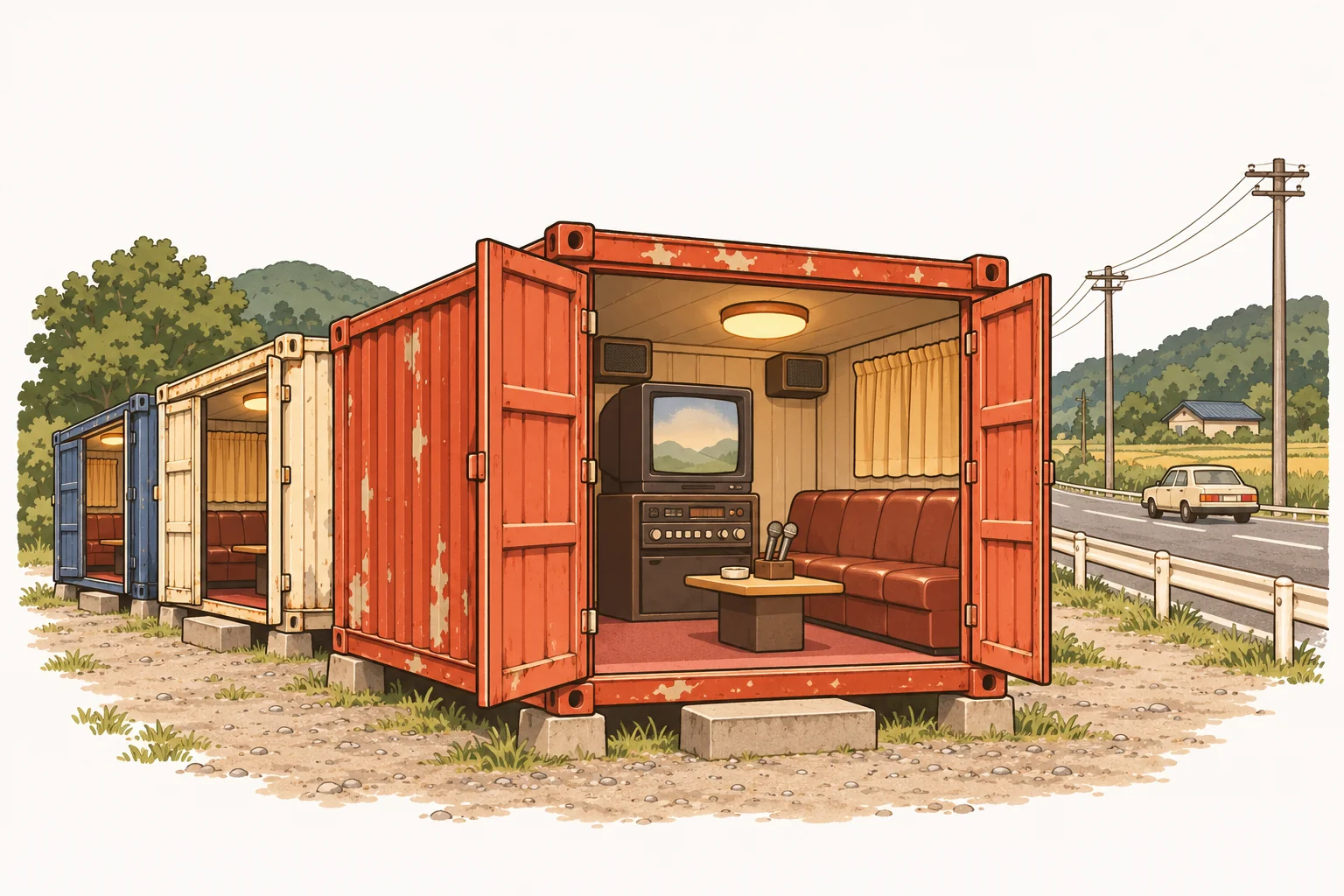
Painted shipping containers turned karaoke rooms on vacant land, as in the late 1980s (illustration).
Within a few years the boxes moved indoors. Through the late 1980s and the 1990s, buildings near train stations filled floor after floor with corridors of small rooms, and chains such as Big Echo, Karaoke-kan and Shidax spread across the country. In 1992 came tsūshin karaoke, network karaoke: instead of discs stored on site, songs were sent down phone lines from a central server. New releases could be sung within weeks of coming out, and catalogs grew into the tens and then hundreds of thousands of songs. As of 2026, two systems dominate almost every room in Japan: DAM, made by Daiichikosho, and JOYSOUND, from Xing, long a wholly owned subsidiary of the sewing-machine and printer maker Brother Industries and controlled by U-NEXT Holdings since 2026.
The mid-1990s were the peak. In fiscal 1995 about 58.5 million people went to karaoke, roughly half the population. Pop music fed the boom and was fed by it. Songs produced by Komuro Tetsuya and theme songs from hit television dramas sold millions of CDs, and many buyers bought them to learn the songs before their next night in a box. After the economic bubble deflated, the population aged and entertainment options multiplied, the numbers slowly declined. The pandemic of 2020 closed many shops for months. Karaoke survived by changing what it is for.
- 1967Negishi Shigeichi’s eight-track sing-along machine
- 1971Inoue Daisuke’s “8 Juke”
- 1985First karaoke box, Okayama (as generally dated)
- 1992Network karaoke arrives
- 1995About 58.5 million karaoke-goers in fiscal 1995
Karaoke moved from coin machines in bars into boxes and peaked in the mid-1990s, when roughly half the population went.
03Why a Reserved Country Sings
Visitors are often struck by the contrast: the same people who will not take a phone call on a train will belt out a power ballad, red-faced, an hour later. The two behaviors fit together. Japanese social life places a high value on composure in front of others, and that is exactly why a sanctioned space for losing composure is useful. In a karaoke room the music starts, the lyrics roll, everyone claps at the end, and then you sit down and life returns to normal. Nothing said or sung there needs to follow anyone out the door.
The office night out makes this explicit. A company gathering usually has stages. The first, at an izakaya (a pub with food), is dinner and drinks; the nijikai, or second party, very often moves to karaoke. A manager sings an enka number from his youth, junior staff clap along, a younger employee sings something current, and a kind of warmth that would be awkward to express in the office gets expressed through turn-taking. Having a few reliable songs is considered a minor social skill. Japanese even has a word for your signature number, ohako, often written with the characters for "eighteen," a borrowing from kabuki, where the Ichikawa Danjūrō acting line called its eighteen signature plays the Kabuki Jūhachiban.
Karaoke in Japan also bends toward practice. Modern machines grade you. DAM’s precision scoring mode breaks a performance into pitch, stability, rhythm, vibrato and long tones, and expression, and draws a scrolling bar on the screen showing whether you are sharp or flat at each note. Television has long run karaoke score contests where amateurs and professionals compete for points. Plenty of people go not to party but to train, singing the same song ten times to push a score from the high 80s into the 90s.
That impulse produced hitokara, solo karaoke. Going alone once looked a little sad; since the late 2000s it has become ordinary, and shops welcome it, since a single customer fills a small room on a slow weekday afternoon. As of 2026, for a few hundred yen you can sing for an hour or so with no one waiting for the microphone and no one hearing you miss a note. Since 2011 some shops have been designed entirely for solo singers, with booths of about 2 square meters where you sing in headphones, some fitted with studio condenser microphones and a mixer. Office workers drop in at lunch, students go before exams, and people preparing for singing contests drill one song over and over. Karaoke rooms have also become cheap private space for other uses: rehearsing a presentation, holding a video call, or, during the pandemic, working remotely.
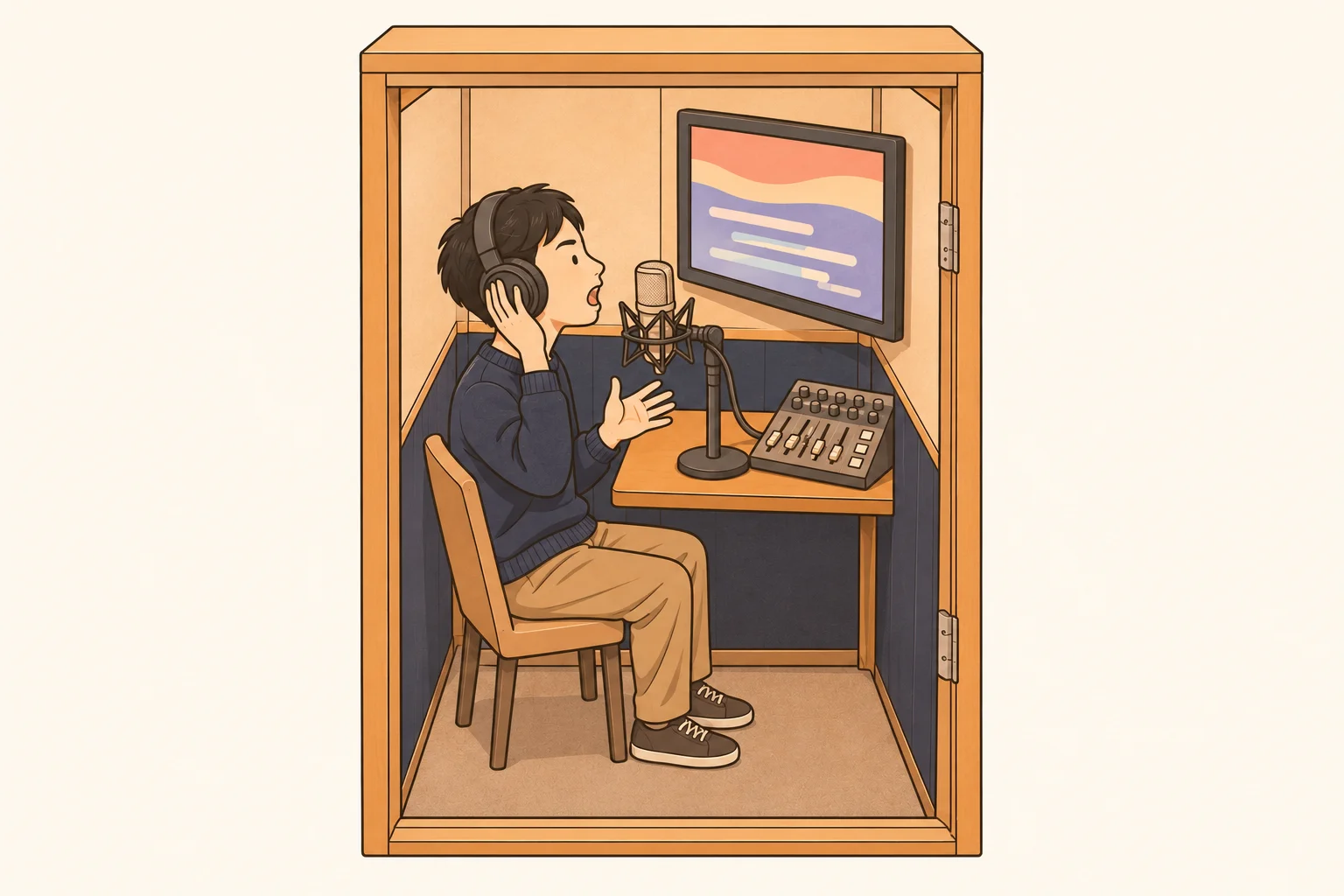
A booth built for solo karaoke: about 2 square meters, sung in headphones, in some cases with a studio condenser microphone.
04What Gets Sung
A Japanese karaoke catalog is a compressed history of the country’s popular music. Older singers favor enka and Shōwa-era songs, and numbers by Misora Hibari or Ishikawa Sayuri never leave the rooms. People in middle age reach for the idol pop, band music and drama themes of the 1980s and 1990s. Younger singers choose current J-pop, anime songs, and Vocaloid tracks, songs written for synthesized voices such as Hatsune Miku. DAM and JOYSOUND publish annual rankings of the most-sung songs, and those lists routinely mix new releases with songs that are decades old, a good measure of which music has actually entered everyday life.
The videos have their own culture. Ordinary songs are paired with footage the karaoke companies shoot themselves: a couple strolling on a beach, a city at night, falling cherry blossoms, often with no connection to the lyrics. Japanese audiences find this generic "karaoke video" faintly absurd and enjoy it for that reason. Popular songs come with honnin eizō, footage of the actual artist from a music video or concert. Anime songs often play the show’s opening sequence, so a group sings along while watching, much as they did in front of the television as children.
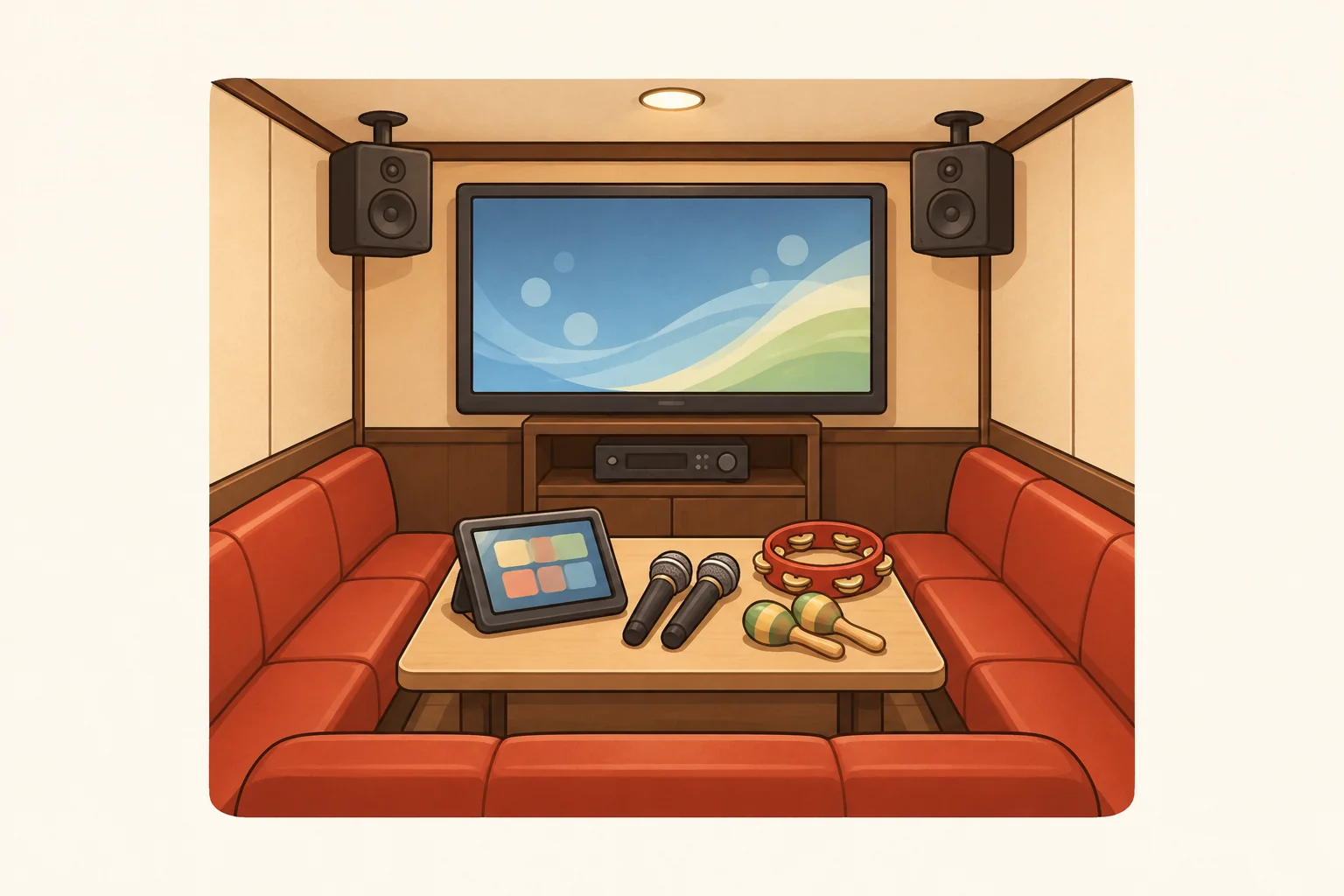
Choosing songs used to mean leafing through a book as thick as a phone directory, finding a code number and punching it into a remote. Now every room has a tablet that searches by artist, title, decade or anime series, and many systems let you queue songs from your phone. Most rooms also come with a tambourine or two and a pair of maracas. They look childish, but in a group the first person to pick up the tambourine is usually the one who keeps the room going.
05Walking Into a Karaoke Box
For visitors, karaoke is one of the easiest and cheapest kinds of nightlife in Japan. Most large stations have a chain shop within a few minutes’ walk, marked カラオケ. At the front desk the staff will ask how many people, how long you want to stay, and whether you have a membership card. As of 2026, pricing is usually per person per 30 minutes, cheap on weekday afternoons and higher in the evening and on weekends. Many shops also offer furī taimu, "free time," a flat rate for unlimited singing within a set window, and late-night packages that run until the first trains, which is how many young people who miss the last train spend the night.
Most shops have a drinks rule: either each person orders at least one drink, or the price includes a dorinku bā, a self-service drink bar in the corridor. A phone or tablet in the room lets you order food and drinks, typically fried chicken, fries, edamame, beer and sweet cocktails, which staff bring to the door. About ten minutes before your time ends, the room phone rings and the front desk asks whether you want to extend. When you leave, take the slip or basket you were given at check-in back to the counter and pay there.
The main machines carry a selection of English, Chinese and Korean songs, and the tablets usually switch to English. The foreign catalog is smaller than the Japanese one, but most well-known hits are there. If you can manage one Japanese song, even a theme from a Studio Ghibli film, it will do more for an evening with Japanese friends than any amount of polite conversation.
Singing with Japanese companions comes with a few unspoken rules. Do not queue several songs in a row for yourself; let the microphone travel. When someone else is singing, do not just stare at the tablet looking for your next song; clap, or shake the tambourine. Avoid picking a song you know is someone else’s ohako, which can come across as a challenge. If an older colleague chooses an old song, humming along is the politest thing you can do. Nobody much cares whether you sing well. What matters is that you were willing to pick up the microphone.
To see karaoke as it was first sung, look for a snack bar. They survive in Tokyo’s Golden Gai in Shinjuku, in the back streets of Ōsaka, and behind the station of almost any provincial town. Push open the door, order a whisky and water, and the mama-san will hand you the song tablet while an older man at the far end of the counter finishes an enka ballad. When your turn comes, a room of strangers will applaud you, which is what karaoke was built for.