

At a glance
How Japan’s place-named folk songs were sung at work and festivals, traveled along trade routes, survived through preservation societies, and where visitors can still hear and dance them.
- Min’yō are the songs people sang at work, at festivals, over drinks and at bon dances; most are named for a place.
- The word min’yō was coined as a translation in the 1890s; the songs themselves are far older.
- Many use call and response: one singer takes the verse and everyone answers with refrains like "yāren, sōran."
- Gokayama’s "Kokiriko Bushi" is accompanied by bamboo sticks and a binzasara, usually said to have 108 slats.
- A summer bon dance is the easiest place to join in: the steps are simple and you can follow after two rounds.
Every Japanese folk song, or min’yō, comes with a place name attached. Sōran from the herring grounds of Hokkaidō, Oiwake from the port of Esashi, Okesa from Sado Island, Kokiriko from the mountain valley of Gokayama. These were songs for planting rice, hauling nets, leading packhorses and dancing for the dead in summer. Over the last century, shamisen accompaniment, radio, records and schoolbooks turned them into melodies almost everyone in Japan can hum. This piece explains what min’yō is, why it sounds the way it does, how it traveled, and where a visitor can hear it, and join in.
01Songs of Work and Festival
The word min’yō is modern. Writers such as Mori Ōgai and Ueda Bin began using it in the 1890s, in the middle of the Meiji period, as a translation of the German Volkslied and the English "folk song," terms that arrived along with European ideas about the nation and its "folk." Before that, people spoke of riyō or zokuyō (common songs) and inaka-uta (country songs), by some accounts also kouta (short songs), or simply named a song after the job it went with. The songs themselves are much older than the label.
Most began as work songs. Rice-planting songs (taue-uta) kept a line of planters bending and stepping back together. Kiyari songs were sung by men hauling timber and later by firefighters in Edo. Fishermen had boat songs for rowing and for pulling nets, packhorse drivers sang mago-uta on lonely mountain roads, and tea pickers sang in the fields of Shizuoka and Uji. Another large family consists of festival songs: those sung for the local kami at harvest, and the bon-odori songs for the summer dances that welcome ancestral spirits home.
Work explains the shape of many songs. A lead singer with a strong voice carries the verse, and everyone else answers with a burst of nonsense syllables that marks the rhythm: yāren sōran, dokkoi, choina choina. These refrains, called hayashi-kotoba, are often what people remember long after the verses fade. "Sōran Bushi" was sung on Hokkaidō herring boats as the crew scooped fish from the nets, and its shouted refrain survives today in a high-energy dance routine that Japanese school children perform at sports days.
The titles follow a pattern: a place name plus bushi, meaning "tune" or "melody." "Tsugaru Jongara Bushi," "Yasugi Bushi," "Kuroda Bushi," "Aizu Bandaisan." For Japanese listeners, a min’yō is first of all an image of a region: the snow and sea wind of the north, the swagger of Kyūshū, the quiet of a mountain village. Many towns still treat their song as a calling card. You will hear it as a train departure melody, at the local festival, or on the regional TV station.
02The Voice and the Scale
First-time listeners are often startled by the singing. A trained min’yō singer produces a high, straight, powerful tone from the chest and throat and holds a single syllable for a long time while bending it with fine, rapid ornaments. The Japanese call this ornamentation kobushi. In "Esashi Oiwake," the most demanding of all, a verse of only twenty-odd syllables (usually given as 26, in lines of 7-7-7-5) is drawn out so far that a single performance lasts two or three minutes. There is no fixed beat. The singer shapes each phrase to the breath, and the accompanying shakuhachi flute has to follow the voice rather than lead it.
Other songs are the opposite: steady, rhythmic and meant for dancing or working, with taiko drums, shamisen and flute driving the beat. Japanese scholars sometimes divide min’yō into these two broad styles, the free-flowing oiwake type and the metered yagi-bushi type, named after a lively dance song from the northern Kantō. Most regions have both.
The melodic material sets min’yō apart from the city music of the Edo period. The ethnomusicologist Koizumi Fumio described a pentatonic "min’yō scale" that sounds open and bright, without the semitones of the miyako-bushi scale typical of urban shamisen genres such as nagauta in kabuki. Put simply, the music of the pleasure quarters and theaters sounds refined and melancholy, while min’yō sounds like it was sung outdoors, which it was.
Instruments were layered on over time. Early work songs used voice and hand claps; festival songs added drums and bamboo flutes. The decisive step came when the shamisen spread in the Edo period. Party musicians and geisha took up country tunes, smoothed out their words, regularized their rhythm and set them to shamisen. That is how many songs moved from the field to the banquet room, and from something you did into something you listened to. A standard stage line-up today is a solo singer, shamisen, shakuhachi and taiko, with one or two backing singers shouting the refrains.
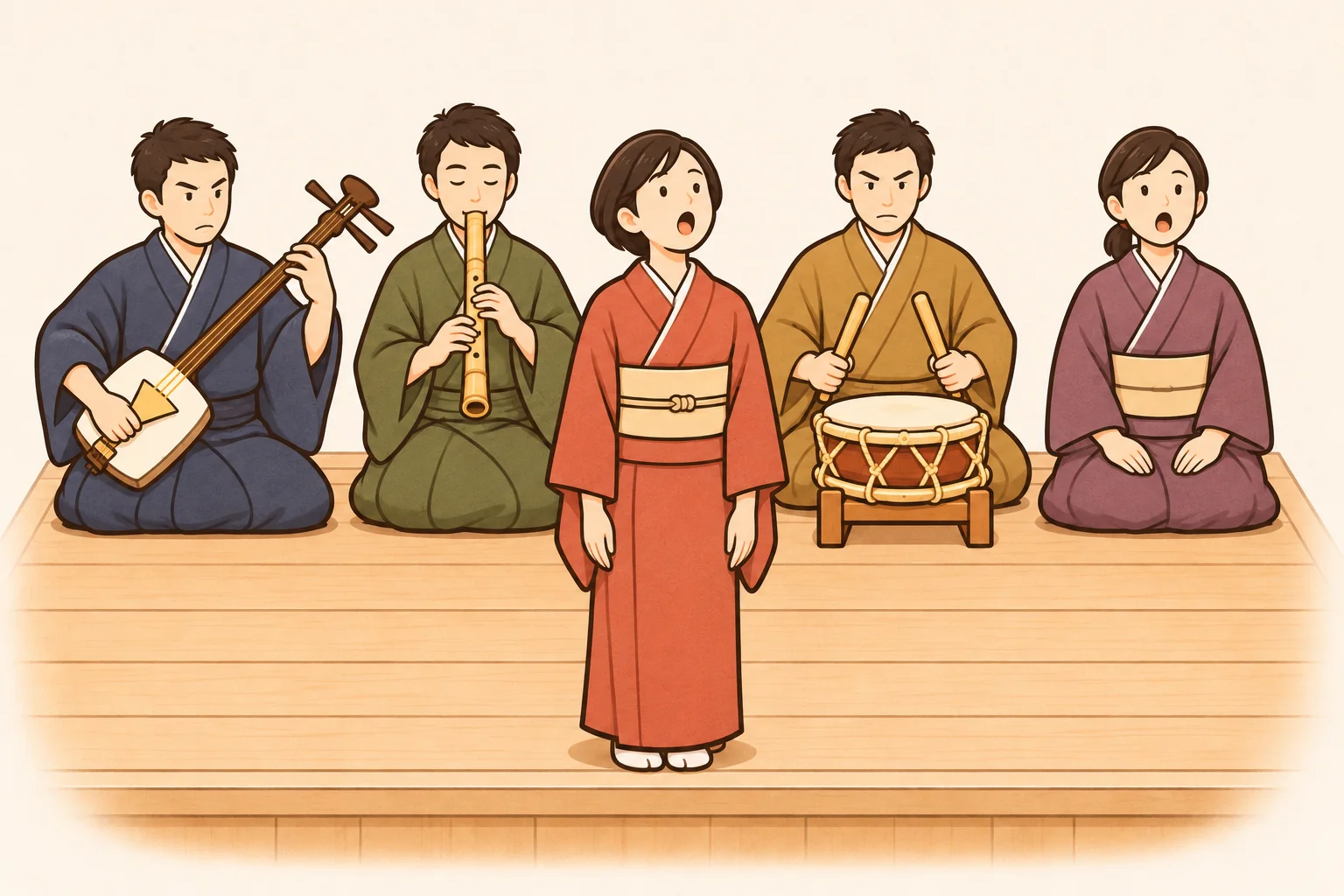
A standard min’yō stage line-up: a solo singer with shamisen, shakuhachi, taiko and a backing singer for the refrains.
03Songs That Traveled
Min’yō did not stay put. In the Edo period people and goods moved along highways and coastal shipping lanes, and songs moved with them.
- 1Shinano Oiwakethe packhorse drivers’ song, sung to shamisen: Oiwake Bushi
- 2Echigospread north
- 3Kitamae-bunemerchant ships sailing to Hokkaido
- 4Esashi (Hokkaido)refined into Esashi Oiwake
A mountain horse-driver’s tune moved along roads and shipping lanes and became Esashi Oiwake.
The classic example is Oiwake. The word means a fork in the road, and Shinano Oiwake was a post town where the Nakasendō highway met the road to the Hokuriku coast. There the packhorse drivers’ song was taken up by the inn maids, who sang it to shamisen at drinking parties, and it became known as "Oiwake Bushi." It spread north to Echigo, and from the ports of the Sea of Japan coast it boarded the kitamae-bune, the merchant ships that sailed between Ōsaka and Hokkaidō. In Esashi, a town grown rich on herring, it was refined over generations by the entertainers of the pleasure quarter into "Esashi Oiwake," a slow, aching song of the sea. A mountain horse-driver’s tune became one of the most respected pieces in the repertoire, hundreds of kilometers from where it started.
A similar story is told of "Ushibuka Haiya Bushi," a lively harbor song from the Amakusa islands in Kyūshū. Sailors carried it from port to port. It is generally thought to lie behind Tsugaru’s "Aiya Bushi" in the far north and to be one of the sources of Sado’s "Sado Okesa." Haiya-type songs can be found from Aomori to Kagoshima, many of them originally sung in waterfront drinking houses.
This mobility explains why the same song often exists in several local versions, and why arguments over which is authentic can be fierce. It is also why local preservation societies (hozonkai) care so much about fixing the correct words, melody and dance steps.
04Kokiriko: An Old Song in a Mountain Valley
Gokayama lies in the deep valleys of the upper Shō River in the southwest of Toyama Prefecture. Together with Shirakawa-gō across the border in Gifu, it is famous for gasshō-zukuri farmhouses, whose steep thatched roofs look like hands pressed together in prayer, and the two areas were listed as a UNESCO World Heritage Site in 1995. Snow here lies meters deep in winter, and until modern roads arrived the valley was extremely isolated. Under the Kaga domain in the Edo period it served as a place of exile and quietly produced saltpeter for gunpowder. Isolation helped old songs and dances survive, and "Kokiriko Bushi" is the best known of them.
A kokiriko is an instrument: a pair of short bamboo sticks, one in each hand, struck together for a dry, bright click. The dance also uses the binzasara, a clapper made of many thin wooden slats strung on a cord. The dancer holds the ends and flexes it so the slats snap together with a rippling rattle. The number of slats is usually given as 108, the number of worldly desires in Buddhism. The song opens by describing its own instrument:

One stick in each hand, struck together for a bright click; the song gives their length as seven sun five bu, about 23 cm.
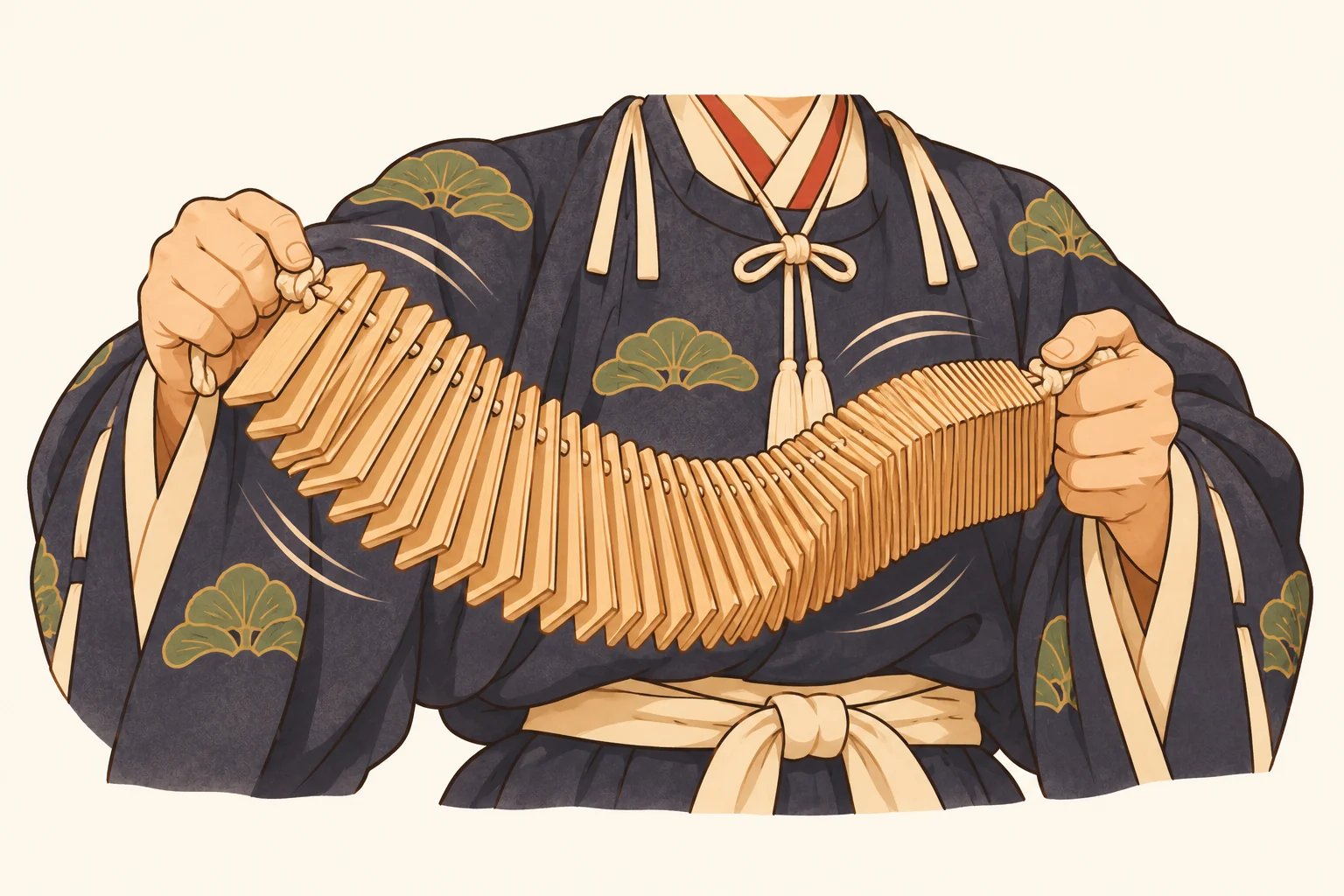
Playing the binzasara: the ends are flexed so the thin wooden slats snap together.
Kokiriko no take wa shichisun gobu ja, nagai wa sode no kanakai ja
"The kokiriko’s bamboo is seven sun and five bu long; any longer and it would catch on your sleeve." (That is about 23 centimeters.) A refrain keeps coming back, mado no sansa wa dedereko den, and that last phrase, dedereko den, said to imitate the sound of a drum, is what most Japanese remember about the song.
Kokiriko is believed to be very old. Tradition links it to dengaku, the medieval music and dance performed to pray for a good harvest. The singers and musicians wear tall black eboshi caps and the formal hitatare robes of earlier centuries; the male dancers wear hitatare and broad ayai-gasa hats as they strike the binzasara, in movements described as slow and upright. The whole has the air of an old shrine rite, far from the cheerful circling of a bon dance.
The song nearly died out. By the early Shōwa period, it is said, only a few elderly villagers could still sing it. Folk song collectors and local enthusiasts wrote down the words and melody from their memories, and after the war a preservation society settled the dance steps and brought it back into village festivals. After the war, it is said, it was adopted as school music material (by one account in middle-school textbooks from 1969), so many Japanese have sung "Kokiriko no take wa" in music class, and the name Gokayama became known nationwide through a song. Today the Kokiriko Festival is held every year on September 25 and 26 at the Hakusan Shrine in the Kaminashi district, with villagers and visitors dancing in front of it. The shrine’s main hall, rebuilt in 1502, is the oldest wooden building in Toyama Prefecture and a national Important Cultural Property.
Gokayama has another famous song, "Mugiya Bushi," which is the opposite in mood. Men dance it with swords at their hips and straw hats in hand, vigorously and with sharp turns, and local legend ties it to the Heike warriors said to have fled into these valleys after their defeat in the twelfth century. The two are often presented together: one calm and ancient, the other martial.
Kokiriko’s story is the modern story of many local songs. They were tied to a particular village’s rituals and work; when that way of life changed, people stopped singing them; then preservation societies, schools and tourism brought them back. What came back is usually more polished and fixed than what was lost, but it is still sung.
05Radio, Records and the Min’yō Classroom
What made min’yō a national music was twentieth-century media. In the 1920s poets such as Kitahara Hakushū and Noguchi Ujō and the composer Nakayama Shinpei led a "new folk song" (shin-min’yō) movement, writing fresh songs in folk style for towns and companies. Kitahara’s "Chakkiri Bushi," a tea-picking song commissioned in 1927 to promote an amusement park run by a Shizuoka railway, is a well-known example. Many such songs are now simply thought of as min’yō.
Radio broadcasting began in Japan in 1925, and along with records it gave regional singers a national audience. After the Second World War, NHK folk song programs and competitions pushed min’yō to the height of its popularity. Singers trained in min’yō, such as Mihashi Michiya, who debuted in 1954, became pop stars in the 1950s, and min’yō vocal technique flowed into enka, the sentimental popular ballad. The heavy, wavering kobushi of enka singers owes a great deal to folk singing.
Another path was the min’yō classroom. Like Japanese dance or the tea ceremony, min’yō developed schools and teacher lineages. Students study singing or shamisen with a teacher, take graded exams and may receive a professional name. On a weekend in a community hall you may find a room of retirees practicing "Hanagasa Ondo" with straw hats decorated with paper flowers. This system gave min’yō standard versions and a certain formality, closer to a classical art than to a song shouted across a paddy.
In the 1970s the Tsugaru shamisen had its own boom. This style from the Tsugaru region of Aomori uses a thick-necked instrument struck hard with the plectrum, and it was once the music of blind itinerant performers who played door to door for rice and coins. Players such as Takahashi Chikuzan won over young audiences in small Tokyo venues; from 1973 Chikuzan played regularly at Jean-Jean, a tiny theater in Shibuya. The Yoshida Brothers, who debuted in 1999, and other younger players took it onto pop stages and overseas tours, and for many foreigners the percussive, rapid-fire Tsugaru shamisen is their first encounter with Japanese folk music.
06Where to Hear It, and Dance It
For a traveler the easiest way into min’yō is the summer bon dance. Bon-odori is danced during the Obon festival to welcome and send off the spirits of the dead. Almost every neighborhood puts up a wooden tower (yagura) in a shrine yard or park, with a drummer and singer on top, and people dance in a ring around it. The steps are a short sequence repeated over and over. Watch for two rounds and you can join; nobody minds an outsider in the ring. A cotton yukata is ideal but not required.
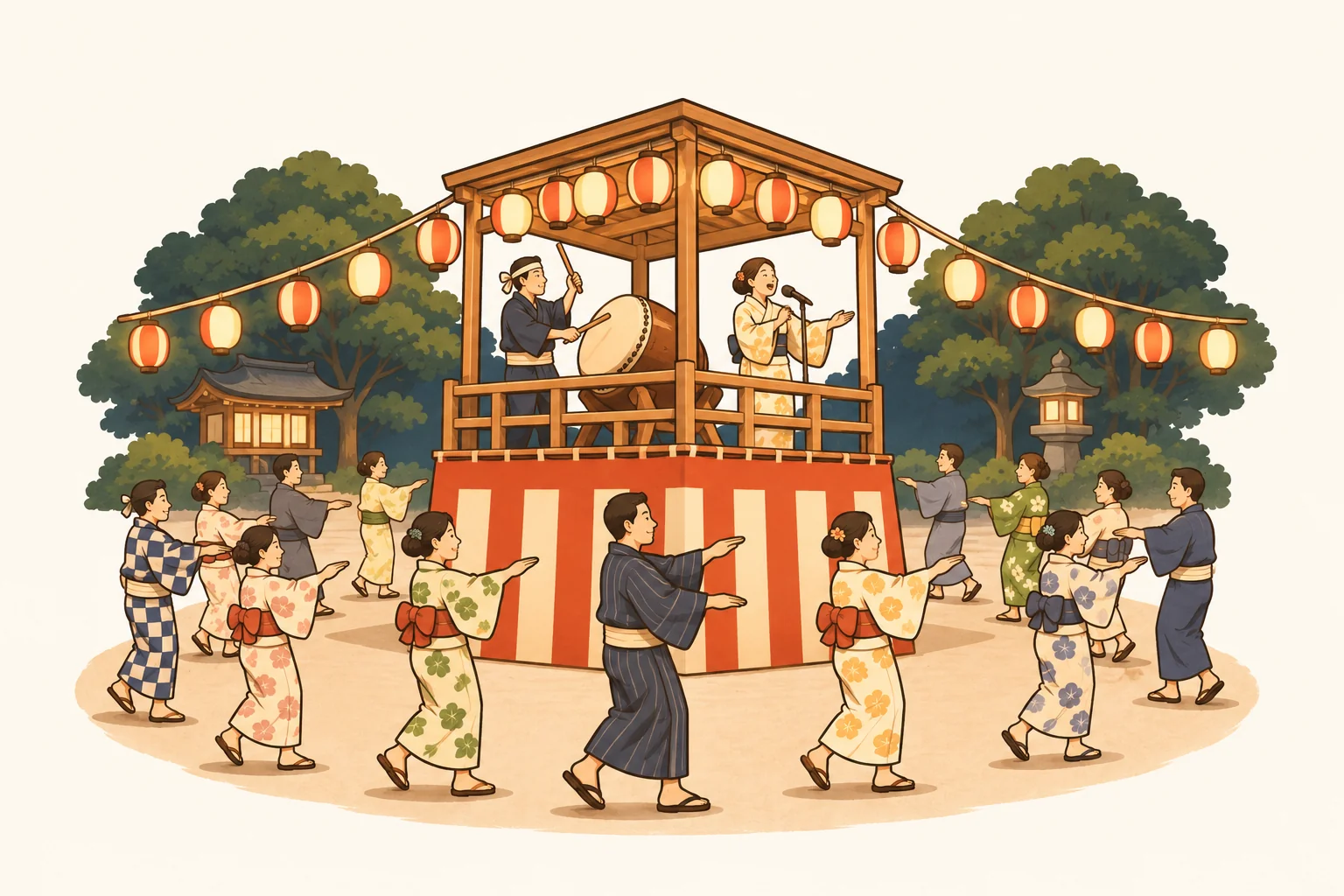
A summer bon dance: people circle a yagura tower where a drummer and singer perform.
A few dances are worth a special trip. In Gujō Hachiman, a small castle town in Gifu, the Gujō Odori is danced on more than thirty nights from mid-July to early September, and over the four Obon nights of August 13 to 16 it goes all night until dawn. The clatter of wooden geta on the stone streets becomes part of the music. Tokushima’s Awa Odori, held August 12 to 15, draws over a million people (as of 2025); it is a parade dance performed by groups called ren, and visitors can join a ren formed for the day. In Akita, the Nishimonai Bon Odori is hushed and eerie, the dancers’ faces hidden under low straw hats or black hikosa-zukin hoods, said to represent the dead, as they move slowly by bonfire light late into the night. On September 1 to 3, the Owara Kaze no Bon in Yatsuo, Toyama, sets "Etchū Owara Bushi" to the plaintive bowed kokyū, and fits neatly into the same trip as Gokayama.
In cities, look for min’yō bars and Tsugaru shamisen live shows. In Aomori and Hirosaki some izakaya stage Tsugaru shamisen performances every evening, and you listen over scallops and local sake. Tokyo still has a handful of old-style min’yō sakaba, where house singers and musicians take turns and regulars get up to sing a verse. Each September the town of Esashi in Hokkaidō hosts the national Esashi Oiwake contest, the summit for singers of that song.
To hear Kokiriko itself, go to the festival on September 25 and 26; at other times of year the dance is also performed at places such as the Murakami House, a gasshō farmhouse in Kaminashi. Standing under a thatched gasshō roof, listening to bamboo sticks clicking and dedereko den echoing off the valley walls, you can see how a song might last for centuries in a place like this.
Min’yō overlaps with several other subjects (see also: Shamisen: The Three-Stringed Sound of Edo Japan; Shakuhachi: The Bamboo Flute That Makes Breath Audible; Taiko: Japan’s Drums, from the Village Shrine to the World Stage; Enka: Japan’s Ballads of Harbors, Snow, and Sake; Karaoke: Japan’s Private Rooms for Singing Out Loud). The shamisen and shakuhachi accompany it, taiko gives the bon dance its pulse, enka borrowed its voice, and "Sōran Bushi" turns up on karaoke menus.