
At a glance
How enka sounds, why its 'heart of Japan' image is younger than it seems, Misora Hibari’s life, and where to hear it live.
- Enka is a slow, minor-key Japanese ballad style whose signature is kobushi, a small wavering ornament on sustained notes.
- Its melodies usually sit on yonanuki, a pentatonic scale without the fourth and seventh degrees.
- The word first meant the "speech songs" of the Meiji-era Freedom and People’s Rights Movement; it took its present meaning in the late 1960s.
- Misora Hibari became famous at twelve with Kanashiki Kuchibue (1949) and received the People’s Honor Award after her death in 1989.
- Enka peaked from the late 1960s through the 1980s; record sales fell steadily from the 1990s.
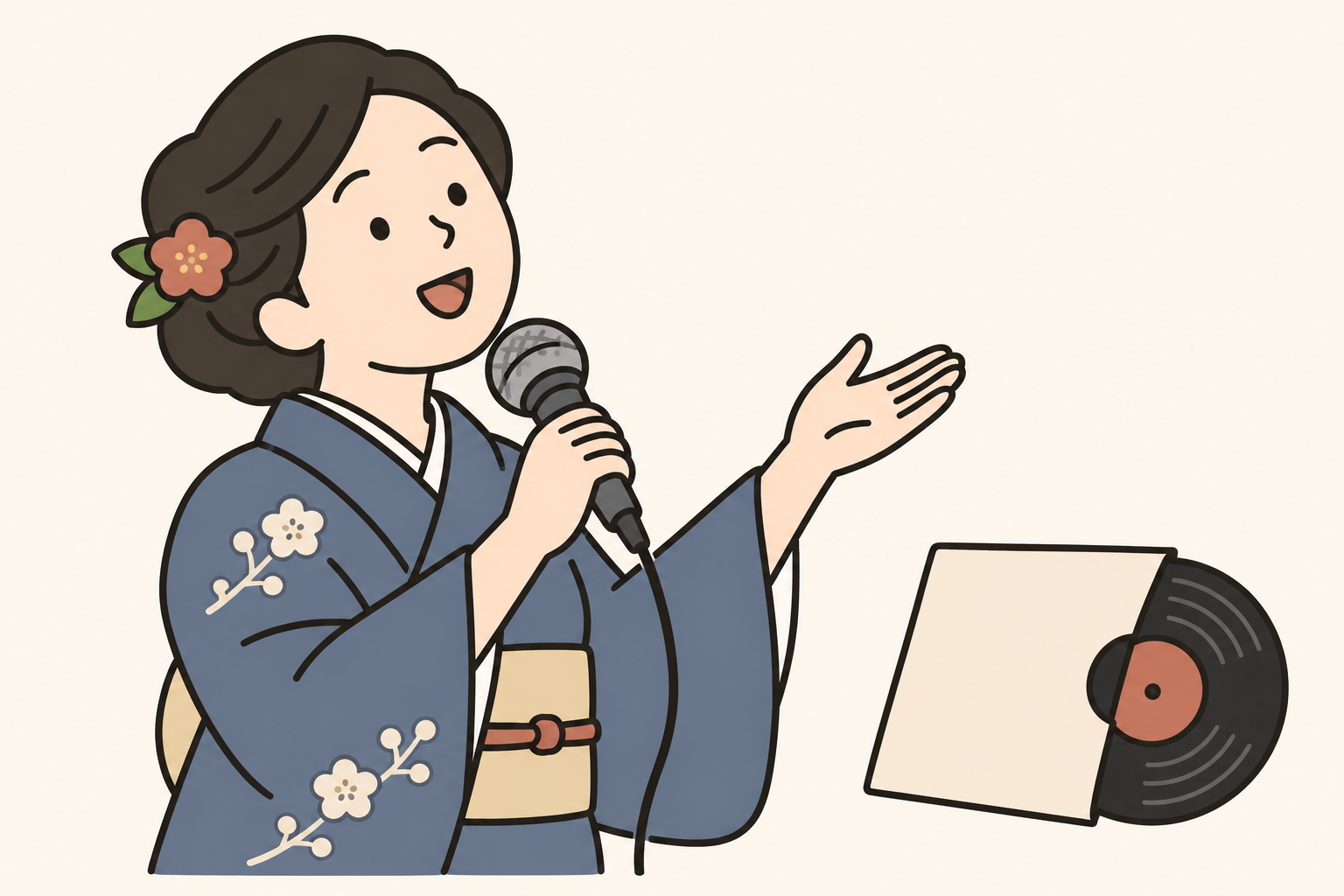
Enka is the slow, sorrowful ballad music of postwar Japan: a singer in a kimono or a sharp suit, a string section swelling behind her, a song about a ferry crossing in winter or a woman drinking alone in a harbor bar. To many younger Japanese it is their grandparents’ music, yet it still claims a block of the most-watched television show of the year, NHK’s New Year’s Eve song contest, and it fills karaoke rooms across the country every night. This piece explains how enka sounds and why, where the word and the idea of enka as "the heart of Japan" came from, who Misora Hibari was and why her death in 1989 felt like the end of an era, and where a visitor can still hear it sung live.
01What an Enka Song Sounds Like
Put on a classic enka record and the opening bars usually tell you what you are in for. A mournful introduction on strings, saxophone, or electric guitar, sometimes with a shakuhachi (bamboo flute) or a koto-like flourish, sets a walking tempo. Then the voice enters, and the first thing a newcomer notices is the kobushi: a small, controlled ornament on a sustained note, the pitch wavering and turning before it settles, as if the singer were working a single syllable between her fingers. Kobushi comes from older Japanese vocal traditions, from folk song (min’yō) and the narrative chanting of rōkyoku, and enka singers and teachers treat it as the thing that gives a song its flavor. Alongside it comes a heavy vibrato on held notes, and a way of letting the voice crack or thicken on the emotional peak of a line.
The melodies tend to sit on a five-note scale known in Japanese as yonanuki, literally "without the fourth and seventh," a pentatonic scale that drops two degrees of the Western scale. In its minor form it produces the bittersweet, slightly old-fashioned sound that Japanese listeners hear instantly as enka. The lyrics are usually built in three verses of matching shape, often ending on the same refrain, so that a listener who has heard a song twice can follow it in their head.
Seven-degree scale
- 1st
- 2nd
- 3rd
- 4th
- 5th
- 6th
- 7th
Yonanuki (five notes)
- 1st
- 2nd
- 3rd
- 5th
- 6th
Dropping the fourth and seventh degrees leaves five notes; enka mostly uses the minor form.
The world of the songs is almost as fixed as the scale. Harbors, straits, and windswept capes. Train stations in the north. Snow, rain, fog, and the long night. Sake warmed in a small bottle, a red paper lantern outside a bar, a ship’s horn in the dark. The characters are a woman left behind, a man who cannot go home, a pair of lovers who must part. Ishikawa Sayuri’s 1977 hit Tsugaru Kaikyō Fuyugeshiki ("Winter Scene at the Tsugaru Strait") packs nearly all of it into its opening verse: a night train leaves Ueno station in Tokyo, the narrator gets off at Aomori at the top of Honshū to find everything buried in snow, and she boards the ferry north alone, weeping as she watches gulls that look half-frozen.
Why these images in particular? The most common answer is social. In the decades of high-speed economic growth after the war, millions of young people left farming and fishing towns in Tōhoku, the Japan Sea coast, and Kyūshū to work in Tokyo and Ōsaka. Enka sang about the places they had left and the loneliness of the city they had come to. Stations and harbors are where people say goodbye; snow and sake are what you get through the night with. A listener did not need to have stood on the Tsugaru ferry to know exactly how that narrator felt.
02Where the Word Came From
The word enka is older than the music it now names, and it began as something quite different. In the 1880s and 1890s, during the Freedom and People’s Rights Movement, young activists campaigning for a constitution and an elected assembly found their public speeches routinely shut down by the police. Their workaround was to set their speeches to simple tunes and sing them in the street. These were enzetsu no uta, "speech songs," shortened to enka. The young men who sang them were called sōshi, roughly "activists" or "strong-arm youths," so the genre was known as sōshi enka. The most famous product of the period was Kawakami Otojirō’s Oppekepē-bushi, a patter song mocking pompous officials and Westernizing gentlemen, which he made a hit in the variety halls (yose) of Kyoto around 1889–90.
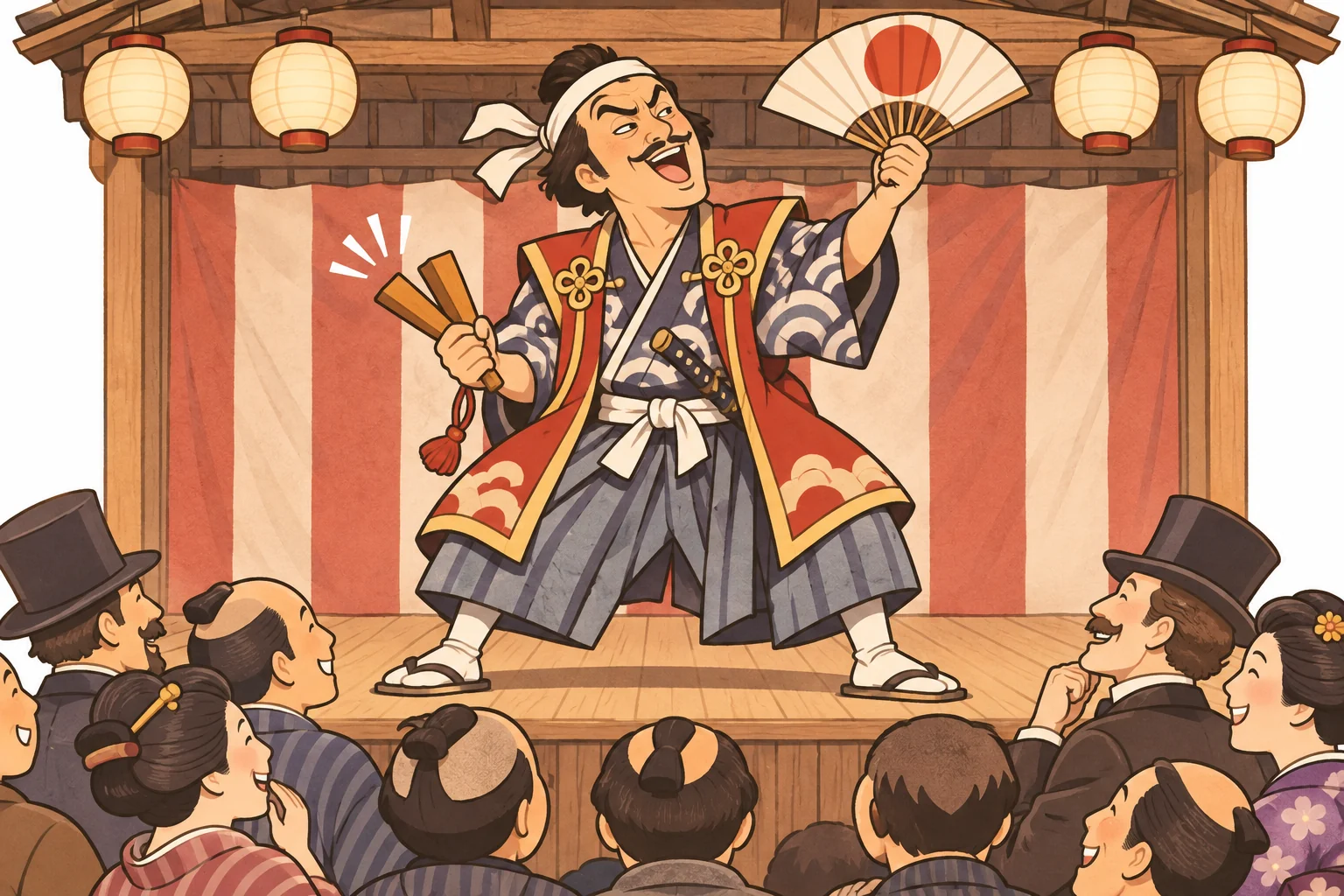
A sōshi performer singing the satirical Oppekepē song on a mid-Meiji yose stage (illustration).
By the late Meiji and Taishō periods, street singers called enkashi had taken up the violin, accompanying themselves as they sang about current events and sold booklets of lyrics to passersby. The political edge softened into social satire and popular sentiment. Soeda Azembō was the best-known figure in this world, writing sharply funny songs about the times.
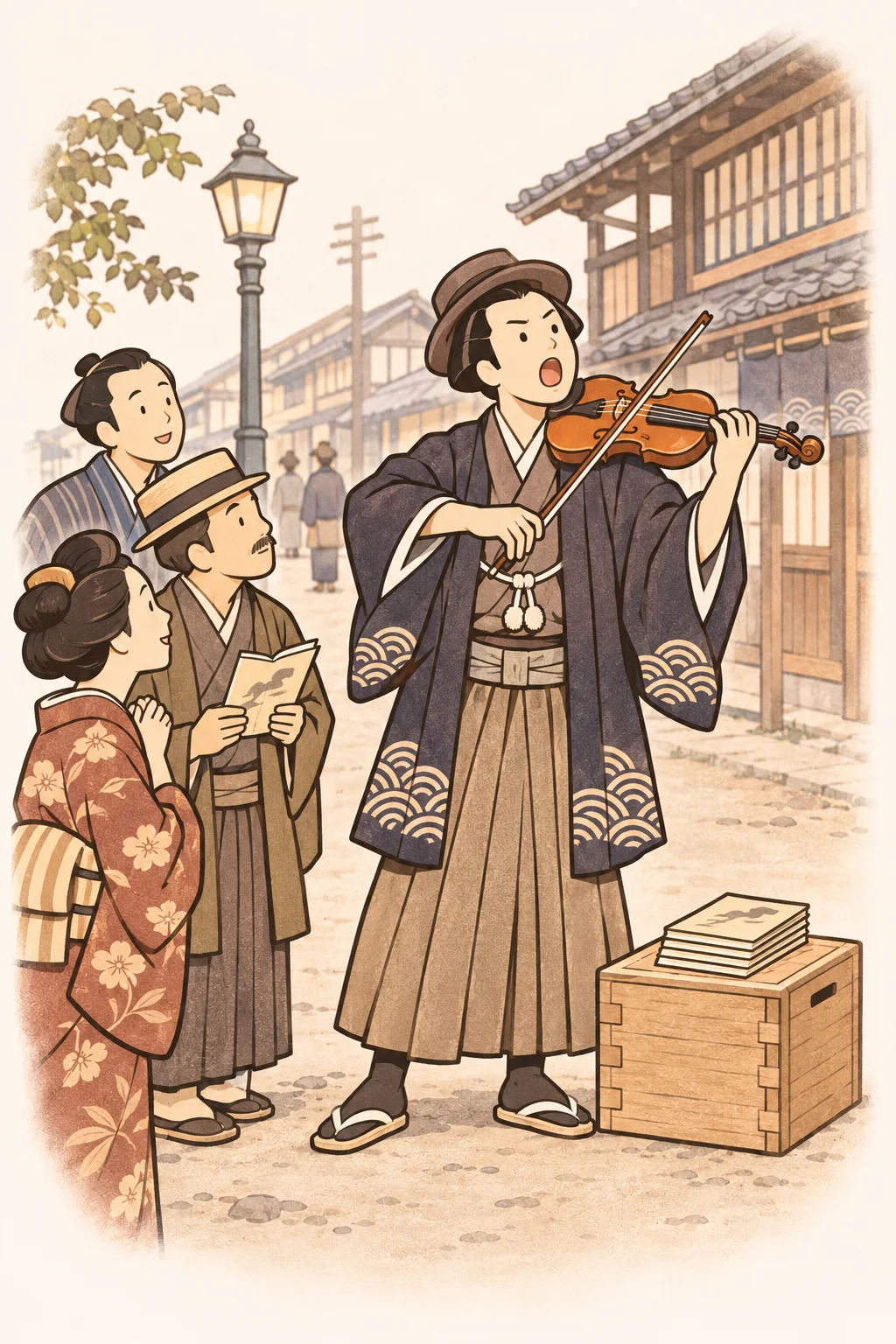
A street enkashi of the late Meiji and Taishō years, singing to his own violin and selling booklets of lyrics.
Records and radio then pushed the street singers aside. From the late 1920s, record companies produced what they called ryūkōka, "popular songs," and later kayōkyoku. The composer Koga Masao’s Kage o Shitaite ("Longing for Your Shadow"), first recorded in 1931 and a hit in Fujiyama Ichirō’s 1932 version, is a melancholy guitar ballad that defined what came to be called the "Koga melody," a sound many later enka songs descend from. For the next three decades, though, nobody called this music enka. It was simply popular song.
The word came back in the late 1960s. The Beatles had toured Japan in 1966, electric guitar bands of the "group sounds" boom were topping the charts, and folk singers with acoustic guitars were writing their own songs. The record industry and critics needed a name for the older, Japanese-flavored, kobushi-laden ballads, and the dusty Meiji word enka was revived for them, sometimes written with other characters meaning "seductive song" or "song of resentment." Fuji Keiko, who debuted in 1969 with a low, husky voice and a repertoire of songs about the Shinjuku night, was described by the novelist Itsuki Hiroyuki as singing the "song of resentment," and her success helped fix the new category.
- 1Sōshi enka1880s and 1890s; Oppekepē-bushi, around 1889–90
- 2Street enkashilate Meiji and Taishō; violin and lyric booklets
- 3Ryūkōka, kayōkyokufrom the late 1920s; Kage o Shitaite, 1931
- 4Enka as a categorylate 1960s; Fuji Keiko debuts in 1969
Enka began as political street song; only in the late 1960s was the word revived for kobushi-laden, Japanese-flavored ballads.
So when enka is described, as it often is in Japan, as nihon no kokoro, "the heart of Japan," the claim is younger than it sounds. The musicologist Wajima Yūsuke made this argument at length in a 2010 book whose title translates as The Invented Myth of "the Heart of Japan," showing how enka’s image as timeless tradition was largely assembled around 1970. The anthropologist Christine Yano, in her study Tears of Longing, looked at how fans, singers, and the industry keep that image alive. None of this makes the songs less moving; it simply means enka is a modern genre that learned to present itself as an old one.
03Misora Hibari
No account of enka can leave out Misora Hibari (1937–1989), even though she sang far more than enka and resisted being boxed into any single genre. Born Katō Kazue to a fishmonger’s family in Yokohama, she was singing on amateur stages as a small child. In 1949, at twelve, she recorded Kanashiki Kuchibue ("Sad Whistle") and starred in the film of the same name; the image of the little girl in a top hat and tails, singing with a grown woman’s assurance, spread across occupied Japan almost overnight. Tokyo Kid followed in 1950, a song about a streetwise child that fit a country full of war orphans.
She was, first of all, a film star. Through the 1950s and into the 1960s she appeared in well over a hundred films, many of them period dramas for the Toei studio, in which she played young samurai, plucky townswomen, and the occasional boy, singing between sword fights. With Eri Chiemi and Yukimura Izumi she formed the "Three Girls" (Sannin Musume), who made a series of musical comedies together. For a generation of moviegoers, Hibari grew up on screen.
On record she could sing nearly anything. Ringo Oiwake ("Apple Oiwake," 1952) borrows the long, free-flowing lines of an oiwake folk song. Minatomachi Jūsan-banchi ("Harbor Town, Lot 13," 1957) is a jaunty harbor number. Yawara (1964), a song about the spirit of judo released in the year of the Tokyo Olympics, won the Japan Record Award the following year. Kanashii Sake ("Sad Sake," 1966) is enka at its most concentrated, and her habit of shedding real tears on stage while singing it became one of the defining images of her career. Makka na Taiyō ("Bright Red Sun," 1967), recorded with the group-sounds band Jackey Yoshikawa and His Blue Comets, had her in a miniskirt singing a go-go beat. She also recorded jazz standards. Listening across her recordings is a lesson in how a voice ages: the clear, startling child, the full and controlled woman of the 1960s and 1970s, the slightly darker, more deliberate voice of her last years, which some listeners prefer to all the rest.
Her last decade was hard. Her brother’s repeated arrests had already brought her years of press criticism; her mother and both her brothers died during the 1980s; and in 1987 she was hospitalized with necrosis of the hip joints and chronic hepatitis. In April 1988 she returned to perform at the newly opened Tokyo Dome in what was billed as the "Phoenix" concert. Wearing a deep-red gown designed by Mori Hanae, with phoenix and flower motifs, she sang 39 songs despite her health. Kawa no Nagare no Yō ni ("Like the Flow of the River"), with lyrics by Akimoto Yasushi and music by Mitake Akira, appeared on an album at the end of 1988 and as a single in January 1989: a calm, reflective song that sounds like a life looked back on. It became her best-known song, and in later polls it has repeatedly been voted among the greatest Japanese songs of all time.
She died in Tokyo on June 24, 1989, at fifty-two (fifty-three by the traditional count). The following month the government awarded her the People’s Honor Award, the first woman to receive it. Emperor Hirohito had died in January of the same year, and for many Japanese the two deaths, six months apart, mark the end of Shōwa as clearly as any date on a calendar.
04The Golden Age and After
Enka was at its commercial peak from the late 1960s through the 1980s. Among the men, Kitajima Saburō, who debuted in 1962, broke through with Hakodate no Hito ("The Girl from Hakodate," 1965) and later made Matsuri ("Festival," 1984) his signature, performing it on New Year’s Eve television amid giant festival floats and men carrying portable shrines. Mori Shin’ichi, with his rough, breaking voice, had a hit with Erimo Misaki ("Cape Erimo," 1974), composed by the folk singer Yoshida Takurō, a crossover that surprised people at the time. Itsuki Hiroshi built a long career on smooth, polished ballads.
Among the women, Yashiro Aki’s Funa-uta ("Boat Song," 1979) and Ame no Bojō ("Longing in the Rain," 1980) are the definitive "bar enka": a small counter by the harbor, warmed sake, a woman serving drinks and listening to the rain. Ishikawa Sayuri followed Tsugaru Kaikyō with Amagi-goe ("Crossing Amagi," 1986), a song of almost violent passion set on a mountain pass in the Izu Peninsula. Sakamoto Fuyumi debuted in 1987 with Abare Daiko ("Wild Drum"), sung with a punch closer to a festival chant. Every one of these is still a karaoke staple.
From the 1990s, record sales fell steadily and the audience grew older. New singers kept appearing, though. Hikawa Kiyoshi debuted in 2000 with Hakone Hachiri no Hanjirō, a song about a wandering gambler, sung in an unapologetically traditional style by a slender young man who drew a huge following among middle-aged and older women; he later branched out into rock and pop. In 2008 Jero, an African American singer from Pittsburgh whose Japanese grandmother introduced him to enka as a child, debuted with Umiyuki ("Sea Snow") and became a minor national sensation, partly for the novelty and partly because he was genuinely good.
05Why People Love It
Enka’s pleasure lies in familiarity rather than surprise. Its melodies, images, and verse forms have barely changed in half a century, and listeners know what is coming: the woman will see someone off at a snowy station, the man will drink in a harbor bar and think of home. That expectation is part of the satisfaction, much as it is for a well-known play. What listeners attend to is how a particular singer gives a familiar feeling new weight, how she leans on a word, where she lets the kobushi bloom.
Japanese fans describe the emotional core of enka with words like aishū (melancholy), ninjō (human feeling, warmth toward others), and gaman (endurance). The sorrow in enka is held in, not shouted; the most powerful lines are often the ones about what the narrator does not say. That restraint is something many listeners treasure, and it connects to a broader Japanese attachment to place and season. A song that names a specific cape or harbor turns that spot into a destination, and dozens of such places around Japan have erected kahi, stone monuments engraved with the lyrics, which fans travel to see and photograph.
Enka also has a very concrete place in ordinary life. Someone gets up to sing it at a company party, a wedding reception, or a small-town summer festival. Older people at karaoke put it on their lists as a matter of course. Singers still promote new releases the old way, through kyanpēn (campaigns): appearances at supermarkets, shopping arcades, and regional record shops, where they sing a few songs, sign copies, and shake every hand in line. A new enka single is often sold one town at a time. Cable music services and regional radio have long been reliable outlets as well.
Most young Japanese do not listen. Enka has become a specialized world inside Japanese popular music, with its own TV programs, magazines, charts, and loyal fan clubs. Because of that, it preserves a lot that has vanished elsewhere: live orchestral backing, kimono on stage, fans walking up during a song to hand over a bouquet or an envelope of money.
06Hearing Enka in Japan
The easiest way in is television. NHK’s Kōhaku Uta Gassen (the "Red and White Song Battle") on New Year’s Eve still gives enka singers some of its most elaborate stage sets, with snow falling, waves crashing, or cherry blossoms drifting, and NHK and satellite channels run weekly music programs where enka singers appear alongside pop acts.
For live performance, look for a zachō kōen, a "star’s company" show, at the Meijiza theater in Tokyo’s Nihonbashi-Hamachō or at Ōsaka’s Shin-Kabukiza. The format is a tradition of the enka world: the first half is a period drama, a sentimental tale of samurai or townspeople in which the singer plays the lead, and after the interval the singer returns in a glittering costume for a concert. The whole show runs three or four hours, and the audience is mostly groups of older fans with boxed lunches and handkerchiefs. For decades the spiritual home of these shows was the Shinjuku Koma Theater in Kabukichō, where Misora Hibari and Kitajima Saburō performed season after season; it closed in 2008.
- 1
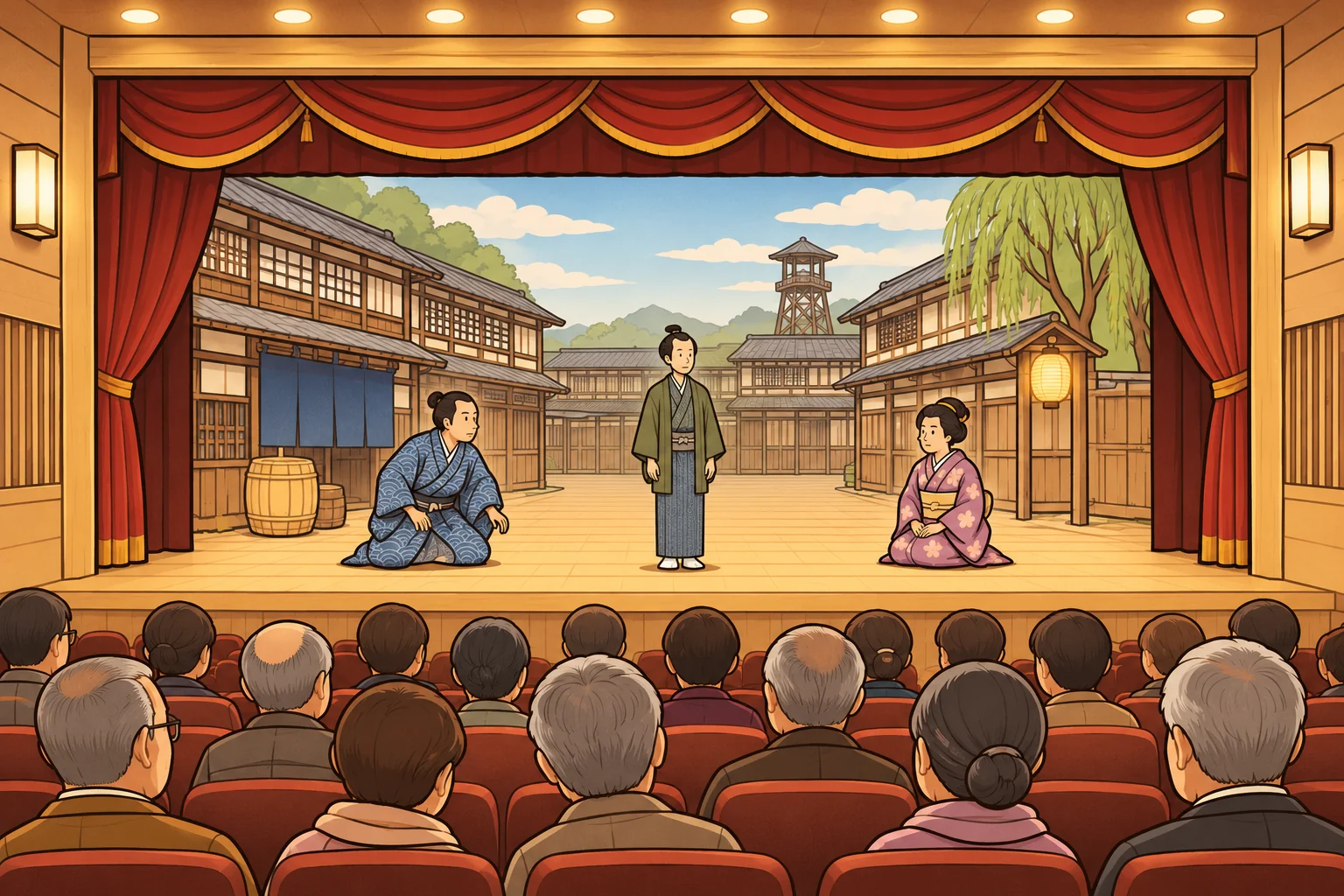 The first half is a period drama in which the singer plays the lead.
- 2
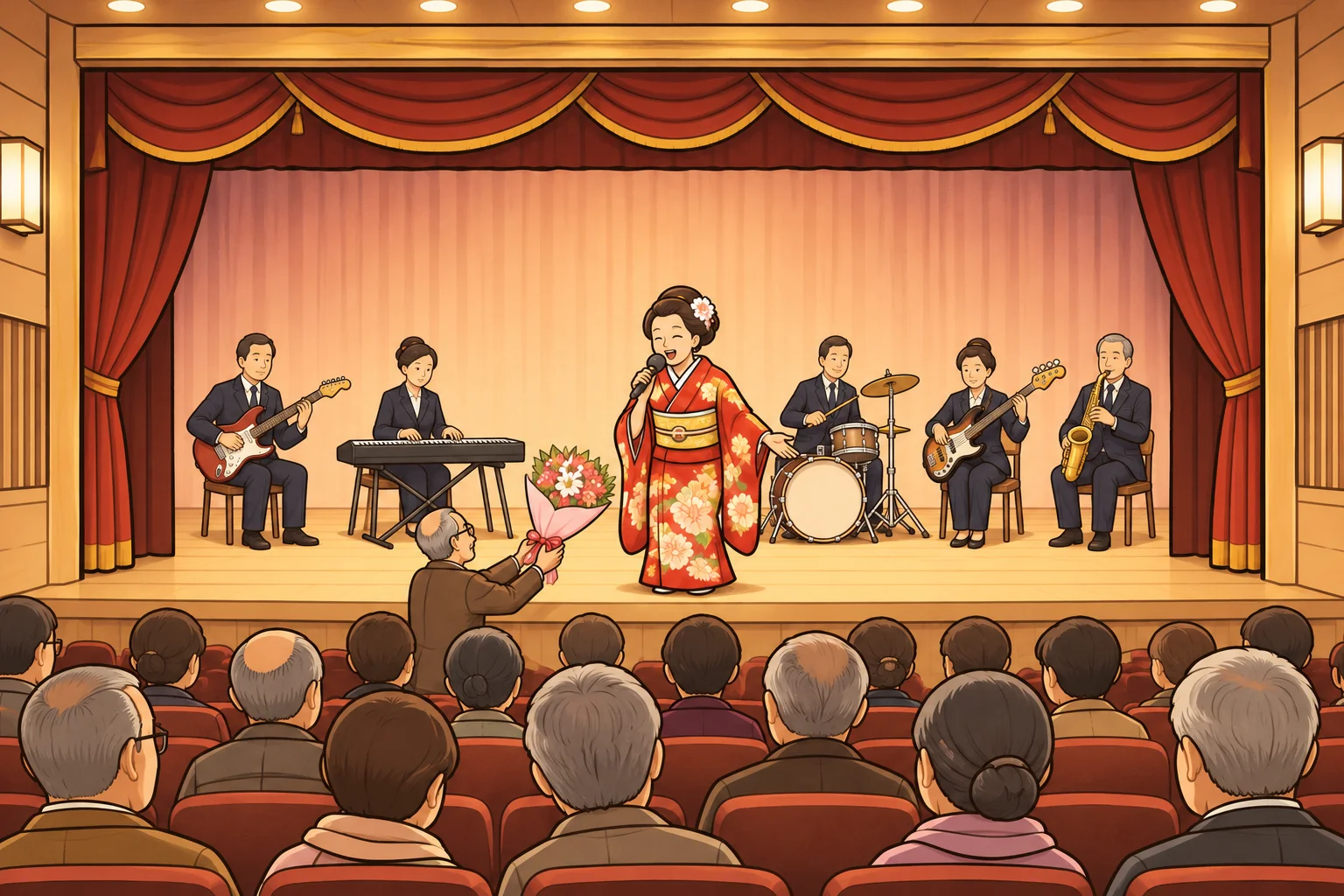 After the interval the singer returns in a glittering costume for a concert.
In Asakusa there are long-established record shops devoted to enka, their walls covered with signed posters. When a singer releases a new song they often come to perform a few numbers at the shop and meet fans. Standing at the edge of the small crowd is the best way to understand the closeness between enka singers and their audience.
And if you want to sing it yourself, karaoke is the obvious place. Choose Kawa no Nagare no Yō ni or Tsugaru Kaikyō Fuyugeshiki, follow the lyrics and the windswept video on the screen, and you will get a sense of what this music means to the people who grew up with it. You do not need to attempt the kobushi; singing each word clearly is enough.
Kyoto’s Arashiyama district once had a memorial hall devoted to Misora Hibari; when it closed in 2013 its collection moved to the Toei Uzumasa Eigamura film park, reopening there the same year with her stage costumes, film posters, and props. That gallery closed in April 2024 to make way for a full redevelopment of the park, which began reopening in phases in 2026 under the new name Uzumasa Eigamura. Fans still leave flowers at song monuments and places associated with her, and around the anniversary of her death each June, Japanese television often reruns her concert footage.