

At a glance
Traces Japanese pop from postwar kayōkyoku through City Pop, Yellow Magic Orchestra, idols and the CD boom to anime songs and Vocaloid hits, with tips for hearing it live.
- Happy End’s 1971 album Kazemachi Roman is seen as the starting point of Japanese-language rock.
- City Pop is the polished, bright urban pop of the late 1970s and 1980s; it found a global audience after 2017.
- YMO formed in 1978 and used the MC-8 sequencer to have machines play while the musicians played along to the machine’s beat.
- In 1998 Japanese record production peaked at about 607.5 billion yen.
- Utada Hikaru’s 1999 album First Love sold about 7.67 million copies and, as of 2026, is still the best-selling album in Japan.
A lot of people now meet Japanese pop by accident. A YouTube recommendation serves up a glossy 1984 song about a woman pretending not to care, an anime opening sticks in the head for a week, or a record shop in Shibuya turns out to fill an entire building. Behind those encounters lies one of the largest and most self-contained music industries in the world, with its own charts, its own idol system, its own obsession with studio craft, and a history that runs from postwar ballads through Tokyo’s electronic pioneers to today’s internet-born hitmakers. This is an introduction to that history, with an eye to what you will actually hear and see if you go looking for it in Japan.
01Before Pop: Kayōkyoku and the Fight Over Language
For most of the postwar era, Japanese popular music meant kayōkyoku, a loose term for songs produced inside the record companies. Staff lyricists and composers wrote the material, contracted singers performed it, and the companies controlled the whole process. The great star of that world was Misora Hibari, who began as a child singer in the late 1940s and remained the voice of the Shōwa era until her death in 1989. Enka, the melancholy, vibrato-heavy ballad style about harbors, sake and parting, grew out of the same system and is now treated as its own genre; see also: Enka: Japan’s Ballads of Harbors, Snow, and Sake.
The change came when young people started writing their own songs. The Beatles played the Nippon Budōkan, a hall built for martial arts, in 1966, and the venue has been a sort of shrine for Japanese musicians ever since. A wave of British-style beat bands known as "group sounds" swept the late 1960s, and an American-style folk movement took hold on university campuses, where students wrote protest songs and songs about everyday life.
Around 1970 the music press hosted a debate that sounds odd today: could rock be sung in Japanese? Many argued that the language, with its even, syllable-timed rhythm, simply did not fit the music. The band Happy End answered with records. Hosono Haruomi, Ōtaki Eiichi, Matsumoto Takashi and Suzuki Shigeru set Matsumoto’s quiet, imagistic Japanese lyrics to arrangements shaped by West Coast American rock, and their 1971 album Kazemachi Roman ("Romance of the Windy City") is widely treated as the founding record of Japanese-language rock. Happy End did not last long, but its four members became the backbone of the next two decades. Hosono went on to form Yellow Magic Orchestra; Ōtaki made one of the defining City Pop albums; Matsumoto became the most important lyricist of the 1980s idol era; Suzuki became one of the busiest session guitarists in Tokyo.
At the same time a young songwriter named Arai Yumi, who debuted as a singer in 1972 and is now known as Matsutoya Yumi or simply Yuming, showed that a woman could write and sing her own material and sell enormously doing it. Her songs were set in the hills of Yokohama, on the Chūō Expressway, on ski slopes in winter: the life of a generation of comfortable, urban young women. This kind of self-written music, distinct from the industry kayōkyoku, came to be called "new music" in the later 1970s. It is the direct ancestor of City Pop.
02City Pop: The Sound of a Confident Tokyo
City Pop was never an official genre, and almost nobody at the time described their own work that way. The term covers a body of music from roughly the late 1970s through the 1980s in which Japanese musicians absorbed American AOR, funk, soul, disco and jazz fusion and turned it into something polished, bright and nocturnal. Think of tight rhythm sections, slick electric bass, chiming guitar, horn sections and string arrangements, and lyrics about highways, beaches, neon and grown-up romance.
The sound makes sense once you picture the country that made it. Japan came through the oil shocks of the 1970s stronger than before and entered the late-1980s bubble economy on a wave of optimism. Young Tokyoites could afford cars, holidays abroad and long nights in the café bars of Aoyama and Roppongi. Sony launched the Walkman in 1979, car stereos were spreading, and music was becoming something you carried with you, matched to motion and scenery. City Pop is the soundtrack to that life. It is not angry and not tragic; it wants the view out of the car window and the song in your ears to line up.
The central figure is Yamashita Tatsurō. His early band Sugar Babe, which also featured the singer Ōnuki Taeko, released a single album, Songs, in 1975; it sold modestly and is now revered. As a solo artist Yamashita broke through in 1980 with "Ride on Time," a hit boosted by its use in a television commercial for Maxell cassette tape. His 1982 album For You came wrapped in a sunlit seaside illustration by Suzuki Eizin, and that kind of image, along with Nagai Hiroshi’s swimming pools and palm trees, became the visual signature of the whole movement. Yamashita is notorious for his perfectionism in the studio, and in Japan he is just as famous for "Christmas Eve," a 1983 album track that reached number one in 1989 after a JR Central railway commercial made it famous, and that returns to the airwaves every December.
Yamashita’s wife and collaborator, Takeuchi Mariya, included a song called "Plastic Love" on her 1984 album Variety. It describes a woman drifting through the city at night, hiding behind a show of indifference, and it was not a major hit at the time. It was released as a single in 1985 and stalled in the lower reaches of the chart. In 2017 an unofficial extended remix uploaded to YouTube by a fan, reportedly paired with an old photograph of Takeuchi, was picked up by the recommendation algorithm and pushed to listeners around the world. It gathered tens of millions of plays and a comment section full of people who did not speak Japanese. In late 2020 another old song, Matsubara Miki’s 1979 debut single "Mayonaka no Door (Stay with Me)," climbed to the top of Spotify’s Global Viral 50 chart after the Indonesian singer Rainych posted a cover. Japanese labels caught on, reissued catalog on vinyl, and original pressings in Tokyo’s used record shops began to fetch several times their old prices.
The overseas revival carries a strange kind of nostalgia. Listeners abroad are longing for a Tokyo they never knew: a booming, untroubled city that most young Japanese never experienced either. Internet genres such as vaporwave and future funk chopped up these records and paired them with clips of 1980s anime. For many Japanese listeners, these had simply been the songs their parents played in the car, and the foreign enthusiasm made them something to be proud of again.
One more album belongs here. Ōtaki Eiichi’s A Long Vacation (1981) transplanted Phil Spector’s "wall of sound" into Japanese pop, came with a Nagai Hiroshi pool on the cover, sold over a million copies, and was among the first batch of albums issued on CD when the format went on sale in Japan on October 1, 1982.
03Yellow Magic Orchestra: Three Musicians and a Computer
In 1978 Hosono Haruomi, by then an established studio musician and producer, brought in two younger players. Sakamoto Ryūichi had a graduate degree in composition from Tokyo University of the Arts and the nickname "Professor." Takahashi Yukihiro had been the drummer of the Sadistic Mika Band since 1972. Together they became Yellow Magic Orchestra, or YMO.
Hosono’s original idea was a joke with an edge. The American bandleader Martin Denny had made a career out of "exotica," lounge music that dressed up a fantasy of the Orient for Western listeners. Hosono wanted to remake that kind of music with electronic instruments, so that the "mysterious East" would be played back by the East itself. The first YMO album, released in 1978, includes a cover of Denny’s "Firecracker."
- 1Cassette tapesthe sequence data
- 2MC-8 sequencerHideki Matsutake feeds in the notes
- 3Synthesizersrepeating lines and rhythms; onstage, a wardrobe-size modular Moog
- 4The band plays and singsfollowing the computer’s clock
Machines played repeating lines and rhythms with perfect precision while the humans played and sang on top; in 1978, putting a computer onstage was radical.
What made the band sound new was the method. Their unofficial fourth member was Matsutake Hideki, a programmer who used Roland’s MC-8 microcomputer sequencer to feed notes to the synthesizers, so that machines could play repeating lines and rhythms with perfect precision while the three humans played and sang on top. Electronic musicians now take this for granted. In 1978, putting a computer onstage and making the band follow its clock was radical. In concert, Matsutake sat behind a modular Moog synthesizer the size of a wardrobe, loading sequence data into the MC-8 from cassette tapes.
The second album, Solid State Survivor (1979), contained "Rydeen" and "Technopolis" and sold more than a million copies in Japan. In August 1979 YMO opened for the American band The Tubes for three nights at the Greek Theatre in Los Angeles, then set out on its first world tour, and foreign critics began writing about the electronic band from Tokyo. Japanese commentators often point out the order of events: YMO became a phenomenon at home partly because it had been noticed abroad first. By 1980 schoolchildren were copying the band’s "techno cut," short hair with the sideburns shaved off, and the red outfits from the Solid State Survivor cover. People called them Mao suits, but Takahashi, who designed them, based them on old-fashioned Japanese ski wear; by some accounts he was behind most of the band’s visual styling. Electronic jingles filled television commercials, and the word tekuno had entered everyday Japanese. "Techno pop" became the name for a whole wave of music.

A sampler stores recorded fragments of sound (generic illustration, not the LMD-649)
Press a pad and the stored sound plays like an instrument
The band did not stay comfortable. BGM and Technodelic, both from 1981, turned darker and more experimental. BGM used the Roland TR-808 drum machine. Technodelic leaned on the LMD-649, a sampler built for the band by a Toshiba-EMI engineer, to turn recorded fragments of sound, including Balinese kecak chanting, into instruments. These records sold less than their predecessors but became cult objects for electronic musicians. In 1983 the band scored a bright pop hit with "Kimi ni, Mune Kyun," then announced its "dispersal," a deliberately gentle word for a breakup. They reunited in 1993 to record Technodon and played together on and off in the 2000s and 2010s.
YMO’s influence traveled in many directions, and electronic musicians in Europe and the United States have long counted the band among their ancestors. Early New York electro and hip-hop, Detroit techno and British synth-pop bands are often named among those it influenced, and tracks such as "Computer Game" have been sampled and covered for decades. Its members went on to remarkable separate careers. Sakamoto scored and acted in Ōshima Nagisa’s Merry Christmas, Mr. Lawrence (1983), whose piano theme is among the most recognized melodies in Japan, and shared the 1988 Academy Award for Best Original Score for The Last Emperor with David Byrne and Cong Su, becoming the first Japanese composer to win it. In later life he was an outspoken environmental and anti-nuclear activist. Hosono drifted toward ambient and exploratory work, wrote songs for idols including Matsuda Seiko, and has seen his solo records of the 1970s and 1980s rediscovered by a new generation of collectors abroad. Takahashi, a fashion designer as well as a drummer and singer, moved easily between music and clothing for his whole career. Takahashi died in January 2023 and Sakamoto in March of the same year, and record shops across Japan set up memorial displays.
What YMO left was less a set of songs than a proposition: Japanese pop could start in the studio and in the machine, and it could be avant-garde and mass-market at once.
04The Idol Era
If City Pop and YMO were the artistic face of the 1980s, television belonged to the idols. In 1980 Yamaguchi Momoe, the biggest star of the late 1970s, gave a farewell concert at the Budōkan, set her microphone down on the stage and walked off to get married and retire. It remains one of the most replayed images of the Shōwa era. That same year Matsuda Seiko debuted with "Hadashi no Kisetsu" and within months was the new queen of the charts with songs such as "Aoi Sangoshō" ("Blue Coral Reef").
Matsuda’s records still hold up because the idol machine of the time drew on the best songwriters in the country. Many of her lyrics were written by Matsumoto Takashi, the former Happy End drummer. Her composers included Ōtaki Eiichi, Hosono Haruomi, and Matsutoya Yumi writing under the pseudonym Kureta Karuho. A three-minute idol single could contain the whole toolkit of new music and City Pop. Nakamori Akina, who debuted in 1982, offered a contrast: darker, edgier songs, a cool image against Seiko’s sweetness. So many idols debuted that year that they are still referred to collectively as the "Class of '82."
Television decided everything. TBS’s weekly chart show The Best Ten, which began in 1978, had singers rushing in to perform live from wherever they happened to be, including train platforms and airports. On New Year’s Eve, NHK’s Kōhaku Uta Gassen divided the year’s top singers into a red team of women and a white team of men; in 1963 its rating reached 81.4 percent, and an invitation was proof that a singer had arrived. In 1985 Fuji TV’s live early-evening show Yūyake Nyan Nyan launched Onyanko Club, a large group of ordinary high-school girls sold as the girls next door. Akimoto Yasushi, who wrote their lyrics and helped script the show, and who is often described as the group’s mastermind, would repeat that idea on a much larger scale two decades later. On the male side, the Johnny & Associates agency dominated for decades, from Shōnentai and Hikaru Genji to SMAP and Arashi.
Outsiders often find the idol phenomenon puzzling, since singing ability is not the point. What fans value is growth: watching an ordinary young person become a performer in public, and supporting that process by buying records and attending events. That emotional structure remains the most stable foundation of the Japanese music business.
05The Birth of J-pop and the Million-Seller Decade
The term "J-pop" is younger than many people assume. It is usually traced to J-Wave, a Tokyo FM station that went on the air in October 1988, whose staff, together with record-company people, wanted a label for Japanese songs that sounded sophisticated enough to play alongside Western pop. Record shops began opening J-pop sections around 1990, and by the mid-1990s (some accounts say the early 1990s) the word had replaced both "new music" and kayōkyoku as the general name for Japanese popular music.
The 1990s were the industry’s golden age. The CD had replaced vinyl, cheap 8-centimeter singles let teenagers buy a new song every week, and karaoke boxes, private rooms rented by the hour, made "singability" a commercial requirement. The fastest route to the top of the charts was the "tie-up," a deal to make a song the theme of a TV drama or a commercial; the theme of a hit drama was almost guaranteed to sell a million. Japanese recorded-music production peaked in 1998 at about 607 billion yen.
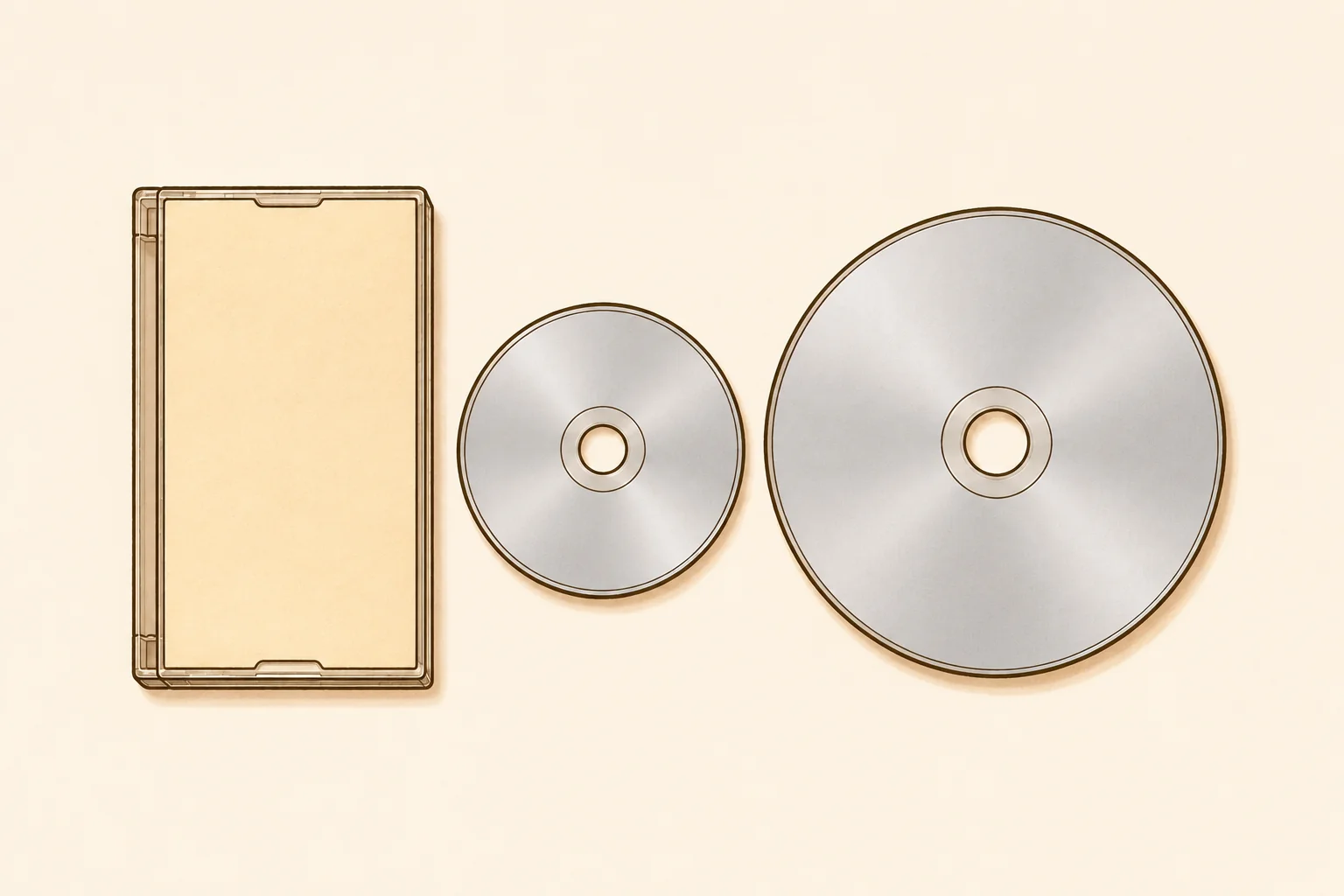
An 8-centimeter single beside a standard CD. In the 1990s these cheap singles let teenagers buy a new song every week.
The names from that decade fill a long list. Southern All Stars, who debuted in 1978 with "Katte ni Sinbad," were still filling stadiums, with frontman Kuwata Keisuke’s lyrics blending Japanese and English into a rhythm all their own. B’z, Mr. Children, Dreams Come True and GLAY sold albums in the millions. The producer Komuro Tetsuya fused dance music and pop and built a stable of acts including Amuro Namie, globe and Kahala Tomomi, at times occupying several spots at the top of the chart at once. Amuro’s miniskirts, platform boots and pencil-thin eyebrows spawned a street style whose followers were known as Amurā.
In 1999 a teenage singer named Utada Hikaru released her debut album First Love. Born in New York and raised between there and Tokyo, she sang Japanese over American R&B rhythms with an ease that made earlier imitations sound stiff. The album sold about 7.67 million copies in Japan by Oricon’s count and as of 2026 is still the best-selling record, album or single, in the history of the Japanese charts.
Two side currents from the 1990s are worth knowing. Shibuya-kei, named after the neighborhood’s import record shops, came from crate-digging bands such as Pizzicato Five, Flipper’s Guitar and Oyamada Keigo’s project Cornelius, who collaged French pop, bossa nova and 1960s soundtracks into stylish, knowing pop that indie fans abroad still adore. Visual kei, led by X Japan, Luna Sea and L’Arc-en-Ciel, put heavy metal and goth aesthetics on stage with dramatic makeup, towering hair and theatrical costume, and created a look found nowhere else.
06Pop Now: Idols, Vocaloids and Anime
When the internet hollowed out record sales around the world in the 2000s, Japan held out. As of 2025, by the Recording Industry Association of Japan’s estimate, physical CDs and music videos still made up more than half of recorded-music revenue there, and Japan has long been the second-largest recorded-music market in the world, a position it still held in the IFPI’s figures for 2025. Part of the reason is that the idol business found a way to keep people buying discs. AKB48, which began performing in its own theater in Akihabara in 2005 under the slogan "idols you can meet," packaged tickets for handshake events and ballots for its annual popularity "general election" inside CD singles. Fans buying dozens or even hundreds of copies of the same single was not unusual. The practice drew heavy criticism, and it kept AKB48 at the top of the annual singles chart for years. On the male side, Johnny & Associates, which had controlled the market for half a century, was forced in 2023 to acknowledge that its late founder, Johnny Kitagawa, had sexually abused large numbers of teenage trainees over decades. The company renamed itself Smile-Up to handle compensation, its performers moved to a new agency called Starto Entertainment, and Japanese entertainment began a long-overdue conversation about how it treats young talent.
Another strand grew out of home computers. In August 2007 Crypton Future Media, a company in Sapporo, released Hatsune Miku, a singing-synthesizer voice built on Yamaha’s Vocaloid technology and sold with the image of a teenage girl with long turquoise pigtails. Amateur producers wrote songs for her at home and uploaded them to the video site Niconico, where other users drew illustrations, recorded covers and choreographed dances. That scene trained a generation of songwriters. One of them, who posted as "Hachi," began releasing music under his real name, Yonezu Kenshi, in 2012 and is now one of the most popular singers in the country; "Lemon," his theme for the 2018 TBS drama Unnatural, sold more than three million downloads. Meanwhile the producer Nakata Yasutaka gave the trio Perfume and the singer Kyary Pamyu Pamyu a glittering electronic sound that brought YMO’s techno pop back to the charts.
Today the most powerful export channel for Japanese pop is anime. Opening and ending themes, known as anison, are no longer children’s songs but premier slots for major bands and singers. LiSA’s "Gurenge," the opening of Demon Slayer, and her movie theme "Homura" were huge domestic hits with wide reach abroad. YOASOBI’s "Idol," the opening theme of Oshi no Ko in 2023, reached number one on Billboard’s Global Excluding U.S. chart in June 2023, a first for a Japanese-language song. YOASOBI itself is a product of the internet: its composer, Ayase, came out of the Vocaloid scene, and the duo’s songs are based on short stories posted to a fiction website. The singer Ado broke through in 2020, while still in high school, with the snarling "Usseewa," and for years appeared only as an illustrated avatar.
There is a clear thread from these songs back to City Pop. Japanese pop remains a tradition that prizes arrangement, harmony and recording quality. A typical J-pop song is likely to change key before its final chorus and to move through chord progressions far busier than those of Western chart pop. Many foreign listeners say that density of musical information is exactly what hooked them.
07Listening in Japan: Record Shops, Live Houses and Concerts
For a first musical outing in Tokyo, start in Shibuya. Tower Records Shibuya fills eight floors and a basement of a building near the station; after a major renovation in 2025 and early 2026, it still flies its slogan "No Music, No Life" as of 2026. Floors are divided roughly by J-pop, idols, anime, jazz and classical, and on release days fans line up for first-press bonuses. For City Pop on vinyl, try the branches of Disk Union in Shinjuku, Ochanomizu and Shimokitazawa, or dig through bins of used CDs at a few hundred yen each (as of 2026) at the chain Book-Off. Japanese shops sort with great care, separating an artist’s singles, albums and limited editions. Many Japanese CDs and records come with an obi, a paper strip wrapped around the spine printed with Japanese text, and collectors at home and abroad prize copies that still have it.

Looking up from a Shibuya street corner at a multi-storey record store, pedestrians passing below (illustration).
The heart of the live scene is the "live house," a small club holding anywhere from a few dozen to a few hundred people. Shimokitazawa, Kōenji and Shibuya are packed with them. At the door you will usually also pay a drink charge, in exchange for a token you trade at the bar. Entry is by the number printed on your ticket, so low numbers get in first and take the front. Shows usually start on time and end early.
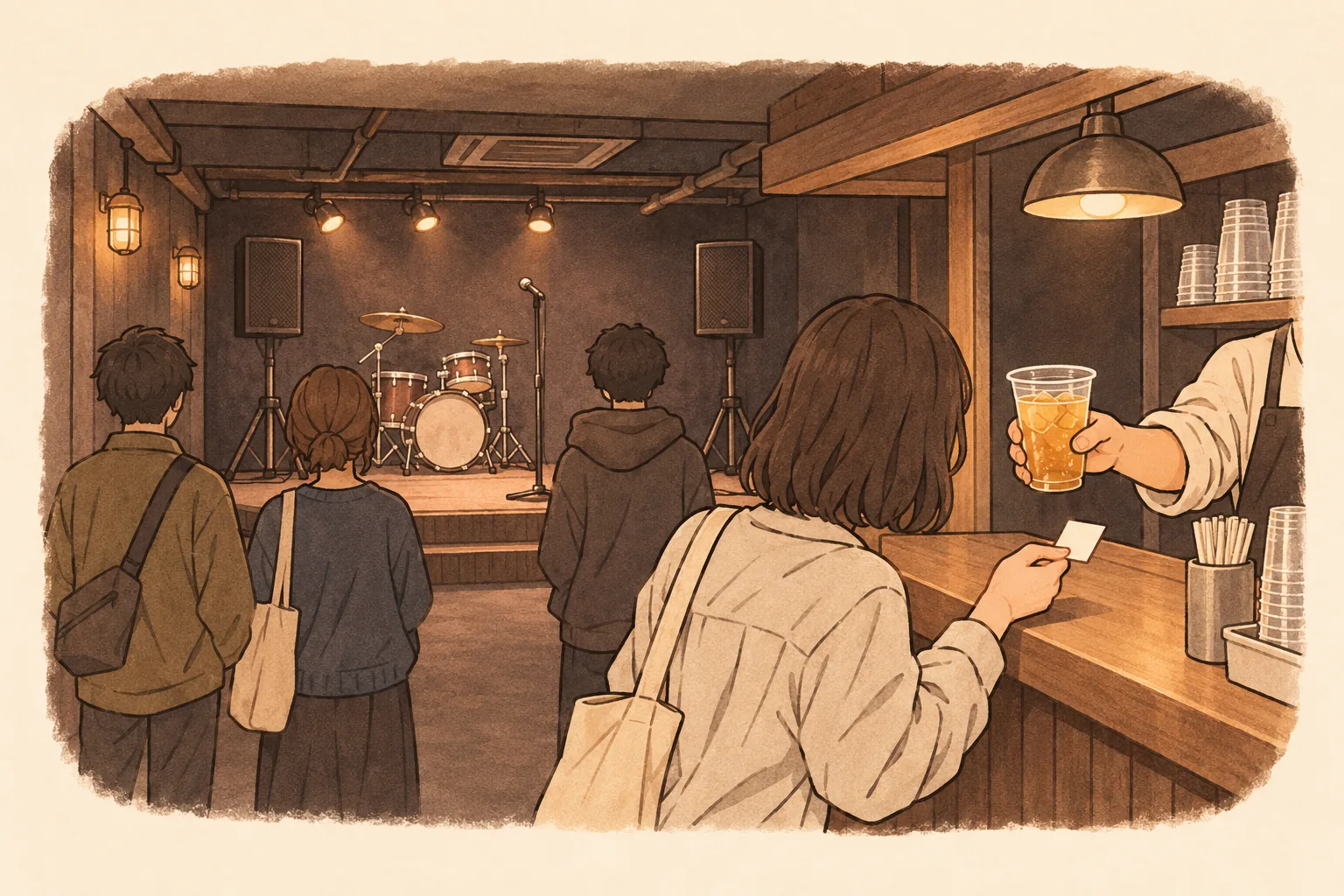
Inside a small live house. The drink charge usually paid at the door buys a token to trade at the bar.
Big concerts are another world. At the Budōkan, Tokyo Dome, Yokohama Arena and on the dome tours that cross the country, photography and filming are usually forbidden, which surprises many foreign visitors. At idol shows the audience waves penlights in each member’s assigned color and shouts coordinated calls at fixed points in each song, as tightly as if they had rehearsed. Summer is festival season: Fuji Rock, held at the Naeba ski resort in Niigata Prefecture, and Summer Sonic, staged simultaneously at Makuhari, just outside Tokyo in Chiba, and in Ōsaka, both draw foreign fans.
The easiest way in, of course, is karaoke. The machines in a karaoke box index decades of hits by year and chart, with lyrics on screen and often the original video. Pick "Plastic Love" or "First Love" and you will find out quickly that these songs are much harder to sing than they sound, with key changes, long held notes and lyrics packed tight against the beat.