
At a glance
How a shocking 1959 performance launched butoh, what its two founders Hijikata Tatsumi and Ōno Kazuo wanted, and why dancers paint themselves white and move so slowly.
- Butoh is a modern dance born in Tokyo in the late 1950s; its starting point is usually set at Hijikata Tatsumi’s Forbidden Colors in May 1959.
- It has two recognized founders: Hijikata Tatsumi (born 1928) and Ōno Kazuo (born 1906).
- The familiar look is white body paint, shaved heads, very slow movement and outturned bent knees, though not all butoh has these.
- Butoh has no standard vocabulary of steps: dancers let an image take place in the body, and movement follows.
- The companies easiest to see today are Dairakudakan, founded in 1972, and Sankai Juku, founded in 1975.
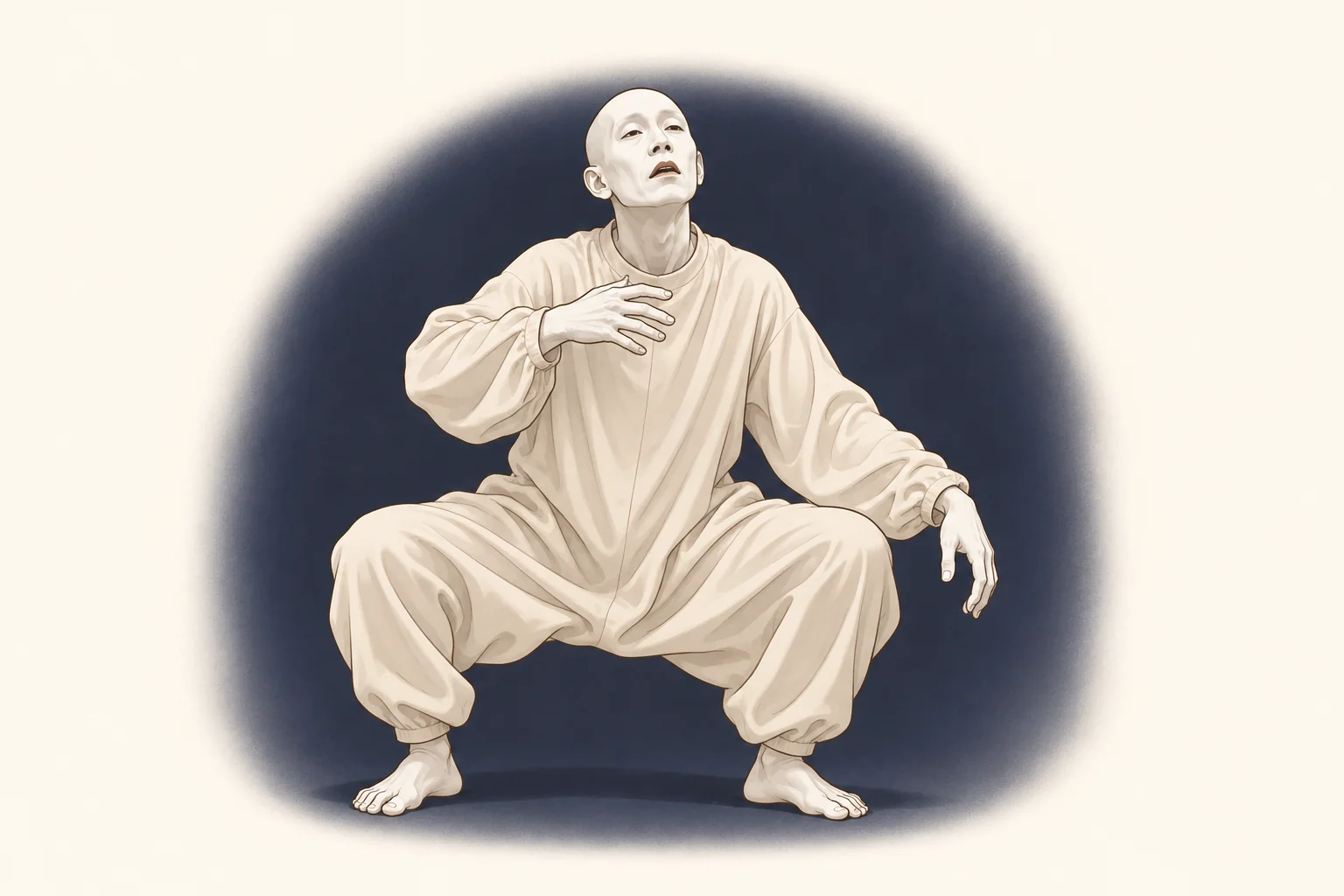
A shaven-headed dancer, painted white from scalp to toe, takes several minutes to raise one hand to his chest. His knees bow outward, his toes grip the floor, his mouth hangs open in a silent cry. This is butoh, a form of dance born in Tokyo at the end of the 1950s. It is not a classical art like kabuki or Noh; it is barely more than sixty years old. Yet for many people outside Japan it has become one of the most recognizable images of Japanese performance. This is an introduction to where butoh came from, why it looks the way it does, what the dancers are actually doing on stage, and how to see it in Japan today.
01A Chicken in the Dark
The usual starting point is May 1959, at an evening of new work by young dancers organized by the All Japan Art Dance Association in Tokyo. A thirty-one-year-old dancer named Hijikata Tatsumi presented a short piece called Kinjiki (Forbidden Colors), borrowing the title of a novel by Mishima Yukio about homosexual desire. There were two performers: Hijikata himself and Ōno Yoshito, the son of the dancer Ōno Kazuo, then about twenty. In near darkness, and by one account through long stretches without music, the older man pursued the younger one. At the climax a live chicken was pressed between the young man’s thighs. Most later accounts say it was killed on stage; Ōno Yoshito himself later said the chicken was not actually killed.
The audience was shocked, the association was outraged, and Hijikata soon broke with it. Accounts of what exactly happened on stage vary, and few people saw it clearly. But the piece drew a line that later dancers would keep returning to. Dance did not have to be beautiful, tell a story, or please anyone.
Hijikata was born Yoneyama Kunio in 1928 in Akita, a rice-growing prefecture in the snowy northeast of Japan. He studied a German-influenced style of modern dance there before moving to Tokyo around 1950 (other accounts give 1949 or 1952), where he lived in poverty and took whatever work he could find in dance studios. Around him gathered a circle of writers and artists: Mishima; Shibusawa Tatsuhiko, translator of the Marquis de Sade; poets, photographers, and avant-garde painters. Hijikata read Jean Genet, Lautréamont, and Antonin Artaud. He first called his work ankoku buyō, "dance of darkness," and then ankoku butō. In time it was shortened to butō, or butoh in English.
The word itself was a deliberately odd choice. In the Meiji era, butō was the stiff, respectable term for Western ballroom dancing; the famous balls held for foreign diplomats at the Rokumeikan in the 1880s were butōkai. Hijikata took this polite word and attached it to the least polite dance imaginable.
02Two Founders
Butoh has two acknowledged founders, and they could hardly have been more different.
Hijikata was the builder. What interested him was how a body could be reshaped, twisted, and compressed into extreme states. In 1968 he gave a solo performance titled Hijikata Tatsumi and the Japanese: Revolt of the Body, in which he appeared in a long dress, danced with brass plates hung behind him, and was finally hoisted up on ropes. It is often described as the high point of his early, confrontational period.
In the 1970s he turned in another direction, back toward the Akita of his childhood: muddy rice paddies, farmers hunched against the winter, old women carrying babies on their backs, crippled and sick bodies. In 1972 he staged a series called Twenty-seven Nights for Four Seasons. One of its pieces, Hōsōtan (A Story of Smallpox), with dancers crumpled and writhing on the floor, produced what many people still regard as the definitive butoh image. After this Hijikata rarely performed himself. He choreographed instead for his students, above all the dancer Ashikawa Yōko. He died of illness in 1986, aged fifty-seven.
Ōno Kazuo stood at the opposite pole. Born in 1906 in Hakodate, on the southern tip of Hokkaidō, he was more than twenty years older than Hijikata. He was a devout Christian and worked as a physical education teacher at a mission school in Yokohama. In 1929 he saw the Spanish dancer La Argentina perform at the Imperial Theatre in Tokyo, and the experience stayed with him for the rest of his life. He went on to study modern dance with Ishii Baku and Eguchi Takaya, two pioneers who had brought ideas from German expressionist dance to Japan. During the war he was drafted, ended up in New Guinea, and spent time as a prisoner of war before returning home.
Ōno met Hijikata in the 1950s and took part in many of his early works, but he became famous as a butoh dancer only in his seventies. In 1977, under Hijikata’s direction, he performed Admiring La Argentina. Dressed in old-fashioned women’s clothing and a flowered hat, the elderly Ōno summoned up the dancer he had watched half a century before. When the piece was shown at the Nancy International Theatre Festival in France in 1980, he became an international figure almost overnight. He toured the world for the next two decades and kept dancing into his late nineties, when he could perform only with his hands from a wheelchair. He died in 2010 at the age of 103.
If Hijikata’s dance was a body wound tight, Ōno’s was something closer to an overflow. He often danced with his eyes half closed and his fingers trembling, as if remembering his mother or speaking to the dead. Most later styles of butoh can be placed somewhere between these two poles.
03White Paint and Bent Legs
Most people know butoh by a handful of features: the white body paint, the shaved heads, the extremely slow movement, the bent knees, the contorted faces, the near nakedness. Not all of these were there from the start, and not all butoh uses them, but each has its reasons.
White makeup, shironuri, already existed in kabuki and in the appearance of geisha. Butoh borrowed it for the opposite purpose. Traditional white makeup is meant to beautify. In butoh it erases the individual face and turns the body into something between a corpse and an unfinished sculpture. Under dim stage lighting, every small movement of a white body becomes visible. The skin works like a screen.
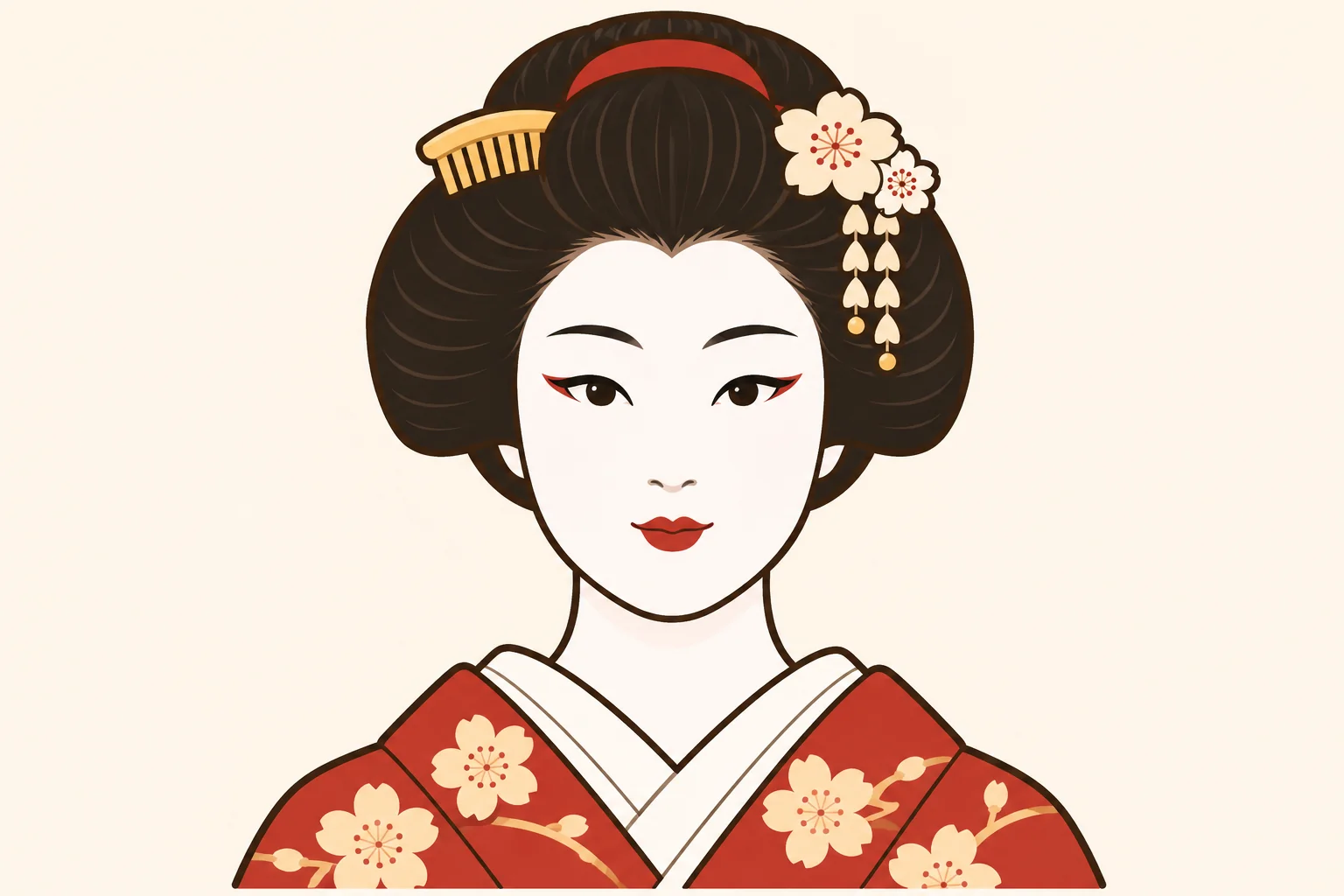
A geisha’s shironuri is meant to beautify, with brows and red lips painted over the white.
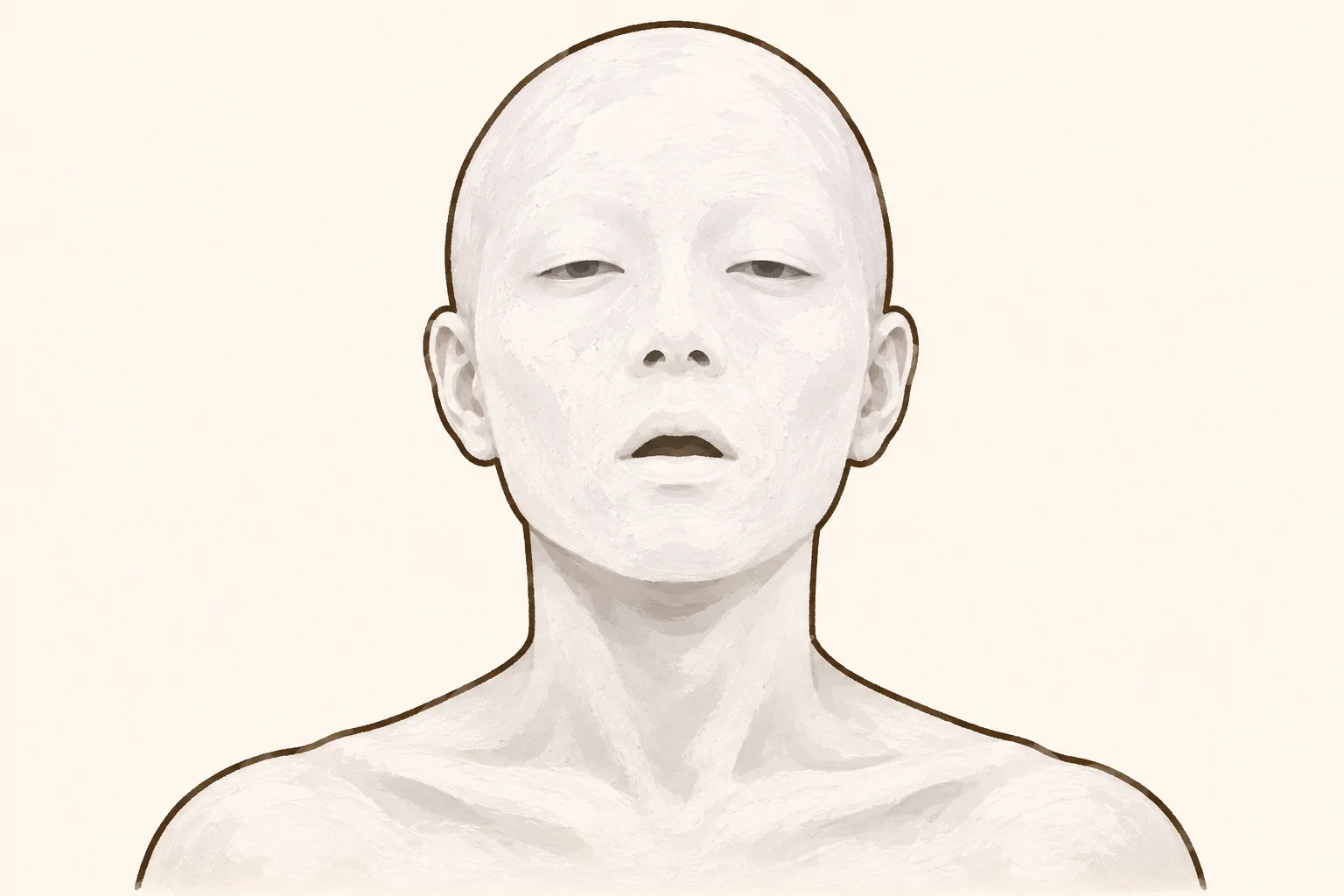
In butoh the white erases the individual face, leaving a body between a corpse and an unfinished sculpture.
The bowed, bandy-legged stance, called ganimata, was something Hijikata pursued on purpose. The ballet body points upward: rising on the toes, straightening the spine, aiming at lightness and flight. Hijikata argued that Japanese bodies had not grown that way. A farmer who spent his life planting rice, squatting, and carrying loads had a low center of gravity, bent legs, and feet pressed into the mud. Hijikata did not see this as a defect. He saw it as a body worth reclaiming from Western-style training. One of his most quoted lines describes butoh as "a corpse standing upright in desperation."
A posture with bent knees, a lowered center of gravity and feet pressed to the floor.
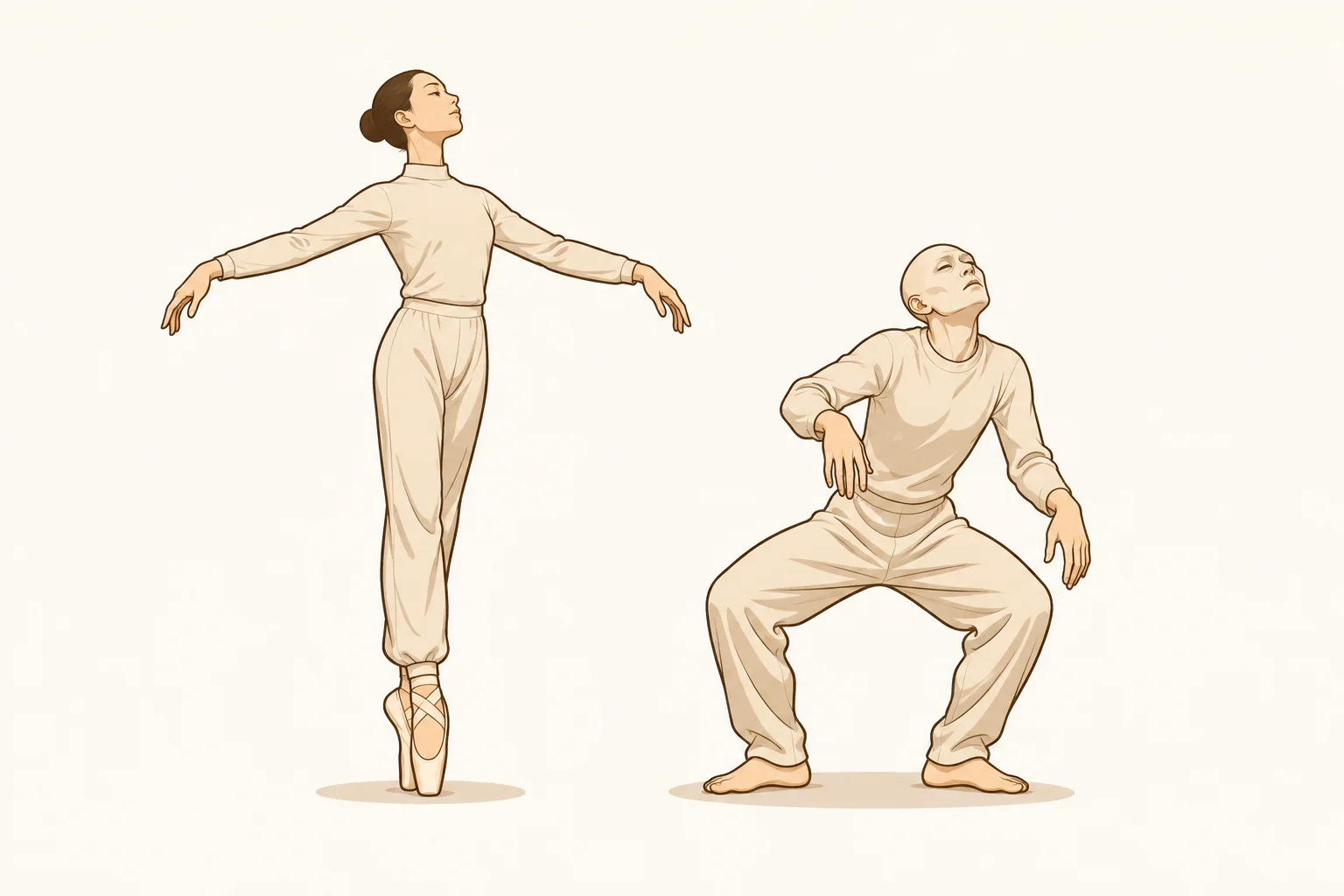
The upward ballet stance beside butoh's ganimata: bent legs, low center of gravity, feet pressed to the floor.
The slowness comes from how butoh movement is produced. It is usually not executed so much as drawn out. In his later years Hijikata rarely set specific steps for his dancers. Instead he gave them chains of images, of roughly this kind: your head is filled with water; an insect is crawling from your ankle up to the back of your neck; you are a sheet of paper blown by the wind; your bones are slowly turning to ash. The dancer’s task is to let the image happen inside the body, and movement follows from it. Records of these image sequences came to be called butō-fu, butoh notation. What an audience sees, then, is often a body slowly becoming something else: an old woman, an animal, a plant, a dead person.
This is why butoh has no fixed vocabulary of steps and no single technique, which sets it apart from both ballet and classical Japanese dance. It is closer to a question asked of the body: beneath social discipline, standards of beauty, and language, what is left?
04The Soil of Postwar Japan
Why did butoh appear in Tokyo in the late 1950s and not somewhere else? The usual answers return to the war.
Both founders lived through it, and Ōno saw a great deal of death in the South Pacific. The atomic bombings of Hiroshima and Nagasaki, the hunger and ruins of the late 1940s, the American occupation, and the high-speed economic growth that began in the 1950s all formed the background against which butoh took shape. Many critics, especially in the West, have connected butoh’s scorched, twisted bodies with the atomic bomb. Hijikata himself seldom made that link directly, and it is best understood as a later interpretation.
The more immediate soil was the Tokyo avant-garde of the 1960s. These were the years of mass protests against the US–Japan Security Treaty, underground theater, happenings, and experimental film. Kara Jūrō’s tent theater and Terayama Shūji’s troupe Tenjō Sajiki were active at the same moment, and people moved freely between these groups and Hijikata’s circle. In 1965 the photographer Hosoe Eikō took Hijikata to the fields and villages of Akita and photographed him there. The resulting book, Kamaitachi (1969), named after a weasel-like spirit of Japanese folklore said to slash travelers, shows Hijikata running across rice paddies and snatching up a village baby like a demon who has wandered in from the hills. It remains one of the essential visual records of butoh.
There was also a search for a different idea of "Japan." Since the Meiji era, Japanese stage dance had been split between the classical traditions of kabuki, Noh, and nihon buyō on one side, and ballet and modern dance imported from Europe and America on the other. Hijikata rejected both. He did not return to the fixed forms of classical performance, and he did not imitate the Western body. He went looking for something older, rougher, and harder to name, in the farming villages of the northeast. That is one reason why foreign audiences have often seen butoh as the "most Japanese" of dances, while in Japan it long remained a marginal, underground art.
05Butoh Goes Abroad
From the 1970s a second generation of dancers began forming their own companies.
In 1972 Maro Akaji, who had performed with Kara Jūrō’s theater, founded Dairakudakan. He turned butoh into large, spectacular group pieces, often with a dozen or more white-painted men on stage, lavish sets, and loud music. Dairakudakan is still active, and many dancers who passed through it later started companies of their own. Maro himself is also a familiar face as an actor in Japanese film and television.
In 1975 Amagatsu Ushio, a member of Dairakudakan, founded Sankai Juku. Its style is the opposite of Dairakudakan’s: refined, symmetrical, quiet, with shaven-headed, white-painted dancers moving slowly and precisely across stages that look like art installations. Sankai Juku first performed in Europe in 1980. From 1982 it created new works in partnership with the Théâtre de la Ville in Paris, premiering many of them there before touring internationally; since 2005 it has also co-produced with the Kitakyushu Performing Arts Center, where some recent works have premiered. In 1985, during an outdoor performance in Seattle in which dancers were lowered upside down from a building, a rope broke and the dancer Takada Yoshiyuki fell to his death. The accident shook the dance world. After a pause, the company continued.
Many dancers worked outside any large company. Tanaka Min, beginning in the 1970s, danced improvisations in fields, on streets, and in odd urban corners, and later moved to a farming village in Yamanashi where he grew crops and danced, developing a training method he called Body Weather. Late in life he became widely known as a film actor, appearing in The Twilight Samurai and in Wim Wenders’s Perfect Days. The couple Eiko & Koma, who settled in the United States, brought butoh’s slowness into American museums and even into rivers.
By the 1990s "butoh" had become an international word. There are companies and workshops calling their work butoh across Europe and the Americas, run by people who never met Hijikata and know the form through photographs and Ōno’s tours. Older Japanese dancers have mixed feelings about this. Butoh spread, but it was also reduced, at times, to a costume of white paint, slow motion, and anguished faces.
- 1959Hijikata, Kinjiki
- 1968Hijikata solo, Revolt of the Body
- 1972Maro Akaji founds Dairakudakan
- 1975Amagatsu Ushio founds Sankai Juku
- 1977Ōno Kazuo, Admiring La Argentina
- 1980Ōno at Nancy; Sankai Juku first in Europe
- 1990s"Butoh" becomes an international word
From a short piece in Tokyo in 1959 to European stages in 1980, and by the 1990s "butoh" was an international word.
06Seeing Butoh in Japan
Butoh has nothing like kabuki’s permanent theaters and daily performances, so you have to watch for listings. There are more chances than you might expect.
The companies you are most likely to find are Sankai Juku and Dairakudakan. Sankai Juku’s new works, after their Paris premieres, usually come back to Japan on tour, and Setagaya Public Theatre in Tokyo is one of its regular venues. Dairakudakan has its own studio theater in Kichijōji in western Tokyo called Kochūten, and company members take turns presenting new pieces under the Kochūten name, lately (as of 2026) often in other small Tokyo theaters such as Za-Kōenji. These rooms are tiny and the audience sits a few meters from the dancers, close enough to see sweat beneath the white powder and the trembling of muscles. That is something a large theater cannot give you.
The Kazuo Ohno Dance Studio in Kamihoshikawa, Yokohama, where Ōno Yoshito continued to teach and perform after his father’s death, ran classes open to anyone regardless of age, nationality or dance experience until his own death in 2020; the studio is said to have held occasional workshops since then, though its recent schedule could not be confirmed as of 2026. Hijikata’s papers, photographs, and films are kept at the Hijikata Tatsumi Archive at Keio University’s Art Center in Tokyo, which holds occasional exhibitions and screenings. Independent dancers also perform in small theaters, galleries, and sometimes temples in Tokyo and Kyoto.
The best way to watch butoh is to stop waiting for a story. Long stretches may pass in which almost nothing seems to happen; a dancer can take ten minutes or more to cross the stage. Pay attention to the details instead: the opening and closing of fingers, the way the soles of the feet meet the floor, the rise and fall of the ribs with each breath, the way a white body changes texture as the light shifts. Some people find it tedious. Others are suddenly struck at some moment they could not have predicted. Both responses are normal. Hijikata never meant butoh to be comfortable.
If you want to try it yourself, many butoh dancers teach workshops that require no dance training. Classes usually begin with standing, walking, and breathing, then move on to letting a single image take over the body. For many participants, an afternoon of this explains better than any performance why butoh moves so slowly.