
At a glance
Three puppeteers move one figure while a single chanter voices every role; how Chikamatsu’s double suicide play still moves audiences to tears.
- Bunraku is Ōsaka’s puppet theater; its formal name is ningyō jōruri.
- A principal puppet stands about 130 to 150 cm tall and is worked by three puppeteers: main, left and foot.
- Three-person operation of a single puppet appeared only around 1734.
- One chanter (tayū) voices the narration and every role, accompanied by a thick-necked shamisen.
- Chikamatsu Monzaemon’s The Love Suicides at Sonezaki drew on a real double suicide of 1703 and was staged by the Takemoto-za that same year.
Bunraku is the puppet theater of Ōsaka, and it is one of the strangest and most moving things you can see on a Japanese stage. Each major puppet is worked by three people in full view of the audience, while a single chanter at the side of the stage voices every character and a shamisen player drives the drama with a deep, percussive lute. The form took shape in the late seventeenth century, when the chanter Takemoto Gidayū and the playwright Chikamatsu Monzaemon turned a popular entertainment into serious theater, and its repertoire later fed straight into kabuki. Most first-timers expect a curiosity. What they usually get is the odd experience of forgetting, within a quarter of an hour, that the weeping woman on stage is made of wood.
01What You Actually See
The puppets are large. A principal figure stands about 130 to 150 centimeters tall, roughly four to five feet, with a head carved from hinoki cypress (kashira) finished in polished white gofun, a paste made from ground shell. Inside the head are strings and toggles that let the eyes swivel, the eyebrows lift and, in some heads, the mouth open. There is no full body inside the costume, only a shoulder board, a hoop for the hips and a hollow space for the puppeteer’s arm.
| Puppeteer | Controls | How |
|---|---|---|
| Omozukai | The head; the puppet’s right hand | Left hand in the back of the costume, gripping the head rod; right hand works the right hand |
| Hidarizukai | The puppet’s left hand | With a rod |
| Ashizukai | The legs | Crouches low; for female puppets, pinches the kimono hem |
A puppet about 130 to 150 cm tall is worked by three people; the main puppeteer stands on clogs 20 to 50 cm tall and signals through his body and breathing.
Three people share the work. The main puppeteer, the omozukai, reaches into the back of the costume with his left hand and grips a short rod that holds the head, controlling its tilt and turn; with his right hand he works the puppet’s right hand. The left puppeteer, the hidarizukai, operates the puppet’s left hand with a rod. The foot puppeteer, the ashizukai, crouches low and moves the legs, stamping on the stage floor to make footsteps. Female puppets usually have no legs at all: the foot puppeteer pinches the hem of the kimono from inside and creates the impression of knees and walking steps, and few people in the audience notice the absence.
The three do not speak. The main puppeteer signals through tiny movements of his body and his breathing, and the others follow. When it works, the puppet sits, turns, raises a sleeve to its eyes or fumbles with a pipe as if a single nervous system ran through it.
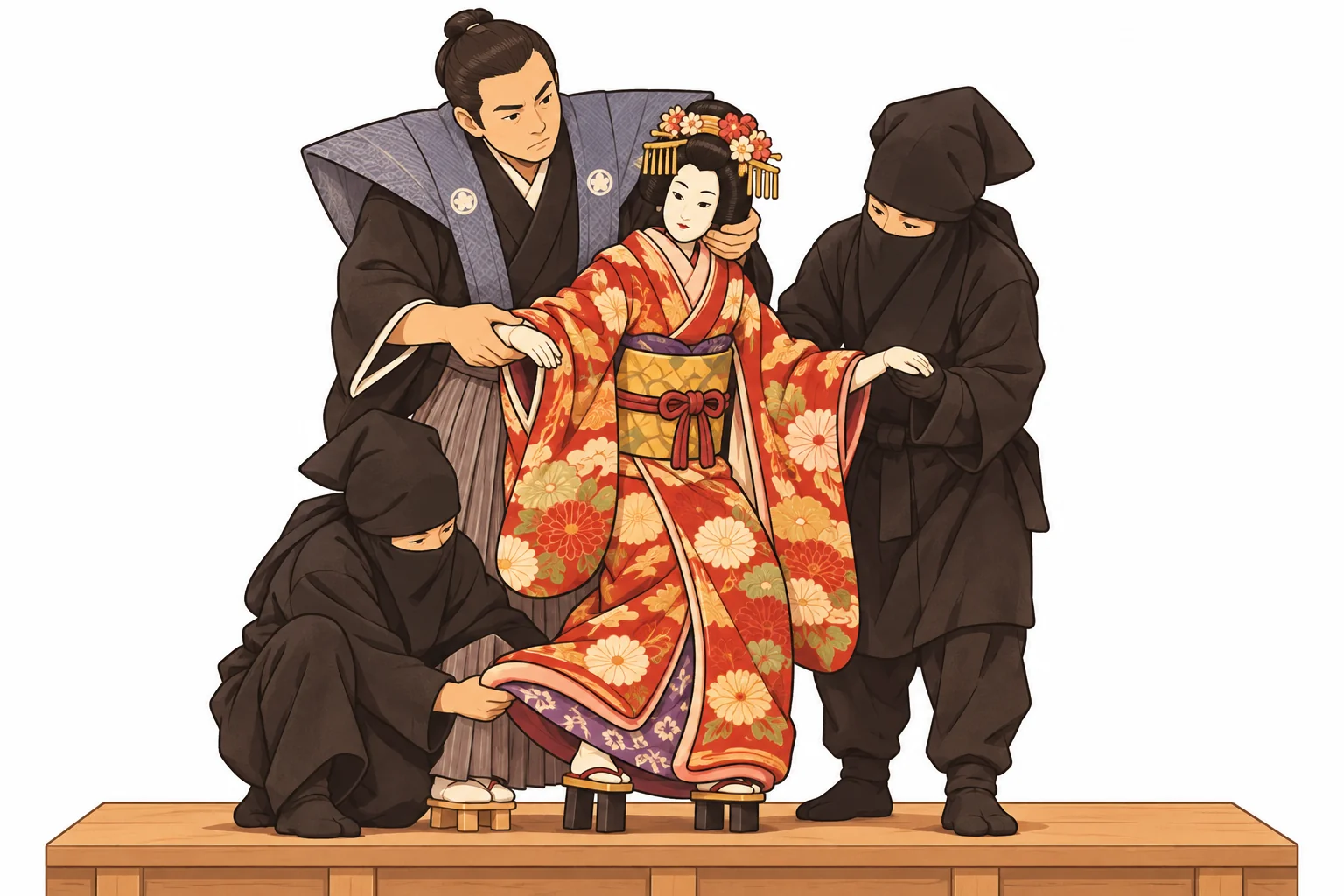
Three puppeteers work a leading female puppet on the bunraku stage, the chief operator bare-faced in formal dress (illustration).
The assistants wear black robes and black hoods, and by stage convention they are invisible. The main puppeteer often performs with his face uncovered, dressed in formal kimono, standing on wooden clogs 20 to 50 centimeters tall that lift him high enough to hold the puppet at the right height. This barefaced style is called dezukai. It seems at first that three adults crowding around a doll would ruin any illusion. In practice the eye adjusts quickly and the puppeteers fade into the background, though you can bring them back into focus whenever you choose.
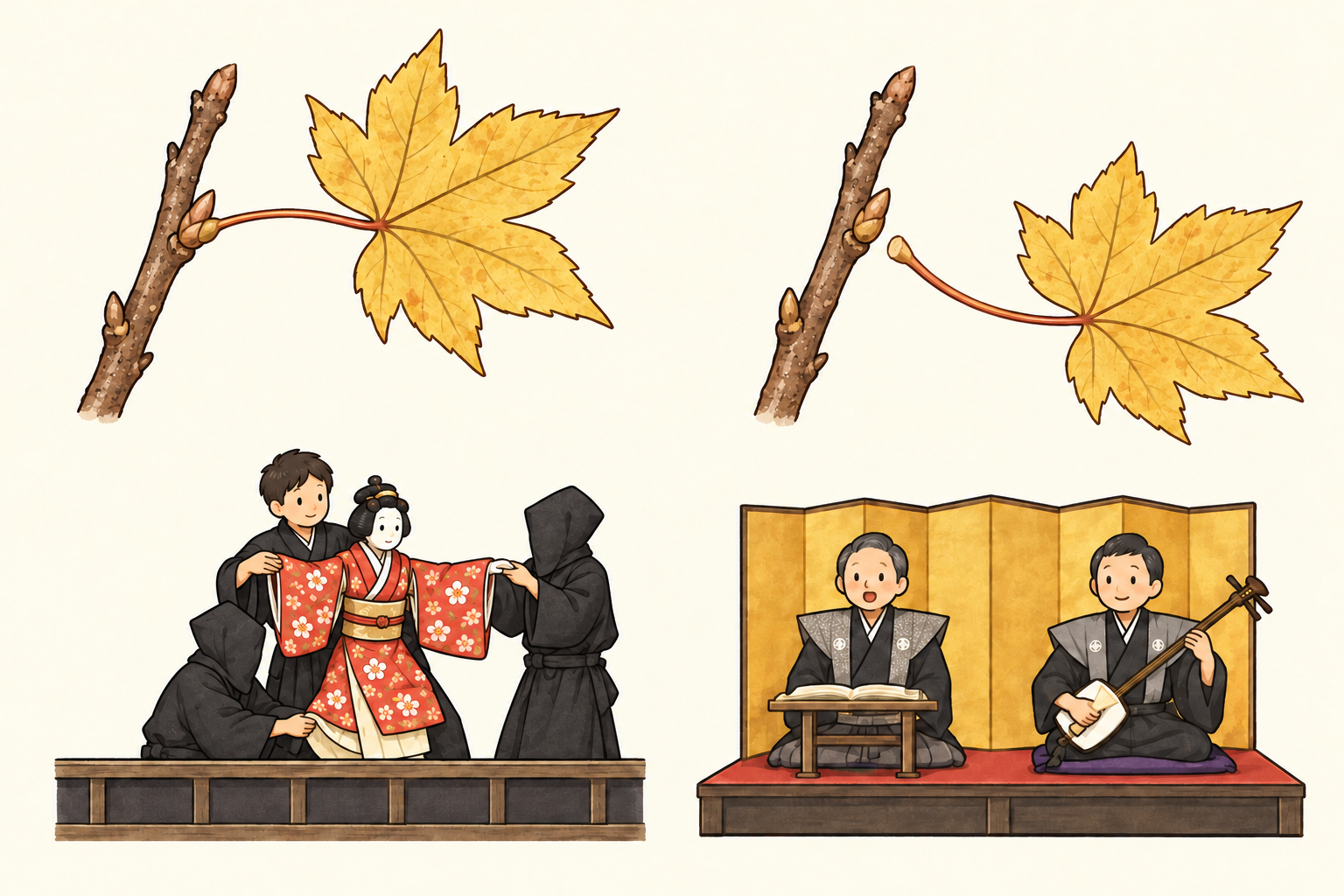
Three-person operation: the bare-faced main puppeteer behind, the hooded left and foot puppeteers at the side and low down.
The yuka at stage right: the chanter behind his lectern, the shamisen player beside him.
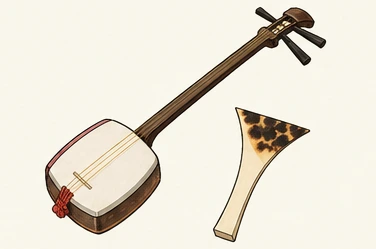
Shamisen and plectrum. Bunraku uses the thick-necked shamisen, with a deep, heavy tone.
02The Voice and the Strings
At the audience’s right, on a small platform called the yuka that juts out from the stage, sit the chanter (tayū) and the shamisen player. At the start of a scene the platform revolves to bring them into view. The chanter kneels before an ornate lacquered lectern holding the text, which he raises respectfully before he begins.
The tayū does everything with his voice. He narrates, describes the scenery, and speaks for every character: an old retainer, a villain, a young courtesan, a child. He laughs, sobs and roars. The style of chanting used in bunraku is called gidayū-bushi after Takemoto Gidayū, and it demands enormous physical effort. A chanter in a climactic scene can be red-faced and drenched in sweat, his body rocking forward from a small seat tucked beneath his hips, with a weighted pouch in his kimono to support his diaphragm.
The shamisen used here is the thick-necked futozao type, heavier and lower in tone than the instruments used for lighter music. Its player is not an accompanist in the Western sense. He sets the emotional temperature of each scene, cues the chanter, and with a single sharp stroke can mark a death or a change of heart. Bunraku is often described as the art of the sangyō, the three crafts of chanter, shamisen and puppeteer, and none of them is subordinate to the others.
03Why Puppets?
Part of the answer lies in specialization. A kabuki actor has to sing, speak, move and act with his face all at once. Bunraku splits these jobs among people who spend their whole lives on one of them. A traditional saying holds that a puppeteer needs ten years on the feet and ten more on the left hand before he can take the head; in practice it is often longer. Chanters and shamisen players train for decades as well, and it is common to see performers in their seventies and eighties at the peak of their reputations.
The other part lies in the puppets themselves. A carved face never changes expression, yet with a slight tilt, a change of light and the right phrase from the shamisen, the same face reads as shy, then stricken, then resolved. The audience fills in what the wood cannot show, and that act of filling in is surprisingly powerful. Puppets can also do things human bodies cannot, collapsing in grief at impossible angles or transforming in an instant into a fox spirit, without looking ridiculous.
04From Street Puppets to the Takemoto-za
The word jōruri comes from a story popular in the fifteenth century about the love affair between the young warrior Ushiwakamaru, later known as Minamoto no Yoshitsune, and a princess named Jōruri. Storytellers recited it to the biwa lute, and so many imitations followed that jōruri became the name for the whole genre of chanted narrative. In the sixteenth century the shamisen arrived by way of the Ryūkyū Islands, by the usual account reaching the Ōsaka area in the late sixteenth century, and chanters adopted it. At around the same time they began to work with puppeteers, including troupes from Nishinomiya and Awaji Island who had long performed with puppets at shrines. By the early seventeenth century, puppet theaters were operating in Kyoto and Ōsaka.
The decisive moment came in 1684, when the chanter Takemoto Gidayū opened his own theater, the Takemoto-za, in Dōtonbori, Ōsaka’s entertainment district. Gidayū’s style combined power with fine emotional shading, and he found the right writer in Chikamatsu Monzaemon, a man of samurai background who had been writing for both puppets and kabuki in Kyoto. Their Shusse Kagekiyo of 1685 is traditionally treated as the start of "new jōruri," the mature form that survives as bunraku.
A rival theater, the Toyotake-za, opened on the same street in 1703 under Toyotake Wakatayū, a former pupil of Gidayū, and competition between the two pushed the art forward. The three-person puppet appeared around 1734. In the 1740s a team of writers including Takeda Izumo II, Namiki Senryū and Miyoshi Shōraku produced three plays that are still at the center of the repertoire: Sugawara and the Secrets of Calligraphy (Sugawara Denju Tenarai Kagami, 1746), Yoshitsune and the Thousand Cherry Trees (Yoshitsune Senbon Zakura, 1747), and The Treasury of Loyal Retainers (Kanadehon Chūshingura, 1748), the great version of the story of the forty-seven ronin. For a time puppet theater outdrew kabuki, and kabuki responded by adapting these plays wholesale. When kabuki performs them today, a gidayū chanter and shamisen player still sit at the side of the stage.
05The Love Suicides at Sonezaki
Chikamatsu’s best-known play began as a news story. In the fourth month of 1703, a young man named Tokubei, a clerk at the Hiranoya soy sauce shop, and Ohatsu, a courtesan of the Tenmaya house, killed themselves together in the woods at Sonezaki, then on the northern edge of Ōsaka. Within about a month, the Takemoto-za had their story on stage as Sonezaki Shinjū, usually translated The Love Suicides at Sonezaki.
In Chikamatsu’s version, Tokubei works for his uncle, who wants him to marry his wife’s niece; Tokubei’s stepmother has already accepted a sum of silver for the match. Tokubei, in love with Ohatsu, refuses. The furious uncle demands the money back and orders him out of Ōsaka. Tokubei manages to recover the money from his stepmother, then lends it to his friend Kuheiji, who claims to be in a desperate fix. When Tokubei asks for repayment, Kuheiji denies the debt, accuses Tokubei of forging his seal, and has him beaten in public. Tokubei has lost the money and his good name in a single afternoon.
The most famous scene takes place at the Tenmaya. Tokubei slips in to see Ohatsu, and she hides him under the veranda, covering him with the hem of her kimono. Kuheiji arrives and sits above them, boasting and slandering Tokubei. Ohatsu, pretending to talk to herself, asks whether Tokubei is ready to die with her. Beneath the floor, he takes her bare foot and draws it across his throat. On the bunraku stage, Ohatsu’s puppet is given a foot for this moment, a rare thing for a female puppet, and the whole theater watches that small white foot.
Late that night the two escape and walk to the Sonezaki woods. This journey, the michiyuki, opens with lines that Japanese readers still treat as among the most beautiful in their literature. A plain rendering: farewell to this world, and farewell to the night; to what should we compare ourselves, walking toward death? To the frost on the road across the graveyard plain, vanishing with every step we take, a dream within a dream. A temple bell tolls the hours left before dawn, and at the edge of the woods the lovers die.
What made the play a sensation was its subject. Earlier jōruri dealt with warriors, nobles and gods. Here the hero was a shop clerk and the heroine a prostitute, and what trapped them was money, debt, family obligation and reputation, the everyday pressures of the merchant audience in the seats. Plays of this kind became known as sewamono, domestic pieces, as distinct from jidaimono, historical pieces. Sonezaki Shinjū was a huge hit and is said to have rescued the Takemoto-za from its debts.
It also started a fashion. Chikamatsu wrote further love-suicide plays, including The Love Suicides at Amijima (Shinjū Ten no Amijima, 1720), other theaters followed, and real double suicides were said to increase. In 1722–1723 the shogunate banned the staging and publishing of love-suicide stories, and officials began to call such deaths aitaijini, "mutual death," denying the bodies proper burial. Sonezaki Shinjū then vanished from the stage for well over two centuries. It returned in the 1950s in revised versions, first in kabuki and then in bunraku, and became one of the most frequently performed works in both.
The place still remembers. Tucked among the office towers of Umeda is the Tsuyu no Tenjinja shrine, known to everyone as Ohatsu Tenjin. Statues of the two lovers stand in the precinct, and couples come to pray for good luck in love.
06How "Bunraku" Got Its Name
Both the Takemoto-za and the Toyotake-za declined in the second half of the eighteenth century. In that same period (by some accounts near the century’s end), a puppet enthusiast from Awaji named Uemura Bunrakuken set up a performance space in Ōsaka, and his successors kept it going. In the early Meiji period it took the name Bunraku-za. As other puppet theaters closed, it became effectively the only major house left, and its name became the name of the art itself.
The Shōchiku entertainment company took over the Bunraku-za in 1909. After the Second World War the performers split into two companies over labor disputes, and audiences dwindled. In 1963 the Bunraku Association was founded with the backing of the national government, Ōsaka Prefecture, Ōsaka City and the broadcaster NHK, reuniting the troupe. The National Bunraku Theatre opened in Ōsaka’s Nipponbashi district in 1984. UNESCO proclaimed ningyō jōruri bunraku a Masterpiece of the Oral and Intangible Heritage of Humanity in 2003, and it was inscribed on the Representative List in 2008.
The art still depends on public support, and that support has been contested; around 2012 the city of Ōsaka moved to cut its subsidy, setting off a public argument. Audiences are aging, and training a performer takes decades. At the same time, younger viewers have been finding their way in, and the troupe occasionally stages new works and adaptations alongside the classics.
07Going to See It
The place to see bunraku is the National Bunraku Theatre in Ōsaka, a few minutes’ walk from Nippon-bashi Station on the subway. Main runs take place several times a year and are usually divided into two or three separate programs, each lasting a few hours. In Tokyo, bunraku traditionally played at the small hall of the National Theatre; that building closed for reconstruction in 2023, and Tokyo performances have moved to other venues in the meantime; as of 2026 the rebuilt theater is scheduled to reopen in fiscal 2033.
Rent the audio guide. It is available in English, and it explains the plot and the conventions without talking over the key passages. Surtitles above the stage show the chanter’s text in Japanese. The language is three-hundred-year-old Ōsaka speech, and many Japanese audience members read the surtitles too.
It helps to direct your attention deliberately. For the first few minutes, watch the three puppeteers: the main puppeteer’s tall clogs, the foot puppeteer’s stamps, the way the left puppeteer passes a fan or a letter into the puppet’s hand. Then let them go and watch only the puppet’s shoulders and hands. When a big passage arrives, turn to the yuka and watch the chanter, who will be performing with every muscle in his face. At the end of a great passage some in the audience call out the chanter’s name or applaud.
The theater has a small exhibition room showing puppet heads, costumes and props, where you can see how the mechanisms inside a head make the eyebrows rise and the eyes roll. The same head type appears in many plays; a new wig and costume turn it into a different person. If you have more time, the Awaji Ningyō-za in Fukura, at the southern tip of Awaji Island, regularly stages short performances in a simpler, more rustic style, a glimpse of one of the roots from which Ōsaka’s puppet theater grew.
Kabuki, noh and kyōgen, and rakugo each have their own entries. If you are in the Kansai area for a few days, try seeing the same play in bunraku and in kabuki. Sonezaki Shinjū, Chūshingura and Yoshitsune Senbon Zakura all turn up in both, and the comparison is the quickest way to see what the puppets can do that people cannot.