
At a glance
Why Japan views the autumn moon twice by the old calendar, what the dumplings, pampas grass and moon rabbit mean, and where to watch.
- The key night is jūgoya, the 15th of the eighth lunar month; in 2026 it fell on September 25.
- Jūgoya is not always the full moon; the astronomical full moon often comes a day or two later.
- Moon viewing came from Tang China to the Heian court, and in the Edo period became a harvest offering among ordinary people.
- Offerings are moon dumplings and pampas grass, usually fifteen dumplings; in Kansai they are wrapped in bean paste.
- Jūsan’ya, the 13th of the ninth lunar month, is a second viewing; watching only one is called katami-zuki and thought unlucky.
Every autumn, on a night fixed by the old lunar calendar, people across Japan set out a small stack of white rice dumplings and a few stems of pampas grass and wait for the moon to rise. This is tsukimi, literally "moon-looking." It has none of the noise of a festival. There are no parades and no fireworks, only a plate of food, a vase of grass, and the full attention of whoever is sitting by the window. The custom came from Tang China, became a poetry party for the Heian court, turned into a harvest rite in the farming villages of the Edo period, and survives today in temple ponds in Kyoto, on supermarket shelves and on fast-food menus. This piece explains what the Japanese look for in the autumn moon, why they traditionally look at it twice, and how a visitor can spend a moon-viewing night of their own.
01The Night of the Fifteenth
The central night of tsukimi is jūgoya, "the fifteenth night": the fifteenth day of the eighth month in the old lunisolar calendar. The moon on that night is called chūshū no meigetsu, the "harvest moon of mid-autumn." In the old calendar the seventh, eighth and ninth months made up autumn, so the eighth month sat in the middle of the season. The air is drying out after the humid summer, and the moon rides at a comfortable height above the horizon, neither glaring overhead nor lost in haze. For a thousand years, poets have called it the finest moon of the year.
Japan switched to the Gregorian calendar in 1873, but tsukimi never followed. It is still reckoned by the lunar date, so it moves around, landing somewhere between mid-September and early October. In 2026 it fell on September 25. Japanese newspapers like to point out each year that the "harvest moon" is not always astronomically full. Because the lunar month starts at the new moon and the time to the full moon varies, the true full moon often comes a day or two later. Few people mind. The moon on the fifteenth is round enough.
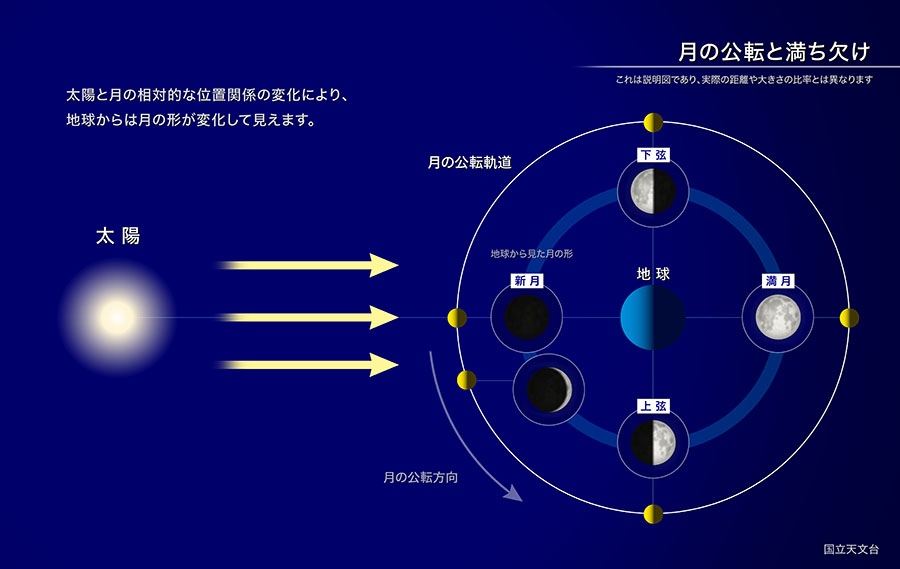
As the moon circles the earth, its sunlit side waxes from new moon to full and wanes again (schematic, not to scale).National Astronomical Observatory of Japan · Terms of use
What says the most about the Japanese attitude is that the nights around the full moon have names of their own. The sixteenth night is izayoi, "hesitation," because the moon rises later than the night before, as if reluctant to come out. Then come tachimachi-zuki, the moon you wait for standing up; imachi-zuki, the moon you wait for sitting down; and nemachi-zuki, the moon you wait for lying in bed. Each name records how long you have to wait. Moon-viewing in Japan was never only about the single brightest moment. It was about the moon’s coming and going, its lateness, and the clouds that hide it.
02From Chang’an to the Heian Court
Moon-viewing at mid-autumn was already a well-established pastime in Tang dynasty China, and it reached Japan along with the poetry, Buddhism and statecraft that envoys and student monks carried home. The figure most often linked to it is Abe no Nakamaro, a young Japanese scholar who went to China in the early eighth century, passed into the Tang civil service and stayed for decades. Tradition says that at a farewell banquet before an attempted voyage home he looked at the moon and composed a waka poem: "Gazing up into the plain of heaven, is that the same moon that rose over Mount Mikasa in Kasuga?" His ship was wrecked, he never saw Japan again, and the poem, later anthologized in the Kokin wakashū and the Hyakunin isshu, became the classic statement of homesickness under the moon. Japanese children still learn it by heart.
At the Heian court (794–1185), moon-viewing became a formal entertainment. On the fifteenth night, aristocrats drifted in boats on garden ponds, played music, and composed poems in Japanese and Chinese. Strikingly, they are said to have often not looked straight up. They admired the moon reflected in the water or floating in a cup of sake. It is a very Heian kind of pleasure: beauty seen at one remove, through a screen, on a ripple, behind thin cloud. Moonlit nights run all through The Tale of Genji and The Pillow Book, and in The Tale of the Bamboo Cutter, Japan’s oldest surviving story, the shining princess Kaguya-hime is taken back to the moon by celestial envoys on the full moon of the eighth month.
The court also produced something China did not have: a second moon-viewing night, about a month later. Its origin is usually traced to a moon-viewing banquet held by the retired emperor Uda in 919, though other accounts credit his son Emperor Daigo. More on that night below.
03Dumplings, Grass and Taro: Moon-Viewing as Harvest Thanks
For the court, moon-viewing was a refined amusement. For ordinary people, it became something else. By the Edo period (1603–1868), when tsukimi had spread to townspeople and farmers, it was tied to the harvest. The eighth lunar month is when rice is nearly ripe and taro is ready to dig, and people offered the new crops to the moon in thanks, and in hope of the same luck next year. The offerings that Japanese families still set out come from this.
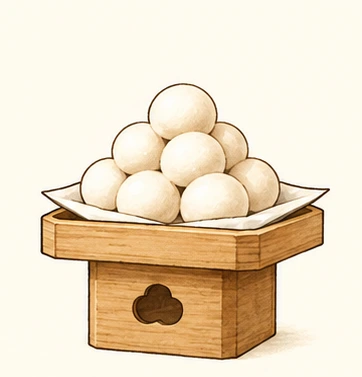
The centerpiece is tsukimi dango, plain white dumplings of rice flour, stacked into a small pyramid on a sanbō, a stand of unpainted wood like those used for offerings at Shinto shrines. For the fifteenth night the usual number is fifteen: nine on the bottom, four in the middle, two on top. Some households set out twelve instead, one for each month, or thirteen in a leap year with an extra month. They are round because they stand for the full moon. Regional style matters here. In Tokyo the dumplings are perfect white spheres. In Kyoto and Ōsaka they are often elongated, pointed at one end and wrapped in a band of sweet red-bean paste, so that each one looks like a small taro. That shape is a clue to the festival’s older meaning.
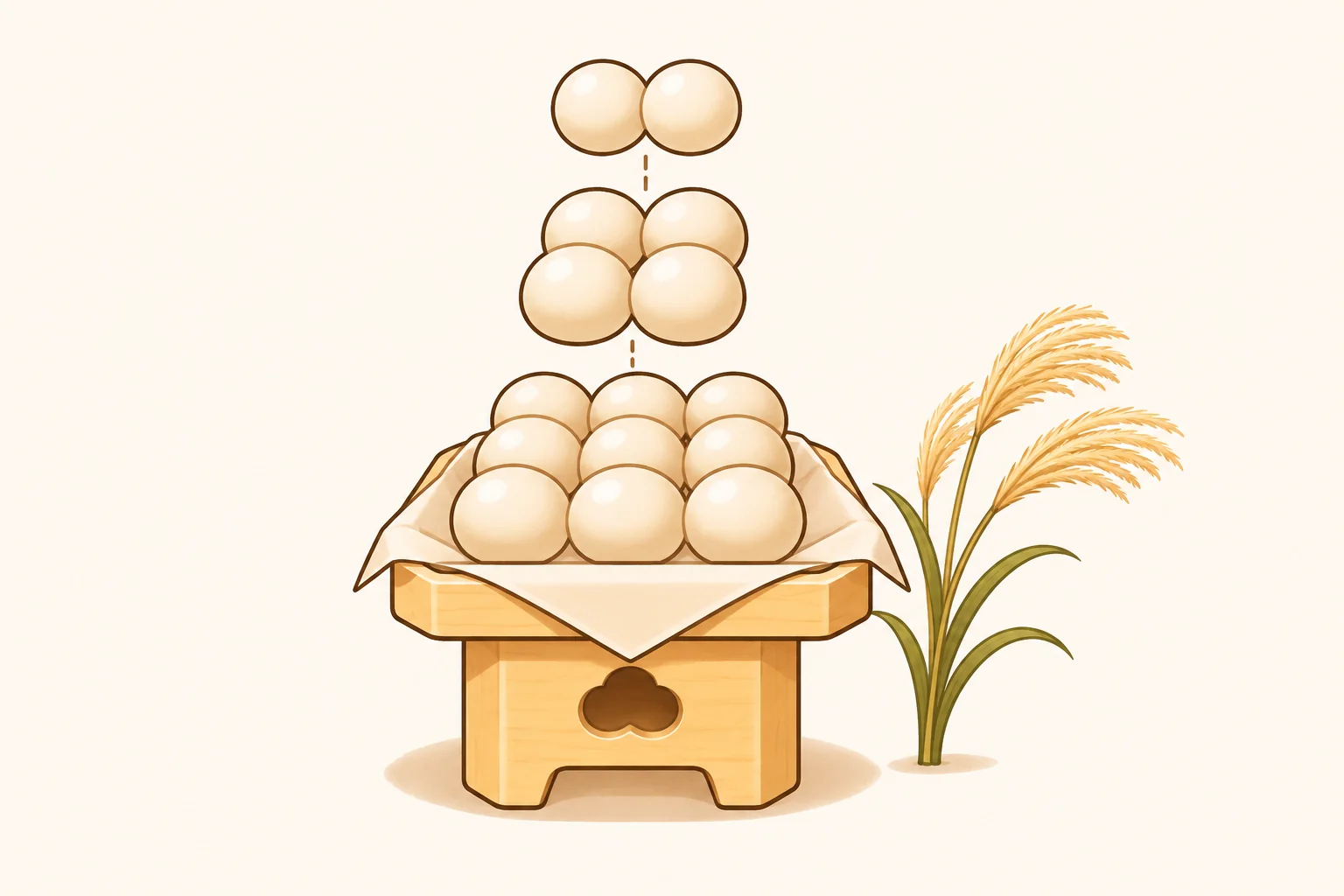
Fifteen tsukimi dango stacked nine, four and two on a sanbō, with stems of pampas grass.
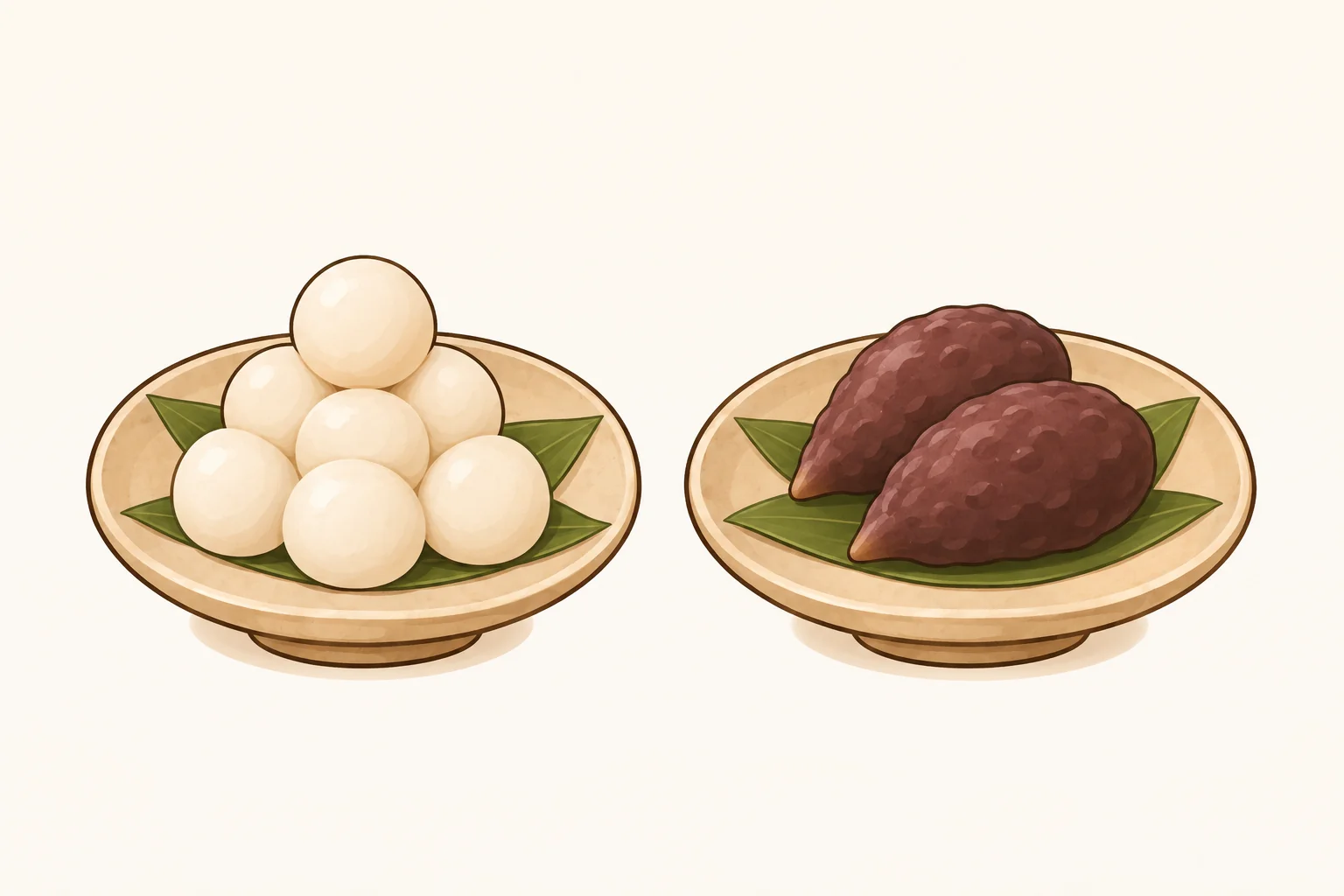
Two kinds of tsukimi dango: white spheres from Tokyo, and pointed, bean-paste-wrapped ones from Kyoto and Ōsaka.
Another name for the fifteenth night is imo meigetsu, "taro moon." Before rice became the dominant crop, taro was one of the most important autumn foods in many parts of Japan, and in some homes boiled taro is still offered alongside or instead of dumplings.
Next to the dumplings stands susuki, Japanese pampas grass. Its feathery plumes, nodding in the autumn wind, resemble ears of rice, and the grass stands in for a crop that has not yet been cut. Some say its sharp-edged leaves ward off evil, and in places the stems are hung under the eaves after the night to keep illness away for the year. Other autumn flowers such as bush clover and bellflower may be added, along with edamame, chestnuts and persimmons. The whole arrangement goes on a veranda or by a window with a view of the sky. Once the moon is up, the family eats the offerings, and food that has been offered to the moon is believed to bring good fortune.
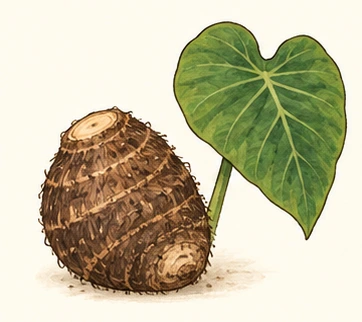
Taro (satoimo): jūgoya is also called the taro moon, and some places still offer boiled taro.
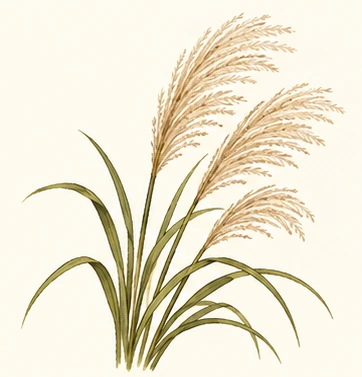
Pampas grass (susuki): its plumes resemble rice ears and stand in for the unharvested crop.
In many villages there was also tsukimi dorobō, "moon-viewing thievery." On the fifteenth night, children were allowed to sneak up to other houses and spear the dumplings and taro off the offering stands with long bamboo poles. Far from scolding them, the owners considered it lucky: the more that was stolen, the better the omen. The custom has nearly vanished from cities, but survives in some places, sometimes in a gentler form where children go door to door asking for sweets, which visitors from the West tend to compare to Halloween.
04The Thirteenth Night: Never Look Only Once
About a month after jūgoya, on the thirteenth day of the ninth lunar month, comes jūsan’ya, "the thirteenth night," also called nochi no tsuki, "the later moon." Autumn is deeper by then, the nights are cool, and the skies are often clearer than in the eighth month. The moon is still two days short of full, and that is part of its appeal. The writer Yoshida Kenkō, in his fourteenth-century Essays in Idleness, asked whether we should look at cherry blossoms only in full bloom and the moon only when it is cloudless. The thirteenth night is that idea turned into a custom: a moon admired because it is not quite complete.
The offerings change with the season. Chestnuts and beans are ripe now, so the thirteenth night is also called kuri meigetsu, "chestnut moon," or mame meigetsu, "bean moon," and the dumplings number thirteen.
In Edo it was considered bad luck to view one moon and skip the other. Doing so was called katami-zuki, "one-sided moon-viewing." The pleasure quarter of Yoshiwara made the most of this: a customer who visited on the fifteenth night was expected to return on the thirteenth of the following month, a rule that was good for business and helped spread the superstition. The Meiji-era writer Higuchi Ichiyō set one of her best-known stories, The Thirteenth Night, on this evening. In it, a woman trapped in an unhappy marriage to a wealthy official returns to her parents’ modest home on the night of the later moon, and has to decide whether she can ever go back.
Some rural areas in eastern and central Japan keep a third night, tōkan’ya, on the tenth day of the tenth month. It is really a thanksgiving to the god of the rice fields after the harvest is in, more than a moon-viewing.
05The Rabbit in the Moon
Ask a Japanese child what lives on the moon and you will be told: a rabbit, pounding rice cakes. In China the moon rabbit pounds the elixir of immortality. In Japan the mortar became the one used for making mochi, and the usual explanation is a pun: mochizuki, "full moon," sounds like mochitsuki, "pounding mochi."
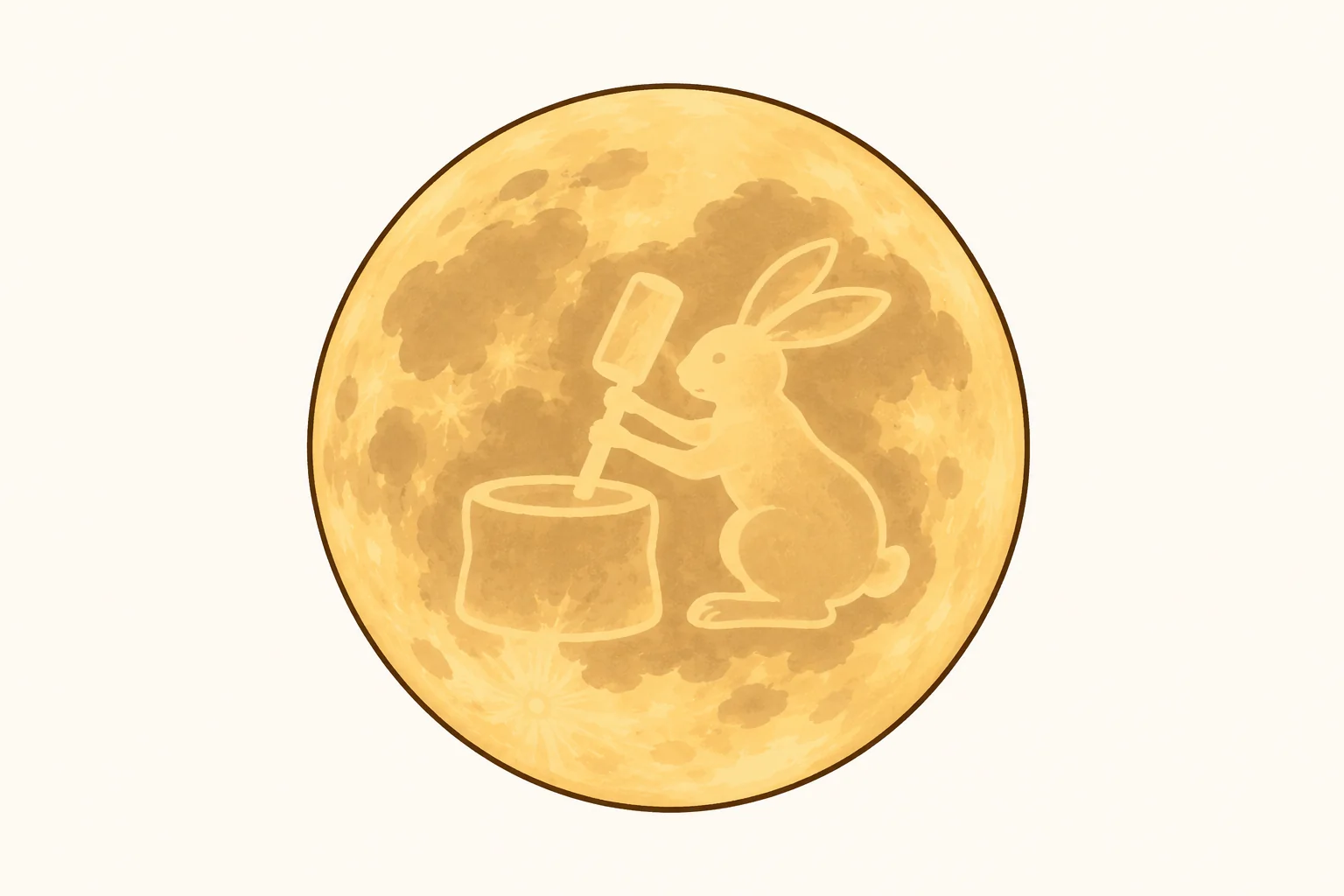
The rabbit pounding mochi that Japanese children see in the full moon (illustration).
As for how the rabbit got there, the story best known in Japan comes from a Buddhist Jātaka tale and appears in the late Heian collection Konjaku monogatarishū. A rabbit, a fox and a monkey want to help a starving old man. The fox and the monkey bring food. The rabbit finds nothing, so it asks the old man to build a fire and leaps into it, offering its own body as a meal. The old man is in fact the god Taishakuten, known in India as Indra, and moved by the sacrifice he places the rabbit’s image on the moon for everyone to see. That rabbit is everywhere in September: on dumpling packaging, on seasonal sweets, in children’s picture books.
06The Moon in Poetry and Landscape
The autumn moon runs through Japanese literature from end to end. Matsuo Bashō wrote, "The harvest moon: walking around the pond all night long," a picture of someone too absorbed to go to bed. Kobayashi Issa is more domestic: "The harvest moon, and a child crying 'Get it for me!'" In haiku, the word tsuki on its own is a seasonal word for autumn. A poet does not need to say which moon is meant. It is taken for granted that the moon worth writing about is the autumn one.
Certain places are famous for it. At Ishiyama-dera, a temple overlooking the southern tip of Lake Biwa in Shiga, legend holds that Murasaki Shikibu was inspired to begin The Tale of Genji while watching the mid-autumn moon over the water. The temple keeps a "Genji room" and holds an autumn moon festival. At Obasute in Chikuma, Nagano Prefecture, the hillside is covered in hundreds of tiny terraced rice paddies; when they are flooded, each one holds its own reflection, a sight called tagoto no tsuki, "a moon in every field." Bashō traveled there specifically to see the moon and recorded the trip in his Sarashina kikō. At Katsura Imperial Villa in Kyoto, the buildings and gardens are said to have been laid out with moon-viewing in mind, and a bamboo platform, the tsukimidai, projects from the Old Shoin toward the pond where the moon rises. At Ginkaku-ji, a flat-topped cone of raked white sand called the Kōgetsudai, "platform facing the moon," is often said to have been made to catch moonlight, though no one knows for certain.
07Tsukimi Today, and How to Join In
Few Japanese households now set up a full offering stand on the veranda, but tsukimi has hardly disappeared. It has moved into everyday life. Each September, supermarkets and confectioners stock boxed tsukimi dango, sometimes with a sprig of pampas grass included, and florists sell bundles of susuki. Noodle shops serve tsukimi soba and tsukimi udon all year round, which simply means a raw egg cracked into the hot broth: the yolk is the moon, the white is the cloud around it. In 1991 McDonald’s Japan introduced the Tsukimi Burger, a burger with a fried egg, as an autumn special, and as of 2026 it has returned every autumn since. Now nearly every fast-food chain in the country launches a "tsukimi" item in September. To a Japanese diner, an egg standing in for the moon needs no explanation.
If you are in Kyoto around the fifteenth night, the best place to go is Daikaku-ji in the Saga district. Its Ōsawa Pond is considered the oldest surviving man-made garden pond in Japan, and Emperor Saga is said to have viewed the moon from a boat there in the ninth century. For several evenings around mid-autumn the temple holds its Kangetsu no Yūbe, "evening of moon-viewing," when visitors can board boats with dragon and waterbird prows and glide over the pond, watching the moon in the sky and in the water at once, exactly as the Heian court did. Shimogamo Shrine holds a moon festival with court music and dance performed on its Hashidono pavilion, and in Nara, the Uneme Festival, held by a subsidiary shrine of Kasuga Taisha, sends two music boats with dragon and waterbird prows around Sarusawa Pond by bonfire light on the night of the harvest moon.
You do not need a temple. A riverbank, a park with an open view to the east, or a high-floor hotel window will do. Buy a box of dango at a supermarket, find your spot before moonrise, and wait. The authentic way to do tsukimi is quiet: sitting, watching the moon climb, watching thin cloud slide across its face. Many Japanese will tell you that a moon partly veiled by cloud is more beautiful than one in a perfectly clear sky. Even rain is accounted for. A rainy harvest night is ugetsu, "rain moon," and a cloudy one mugetsu, "no moon," and people set out the dumplings anyway and imagine the moon behind the weather.
And if your first tsukimi is the fifteenth night, make a note of the thirteenth night a month later. By Edo rules, if you have seen one, you owe the other a visit.