
At a glance
Takayama’s spring and autumn festivals: lacquered floats, string-worked puppets that transform mid-show, and the rival merchant neighborhoods who built and still pull them.
- Takayama Matsuri is two festivals: Hie Shrine’s Sannō Matsuri on April 14–15 and Sakurayama Hachimangū’s Hachiman Matsuri on October 9–10.
- The spring festival has 12 yatai and the autumn one 11, all 23 designated Important Tangible Folk Cultural Properties.
- In 2016 it was inscribed on UNESCO’s Representative List as one of 33 float festivals grouped as Yama, Hoko, Yatai.
- Three yatai stage karakuri puppets in spring and one, Hotei-tai, in autumn, worked by strings from inside the float.
- The first yatai was the Kagura-tai of 1708; wealthy merchants of shogunal Takayama built them up to a peak in the late Edo period.
Takayama is a small city in the mountains of northern Gifu Prefecture, a few hours by train from Nagoya. Twice a year, in April and October, its neighborhoods roll out towering festival floats that have been built, carved, lacquered and repaired by the same streets for more than two centuries. Some of them carry string-operated puppets that dance, transform and somersault high above the crowd. The Takayama Matsuri is usually counted among Japan’s three most beautiful festivals, and the beauty in question is the floats. This is an introduction to what you will see, why a remote mountain town produced it, and how to watch it well.
01One Town, Two Festivals
"Takayama Matsuri" is a collective name for two separate shrine festivals. The spring festival, the Sannō Matsuri, belongs to Hie Shrine and is held on April 14 and 15. The autumn festival, the Hachiman Matsuri, belongs to Sakurayama Hachimangū and is held on October 9 and 10. Hie Shrine sits in the south of the old town and its parishioners are the southern districts; Sakurayama Hachimangū sits to the north and draws on the northern ones. Each festival has its own set of floats: twelve in spring, eleven in autumn. All twenty-three are designated Important Tangible Folk Cultural Properties of Japan.
Most Japanese festivals revolve around the mikoshi, the portable shrine in which the deity is carried through its parish. Takayama has its mikoshi processions too, but what draws visitors from across the country is the floats, known locally as yatai. Elsewhere in Japan similar vehicles are called dashi, yama or hoko. Takayama uses the same word that now means a street-food stall, and in both cases it simply means "a platform with a roof." In 2016 Takayama’s float festival was inscribed by UNESCO on the Representative List of the Intangible Cultural Heritage of Humanity, as one of thirty-three float festivals grouped together as "Yama, Hoko, Yatai."
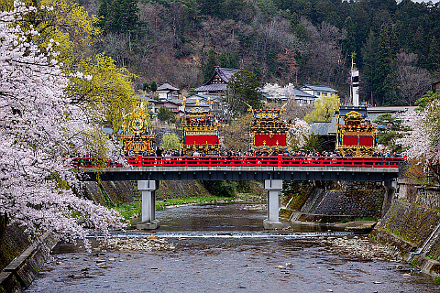
At the spring Sannō Festival, a row of yatai lines the Nakabashi bridge among cherry blossoms.
The two festivals share a structure. By day the floats are parked in a line for display, and a few of them perform puppet shows. A long procession escorts the deity’s mikoshi through the parish. By night the floats are hung with lanterns and pulled slowly through the streets. What differs is the mood. In mid-April the mountains above Takayama often still carry snow, the cherry trees are just opening, and the air is sharp. In October the evenings are cool and the trees along the Miyagawa River are starting to turn. People often describe the spring festival as bright and the autumn one as quieter, and the seasons account for much of that.
02The Yatai: Woodwork on Wheels
The first thing that strikes you up close is the height. A Takayama yatai has two or three tiers and can rise six to eight meters, taller than the eaves of the merchant houses beside it. Most roll on four large wooden wheels, though a few, such as Kyūhōsha in autumn, have three. Some floats carry an extra wheel that can be lowered to pivot the whole structure at tight corners, and watching a team of townsmen inch a float around a narrow junction, with men wedging and shouting and the top tier swaying, is part of the show.
- 1Two or three tierssix to eight meters
- 2Carvingrelief and openwork on pillars and railings
- 3Curtainsembroidered or brocade, around the lower body
- 4Miokurilarge tapestry at the back
- 5Wheelsmost have four large wooden wheels, a few three
- 6Extra wheellowered to pivot at tight corners
A yatai has two or three tiers and can rise six to eight meters, taller than the eaves of the houses beside it.
Then come the details. The woodwork is finished in many coats of black and vermilion lacquer and fitted with gilt metal fittings. Pillars, railings and panels are covered in relief and openwork carving: lions, dragons, phoenixes, peonies, waves, and crowds of Chinese children at play. The lower body is often hung with embroidered or brocade curtains, and many floats carry a large tapestry at the back called a miokuri, "the view as it leaves." Some of these textiles are Chinese embroidery; others are imported weaves, among them a Korean-made rug and, by one account, European fabrics, that reached Takayama through Nagasaki during the Edo period (1603–1868), when foreign trade was tightly restricted. For a merchant in a mountain town, acquiring one was a statement.
Each float has a name and a theme. Kagura-tai, in the spring festival, carries a great drum played on top as the float leads the procession. Kirin-tai, whose crest is the face of a kirin, the mythical beast, is known for a carving of Chinese children at play by Taniguchi Yoroku, the most celebrated carver associated with the festival. Hōō-tai in the autumn festival is crowned with a phoenix.
None of these floats belongs to a shrine or to the government. Each is owned by a neighborhood association, a yatai-gumi, made up of the households on a handful of streets. The association pays for lacquer work, regilding and new curtains, organizes the pullers, and trains the musicians. A full restoration happens every few decades and is expensive, by some reports tens of millions of yen for a single float; national and local subsidies help now, but the neighborhoods still carry a real share. Between festivals each float lives in its own yatai-gura, a tall, white-walled storehouse with a door almost as high as the building. Walk around old Takayama and you will notice these narrow white towers squeezed between houses. Each one is a float’s home.
- 1
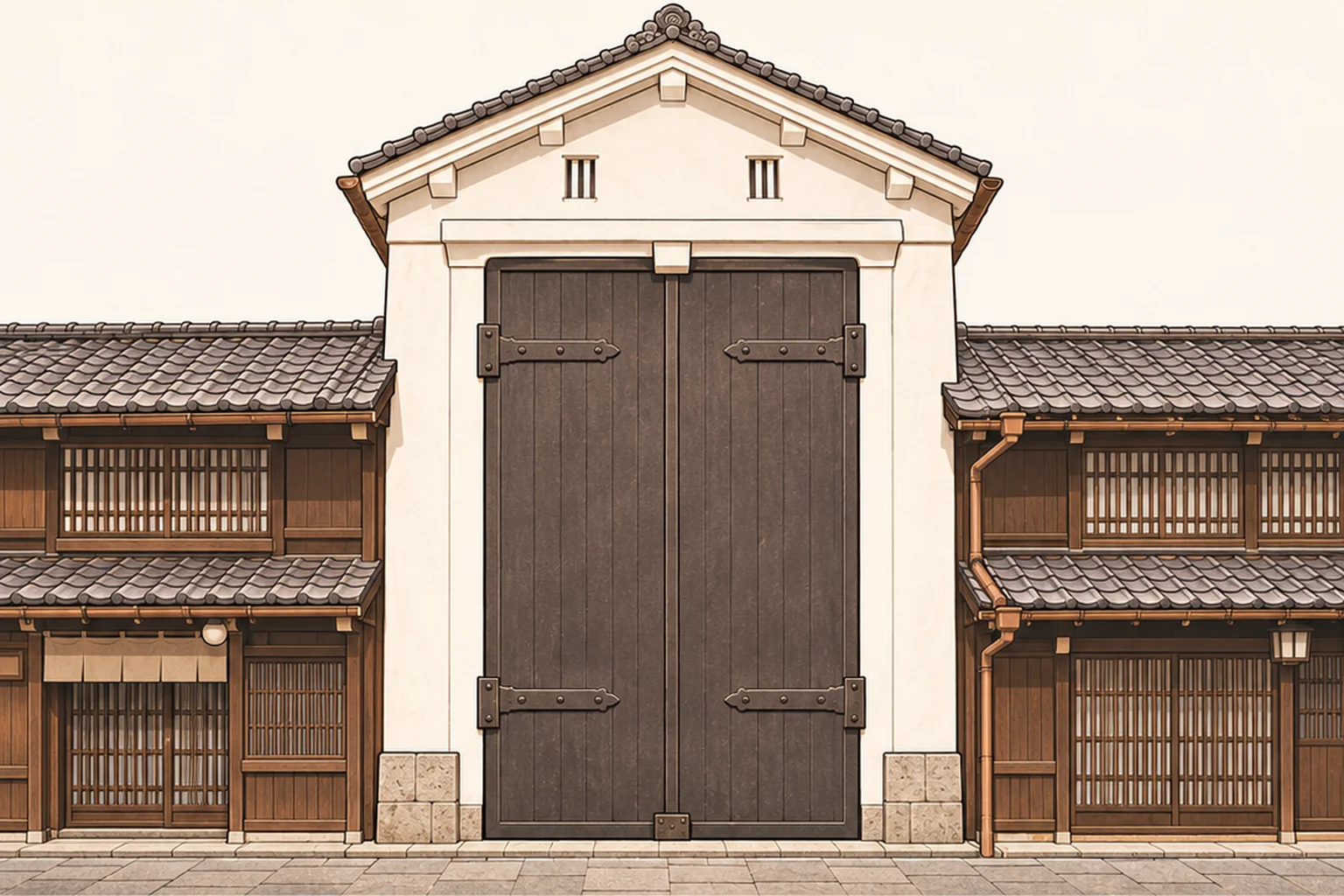 Between festivals the float lives in this tall white-walled storehouse, its door almost as high as the building.
- 2
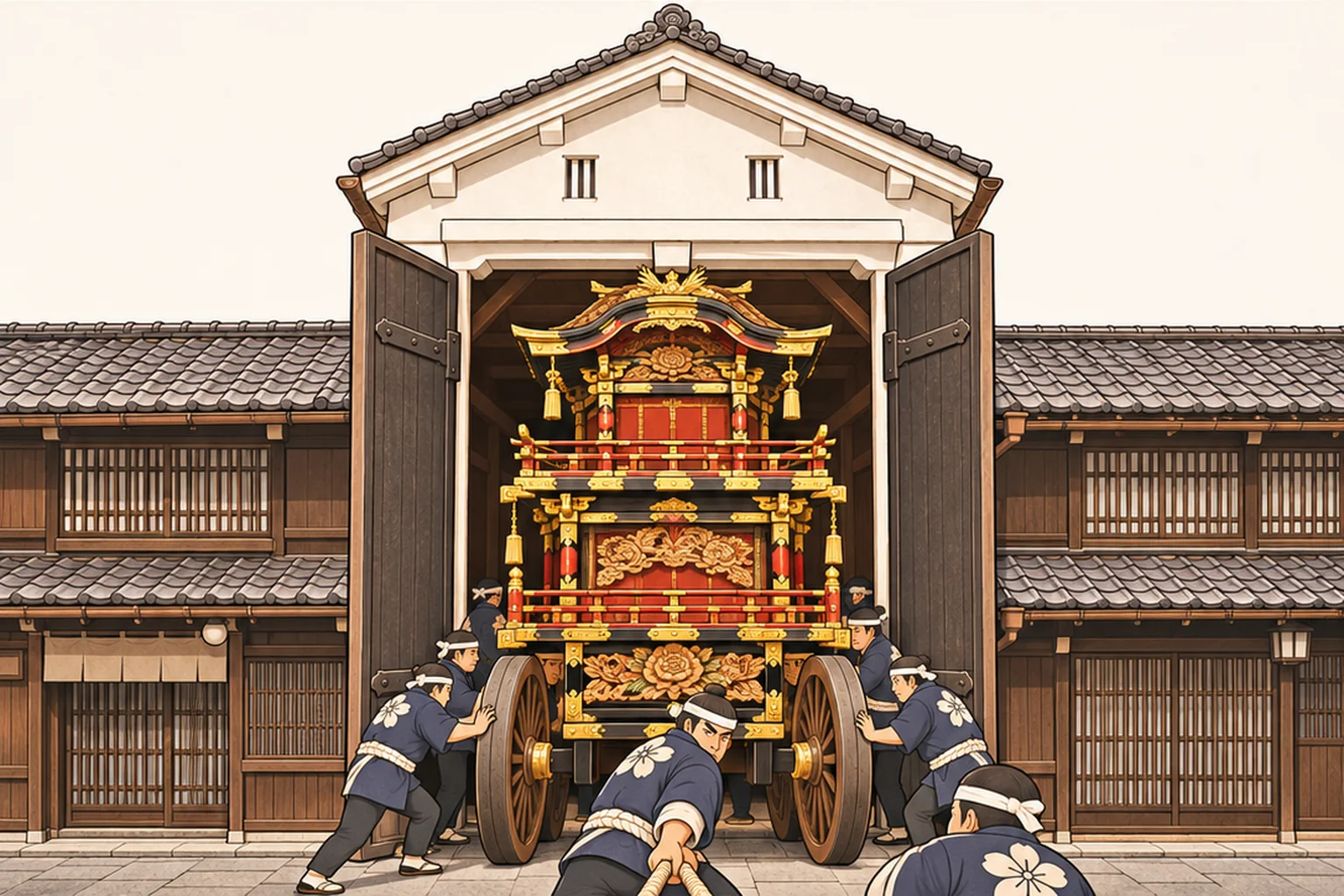 On festival day the doors open and the neighborhood pulls its yatai out into the street.
Why put this much into a cart? Because the yatai was the face of the neighborhood. In the Edo period Takayama’s districts competed with each other. When one built a new float or added a new set of carvings, the others had to answer. The history of the floats is largely a history of rival merchant neighborhoods trying to outdo one another, and what visitors call beauty today is the accumulated result of that rivalry.
03The Karakuri Puppets
The most astonishing thing at the festival sits on top of a few of the floats: karakuri ningyō, mechanical puppets. Three floats in spring perform them, Sanbasō-tai, Ryūjin-tai and Shakkyō-tai, and one in autumn, Hotei-tai. The puppet stands on a platform that extends from the top tier, while the operators hide inside the float and work it through dozens of strings, in time with flutes and drums.
Sanbasō-tai performs a piece from the Noh repertoire. A boyish figure dances, picks up a fan and a bell, moves to the front of the platform and lowers his face into a mask box; when he lifts it again he wears the mask of Okina, the old man. Ryūjin-tai draws on a legend of Chikubushima, an island in Lake Biwa. Chinese children carry a jar out to the end of a long mechanical arm; the jar bursts open and a red-faced dragon god leaps out, writhing, in a shower of paper confetti. Shakkyō-tai tells a story familiar from kabuki: a beautiful woman dances, turns in an instant into a raging lion tossing a long white mane, then returns to her own form and finishes with a celebratory dance, a peony in each hand. In 1892 the performance was stopped as harmful to public morals, and it was not revived until 1984.
Hotei-tai in autumn is the most intricate. On its platform stand the potbellied god Hotei and two Chinese children. The children swing from bar to bar like gymnasts and, at the end, land on Hotei’s back and right hand; the war fan in Hotei’s left hand then turns into a flag reading wakō dōjin, a classical phrase about softening one’s brilliance to live among ordinary people. The routine is worked by dozens of strings and a team of eight or nine operators with no markings on the cords, only practice and timing. Whether the children land cleanly is the tensest moment of the autumn festival, and the crowd applauds when they do.
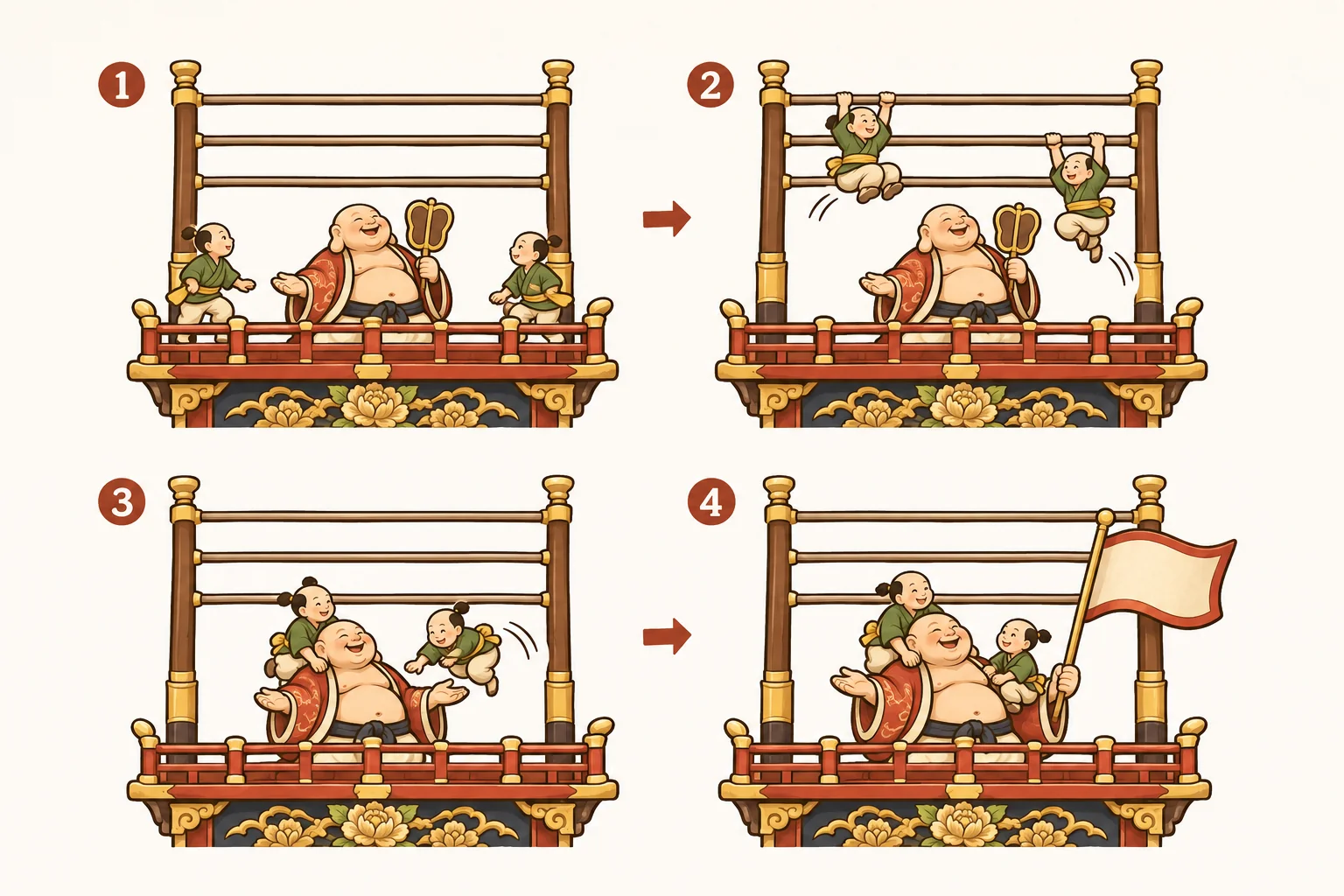
Hotei-tai's karakuri puppets: two Chinese children swing from bar to bar and land on Hotei.
The technique belongs to a wider Edo-period fashion for automata. Mechanical puppet theaters were a sensation in Ōsaka in the seventeenth and eighteenth centuries, and float festivals around Nagoya in the old province of Owari made heavy use of karakuri. Takayama’s puppets developed their own character over generations of repair and adjustment: carved wooden heads and bodies, hidden joints, internal string paths reworked by each generation of operators. The skill is passed down within families and neighborhoods and rehearsed before every festival. What you are watching is animation without electricity, wood made to move by hand.
04Carpenters and Merchants
The roots of all this craft go back to the carpenters of Hida, the old province that Takayama belongs to. Hida is steep and short of rice land. Under the ancient legal codes of the seventh and eighth centuries, provinces paid taxes in goods, but Hida was allowed to send labor instead: each year a contingent of carpenters went to the capital to work on palaces and temples. These "Hida craftsmen," Hida no takumi, earned a reputation in Nara and Heian-period building yards, and the phrase became shorthand for a master woodworker in Japanese legend and literature.
The town itself took shape at the end of the sixteenth century, when the warlord Kanamori Nagachika conquered Hida in 1585 on Toyotomi Hideyoshi’s orders, began a castle in 1588, and laid out a grid of merchant streets east of the Miyagawa River, said to be partly on a Kyoto model. The Kanamori ruled for about a century. In 1692 they were transferred elsewhere and Hida became tenryō, territory directly governed by the Tokugawa shogunate through an appointed intendant, raised to the higher rank of gundai in 1777. His headquarters, Takayama Jin’ya, still stands.
Without a resident lord, Takayama’s merchants found room to grow. They traded timber, raw silk, sake and miso, lent money, and did business with Edo, Kyoto and Ōsaka. These wealthy townsmen, the danna-shū, cultivated Kyoto tastes in tea and poetry and spent lavishly on the festival. The first yatai was the Hachiman festival’s Kagura-tai of 1708; more followed through the eighteenth century, and the floats reached their mature form in the Bunka and Bunsei eras (1804–1830) and were remodeled and enlarged through the late Edo period, when the tradition peaked. Some work was commissioned from outside masters, but most came from local carvers, lacquerers and metalworkers. Taniguchi Yoroku (1822–1864) is the best remembered of them.
The modern era brought fires, rebuildings and major restorations. The floats were designated national cultural properties in 1960, and the float festival itself was designated an Important Intangible Folk Cultural Property in 1979. Tourism now shapes the town’s economy, yet the floats are still maintained and pulled by the neighborhoods that own them.
05Processions by Day, Lanterns by Night
On festival days the mikoshi of the shrine makes its round of the parish, escorted by a procession of several hundred people: neighborhood officials in formal kamishimo, bearers of spears and lacquered hats, lion dancers, court musicians, and a group particular to Hida called tōkeiraku. The tōkeiraku performers, by one account usually boys, wear tall headdresses shaped like a phoenix or a rooster’s comb and beat gongs and drums strapped to their chests as they walk. The procession moves slower than a stroll, and a whole street can take a long time to pass, like a scroll painting being unrolled.
After dark the festival changes completely. On the first evening of each festival, the spring yomatsuri and the autumn yoimatsuri, every float is hung with close to a hundred paper lanterns lit by candles and drawn slowly through the old streets. The carvings and gilt that dominated the day fade into shadow, and what remains is a moving block of warm light, accompanied by flute and drum. At the end of the evening the floats return one by one to their storehouses. In autumn there is an extra afternoon event, the hikimawashi, when several of the floats set out from the shrine approach and are pulled in a circuit through the parish before the lanterns are lit.
06Going to See It
In spring, the floats line up mainly near Hie Shrine’s otabisho, the temporary resting place of the deity, and from Shinmei-machi through the Kamimachi streets of the southern old town; the three karakuri floats perform in front of the otabisho. In autumn the floats gather along the approach to Sakurayama Hachimangū, and Hotei-tai performs within the shrine grounds. People start claiming spots half an hour before each performance, so arrive early. For a good view of a whole float, step back to a corner and wait for it to turn rather than pressing in at the front.
Weather is the great variable. Rain damages lacquer and textiles, so if it rains or looks likely to, the floats stay in their storehouses and the puppet shows are canceled. Some neighborhoods are said to open the great storehouse doors on such days so that visitors can look at the float inside. This happens regularly, and April can even bring snow, so if you can, plan to stay for both days. Both evenings are worth seeing; the lantern-lit nights draw slightly smaller crowds than the days, though "less crowded" is relative on any festival night.
Accommodation is the other challenge. Inns in Takayama fill months ahead for festival dates, and many visitors stay in Gero or Hida-Furukawa, or come up for the day on the JR Takayama Line express from Nagoya or Toyama.
If your dates don’t line up, you can still see real floats. The Takayama Matsuri Yatai Kaikan, the float exhibition hall next to Sakurayama Hachimangū, displays, as of 2026, four of the autumn floats on rotation, close enough to study the lacquer and carving. Around Sanmachi, the preserved merchant quarter, the streets look much as they did in the late Edo and Meiji periods; there is a morning market along the Miyagawa; sake breweries mark new sake with a ball of cedar fronds over the door and offer tastings; and stalls sell Hida beef on skewers and on sushi rice.
At the festival itself, watch the people as well as the floats. The men in happi coats wedging blocks under the wheels, the older residents steering a float under its lanterns, the unseen operators pulling strings inside Hotei-tai: they all live on the streets that own these floats. Twice a year they take their grandparents’ yatai out into the town, and afterwards they push them carefully back into the storehouse, having paid for the repairs and given up their evenings to rehearse.