
At a glance
Setsubun, the night before spring when families throw roasted beans at demons: its court origins, the convenience-store ehōmaki boom, and where to watch.
- Setsubun is the day before risshun, so its date moves; in 2021 it fell on February 2 for the first time since 1897.
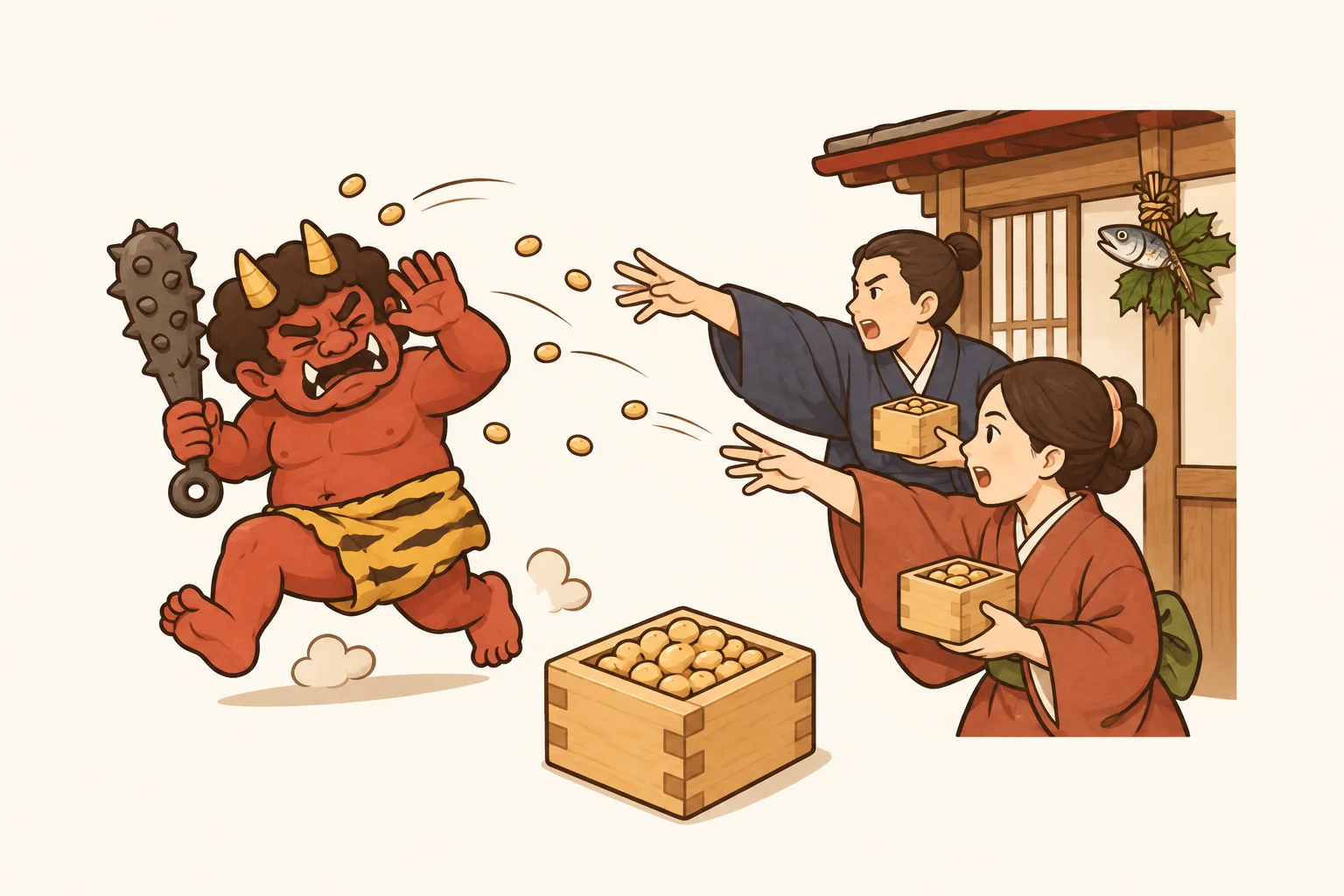
- People throw roasted "fortune beans," shouting "Oni wa soto! Fuku wa uchi!", then eat as many beans as their age.
- It goes back to the Chinese nuo exorcism, which became tsuina at the Japanese court; bean throwing on Setsubun night appears in Muromachi records.
- Demons have ox horns and tiger-skin loincloths, usually explained by the northeast "demon gate" matching the zodiac signs ox and tiger.
- Ehōmaki began in Ōsaka; 7-Eleven sold it under that name in 1989 and took it nationwide in 1998.
On an evening in early February, households across Japan slide open their windows and fling handfuls of roasted soybeans into the cold, shouting "Oni wa soto! Fuku wa uchi!" — "Demons out! Good fortune in!" Somewhere in the house a parent in a cardboard mask plays the demon and is pelted by delighted children. At temples and shrines, sumo wrestlers and television actors toss packets of beans to crowds of thousands, and at convenience stores people pick up thick, uncut sushi rolls to eat in silence while facing a lucky direction. This is Setsubun, a small date on the calendar that carries an ancient court exorcism, a whole folklore of demons, and one of modern Japan’s most successful marketing campaigns.
01The Day Before Spring
The word setsubun means "seasonal division." Under the system of twenty-four solar terms that Japan adopted from China, the four seasons begin on Risshun (the start of spring), Rikka (summer), Risshū (autumn) and Rittō (winter). The day before each of these was a setsubun, so the old calendar had four of them. Over the centuries only the one before spring kept its importance, and by the Muromachi period (1336–1573) "Setsubun" had come to mean that day alone.
Spring was special because in the traditional lunisolar calendar Risshun was treated as the true turning of the year, and it fell close to the lunar New Year. Moments of transition were thought to be dangerous: the old year’s accumulated sickness and bad luck lingered, and the boundary between seasons was a gap through which evil could slip. Setsubun was a chance to clean house in a spiritual sense, expelling whatever had built up so that the new spring could start fresh. In that sense it worked like a second New Year’s Eve, and many people still visit temples and shrines around this time for yakuyoke, rites to ward off misfortune.
Because Risshun is fixed by the sun’s position rather than by a calendar date, Setsubun moves slightly. From 1985 to 2020 it fell on February 3 every year, and Japanese people came to think of the two as the same thing. In 2021 it fell on February 2 for the first time since 1897, which made the news. It did so again in 2025, and for the next few decades a February 2 Setsubun will come round about every four years.
Setsubun is not a public holiday. It is an ordinary working evening, and the bean-throwing happens after dinner at home. That ordinariness is much of its charm.
02From Court Exorcism to Household Ritual
The roots of Setsubun lie in a Chinese year-end exorcism called nuo. Ancient Chinese texts describe an officer called the fangxiangshi who wore a bear skin and a mask with four golden eyes, carried a spear and shield, and led a procession through the palace driving out the demons of pestilence. This ritual came to Japan along with Chinese-style government; the court chronicle Shoku Nihongi records one held in 706 during an epidemic. At the Japanese court it was called tsuina or oniyarai, "driving out demons." By the Heian period (794–1185) it was performed every year on the last night of the twelfth month.
Something curious happened over time. The Japanese hōsōshi, as the exorcist was called, wore such a frightening four-eyed mask that people began to see him as the demon himself, and in later versions of the rite courtiers chased him out instead. This inversion is often cited as part of how the Japanese demon acquired a definite look.
Bean-throwing was a later addition. Records from the Muromachi period already mention scattering beans on the night of Setsubun, and during the Edo period (1603–1868) the custom spread from temples and samurai households to ordinary townspeople, becoming one of the fixed events of the year. Why beans? Grains were believed to hold spiritual power. Wordplay also helps: mame (bean) can be read as ma-me, "demon’s eye," or ma-metsu, "destroying evil." The Japanese love this kind of auspicious pun.
The beans are always roasted first and are called fukumame, "fortune beans." One explanation is that raw beans might sprout where they land, which was considered unlucky; another is that iru, to roast, sounds like iru, to shoot an arrow. After the throwing, everyone gathers up beans and eats as many as their age in full years, or one more for luck in the coming year. Elderly people who would face eighty beans sometimes drink fukucha instead, a tea made with a few beans, a pickled plum and a piece of kelp.
03What a Demon Looks Like, and Who Lets Them In
Everyone in Japan knows what a Setsubun oni looks like: red or blue skin, a pair of horns like a bull’s, fangs, a tiger-skin loincloth and an iron-studded club. There is a logic behind the costume. In Onmyōdō, the Japanese system of yin-yang divination, the northeast is the kimon, the "demon gate" through which evil enters. The northeast is designated in the old zodiac system as ushitora, ox-tiger. So the demon has an ox’s horns and wears a tiger’s skin. The explanation was worked out after the fact, but it fixed the image firmly.
Japanese demons are not purely evil. Folktales include the man-eating Shuten Dōji of Mount Ōe, but also defeated demons who swear to reform, and the straw-cloaked Namahage of Akita, who look like demons but are visiting deities who go from house to house on New Year’s Eve to scare lazy children into good behavior. Parents playing the oni at Setsubun tend to ham it up, and children shriek and laugh as they hurl beans at them.
Not everyone shouts "demons out." At Sensō-ji in Tokyo the chant is "Senshū banzai, fuku wa uchi" — "a thousand autumns, ten thousand years, fortune in" — on the grounds that no demon could exist in the presence of the bodhisattva Kannon. At Kinpusen-ji in Yoshino, Nara, the call is "Fuku wa uchi, oni mo uchi," "fortune in, and demons in too": the temple takes in the demons driven from everywhere else and reforms them through Buddhist teaching. Temples devoted to Kishimojin, a demon-mother turned protector of children, also avoid driving demons away.
There is even a family-name exception. According to legend, the Heian-period warrior Watanabe no Tsuna cut off a demon’s arm at the Ichijō Modoribashi bridge in Kyoto (later tellings name the demon Ibaraki Dōji), and ever since, demons have been afraid of anyone named Watanabe. Some Watanabe families therefore do not bother throwing beans. Most treat this as a joke, but it is a well-known one.
The beans themselves vary. In much of Kantō and Kansai people use roasted soybeans, but in Hokkaidō, Tōhoku, Niigata and parts of southern Kyūshū many households throw peanuts in the shell. The reason is practical: soybeans vanish into snow, while peanuts are easy to find and, once shelled, are clean to eat; Miyazaki and Kagoshima also grow a lot of peanuts.
Some homes add another defense at the door, the hiiragi iwashi: a grilled sardine head stuck on a sprig of holly-like hiiragi (Japanese holly olive). The prickly leaves poke the demon in the eye, and the smell of the burnt fish drives it off. Some say the custom survives best in western Japan. It is uncommon in city apartments, but supermarkets still sell the sprigs around Setsubun.
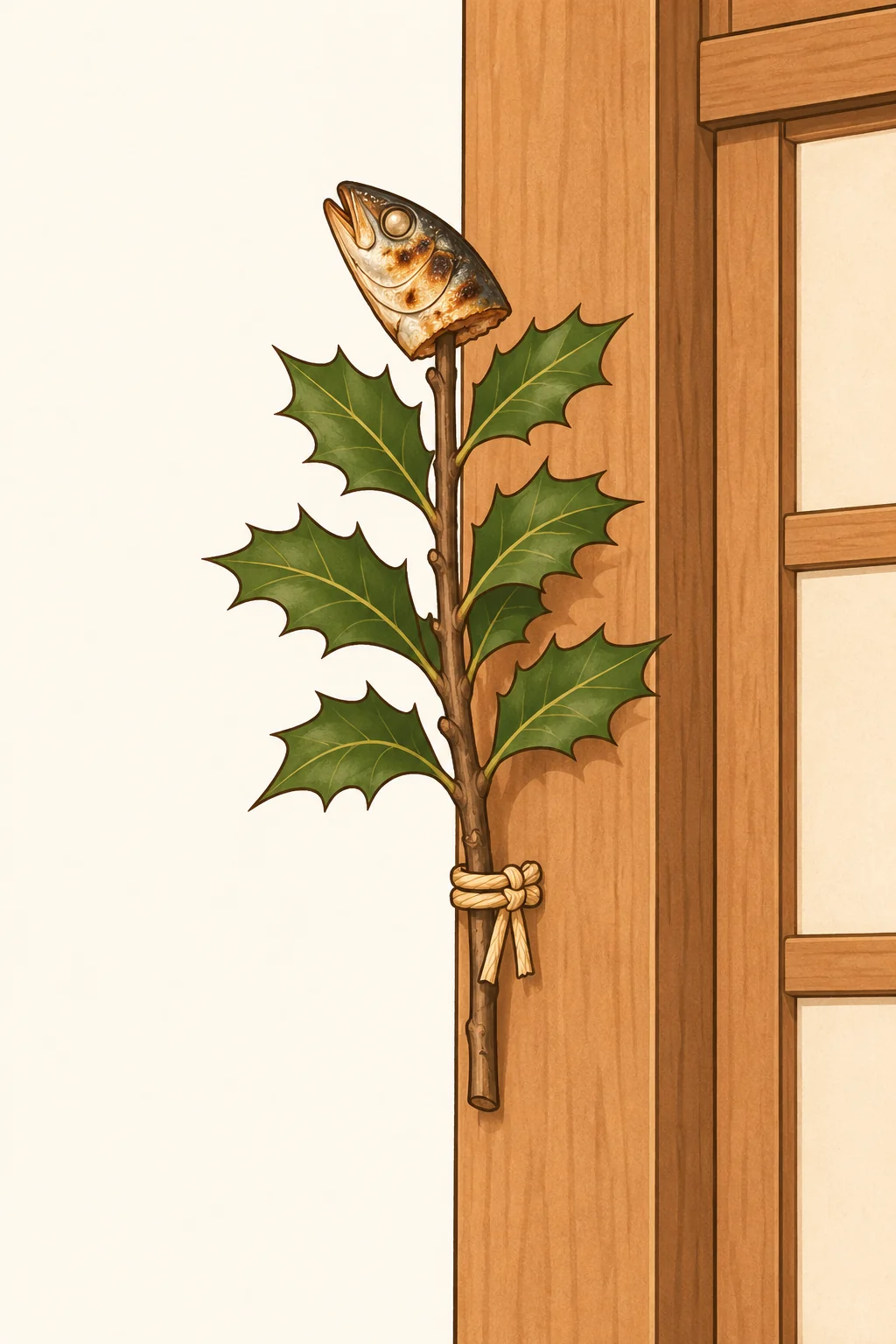
Hiiragi iwashi: a grilled sardine head stuck on a sprig of prickly hiiragi, put up at the door to drive demons off.
04Ehōmaki: The Sushi Roll You Eat in Silence
In the weeks before Setsubun, every convenience store and supermarket in Japan puts up posters and order forms for ehōmaki, "lucky-direction rolls." An ehōmaki is a thick roll of sushi rice and seaweed, traditionally filled with seven ingredients to match the Seven Lucky Gods: typically simmered gourd strips, shiitake mushrooms, rolled omelet, eel, cucumber and sweet fish flakes, among others.
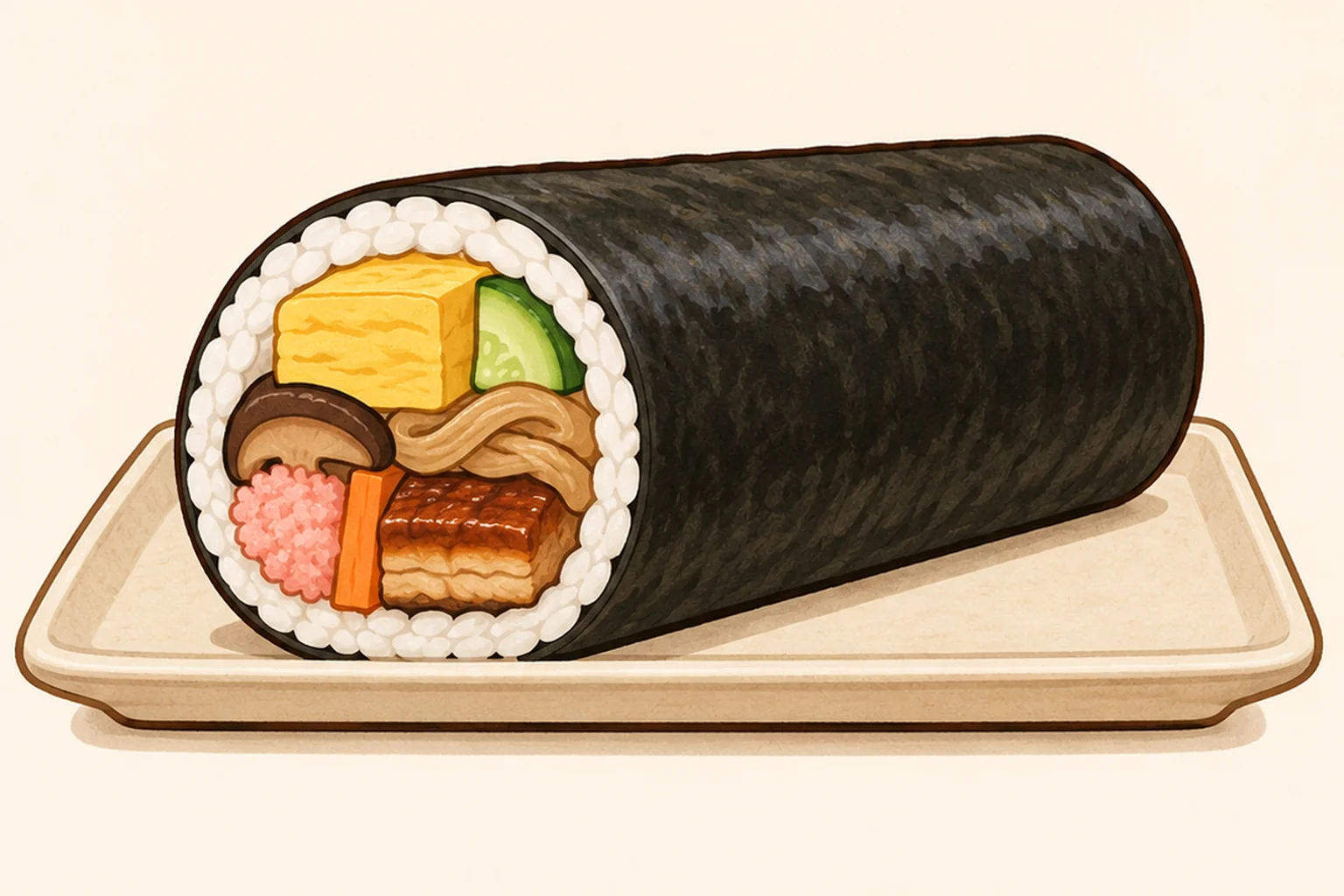
A thick, uncut roll of sushi rice and seaweed, traditionally filled with seven ingredients.
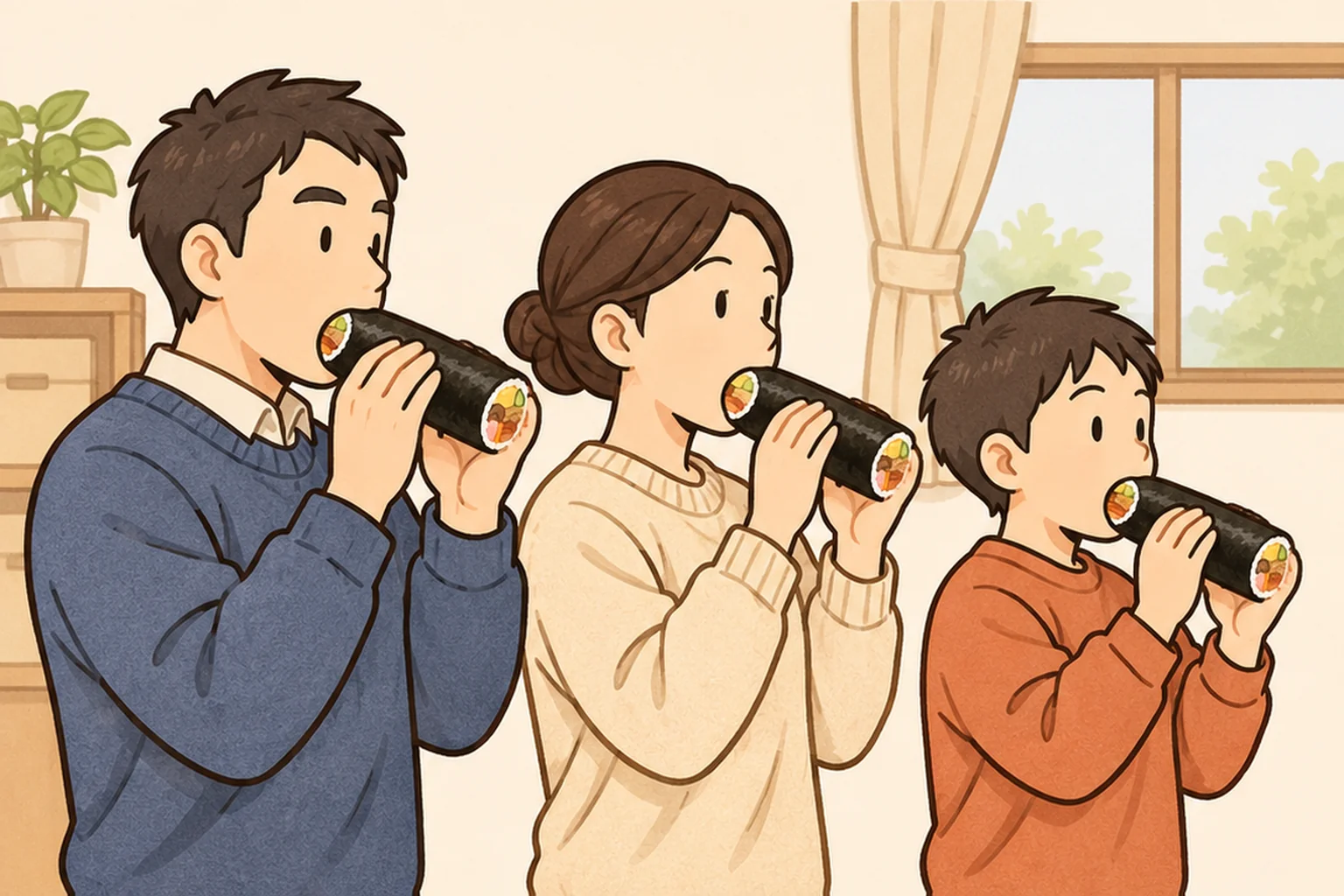
Each person finishes a whole roll in silence, everyone facing the year's lucky direction.
There are rules for eating it. First you find the year’s ehō, the direction in which the deity of the year, Toshitokujin, resides. The direction is set by the year’s celestial stem and rotates among just four possibilities; in 2027 it is north-northwest. You face that way, make a silent wish, and eat the entire roll without speaking. It must not be cut, because cutting it would sever your good fortune, and talking lets the luck escape. The sight of a whole family silently chewing toward the same corner of the room is part of the fun.
The ehōmaki is far younger than bean-throwing. It is generally traced to Ōsaka. The usual story is that merchants in the Senba district ate sushi rolls on Setsubun for business luck in the late Edo period; another version places its start in the pleasure quarters of the Taishō era, and neither has contemporary documentation. An Ōsaka sushi merchants’ group printed a flyer about it in 1932, and Ōsaka’s sushi and seaweed trades promoted the custom after the Second World War. Even so, for most of the twentieth century it remained a regional Kansai habit, and most Tokyo residents had never heard of it. The convenience store changed that. In 1989, some 7-Eleven stores in Hiroshima began selling the rolls under the name "ehōmaki," the chain took them nationwide in 1998, and competitors, supermarkets and department stores quickly followed. Within a few years it was a national Setsubun food.
Japanese feelings about it are mixed. Many people enjoy it and do it at home every year; others see it as a tradition invented by retailers. In recent years the mountains of unsold ehōmaki thrown away after February 3 have become a news story, and since 2019 the Ministry of Agriculture, Forestry and Fisheries has urged retailers to stock only what they can sell. Many shops now take preorders. The roll has also mutated: there are versions with pork cutlet or roast beef, half-length rolls, and even sweet "ehōmaki" made from roll cake at patisseries.
05Seeing Setsubun at Temples and Shrines
If you are in Japan in early February, Setsubun is worth planning a day around. Many major temples and shrines hold a setsubun-sai or setsubun-e, and the largest draw tens of thousands of visitors in a day; some reports put the biggest crowds at more than a hundred thousand.
The most famous is Naritasan Shinshō-ji in Chiba Prefecture, near Narita Airport. As of 2026, the stars of NHK’s current historical drama and popular sumo wrestlers still stand on a platform before the main hall and throw beans to the crowd, a scene that appears on the national news almost every year. The temple is dedicated to Fudō Myōō, before whom even demons are said to reform, so here too the chant is only "fuku wa uchi." In Tokyo, Zōjō-ji, Sensō-ji and Kanda Myōjin also invite celebrities, and crowds reach up to catch small paper packets of beans, some of which contain lottery tickets for prizes.
Kyoto is the best place to see Setsubun, with different rituals at different sites over several days. At Yoshida Shrine the tsuina-shiki is closest to the old court rite: the four-eyed hōsōshi appears with spear and shield and drives off red, blue and yellow demons, and at night a great bonfire burns the old year’s amulets while food stalls line the approach. At Rozan-ji the oni hōraku features red, blue and black demons dancing an eerie, stamping dance to drums and conch shells before being driven out by Buddhist rites and beans. On the eve and day of Setsubun, Mibu-dera repeatedly stages its silent masked Mibu Kyōgen play Setsubun, in which a widow is tempted by a demon and finally drives it away (as the play is usually summarized, the demon comes disguised as a man and she routs it with beans), whereupon the demon’s magic mallet and robes vanish: a lesson about resisting temptation and working honestly. At Yasaka Shrine, geiko and maiko from four of Kyoto’s geisha districts, Gion Kōbu, Miyagawachō, Pontochō and Gion Higashi, take turns dancing on the stage and then scatter beans into a packed crowd.
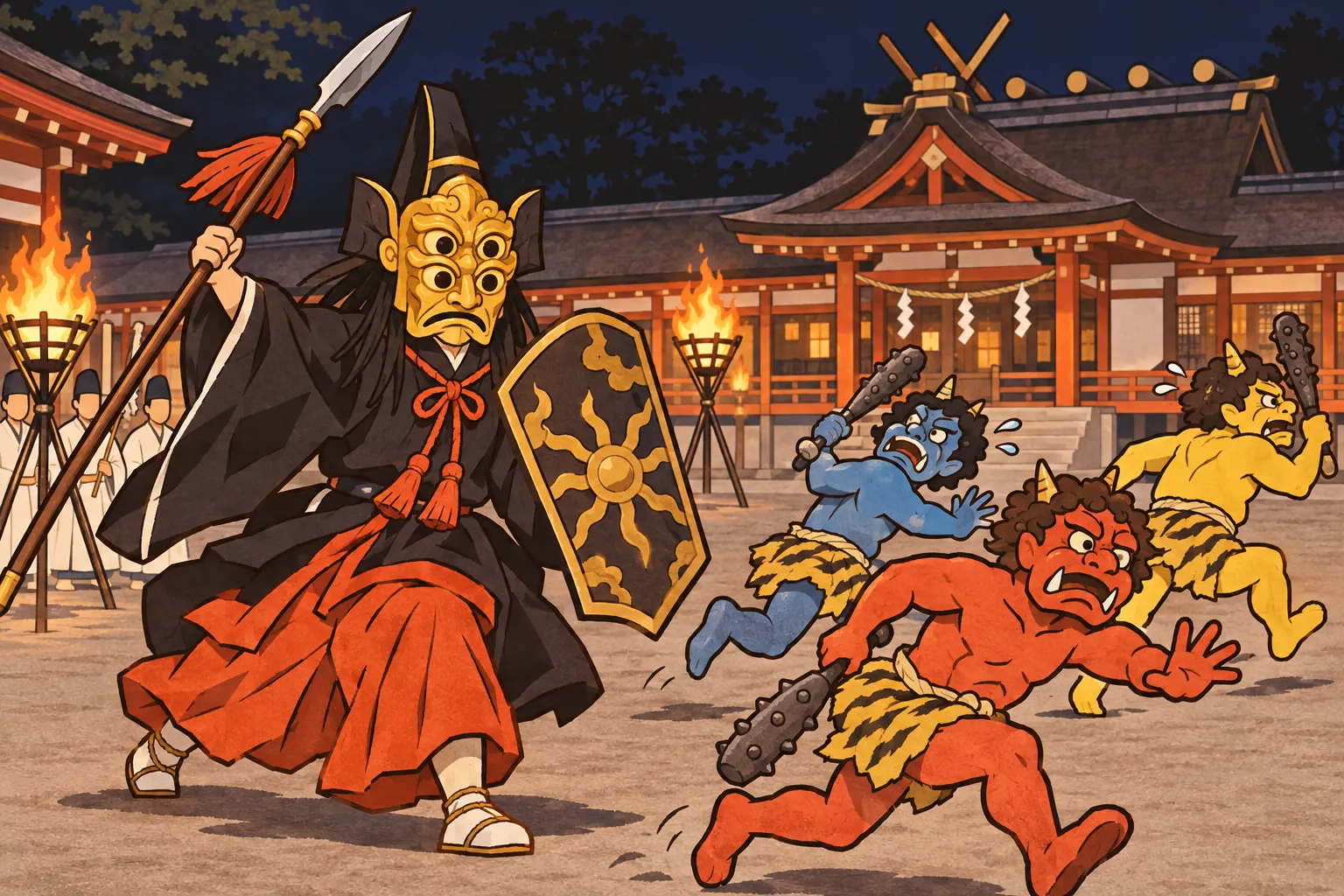
Yoshida Shrine's tsuina rite: the four-eyed, gold-masked Hōsōshi with spear and shield drives off red, blue and yellow demons (illustration).
Kyoto’s geisha districts have their own playful custom, obake, in which geiko and maiko dress up in costumes completely unlike their usual appearance and perform short skits for regular patrons at teahouses. It is said to come from an old practice of disguising oneself at the turn of the season to fool the demons. Visitors rarely get into these parties, but around Setsubun night you may glimpse oddly dressed figures hurrying through the lanes.
At a public bean-throwing, wear clothes you can move in and arrive early. When the packets start flying, protect your glasses and phone, and keep small children toward the back. Visitors can often pay a prayer fee to throw beans from the stage themselves, which counts as a donation and a prayer for the year; some temples reserve this for a toshi-otoko or toshi-onna, a man or woman born in the year of the current zodiac animal.
Doing it at home is easy. Before Setsubun, supermarkets sell small boxes of fukumame that come with a paper demon mask, for a few hundred yen as of 2026. The throwing happens after dark, since demons come out at night. Start at the room farthest from the entrance, open the window and throw outward shouting "oni wa soto," close it and throw inward with "fuku wa uchi," and finish at the front door. If you are staying at a hotel or ryokan, you need not scatter beans across the room: eat your age in fukumame, buy an ehōmaki, and finish it in silence facing the year’s lucky direction.
- 1
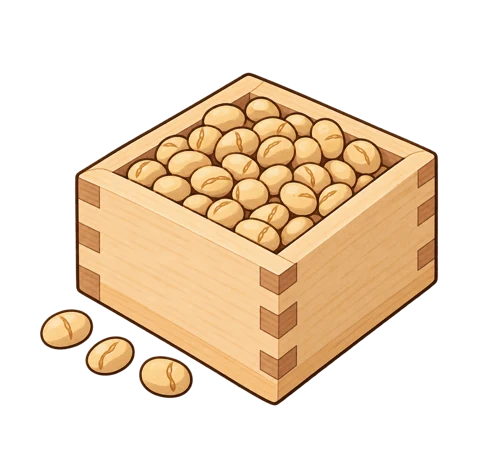 Have the roasted fortune beans ready.
- 2
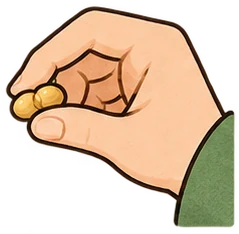 Take a handful of beans.
- 3
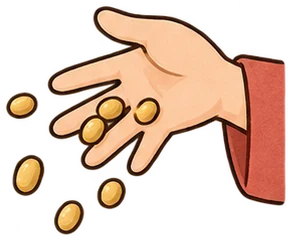 Throw them out the open window with "Oni wa soto," then into the room with "Fuku wa uchi."
- 1
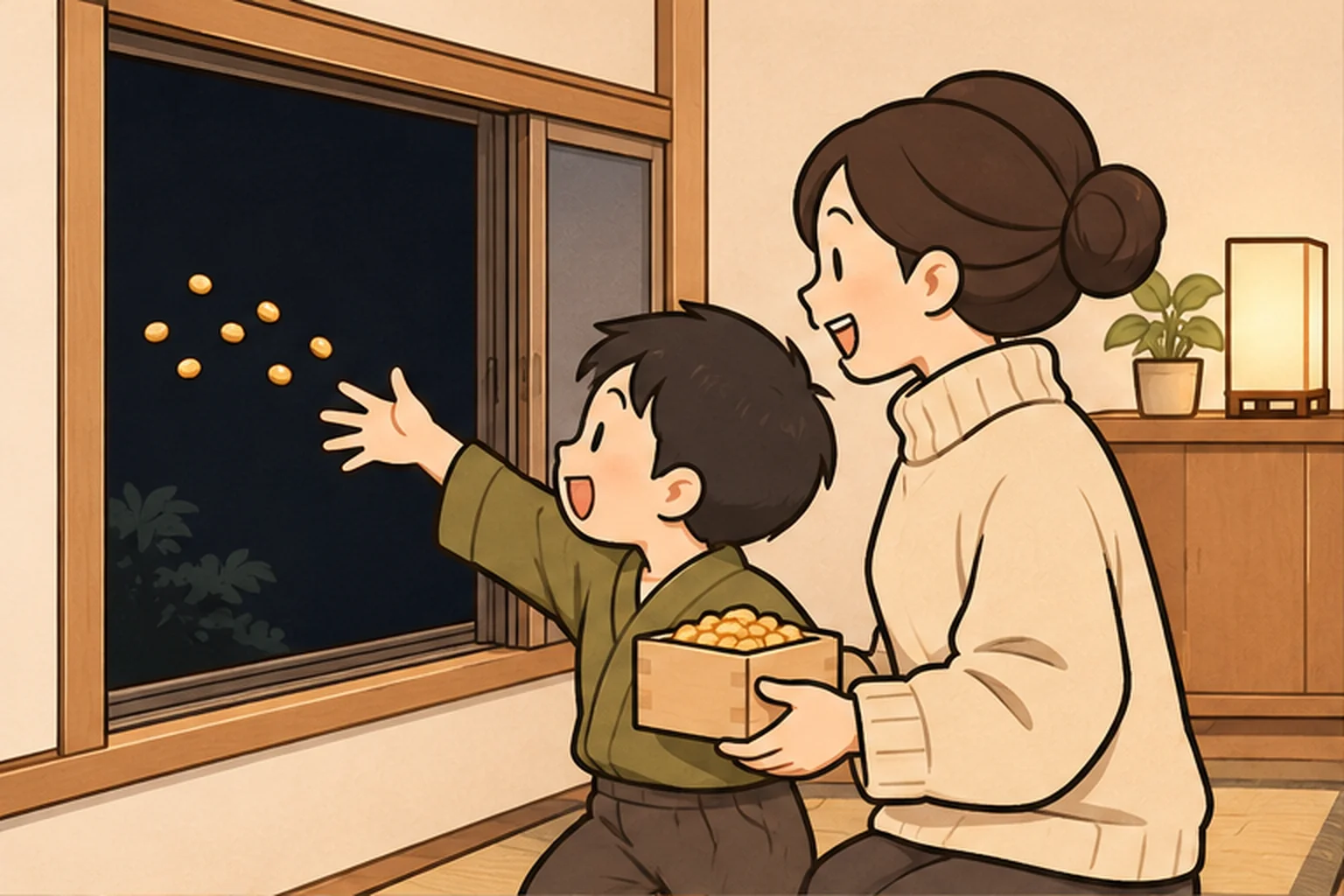 Open the window and throw the beans outward, shouting "oni wa soto."
- 2
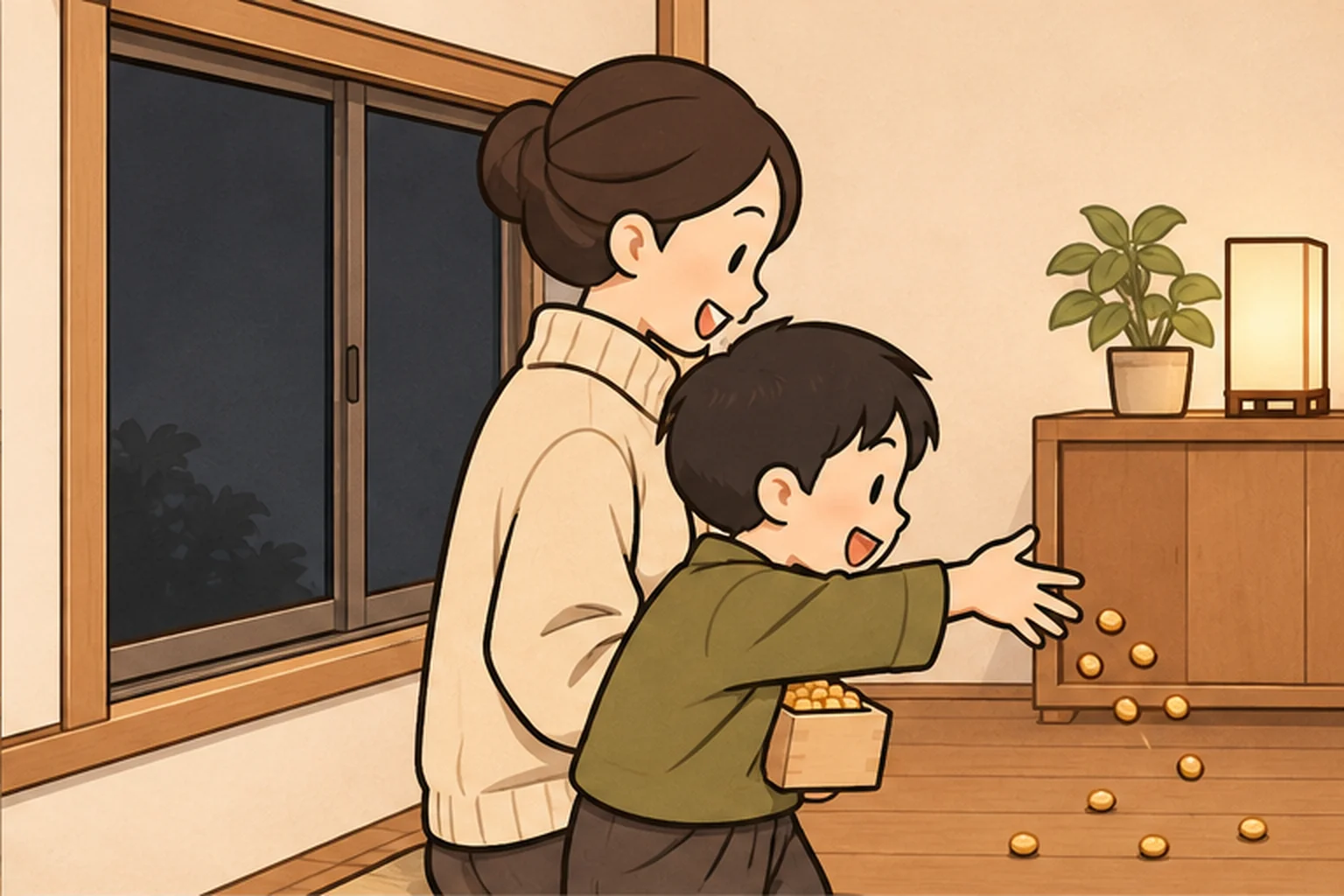 Close the window and throw inward with "fuku wa uchi."
- 3
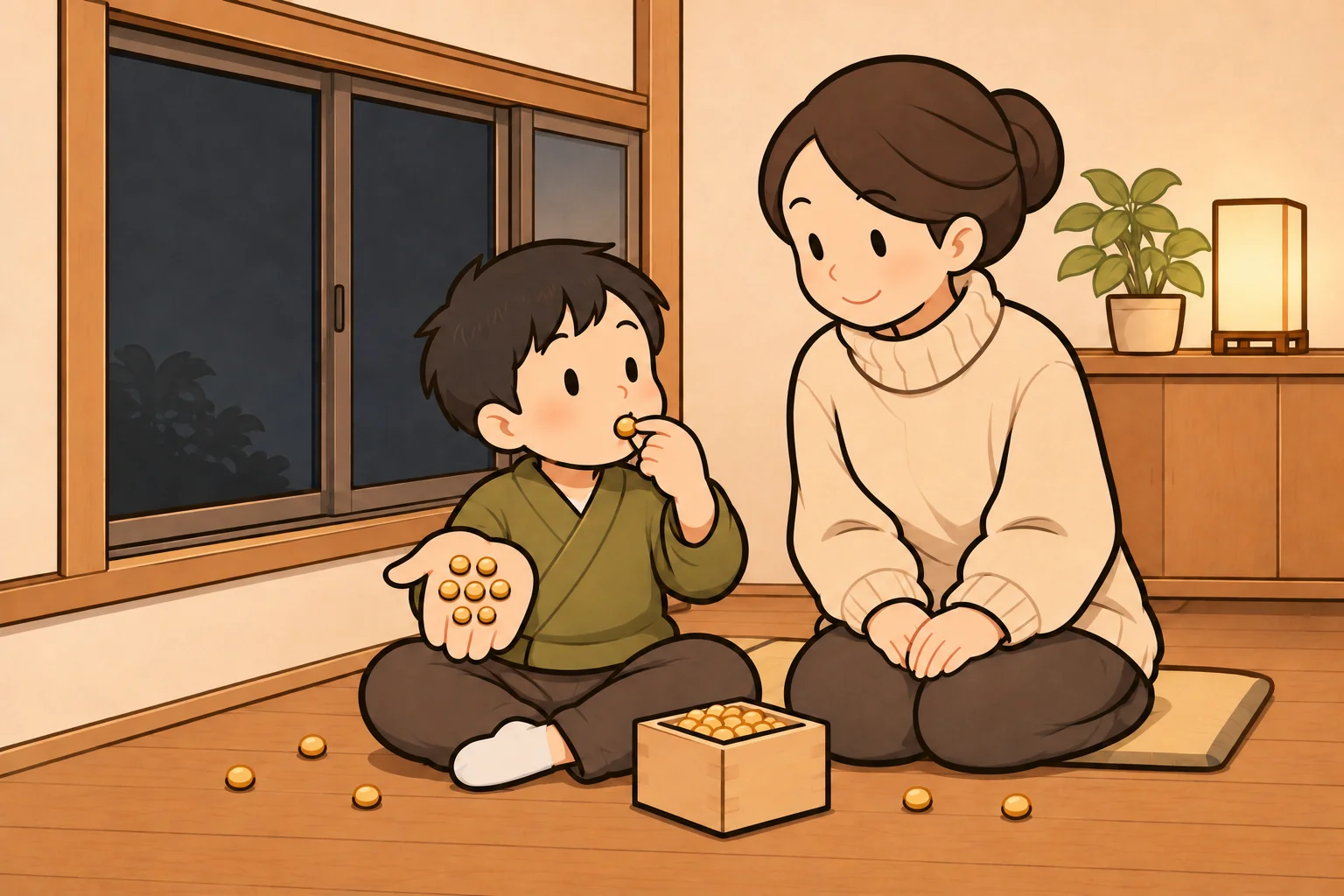 After the throwing, everyone gathers up beans and eats as many as their age in full years.
The next day is Risshun, the first day of spring. Early February is usually the coldest part of the Japanese year, but the plum blossoms are already opening, and the Doll Festival and cherry blossoms are not far off.