
At a glance
How Japanese families welcome their ancestors home in summer, from the Ullambana sutra to welcoming fires, cucumber horses, Bon dances and Kyoto’s mountain send-off fires.
- Obon is the time when families bring the spirits of their ancestors home for a few days; in most places today it runs from August 13 to 16.
- The name comes from the Ullambana Sutra and its story of Mokuren saving his mother; a Bon rite at Asuka-dera in 657 is the earliest clear record in Japan.
- A welcoming fire on the evening of the 13th brings the ancestors home and a send-off fire on the 16th returns them; a cucumber horse and an eggplant ox stand on the spirit shelf.
- Since the Meiji calendar reform, Tokyo and some other areas keep Bon in July, most of Japan a month later in August, and Okinawa and a few other places by the lunar calendar as Old Bon.
- On the night of August 16, Kyoto’s Five Mountain Send-off Fires light huge fire images one after another on the mountains around the basin to send the ancestors back.
For a few days every August, Japan turns its attention to the dead. Families light small fires at their gates to guide ancestral spirits home, set out food and fruit for them on a special altar, and a few days later light another fire to send them back. Tens of millions of people travel to their hometowns to be there for it, jamming the expressways and the bullet trains. Obon is not a public holiday, yet it is the second great family gathering of the Japanese year after New Year. This piece explains what happens at Obon, why it matters to people who may not think of themselves as religious, where the custom came from, and how a summer visitor can see it and take part without intruding.
01A Holiday That Isn’t on the Calendar
Ask someone in Japan when they last went back to their parents’ house, and the answer will very often be "at Bon" or "at New Year." The two are paired so naturally that there is an old expression, bon to shōgatsu ga issho ni kita yō, "as if Bon and New Year came at once," for a moment when too many good things happen together. New Year welcomes the god of the incoming year; Bon welcomes the ancestors. One falls in winter, the other in high summer, and between them they divide the year in half.
In most of Japan today, Obon runs from August 13 to 16. On the evening of the 13th the spirits are welcomed; on the 14th and 15th they stay in the house; on the 16th they are sent off. None of these days is an official holiday, but most companies close for what everyone calls Obon yasumi, the Bon break. Factories shut down, small restaurants post signs saying they are closed for the period, and since 2016, when August 11 became a national holiday called Mountain Day, many workers have been able to stitch together a week or more off.
The result is one of the great annual migrations of the industrialized world. Television news covers the kisei rasshu, the homecoming rush, as faithfully as the weather: traffic jams of 40 or 50 kilometers on the Tōmei, Chūō and Tōhoku expressways heading out of Tokyo around August 10, bullet trains running well over 100 percent of seated capacity, departure halls at Haneda crowded with families carrying paper bags of gifts. Around the 15th and 16th the same scenes play out in reverse, in what the media call the "U-turn rush."
People are not only going home to see their parents. The family house usually has a butsudan, a Buddhist household altar, a cabinet holding memorial tablets for grandparents and great-grandparents. Somewhere nearby, on a hillside or in a temple graveyard, is the family grave. Obon is the time when the living members of a family and the dead ones are, in a sense, gathered under one roof again. For many Japanese people it is the time of year when they feel most plainly where they come from.
02A Monk, His Mother, and a Very Chinese Sutra
The full name of the festival, Urabon or Urabon-e, comes from a short Buddhist scripture known in English as the Ullambana Sutra. It tells the story of Maudgalyāyana, known in Japan as Mokuren, one of the Buddha’s leading disciples and the one most gifted in supernatural powers. Using his divine sight to look for his dead mother, he found her reborn among the hungry ghosts, starving and emaciated. Every time he brought food to her lips it burst into flame. Unable to help her, he went to the Buddha, who told him that his mother’s sins were too heavy for one person’s merit to undo. But on the fifteenth day of the seventh month, when monks gather at the end of their three-month summer retreat, he should offer food and drink to the whole community of monks. The merit of that offering would release not only his mother but parents and ancestors back seven generations. Mokuren did so, and his mother was freed.
Most scholars think the sutra was composed or heavily reworked in China rather than translated from an Indian original, and it is easy to see why. It ties Buddhist almsgiving to the thing Chinese society cared about most: filial duty and the care of ancestors. The meaning of "Ullambana" is itself disputed. The traditional explanation reads it as a Sanskrit word for "hanging upside down," a picture of the suffering of the dead; other scholars have traced it to an Iranian word for the soul. Whatever its origin, the fifteenth day of the seventh month became, in China, a day for feeding monks, releasing the dead from suffering, and honoring ancestors. Emperor Wu of the Liang dynasty is said to have held the first Ullambana feast in 538. The Daoists, meanwhile, made the same day their Zhongyuan festival, and in popular practice the two merged into the "Ghost Festival" still observed across the Chinese-speaking world.
Buddhism reached Japan by way of the Korean peninsula in the sixth century, and the summer rite followed soon after. The Nihon shoki, Japan’s early court chronicle, records that from 606 temples held feasts on the eighth day of the fourth month and the fifteenth of the seventh. In 657, under Empress Saimei, the court set up a model of Mount Sumeru, the mountain at the center of the Buddhist cosmos, west of Asuka-dera temple and held an Urabon gathering there, the earliest clear record of the rite in Japan. By the Nara period it had become an annual court observance. For centuries it remained the business of the court and the great temples; only in the Kamakura and Muromachi periods, as Pure Land devotion spread among warriors and commoners, did it move into ordinary households.
That is only half the story, though. Folklorists led by Yanagita Kunio argued that Japanese villages had long held their own rites for ancestral spirits at two points in the year, midsummer and the turn of the year, and that the Buddhist Urabon was laid on top of this older pattern. That would explain why so much of Japanese Obon has nothing to do with the sutra: the fires lit to guide the spirits, the animals made from vegetables, the lanterns floated on rivers, the dancing in the village square. The everyday word bon is usually taken as a shortening of urabon, though some have linked it to bon in its ordinary sense of a tray for offerings. Nobody has settled the question.
By the Edo period Bon was a festival for everyone. Merchants settled their accounts twice a year, at Bon and at year’s end, a pairing still preserved in the phrase bon kure, "Bon and year-end." Apprentices and live-in servants were given a day or two off around the sixteenth of the first and seventh months to go home to their families, a custom called yabuiri. The modern homecoming rush is in some ways its descendant.
03Welcoming, Hosting, Sending Off
How a household keeps Obon varies with region and Buddhist sect, but the structure is the same almost everywhere: prepare the house, bring the ancestors home, look after them well, and see them off.
In the days before Bon, families visit the grave. A Japanese grave is usually a family grave, an upright stone carved with the family name, "Grave of the Tanaka Family," over a chamber holding the ashes. People bring a bucket and a long-handled ladle, pour water over the stone from the top down to wash it, pull the weeds around it, replace the flowers, light incense, and put their hands together. During the Bon week cemeteries are busy places, full of three generations in the heat carrying water.
At home, a shōryōdana, a "spirit shelf," also called a bondana, is set up. In its traditional form it is a small table in front of the household altar, covered with a mat woven from wild rice stalks, with bamboo poles at the corners and a rope strung between them, hung with things like the papery orange lanterns of the Chinese lantern plant. The memorial tablets are taken out of the altar and placed at the center. The offerings are seasonal: summer vegetables and fruit, thin sōmen noodles, rice dumplings, cooked rice, fresh water. In some regions people dice eggplant finely, mix it with washed raw rice, and set it on a lotus leaf as mizu no ko, an offering for the hungry ghosts who have no family to feed them.
The best-known objects on the shelf are the shōryōuma, the "spirit animals." Stick four legs made of dried hemp stalks or disposable chopsticks into a cucumber, and you have a horse. Do the same with an eggplant, and you have an ox. The usual explanation is that the ancestors ride home on the horse so they arrive quickly, and return on the slow ox so they linger a little longer, and so the ox can carry the offerings back with them. Making one takes about a minute, and it is one of the gentlest sights of a Japanese summer. Supermarkets stack cucumbers and eggplants at the front in the days before Bon.
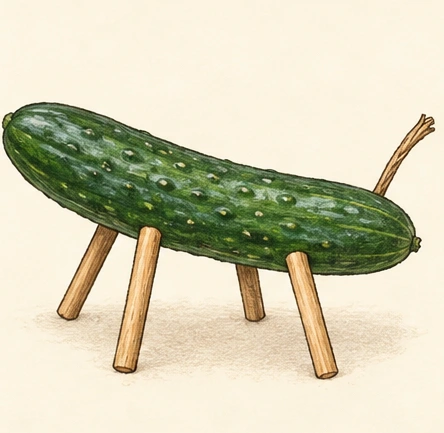
A cucumber on four legs is a horse, so the ancestors arrive quickly.
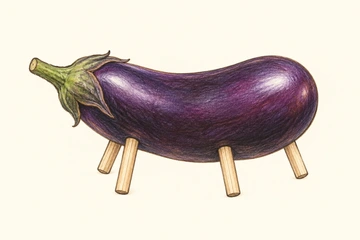
An eggplant on legs is an ox, so they go back slowly.
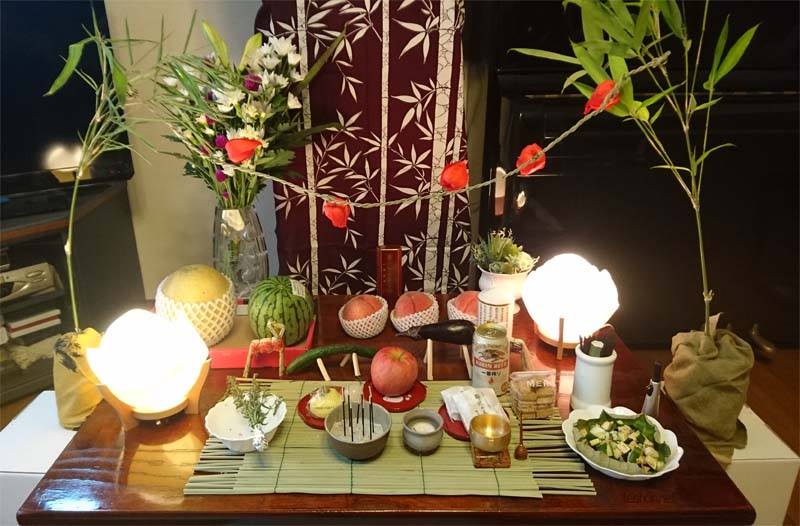
A household Bon altar: offerings on a makomo mat, bamboo at the corners and a rope strung with hōzuki lanterns.
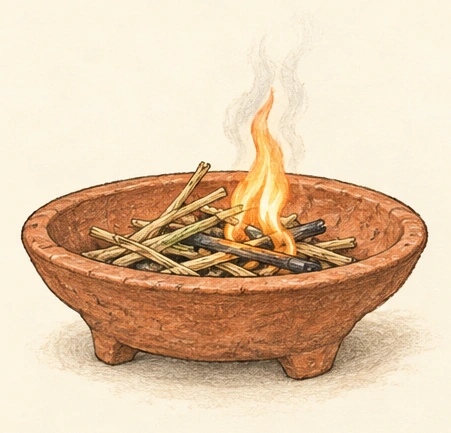
On the evening of the 13th comes mukaebi, the welcoming fire. At the front door, or at the grave, people burn a handful of peeled hemp stalks, ogara, in a small unglazed clay dish. The smoke rises, and the ancestors follow its light home. In city apartments where open flames are impractical, people light a Bon lantern instead, or simply switch on a pair of electric candles at the altar. Bon lanterns, bon chōchin, are painted with autumn grasses and flowers and often have an inner shade that turns slowly, sending moving patterns across the walls. A family’s first Bon after a death, niibon or hatsubon, is observed with special care: relatives and friends come to offer incense, and a plain white lantern hangs at the entrance as a sign that someone newly dead is coming home for the first time.
While the ancestors are in the house, the family serves them meals morning and evening, changing the water and rice like hosts looking after guests who have come a long way. Many temple priests make the rounds of their parishioners’ homes, chanting a short sutra in front of each spirit shelf, a visit called tanagyō. In the countryside it is a familiar sight to see a priest in robes finish his tea and ride off on a scooter to the next house. Temples also hold segaki-e, rites that feed the wandering hungry ghosts with no one to remember them. Of everything done at Obon, this comes closest to the original story of Mokuren.
On the evening of the 16th, or the 15th in some places, comes okuribi, the sending-off fire, another small blaze of hemp stalks at the door to send the spirits back to the other shore. Some families wrap up the offerings and spirit animals and set them adrift on a river or the sea, which is the original sense of shōryō nagashi, "sending the spirits downstream." In many places this became tōrō nagashi, floating paper lanterns, each carrying a name or a wish, slowly carried away in the dark. It is the quietest moment of the festival. These days lanterns are usually collected downstream, and offerings are often handed in to the temple rather than thrown in the water.
Not everyone keeps Bon this way. Jōdo Shinshū, the True Pure Land school, one of the largest Buddhist traditions in Japan and often described as the largest by number of temples and followers, teaches that the dead have already been born into the Pure Land through Amida Buddha’s vow and do not need to come back to be fed. Its followers generally skip the spirit shelf and the fires and attend a temple service of gratitude instead, which some temples call kangie, "the gathering of joy." Two households on the same street may keep the festival quite differently.
04July Bon, August Bon, Old Bon
A question that puzzles many visitors is whether Obon happens in July or August. The answer is both, and the reason is a calendar reform in the early Meiji period.
Japan used a lunisolar calendar until the end of 1872, and Bon fell around the fifteenth day of the seventh lunar month, which usually lands somewhere in August. When the government switched to the Gregorian calendar in 1873, "the fifteenth of the seventh month" suddenly meant July 15. Tokyo and some other cities followed the new date and still keep Bon in mid-July, sometimes called "Tokyo Bon." But mid-July is one of the busiest times in the farming year, so most of the country settled on a compromise: keep the same day number but shift it a month later, to August 15. This "one-month-late Bon," tsuki-okure no bon, became the national norm, and when people talk about the Bon break, they mean the August week. Okinawa and the Amami Islands still follow the old lunar calendar, so their kyūbon, "old Bon," moves from year to year, usually falling between mid-August and early September.
So in mid-July you may see Bon lanterns and visiting priests in Tokyo’s temples and cemeteries while offices carry on as normal. By mid-August, Tokyo is noticeably emptier than usual, because so many of its residents have gone home to somewhere else.
Okinawa’s Bon is particularly distinctive. The first day, Unkē, welcomes the ancestors; the middle day, Nakanuhī, is for visiting relatives; on the last day, Ukui, the family gathers in front of the altar for a meal late into the night and burns paper money for the spirits to take with them. Some households lean stalks of sugarcane beside the altar as walking sticks for the ancestors. During these nights, groups of young people move through the neighborhoods playing large and small drums, singing folk songs and dancing in formation. This is eisā, originally a Buddhist chanting dance for welcoming and sending off the dead, now the most recognizable summer performance in Okinawa.
05Fire, Lanterns and Dance in Public
Obon is above all a private, family affair, but in many cities it has also grown into something the whole community watches together.
The most famous is Kyoto’s Gozan no Okuribi, the Five Mountain Send-off Fires. On the night of August 16, five enormous fire images are lit one after another on the mountains ringing the Kyoto basin. First comes the character 大, dai, "great," on Nyoigatake in the eastern hills; then the two characters 妙法, myōhō, from the Lotus Sutra, at Matsugasaki; then a boat shape at Nishigamo; then a second 大 near Kinkaku-ji, called the "left" daimonji; and finally a torii gate shape at Saga, in the west. Each stroke of the great 大 is made of dozens of fire beds, and the character reads clearly from the city below. The fires burn for about half an hour each. Kyoto people are particular that this is a send-off fire, not a fireworks show, and they wince when outsiders call it Daimonji-yaki, "the Daimonji burning," as if it were entertainment. Crowds gather along the Kamo River and on the bridges, and you will see many people quietly put their hands together as the fires catch.
- 1大 (dai)Nyoigatake, eastern hills; first
- 2妙法 (myōhō)Matsugasaki
- 3BoatNishigamo
- 4“Left” daimonjinear Kinkaku-ji
- 5ToriiSaga; last
Lit one after another on the night of August 16; each burns for about half an hour.
In Kyoto, Bon actually starts earlier in the month. From August 7 to 10, Rokudō Chinnō-ji, a small temple in the Higashiyama district, holds Rokudō mairi. Tradition places the entrance to the underworld here, and a legend says that the Heian-period official Ono no Takamura went down a well in the temple grounds every night to assist King Enma, the judge of the dead. Visitors come to ring the mukae-gane, the welcoming bell, which hangs out of sight inside its bell house: all you see from outside is a rope, which visitors describe as coming out through a hole in the wall. One pull sends the sound down to the underworld to call the ancestors home. Stalls outside sell sprigs of kōyamaki, Japanese umbrella pine, for the spirits to ride on, and the street smells of incense.
Nagasaki’s shōryō nagashi on the evening of August 15 is far noisier. Families who have lost someone during the year build a spirit boat, sometimes small enough for two people to carry, sometimes nearly ten meters long, fitted with lights and a sound system and decorated with the name and photograph of the dead person. Friends and relatives push it through the streets to the harbor amid huge strings of firecrackers and the clash of gongs, chanting "dōi, dōi." The city fills with smoke and the smell of gunpowder, and a first-time visitor would struggle to guess that this is a funeral procession. One account traces the custom to the Edo period, when Chinese residents of Nagasaki’s walled Chinese quarter set small offering boats adrift in the harbor for their dead. In 1974 the Nagasaki-born singer-songwriter Sada Masashi, then half of the duo Grape, released a soft, melancholy song called "Shōryō Nagashi" that made the name famous across Japan; the real thing is nothing like as quiet.
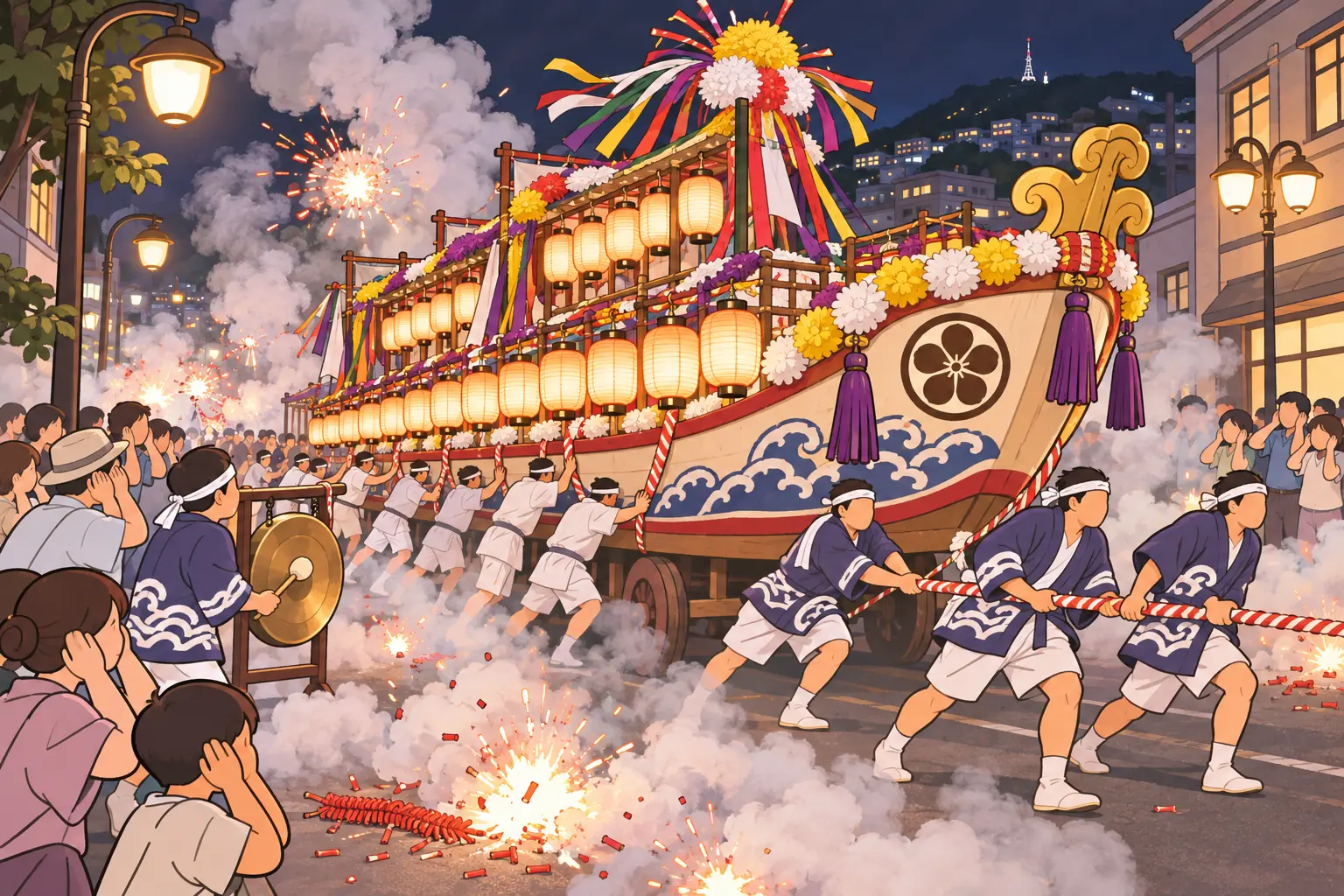
Nagasaki's Shōrō Nagashi on the night of August 15: relatives push a large spirit boat through streets thick with firecracker smoke (illustration).
Lantern floating is held in many more places. In Arashiyama on the western edge of Kyoto, lanterns are floated on the Ōi River near Togetsukyō Bridge on the night of August 16, while the torii fire burns on the mountain beyond; the event began in 1949 as a memorial for the war dead. In Hiroshima, lanterns are floated on the Motoyasu River on August 6 for the victims of the atomic bomb. The timing is close to Bon and the feeling is related, but it is a separate observance.
And there is dance. Bon odori, Bon dancing, is generally traced to the medieval nenbutsu odori, in which people chanted the name of Amida Buddha as they danced, to comfort the dead and protect themselves. Over time it became the summer-night entertainment of every village and town. A tower goes up in the middle of a square with drummers and singers on top, lanterns are strung out from it in every direction, and young and old in light cotton yukata circle it, repeating a short sequence of movements to the beat. Bon dancing and the great dance festivals such as Tokushima’s Awa Odori are covered separately (see also: Bon Odori: The Summer Dance Where Everyone Joins the Circle; Awa Odori: Tokushima’s Festival of Fools), but one point belongs here: these dances were originally a way of welcoming and consoling the dead during Bon, and many older people still feel that the slowly turning ring includes the visiting spirits as well as the living.
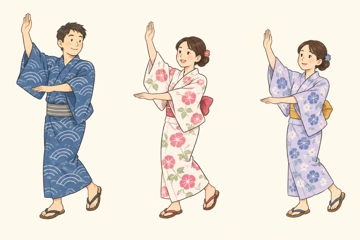
Young and old in yukata circle together, repeating a short sequence of movements to the beat.
Bon also falls at the height of the Japanese summer, and it colors much of what happens around it. Fireworks displays cluster in July and August, and some of them began as memorial events for the dead. In many regions Tanabata, the star festival, was once treated as a kind of prelude to Bon. The custom of telling ghost stories and watching horror films in summer is often linked, at least in popular explanation, to the idea that the dead are close by in this season. Grandparents warn children not to swim in the sea after Bon, or the dead will pull them under. The practical sense in the warning is that by late August the waves get bigger and the jellyfish arrive in numbers.
06Obon Today
Like many old customs, Obon has become smaller and lighter. Young families in the cities often live in apartments with no household altar at all. The fires have become electric lights; the vegetable animals come ready-made from the supermarket or are skipped. For people whose parents still live in the family home, Bon means a trip back, a visit to the grave and a big meal together. Once the parents too have moved to the city, "going home for Bon" can shrink to a drive to the cemetery.
The graves themselves are changing. With a shrinking birth rate and young people leaving the countryside, many old family graves in rural areas have no one left to look after them. Hakajimai, "closing the grave," which means removing the old stone and moving the remains to an urban columbarium, a shared memorial, or a tree burial, has become a common topic in the last decade or so. Around Bon, the news features companies that clean and tend graves on behalf of distant families, and temples that offer memorial services online.
Still, the basic shape holds. The August rush comes every year. Supermarkets set out Bon flowers, packaged offerings and lanterns; temples hold their segaki rites; children at the neighborhood Bon dance still chase the shaved-ice stall. Most people in Japan could not tell you the story of Mokuren, and few would say they literally believe their grandparents ride home on a cucumber. But a great many feel that in these days you ought to go home, and you ought to stand in front of the family grave for a while.
Obon also overlaps with another date. August 15 is the anniversary of the end of the Second World War in Japan. At noon there is a minute of silence, and the government holds a national memorial service for the war dead at the Nippon Budōkan in Tokyo. For the generation that lived through the war, the relatives they welcomed home at Bon included fathers and brothers who died in it, and mid-August in Japan still has a hushed, mournful undertone.
A further custom connected to Bon is ochūgen, the summer gift season. Its name comes from the Daoist Zhongyuan festival on the fifteenth of the seventh month, but in Japan it became a time to send gifts to bosses, clients and relatives: beer, sōmen, fruit, hams, boxed sweets. Department stores open special ochūgen counters. In eastern Japan the season runs from early to mid-July; in the west it tends to run later. Together with the year-end gifts of oseibo, it mirrors the old pairing of Bon and year’s end.
07Meeting Obon as a Visitor
If you travel in Japan in mid-August, the first thing you will notice about Obon is crowding and cost. The Bon week is the peak of domestic travel. Bullet trains, flights and popular hot-spring inns sell out early and prices rise. Trains leaving Tokyo are fullest just before Bon and trains returning are fullest just after. At the same time, central Tokyo and Ōsaka become strangely calm, and some family-run shops and restaurants close for the week, so it is worth checking opening hours before you set out.
If you want to see Bon itself, Kyoto is the clearest place to do it. For the Five Mountain fires on August 16, go early in the evening to the west bank of the Kamo River or around Demachiyanagi to find a spot. The great 大 is lit at 8 p.m., and the others follow at intervals of about five minutes. No single spot gives you a good view of all five, so pick one or two and watch them properly. There is no need to be loud; many of the people around you are seeing off members of their own families. Between August 7 and 10, a visit to Rokudō Chinnō-ji to pull the rope of the welcoming bell gives a sense of how much this festival still means in Kyoto’s old neighborhoods.
Nagasaki’s spirit boats can be watched from the main streets of the city center on the evening of August 15, but the firecrackers are extremely loud. Earplugs are a good idea, especially with children, and do not stand too close. Okinawa’s Old Bon follows the lunar calendar and changes from year to year; if you are in Naha or Okinawa City on one of those evenings, you may well run into an eisā troupe dancing from house to house through a residential neighborhood.
Almost every town in Japan has a Bon dance sometime in the summer, usually in a shrine compound, a temple yard, a park or a school sports ground, starting in the early evening. Unless it is a formal performance by a preservation society, you can simply join the circle, follow the person in front of you, and pick up the moves. Nobody minds mistakes, and wearing a yukata makes it easier to feel part of things. Around the edge there are usually stalls selling yakisoba, shaved ice and grilled corn, the core of countless Japanese childhood summer memories.
At temples and cemeteries during Bon, people are doing something very personal. Visiting a temple is fine, but do not photograph other families at their graves, do not touch the offerings, and do not help yourself to the buckets and ladles lined up near the entrance, which usually belong to the temple and are lent to its parishioners. If you are staying with a Japanese family over Bon and see a spirit shelf with cucumber horses in front of the altar, it is natural to ask whom it is for. If you are invited, lighting a stick of incense and putting your hands together for a moment is a gracious response.
Obon has no great parade and needs no ticket. It is more of a mood, a week when a whole country slows down at the same time. On an August evening in a residential street, someone crouches at a front door and lights a handful of hemp stalks. The smoke rises and the flame goes out almost at once. Inside, a family is waiting for its relatives to come home.