
At a glance
How the circle dance of Japan’s summer nights grew from Buddhist chanting into a neighborhood event, where the famous ones are, and how to join in.
- Bon odori began as a dance to welcome and send off the spirits of the dead at Obon; today it is mostly a neighborhood summer-night gathering held from July to late August.
- Dancers form a large ring around a lantern-hung tower called the yagura, usually moving slowly counterclockwise.
- Each song has a fixed routine of about ten beats; after two or three rounds you know it, and anyone can join mid-song.
- Its roots are usually traced to Ippen’s dancing nenbutsu, which merged with Muromachi-period furyū and spread everywhere in the Edo period.
- In 2022 Nishimonai Bon Odori and Gujō Odori were inscribed on UNESCO’s intangible heritage list as part of Furyū-odori.
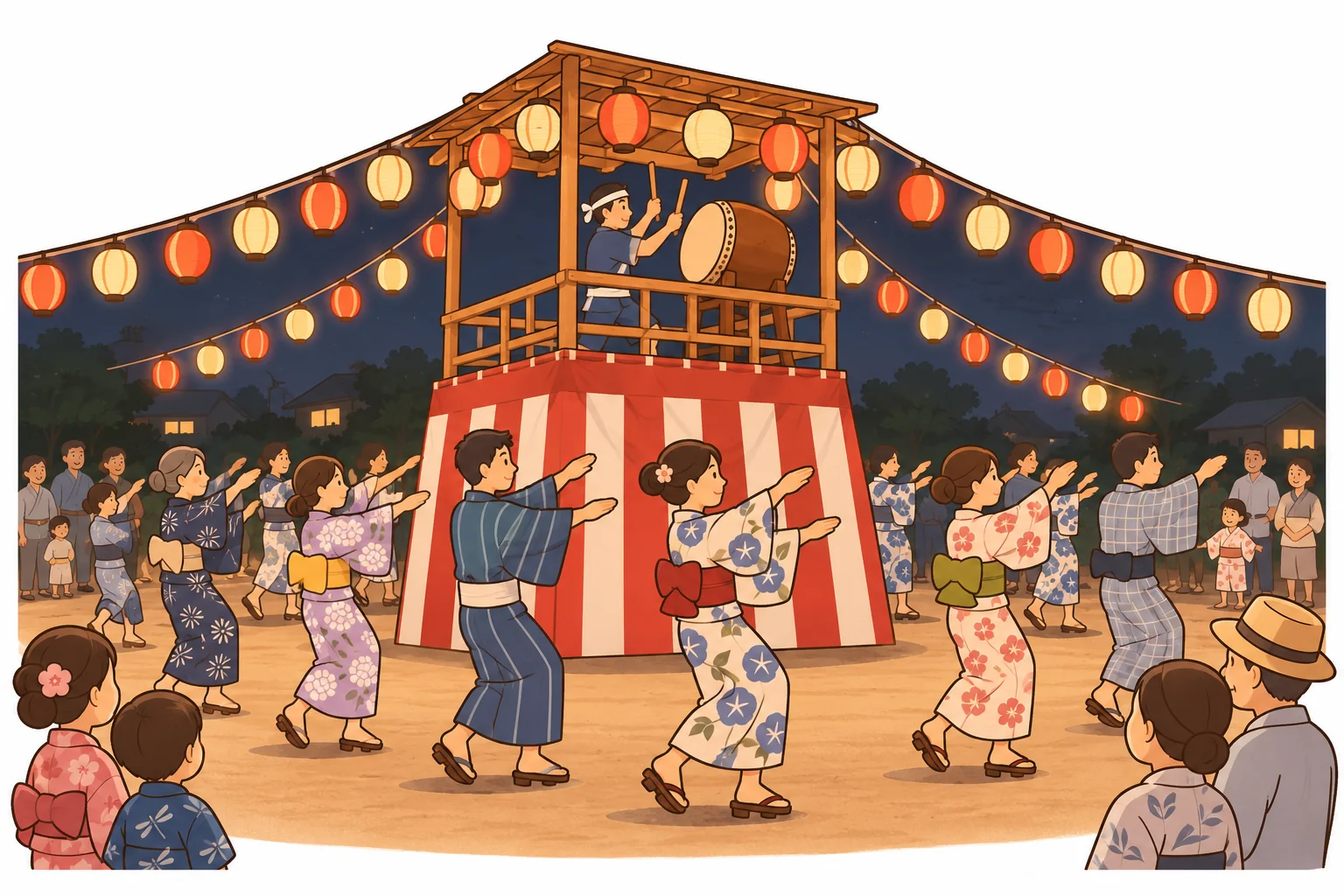
On summer evenings in Japan, usually in mid-August, a wooden tower goes up in a shrine courtyard, a school playground or a neighborhood park. Paper lanterns are strung out from its top, a drummer climbs onto it, and as the first song plays, people of every age begin to dance slowly around it in a ring. This is bon odori, the dance of the Bon season, when the spirits of the dead are believed to return home. It began as a Buddhist dance for the departed and has become one of the most ordinary and best-loved parts of a Japanese summer: a free, open, slightly clumsy community party that anyone, including a visitor who has never seen it before, can step into.
01A Ring Around a Tower
At the center of almost every bon odori is the yagura, a raised platform two or three meters high, built of timber or scaffolding poles and wrapped in red-and-white bunting. On top sits a large taiko drum. In older or more ambitious festivals there will also be a singer, a flute player and someone on the shamisen, the three-stringed lute; in most neighborhood events today the music comes from loudspeakers, and the platform holds a drummer and a few dancers in matching yukata, light cotton summer kimono, who model the moves for everyone below. Ropes run from the top of the tower out to the edges of the grounds, hung with paper lanterns printed with the names of local shops and the neighborhood association that paid for them. When darkness falls and the lanterns are lit, the whole space sits under a canopy of light.
The dancers form a circle around the tower and move slowly around it, usually counterclockwise. Each song has its own fixed sequence of movements, typically short enough to learn in a few minutes: two claps, two steps forward, a step back, the hands sweeping outward as if scooping water, a half turn, and then the whole thing again. A song lasts three or four minutes and the sequence repeats many times, so by the second or third repetition, most newcomers can follow along. When the crowd is large, the circle doubles or triples. The inner rings tend to belong to the experienced dancers, older residents and members of a local preservation society, while children and the uncertain drift along the outer edge. Anyone can join mid-song and leave whenever they like.
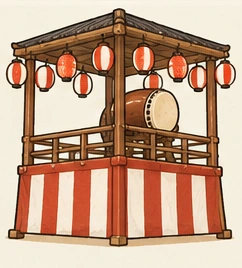
The yagura: a raised stand draped in red and white, with a big drum on top and lanterns around it; forms vary by place.
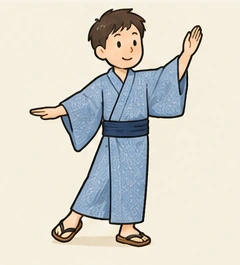
A dancer in yukata raises an arm, reaches out and steps; the moves are simple and repeat.
Around the edges are the food stalls that come with any Japanese summer gathering: yakisoba fried noodles, shaved ice drenched in syrup, grilled chicken skewers, goldfish scooping, cold beer. Children run about in yukata with paper fans tucked into the backs of their sashes. Many neighborhood dances run for two or three evenings, ending around nine o’clock, when an announcer thanks everyone over the PA system and volunteers start taking down the lanterns. For residents, it is often the one time each year when the whole neighborhood turns out, and new arrivals sometimes meet their neighbors for the first time in the circle.
- 1Yaguratwo or three meters high, a large taiko on top
- 2Lanternson ropes running from the top of the tower
- 3Inner ringsexperienced dancers, preservation society members
- 4Outer edgechildren and the uncertain; join or leave anytime
- 5Food stallsaround the edges
The grounds run from the tower at the center to the stalls at the edge; dancers circle the tower, usually counterclockwise.
02A Dance for the Returning Dead
The "Bon" in bon odori is Obon, the Buddhist festival of the dead, derived from the Ullambana observance that came to Japan from China. Traditionally centered on the fifteenth day of the seventh lunar month, it is the time when ancestral spirits are believed to come back to their families. Households light small welcoming fires at the gate, set out offerings at the home altar, and a few days later light sending-off fires to guide the spirits back. Most of Japan now observes Obon from roughly August 13 to 16, while Tokyo and some other areas keep it in July, which is why the bon odori season stretches across both months.
The dance was originally part of this cycle: a way of keeping the visiting dead company, comforting them, and seeing them off with a celebration. Some communities hold a special dance for the niibon, the first Obon after a death in the family. In the Nishimonai bon odori in Akita Prefecture, dancers hide their faces under deep straw hats or black cloth hoods with narrow eyeholes, a costume commonly explained as representing the dead returned from the other world, so that the living and the dead appear to dance together by the bonfire.
In a city neighborhood today, few dancers are thinking about their ancestors. But the form still carries its origins. The dance happens only around Obon, it happens at night, it circles a center, and it ends with a parting. Japanese people often speak of bon odori with a mild melancholy: it comes at the turn of the summer, just before those who traveled home for the holiday head back to the cities.
03From Chanting Monks to Flamboyant Crowds
Historians usually trace bon odori back to nenbutsu odori, dancing while chanting the name of Amida Buddha. In the tenth century the wandering monk Kūya is said to have preached in the streets of Kyoto, striking a small gong and chanting "Namu Amida Butsu," and his practice is often described as including song and dance. In the thirteenth century the itinerant preacher Ippen, founder of the Ji school of Pure Land Buddhism, traveled the country leading followers in ecstatic dancing as they chanted. To lose oneself in the dance while calling on Amida was understood as a way of forming a bond with the Buddha and being reborn in his Pure Land, and the practice spread widely among ordinary people.
In the Muromachi period (1336–1573) this merged with another current, known as furyū. Furyū meant showiness: extravagant hats, outlandish costumes and loud drums and gongs, worn and played by crowds dancing through the streets to drive away epidemics and placate restless spirits. Combined with the nenbutsu dance and with the Obon rites for ancestors, it produced the crowds dancing in Kyoto and elsewhere during the Bon season that appear in records of the fifteenth and sixteenth centuries. The name "bon odori" is generally thought to have come into use around this time.
By the Edo period (1603–1868), bon odori had spread to towns and villages throughout Japan and had become one of the high points of the commoner’s year. It was also a social occasion in a looser sense. Young men and women met in the dark, courtships began, and the dances could run late into the night. For exactly these reasons, the shogunate and local lords periodically tried to restrain the dancing; later accounts say the usual rules forbade dancing all night and wearing outlandish costumes. These efforts had limited success. Most of the regional bon odori styles that survive today took their present form during these centuries.
04Bans, Hit Songs and Housing Estates
After the Meiji Restoration of 1868, the new government’s drive for "civilization and enlightenment" cast many folk customs as backward or indecent. A number of prefectures banned bon odori or placed it under police control, and in some places the dance died out. Elsewhere it carried on quietly. In the Taishō and early Shōwa years, a renewed interest in regional folk culture, along with a fashion for newly composed "new folk songs," brought it back.
What turned bon odori into a nationwide urban event was a pop song. In 1932 the poet Saijō Yaso and the composer Nakayama Shinpei wrote "Marunouchi Ondo" to promote the shops around Hibiya in central Tokyo. The following year it was rewritten as "Tokyo Ondo," recorded, and became a massive national hit. Ondo originally referred to a folk-song style in which a lead singer calls out the verse; after "Tokyo Ondo," the word became almost synonymous with bon odori music. The song is still played at dances across Tokyo, and when its opening call rings out, the circle starts moving almost by reflex.
After the Second World War, "Tankō Bushi," a coal miners’ song from the Tagawa area of the Chikuhō coalfield in Fukuoka Prefecture, spread through radio broadcasts and became the other national standard. Its opening line, "Tsuki ga deta deta, tsuki ga deta" ("The moon is out, the moon is out"), and its gestures of digging coal, pushing a cart and looking up at the moon are known to children who have no idea where the song came from. During the high-growth decades, the huge public housing estates and new suburbs built around Japan’s cities adopted bon odori as a way of turning strangers into neighbors. Neighborhood associations, shopping streets and school parents’ groups ran the events, and bon odori shifted from a religious observance to a civic one. It has kept absorbing new music ever since, from children’s anime theme songs like the "Doraemon Ondo" to recent bon odori nights built around DJ sets or anime songs.
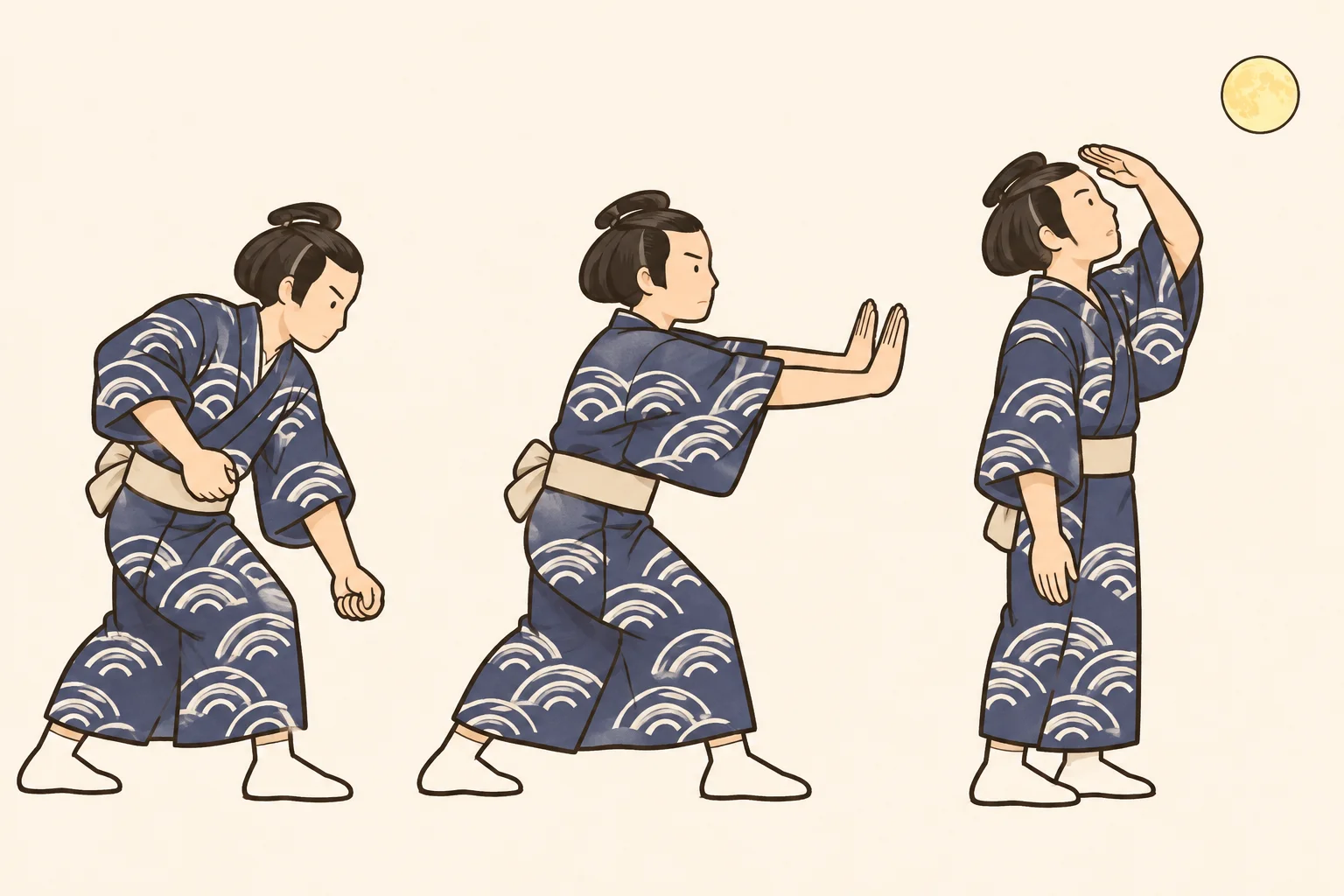
The gestures of Tankō Bushi come from the coal mine: digging coal, pushing a cart and looking up at the moon.
05Dances Worth Traveling For
Three dances are often grouped as the "three great bon odori" of Japan: Nishimonai in Akita Prefecture, Gujō Odori in Gifu Prefecture, and the Awa Odori of Tokushima; by another account, the Kemanai bon odori of Kazuno in Akita takes Awa Odori’s place. Awa Odori, a procession of dancing troupes through the city streets, is large and loud enough to be a world of its own (see also: Awa Odori: Tokushima’s Festival of Fools).
The Nishimonai bon odori takes place on August 16–18 in the small town of Ugo. Both men and women dance, dressed either in hanui robes pieced together from several different silks or in indigo yukata, their faces hidden by low straw hats or by the black hikosa zukin hood. Bonfires burn in the middle of the street. The flutes and drums of the accompaniment are fast and high, while the dancers’ hands move with extraordinary slowness and grace, and the gap between the two rhythms gives the dance its eerie, absorbing quality. In 2022 Nishimonai and Gujō were among the dances inscribed together on UNESCO’s list of Intangible Cultural Heritage as furyū-odori.
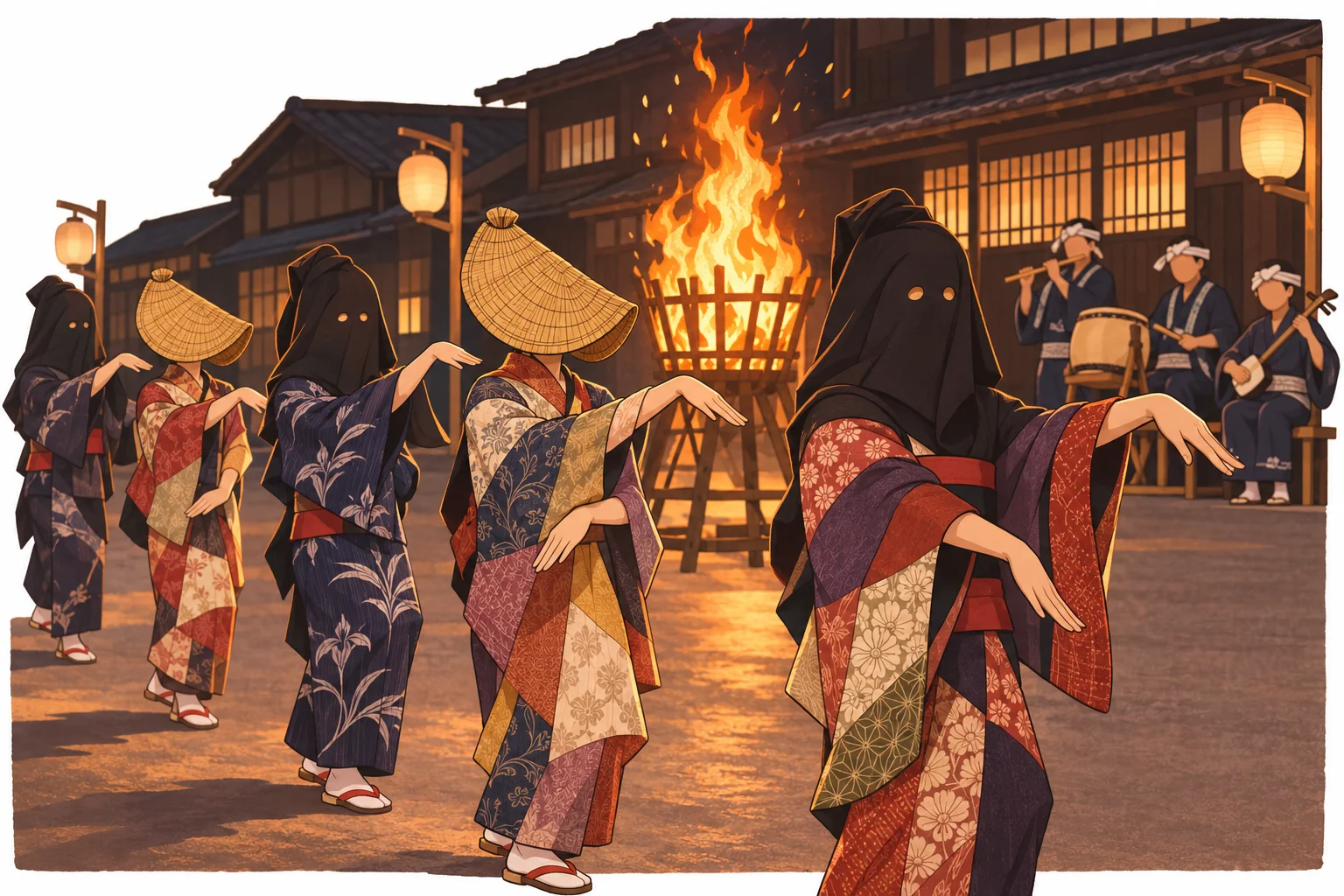
Nishimonai Bon Odori: dancers hooded in black hikosa zukin or deep straw hats move slowly beside a street bonfire (illustration).
Gujō Odori has a different spirit. In the mountain castle town of Gujō Hachiman, dancing moves from neighborhood to neighborhood on more than thirty nights between mid-July and early September, making it one of the longest bon odori seasons in the country. During the all-night dances of August 13 to 16, the streets fill until dawn with people in yukata and wooden geta sandals, whose clatter on the pavement is part of the sound of the festival; some of the old town’s lanes are said to be paved with stone. There are ten traditional songs, the best known being "Kawasaki" and "Harukoma," and visitors are encouraged to join in; dancers judged skillful enough can receive a certificate from the town’s preservation society. A popular story holds that a lord of the Gujō domain in the Edo period encouraged the dance to promote harmony among his subjects, though this is hard to confirm.
Other dances have their own devotees. The Owara Kaze no Bon in Yatsuo, Toyama, held on September 1–3, is danced quietly up and down sloping streets to the sad sound of the kokyū, a bowed string instrument, and is widely considered the most beautiful. Kawachi Ondo, from the Yao area near Ōsaka, is driving and earthy, with lead singers chanting long narrative verses; skilled singers are said to improvise lines about current events and people in the crowd. In Okinawa, eisā is a drum dance performed through the streets at the old Obon season, sharing the same roots but looking nothing like mainland bon odori. Japanese emigrants carried the dance abroad as well; Buddhist temples in Hawaii still hold bon dances in summer, and Japanese-Brazilian communities hold their own.
06Stepping Into the Circle
If you are in Japan in July or August, you are likely to find a bon odori without looking very hard. Posters go up at stations, on shopping streets and at shrine gates, giving the dates and times. In Tokyo, the summer dance at Tsukiji Hongan-ji temple is one of the best known, and almost every ward has neighborhood dances. If you are planning to see Nishimonai or the all-night dances at Gujō, book accommodation early.
A yukata is the ideal thing to wear, and you will see plenty of foreign visitors in them, but ordinary clothes are perfectly fine. When you arrive, stand outside the circle for a song or two and pick out someone in the inner ring who clearly knows what they are doing. Watch their hands and feet, then slip in behind them and copy. Nobody expects perfection. What matters is to keep moving with the circle, not against it, and not to stop inside the ring to take photographs. If you want pictures, take them from outside the circle, and do not use a flash in the dancers’ faces.
Bon odori is not a performance for an audience but something done together, and outsiders are generally welcomed. It is not unusual for an older woman in the circle to start showing you the hand movements without being asked. After a few songs, buy a shaved ice from one of the stalls, sit down under the lanterns, and watch the circle keep turning until the last song of the night.