
At a glance
Why Japan’s coming-of-age ceremonies feel like town-wide reunions, how they grew from old capping rites, why they stayed at twenty, and how kanreki is celebrated.
- Since 2000, Coming of Age Day falls on the second Monday of January, when each municipality holds ceremonies for people around twenty.
- Most towns send invitations by junior-high school district, so the day works like a town-wide class reunion.
- Today’s municipal ceremonies are usually traced to a youth festival held in Warabi, Saitama, in November 1946.
- The legal age of adulthood dropped to 18 in 2022, yet almost every town still holds the event at twenty, often renamed a gathering for twenty-year-olds.
- Kanreki marks turning sixty (61 in the old count); children traditionally give a red sleeveless vest and red hood.
On the second Monday of January, the plazas outside Japan’s civic halls fill with young women in long-sleeved silk kimono and young men in dark suits or flamboyant formal hakama. It is Seijin no Hi, Coming of Age Day, and in nearly every city, town and village the local government is holding a ceremony for the people who have reached twenty. On paper it is an official event with speeches from the mayor. In practice it is a giant school reunion, a family milestone that parents start saving for when their daughters are small, and for many women the most elaborate outfit they will ever wear. This piece explains what happens on the day, how an ancient capping rite turned into a postwar civic ceremony, why the event stayed at twenty when the legal age of adulthood dropped to eighteen in 2022, and what Japan does when people reach another round-number threshold: kanreki, the sixtieth birthday.
01A Monday in January
Coming of Age Day is a national holiday. The 1948 law that set out Japan’s postwar public holidays placed it on January 15 and gave it a modest purpose: to congratulate and encourage young people who have become aware that they are adults and who are setting out to make their own way. In 2000, under the so-called Happy Monday system that moved several holidays to Mondays to create three-day weekends, it shifted to the second Monday of January.
The law creates the holiday but says nothing about a ceremony. The ceremonies, called seijin-shiki, are organized by each municipality on its own, so there is no single national event. There are more than 1,700 of them, and they range from a few dozen people in a mountain village hall to tens of thousands in a big city. Yokohama, for years, has used a large arena to hold its new adults in sessions; Tokyo’s wards each run their own.
The program is short and predictable. There may be the national anthem or a city song, an address from the mayor, a few words from local dignitaries, a pledge read by a representative of the new adults, and perhaps a video message from former teachers or a performance by a local musician. It is usually over in about an hour. What matters more happens outside the doors. Municipalities typically invite people by junior high school district, so the crowd sorts itself into the graduating classes of the local public schools. Friends who scattered to different high schools, universities and jobs see each other for the first time in years. There is shrieking, hugging and a great deal of photography. Many people who have moved to Tokyo or Ōsaka travel home for the weekend, and that evening the old class gathers again for a dōsōkai, a formal reunion party, sometimes with their former homeroom teacher as guest of honor.
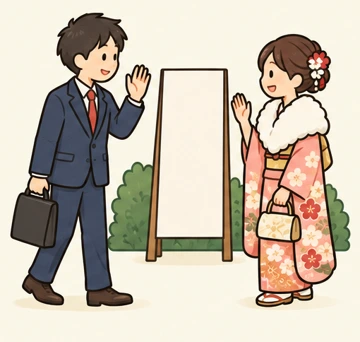
Former junior-high classmates meet again outside the ceremony hall.
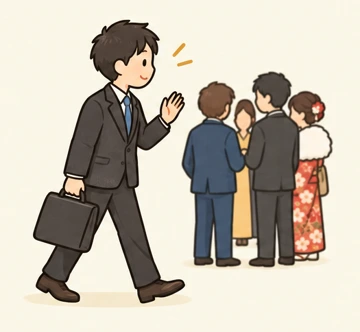
New adults in suits and furisode gather to catch up.
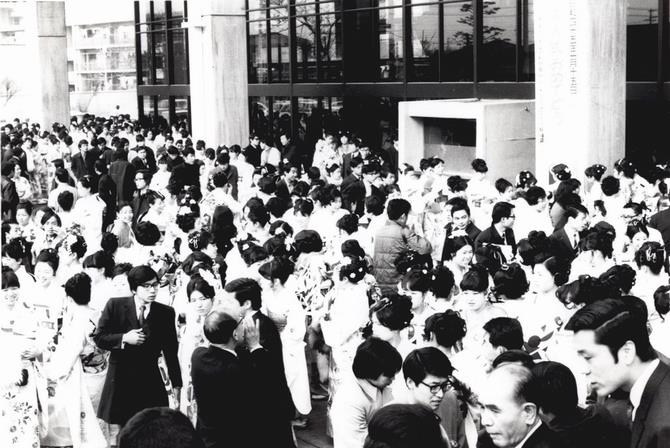
Coming of Age Day, 1970: new adults in kimono and suits crowd outside the Ōmiya civic hall.
02From Genpuku to a Postwar Festival
Japan has marked the passage to adulthood for well over a thousand years, though for most of that time the age was not fixed. It depended on physical maturity and family circumstances, varied by period and rank, and usually fell somewhere between about eleven or twelve and fifteen or sixteen by the traditional count.
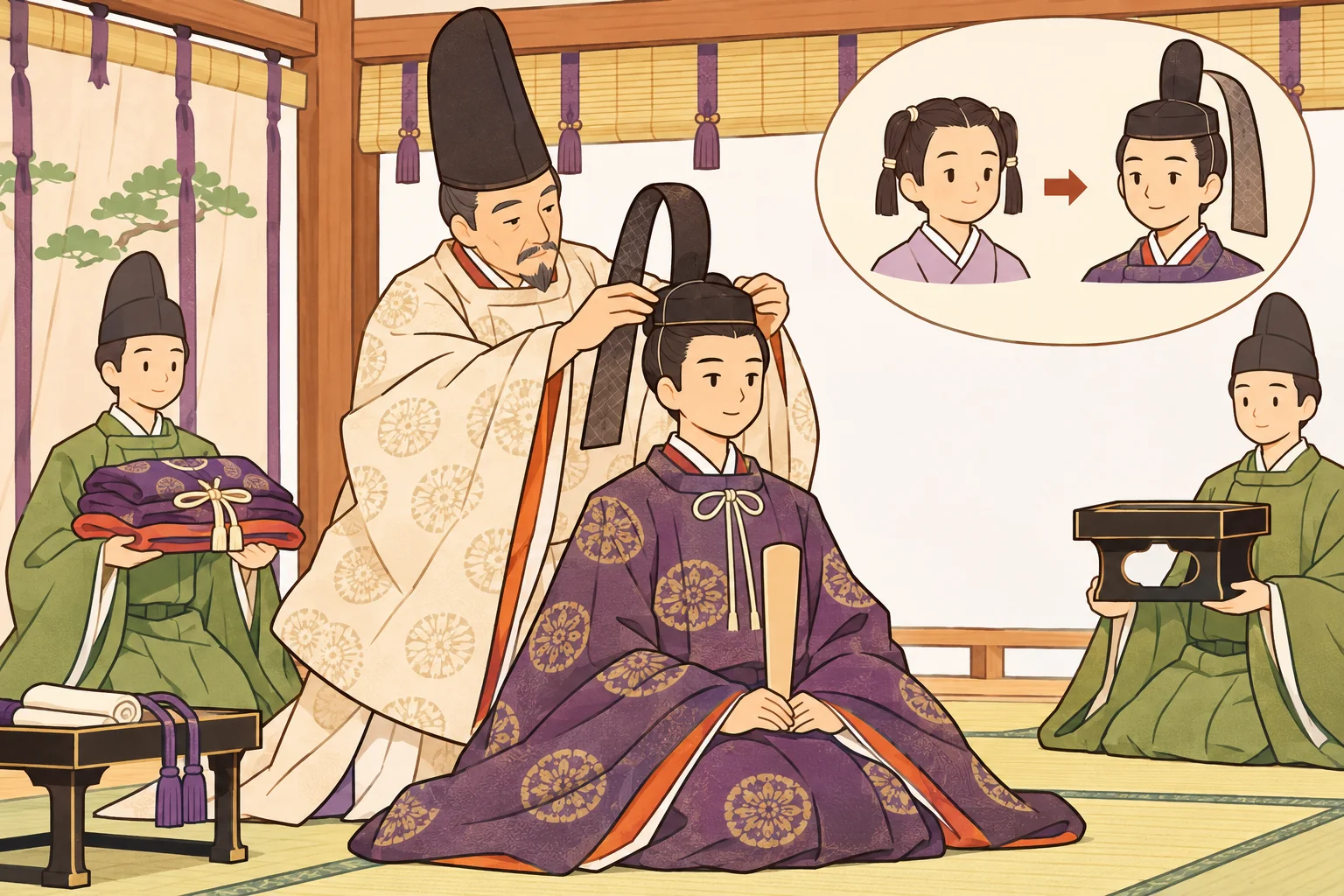
A Heian noble boy's genpuku: the sponsor places a court cap on his newly dressed adult topknot (illustration).
For boys of the aristocracy and, later, the warrior class, the rite was genpuku, written with characters meaning roughly "head" and "to put on." At the ceremony the boy’s childhood hairstyle was replaced with an adult topknot, and he was capped for the first time with a court cap or the tall lacquered hat called an eboshi. He put on adult clothing and gave up his childhood name for an adult one. The senior man who placed the cap on his head, known as the eboshi-oya or "cap parent," took on a lasting relationship with him, and among samurai families this was a serious bond. Young warriors often received one character of their adult name from a powerful patron at genpuku, which worked as a public declaration of allegiance.
Girls of the Heian court had their own rite, mogi, at somewhere around twelve to sixteen. The girl was dressed for the first time in the mo, a long pleated train tied at the back of the waist, and her hair was put up. From then on she was considered marriageable. In the Edo period, ordinary townspeople and farmers had simpler markers: a boy had the forelock at the front of his head shaved off, and a young woman blackened her teeth when she came of age or married, shaving her eyebrows later, usually after pregnancy or the birth of a child.
These customs faded after the Meiji Restoration. A government decree in 1876 set the age of majority at twenty (by actual age), and the Civil Code of 1896 kept it there. For more than a century afterward, twenty was simply the age at which a Japanese person became an adult.
The ceremony as it exists today is usually traced to November 1946 and the town of Warabi in Saitama Prefecture, just north of Tokyo. In the year after defeat, with food short and morale low, the local youth association organized a "Youth Festival" in tents on a school ground, centered on a coming-of-age rite meant to give young people some hope. (Nagoya and a few other places claim earlier precedents.) The idea spread quickly, and within two years the national government had created Coming of Age Day. The choice of January 15 is generally explained by its link with Koshōgatsu, the "Little New Year" in mid-January, since genpuku had often been held around the New Year season. Warabi still calls itself the birthplace of the coming-of-age ceremony, still uses the old name seinen-shiki for its event, and in 1979 put up a monument in Warabi Castle Ruins Park to prove it.
03Furisode and Hakama
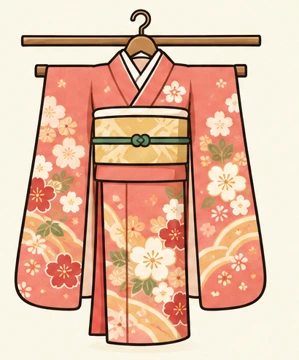
Ask anyone in Japan to picture Coming of Age Day and they will describe furisode. The name means "swinging sleeves": the sleeves of this kimono can hang to the calves or even the ankles, and it is the most formal garment an unmarried woman can wear. Furisode are made in bright, dense patterns of flowers, cranes and fans, and are worn with a wide, stiff fukuro obi tied at the back into an elaborate bow, often sculpted into wings or layered petals. A white fur stole around the shoulders has become a near-universal accessory for the January cold.
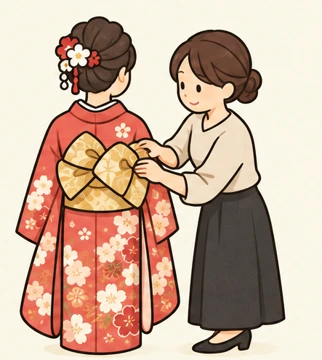
A dresser ties a sculpted fukuro obi knot at the back of a furisode.
Getting into all this takes time. Hair salons and photo studios open at four or five in the morning on the day, and each woman spends an hour or more having her hair set, her makeup done and her kimono put on by a professional dresser. Bookings for those dawn slots are made a year or more ahead.
The cost is serious. Commissioning a new furisode with its obi, under-kimono and accessories easily runs to several hundred thousand yen and can pass a million. Most families now rent, and a growing number of daughters wear their mother’s furisode from a generation earlier, a practice nicknamed mama-furi. Kimono dealers start sending glossy catalogs to girls in their second or third year of high school. Many families also book a maedori, a formal portrait session in full furisode taken months before the ceremony, so that the official photographs are done calmly rather than in the crush of the day itself.
How much this matters to families became painfully clear in January 2018. On the morning of Coming of Age Day, a kimono rental and sales company called Harenohi, with shops in Yokohama, Hachiōji and elsewhere, simply failed to open. The company had vanished, and hundreds of young women who had paid for their furisode and dressing could not get them. Some attended in ordinary clothes; others were dressed by kimono shops and salons that offered help when they heard the news, and some reports told of strangers lending their own kimono. The story stayed in the national news for days.
Men mostly wear suits, but more and more choose montsuki hakama, the formal combination of a crested haori jacket over pleated trousers. Traditionally this is black with gray stripes. At coming-of-age ceremonies it is often gold, purple, pink or white. The city of Kitakyūshū in Fukuoka Prefecture is famous for taking this to extremes: young men arrive in embroidered hakama in metallic colors with dyed, sculpted pompadours, young women in shortened, customized furisode with enormous hair ornaments, often in convoys of decorated cars. The outfits are made by local shops that specialize in the look, and television crews now cover it every year.
04Rowdy Ceremonies and the Age of Eighteen
The ceremonies have not always been decorous. Around 2000 the phrase areru seijin-shiki, "rowdy coming-of-age ceremonies," became a staple of the news. Drunk attendees heckled speakers, rushed the stage, or set off fireworks during the mayor’s address. In January 2001, at Kōchi City’s ceremony, the prefectural governor, Hashimoto Daijirō, was heckled during his speech and shouted back at the new adults to be quiet and get out; the same day in Takamatsu, a handful of attendees fired party crackers at the mayor as he spoke, and after he filed a criminal complaint the police arrested them; by one account they were later prosecuted. Local governments responded by shortening the speeches, turning the ceremony into a concert or social event, and handing planning over to committees of the new adults themselves. Today most ceremonies are quiet and brief, and the occasional disorder is concentrated in a few places.
A larger change came from the law. On April 1, 2022, an amendment to the Civil Code lowered the age of majority from twenty to eighteen. Eighteen-year-olds can now sign contracts, take out credit cards and marry without parental consent, and the minimum marriage age for women was raised from sixteen to eighteen to match men’s. Logically the coming-of-age ceremony should have moved to eighteen as well. Almost nowhere did it.
The reasons are practical. January of the year a student turns eighteen is the peak of university entrance exam season, and no family wants to spend that month on kimono fittings. The legal age for drinking, smoking and betting on horse races stayed at twenty, so twenty remains a meaningful line in daily life. Furisode are reserved a year or two in advance, and the kimono trade had every reason to keep the calendar as it was. Most municipalities therefore kept holding the event for twenty-year-olds and renamed it, typically along the lines of hatachi no tsudoi, "the gathering for twenty-year-olds," dropping the word "adult" from the title. Kyoto now calls its event the "ceremony celebrating twenty-year-olds," and Yokohama its "gathering to celebrate citizens turning twenty." The national holiday itself kept its old name and its place on the second Monday of January.
05Kanreki: Back to the Year You Were Born
If twenty is the first great public milestone of a Japanese life, sixty is the next. It is called kanreki, literally "return of the calendar." The idea comes from the sexagenary cycle that Japan inherited from China, in which ten "heavenly stems" and twelve "earthly branches," the latter the familiar zodiac animals, combine to name the years in a sixty-year loop. A person born in a given combination of stem and branch, say the year kinoe-ne, the "wood rat," will not see that exact combination again until sixty years later. Reaching it means the calendar has come all the way around, and the traditional reading is that you are born again and start life afresh. By the old way of counting age, in which a baby is one at birth and everyone gains a year at New Year, this happened at sixty-one; today people usually celebrate around their sixtieth birthday.
The color of kanreki is red. Children traditionally give a parent a red sleeveless padded vest called an akai chanchanko and a red hood, and the guest of honor wears them for photographs and dinner. Red has long been considered protective against evil in Japan, and babies were once dressed in it, so wearing red at sixty fits the idea of being reborn. Many people now find the vest a little embarrassing and too obviously "old," and the gift has shifted to a red sweater, a red tie, a bottle of red wine or red flowers, but the expectation of something red holds firm. Because sixty was also, for decades, the standard retirement age at Japanese companies, kanreki often coincides with retirement and becomes a large family gathering.
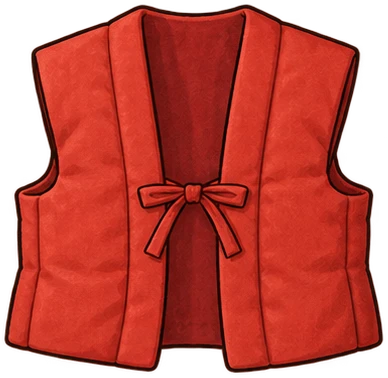
The red padded sleeveless vest (aka chanchanko) children give for kanreki.

The red hood worn with the vest.
After kanreki comes a series of longevity celebrations whose names are mostly puns on the shapes of characters. Seventy is koki, "rare since ancient times," from the Tang poet Du Fu’s line that few people live to seventy. Seventy-seven is kiju, because the cursive form of the character for joy, 喜, looks like the characters for seventy-seven. Eighty is sanju, because an abbreviated form of the character for umbrella, 傘, resembles "eighty." Eighty-eight is beiju, because the character for rice, 米, can be broken into the strokes for eighty-eight. Ninety is sotsuju, from a variant of 卒 written 卆, which looks like "nine" over "ten." Ninety-nine is hakuju, because the character for white, 白, is the character for a hundred, 百, with its top stroke removed: one hundred minus one. These ages were traditionally counted in the old way, though many families now celebrate them by actual age. By popular convention each has its color, too, usually purple for koki and kiju, gold for beiju, white for hakuju.
- 60Kanreki · red
- 70Koki · purple
- 77Kiju · purple
- 80Sanju
- 88Beiju · gold
- 90Sotsuju
- 99Hakuju · white
Most of the names after kanreki are puns on the shapes of characters, and several have their own color.
Alongside these are the yakudoshi, the ages considered unlucky. The most dangerous are said to be forty-two for men and thirty-three for women by traditional reckoning, and many people visit a shrine or temple that year for a purification ritual to ward off misfortune. Taken together, from a baby’s first shrine visit and the Shichi-Go-San festival for small children, through the coming-of-age ceremony, the unlucky years and kanreki to the longevity celebrations, a Japanese life is marked out by a string of named ages.
06Seeing It for Yourself
If you are in Japan around the second Monday of January, you will almost certainly see new adults in furisode on trains, at stations and at shrines. After the ceremony groups often go together to a nearby shrine or into town for photographs; Meiji Jingū in Tokyo and the streets around Asakusa are popular. People dressed up for the day are generally happy to be complimented, and many will agree to a photo if you ask first. Pointing a camera at someone’s face without asking is rude here as anywhere. The ceremonies themselves are for the new adults and their families, and there is no reason for visitors to try to get in.
In Kyoto, the temple of Sanjūsangen-dō holds an archery contest on a Sunday in mid-January called the Ōmato Taikai, descended from the tōshiya that flourished in the Edo period, endurance contests in which archers shot arrows the length of the temple’s long veranda. Today the contest draws one to two thousand archers from around the country, most of them new adults, who shoot at targets 60 meters away on the west side of the hall, the young women in furisode and hakama with their long sleeves tied back by cords. It is one of the loveliest sights of the Kyoto winter.
If you want to wear furisode yourself, kimono rental shops in Kyoto, Asakusa and Kamakura offer them, though in January local new adults get priority. Many photo studios will also dress and photograph visitors. As for kanreki, you are most likely to see it in a restaurant: a table of family members, a sea bream and a bowl of red-bean rice in the middle, and at the head of the table an older man or woman in a red hood, celebrating sixty years and a calendar that has come back to where it started.