
At a glance
Why Japan’s cloned cherries bloom all at once, how flower viewing passed from court banquets to picnics, and where to see the blossoms.
- Cherry season peaks from late March to early April; in Tokyo, Somei Yoshino takes about a week from first bloom to full bloom.
- Somei Yoshino is often said to make up 70–80 percent of Japan’s cherry trees; all are propagated by grafting or cuttings and form a single clone.
- Emperor Saga’s 'flower banquet' at Shinsen’en in 812 is regarded as the first recorded cherry-viewing party.
- In the Kyōhō era Tokugawa Yoshimune planted cherries at Asukayama and the Sumida embankment, generally seen as the direct origin of popular hanami.
- The JMA watches a sample tree: five or six open flowers means 'blooming'; about 80 percent of buds open means 'full bloom'.
For about two weeks each spring, Japan rearranges itself around a tree. Television weather maps sprout a line that creeps north across the archipelago day by day; a government meteorologist walks up to a single cherry tree in central Tokyo, counts its flowers, and declares the season open on the evening news. Parks fill with blue tarps, office juniors are sent out at dawn to hold a patch of grass, and by nightfall thousands of people are eating and drinking under lantern-lit branches. This is hanami, "flower viewing," and it is one of the few customs that nearly everyone in Japan takes part in. What follows explains what the cherry trees actually are, why so many of them bloom on the same day, how an aristocratic poetry party became a national picnic, and how to join in if you are lucky enough to be there.
01A Tarp, a Bento, and a Lantern
The day begins early. In Ueno Park in Tokyo, along the broad avenue lined with old cherry trees, people start spreading plastic sheets on the ground by seven in the morning. They tape a name to the corner, a company, a university club, a family, weigh the sheet down with bottles of water, and then sit there, sometimes for ten hours, until the rest of the group arrives after work. This job is called basho-tori, "place-taking," and it traditionally falls to the newest employee. The timing is not an accident. The Japanese fiscal and school year begins on April 1, so the cherry blossoms coincide with first days at school, first days at work, and transfers to new posts. For many Japanese people the flowers are bound up with the feeling of beginnings.
By evening the party has assembled. Shoes come off at the edge of the tarp. In the middle go convenience-store rice balls, fried chicken, edamame, department-store bento boxes, cans of beer, bottles of sake, plastic cups of shochu mixed with water or tea. Someone has a portable speaker. The section chief sits in the middle and is toasted by his staff. Overhead, the blossoms are lit by strings of paper lanterns or by the park’s floodlights, and against the black sky they look almost white, a pale cloud floating above the noise. Viewing cherry blossoms at night has its own word, yozakura. So does the cold that comes with it: late March evenings in Tokyo can drop to single digits Celsius, a chill called hanabie, "flower cold," and seasoned revelers bring cushions, blankets, and down jackets.
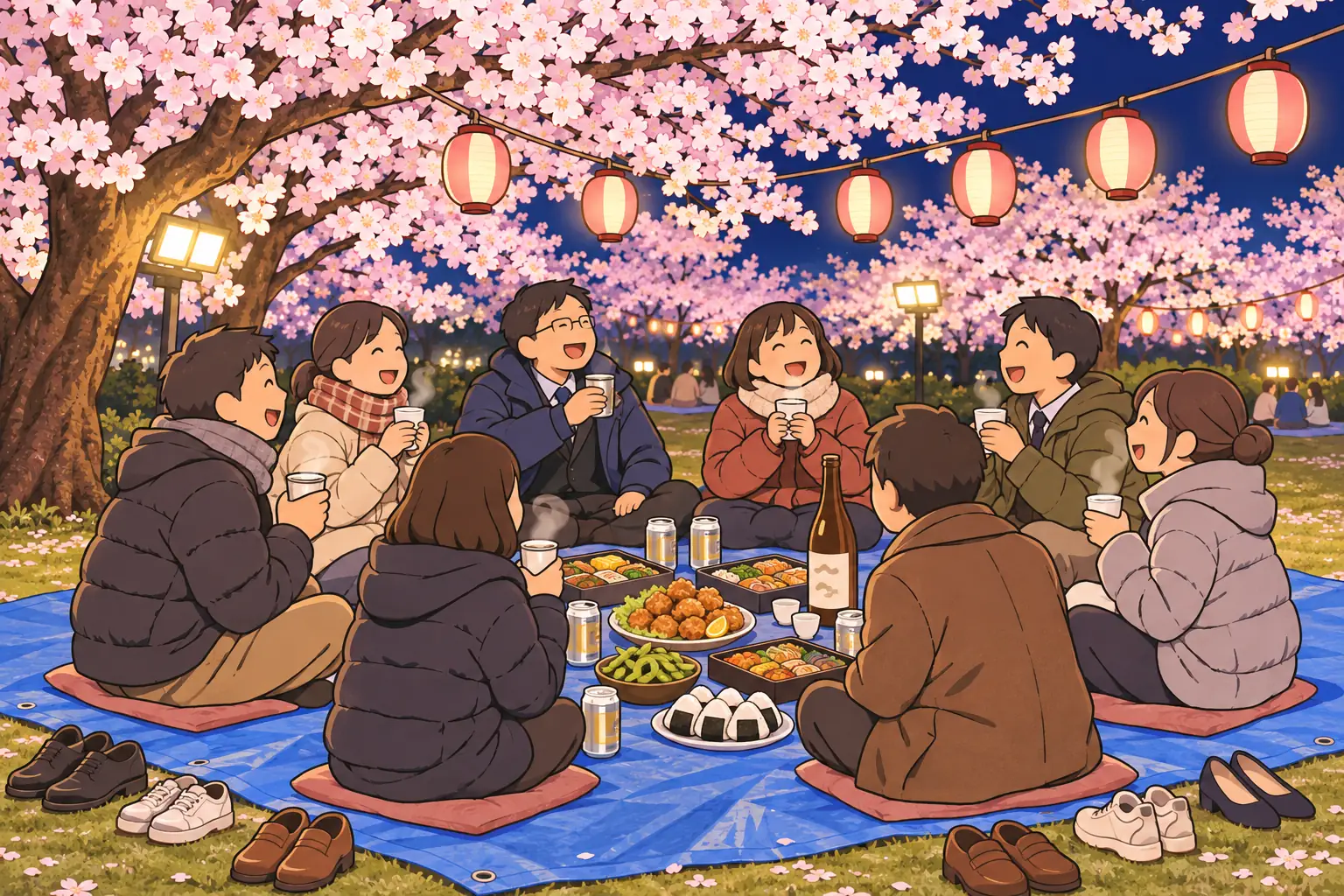
After dark under the cherry trees, coworkers in coats hold a yozakura party on a blue tarp (illustration).
Daytime hanami is gentler. Families stroll along riverbanks, retirees sit on benches, couples photograph each other under the branches along the Meguro River, and food stalls sell grilled dango and sweet amazake. Shops turn pink. Convenience stores stock cherry-blossom lattes, cherry-flavored mochi, and beer cans printed with petals; coffee chains and confectioners roll out "sakura season" limited editions, many of them flavored with salted cherry leaves or blossoms.
Why does one flower command this much attention? The simplest answer is brevity. The commonest cherry in Japanese cities goes from first flowers to full bloom in about a week, and the petals are usually gone within another week after that. A single rainstorm can end it early. Japanese people do not regard this as a defect. They see it as the point. The trees bloom with total extravagance and then let go all at once, and because everyone knows the window is short, they drop what they are doing and go. Cherry blossoms sit at the center of the Japanese sense of season: spring poems, sweets, kimono patterns, and shop displays all revolve around them, and only autumn’s red maple leaves come close as a rival.
02What a Cherry Tree Is
In English "cherry blossom" sounds like one thing. In Japan, sakura is a large family of trees. Botanically they belong to the rose family, in the genus Prunus (some botanists split them into their own genus, Cerasus), close relatives of plums, peaches, and apricots. A quick way to tell a cherry flower from a plum: cherry petals usually have a small notch at the tip, and cherry flowers hang on longer stalks, while plum flowers sit tight against the branch.
Japan has around ten wild cherry species, and from them, through natural crossing and centuries of deliberate breeding, have come hundreds of cultivated varieties. A handful of the wild ones explain almost everything about Japanese cherry culture.
The yamazakura, or mountain cherry, grows wild in the hills of Honshū (roughly from Miyagi and Niigata southward), Shikoku, and Kyūshū. It is the cherry the ancient Japanese saw, and it has one defining trait: its leaves and flowers open together. The young leaves are reddish-brown, the flowers white or faintly pink, and from a distance a yamazakura looks red and white rather than pink. Each wild tree is genetically different, so a hillside of mountain cherries blooms unevenly, some trees early and some late, the color working its way slowly up the slope.
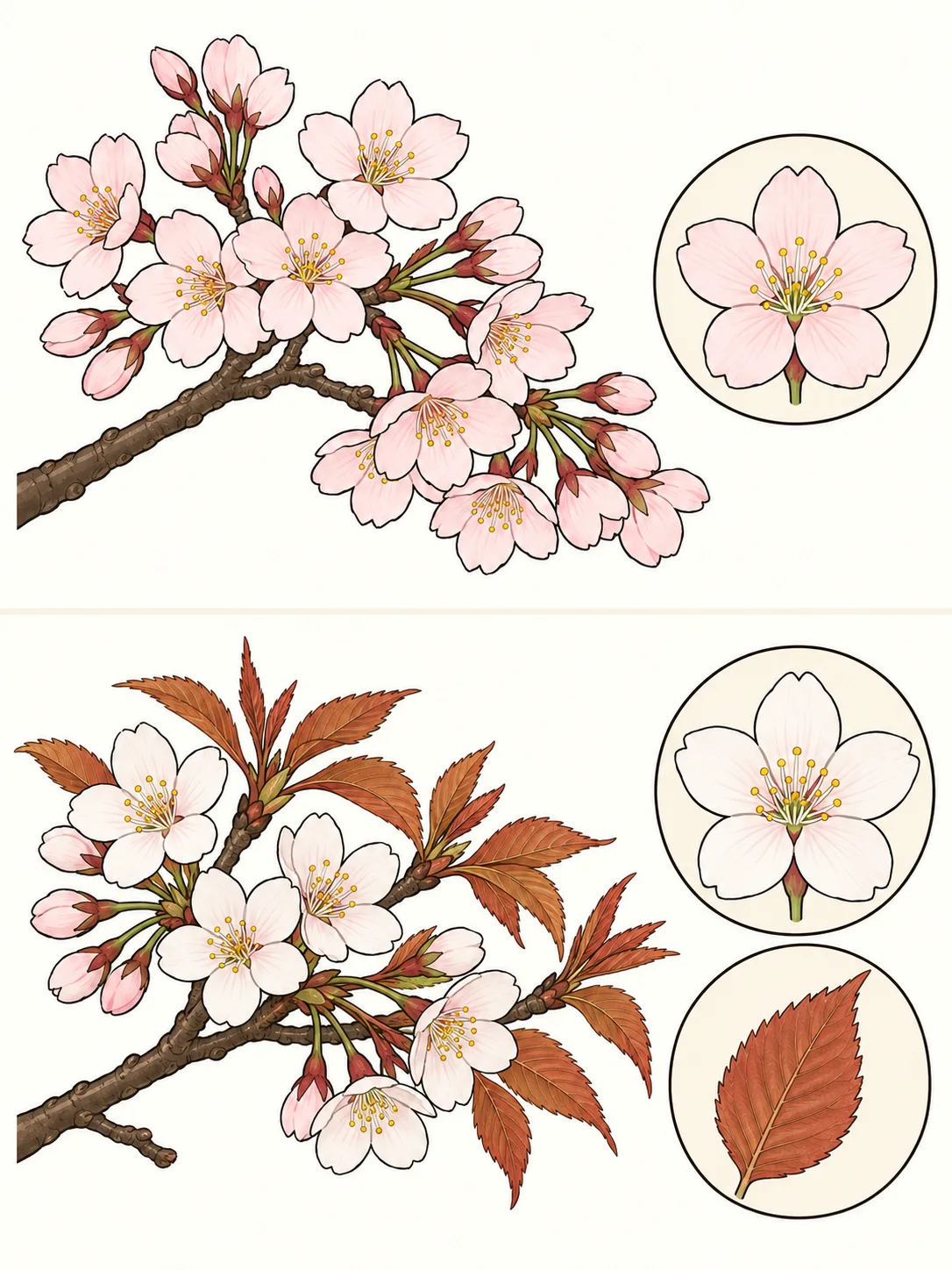
Top: Somei Yoshino, in bloom before its leaves appear. Bottom: yamazakura, white flowers among reddish-brown young leaves.
The edohigan blooms early, around the spring equinox, the Buddhist week known as higan, which gives it its name. It is extraordinarily long-lived and grows into the massive, gnarled old trees that villages and temples treat as sacred. Its weeping form, the shidarezakura, with branches that hang like a curtain, is behind many of Japan’s most celebrated individual trees, including the floodlit weeping cherry in Kyoto’s Maruyama Park.
The ōshimazakura, native to the Izu Islands south of Tokyo, has large white fragrant flowers and big leaves. Pickled in salt, those leaves are what wrap sakura-mochi, the pink rice cake eaten in spring; the scent comes from coumarin, the same compound that gives freshly cut hay its smell. Vigorous and large-flowered, the ōshimazakura is a parent of many garden varieties.
In the far north grows the ōyamazakura, a mountain cherry with deeper pink flowers. In Okinawa and southern Kyūshū there is the kanhizakura, which produces dark-pink, bell-shaped flowers in January and February that hang downward and never fully open.
The cultivated varieties bred from these wild species are collectively called satozakura, "village cherries," and many of them were selected in the gardens of Edo-period (1603–1868) temples and estates. Most are double-flowered, with dense pom-poms of petals, and bloom a week or two after the main season. The most familiar is 'Kanzan,' with heavy clusters of deep pink. Its blossoms, preserved in salt and dropped into hot water, make sakurayu, a faintly salty tea served at weddings and other celebrations, partly because ordinary green tea is avoided at such events.
Growing and tending cherries is a craft in its own right. A sakuramori, "cherry guardian," is someone who looks after trees, propagates old specimens by grafting, and nurses ailing ones. The Sano family of Kyoto has done this for generations, collecting cuttings from famous trees across the country before they die. Gardeners still quote an old saying: "A fool cuts a cherry; a fool doesn’t cut a plum." Cherry wood rots easily where it is cut, while plums need regular pruning to flower well. Modern arborists do prune cherries, carefully, sealing the cuts, but the saying captures the old caution.
03Somei Yoshino: One Tree, Copied Millions of Times
When Japanese people today say "sakura," they almost always mean one variety: the Somei Yoshino. It dominates parks, schoolyards, castle grounds, and riverbanks across the country, and it is the tree in nearly every photograph of Japanese cherry blossoms you have ever seen.
It flowers before its leaves appear, so the whole tree is a single mass of blossom with no green at all. The flowers open pale pink and fade toward white as they age. That uniform cloud of color was something Japan had not seen before the tree existed.
It came from the outskirts of Edo, present-day Tokyo. In the late Edo period the village of Somei, in today’s Toshima Ward near Komagome, was home to a cluster of nurseries that supplied plants to samurai estates and city gardens. The new cherry appeared and was sold there, and nurserymen borrowed the prestige of Yoshino, the most famous cherry mountain in Japan, calling it "Yoshino cherry." In the Meiji period a researcher studying the trees of Ueno Park realized it had nothing to do with the wild mountain cherries of Yoshino, and in 1900 he published the name Somei Yoshino, combining its real birthplace with its borrowed one.
Its parentage took decades to work out. In the mid-twentieth century the geneticist Takenaka Yō proposed, on the basis of crossing experiments, that it was a hybrid between the edohigan and the ōshimazakura, and later genetic studies supported him. From the edohigan it inherited early flowering and blossoms before leaves; from the ōshimazakura, large flowers and fast growth.
The crucial fact is what happened next. Somei Yoshino sets very little seed, and seedlings that do grow are not Somei Yoshino. Every Somei Yoshino in Japan, and in the world, has been propagated by grafting or cuttings from an original tree or a very small number of them. They are, in effect, a single individual: a clone.
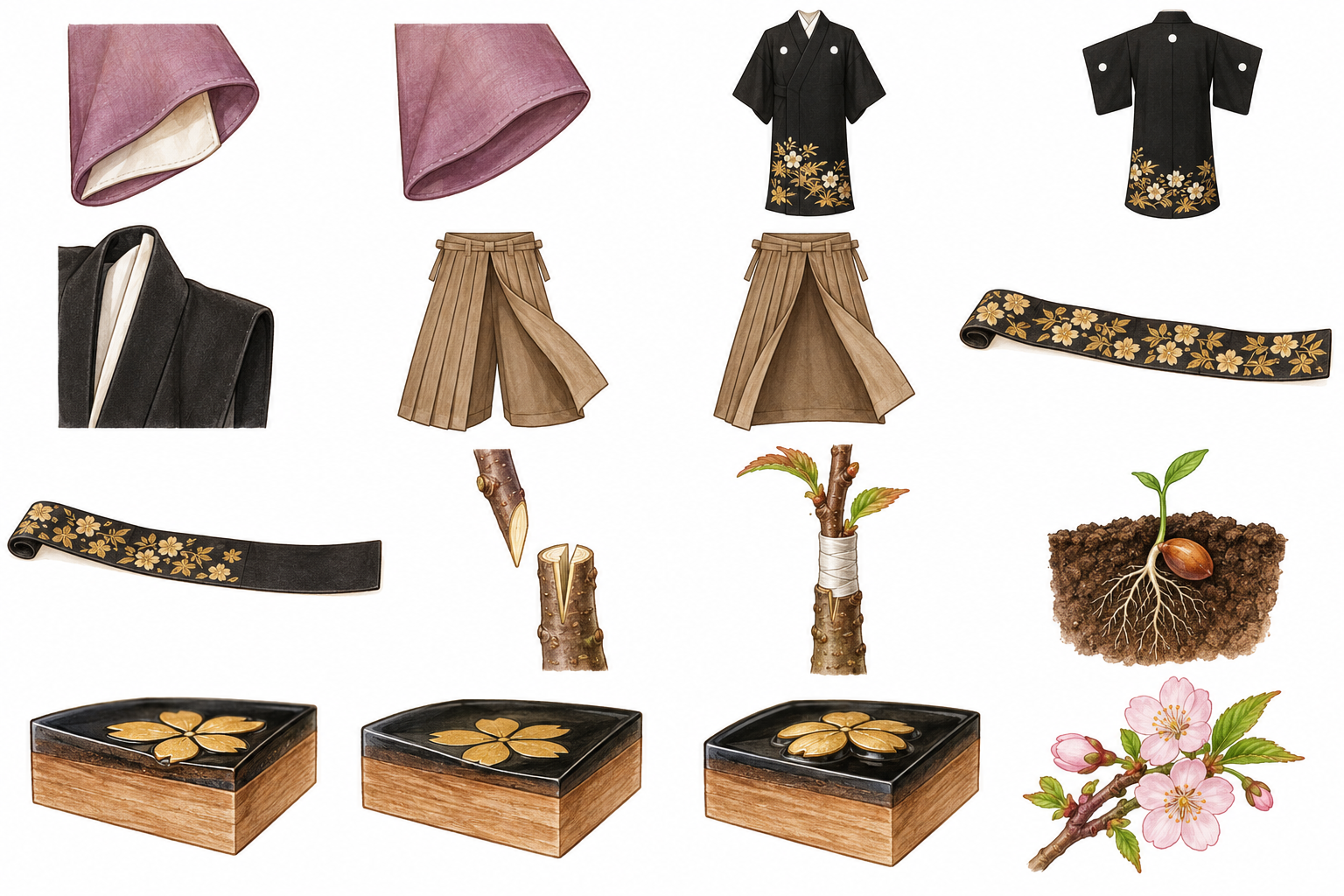
Grafting: a cutting joined to a rootstock grows into a tree genetically identical to the original.
Seed: a tree grown from seed is no longer a Somei Yoshino (generic illustration).
That explains the most spectacular thing about hanami. Trees with identical genes respond identically to temperature, so a riverbank planted with hundreds of Somei Yoshino blooms on the same day, peaks on the same day, and drops its petals in the same week. The staggered flowering of a mountain-cherry forest becomes, in a city, one synchronized wave. It is also why the Japan Meteorological Agency uses the variety to track spring: since every tree is genetically the same, differences in bloom date between cities reflect only differences in climate.
The Somei Yoshino grows fast, flowers well within a decade, and grafts easily, so after the Meiji Restoration it spread across the country with the new institutions of the modern state: schools, army barracks, railway embankments, public parks. Another wave of planting followed in the postwar recovery and the high-growth decades of the 1950s and 1960s, when cities lined rivers and boulevards with it. In 1912 the mayor of Tokyo, Ozaki Yukio, sent some 3,000 cherry trees to Washington, D.C.; most were Somei Yoshino, and their descendants around the Tidal Basin still bloom every spring; as of 2026 the festival around them is reported to draw well over a million visitors a year.
Being a clone has costs. Every tree is equally vulnerable to the same diseases, and Somei Yoshino is especially susceptible to witches’ broom, a fungal disease that makes branches sprout in dense useless clusters that no longer flower. A popular belief holds that the variety lives only about sixty years. That is too simple: Hirosaki Park in Aomori has Somei Yoshino more than a century old, still blooming heavily thanks to a distinctive local regime of pruning and feeding. But the great postwar plantings are aging, and many cities are gradually replacing them, some with a similar-looking variety called 'Jindai-akebono' that resists witches’ broom.
04From Court Banquet to National Picnic
The earliest Japanese flower viewing was not about cherries. In the Man’yōshū, the great eighth-century poetry anthology, poems about plum blossoms far outnumber poems about cherries. The plum had come from China and carried the glamour of continental learning; Nara aristocrats planted plums in their gardens and composed Chinese verse beneath them.
In the Heian period (794–1185) the court’s taste turned. The tree planted before the main hall of the imperial palace, the Shishinden, was originally a plum and was later replaced by a cherry, the famous "cherry of the left." In 812 Emperor Saga held a "flower banquet" at the Shinsen’en garden in Kyoto, often cited as the first recorded cherry-viewing party. By the time of the Kokinshū, the imperial poetry anthology compiled in the early tenth century, the word hana, "flower," on its own simply meant cherry blossom. One of its most quoted poems, by Ariwara no Narihira, says that if there were no cherry blossoms in the world, the heart in spring would be at peace. He means the opposite, of course: because the cherries exist, people spend all spring fretting about when they will open and whether wind will scatter them. Anyone who has refreshed a bloom forecast before a trip to Japan knows the feeling.
For centuries hanami belonged to the aristocracy and then the warrior elite, a matter of poetry, music, and wine in private gardens and mountain retreats. Its most lavish moment came in the spring of 1598, when the warlord Toyotomi Hideyoshi staged the Daigo Flower Viewing at Daigo-ji temple in southeastern Kyoto. He had some 700 cherry trees transplanted onto the temple grounds and invited his wives, the women of his household, and close retainers, a party often put at 1,300; according to tradition, the women changed into new kimono twice during the day. Hideyoshi died a few months later. Daigo-ji still holds a costumed procession re-enacting the event every April.
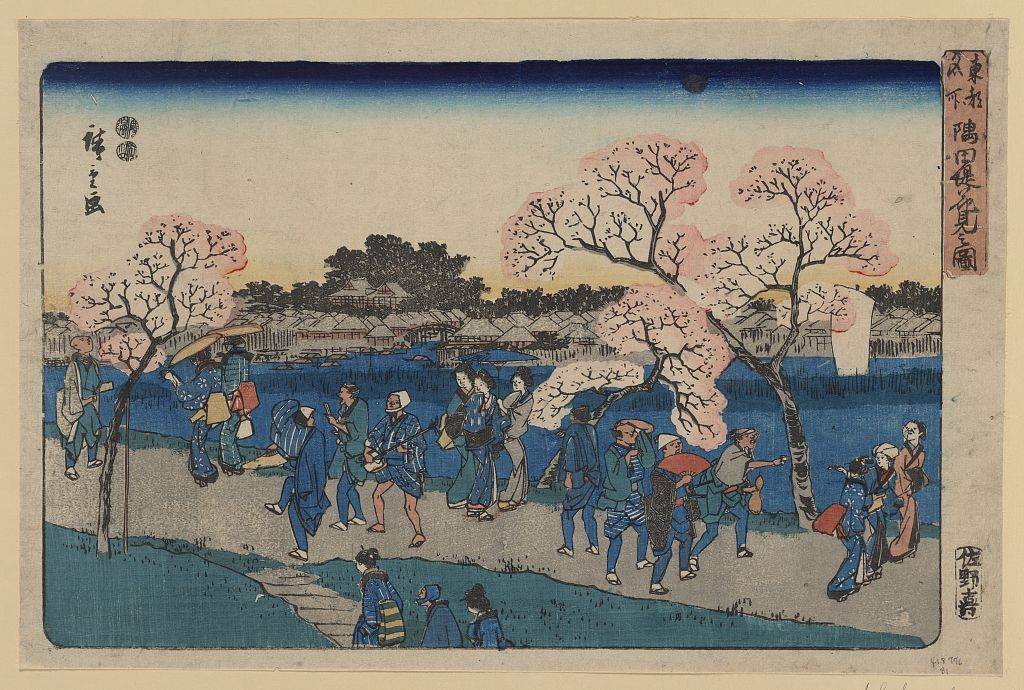
The hanami we know today was born in Edo. The city was huge and crowded, and townspeople wanted somewhere to go and be loud. Ueno’s Kan’ei-ji had cherries from the early seventeenth century, but it was a temple of the shogun’s family, and drinking and revelry there were restricted. In the Kyōhō era (1716–1736) the eighth shogun, Tokugawa Yoshimune, had cherries planted in quantity along the banks of the Sumida River (from 1717) and at Asukayama (from 1720), as well as, by the usual account, at Gotenyama in Shinagawa, and opened them to the public. These became the city’s great picnic grounds, and they are usually seen as the direct ancestors of the modern hanami party. Edo merchants and artisans packed tiered lunch boxes and gourds of sake, dressed in special "flower-viewing kimono," and went out in groups to eat, drink, dance, and sometimes perform in costume beneath the trees. Woodblock artists recorded it all; Utagawa Hiroshige’s One Hundred Famous Views of Edo includes the blossoms of Asukayama and the Sumida embankment. The food took shape in the same period. Sakura-mochi is said to have been invented in 1717 by Yamamoto Shinroku, a gatekeeper at Chōmei-ji temple on the Sumida, who wrapped a sweet-bean crepe in salted cherry leaves, and the tricolor hanami dango, pink, white, and green dumplings on a skewer, became popular too.
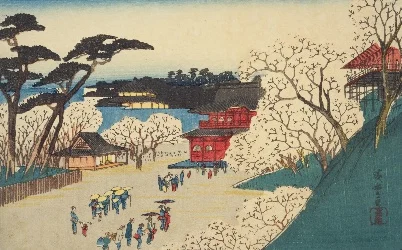
Ueno’s cherries and visitors in a print by Hiroshige. Kan’ei-ji planted cherries early but banned rowdiness and drinking.National Diet Library, Utagawa Hiroshige, print of cherry viewing at Ueno (late Edo period)
After 1868 the cherry acquired another meaning. As Somei Yoshino spread through schools and barracks, the image of blossoms falling at their peak was turned into a metaphor for young soldiers dying for the emperor. The kamikaze units of 1944–45 used cherry-blossom names and emblems, and one of the suicide aircraft was called Ōka, "cherry blossom." That history makes some Japanese people uneasy, to this day, about rhetoric linking the flower to national spirit. After the war, the trees went back to being something for parks and picnics, which is how they remain.
05Mountain Cherries and the Poets of Yoshino
If the Somei Yoshino is the cherry of modern Japan, the yamazakura is the cherry of classical Japan. The blossoms in court poetry, Noh plays, and haiku are overwhelmingly mountain cherries, or at least wild cherries seen on hillsides. Knowing that helps you read old poems: they compare cherries to clouds and to spring haze because that is what wild cherries look like from a distance, white patches scattered across a green-brown slope, merging with the mist.
The place where this image is most concentrated is Mount Yoshino in Nara Prefecture. Its slopes are said to hold some 30,000 cherry trees, mostly white mountain cherries, arranged in four zones by altitude: Shimo Senbon, Naka Senbon, Kami Senbon, and Oku Senbon, the "lower," "middle," "upper," and "inner" thousand trees. Because the zones rise in height, the bloom climbs the mountain over two or three weeks in April, from the foot to the summit. The expression hitome senbon, "a thousand trees in a single glance," describes this view.
Yoshino’s cherries are inseparable from religion. According to legend, En no Gyōja, the seventh-century founder of the mountain ascetic tradition of Shugendō, called forth the fierce deity Zaō Gongen during austerities on the mountain and carved its image in cherry wood. Cherry trees thereafter became sacred to Zaō Gongen, and pilgrims offered saplings at Kinpusen-ji temple, generation after generation, which is how the mountain came to be covered with them. Yoshino is part of the "Sacred Sites and Pilgrimage Routes in the Kii Mountain Range," inscribed as a UNESCO World Heritage Site in 2004.
The poet-monk Saigyō, who lived from 1118 to 1190, went to Yoshino again and again, built a hermitage there, and wrote more poems about cherry blossoms than almost anyone. In his most famous, he wishes to die beneath the blossoms in spring, around the full moon of the second month, the traditional date of the Buddha’s death. He died on the sixteenth day of the second lunar month in 1190, almost exactly as he had hoped, and contemporaries were deeply moved. The poem remains the line Japanese people reach for most often when they speak of cherries and mortality.
In the eighteenth century the nativist scholar Motoori Norinaga wrote a poem that asks what the Japanese spirit is and answers: mountain cherry blossoms, fragrant in the morning sun. He meant the yamazakura, leaves and flowers glowing together at dawn, as an image of native Japanese feeling. In the twentieth century the poem was conscripted by militarist propaganda and fused with the imagery of falling petals, a long way from what Norinaga had in mind; the names of the four original kamikaze units were taken from its words.
The beauty of a mountain cherry is different from that of a Somei Yoshino. It lacks the overwhelming pink cloud, but up close the white flowers against copper leaves are delicate and clean, and a whole hillside of trees, each a slightly different color and blooming at its own pace, has a depth and liveliness that a clone avenue never does. Plenty of Japanese cherry lovers skip the crowded city parks altogether and head into the hills in mid-April to find them.
06The Sample Tree: How Japan Measures Spring
Whether Tokyo’s cherries have opened is decided by one tree. It stands in the grounds of Yasukuni Shrine, it is a Somei Yoshino, and the Japan Meteorological Agency calls it the hyōhonboku, the "sample tree." From mid-March, staff from the Tokyo weather office visit it every day. When five or six flowers have opened, the agency announces that Tokyo’s cherries are "in bloom." When about 80 percent of the buds are open, it declares mankai, "full bloom." The announcement is covered live, with reporters and camera crews gathered around the tree while an official peers up into the branches.
This is part of the agency’s phenological observation program, run under unified national rules since 1953, with each local weather station keeping its own designated trees. For decades the program also recorded dozens of other plants and animal events such as the first song of the bush warbler, the first cicada, and the first firefly. In 2021, with changing surroundings making suitable sample trees and many animal species hard to find near weather stations, the agency cut the program sharply and stopped all animal observations. Cherry blooming and full bloom were kept, along with a handful of other plant events: the first plum, hydrangea, and pampas-grass flowers, and the turning and falling of maple and ginkgo leaves.
Tokyo’s average bloom date is in the last week of March, with full bloom about a week later. It has been getting earlier: Tokyo’s cherries were declared open on March 14 in 2020, 2021, and 2023, tying the earliest date on record, which still stood as of 2026. Kyoto and Ōsaka bloom at roughly the same time as Tokyo or slightly later. From there the date moves north: Sendai in early April, Aomori and Hirosaki in late April, Sapporo in late April or early May, just in time for the Golden Week holidays. Nemuro, on Hokkaidō’s eastern tip, comes last in mid-May, and there the agency watches not Somei Yoshino but the hardier chishimazakura. Okinawa observes the kanhizakura, which opens in January. Because that species needs a cold spell to flower, Okinawa’s bloom is usually said to start in the cooler northern hills and move south, the opposite direction from the rest of the country.
- 1Tokyoaverage: last week of March
- 2Kyoto, Osakaabout the same time or slightly later
- 3Sendaiearly April
- 4Aomori, Hirosakilate April
- 5Sapporolate April or early May, Golden Week
- 6Nemuromid-May; chishimazakura
The front sets out from Kyushu and reaches Hokkaido in about six weeks; Okinawa’s kanhizakura opens in January and moves the opposite way.
Join the bloom dates on a map and you get the sakura zensen, the "cherry-blossom front," which sets out from Kyūshū and travels north and uphill over about six weeks until it reaches Hokkaidō. The Meteorological Agency used to publish its own forecasts but stopped in 2010, leaving the field to private forecasters such as the Japan Weather Association and Weathernews, whose frequently updated predictions from February onward are national news in themselves.
When cherries bloom depends not only on how warm spring is but on how cold winter was. The trees form their flower buds the previous summer and go dormant in autumn; they need a period of winter chill to break dormancy before the warmth of spring can push the buds open. That is why a mild winter does not necessarily mean early blossoms and can mean a ragged, uneven bloom. There is also a folk rule of thumb, the "600-degree rule": add up Tokyo’s daily maximum temperatures from February 1, and when the total reaches about 600°C the cherries will open. It is crude, but every spring someone does the sum.
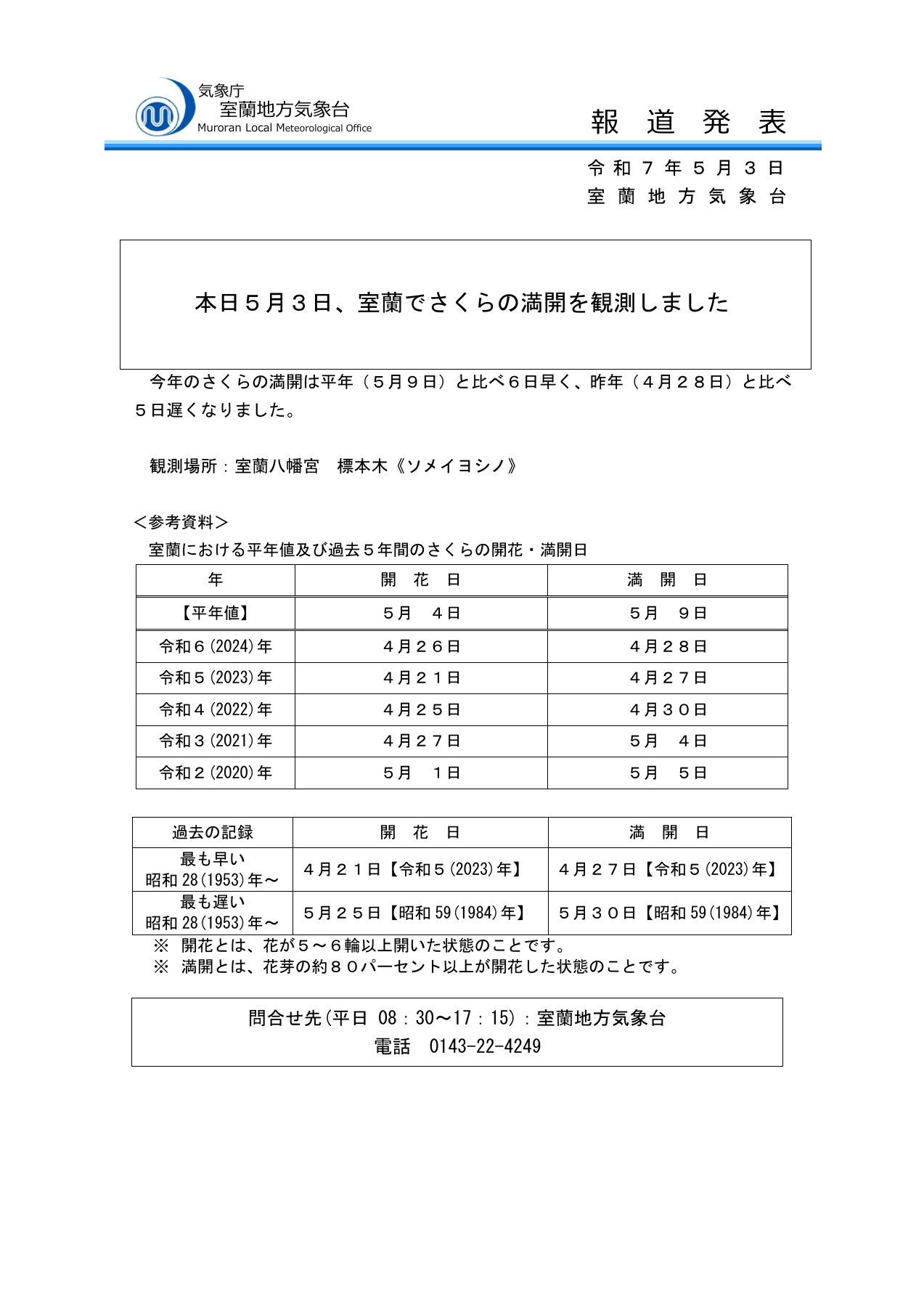
The Muroran weather office’s 2025 full-bloom notice; its sample tree is a Somei Yoshino.Japan Meteorological Agency, Muroran Local Meteorological Office, "Cherry blossoms in full bloom" (May 3, 2025) · Terms of use
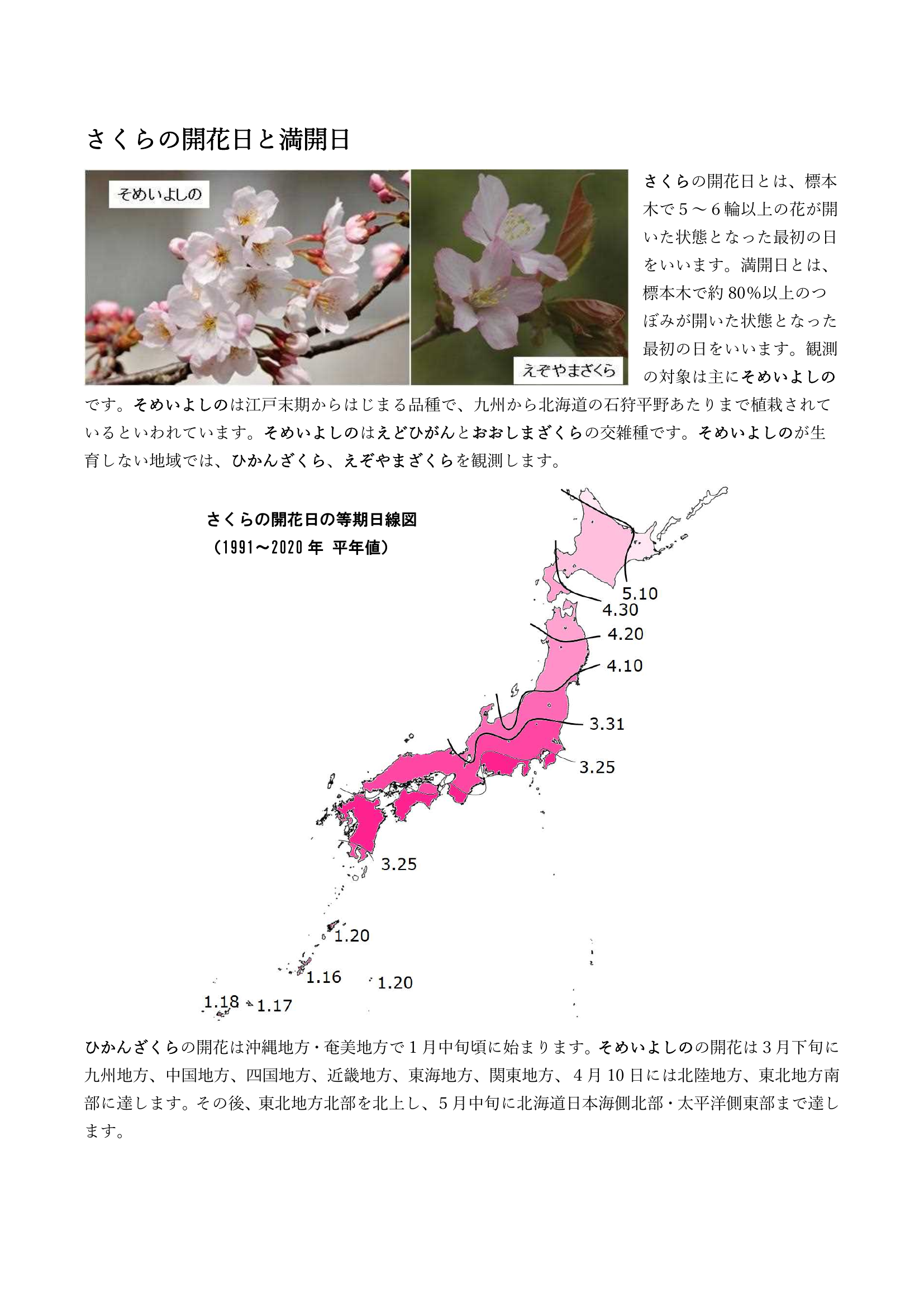
JMA handout: the definitions of blooming and full bloom, with the cherry front drawn from average bloom dates.Japan Meteorological Agency, cherry blossom flowering and full-bloom dates · Terms of use
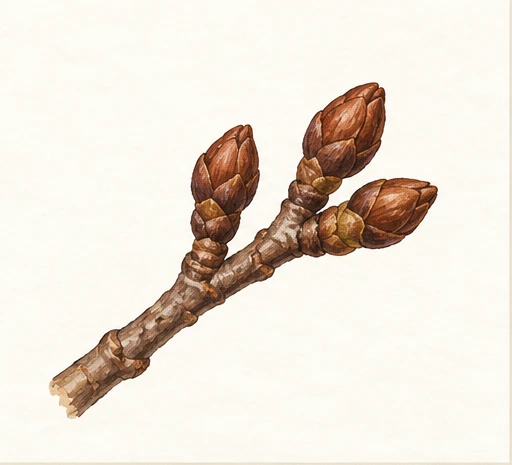
Flower buds formed in summer go dormant in autumn.
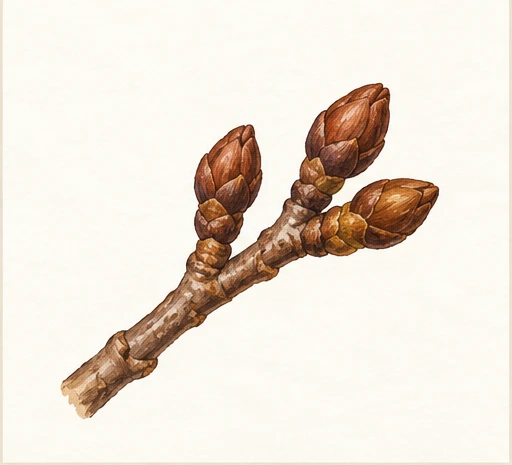
A spell of winter cold wakes the buds from dormancy.
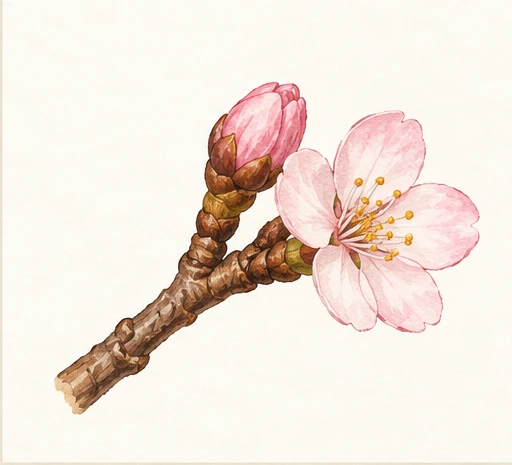
As spring warmth accumulates, the buds swell and open.
07A Tree with a Name: Miharu Takizakura
Against the millions of interchangeable Somei Yoshino stands another strand of Japanese cherry culture: the individual tree with a name, a history, and a community devoted to keeping it alive. The most famous is the Miharu Takizakura in Miharu, Fukushima Prefecture.
It is a deep-pink weeping cherry of the edohigan line, generally said to be more than a thousand years old. It stands over ten meters tall, and its branches fall in every direction from its crown, so that in bloom the pale pink flowers cascade almost to the ground. Taki means waterfall; the tree is the "waterfall cherry." The town’s name, Miharu, means "three springs," and local tradition explains it as the place where plum, peach, and cherry all bloom at once.
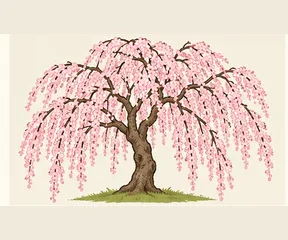
A weeping cherry’s branches fall on every side, a waterfall of blossom in bloom (illustration, not the Takizakura itself).
In October 1922 the Takizakura was designated a national Natural Monument, one of the first cherry trees to receive that status. Together with the Yamataka Jindai-zakura in Hokuto, Yamanashi, and the Neodani Usuzumi-zakura in Motosu, Gifu, it is counted among the "Three Great Cherry Trees of Japan." All three are ancient edohigan, and all three are national Natural Monuments.
A thousand-year-old tree survives because people keep it alive. The Takizakura’s long, heavy limbs rest on dozens of wooden props. When snow falls, caretakers, reportedly joined by local people, go out to brush it off the branches so they will not snap. The ground around the trunk is fenced so that visitors’ feet do not compact the soil over the roots. The tree usually blooms in mid to late April. After the 2011 earthquake and nuclear disaster, tourism to Fukushima collapsed for a time, but the Takizakura bloomed as usual that spring, and for people in the region it became something to hold on to.
The tree also has "children." Many weeping cherries in the surrounding area, at temples, shrines, and farmhouses, are said to have grown from the Takizakura’s seeds, and locals call them its offspring. Unlike Somei Yoshino clones, trees grown from seed are genetically distinct from the parent, and each has its own color and shape. In Miharu, the old tree is regarded as something like an ancestor.
Japan has many such named cherries: the weeping cherries of Daigo-ji and Heian Shrine in Kyoto, the great weeping cherry of Rikugien garden in Tokyo, the Kariyado Geba-zakura in Shizuoka, the dense pink kohigan cherries of Takatō Castle ruins in Nagano. Each comes with a story, a general who tied his horse to it, a priest who planted it. Seeing one is a different experience from walking a pink riverbank: you are looking at a single living thing and its centuries-long relationship with a place.
08Going Yourself
The hardest part of a cherry-blossom trip is choosing the dates. The bloom can vary by one or two weeks from year to year, and you have to book long before anyone knows. In general, full bloom in Tokyo, Kyoto, and Ōsaka falls between the last week of March and the first week of April, and those dates give the best odds. If your trip lands in mid-April, go north or go up: Yoshino, Hirosaki, and Takatō bloom later. From late February, check the private forecasts every few days.
In Tokyo, Ueno Park is where you see the parties at full volume. At Chidorigafuchi, the branches lean over the old moat of the Imperial Palace and you can rent a rowboat and drift beneath them. The Meguro River, lined with some 800 trees whose branches droop to the water and are lit at night, draws the youngest and most fashionable crowd. Shinjuku Gyoen has many varieties and a long season, but bans alcohol, which makes it calmer. In Kyoto, the Philosopher’s Path follows a narrow canal; when the petals fall they carpet the water, a sight the Japanese call hanaikada, "flower rafts." Maruyama Park’s great weeping cherry is lit at night and surrounded by food stalls, and in Arashiyama the blossoms frame the Togetsukyō bridge and the hills behind it. In Ōsaka, the Japan Mint opens its riverside "cherry passage" after the main bloom, showing more than a hundred late-flowering varieties. In late April, Hirosaki Park in Aomori combines a castle keep, moats, and some 2,600 trees; when the petals fall the moat turns into a solid pink ribbon.
If you want to picnic like a local, bring a tarp or picnic mat, buy food at a convenience store or a department-store food hall, and head to a park early in the afternoon. At popular spots, space is almost gone by evening, earlier on weekends. Take off your shoes before stepping onto the tarp. The firm rules concern the trees: do not break branches, shake the trees, climb them, or pull branches down for photographs. Cherry roots are shallow and easily damaged by trampling, which is why the most famous trees are fenced. Take your trash home or use the sorted collection points parks set up. Many parks post rules at the entrance limiting alcohol, barbecues, amplified music, and late-night hours, and they are enforced.
If you dislike crowds, go early. At six or seven in the morning a park holds only dog walkers and joggers, and low sunlight makes the flowers glow. An overcast day is no loss; there is a word, hanagumori, for the hazy sky of cherry season, under which the blossoms look soft and luminous. A few days after full bloom, when the wind picks up and petals stream through the air, comes hanafubuki, a "blossom blizzard," which many people think is the most beautiful moment of all.
Eat the season while you are at it. Sakura-mochi comes in two forms: in the Kantō region, the Chōmeiji style is a thin pink crepe folded around sweet bean paste; in Kansai, the Dōmyōji style wraps the paste in coarse, pink-tinted glutinous rice. Both come in a salted cherry leaf, which you can eat or peel off; much of the fragrance is in the leaf. The pink, white, and green of hanami dango are often said to stand for blossoms, lingering snow, and fresh shoots. Confectioners sell cherry-shaped namagashi only for these few weeks. And a cup of sakurayu, a single salted blossom unfurling in hot water, is a quiet pleasure after a noisy day.
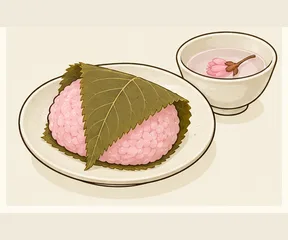
Kansai-style Dōmyōji mochi wraps bean paste in glutinous rice grains and a salted cherry leaf; beside it, a cup of sakurayu.
When the petals are gone, the year rolls on: Golden Week at the start of May, carp streamers for Children’s Day, the red leaves of autumn. But for many people in Japan, the year feels as though it truly begins in the week the cherry trees bloom.