
At a glance
How Hinamatsuri grew from riverside purification into a seven-tier doll court, who each figure is, what families eat, and where to see displays.
- Hinamatsuri falls around March 3. It is also called the Peach Festival and is not a public holiday.
- It grew from China’s Shangsi riverside purification and the custom of passing bad luck to paper stand-ins set adrift.
- The shogunate made the day one of the five seasonal festivals, and its present form largely took shape in the Edo period.
- On a seven-tier set, the top pair stands for the emperor and empress; court ladies, musicians, guards, servants and trousseau sit below.
- Families eat hishi-mochi, hina-arare, shirozake, chirashi-zushi and clam soup, and put the dolls away soon after.
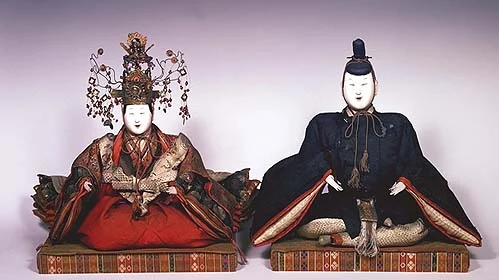
On March 3, Japanese families with daughters celebrate Hinamatsuri, the Doll Festival, also called Momo no Sekku, the Peach Festival. In the weeks before, a stepped platform covered in red felt goes up in the living room, and on it the family arranges a set of dolls dressed as an imperial court: an emperor and empress at the top, then court ladies, musicians, ministers and servants, and below them a lacquered trousseau of tiny furniture, a palanquin and an ox-drawn carriage. It is not a public holiday, and most of it happens at home, but for many Japanese women it is one of the most affectionately remembered days of childhood. This is an introduction to where the festival came from, who all those dolls are, what people eat and do, and where a visitor can see it.
01Dolls That Carried Away Bad Luck
The festival began not as a celebration but as a purification. In ancient China, the first "snake day" (si) of the third lunar month was a day for washing at the riverbank to rid oneself of misfortune, and over time it settled on the third day of the third month. The custom reached the Japanese court, where it met a native idea: that impurity and bad luck could be transferred into a substitute body.
People made small human figures, katashiro or hitogata, out of paper or straw. They rubbed the figure against their body or breathed on it, so that whatever ill fortune they carried passed into it, and then they set it adrift on a river. The practice survives today as nagashi-bina, "floating dolls": simple paper figures placed on a little round raft of woven straw and let go on the current. The earliest Hinamatsuri dolls, in other words, were not toys at all. They were scapegoats.
A second strand came from the toy cupboards of Heian-period (794–1185) aristocrats. Noble girls played hiina-asobi, a kind of dollhouse game with small figures and miniature household goods. Hina means something small and dear. In The Tale of Genji, the young Murasaki is absorbed in this game, and Sei Shōnagon lists little doll furnishings among the things she finds charming in The Pillow Book.
Over the following centuries the purifying figure and the beloved plaything gradually merged. By the Edo period (1603–1868), dolls were no longer sent away. They were crafted with great care, displayed every spring, and packed away again to be brought out the next year. The shogunate made the third day of the third month one of the five official seasonal festivals, the gosekku, alongside the seventh day of the first month, the fifth of the fifth, the seventh of the seventh and the ninth of the ninth. Samurai households and merchants alike marked the day, and the festival took on the form people know now: a day to pray that a daughter grows up healthy and happy.
02The Edo Doll Boom
The oldest style of doll still made is the tachi-bina, a standing pair of paper figures whose robes are folded from colored paper. They are austere and elegant, and some families still prefer them. Seated dolls in real silk came later.
In the early seventeenth century, dolls of the Kan’ei era were small. By the Kyōhō era in the early eighteenth century, as the merchant class grew wealthy, they had grown large: Kyōhō-bina could stand tens of centimeters tall, with long, pale, rather severe faces and robes of gold brocade. The shogunate issued sumptuary edicts restricting their size, and doll makers responded by pouring their effort into refinement instead of scale. In the later eighteenth century (the Meiwa and An’ei eras), craftsmen such as Hara Shūgetsu of Jikkendana produced the kokin-bina style, with inset glass eyes, full, lifelike faces and carefully tailored costumes. Most hina dolls made today descend from that look.
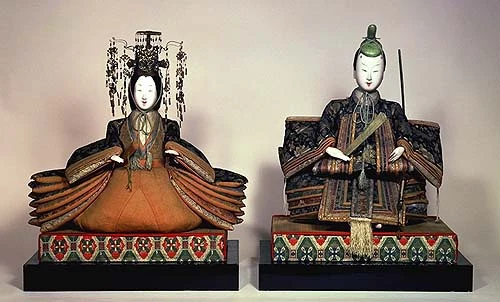
Kyōhō-bina have long faces and rich costumes, unlike the fuller-faced kokin-bina that came later.Kyoto National Museum, Kyōhō-bina dolls (Edo period)
More figures meant more shelves. A single pair on a table grew into a display of two or three tiers, then five, then seven, as attendants, musicians and furniture joined the scene. In Edo, doll markets called hina-ichi sprang up each spring, the busiest at Jikkendana near Nihonbashi. That trade has never left. Tokyo’s Asakusabashi is still a district of doll wholesalers, nearby Ningyōchō is said to keep a few old doll shops, and Iwatsuki in Saitama, which calls itself a doll town, gets very busy in February.
03Who Sits on the Steps
A full seven-tier display, read from the top down, is both a miniature Heian court and a wedding procession.
- Dairi-binaemperor and empress
- Sannin kanjo3
- Gonin-bayashi5
- Zuishin2
- Shichō3
- Bride’s goods
- Palanquin and ox carriage
Dairi-binagold screen, bonbori lamps
Sannin kanjocourt ladies with sake vessels
Gonin-bayashistick drum, hip drum, shoulder drum, flute, singer
ZuishinMinisters of the Left and Right; rice cakes and food; cherry and mandarin orange
Shichōcrying, laughing, scowling
Bride’s goodschests of drawers, long chest, mirror stand, sewing box, tea utensils
Read from the top down: the court above, attendants and the bride’s goods below, and a palanquin and ox carriage on the lowest step.
At the top are the dairi-bina, the emperor and empress dolls, called obina and mebina. He holds a flat ceremonial baton; she holds a folding fan of cypress slats. Behind them stands a gold screen, and on either side are bonbori, lamps with paper shades.
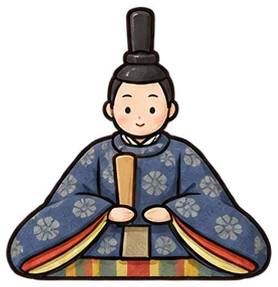
The male doll holds a ceremonial baton (shaku).
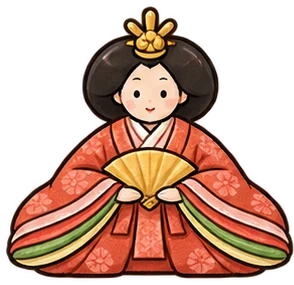
The female doll holds a cypress-slat fan.
The second tier holds three court ladies, sannin kanjo, carrying sake vessels. The one in the middle is usually an older married lady-in-waiting, with shaved eyebrows and blackened teeth, the old cosmetic marks of an aristocratic married woman. The third tier holds the gonin-bayashi, five musicians: from left to right, a stick drum, a hip drum, a shoulder drum, a flute and a singer. This is the ensemble of the Noh theater, not anything from the Heian court, which tells you that the hina display is the Edo townsman’s idea of an imperial court rather than a reconstruction of one.
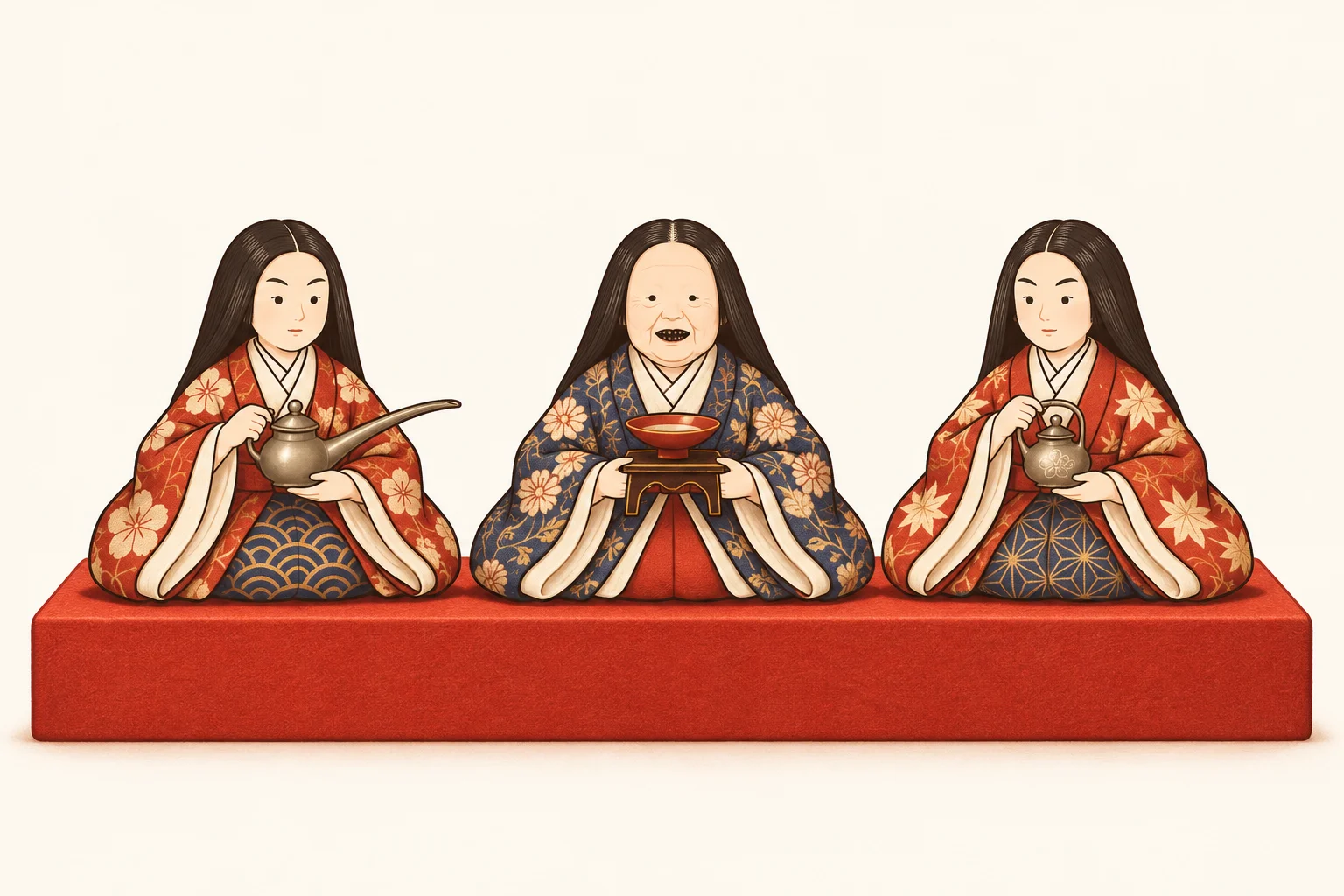
Second tier: three court ladies, sannin kanjo, with sake vessels; the middle one usually has shaved eyebrows and blackened teeth.
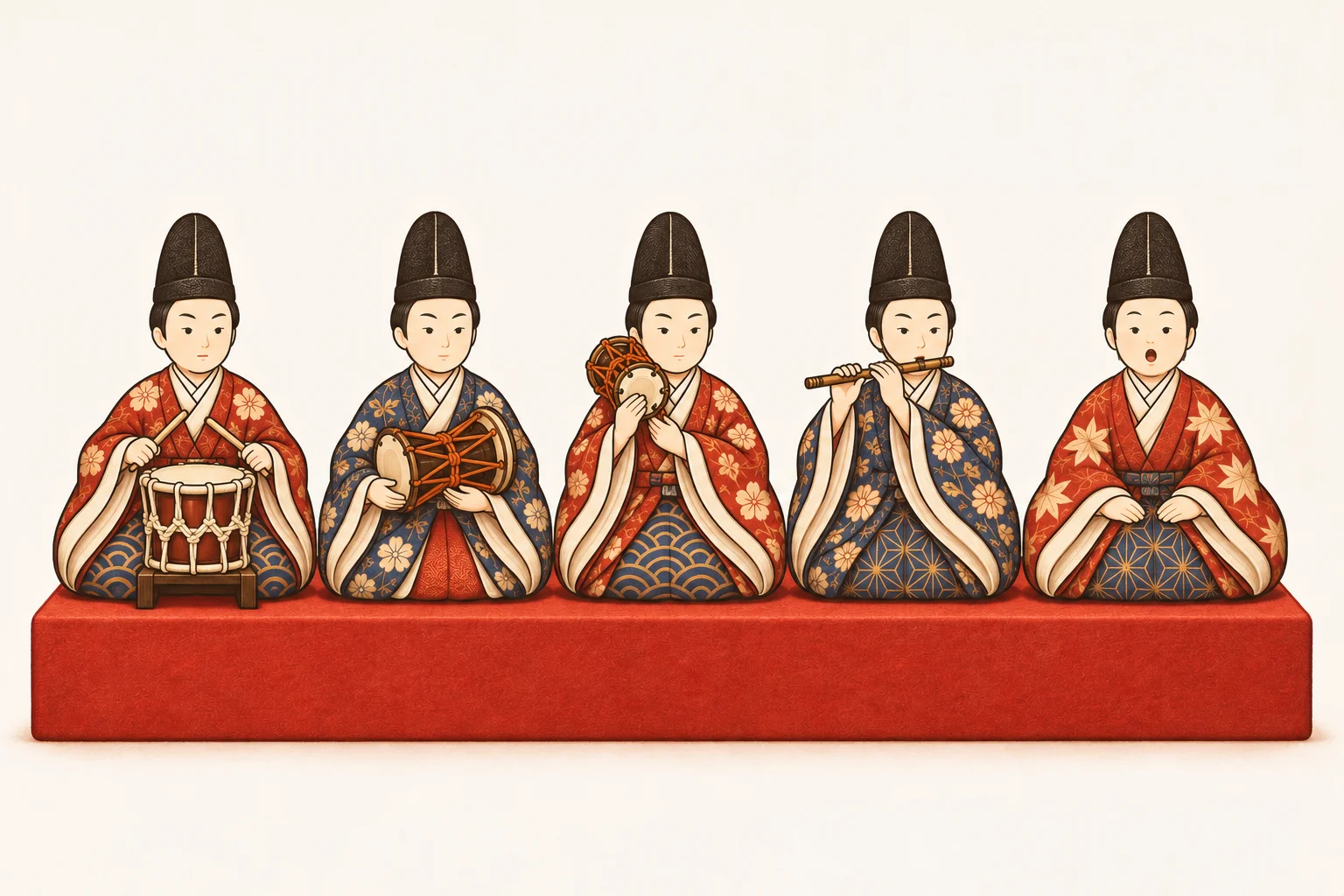
Third tier: the gonin-bayashi, from left to right a stick drum, a hip drum, a shoulder drum, a flute and a singer.
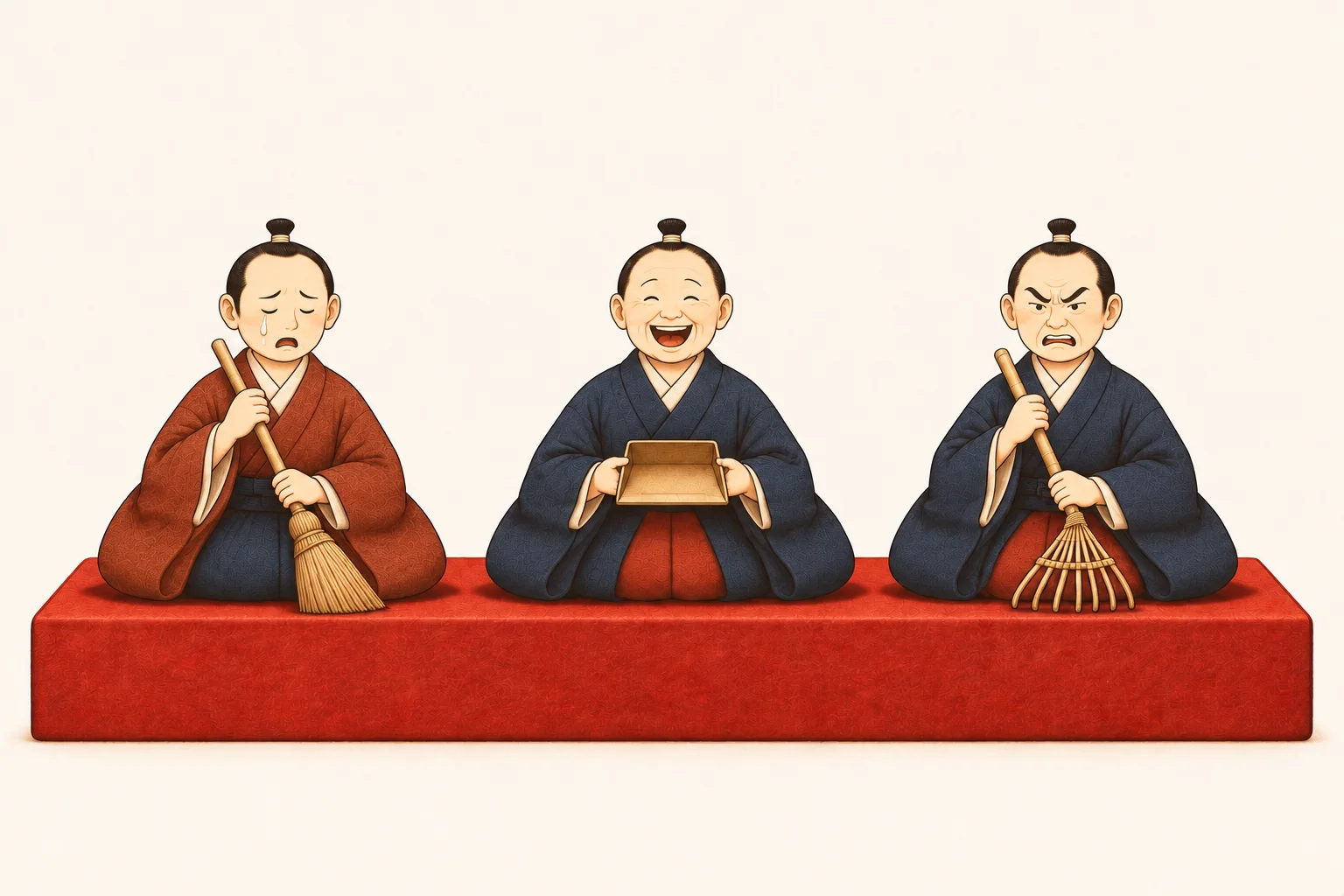
Fifth tier: three servants, shichō, often shown crying, laughing and scowling, holding a broom, a dustpan or a rake.
The fourth tier has two guards, zuishin, one old with a white beard and one young, popularly called the Minister of the Left and the Minister of the Right. Between them sit offerings of food and the diamond-shaped rice cakes. On either side stand a cherry tree and a mandarin orange tree, copying the cherry and the orange that flank the steps of the Shishinden, the ceremonial hall of the old imperial palace in Kyoto. The fifth tier has three servants, shichō, often shown crying, laughing and scowling, holding a broom, a dustpan or a rake. They are the most human figures on the stand, and children tend to love them.
Below come the bride’s goods: chests of drawers, a long chest for bedding, a mirror stand, a sewing box, tea utensils, and finally a palanquin and an ox carriage on the lowest step. Read whole, the display wishes the girl a good marriage and a comfortable life.
People often ask which side the emperor sits on. In old Japanese court custom the left was the place of honor, so in the Kyoto style the male doll sits on the viewer’s right. In Tokyo and most of the country, he sits on the viewer’s left. The usual explanation is that the modern imperial household adopted Western etiquette, in which the emperor stands to the empress’s right, the viewer’s left, and Tokyo doll makers followed; accounts differ on whether this began in the Taishō era or the early Shōwa era. Both arrangements are correct; they simply reflect regional habit.
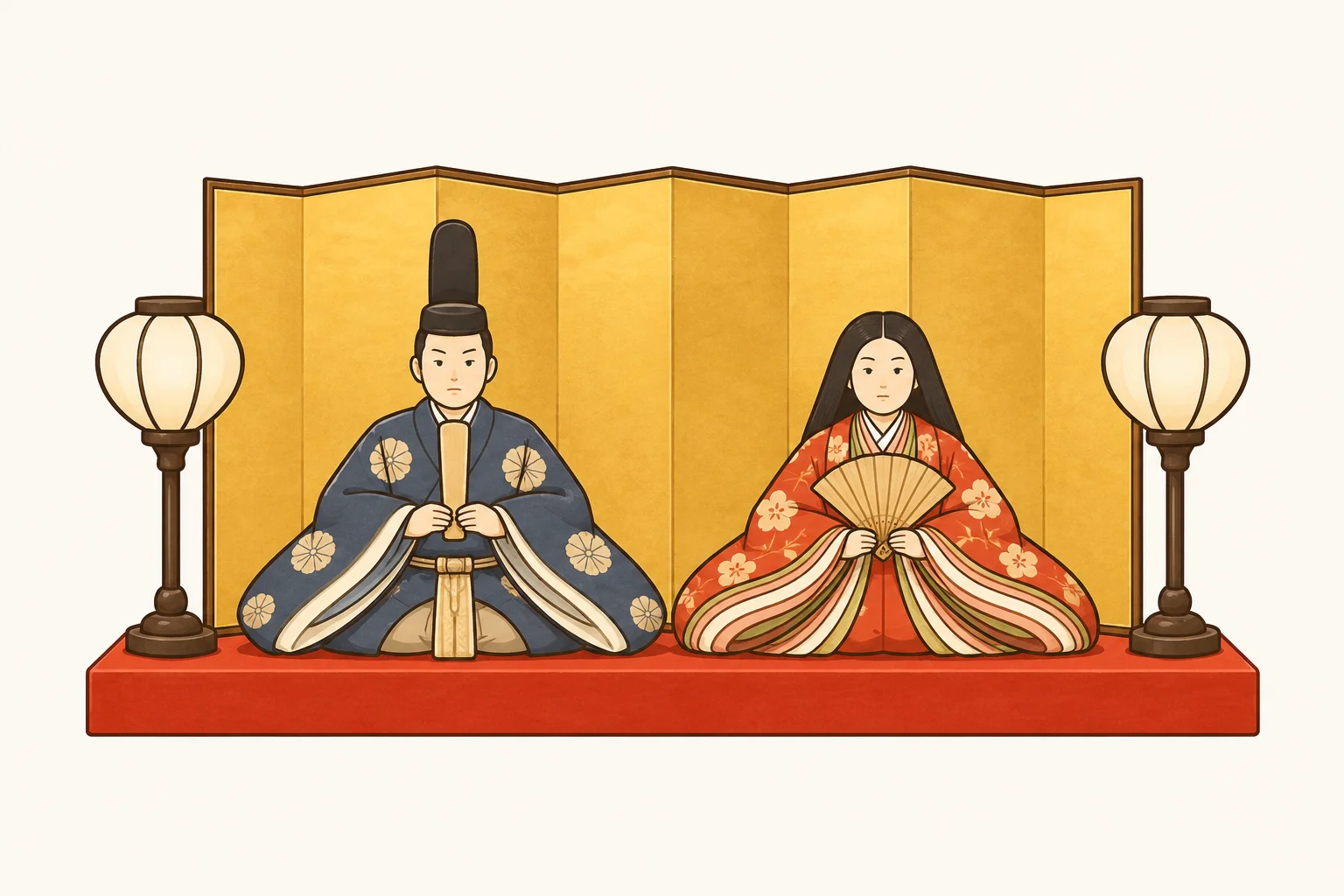
The Tokyo arrangement: the male doll sits on the viewer's left, the reverse of the Kyoto style.
04Peach Blossoms, Clams and Sweet White Sake
In the old lunar calendar, the third day of the third month fell when peach trees were blooming, hence the festival’s other name. Peaches were believed in both China and Japan to ward off evil, and branches of peach blossom are set beside the dolls. Since Japan adopted the Western calendar in 1873, early March usually comes before the peach trees outdoors are in flower, so the branches sold in florists’ shops are forced in greenhouses.
The festival foods each have a meaning. Hishi-mochi are diamond-shaped rice cakes stacked in layers, most often pink, white and green from top to bottom. One reading is that pink is the peach blossom, white is the last snow, and green is the new grass coming up beneath it, so that the stack is a small picture of early spring. Hina-arare are colored rice crackers; in the Kantō region they tend to be sweet puffed grains, while in the Kansai region they are more often small, savory fried pieces of rice cake. Shirozake is a thick, milky, sweet sake made from rice, rice malt and distilled spirit, and it is around 10 percent alcohol, so children usually drink amazake, a sweet, non-alcoholic rice drink, instead.
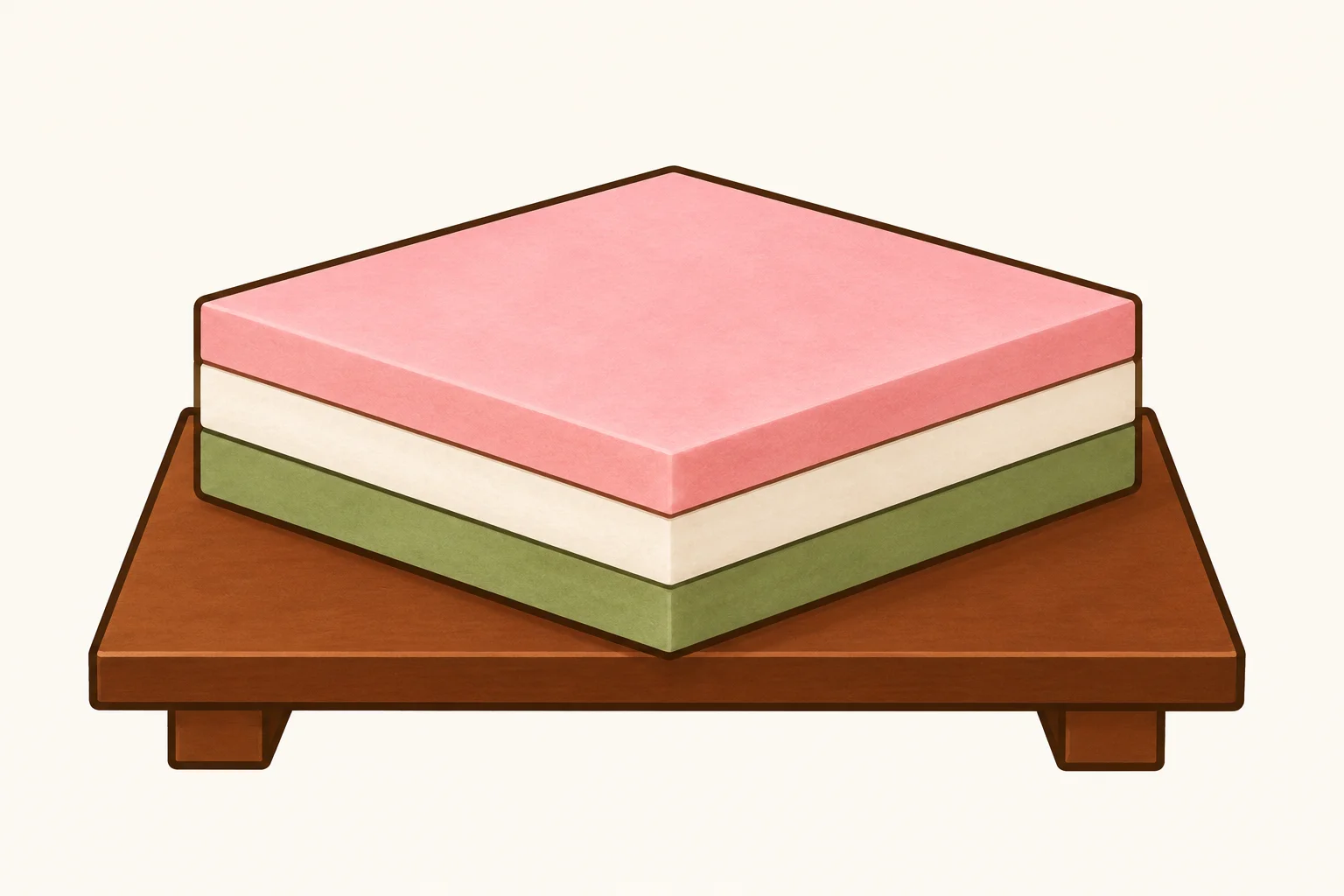
Hishi-mochi: diamond-shaped rice cakes stacked in layers, most often pink, white and green from top to bottom.
Dinner is often chirashi-zushi, sushi rice scattered with ribbons of egg, shrimp, lotus root and snow peas, as bright as the display itself, served with a clear soup of hamaguri clams. Each clam shell fits only its own partner and no other, which makes the clam a symbol of a faithful marriage. Edo-period brides of high rank brought a set of painted clam shells in a lacquered case for a matching game, and the miniature trousseau on the doll stand often includes one.
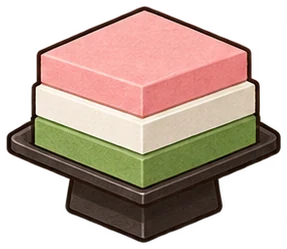
Hishi-mochi: usually three layers, pink, white and green from the top.
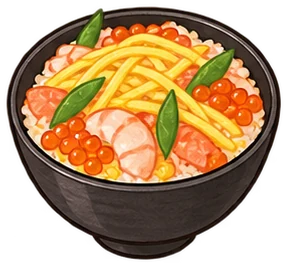
Chirashi-zushi, bright with egg strips, shrimp and other toppings.
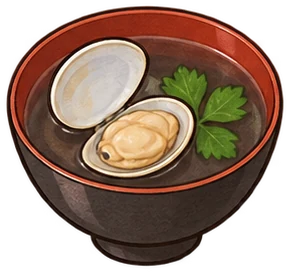
Clam soup: each shell fits only its own partner, a sign of a harmonious marriage.
Nearly every Japanese child learns the song "Ureshii Hinamatsuri" ("Happy Doll Festival"), with words by the poet Satō Hachirō and music by Kawamura Kōyō, released on record in 1936. Its melody is in a minor key, which gives it a slightly wistful sound for a happy song. The lyrics use names for the two top dolls that are not strictly correct, and Satō is said to have regretted the slip in later life. The song was so popular that the loose usage stuck.
05Putting Them Out and Putting Them Away
Traditionally, a girl’s first set of dolls is a gift from her maternal grandparents, timed for her first Hinamatsuri, the hatsu-zekku, which is celebrated with relatives. Because the dolls are understood to protect the girl and take misfortune on her behalf, the ideal is one set per girl. A younger sister gets her own, and sets are not passed on to other families.
Many households put the display out after Risshun, the traditional beginning of spring in early February, or around Usui, the seasonal point in mid-February when snow turns to rain. The rule for taking it down is stricter: do it promptly after March 3, on a fine, dry day. Everyone knows the saying that if the dolls stay out too long, the daughter will marry late. Nobody really believes it, and nearly everybody obeys it. The practical reasons are plain enough: put silk dolls away while the air is dry and they will not mildew, and a girl learns that when something is finished, it is tidied up.
Japanese homes are small, and full seven-tier displays have become rare. Many families now buy a shinnō-kazari, just the emperor and empress pair, or a set in a glass case, or small dolls of wood, ceramic or cloth that sit on a shelf by the front door. As of 2026, prices run from tens of thousands of yen to more than a million. In a good set, the heads, the hands and the costumes are each made by different specialist craftsmen.
Eventually the dolls can no longer be displayed: the girl grows up and leaves home, a grandparent dies, the family moves. Because of their old role as substitutes, Japanese people are reluctant to throw them away. Instead they take them to a temple or shrine for ningyō kuyō, a memorial service for dolls, after which the priests burn them or keep them. Awashima Shrine in Wakayama is famous for this; its grounds are crowded with thousands of hina and other dolls sent from all over the country, a sight that is at once cheerful and slightly unnerving.
06Where to See It
Because Hinamatsuri is a domestic festival, there is no single great public event. But from February to early March, and in some places into April, towns across Japan turn it into a community affair.
The most ancient form is the floating of dolls. At Shimogamo Shrine in Kyoto, a nagashi-bina ceremony is held every March 3, when participants in Heian court dress set paper dolls adrift on the shrine’s stream. In Mochigase, now part of Tottori City, the floating is held on the lunar-calendar date, usually in late March or early April, and children send pairs of paper dolls with small offerings down the Sendai River on straw rafts; the custom is designated an intangible folk cultural property of Tottori Prefecture, and locals often describe it as the most completely preserved form of the practice. Awashima Shrine in Wakayama loads dolls offered by worshippers onto three wooden boats, said to be of plain unpainted wood, on March 3 and sends them out to sea; by some accounts the boats carry thousands of dolls. In 2026, it was reported, only two small boats were used, carrying about 300 dolls, and bad weather kept them from being launched, so worshippers carried the boats around the shrine grounds instead.
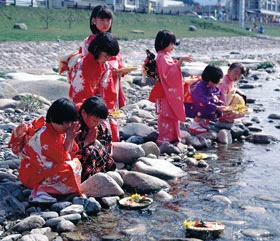
Mochigase nagashi-bina: children set straw discs bearing paper dolls afloat on the Sendai River.
A different and very pretty tradition is the hanging display. In Inatori on the Izu Peninsula, hina no tsurushi-kazari are strings of small stuffed figures sewn from fabric scraps, rabbits, peaches, monkeys, straw sandals and more, hung from the ceiling in cascades. The story goes that they began in the Edo period among families who could not afford expensive dolls, sewn by mothers and grandmothers for their girls. Yanagawa in Fukuoka has its own version called sagemon, and Sakata in Yamagata has kasafuku, hung from umbrellas.
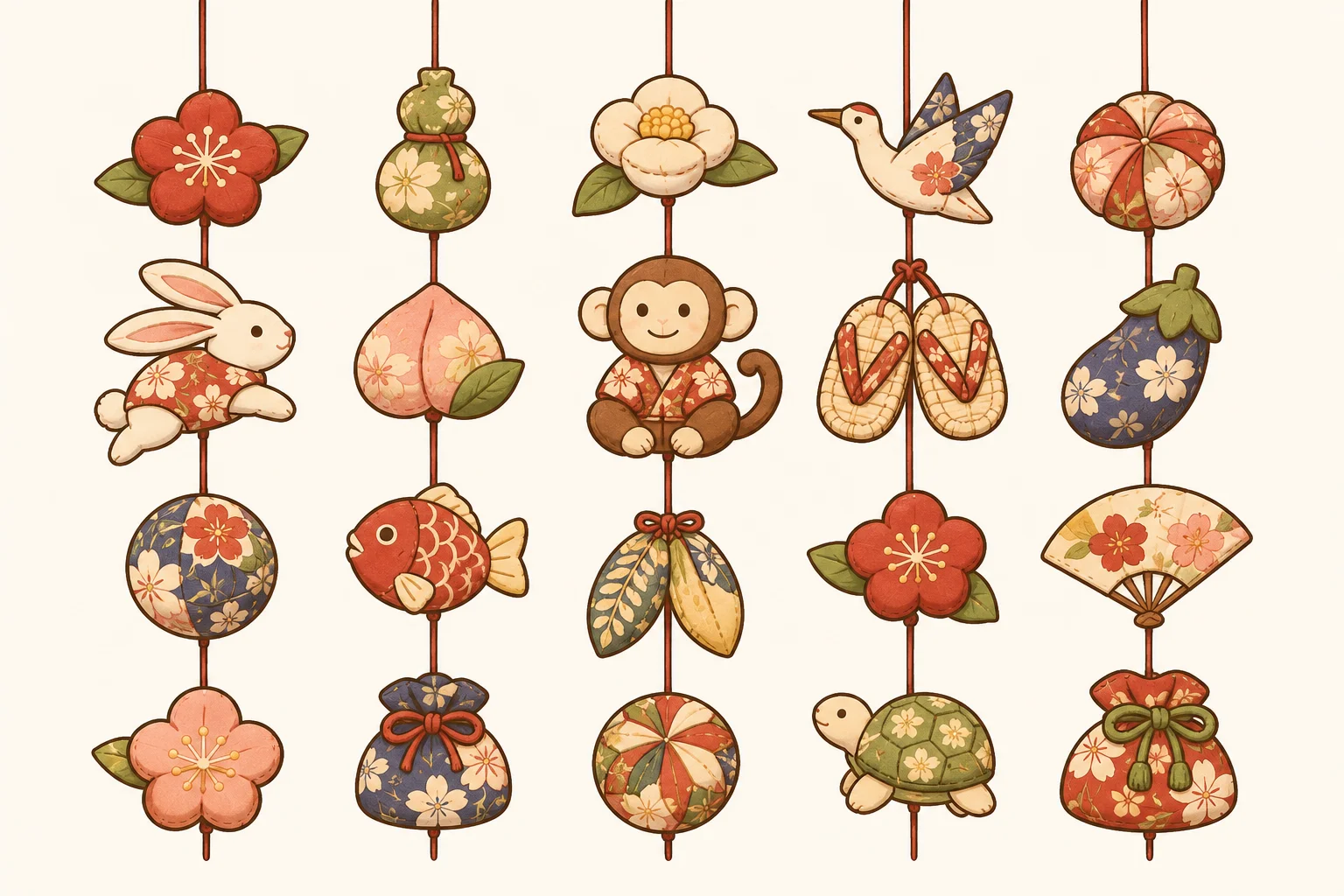
Hina no tsurushi-kazari from Inatori: strings of small figures sewn from fabric scraps, among them rabbits, peaches, monkeys and straw sandals.
For sheer scale, the Big Hina Festival in Katsuura, Chiba, arranges some 1,800 donated dolls on the 60 stone steps of Tomisaki Shrine, so that the whole flight of steps becomes one enormous display; it was inspired by a festival of the same name in Katsuura, Tokushima. Old castle towns such as Takayama and Matsumoto bring heirloom dolls out of merchant houses and storehouses, some on the lunar date in early April. Museums in Tokyo and elsewhere hold special exhibitions of Edo-period dolls from daimyo and wealthy merchant families, often with complete gold-lacquered trousseaus. The Tokugawa Art Museum in Nagoya mounts one every year from the collection of the Owari Tokugawa house.
Even without leaving the city, you can feel the season. In February, department-store doll floors fill with grandparents choosing a set for a new granddaughter. Confectioners sell sakura-mochi, doll-shaped sweets and hishi-mochi, and supermarkets stack hina-arare and shirozake by the entrance. Then on May 5 comes Children’s Day, the old boys’ festival, and carp streamers and warrior dolls take over from the court on the red steps.