
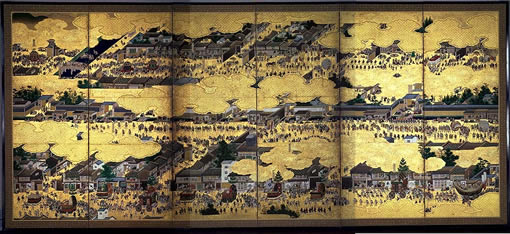
At a glance
How Kyoto’s neighborhoods have kept a month-long plague festival alive since 869, from rope-lashed floats and wet-bamboo turns to lantern-lit yoiyama nights.
- The Gion Matsuri is a rite of Yasaka Shrine that runs from July 1 to July 31.
- Its origin is usually traced to a goryōe held in 869 to calm an epidemic.
- As of 2026, 34 floats join the parades; the heaviest, the Tsuki-hoko, weighs close to 12 tons.
- The hoko are built without a single nail, their joints lashed with rope, and taken apart on parade day.
- Hoko wheels cannot steer, so at corners the float is dragged over wet split bamboo, 90 degrees in three or four pulls.
Most visitors know the Gion Matsuri as a single day in July: a parade of towering wooden floats creaking down Shijō Street, pulled by teams of men in matching cotton robes while musicians on the upper deck play flutes, drums and small brass gongs. That parade, the Yamahoko Junkō, is real and spectacular, but it is one moment in a festival that fills the whole of July. Behind it stand Yasaka Shrine, which has staged the festival in some form for more than 11 centuries, and the merchant neighborhoods of central Kyoto, each of which owns, stores, assembles and pulls its own float. This introduction explains why the festival exists, how the floats are built with rope instead of nails and turned at intersections on wet bamboo, what happens on the evenings before the parade, and how to see it all without melting in the Kyoto heat.
01A festival to calm a plague
The Gion Matsuri traces its origin to the year 869. Epidemics were sweeping the capital and the provinces, and in the thinking of the time, disease came from angry spirits and wandering gods of pestilence. According to the tradition kept by Yasaka Shrine, 66 halberds, or hoko, were raised at Shinsen’en, an imperial garden south of the palace, one for each of the provinces of Japan, and the god of Gion was invoked to drive the sickness away. Rites of this kind were called goryōe, assemblies to pacify vengeful spirits, and the festival’s old name was the Gion Goryōe.
The name Gion itself is Buddhist. It is the Japanese reading of Jetavana, the monastery park where the Buddha preached, and until 1868 Yasaka Shrine was a mixed Buddhist-Shinto institution known as Gionsha or Kanshin-in. Its principal deity was Gozu Tennō, the Ox-Headed Heavenly King, a god of uncertain foreign origin who controlled epidemics. Neglect him and he sent disease; honor him and he held it back. Over time he was identified with Susanoo, the storm god of the Kojiki and Nihon shoki, the unruly younger brother of the sun goddess. When the Meiji government separated Buddhism from Shinto in 1868, Gionsha was renamed Yasaka Shrine and Susanoo became its official deity. Kyoto people still call it Gion-san.
The timing in high summer makes sense once you know Kyoto’s climate. The city sits in a basin that traps heat and humidity, and in the past the rainy season and the weeks after it were when dysentery and other diseases spread fastest, especially after the Kamo River flooded. The festival is held exactly when people were most likely to fall ill. Its logic is to call the plague gods out, entertain and gather them, and then send them away. Seen this way, the floats are not just decoration. They were understood to attract and collect the spirits of disease wandering the streets ahead of the shrine’s portable shrines, and when the parade ends the neighborhoods dismantle the floats almost immediately, traditionally so that the gathered spirits do not linger.
One more story explains a small object you will see everywhere in July. A god traveling in disguise, identified in different versions as Susanoo or as Gozu Tennō, asked for a night’s lodging. A rich man named Kotan Shōrai turned him away; his poor brother Somin Shōrai took him in. Leaving, the god promised that in times of plague anyone who declared himself a descendant of Somin Shōrai and wore a ring of reeds would be spared. The chimaki charms sold by each float neighborhood carry a paper slip reading "descendants of Somin Shōrai," and Kyoto households hang them over the front door for a year.
02The townspeople’s festival
In its early centuries the goryōe was a court-sponsored rite. Over the late Heian, Kamakura and Muromachi periods, the people who actually carried the festival became the merchants and artisans of Shimogyō, the lower town. These were the machishū, townspeople organized by chō, the small block-sized neighborhoods that ran their own affairs. Wealthy households around Shijō and Muromachi streets paid for floats and competed to make them more splendid. Today most floats still belong to a single neighborhood, a yamahoko-chō, and nearly all of these lie within a few hundred meters of the Shijō-Karasuma intersection. That is why, on festival evenings, the grid of streets around Karasuma, Muromachi and Shinmachi fills with floats standing in the roadway.
The Ōnin War of 1467–1477 burned much of Kyoto, and the festival stopped for over 30 years. In 1500 the townspeople revived it, and records list the floats that went out that year. Ever since, the Gion Matsuri has been read as a symbol of the self-government of Kyoto’s merchant class: shoguns and courts came and went, but the neighborhoods kept running their festival by their own rules. Fires during the Edo period, especially the Great Tenmei Fire of 1788 and the fire that followed the Hamaguri Gate Incident of 1864, destroyed many floats, and some neighborhoods needed decades, or more than a century, to rebuild theirs.
Those stories of loss and revival are still being written. The Ōfune-hoko, the Great Ship Float, burned in 1864 and for most of the next 150 years took part only by displaying its surviving ornaments during the evening events. In 2012 its people rejoined the parade carrying a chest of ritual objects, and in 2014 the rebuilt float itself returned. The Taka-yama, the Falcon Float, was damaged by storms in the early 19th century and stopped parading for nearly 200 years; it rejoined the procession in 2022. Each revival meant years of fundraising, research into old drawings and records, and training a new generation to pull, steer and play music for a float that nobody alive had seen in motion.
The modern festival has changed shape too. The Saki Matsuri parade once ran along narrow Teramachi and Matsubara streets; in 1956 it was rerouted north to broad Oike Street, and in 1961 onto Kawaramachi, giving roughly today’s course. In 1966, to reduce traffic disruption, the two traditional parades, the Saki Matsuri on July 17 and the Ato Matsuri on July 24, were merged into one on the 17th, and the Hanagasa procession was created to give the 24th something in its place. The merger lasted almost half a century. In 2014 the two parades were separated again, restoring the festival’s double structure. The float ceremonies were designated an Important Intangible Folk Cultural Property of Japan in 1979, inscribed on UNESCO’s Representative List of the Intangible Cultural Heritage of Humanity in 2009, and in 2016 folded into a joint inscription, "Yama, Hoko, Yatai, float festivals in Japan," covering 33 float festivals across the country.
03A month on the calendar
The festival runs from July 1 to July 31, with something happening almost every day.
On July 1 the float neighborhoods open their festival season with a rite called kippu-iri. Around this time the boy chosen as the sacred child of the Naginata-hoko visits Yasaka Shrine and is formally made a messenger of the god. On July 2 a lottery, kuji-tori, is held at Kyoto City Hall to fix the parade order. The lottery is said to have begun because neighborhoods quarreled over who would go first, and it was already being held under the shogunate’s officials when the festival was revived in 1500. A handful of floats are exempt and hold fixed positions, above all the Naginata-hoko, which always leads.
Around July 10 the neighborhoods begin building their floats in the street. On the same evening comes mikoshi-arai, the washing of the portable shrine, on the Shijō Bridge with water drawn from the Kamo River. Once a float is assembled, it is given a short trial pull through its own neighborhood, the hikizome. Anyone may join in and take hold of the rope, which makes it one of the few chances for a visitor to touch the festival rather than just watch it.
The evenings of July 14, 15 and 16 are the yoiyama of the Saki Matsuri, known in order as yoi-yoi-yoiyama, yoi-yoiyama and yoiyama. On the morning of the 17th, 23 floats parade. That evening the shrine’s three mikoshi, portable shrines carrying the gods, leave Yasaka Shrine in the Shinkōsai procession and are carried to the Otabisho, a temporary residence on Shijō near Teramachi, where the gods stay for a week. The Ato Matsuri follows the same pattern: yoiyama on July 21 to 23, a parade of 11 floats on the morning of the 24th, alongside the Hanagasa Junkō, a procession of flower-hatted dancers and children, and in the evening the Kankōsai, when the mikoshi return to the shrine. A second mikoshi washing takes place on July 28. On July 31 the festival closes at Ekijinja, a small shrine to the plague god inside the Yasaka precinct, where people pass through a large ring of woven reeds, a chinowa, for purification.
The two parades thus mirror the gods’ journey. The Saki Matsuri floats clear the way for the gods going out; the Ato Matsuri floats clear it for their return. Restoring the second parade in 2014 restored that logic.
04Yama and hoko
As of 2026, 34 floats take part. They come in two basic kinds.
A hoko is a huge wooden wagon on four wheels, with a two-story tower and a tall pole called the shingi rising from the roof. At the top of the pole is the float’s emblem: a long halberd on the Naginata-hoko, a crescent moon on the Tsuki-hoko, a mountain and moon on the Kanko-hoko. The largest hoko stand about 25 meters from the ground to the tip of the pole and weigh around 10 tons, the heaviest, the Tsuki-hoko, nearly 12. The upper deck carries several dozen musicians who play throughout the parade. The hoko are the Naginata, Kanko, Niwatori, Kikusui, Tsuki, Hōka, Fune and Ōfune floats. The last two are built in the shape of ships and illustrate the legend of Empress Jingū; the Fune-hoko parades in the Saki Matsuri, the Ōfune-hoko in the Ato Matsuri.
A yama was originally carried on shoulders. It is much smaller, with a pine tree and life-size figures arranged to depict a scene from legend or literature. The Hōshō-yama shows Fujiwara no Yasumasa stealing plum blossoms from the palace garden for the poet Izumi Shikibu, so its charms are said to help in love. The Mōsō-yama depicts a filial son from the Chinese Twenty-Four Paragons of Filial Piety digging for bamboo shoots in the snow to feed his mother. Others draw on Chinese tales about Guo Ju, the zither master Boya, and the poet Bai Juyi. The carried floats are called kakiyama. A few yama have grown large and acquired wheels, making them nearly the size of hoko; these hikiyama, pulled floats, are the Iwato-yama, the Kita-Kannon-yama, the Minami-Kannon-yama and the Taka-yama. Two more, the Ayagasa-hoko and the Shijō-kasa-hoko, are umbrella floats with a giant parasol and accompanying dancers, preserving an older and simpler style.
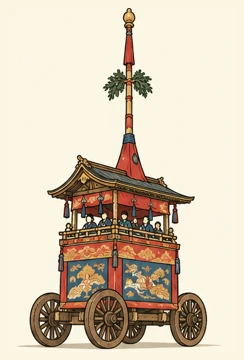
Hoko: a four-wheeled wagon with a two-story tower and a tall pole
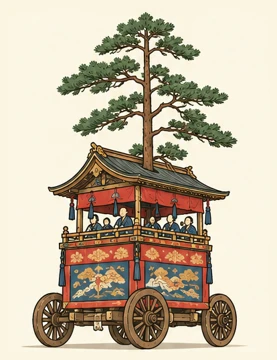
Hikiyama: a yama grown to near-hoko size, with wheels and a pine tree
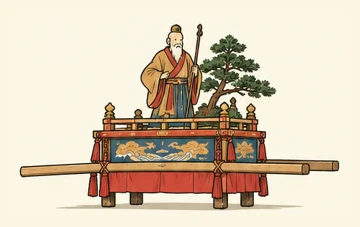
Kakiyama: a carried platform with a pine and figures acting out a story
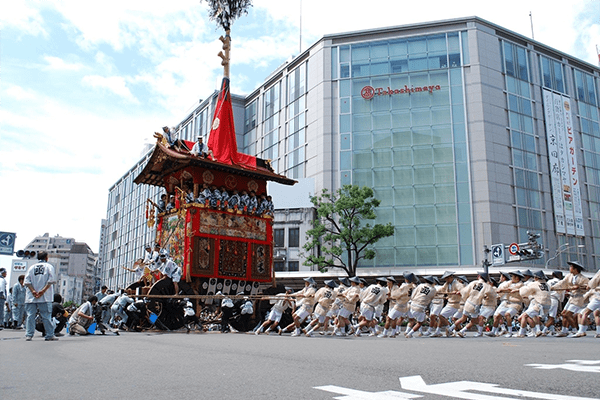
A hoko on parade: huge wooden wheels, a two-story body and the tall shingi mast rising from the roof.
Kyoto people call the floats moving museums. Each is hung with textiles: the maekake at the front, dōkake on the sides and the miokuri at the back. Among them are masterpieces of Nishijin weaving, Chinese rugs and embroideries of the Ming and Qing dynasties, Persian and Indian carpets, and even 16th-century European tapestries. The most famous are the front and rear hangings of the Koi-yama, 16th-century tapestries woven in what is now Belgium, with figures from a Greek epic, designated Important Cultural Properties. The Niwatori-hoko, Kanko-hoko, Hakurakuten-yama and Arare Tenjin-yama also carry European tapestries. The Niwatori-hoko’s miokuri is likewise an Important Cultural Property, said to have been woven around Brussels in the 16th century and to show Hector’s farewell to his wife and son from the Iliad (another account dates it to the 17th century), and the Kanko-hoko’s front hanging is said to show the Old Testament search for a wife for Isaac. All of these reached Kyoto during the Edo period, by one account through the Dutch and Chinese trade at Nagasaki, most of them bought by wealthy merchants and donated to their neighborhoods’ floats. Many originals are now too valuable to expose to sun and rain; replicas go out in the parade, and the originals are shown in the neighborhood halls during yoiyama or kept in storage.
The eaves and railings also carry carvings and metalwork by Kyoto craftsmen from the Edo period onward, and some floats have painted ceilings. The small ceiling panels of the Tsuki-hoko are covered in gold paper painted with fans showing scenes from The Tale of Genji, the work of the late-Edo Kyoto painter Iwaki Sōren. Tradition attributes the flower paintings under its roof to Maruyama Ōkyo and the carving in its gable to Hidari Jingorō. The Tsuki-hoko lost only its pole in the great fire of 1864, so its Edo-period decoration survives unusually complete. Standing beneath a hoko on a summer night, looking up at brocade and gilt in lantern light, is one of the best sights the festival offers.
05Built with rope
Each hoko is assembled from scratch in the middle of the street around July 10 and taken apart on the afternoon of the parade. The parts go back into the neighborhood storehouse until next year. No nails are used. The joints are lashed with rope.
The technique is called nawagarami. Craftsmen first fit the timbers of the base into a frame, then bind each joint with straw and hemp rope, wound in set patterns handed down within each float, said to bear names such as "male butterfly," "female butterfly" and "shrimp knot," some shaped like butterflies, others like shrimp. The bindings have to be strong and also handsome, since some of them show. Rope has a little give. When a top-heavy tower bumps over a road or is dragged sideways at a corner, the lashed joints absorb some of the shock in a way nailed joints could not, and that flexibility is part of how a 12-ton wagon with no suspension stays upright.
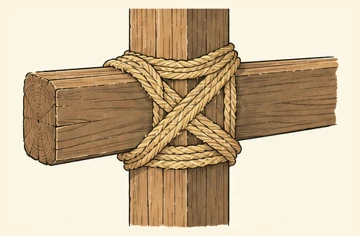
Where timbers cross, rope is wound tight in set patterns
The main work is done by specialist builders, the tetsudaikata, helped by neighborhood men. They assemble the tower on its side, insert the pole, and then haul the whole structure upright with ropes and manpower in a step called hikiokoshi, which always draws a crowd. Then come the wheels, the textiles and the lanterns, and the float is ready for its trial pull.
Taking it apart is just as fast. The parade finishes in the early afternoon, the floats roll home, and within a few hours the street holds only stacked timbers and coils of rope. The old explanation is that the floats have gathered the plague spirits and must be dispersed quickly. Few people in Kyoto think of it that way now, but the habit holds, and so the floats exist in the street for only a few days each year.
06Parade day: the rope, the child and the turn
The Saki Matsuri parade leaves Shijō-Karasuma at 9 a.m. on July 17. The Naginata-hoko leads east along Shijō. At Shijō-Fuyachō a sacred rope, a shimenawa, is stretched across the street, and the child on the float cuts it with a single stroke of a sword. This is the shimenawa-kiri, which opens the boundary into sacred space and lets the procession pass. It is the first great moment of the day, and the sidewalks there are full by early morning.
The Naginata-hoko is the only float still carrying a living chigo, or sacred child; the others use dolls. The chigo is usually a boy of about 10 from a Kyoto merchant family. After a series of rites he is treated as a messenger of the god, and for part of the festival his feet must not touch the ground; adults carry him on and off the float. At his shrine visit the chigo is granted the fifth court rank and the title of junior captain, a standing likened to that of a feudal lord with a domain of 100,000 koku, which is why the rite is nicknamed "receiving rank." The family that provides the chigo bears heavy expenses. It is an honor and also a burden.
At the Shijō-Kawaramachi intersection the parade turns north. This is the tsuji-mawashi, the turning at the crossroads, and it is the part of the parade most people come to see. A hoko’s wheels are fixed to their axles and cannot steer. To turn, the crew lays split green bamboo under the front wheels and soaks it with water so it becomes slippery. Between 2 and 4 men called ondotori stand at the front of the float’s lower deck, facing the pullers, and signal with folding fans while calling out a rhythm. Dozens of pullers heave on the ropes together, the wheels slide sideways over the wet bamboo, and the float pivots a few degrees. Then the bamboo is reset, more water is thrown, and they pull again. It usually takes 3 or 4 pulls to bring the float through 90 degrees, and each one earns applause.
- 1
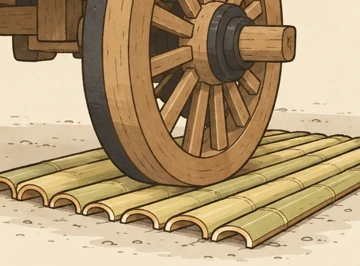 Split green bamboo is laid under the wheels
- 2
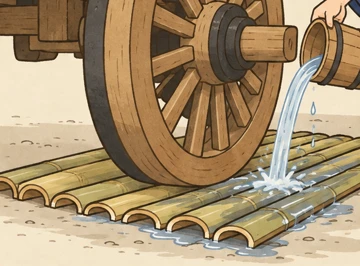 Water is poured on the bamboo to make it slippery
- 3
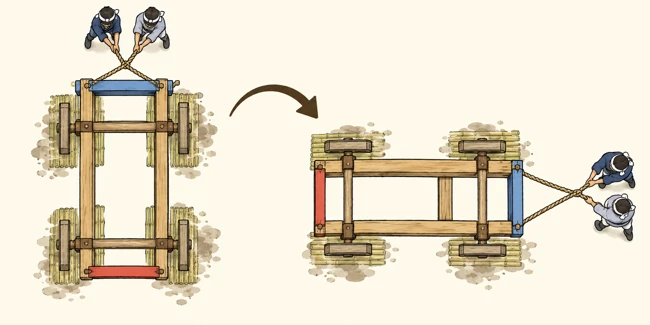 The pullers heave together, dragging the fixed-wheel float sideways until it has turned 90 degrees, usually in three or four pulls
The difficulty is the height and weight. Pull too hard and the pole, its tip more than 20 meters up, whips, throwing the people on the float around; pull unevenly and the wheels jam. The ondotori are the conductors of the whole operation and the most watched men on the float. The kurumakata, wheel men, crouch by the wheels with wooden levers and wedges to adjust direction. The yanekata, roof men, ride on the roof watching for wires and signboards and keeping balance. All of them belong to the neighborhood or its preservation society, and in some families the same position has passed down for generations.
There are further turns at Kawaramachi-Oike and Shinmachi-Oike. The Saki Matsuri route runs east on Shijō from Karasuma, north on Kawaramachi, west on Oike, and south down Shinmachi back toward the neighborhoods. The Ato Matsuri runs the reverse: from Karasuma-Oike east to Kawaramachi, south to Shijō, and west back to Karasuma. Shinmachi Street is narrow, and the floats pass so close to the houses that their eaves nearly brush the second-floor windows. It is the place to see a hoko at its most overwhelming.
Saki Matsuri
- Leaves Shijō-Karasuma
- Shijō-Fuyachō: shimenawa-kiri
- Shijō-Kawaramachi: turn north
- Kawaramachi-Oike: turn west
- Shinmachi-Oike: turn south
- Back toward the neighborhoods
Ato Matsuri
- Leaves Karasuma-Oike
- Kawaramachi: turn south
- Shijō: turn west
- Back to Karasuma
Every corner means a tsuji-mawashi; the Saki Matsuri first cuts the sacred rope at Shijō-Fuyachō, and the Ato Matsuri runs the route in reverse.
Along the way, at Shijō-Sakaimachi for the Saki Matsuri and in front of City Hall for the Ato Matsuri, each float stops for the kuji-aratame, the lottery check. An official played by the mayor of Kyoto, dressed as a magistrate, inspects each float’s lottery slip to confirm it is in its proper place. A float representative presents the slip in a lacquered box with formal movements, and the exchange plays out like a short piece of theater.
The music is Gion-bayashi: transverse flutes, small hand gongs called kane, and drums. The bright clang of the gongs is rendered in Japanese as konchikichin, and to Kyoto ears it is the sound of July. During the parade the music is slow and stately; on the way home after the parade it becomes faster and lighter. Each float has its own repertoire, sometimes dozens of pieces, all transmitted by ear. From early July the musicians rehearse every night on the second floor of their neighborhood halls, and the sound drifts down into the streets.
07Yoiyama: lanterns, folding screens and chimaki
Ask a Kyoto resident when to go and many will say yoiyama, not the parade. The parade is in daytime heat and crushing crowds. Yoiyama is at night. Each float is hung with rows of paper lanterns arranged in a triangle from the top of the tower down to the base, the music floats out over the street, and the district around Shijō-Karasuma becomes one enormous night market.
On the evenings of July 15 and 16, parts of Shijō and Karasuma streets are closed to cars and lined with food stalls. The main intersection can become nearly impossible to move through. The better experience is in the side streets, along Muromachi, Shinmachi and Nishinotōin, where the neighborhood halls are open and display their floats’ ornaments, figures and old textiles.
Each neighborhood also sells chimaki, along with hand towels, fans and other charms. A Gion chimaki is not food. It is a bundle of bamboo grass leaves bound with the Somin Shōrai slip, hung over the door for a year and replaced at the next festival. Each float’s chimaki carries its own blessing: the Hōshō-yama for romance, the Arare Tenjin-yama for protection from lightning and fire, the Kakkyo-yama for prosperity. Buying a chimaki often earns admission to climb the float and see the musicians’ deck and the painted ceiling up close. As of 2026, some floats still do not allow women aboard, among them the Naginata-hoko and Hōka-hoko, a rule that has drawn public debate in recent years; according to some reports, certain floats have admitted women to their musical ensembles since 2001.
Yoiyama is also the time of the byōbu matsuri, the folding-screen festival. Old merchant families along Muromachi and Shinmachi remove the lattice fronts of their townhouses and display heirloom screens and artworks in their front rooms for passers-by. Kyoto’s machiya townhouses are long and narrow, nicknamed "eel beds," and are closed to the street the rest of the year. These evenings are a rare look inside.
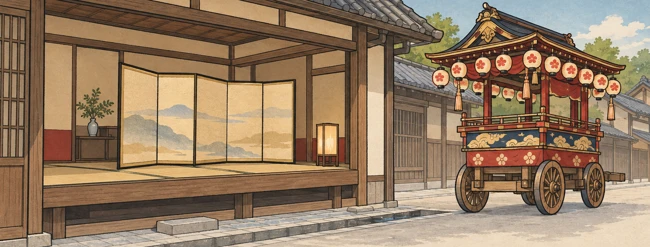
During yoiyama, old merchant houses remove their lattice fronts and display folding screens to the street
Children in light summer kimono stand in front of the halls singing a slow, drawn-out song in Kyoto dialect, inviting passers-by to buy chimaki and offer a candle. Along with the konchikichin of the gongs, it is the sound of a Kyoto summer night.
The Ato Matsuri yoiyama is smaller, with no food stalls and perhaps half the crowd, but the Kita-Kannon-yama, Minami-Kannon-yama and Ōfune-hoko are on this side, and the quieter streets suit a slow look. The Minami-Kannon-yama is known for the abare Kannon, the rampaging Kannon. Tradition holds that the Kannon of the northern float is male and that of the southern float female, and late on the last night of yoiyama, July 23, the statue, by one account first wrapped in cloth and lashed to a litter, is carried through the neighborhood like a portable shrine and shaken hard, as a prayer for a safe parade the next day.
08Yasaka Shrine and the mikoshi
The floats belong to the neighborhoods. The mikoshi belong to the shrine, and they are the festival’s religious core. On the evening of July 17 three portable shrines leave Yasaka Shrine; on the evening of July 24 they return.
The three are the Naka-goza, carrying Susanoo; the Higashi-goza, carrying his wife Kushinadahime; and the Nishi-goza, carrying their eight children. They are enormously heavy, the Nishi-goza at around 3 tons, and each is borne by its own bearers’ association: Sanwaka, Shiwaka and Nishiki. In the plaza at the foot of the shrine’s steps the three are lifted high and spun in turn, a moment called sashiage, before they set off by separate routes through the city, arriving late at night at the Otabisho on Shijō. The Nishiki association, which carries the Nishi-goza, is centered on the merchants of Nishiki Market, the long covered food street known as Kyoto’s kitchen.
The mikoshi washing on July 10 is a quieter rite. The Naka-goza is carried onto the Shijō Bridge, and the chief priest sprinkles it with Kamo River water from a branch of sakaki, the sacred evergreen. Bystanders who catch a drop are said to be protected.
Many tourists treat Yasaka Shrine as the festival’s venue. It is the festival’s spiritual home, but the floats and yoiyama are a little over a kilometer west, around Shijō-Karasuma. At the shrine you see the mikoshi.
09Seeing the festival
The festival falls in Kyoto’s hottest weeks. Daytime highs in mid-July often pass 35°C with high humidity, and the parade means hours standing in the sun. Bring a hat, a fan, water and a towel for sweat.
Where to stand depends on what you want to see. For the rope-cutting, be near Shijō-Fuyachō by around 7 a.m.; it is the most crowded spot on the route. For the turns, the corners at Shijō-Kawaramachi and Kawaramachi-Oike are best, ideally from the diagonal corner where you can watch the whole maneuver. For a seat, shade and a view of the full procession, the seating stands along Oike Street are a good choice with children or older companions. For the closest view of a hoko, try Shinmachi Street, but it is narrow and packed, so take care.
For yoiyama, the 14th is the least crowded and best for looking at displays and screens. The 15th and 16th are the busiest, with roads closed after dark and stalls lining the streets. After 9 or 10 p.m. the crowds thin, and walking the lanes of Muromachi and Shinmachi with the lanterns still lit and the music still playing can be the best part of the trip.
To take part rather than watch, join a hikizome trial pull around July 12 and 13; the floats announce their times and anyone can take the rope. Buy a chimaki and climb a float during yoiyama. Or come on July 24 for the Ato Matsuri parade and the Hanagasa procession, with far smaller crowds than the 17th.
A few things to keep in mind. The festival belongs to the neighborhoods and the shrine. Inside the halls and on the floats, some places forbid photography or require you to remove your shoes; follow the instructions of the people in charge. Do not open an umbrella in a crowd, and stay off the roadway when floats pass: a hoko has no brakes and is hard to stop once it is moving. Food stalls are many and trash cans few, and the city asks visitors to carry their trash home.
July in Kyoto is also the season of hamo, pike conger, a bony eel-like fish that cooks score finely so the bones disappear, then blanch until the flesh opens like a white flower and serve with pickled plum. The Gion Matsuri is sometimes called the hamo festival for this reason, and you will see the fish on menus everywhere. Ōsaka holds its Tenjin Matsuri later in July, and towns across Japan have their own summer festivals and fireworks, each a subject of its own (see also: Tenjin Matsuri: Ōsaka’s Festival of Fire and Water; Hanabi: Japan’s Summer Fireworks Festivals).