
At a glance
Ōsaka’s July festival for Sugawara no Michizane: the halberd ritual, land and boat processions, fireworks, the Ōsaka-jime handclap, and where to watch.
- Tenjin Matsuri honors Sugawara no Michizane, god of learning, at Ōsaka Tenmangū; it ranks with Gion and Kanda as one of Japan’s three great festivals.
- It is always held on July 24 (yoimiya) and July 25 (honmiya), whatever the weekday.
- Its origin is said to be the hoko-nagashi rite of 951; a child still casts the sacred halberd into the Dōjima River on the morning of the 24th.
- On the 25th a land procession of about 3,000 people is followed by some 100 boats on the Ōkawa River.
- Offertory fireworks, about 3,000 shells, begin around 7:30 pm, and passing boats exchange the Ōsaka-jime hand-clap.
On July 24 and 25 every year, Ōsaka gives two days to a man who died in exile more than eleven centuries ago. Sugawara no Michizane, the scholar-statesman worshipped as Tenjin, is carried out of Ōsaka Tenmangū shrine in a gilded palanquin, paraded through the streets by some 3,000 people in period dress, and then put on a boat. Around a hundred vessels follow him up and down the Ōkawa river while drums pound, Noh is performed on floating stages, crowds on the banks clap in unison, and fireworks burst overhead. The Tenjin Matsuri is counted among Japan’s three great festivals, alongside Kyoto’s Gion Matsuri and Tokyo’s Kanda Matsuri, and it is the loudest and most sociable of the three. This is an introduction to who is being honored, why the festival happens on water, what goes on across the two days, and how to see it.
01Tenjin and His Ōsaka Shrine
Sugawara no Michizane (845–903) was a court scholar, poet, and statesman of the Heian period who rose to the post of Minister of the Right. In 901 he lost a political struggle with the powerful Fujiwara clan and was sent into exile at Dazaifu, in Kyūshū, where he died two years later. What followed made him a god. Lightning struck the imperial palace, plagues broke out, and several of his rivals and members of the imperial family died. The court concluded that Michizane’s angry spirit was responsible, restored his rank posthumously, and enshrined him as Tenman Daijizai Tenjin, a deity associated with thunder.
Over time the fearsome thunder god softened into something gentler. Because Michizane had been a brilliant scholar and calligrapher, Tenjin became the patron of learning, and today the many Tenmangū shrines across Japan fill each winter with wooden ema (votive plaques) written by students praying to pass their exams.
Ōsaka Tenmangū stands in Kita Ward, a short walk north of the Ōkawa river. Locals call it simply "Tenjin-san," and the surrounding district takes its name, Tenma, from the shrine. According to the shrine’s founding legend, Michizane stopped to pray at a small local shrine here on his way into exile. Some fifty years after his death, seven pine trees sprang up overnight in front of that shrine and glowed at night; when Emperor Murakami heard of the wonder, he ordered a shrine to Michizane built on the spot. The shrine dates this to 949; other accounts give 953 for the founding itself.
02A Halberd on the River
The festival is said to have begun in 951, two years after the shrine’s founding. Priests launched a sacred hoko, a ceremonial halberd, into the river beside the shrine and let it drift. Where it washed ashore, they set up a temporary sacred site, an otabisho, and carried the deity there for a visit. The people who escorted the god traveled by boat, and that river journey is the seed of everything that came after.
The ritual, called the hoko-nagashi shinji, is still performed on the morning of July 24. A boy chosen as the shindō, or divine child, by custom a pupil at the local Nishi-Tenma elementary school, rides out into the middle of the Dōjima river with priests and casts the halberd into the water. The halberd no longer decides anything, but the festival still opens with that gesture.
It makes sense that Ōsaka would honor its god on water. In the Edo period (1603–1868) the city was known as "the nation’s kitchen": rice and goods from all over Japan arrived by boat, and the town was laced with canals and bridges. Merchants dominated the city, and they took over the festival. Trade guilds and neighborhood associations, called kō, each took responsibility for a particular part of the procession, supplying the money, the boats, and the people, and passing the duty down through generations. The kō took shape in the early eighteenth century, and many of the groups that take part today still operate in this way.
By the mid-Edo period the Tenjin Matsuri had reached a scale that astonished visitors. The boat procession floated downstream to an otabisho on the west side of the city (by one account near the Zakoba fish market), merchants built viewing stands along the banks, and the boats that went out to meet the god carried omukae ningyō, "welcoming dolls": huge figures of historical heroes and theater characters, some taller than a person, raised high to greet him as his boat passed. About fifteen of these dolls survive, designated tangible folk cultural properties by Ōsaka Prefecture, and they are put on display during the festival.
The modern era was harder on the festival. It was interrupted in the upheavals at the end of the Edo period and again during both world wars, and the boat procession only returned in 1949. By then land subsidence in Ōsaka had lowered the bridges until the boats could no longer pass under them on the old route downstream. In 1953 the boat procession was reorganized to run upstream on the Ōkawa from Tenjinbashi bridge, which is the pattern it follows today. The welcoming dolls faded from use. What survives is a rebuilt version of the Edo festival, but its core, a god taken out onto the water by the people of the city, has held.
03July 24: The Drums Wake the City
The first day, the yoimiya or eve, belongs mostly to the neighborhood. After the halberd ritual in the morning, the sound that carries through Tenma all day is the moyōshi-daiko, the "summoning drum."
The moyōshi-daiko is a big drum mounted on a wooden frame and carried on the shoulders of a team of men. Six drummers, known as ganji, sit on the frame, three on each side of the drum, wearing long red hoods called nage-zukin, the single most recognizable image of the festival. Their beat is heavy and carries a long way. When the drum enters the shrine, the bearers slip logs under the frame and rock it like a seesaw, so violently that the drummers end up almost sideways, still striking; this move is called karausu. As the name suggests, the drum’s job is to announce the festival and clear the way for the god, and on the eve it makes the rounds of the surrounding streets while shopkeepers and residents step outside to watch. According to spectators’ accounts, though, the drum was missing from the land procession in both 2024 and 2025; a weekly magazine reported that at the end of 2023 the shrine had banned the Taikonaka, the group that runs the drum, indefinitely. As of 2026 the shrine has given no public explanation, and a news report on the 2026 festival described the land procession as led by a band.
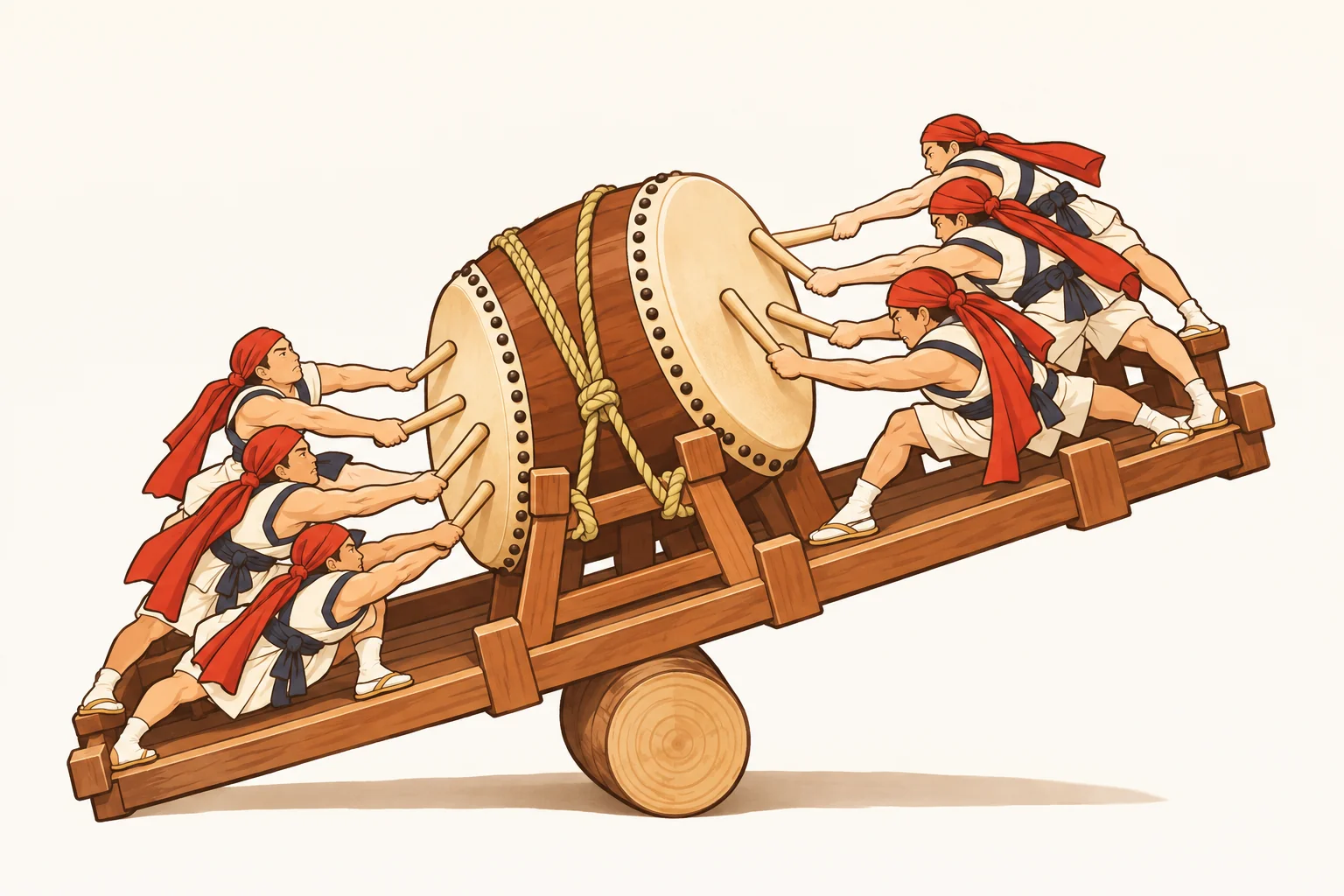
The moyōshi-daiko rocked like a seesaw as it enters the shrine, its red-hooded ganji still drumming.
Other sounds layer on top of it. Danjiri, ornately carved wooden festival carts, are accompanied by danjiri-bayashi, a quick, bright music of gongs, drums, and flutes. Lion dancers weave through the crowds. Just west of the shrine runs the Tenjinbashi-suji shopping arcade, which at about 2.6 kilometers claims to be the longest in Japan, and on July 23, the day before the eve, it hosts the gyaru mikoshi, a portable shrine carried by young women recruited by open call. The tradition dates only from 1981, but it caught on quickly and is now one of the festival’s best-known sights.
By evening the streets around the shrine are lined with food stalls selling takoyaki, yakisoba, and shaved ice, and families and teenagers in yukata (light cotton summer kimono) drift between them. The eve is a local’s night, noticeably more relaxed than what follows.
04July 25: The Land Procession
On the main day, the honmiya, priests hold a ceremony in the afternoon to transfer Michizane’s spirit from the main hall into his palanquin. The deity rides in the gohōren, a gilded palanquin crowned by a golden phoenix. Two portable shrines accompany it, the Tama-mikoshi and the Ōtori-mikoshi, each maintained by its own association.
A shrine palanquin: the gohōren carrying Tenjin’s spirit likewise has a golden phoenix on its roof
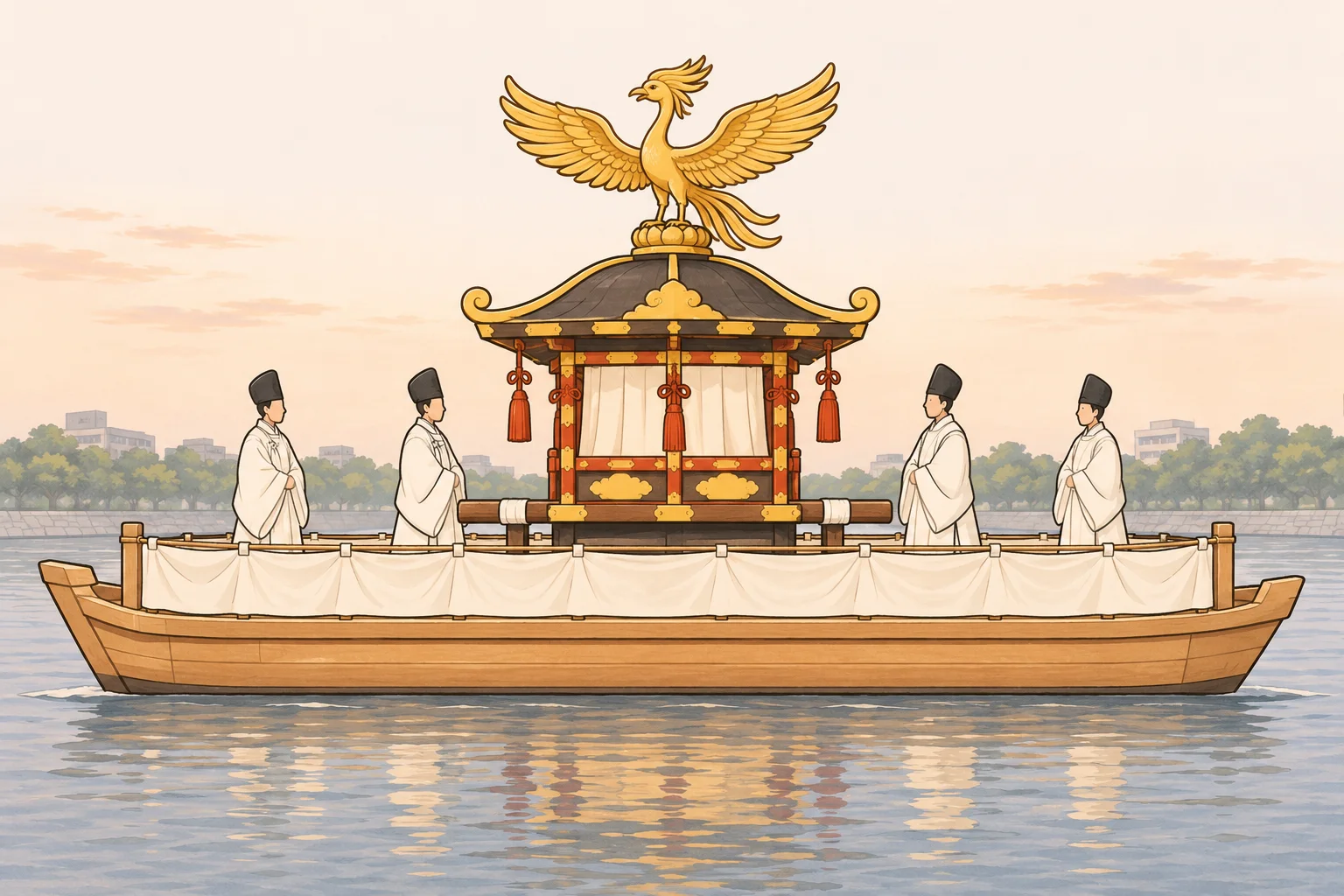
The boat carrying the gohōren, the deity’s palanquin crowned by a golden phoenix, is at the center.
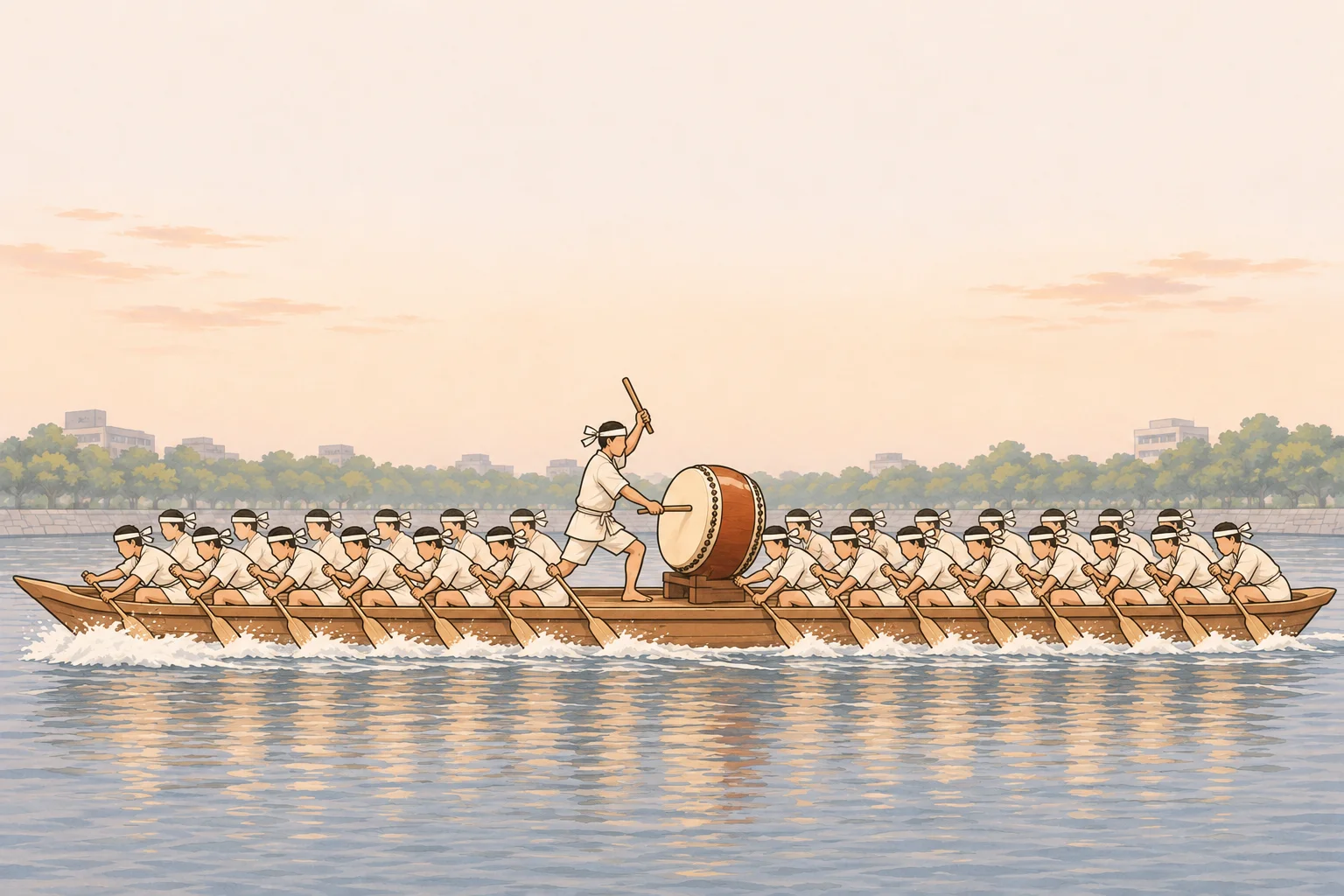
A dondoko-bune is a long narrow boat rowed by some forty young men to a drum in the middle of the hull.
At around 3:30 p.m. the riku-togyo, or land procession, sets out. By custom the moyōshi-daiko leads, followed by a figure dressed as Sarutahiko, the long-nosed god who guides deities on their travels, then mounted priests, a child leading an ox, standard-bearers, people in Heian-period court costume, danjiri, lion dancers, umbrella dancers, and finally the gohōren and the mikoshi. Some 3,000 people take part. They walk slowly through the afternoon heat from the shrine to the riverbank at the north end of Tenjinbashi bridge. Watching the land procession is about looking at people: each association wears its own costume and carries its own regalia, so the line reads like a parade of the roles and trades that made up old Ōsaka.
- 1Moyōshi-daikoleads
- 2Sarutahikoguide of the deities
- 3Mounted priests
- 4Child leading an ox
- 5Standard-bearers
- 6Heian court costume
- 7Danjiri
- 8Lion and umbrella dancers
- 9Gohōren and mikoshi
Some 3,000 people walk from the shrine to the north end of Tenjinbashi bridge, with the deity’s gohōren and the mikoshi coming last.
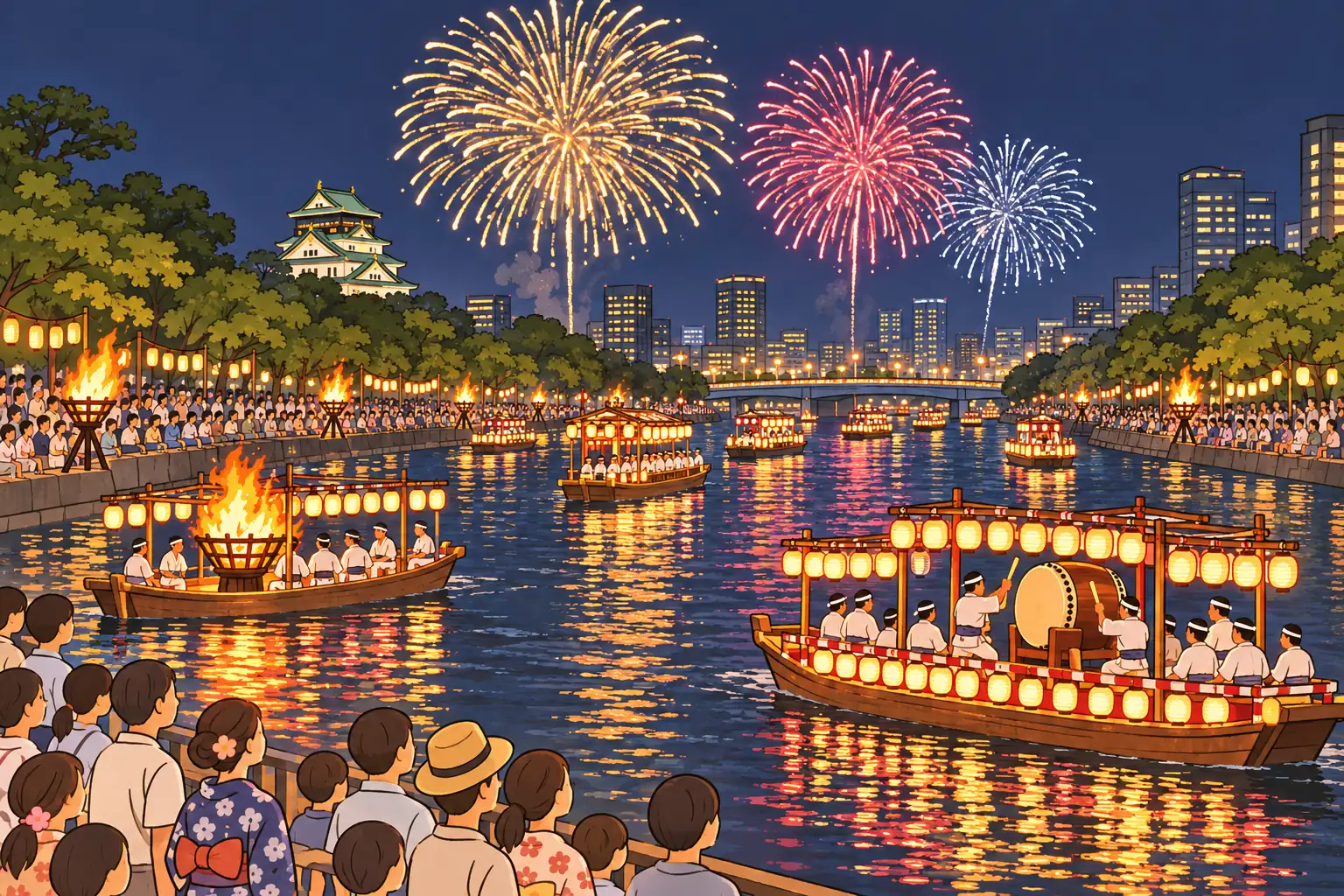
Tenjin Matsuri night: lantern-lit boats on the Ōkawa River beneath offertory fireworks, crowds lining both banks (illustration).
05The Boat Procession and the Fireworks
At the river the procession boards boats, and the funa-togyo, the boat procession, begins at around 6 p.m. About a hundred vessels take part. At the center are the boats carrying the gohōren and the mikoshi. Around them are boats bearing the summoning drum and danjiri musicians, a boat with a Noh stage on which Noh and kyōgen comedy are performed, a boat carrying Bunraku puppets, and dozens of hōhaisen, "worship boats," chartered by companies and organizations whose passengers, also in yukata, come to pay their respects to the god as his boat goes by.
The most energetic vessels are the dondoko-bune, long narrow wooden boats rowed by some forty young men each to the beat of a drum in the middle of the hull. They are fast and loud, and they dart among the larger boats.
Part of the fleet travels upstream from Tenjinbashi while another part comes down from farther up the river, so the boats cross each other on the water. Whenever two boats meet, the people aboard exchange the Ōsaka-jime, a rhythmic hand-clapping ritual peculiar to the city. A leader calls "Uchimasho" ("let’s clap"), and everyone claps twice; "Mo hitotsu se" ("once more"), and two more claps; "Iwōte sando" ("three times to celebrate"), and a final clap-clap, clap. Through the evening this exchange ripples across the river, and people on the banks and bridges join in. For a visitor it is the easiest way to become part of the festival.
As darkness falls, bonfires and lanterns are lit along the banks, the boats’ lanterns come on, and their reflections spread across the water. At around 7:30 p.m. the hōnō hanabi, the fireworks offered to the god, begin, launched upstream around Sakuranomiya and Kawasaki parks and lasting more than an hour, about 3,000 shells in all. They are an offering rather than a commercial fireworks show, but for the crowds on shore the combination of fire in the sky, light on the water, and drums from the boats is the image of the Tenjin Matsuri that stays. After the boat procession the god returns overland to the shrine, and a closing ceremony is held at around 10 p.m.
06Why Ōsaka Celebrates This Way
Put the Tenjin Matsuri next to Kyoto’s Gion Matsuri and the difference in temperament is plain. The Gion Matsuri’s great float procession is stately and connoisseurial, with each neighborhood’s float a moving museum of textiles and carving. The Tenjin Matsuri prizes energy, numbers, and noise, and it wants everyone clapping together.
That reflects the city. Ōsaka grew rich as a merchant town, and putting on a lavish, generous festival was itself a form of standing. Edo-period merchants showed their strength by taking on festival duties and used them to cement ties within their trades and neighborhoods. The companies that charter worship boats today, and the shopping streets that organize associations, are doing something very similar.
The festival is also a marker in the Ōsaka year. It falls just after the rainy season ends, at the start of the worst of the heat, and for Osakans it is the liveliest two days of the summer; some say summer only really begins once it is over. People can have a lifelong relationship with it: the night stalls as children, the riverside fireworks as teenagers, a seat on the company boat as adults. Its god may be the patron of exams, but the festival rarely makes anyone think of studying. It is the city showing up for itself once a year.
07Seeing It for Yourself
The festival is held on July 24 and 25 regardless of the day of the week. If you can, go on both days. The 24th is the time for the halberd ritual, the lion dancers, and the shopping arcade, with smaller crowds; the 25th brings the land procession, the boats, and the fireworks, along with more than a million spectators. The nearest stations to the shrine are Minami-morimachi on the subway and Ōsakatenmangū on the JR Tōzai Line, each a few minutes’ walk away.
For the land procession, find a spot along the route between the shrine and Tenjinbashi in the early afternoon; any stretch with shade goes quickly. For the boats and fireworks, the main viewing areas are along both banks of the Ōkawa, around Sakuranomiya Park, Kawasaki bridge, and Tenmabashi. These get extremely crowded by evening; police set up one-way foot traffic and some bridges are closed to standing. If you get the chance to board a worship boat, seeing the festival from the water is a different experience altogether.
Late July in Ōsaka routinely reaches around 35°C, and evenings bring little relief. Carry water and a small towel. If you wear yukata, remember that wooden geta sandals can be punishing over a long walk. Stations jam up when the fireworks end, so it can be worth lingering by the river or walking to a station farther away. And when a boat comes past and someone on board starts calling "Uchimasho," clap along. One round of the Ōsaka-jime and you are in.