
At a glance
Why carp streamers fly in May: how Japan’s Tango festival moved from iris charms to samurai pride, merchant carp and Children’s Day, plus where to see them.
- Japan’s Tango festival is on May 5, also called the Iris Festival; since 1948 it has also been the national holiday Children’s Day.
- Shōbu, iris, sounds like the word for martial spirit, so under samurai rule the day became a boys’ festival.
- Carp streamers were invented by Edo townspeople, drawing on the carp-leaps-the-Dragon-Gate story as a wish for sons to rise in life.
- The black carp is the father, the red the mother, smaller fish the children; this family set became common only around the 1970s.
- Indoors families display helmets and armor; the Kantō region eats kashiwa-mochi, the Kansai more often chimaki, and evenings bring an iris bath.
Travel through Japan in late April or early May and you will see fish in the sky: long cloth carp, black, red and blue, swelling with wind above rooftops, balconies and riverbanks. These are koinobori, carp streamers, and they belong to May 5, a day once called Tango no Sekku, the Boys’ Festival, and now a national holiday named Children’s Day. The festival came from China as a ritual against disease, was reshaped by Japan’s warrior class, and was given its carp by the merchants of Edo. This is the story of why the fish fly, what families display indoors and eat on the day, and where to see hundreds of streamers crossing a river at once.
01What You See in May
The classic set-up is a tall pole in a garden, often taller than the house. At the very top spins a little wheel of arrows, the yaguruma, which clatters in the wind. Below it hangs the fukinagashi, a windsock of five colored stripes. Then come the carp, largest first: a black carp, a red carp, and one or more smaller carp in blue, green or orange.
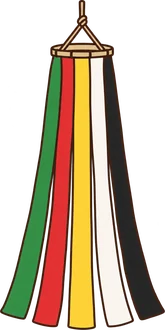
Fukinagashi: the five-colored streamer at the top of the pole.
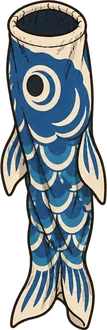
With no wind, the fish is a limp cloth tube.
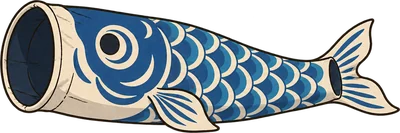
When the wind blows, the body fills out round.
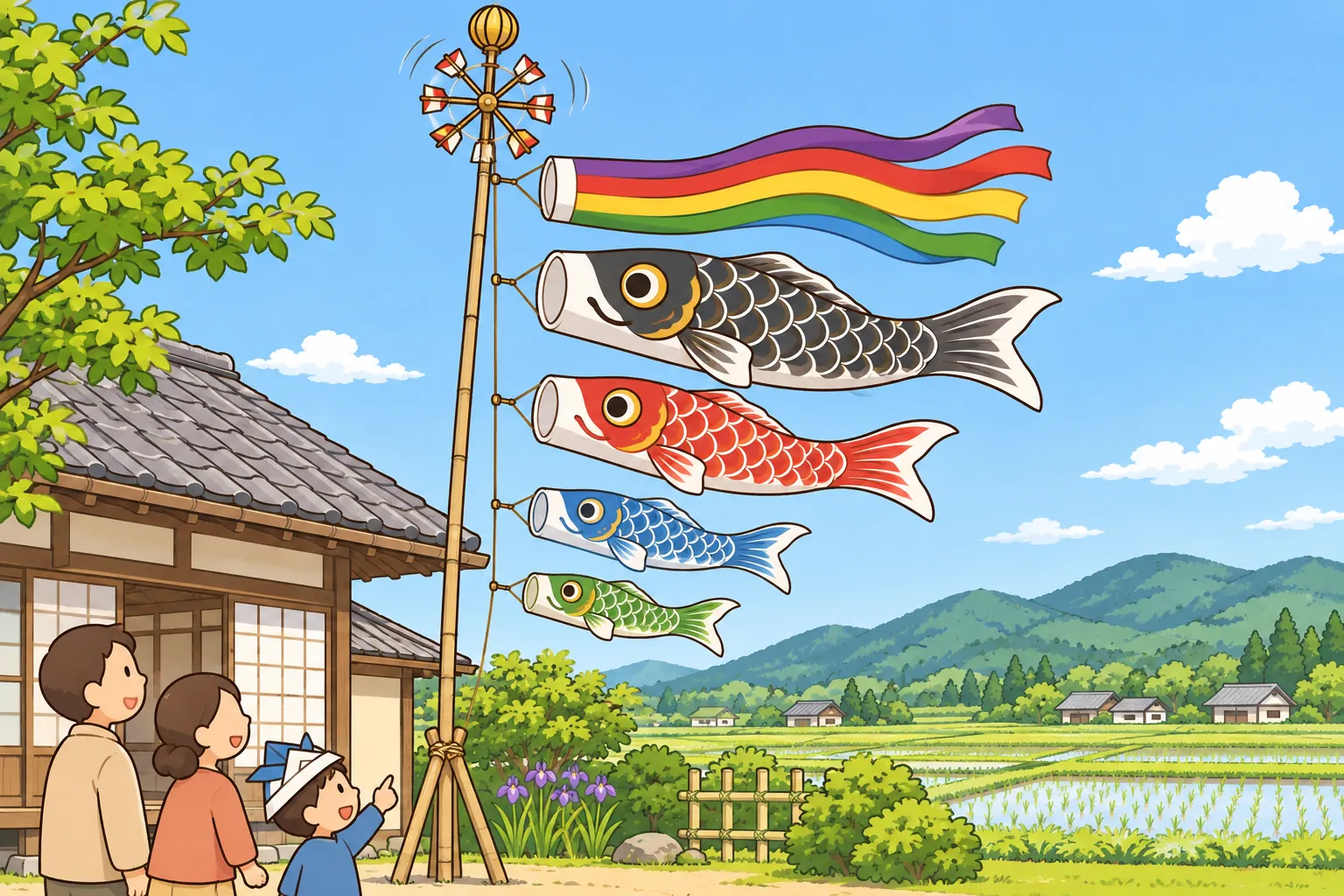
A pole taller than the roof in a country yard in May, flying a pinwheel, five-colour streamer and carp banners (illustration).
Most Japanese can read the set at a glance. The black magoi is the father, the red higoi is the mother, and the small fish are the children, traditionally one for each son. The five colors of the windsock stand for the five elements of Chinese cosmology and are meant to ward off evil; the rattling arrow wheel is said to catch the attention of the gods.
What makes koinobori work as an image is the wind. On a still day the streamers hang limp, like laundry. When a breeze picks up, each tube of cloth fills from the mouth, the body rounds out, and the tail flicks from side to side. The fish appear to be swimming upstream against the current of air, which is exactly the point.
Koinobori face outward, toward the street. They announce that a boy lives in this house and that his family hopes he will grow strong and rise in the world. Inside the house there is a second, quieter set of objects: miniature armor and helmets, warrior dolls, and on the day itself rice cakes wrapped in oak leaves and a bath scented with iris leaves. All of this sits under the name Tango no Sekku, the seasonal festival of the fifth day of the fifth month, also called Shōbu no Sekku, the Iris Festival. Since 1948 the same date has been Kodomo no Hi, Children’s Day. Families today rarely bother to separate these layers.
02From Medicine to Martial Spirit
The word tango originally meant the first "horse day" of the month in the Chinese calendrical cycle. Because "horse" (go) and "five" (go) sound the same, the festival settled on the fifth day of the fifth month. In China this was regarded as a dangerous time: the weather turned hot and humid, and illness spread. People hung mugwort and sweet flag over their doors, tied five-colored threads around their wrists, and drank realgar wine. Dragon-boat races and rice dumplings were tied to the legend of the poet Qu Yuan, who drowned himself in a river.
Much of this reached Japan early. The imperial court of the Nara and Heian periods held a fifth-month ceremony at which courtiers received kusudama, balls of sweet flag, mugwort and fragrant herbs trailing five-colored cords, to hang as protection. There were displays of mounted archery. In The Pillow Book, written around the year 1000, Sei Shōnagon declared that no festival could match the fifth-month one, when sweet flag was tucked under the eaves of every building, from the palace to the humblest house, and its scent filled the air. Two of these customs survive almost unchanged: nokishōbu, sweet flag placed along the eaves, and shōbu-yu, a bath with bundled sweet-flag leaves floating in the water.
The plant is the key to what happened next. Sweet flag in Japanese is shōbu, which sounds exactly like shōbu meaning "esteem for martial arts" (尚武) and like shōbu meaning "victory or defeat" (勝負). After warrior governments took power from the late twelfth century, a festival named after the plant became, by pun, a festival of martial spirit. The long, blade-shaped leaves even looked like swords, and boys used them for mock fights.
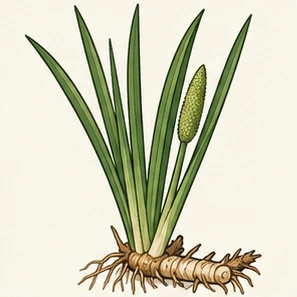
Shōbu: long, sword-like leaves and an inconspicuous flower spike.
Under the Tokugawa shogunate, which ruled from 1603, Tango became one of the five official seasonal festivals, the gosekku, alongside the seventh day of the first month, the third of the third, the seventh of the seventh and the ninth of the ninth. On these days daimyo and senior retainers put on formal dress and went to Edo Castle to offer greetings to the shogun. Over the same period the third-month festival became the Doll Festival for girls, Hinamatsuri, and the fifth-month festival became its counterpart for boys. Samurai families celebrated the birth of a son by setting up banners called nobori bearing the family crest outside the gate and displaying armor, spears and helmets in the entrance hall for the street to see.
03Why a Carp?
Merchants and artisans in Edo had no family crests to fly and no armor to show, but they wanted to celebrate their sons just as visibly. The usual account is that sometime in the mid-Edo period, townspeople began attaching paper carp to their banner poles. Over time the carp grew larger and the banners shrank, until the fish became the whole display.
The carp came from a Chinese legend. Somewhere on the middle reaches of the Yellow River lay a set of rapids called the Dragon Gate. Fish swam up from below, and any carp strong enough to leap the falls turned into a dragon. In China the phrase "a carp leaping the Dragon Gate" became shorthand for passing the imperial examinations; in Japan, the related word tōryūmon, "climbing the Dragon Gate," still means a gateway to success. A fish that fights its way upstream made a natural emblem for a son’s career. The carp is also a tough animal, able to survive in muddy water and to grow very large, which suited parents who mostly wanted a healthy child.
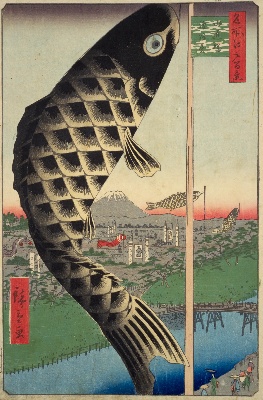
By the mid-nineteenth century carp streamers were a fixture of Edo in May. In Utagawa Hiroshige’s late print series One Hundred Famous Views of Edo, one sheet of 1857, Suidō Bridge and Surugadai, is almost entirely filled by a single enormous carp in the foreground. The view looks down from the Hongō heights across the Kanda River and Suidō Bridge to the rooftops of Surugadai, where samurai residences fly windsocks and banners of the demon-queller Shōki, with Mount Fuji far behind. Hiroshige makes the fish the subject and the city the background, and the print is one of the best-known images of koinobori ever made.
The family arrangement of the streamers is newer than it looks. Early koinobori were single black carp. A red carp was added later, from the Meiji period on, and at first it stood for the child rather than the mother. The children’s song "Koinobori," published in 1931 and known by its opening words "Yane yori takai" ("higher than the roof"), still describes the big black carp as father and the small red carp as the children. Only around the 1970s, by the usual account, did the set settle into a portrait of the nuclear family, with the red carp as mother and blue and green carp added for the children. Materials changed too, from hand-painted washi paper to cotton and then to nylon and polyester, which shrug off rain and keep their colors.
This flexibility is the most interesting thing about koinobori. They were never a court ritual. They were a commoners’ improvisation next to samurai ceremony, and they have kept changing with the shape of the family. Some households now fly carp for daughters too. City families without gardens buy one-meter sets that clip to a balcony railing, or tabletop versions a few inches long.
04Armor, Dolls and Oak-Leaf Cakes
Indoors, families display gogatsu ningyō, "May dolls." The centerpiece is usually a miniature suit of samurai armor or a helmet, a kabuto, sometimes with bows, swords and a folding screen. There are also figures of warriors, of the folk hero Kintarō, a red-skinned boy of enormous strength often shown riding a bear, and of Shōki, the bearded demon-queller from Chinese lore. None of this is meant to send the boy to war. Armor protected the body, and in the festival it becomes a talisman that takes misfortune in the child’s place.
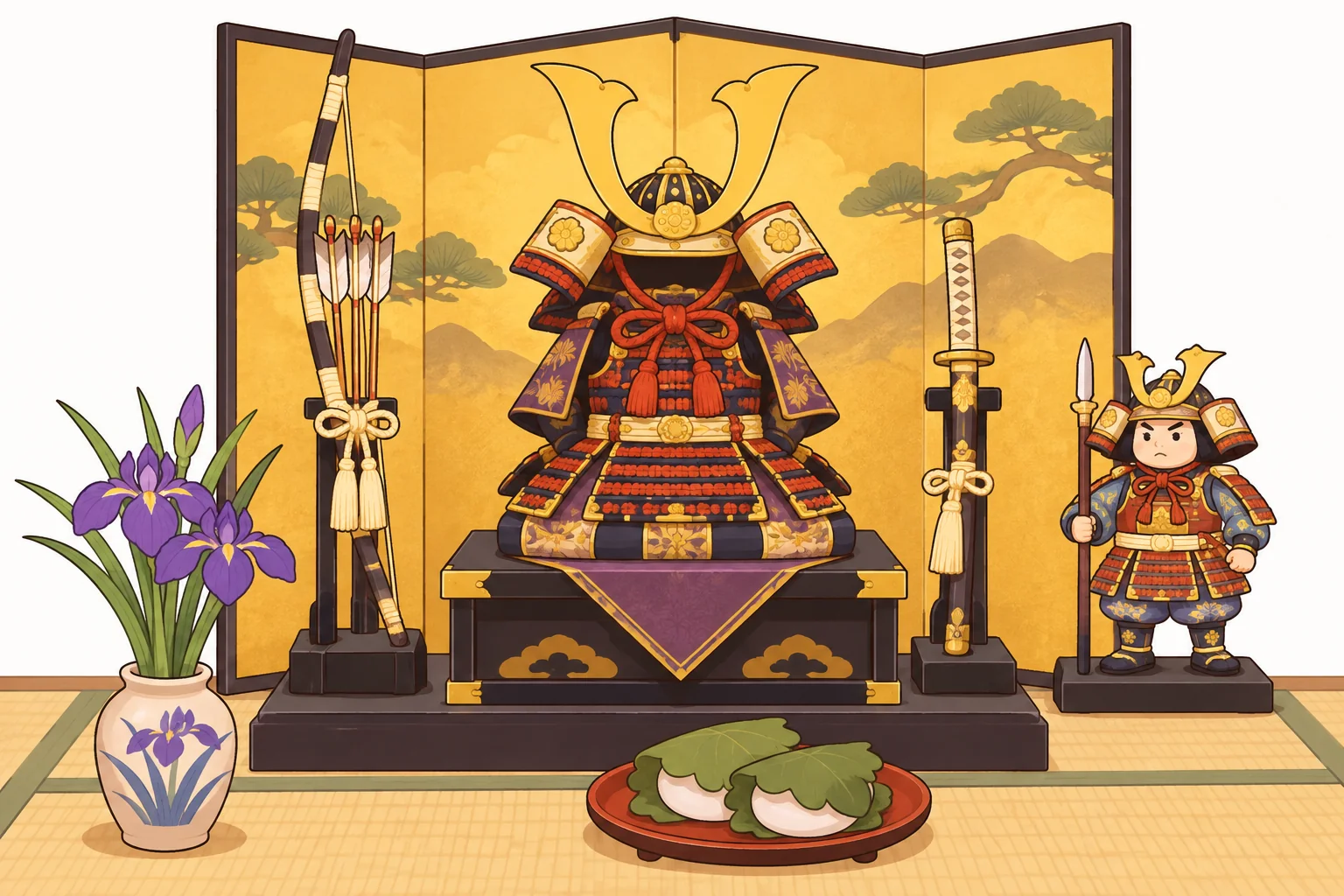
A May doll display on tatami: miniature armour and helmet with bow, sword and folding screen (illustration).
A boy’s first Tango is called his hatsuzekku, and in many regions it is customary for the mother’s parents to give the koinobori or the armor. A full armor display of fine workmanship can cost hundreds of thousands of yen, and many families now settle for a single helmet in a glass case. Iwatsuki, in Saitama, is the best-known doll-making town near Tokyo, and the wholesale district around Asakusabashi in Tokyo fills its shop windows with helmets every spring.
The food differs by region. In the Kantō area around Tokyo, people eat kashiwa-mochi: a disc of white rice cake folded around sweet bean paste and wrapped in a leaf of the kashiwa oak. The oak’s old leaves do not fall until new buds have grown, which made the leaf a symbol of a family line continuing unbroken, an idea that appealed to samurai households in Edo. You don’t eat the leaf. In the Kansai region around Kyoto and Ōsaka, people are more likely to eat chimaki, the older Chinese-derived festival food. Japanese chimaki are usually slender cones of sweetened rice-flour dough wrapped in bamboo or reed leaves and tied with rush.
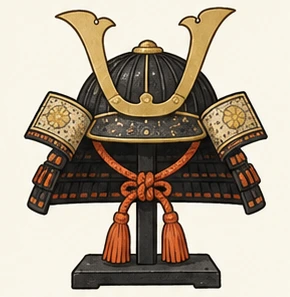
Many families now display just a helmet as their May decoration.
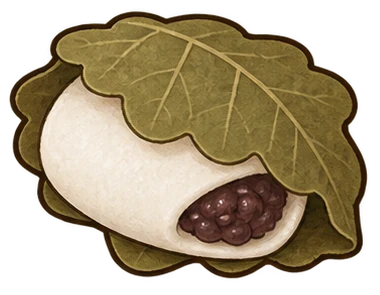
Kashiwa-mochi: rice cake with bean paste in an oak leaf, eaten mainly in the Kantō region.
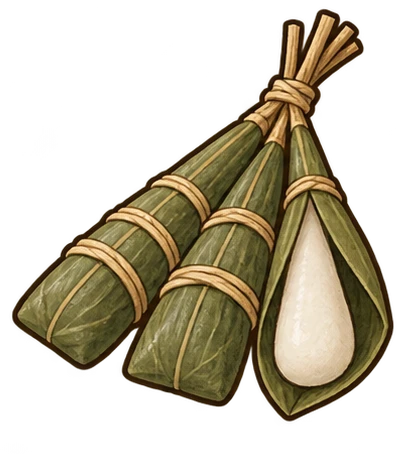
Chimaki: slender rice-flour dumplings wrapped in bamboo or cogon leaves, more common in Kansai.
In the evening many households take a sweet-flag bath, and public bathhouses often float bundles of leaves in the tubs on May 5. The water smells green and sharp. One source of confusion is worth clearing up: the shōbu of the festival is sweet flag, a plant grown for its aromatic leaves, with an inconspicuous flower spike, now placed in its own family, Acoraceae. The spectacular purple and white irises that bloom in Japanese gardens in June are hanashōbu, a different plant that only shares the name.
05Children’s Day and Where to See the Carp
In 1948 Japan’s new national holidays law made May 5 Children’s Day. The law describes it as a day to respect children’s personalities, to work for their happiness, and to thank mothers. On paper the festival now belongs to all children, not just boys. Falling after Constitution Memorial Day on May 3 and Greenery Day on May 4, it closes out Golden Week, when much of the country travels, trains are packed and expressways jam.
The older boys’ festival has not disappeared. Supermarkets still stack kashiwa-mochi and bundles of sweet flag, and department stores still open armor counters in April. But Japan has fewer children and smaller homes, and the backyard pole is getting rarer in cities. Many families end up with streamers they no longer use, and donated koinobori have produced the most spectacular sight of the modern festival: hundreds or thousands of carp strung on cables across a river.
The Shimanto River in Kōchi Prefecture, on Shikoku, is often credited with starting this practice, and several hundred carp fly above its clear water each spring. In Tatebayashi, Gunma Prefecture, thousands of streamers are still hung along the Tsuruuda River each spring as of 2026, a display that once set a record for numbers. Kazo, in Saitama, is a traditional center of koinobori manufacturing and owns a giant carp about 100 meters long, raised by crane during its festival. At Tsuetate Onsen in Kumamoto, streamers crisscross the narrow gorge above the hot-spring inns, so you can watch them from the bath.
If you go, aim for a sunny, windy day in April or early May; most displays come down within a week or two after Golden Week. On a calm afternoon the carp droop. When the wind rises, every fish over the river turns at once and fills out in the same direction, and that is the moment people come to see.
One last detail explains a few oddities. Japan moved to the solar calendar in 1873, so May 5 now falls about a month earlier than the old lunar date, which landed in the rainy season when sweet flag was at its best. Some areas, said to be mostly in Tōhoku and Hokuriku, still keep the festival a month late, around June 5, and you can occasionally spot carp in June. In Okinawa, dragon-boat races called hārī are traditionally held on the fourth day of the old fifth month, and Nagasaki has its own boat races, pēron, both much closer to the Chinese festival than the carp of Edo ever were.