
At a glance
How a Chinese star legend became Japan’s day for hanging written wishes on bamboo, why it falls in July or August, and Sendai’s paper streamers.
- Tanabata comes from the Chinese legend of the Weaver Girl and the Cowherd and reached the Japanese court with Tang culture in the Nara period.
- Vega and Altair, the two lovers’ stars, are both first-magnitude stars and form the Summer Triangle with Deneb, visible even from cities.
- In the Edo period Tanabata became one of the five seasonal festivals; temple-school pupils hung writing on five-colored paper strips, the origin of today’s wish slips.
- Since the 1873 switch to the solar calendar, most places celebrate on July 7, while Tōhoku and Hokkaidō often keep it around August 7.
- Sendai’s Tanabata runs August 6–8, with about 3,000 bamboo decorations hung in its covered shopping arcades.
In early July, stands of green bamboo appear in Japanese train stations, shopping malls, kindergartens and shrine forecourts, their branches sagging with strips of colored paper. Each strip carries a wish in someone’s handwriting: to pass an entrance exam, to get a puppy, for grandmother’s health to hold. This is Tanabata, the Star Festival. Its story of two lovers separated by the Milky Way came from China, but in Japan it grew into something different, less a lovers’ day than a day when anyone can write down what they hope for and hang it in the wind. This piece explains where the festival came from, why some Japanese celebrate it in July and others in August, and what you will see at Sendai, where Tanabata becomes a whole city’s paper art.
01Two Stars and a River of Sky
Tanabata is about two stars. On a summer night, the brightest star near the top of the sky is Vega, in the constellation Lyra. In Japan it is Orihime, the Weaver Princess. Across the pale band of the Milky Way, a little lower toward the southeast, is Altair in Aquila, known as Hikoboshi, the Cowherd. Together with Deneb in Cygnus they form the Summer Triangle, bright enough to find even from a Japanese city.

Vega and Altair face each other across the Milky Way (a sketch of their relative positions, not a scaled star chart).
The legend runs much as it does in China. The daughter of the Heavenly Emperor was a tireless weaver. When she married a cowherd from the far bank of the heavenly river, the two were so happy together that she stopped weaving and he let his cattle wander. Her father, angry, separated them on opposite sides of the river and allowed them to meet only once a year, on the seventh night of the seventh month. In the Chinese telling, magpies form a bridge so they can cross. Japanese tellings keep the magpies, but children are more likely to hear a different detail: if it rains on Tanabata, the river rises and the lovers cannot meet. Rain on that night is sometimes called sairuiu, "tear-hastening rain," the Weaver’s tears.
The festival’s name is a puzzle in itself. It is written with the characters for "seven" and "evening," but read tanabata, which matches neither character. The usual explanation is that the reading comes from a native word, tanabata, a kind of loom with a treadle, and from an old Japanese figure called the tanabata-tsume, a maiden who sat in a loom-hut built over water and wove cloth for a visiting god. When the Chinese story of the Weaver arrived, it merged with this local weaving maiden, and the Chinese characters took on the Japanese name.
02From Court Ritual to Schoolroom
Tanabata reached the Japanese court with the flood of Tang Chinese culture in the seventh and eighth centuries. The Man’yōshū, the great eighth-century poetry anthology, contains more than a hundred poems on the Tanabata theme, many written in the voice of the lovers waiting on either bank. The poet Yamanoue no Okura, usually regarded as the most celebrated of them, alone left twelve. By then the story was a standard subject for courtly verse.
At the Heian court, the festival took the form of a rite called kikkōden, literally "an offering to beg for skill." In China, women had prayed to the Weaver on this night for skill at weaving and needlework. In the palace garden (by one account, the courtyard of the Seiryōden, the emperor’s residential hall), offerings of melons, fruit, wine, needles and threads of five colors were laid out on tables, incense was burned, music was played, and courtiers composed poems under the stars. They wrote verses on the broad leaves of the paper mulberry (kaji), hoping to improve their poetry and calligraphy. The Reizei family of Kyoto, a court lineage that has kept a tradition of waka poetry for centuries, still holds a kikkōden around the old lunar date, with offerings laid out in the old manner. It is the closest thing to a Heian Tanabata that can be seen today.
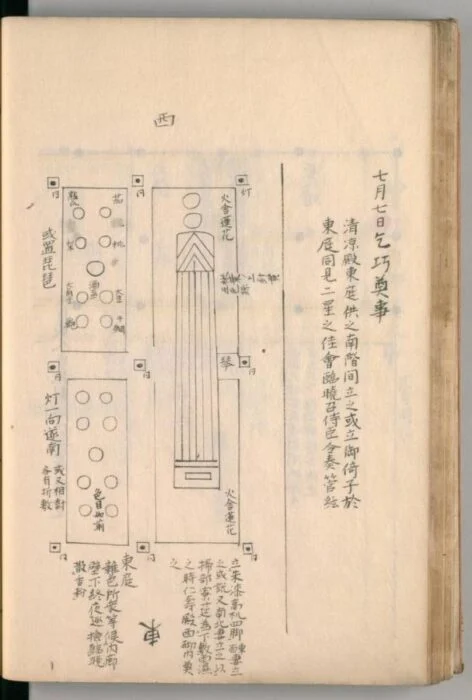
The "Kikkōden of the Seventh Day of the Seventh Month" layout in the Unzushō, showing where offering tables were set in the palace courtyard.National Diet Library, Unzushō manuscript
A food custom came from China too. People there ate a twisted wheat snack on the seventh night, and in Japan this gradually turned into eating sōmen, thin white wheat noodles. The noodles are said to resemble the Milky Way, or the Weaver’s threads. In 1982 Japan’s national association of dried-noodle producers declared July 7 "Sōmen Day," and a bowl of chilled sōmen is how plenty of families still mark the evening.
The decisive change came in the Edo period (1603–1868). The shogunate recognized five seasonal festivals, the gosekku, and Tanabata was one of them, alongside the seventh day of the first month, the Doll Festival on the third day of the third month, Boys’ Day on the fifth of the fifth, and the Chrysanthemum Festival on the ninth of the ninth. As an official holiday, Tanabata spread through ordinary society. The most important carriers were the terakoya, the small private schools where townspeople’s children learned to read and write. On Tanabata, pupils wrote poems and characters on strips of colored paper and tied them to bamboo, praying that their handwriting would improve. Over time the wishes widened from "better calligraphy" to anything at all, and the modern habit of writing a wish on a tanzaku, a narrow paper strip, grew from there.
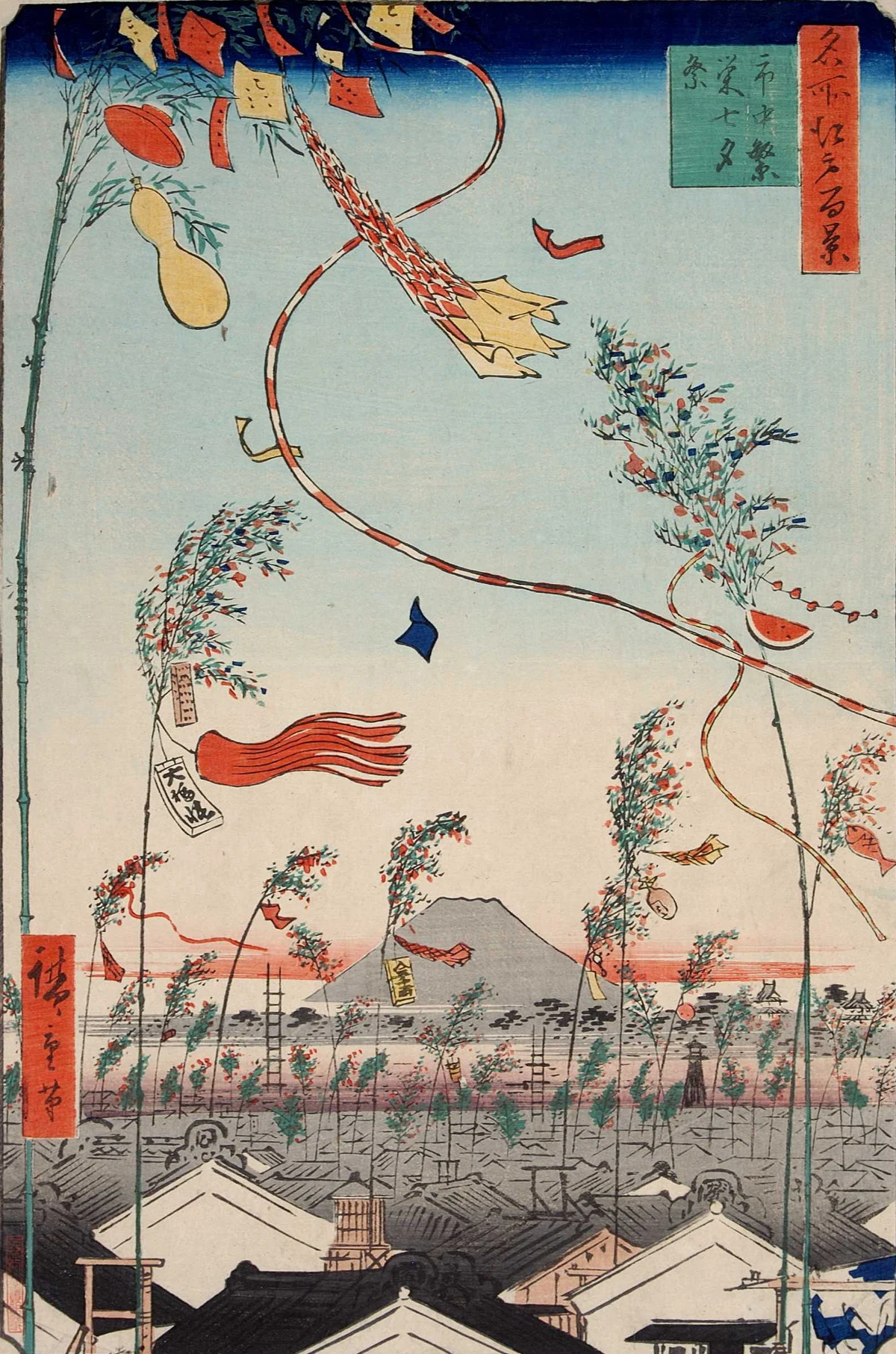
Edo itself went all out. In his series One Hundred Famous Views of Edo, Utagawa Hiroshige made a print of the city during Tanabata: above the rooftops, tall bamboo poles rise from almost every house, flying paper strips, streamers, and cut-paper shapes of an abacus, a merchant’s ledger, a watermelon and a sea bream, with Mount Fuji in the distance. Merchants hung abacuses and ledgers to pray for good business. The next day, the bamboo was carried to a river or the sea and set adrift, taking impurities away with it, an idea of ritual cleansing that runs deep in Japanese religious life.
03Bamboo, Paper and a Children’s Song
Why bamboo? It grows straight and fast, stays green all year, and has hollow sections, and in Japan it has long been seen as a plant a deity can descend into. The pine-and-bamboo kadomatsu set out at New Year draws on the same idea. For Tanabata people use leafy bamboo or dwarf bamboo, sasa, whose leaves rustle in the slightest breeze.
That rustle opens the song every Japanese child learns, "Tanabata-sama." Its first lines picture bamboo leaves rustling sara-sara under the eaves while the stars twinkle kira-kira overhead like scattered grains of gold and silver sand. The lyrics are by Gondō Hanayo, with additions by Hayashi Ryūha, and the music by Shimofusa Kan’ichi. The song appeared in a national school music textbook in 1941 and has been sung in kindergartens and primary schools ever since. Its second verse mentions "tanzaku of five colors."
The five colors are usually given as blue or green, red, yellow, white and black or purple, the colors of the Chinese five-phase system, the same palette as the threads laid out at the court rite. Today’s tanzaku come in every shade of craft paper, and while you may hear that a given color suits a given kind of wish, most people simply pick one they like.
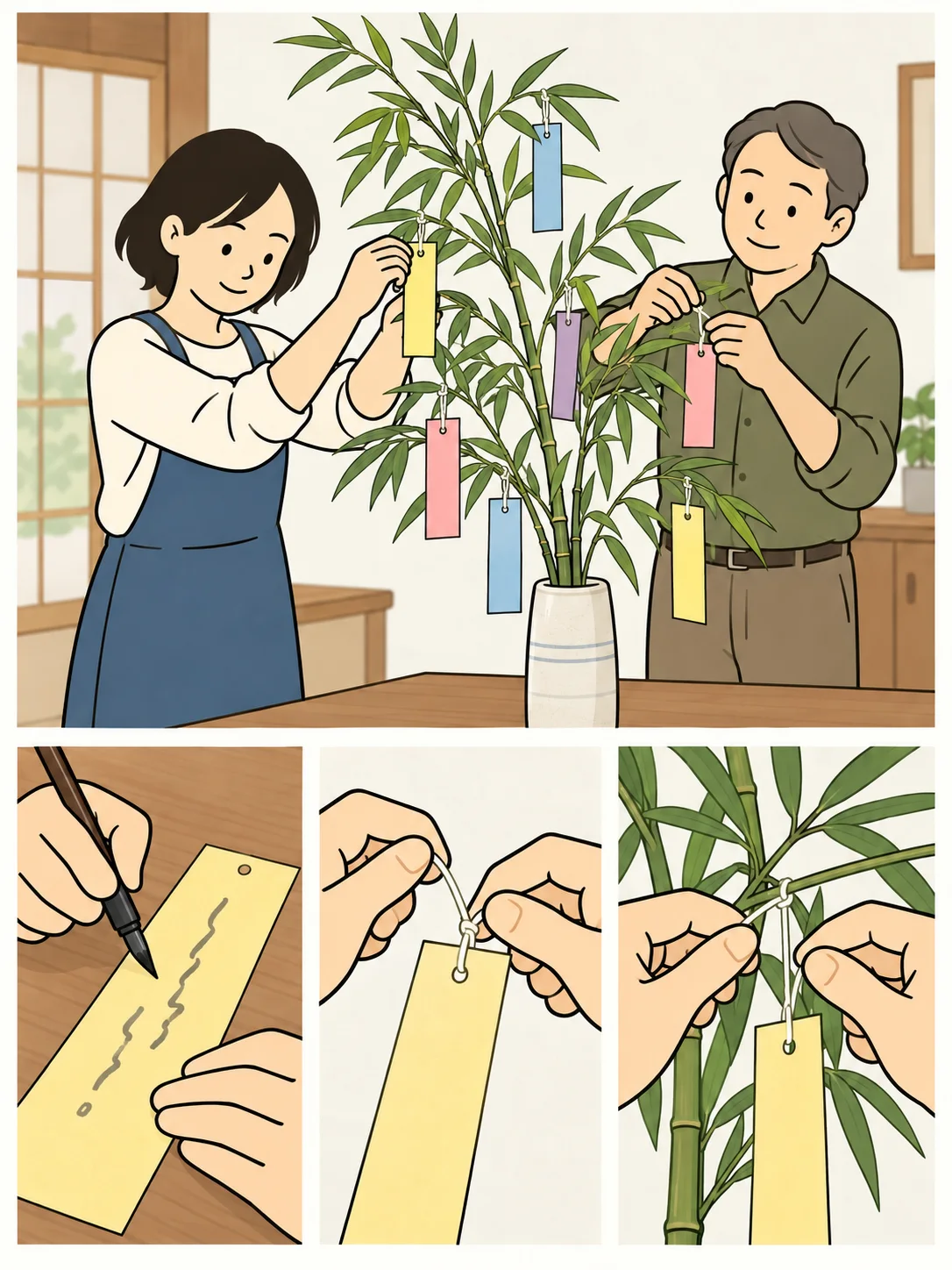
A family hangs wish slips on bamboo; below, the three steps: write the wish, thread the string, tie it to the branch.
Bamboo carries other paper decorations too: long streamers called fukinagashi, standing for the Weaver’s threads; little paper kimonos, kamigoromo, for skill at sewing and freedom from want; paper cranes, nets and purses. Sendai turned these into a set of seven, discussed later.
04July or August? A Calendar Split
Tanabata belongs to the seventh day of the seventh lunar month, which usually falls in August by the modern calendar. By then the rainy season is over, nights are clear, and the half-lit moon of the seventh lunar day sets before midnight, leaving the sky dark for the Milky Way. When the Meiji government adopted the Gregorian calendar in 1873, Tanabata was moved straight to July 7, which in much of Japan lands at the tail end of the rainy season. The chance of a clear sky is poor, and the old line about rain keeping the lovers apart now fits better than ever.
The result is that Japan has two Tanabatas. Schools, kindergartens, shopping malls and most households observe July 7, and many Tokyo-area shopping streets hold their Tanabata events in July. Other places, especially in the Tōhoku region of the north and in Hokkaidō, celebrate a month late, around August 7. That timing is closer to the season of the old calendar and keeps Tanabata next to Obon, the midsummer festival of the dead. In older custom, Tanabata was part of the run-up to Obon: washing utensils, cleaning family graves, floating away bamboo and impurities before the ancestral spirits returned. The great lantern festivals of Tōhoku, the Nebuta of Aomori and the Kantō of Akita, are commonly traced to nemuri-nagashi, customs of "floating away sleepiness" and misfortune around this time.
A few holdouts keep the lunar date, such as the Reizei family’s rite. The National Astronomical Observatory of Japan also promotes a "traditional Tanabata" calculated from the old calendar, announcing the date each year and encouraging people to go out and look at the stars on a night when they are more likely to be visible.
05Sendai: A City Hung with Paper
Japan’s most famous Tanabata takes place in Sendai, the largest city in Tōhoku, from August 6 to 8. It counts as one of the three great festivals of Tōhoku, with Aomori Nebuta and Akita Kantō, but it is unlike them. There are no floats, no drums, no chanting crowds, and, as it is usually described, no parade. The stars of the show are enormous bamboo decorations hanging silently beneath the glass roofs of the city’s covered shopping arcades.
Local tradition traces Sendai’s Tanabata to the time of the domain’s founder, Date Masamune, in the early seventeenth century, saying he promoted it as a rite for progress in learning and the arts, though this is a later story rather than a documented fact. What is certain is that Sendai observed Tanabata through the Edo period and that it faded after the Meiji calendar change. In 1927, local merchants revived it in a big way to draw customers during hard economic times, and the decorations grew steadily grander. The festival stopped during the Second World War, and in 1945 American air raids burned much of central Sendai. In 1946, residents put up 52 bamboo decorations among the ruins of Ichibanchō, and the festival became a symbol of the city’s recovery.
Today the decorations line the arcades of Chūō-dōri and Ichibanchō in the city center, roughly 3,000 of them by common estimates. Each uses a whole stalk of bamboo about ten meters tall, said to be mostly mōsō bamboo, the giant timber bamboo. At the top sits a big paper ball, the kusudama, and below it hang streamers several meters long, cut, folded and layered from washi paper in intricate patterns. Walking the arcade means brushing through curtain after curtain of paper. Each shop pays for and designs its own decoration, work begins months ahead, and designs are kept secret until the morning of August 6, when they all go up at once. Prizes are awarded, and winning decorations wear their ribbons proudly.
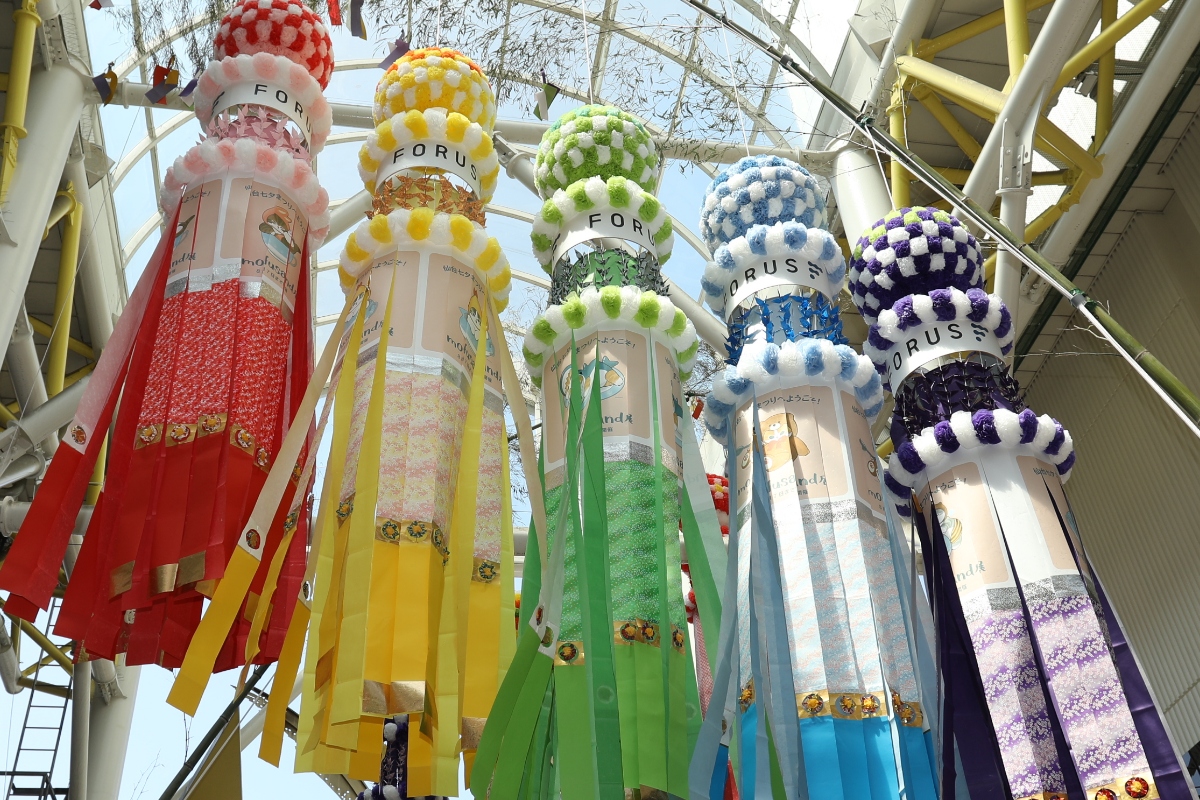
Giant fukinagashi streamers hang in a row under the arcade, each topped with a paper-flower kusudama.
Sendai codified Tanabata’s paper ornaments as the nanatsu-kazari, the seven decorations, each tied to a wish. The tanzaku is for learning and calligraphy. The paper kimono, kamigoromo, wards off illness and asks for skill at sewing. Paper cranes, orizuru, are for long life. The purse, kinchaku, is for prosperity. The net, toami, is for a good catch from the sea. The waste basket, kuzukago, filled with the scraps left over from cutting the other pieces, stands for thrift and cleanliness. And the fukinagashi streamer, the largest and most eye-catching piece, represents the Weaver’s threads and the wish for skill in handiwork.
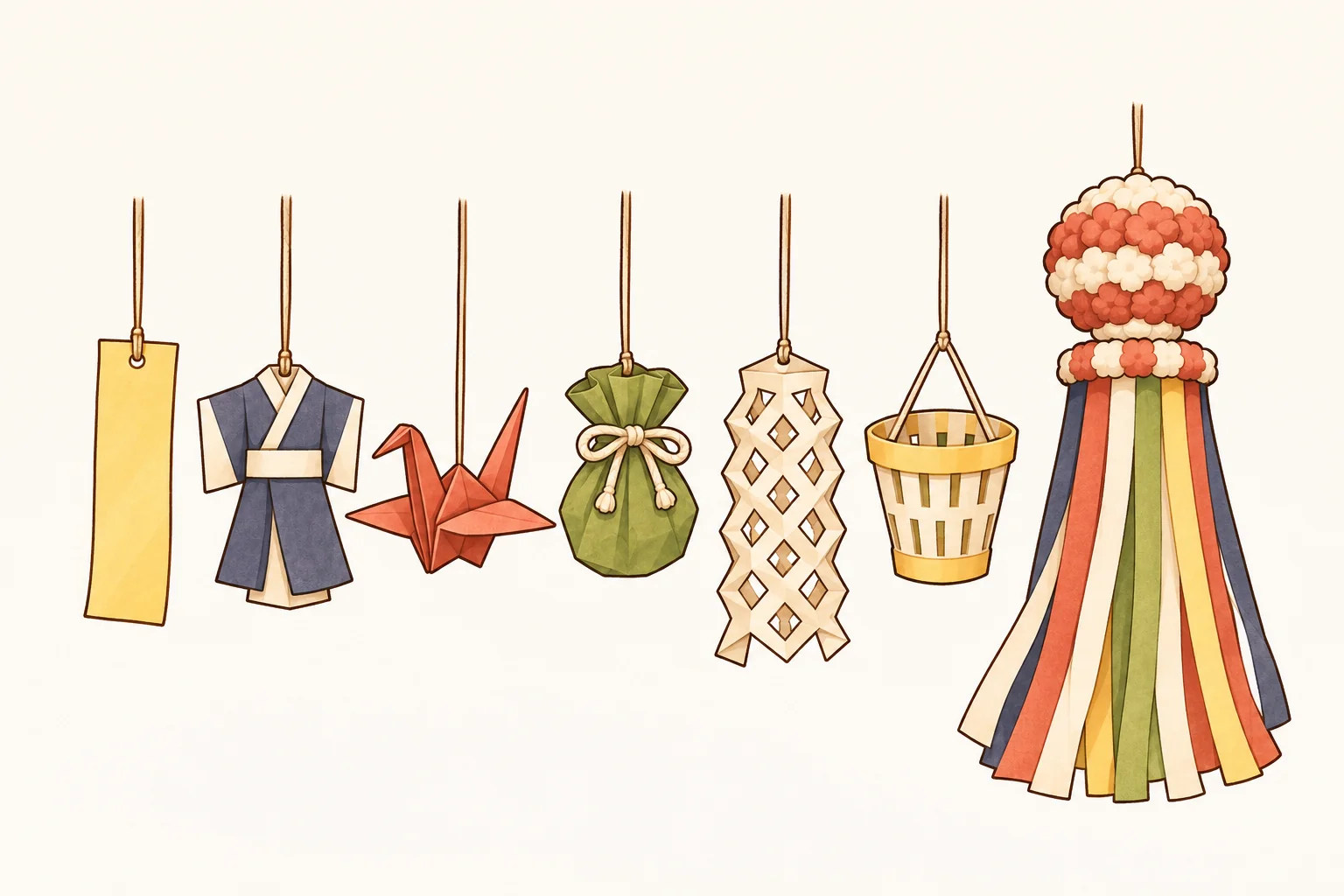
Sendai's nanatsu-kazari: tanzaku, kamigoromo, orizuru, kinchaku, toami, kuzukago and fukinagashi.
On the evening of August 5, a fireworks display over the Hirose River serves as the festival’s eve. By the organizers’ count, attendance over the three days usually runs to around two million, with about 1.97 million in 2026, and central hotels fill up early.
06Experiencing Tanabata in Japan
If you are in Japan in early July, you will almost certainly come across Tanabata bamboo without trying. Stations, department stores, malls and shrines set up a cluster of bamboo with a table of pens and blank tanzaku, and anyone may write one and tie it on. Wishes in English, Chinese or any other language are perfectly welcome. Reading other people’s wishes is half the pleasure: children want to be a Pokémon trainer or a professional soccer player, adults ask for a promotion, a slimmer waistline or a safe family, and someone usually asks for world peace. Shrines gather the strips afterward and burn them with prayers; malls simply take them down after the seventh.
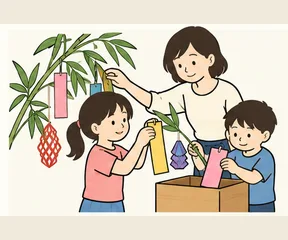
Children and an adult hang wish slips and paper ornaments on a bamboo branch.
Several big July festivals are worth a trip. The Shōnan Hiratsuka Tanabata Festival in Kanagawa, held in early July, has lavish decorations and is often named with Sendai among Japan’s "three great Tanabata festivals"; the third place goes to either Ichinomiya or Anjō, both in Aichi Prefecture, depending on who is counting. Tokyo’s Asagaya festival, in early August, is famous for papier-mâché characters from anime and pop culture hanging over its shopping street, and it has a more casual, playful feel.
In Sendai, go to the arcades during the day on August 6 to 8. Because the decorations hang under the arcade roofs, rain is no problem, and the arcades are a few minutes’ walk from the west exit of Sendai Station. Crowds are heavy, so go in the morning if you can, when you can still walk slowly beneath the streamers and look up at the texture of the paper. After dark, the lighting gives the decorations a different mood. Shops near the station sell Tanabata-themed sweets and small paper ornaments to take home.
Wherever you are, on Tanabata night it is worth walking somewhere dark and looking up for Vega and Altair. Early July in Tokyo is usually overcast, and the August dates around the lunar Tanabata give you a better chance. Even if the Milky Way stays hidden, tying a strip of paper with your wish to a bamboo branch is exactly how most Japanese people spend the festival.