
At a glance
How old calendars, the 72 micro-seasons, rainy spells, cicadas, morning glories and planted cedar forests give each stretch of the Japanese year its own signs.
- Japan’s seasonal vocabulary comes from the old calendar: a solar term for every 15 degrees of the sun’s path, and 72 micro-seasons of about five days each.
- From Honshū to Kyūshū the year is four seasons plus two rainy spells: tsuyu between spring and summer, autumn rain between summer and autumn.
- When the Meiji government adopted the Gregorian calendar in 1872, many festivals moved about a month earlier against the seasons.
- On the 1991–2020 averages, the rainy season in Kantō-Kōshin begins around June 7 and ends around July 19.
- A haiku normally contains a season word, and the fattest saijiki, the dictionaries of season words, run to several thousand entries.
Japanese people like to say that their country has four distinct seasons, and visitors often hear it as a slightly odd boast; plenty of countries have four seasons. What is distinctive is not the weather itself but how much attention is paid to it. Sweet shops change their window displays every couple of weeks, formal letters open with a remark about the weather of the month, the evening news announces when the rainy season has "probably" begun, and a single cherry tree at a Tokyo shrine is watched by meteorologists. This piece explains where that attention comes from: an old calendar that cut the year into seventy-two five-day pieces, two rainy seasons wedged between the four official ones, and a cast of plants, insects and objects, from cicadas and fireflies to pine trees and wind chimes, that the Japanese read as signs of the time of year.
01Four Seasons, Plus Two Wet Ones
The main Japanese islands of Honshū, Shikoku and Kyūshū sit in a temperate monsoon zone. In winter, dry cold winds come off Siberia, dumping snow on the Sea of Japan coast and leaving the Pacific side, including Tokyo, clear and crisp. In summer, a high-pressure system over the Pacific pushes hot, humid air across the islands. The handover between these two regimes is slow and messy. Early summer brings tsuyu, the plum rains; late summer and early autumn bring a second band of rain, akisame, along with typhoons. In practice Japan has six seasons rather than four, and its transitions are long enough to have their own names, foods and moods.
A rice-growing society had every reason to watch this closely, and the aristocracy turned the same attention into poetry. The Kokinshū, an imperial anthology compiled in the early tenth century, is arranged by season, beginning with spring, and for the next thousand years Japanese verse kept that order. In haiku the season became a rule: a poem is expected to contain a kigo, a season word. Frogs mean spring, fireflies summer, the moon on its own means the autumn moon, and so on. Books called saijiki collect these words with model poems, and bookstores still stock them; a full one runs to thousands of entries.
The habit spread into almost every refined corner of life. In the tea ceremony the scroll, flowers and sweets follow the calendar. Kimono patterns are worn slightly ahead of the season, so cherry blossoms appear on cloth before they appear on trees; once the real trees bloom, the pattern starts to look like it is competing with them. Cooks speak of shun, the peak season of an ingredient, and also of hashiri, the first of the season, and nagori, the last lingering taste of it. Schools and many offices switch to summer uniforms on June 1 and back on October 1, a custom called koromogae, "changing clothes."
Some of this is old and some was invented by department stores within living memory, but together it makes the season a shared program the whole society performs each year. The big set pieces of that program, such as New Year, cherry-blossom viewing, Obon, autumn leaves and moon viewing, are covered separately; see also: Japanese New Year: How Japan Welcomes the God of the Year; Hanami: How Japan Watches the Cherry Blossoms; Obon: The Summer Days When Japan’s Dead Come Home; Momiji: Japan’s Autumn Leaves and the Art of Chasing Them; Tsukimi: Japan’s Autumn Moon-Viewing, from Heian Boats to the Tsukimi Burger. This one covers the structure underneath them and the smaller signs in between.
02The Old Calendar, the Solar Terms and the Seventy-Two Micro-Seasons
Japan uses the Gregorian calendar today, but most of its seasonal vocabulary comes from the older lunisolar calendar, known as kyūreki. In that system each month began at the new moon, so the full moon fell around the fifteenth. Months ran twenty-nine or thirty days, and twelve of them came to about 354 days, roughly eleven days short of a solar year. To stop the months drifting through the seasons, an extra "leap month" was inserted about every three years. The result was a calendar that told you the shape of the moon reliably but the season only approximately: New Year’s Day could fall anywhere from late January to mid-February.
The part of the system tied to the seasons was the twenty-four solar terms, or nijūshi sekki, inherited from China. They are based on the sun rather than the moon. The sun’s yearly path across the sky is divided into twenty-four segments of fifteen degrees each. When the sun reaches zero degrees of longitude, it is the spring equinox; ninety degrees is the summer solstice; and so on round the circle, with the "beginnings" of spring, summer, autumn and winter falling halfway between. Because the terms follow the sun, their Gregorian dates barely move: risshun, the beginning of spring, is always around February 4. The spring and autumn equinoxes are still public holidays in Japan, and their exact dates are calculated and announced by the National Astronomical Observatory each February for the following year.
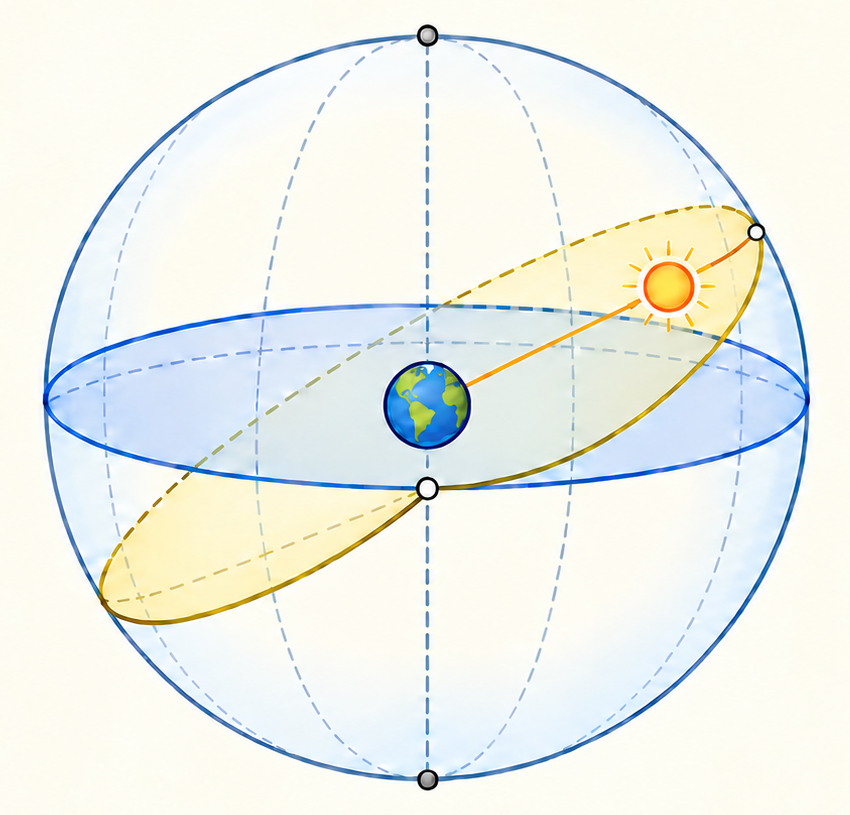
Seen from the earth: the yellow band is the ecliptic, the sun’s yearly path; the blue band is the celestial equator.
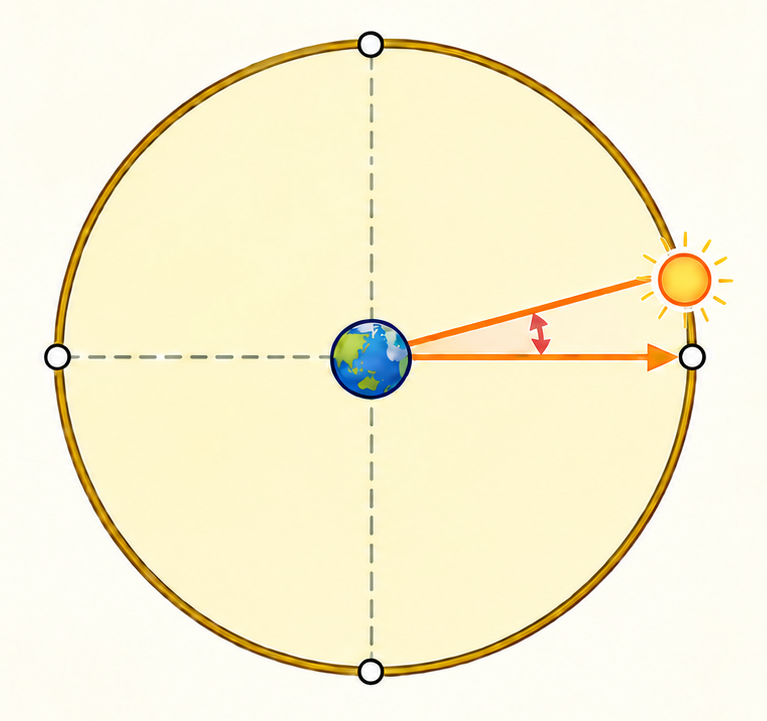
Seen from above the ecliptic: each 15-degree shift in the sun’s direction begins the next solar term.
The mismatch between the months and the solar terms was simply part of life: the very first poem in the Kokinshū puzzles over spring arriving before the lunar New Year. Should the remaining days count as last year or this year?
Because the solar terms were designed for northern China, Japan added supplementary markers, zassetsu: setsubun, the eve of spring; higan, the equinox weeks when families visit graves; hachijū-hachiya, the eighty-eighth night, in early May, time for tea picking; doyō, the midsummer days when people eat grilled eel; and nihyaku-tōka, the two hundred and tenth day, around September 1, when farmers braced for typhoons.
Below the solar terms lies a finer division: the seventy-two kō, or micro-seasons. Each solar term is split into three parts of roughly five days, and each part is given a short phrase describing what is happening in nature. This system also came from China, but the Chinese version included ideas such as hawks turning into doves and sparrows entering the sea to become clams, and many of its observations did not fit Japan. In the late seventeenth century the astronomer Shibukawa Harumi, who produced Japan’s first home-made calendar, the Jōkyō calendar, proclaimed in 1684 and put into use in 1685, also rewrote the micro-seasons for Japanese conditions. The version most people use now descends from a simplified calendar published by the Meiji government in the 1870s.
Reading the list is like reading a very compressed nature diary. The first micro-season of spring is "east wind melts the ice." Around the spring equinox comes "cherry blossoms begin to open." In early April, "swallows return." In June, "rotten grass becomes fireflies," a reflection of the old belief that fireflies were born from decaying vegetation. In August comes "evening cicadas sing." In October, "chrysanthemums bloom," and in early November, "maple leaves and ivy turn yellow." In December, "salmon gather and swim upstream." After the Meiji calendar reform the list was half forgotten, but in the past fifteen years or so it has been revived in calendars, apps and confectioners’ sweets. The appeal is resolution: a year seen not in four pieces but in seventy-two.
- 1East wind melts the icefirst of spring
- 2Cherry blossoms begin to openaround the spring equinox
- 3Swallows returnearly April
- 4Rotten grass becomes firefliesJune
- 5Evening cicadas singAugust
- 6Chrysanthemums bloomOctober
- 7Maple leaves and ivy turn yellowearly November
- 8Salmon gather and swim upstreamDecember
Each solar term splits into three micro-seasons of roughly five days; here are eight of the seventy-two, in calendar order.
In 1872 the Meiji government announced the switch to the Gregorian calendar, and the third day of the twelfth month of Meiji 5 became January 1, 1873. Festivals that had been tied to lunar dates suddenly fell about a month earlier in the season. Tanabata, the star festival on the seventh day of the seventh month, had originally fallen around August, after the rainy season, when the night sky was usually clear; moved to July 7, it landed in the middle of tsuyu, and the stars are often hidden. Some communities kept the new date, some moved festivals a month later (which is why Obon falls in mid-August in much of Japan), and some still use the old calendar. Moon viewing, which depends on the full moon, has always been reckoned by the lunar calendar, so its date shifts each year.
03Spring: Plum First, Wisteria Later
Mention spring in Japan and people think of cherry blossoms. Yet in the Nara period, the eighth century, the flower the court loved most was the plum, ume. It arrived from China with the tastes of Chinese scholars attached: it blooms in the cold of late winter, and its scent is cool and clean. The Man’yōshū, the oldest surviving Japanese poetry anthology, contains about 120 poems on plum blossoms and only around forty on cherry. In 730 the governor of Dazaifu in Kyūshū, Ōtomo no Tabito, held a plum-blossom party at which his guests composed poems; the preface to those poems supplied the name of the current imperial era, Reiwa, adopted in 2019. From the Heian period onward the cherry gradually took over as "the" flower, and the plum settled into its place as the herald of early spring.
The plum is also bound up with Sugawara no Michizane, a Heian scholar and statesman who was exiled to Dazaifu. According to legend he composed a farewell poem to the plum tree in his Kyoto garden, and the tree flew after him to Kyūshū overnight. Shrines dedicated to Michizane, the Tenmangū shrines, are planted with plum trees, and in February and March Dazaifu Tenmangū, Kitano Tenmangū in Kyoto and Yushima Tenjin in Tokyo fill with blossoms and with students praying to pass exams, since Michizane is the patron of learning. Kairakuen in Mito, laid out in 1842 by the daimyo Tokugawa Nariaki, has around three thousand plum trees.
The plum is a fruit tree as much as an ornamental. Raw, the fruit is sour and mildly toxic, so it is always processed: salted and sun-dried into umeboshi, steeped in liquor and sugar to make umeshu, or boiled down into paste. The fruit ripens in June, just as the rains begin, and one explanation of the name tsuyu, written with characters meaning "plum rain," is that it is the rain of the plum season. Wakayama Prefecture produces the largest share of the crop, and its Nankō variety, thin-skinned and fleshy, is the standard for good umeboshi.
- 1
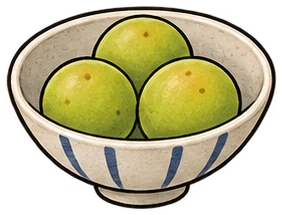 The fruit ripens in June; raw green ume are sour and mildly toxic.
- 2
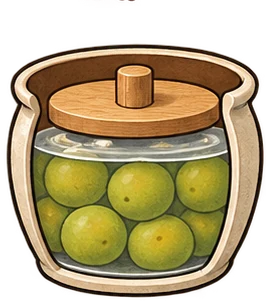 First they are packed in salt.
- 3
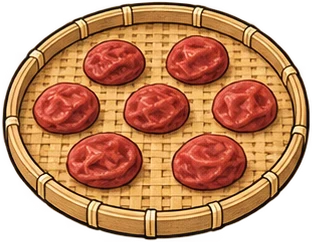 Then they are spread out to dry in the sun.
- 4
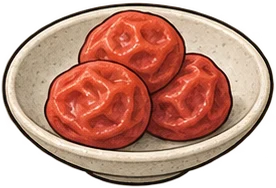 The result is umeboshi.
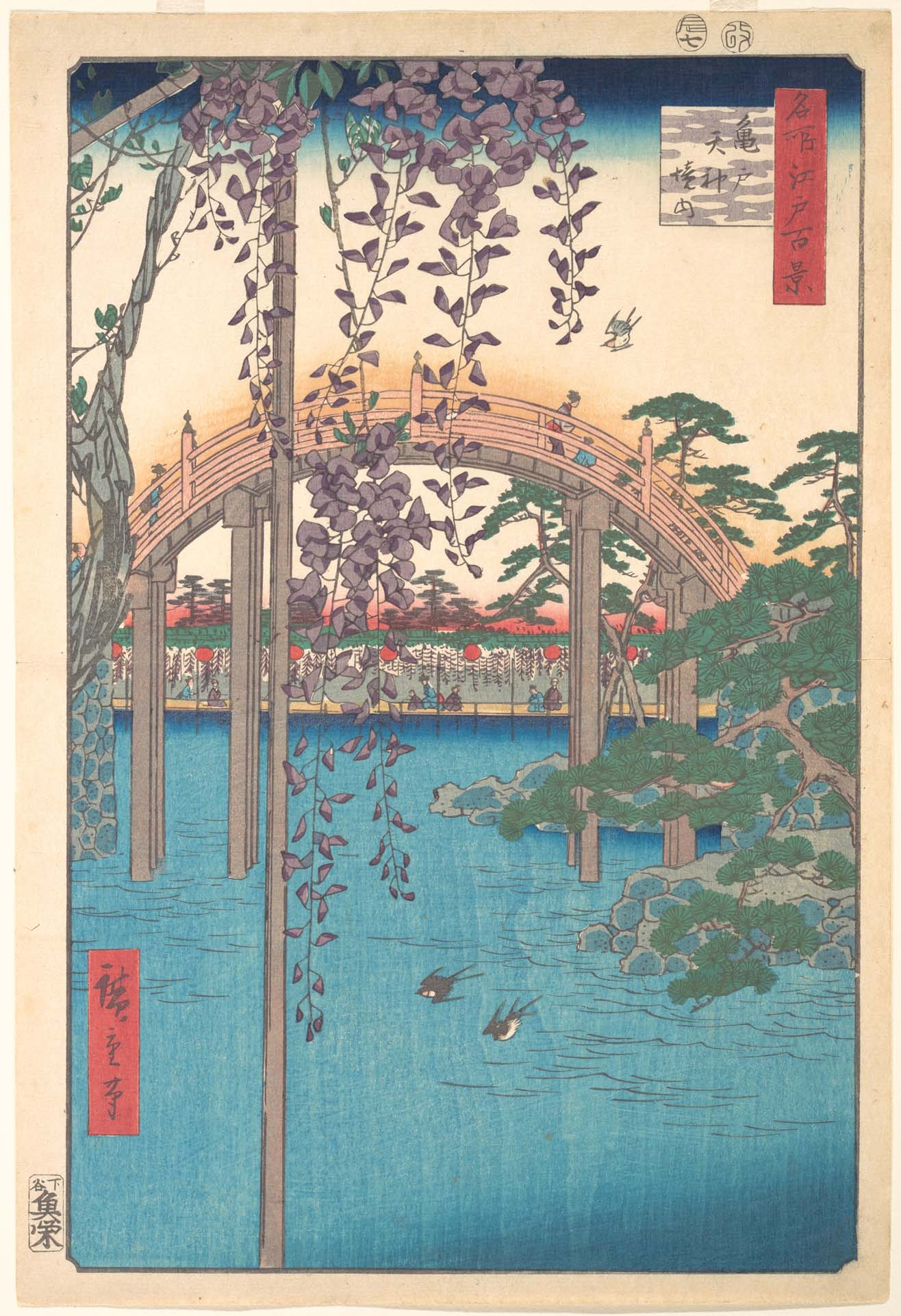
After the cherries, from late April into early May, comes wisteria, fuji. Wisteria is a climber that twines its stems around whatever it can reach. The most common Japanese species, noda-fuji, has long hanging flower clusters that can exceed a meter; yama-fuji has shorter ones. The two species twine in opposite directions, a detail gardeners use to tell them apart. In gardens it is trained over a flat trellis, a fujidana, so that the flowers hang overhead and walking beneath feels like passing through a curtain. The great wisteria at Ashikaga Flower Park in Tochigi, well over 150 years old, covers a trellis of about a thousand square meters on its own. At Kameido Tenjin in Tokyo, wisteria trellises reflected in a pond beneath an arched bridge have been a famous sight since the Edo period, and Utagawa Hiroshige painted them.
The name of the Fujiwara, the family that dominated the Heian court, begins with the character for wisteria, and the hanging-wisteria design became one of the most widespread Japanese family crests. Surnames containing the same character, such as Satō and Itō, are traditionally said to descend from Fujiwara branches.
04The Rainy Season: Hydrangeas and Fireflies
Tsuyu is the most distinctive season in the Japanese year. It reaches Okinawa in early May and moves up through Kyūshū to the Kantō region around Tokyo by early June, ending in mid to late July, when real summer begins. By the Japan Meteorological Agency’s averages for 1991 to 2020, the Kantō rainy season starts around June 7 and ends around July 19. Hokkaidō is generally considered to have no rainy season at all. What defines tsuyu is less heavy rain than overcast skies and saturating humidity: laundry will not dry and tatami grows mold, which is why one spelling of the name uses the character for mold. The cause is a standoff between a cool high-pressure system over the Sea of Okhotsk to the north and the warm Pacific high to the south. Where they meet, a stationary front forms and wavers back and forth over the archipelago.
The Meteorological Agency announces only that the rainy season "appears to have begun," then revisits the dates in September with the whole season’s data, sometimes revising them substantially. The cautious wording is honest: no single day marks the boundary.
The season is gloomy, but it has its own beauty, above all the hydrangea, ajisai. Japan is one of its homelands. The wild form, gaku-ajisai, grows on the coasts south of Tokyo and on the Izu Peninsula. It has a flat head with a cluster of tiny true flowers in the middle and a ring of large showy "flowers" around the edge, like a picture frame. Those showy parts are actually sterile flowers made of enlarged sepals; they set no seed and exist to attract insects. A form in which nearly all the flowers became the showy kind produced the familiar mophead, a ball of color. In the nineteenth century the German physician Philipp Franz von Siebold, working at Nagasaki, took Japanese hydrangeas to Europe and described one under the name otaksa, generally taken to come from "Otaki-san," his Japanese partner Kusumoto Taki. European breeders developed the plant heavily, and in the twentieth century these "Western hydrangeas" returned to Japan, bigger and more intensely colored.
Hydrangea color changes with the soil. The pigment in the flowers turns blue when it binds with aluminum, and aluminum dissolves more readily in acidic soil. So, broadly, acidic soil gives blue flowers and neutral to alkaline soil gives pink. Japan’s rainy climate makes its soils mostly acidic, so Japanese hydrangeas lean blue. A single flower head also shifts color as it ages, from greenish to blue to purple, which earned the plant the old nickname shichi-henge, "seven transformations." By one account, some samurai households in the Edo period considered it unlucky for that very fickleness and kept it out of their gardens. In Kamakura, the temples Meigetsu-in and Hase-dera are packed in June with hydrangea viewers, and the deep blue at Meigetsu-in has its own name, "Meigetsu-in blue." The Hakone Tozan Railway, which winds up into the Hakone hills, is lined with them.
The other spectacle of the rainy season is fireflies, hotaru. The best known is the Genji-botaru, a fairly large species whose larvae live in clean streams and feed on freshwater snails. On warm nights around June, the adults rise from the grass along the banks and drift above the water, glowing slowly on and off. The smaller Heike-botaru breeds in rice paddies and ponds, where the water barely moves, and gives a weaker light. The origin of the names is uncertain. One explanation links Genji to the shining prince of The Tale of Genji; the smaller, dimmer Heike is usually said to be named for the Heike, the clan that lost the war that ended the Heian period.
Not all Japanese fireflies live by water. The Hime-botaru spends its larval life in the leaf litter of forests, and the adults flash in quick, sparkling golden bursts, nothing like the slow breathing pulse of the Genji. They appear in mountain woods, shrine forests and even some city parks. The Genji firefly also has a famous regional quirk: in eastern Japan it flashes roughly every four seconds, in western Japan roughly every two, with the dividing line running through central Honshū.

Genji firefly: larvae live in clean streams and eat freshwater snails.

Heike firefly: larvae live in rice paddies and ponds with slow water.
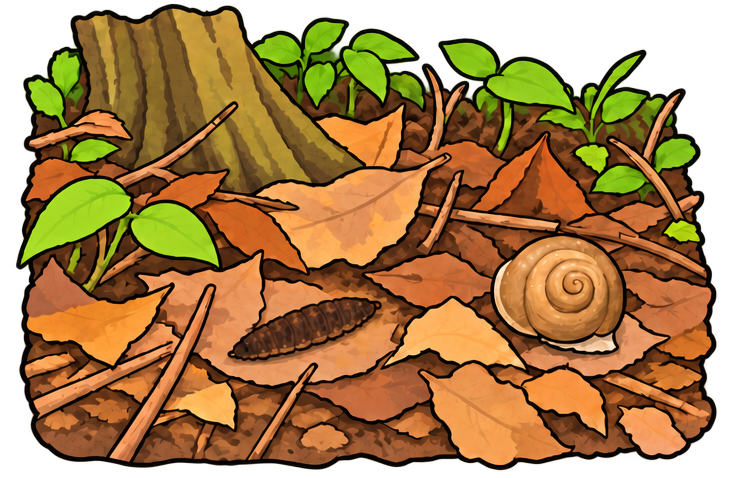
Hime firefly: larvae live in the leaf litter of forests.
Firefly hunting, hotaru-gari, was an Edo-period summer pastime; people caught them by suburban streams and brought them home in cages. Many places hold firefly festivals, and Kyoto’s Philosopher’s Path and the garden of the Hotel Chinzanso in Tokyo are well-known viewing spots. The best nights are warm, humid and windless, from about 7:30 to 9 p.m. Never use a flashlight or camera flash: fireflies use light to find mates.
05High Summer: Cicadas, Morning Glories and Wind Chimes
When the rainy season ends, the Japanese summer is suddenly full of cicadas, semi. Their calls differ enough that people can tell which species is singing and, from that, where the summer stands. The earliest is the small niiniizemi, which begins a thin, continuous buzz near the end of the rainy season. The main voice of a Tokyo summer is the aburazemi, a cicada with opaque brown wings whose call is said to sound like food sizzling in oil, which is how it got its name, "oil cicada." The minminzemi calls its own name, a long, wavering "meen-meen-meen." In Ōsaka, Fukuoka and other western cities, the loudest is the big kumazemi, which sings in great morning choruses, a rattling "sha-sha-sha" like heavy rain. It has become more common around Tokyo in recent decades.
As August goes on, the tsukutsuku-bōshi grows louder, repeating something like "tsuku-tsuku-bōshi" and finishing with a long, drawn-out buzz. To Japanese children it means the holidays are ending. The higurashi, the evening cicada, sings at dawn and dusk, a clear, slightly melancholy "kana-kana-kana" that sounds almost cool. It calls from early summer to late summer, yet in haiku it counts as an autumn word, and it is the cicada in the micro-season "evening cicadas sing." So when you hear cicadas in Japan, the question is not just "is it summer?" but which species, at what time of day, and where.
Japan’s most famous cicada belongs to Matsuo Bashō. In 1689, on the journey he recorded in The Narrow Road to the Deep North, he climbed to the mountain temple Risshaku-ji in Yamagata and wrote a haiku about stillness, with the cicadas’ cry seeping into the rocks. In the twentieth century the poet Saitō Mokichi argued that these were aburazemi, while the scholar Komiya Toyotaka argued for niiniizemi, pointing out that Bashō visited in what would now be mid-July, too early for large numbers of the oil cicada. Later field checks supported Komiya, and the niiniizemi is now the generally accepted answer. Accounts of Mokichi’s own response differ: the usual story is that he went to the site himself and conceded, while other accounts say he never publicly gave way, though his son, the novelist Kita Morio, recalled that his father privately seemed to know he had lost. Cicada larvae spend years underground and the adults live only a few weeks, and the Japanese have long read impermanence into this. The empty shell a cicada leaves behind, utsusemi, became a poetic word for the emptiness of the world, and it is the name of a chapter of The Tale of Genji.
Summer mornings belong to the morning glory, asagao, literally "morning face." It reached Japan from China around the Nara or Heian period as a medicinal plant; its seeds were used as a laxative. It became a summer icon in the Edo period, when two waves of enthusiasm, in the early nineteenth century and again in the 1850s, gripped Edo and Ōsaka. Enthusiasts bred henka asagao, "transformed morning glories," with petals split into threads, crumpled like a lion’s mane or rolled into tubes, and leaves that were just as strange. Some no longer looked like morning glories at all.
The most extreme of these forms were caused by recessive mutations, and the stranger the flower, the more likely it was to be completely sterile. Edo growers found a workaround. Instead of saving seed from the spectacular plant itself, they saved seed from its normal-looking siblings. Some of those siblings carried a hidden copy of the mutation, and when their seeds were sown, about a quarter of the next generation would produce the strange flower again. The growers knew nothing of genetics; they found the pattern by experience. Kyushu University and hobbyist societies still maintain the strains.
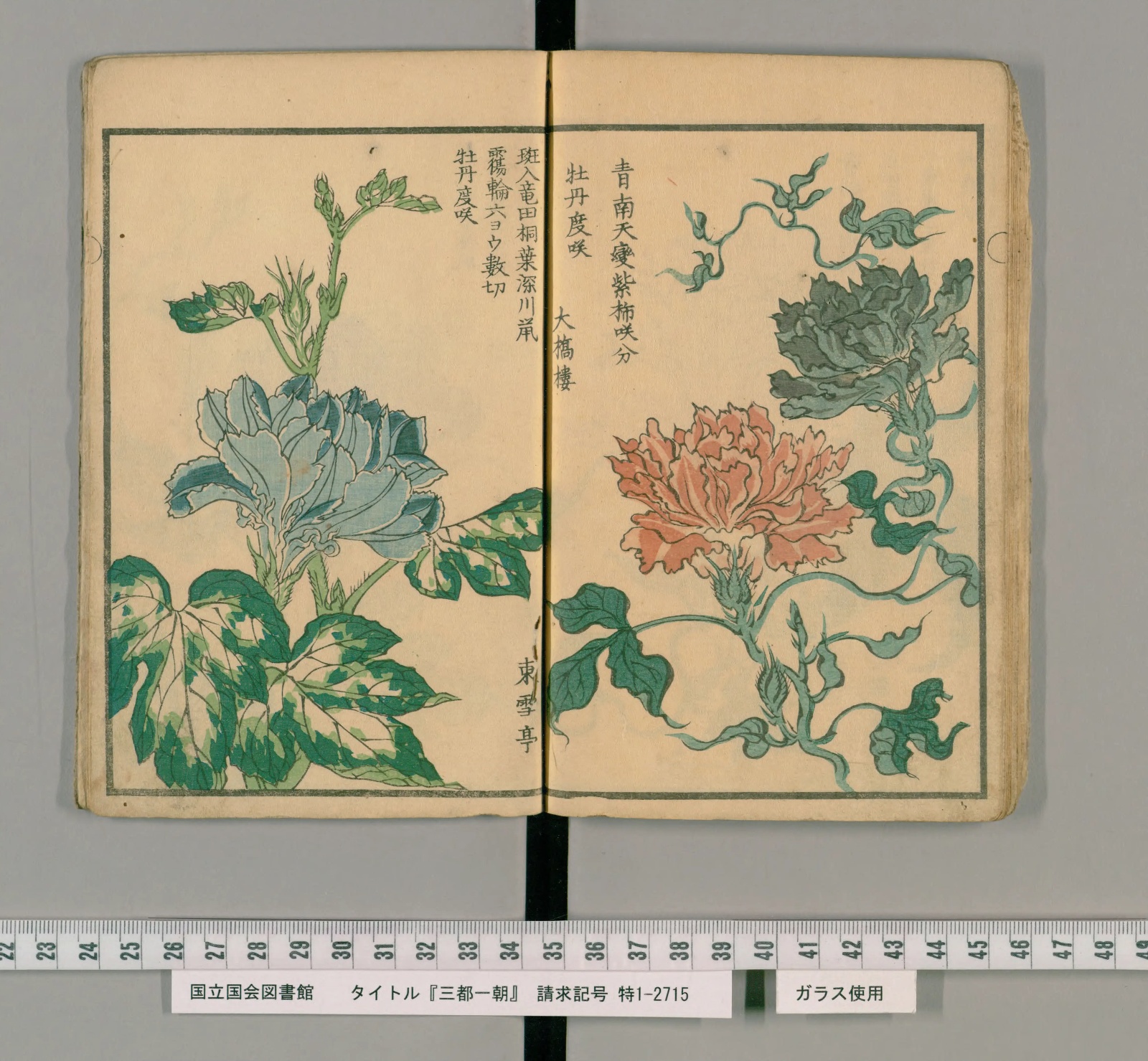
Henka asagao in Santo itchō (1854): crumpled, split petals that no longer look like a morning glory.National Diet Library, Santo itchō, vol. 1 (illustrated by Tazaki Sōun, 1854)
The morning glory is also everybody’s flower. From July 6 to 8, the Iriya Morning Glory Fair, still held as of 2026, takes place around the Kishimojin temple in Iriya, in Tokyo’s Taitō Ward, where dozens of growers line the street with potted plants trained on bamboo frames; reported totals range from tens of thousands of pots to more than two hundred thousand. Most Japanese first-graders sow one at school in May, keep an observation diary, and carry the pot home before the summer holidays to keep tending it.
Summer is also something to be cooled by sound. A wind chime, fūrin, hangs under the eaves, and when the breeze moves it, a single clear note sounds and people feel a little cooler. Its ancestor is the fūtaku, the bronze bell hung from the corners of temple roofs, which was meant to ward off evil: when the wind rang the bell, malign influences kept away. Glass chimes became popular in the Edo period, and the Edo-style chimes made in Tokyo are mouth-blown, with the rim deliberately left rough so that the striker produces a brighter ring; they are painted on the inside with goldfish, morning glories and other summer motifs. In Iwate, makers of Nanbu ironware produce iron chimes with a low, long-lasting tone.
The real mechanism of a fūrin is not the bell but the paper strip hanging below it, the tanzaku. A string runs down from inside the bell through a small striker, and the strip hangs from the end of the string. The wind catches the paper, the paper pulls the striker, and the striker hits the bell. Without the strip, a light breeze could not move the striker at all. That is why a wind chime feels cool: it turns moving air, which you cannot see, into a sound you can hear. When it rings, you know a breeze has passed.
- 1The wind catches the paper strip (tanzaku)
- 2The paper pulls the striker
- 3The striker hits the bell
- 4It rings: a breeze has passed
The key is the paper strip, not the bell: without it a light breeze could not move the striker.
06Autumn: Autumn Rain, Chrysanthemums and Ginkgo
The beginning of autumn in the old calendar falls around August 7, in the hottest part of the year, and letters still speak of "the lingering heat." The real change comes in September. From late August into October another front forms over Japan, as the Pacific high retreats and cooler air pushes south. This is akisame, autumn rain, a cooler, more intermittent rain than tsuyu. It coincides with typhoon season, and when a typhoon pushes moist air into the autumn front the result can be torrential; many of Japan’s worst floods happen in September.
After the autumn rain comes the clear season of moon viewing, autumn leaves, new rice and grilled saury, all covered elsewhere (see also: Tsukimi: Japan’s Autumn Moon-Viewing, from Heian Boats to the Tsukimi Burger; Momiji: Japan’s Autumn Leaves and the Art of Chasing Them). Two autumn plants deserve attention here.
The chrysanthemum, kiku, came from China around the end of the Nara period, bringing associations with long life. China celebrated the ninth day of the ninth month by climbing hills and drinking chrysanthemum wine, and the Heian court held a chrysanthemum banquet on the same day. On the eve of the festival, court ladies laid silk floss over the flowers to soak up dew and scent, then wiped themselves with it next morning in the hope of long life. Sei Shōnagon and Murasaki Shikibu both mention it.
In the early thirteenth century the retired emperor Go-Toba was particularly fond of the chrysanthemum and used it as a personal emblem, and a sixteen-petal chrysanthemum became the crest of the imperial house. In the early Meiji period the government restricted its use by others, tightening the link between the flower and the throne. A chrysanthemum appears on the cover of the Japanese passport and on the 50-yen coin. The chrysanthemum is at once the imperial flower, the autumn flower and the flower of funerals and graves, where white and yellow blooms are standard, so Japanese people rarely give chrysanthemums as a gift.
What Japanese chrysanthemum shows display are mainly ōgiku, large-flowered chrysanthemums grown to extraordinary standards. The main forms include atsumono, with petals curving inward into a dense globe; kudamono, with long tubular petals radiating out like a firework; and ichimonji, with a single flat ring of broad petals. The classic show style, sanbon-jitate, trains one plant into three stems carrying three blooms at set heights, the back one tallest, all of matching size. Getting there takes daily attention from spring cuttings to autumn bloom. During the Edo period different regions developed their own classical types, such as Saga chrysanthemums in Kyoto, Edo chrysanthemums in Tokyo, Higo chrysanthemums in Kumamoto and Ise chrysanthemums in Mie.
Chrysanthemum shows run from late October to mid-November. Shinjuku Gyoen in Tokyo, once an imperial garden, displays its collection in traditional wooden pavilions in a show that grew out of the imperial chrysanthemum parties. Kiku ningyō, life-size figures of historical characters dressed in living chrysanthemums, appeared in late Edo, were a hit in Meiji Tokyo, and as of 2026 are still staged in Nihonmatsu in Fukushima and elsewhere. In Yamagata people eat a pale purple chrysanthemum nicknamed mottenohoka, blanched and dressed; it is crisp and faintly bittersweet.
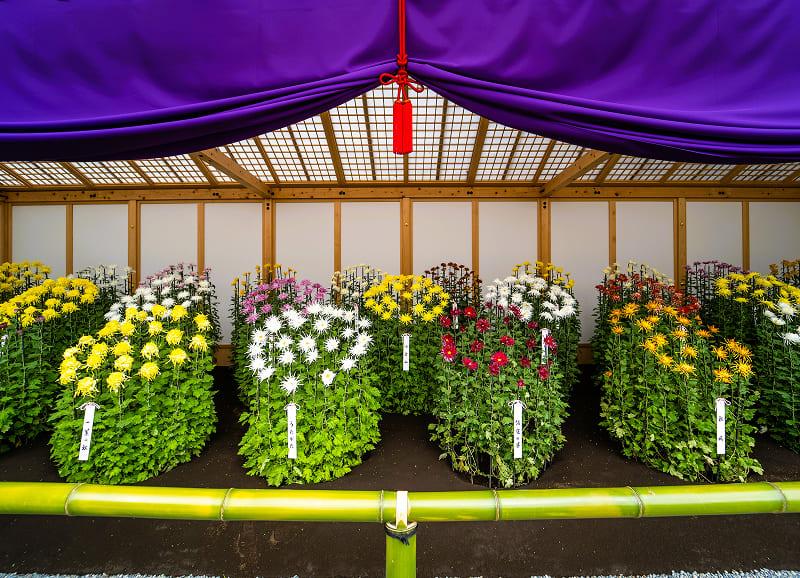
Edo chrysanthemums at the Shinjuku Gyoen show, set out beneath a traditional wooden pavilion.
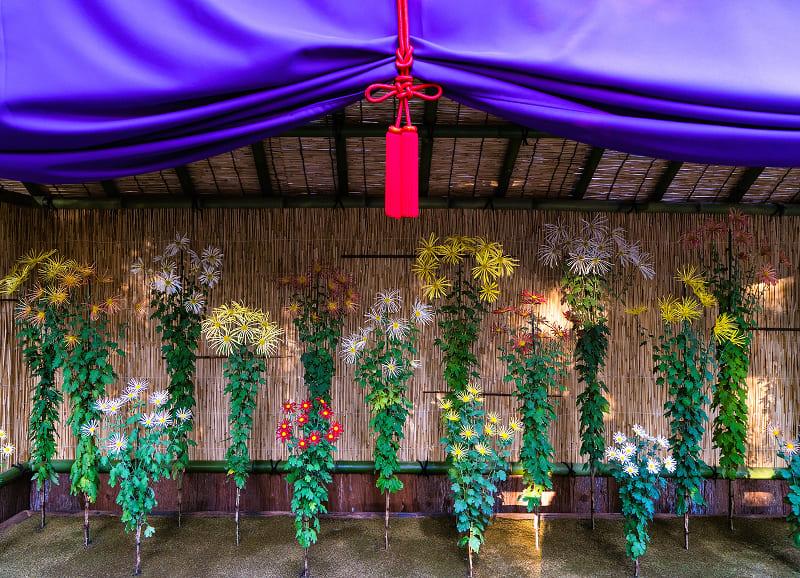
The Higo chrysanthemum bed in the same garden; Higo chrysanthemums are a classical type developed in Kumamoto.
Ministry of the Environment, Shinjuku Gyoen, "Chrysanthemums: garden highlights" · Terms of use
The last color of the year is the gold of the ginkgo, ichō. The ginkgo is the sole surviving species of an ancient lineage and is often called a living fossil. It is native to China; accounts of when it reached Japan vary, but it is generally thought to have arrived around the Kamakura or Muromachi period. Its fan-shaped leaves, with veins radiating from the stem and often a notch in the middle, are unmistakable. Ginkgo trees are either male or female. Female trees drop seeds with a fleshy coat that smells famously foul, but the nut inside, ginnan, is a classic autumn snack in Japan, roasted until it turns soft, green and slightly bitter. Street plantings favor male trees.
The ginkgo is one of Japan’s most common street trees. The avenue at Meiji Jingū Gaien in Tokyo, about three hundred meters long, is lined with some 140 trees clipped into neat cones that turn solid gold in late November and draw enormous crowds. Midōsuji, Ōsaka’s main boulevard, is famous for its ginkgo too. The ginkgo is Tokyo’s official tree, and the University of Tokyo uses its leaf as an emblem. At Tsurugaoka Hachimangū in Kamakura a huge ginkgo once stood beside the main stone stairway; legend says that in 1219 the assassin of the shogun Minamoto no Sanetomo hid behind it. The tree was blown down in a storm in March 2010, and shoots have since sprung from what remained of it. Because ginkgo leaves are thick and full of water and slow to burn, many temples and shrines have legends of a "water-spouting ginkgo"; the great ginkgo at Nishi Hongan-ji in Kyoto is said to have sprayed water to save the halls when the temple caught fire.
07Winter and the Evergreens: Pine, Bamboo and Cedar
Winter is not simply bleak in the Japanese seasonal imagination. Chinese scholars called the pine, bamboo and plum the "three friends of winter," because they stay green or bloom in the cold. Japan adopted the trio and turned it into a ranking of good fortune: sushi sets, bento and sake are often sold in three grades, matsu, take and ume, pine, bamboo and plum, with pine at the top. The kadomatsu that stand at house and shop entrances at New Year combine pine branches with diagonally cut bamboo, often with a sprig of plum.
The Japanese matsu is mainly two species. The Japanese black pine, kuromatsu, has dark bark and stiff needles and tolerates salt and wind, so it grows along coasts; it is called the "male pine." The Japanese red pine, akamatsu, has reddish bark and softer needles and grows inland; it is the "female pine." "White sand and green pines" is the classic image of the Japanese coastline, seen at Miho no Matsubara near Mount Fuji and at Amanohashidate, a sandbar on the Sea of Japan covered with pines. Many coastal pine forests were planted in the Edo period as windbreaks and to hold the sand. Since the early twentieth century a nematode introduced from North America has killed pines across the country, and pine wilt remains a serious forestry problem.
In Japanese gardens almost every pine is sculpted. In spring, gardeners pinch back the new candles of growth to control the length of branches. In autumn and winter they pluck out old needles by hand so that light passes through and the shape of the branches shows. In winter, at Kenrokuen garden in Kanazawa, gardeners begin the yukitsuri around November 1: a tall pole is set up beside a pine and dozens of ropes are dropped from its top to the branches, like the ribs of an umbrella, to stop heavy snow from snapping them. The first tree done is the Karasaki pine, and the sight marks the start of winter in Kanazawa. Around the same time, many gardens wrap a band of straw matting, komomaki, around pine trunks. The idea was to lure overwintering pests into the straw and burn it in spring, though studies have reported that the wraps catch more beneficial insects than pests.
The pine is also one of the central images in Japanese art. The back wall of every Noh stage carries a painting of an old pine, usually explained as the tree through which a deity descends. Matsu also sounds like the verb "to wait," a pun poets have used for a thousand years.
Bamboo, take, is botanically a grass, not a tree. It spreads through underground stems, so a whole grove may be just a few individuals joined beneath the soil. In spring the shoots push up and grow astonishingly fast; a shoot of mōsō-chiku, the largest common species, can grow about a meter in a day and reach full height within a couple of months, after which it never gets thicker. Three species dominate. Mōsō-chiku is the biggest and has the best-tasting shoots; it is generally said to have been brought from China via the Ryūkyū Kingdom to Satsuma in southern Kyūshū in the eighteenth century. Madake has strong, springy wood and is the bamboo of most crafts. Hachiku is finer-grained, and the whisks used in the tea ceremony are usually made from it. Bamboo has a strange life cycle: a species may flower only once in many decades, after which entire groves die together. For madake the cycle is usually estimated at around 120 years. According to records, madake flowered and died off over wide areas of Japan in the 1960s and 1970s, causing a temporary shortage of bamboo for craftsmen.
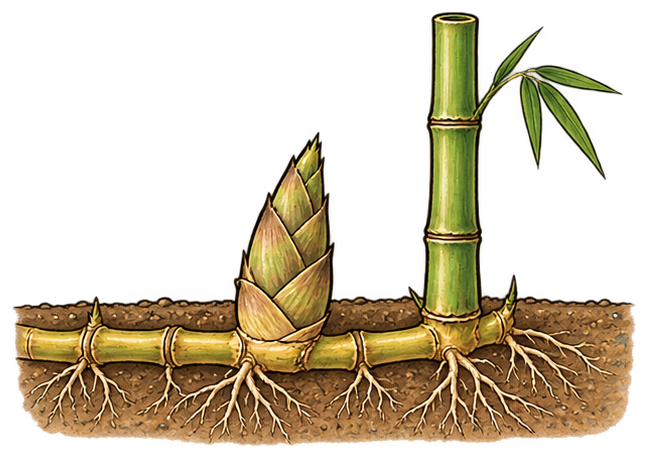
Shoots rise from a creeping rhizome, so a grove is often connected underground.
Bamboo also runs on its own seasonal clock. In spring, as the parent plants pour energy into new shoots, their leaves turn yellow and drop, so in haiku "bamboo autumn" is a spring word; in autumn bamboo is at its greenest, so "bamboo spring" is an autumn word. The bamboo grove path at Sagano in Kyoto, woven baskets, bamboo-shoot rice, the bamboo branches hung with wishes at Tanabata, and Princess Kaguya, found inside a bamboo stalk in The Tale of the Bamboo Cutter, all show how deeply it runs through Japanese life. Today neglected groves, no longer cut now that plastic has replaced bamboo, spread their rhizomes into surrounding woods and fields.
The sugi, or Japanese cedar, is found naturally only in Japan; despite the English name it is not a true cedar. It is easy to recognize: a perfectly straight trunk running to the top and a narrow, pointed, conical crown, so that a stand of them looks like rows of upright spears. The wood is straight-grained, light, easy to work and fragrant, and since ancient times it has been a main material for building and woodwork: sake barrels, bathtubs, ceilings, chopsticks. The green ball of sugi needles hung outside a sake brewery, the sugidama, is put up when new sake is made; as it fades from green to brown, it tells passers-by that the sake has matured.
Most Japanese cedar forests were planted. Regions have their own famous varieties, including Akita, Yoshino and Tenryū cedar. In the Kitayama hills north of Kyoto, foresters raise cedar by the daisugi method, growing many straight slender trunks from a single base to produce polished logs for tea houses and sukiya architecture. Yoshino forestry is known for dense planting, many thousands of seedlings per hectare, so the trees compete, grow straight and slow, and form tight grain. The Cedar Avenue of Nikkō was planted from 1625 by Matsudaira Masatsuna and his son Masanobu over some twenty years; it runs for about 37 kilometers along the roads to Nikkō and as of March 2026 still had about twelve thousand trees. On the island of Yakushima, south of Kyūshū, grow the yakusugi, natural cedars more than a thousand years old; estimates for the oldest, the Jōmon Sugi, range from about 2,000 to 7,200 years.
After the Second World War, to meet the timber demand of reconstruction and to control erosion, Japan cleared large areas of natural forest and replanted them with cedar and cypress. Decades later imported timber was cheaper, domestic cedar went uncut, and vast plantations matured all at once, releasing huge clouds of pollen each year from February to April. Cedar pollen allergy is now practically a national affliction, and spring weather forecasts include pollen counts. On a train through the mountains, a hillside of uniform dark green with evenly spaced pointed crowns is almost certainly a postwar cedar plantation; a slope of mixed shades that changes color in autumn is natural or secondary forest.
08Experiencing the Seasons in Japan
The easiest way in is food. In a wagashi shop, the fresh sweets in the case change through the year: cherry-leaf rice cakes in spring, translucent kudzu jellies in early summer, chestnut and persimmon shapes in autumn, white snow shapes in winter. Convenience-store "seasonal limited" shelves follow the same calendar. At an izakaya, asking what is in season today will get you further than the fixed menu.
If you don’t mind rain, tsuyu is a good time to travel: crowds are thinner, the hydrangeas are out at the temples of Kamakura and Kyoto, and the moss gardens glow. Firefly season moves north from Kyūshū between late May and early July; at a viewing spot, keep quiet, dim your phone, and leave the fireflies where they are.
In summer, listen. The cicadas of Meiji Jingū in Tokyo are not those of Ōsaka Castle park, and early August does not sound like late August. If you hear the kana-kana of the evening cicada at dusk at a country inn, you are hearing what most Japanese think of as the end of summer. A morning glory from the Iriya fair or a glass chime from an Edo fūrin maker takes a piece of the season home.
In autumn, look closely at the three-bloom chrysanthemums at Shinjuku Gyoen, then walk the Gaien ginkgo avenue in late November. In winter, see the snow ropes at Kenrokuen. On any train through the mountains, sort the cedar plantations from the wild forest.
Finally, look up which of the seventy-two micro-seasons it is today. In Japan the name of a season often arrives before the season itself: it is still cold at the beginning of spring and still blazing at the beginning of autumn, and when "cherry blossoms begin to open," there may be only a handful on the trees. People do not mind. The name arrives, and they start to look forward to what it promises.