
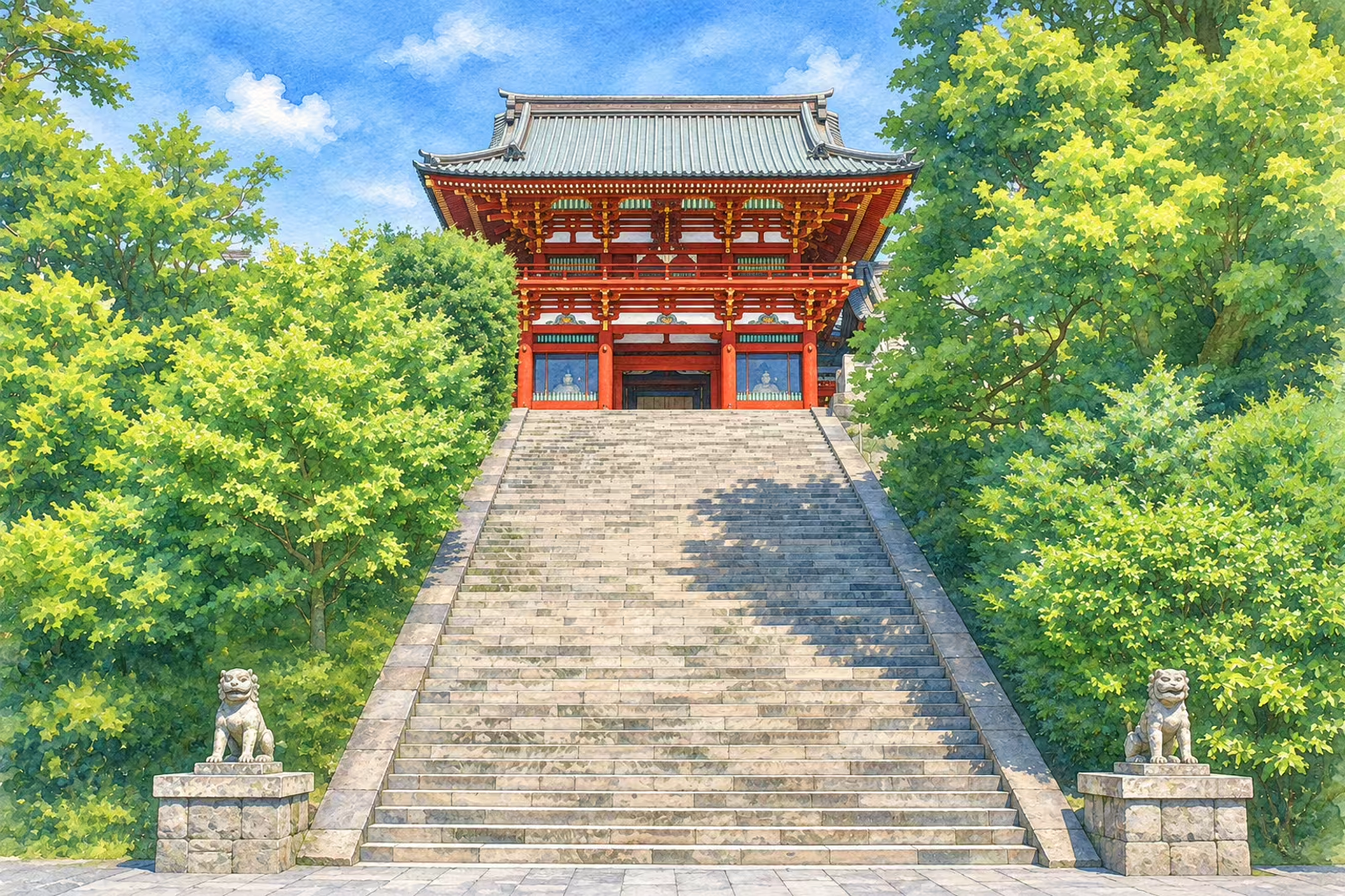
Tsurugaoka Hachimangū is the Hachiman shrine at the center of Kamakura, Kanagawa Prefecture, which Minamoto no Yoritomo adopted as the guardian of the warrior government he founded there. Wakamiya-ōji, the avenue running straight north from Yuigahama beach, ends at the shrine, and the medieval city was laid out along that axis. For most visitors it is the natural place to begin making sense of Kamakura.
01Founding and relocation
The shrine traces its origin to 1063, when Minamoto no Yoriyoshi, returning from the Former Nine Years’ War, brought a branch of the Hachiman deity from Iwashimizu Hachimangū near Kyoto and enshrined it near the coast at Yuigahama; that first site is known as Moto-Hachiman. In 1180, after entering Kamakura, Yoritomo moved the shrine inland to its present position at the foot of the northern hills. When fire destroyed it in 1191, he rebuilt it as two complexes: an upper shrine on the hillside and a lower shrine at its foot, the arrangement that survives today. In 1182 he also had the raised central causeway of Wakamiya-ōji, the Dankazura, built as a prayer for the safe delivery of his wife Hōjō Masako’s child.
02Events of the Kamakura period
In 1186 Shizuka Gozen, the captured lover of Minamoto no Yoshitsune, was made to dance before Yoritomo at the shrine and sang of her longing for the fugitive Yoshitsune, an episode recorded in the Azuma Kagami. In the first month of 1219 the third shogun, Minamoto no Sanetomo, was assassinated beside the shrine’s stone steps by his nephew Kugyō, ending the Minamoto line of shoguns. According to tradition Kugyō hid behind the great ginkgo tree by the steps; the old tree was blown down in a storm in 2010, and new shoots have since grown beside its stump. The shrine enjoyed shogunal patronage throughout the period, and after damage in the wars of the sixteenth century it was restored with support from the Odawara Hōjō and later the Tokugawa. Until the Meiji era it combined Shinto and Buddhist worship as Tsurugaoka Hachimangū-ji, with a pagoda and temple halls in its precincts; these were demolished when shrines and temples were forcibly separated in the early Meiji years.
03What can be seen today
The present main sanctuary of the upper shrine was rebuilt in 1828 on the orders of the shogun Tokugawa Ienari, and the lower shrine, the Wakamiya, dates from 1624 under Tokugawa Hidetada; both are designated Important Cultural Properties. The Maiden, the dance pavilion at the foot of the steps, stands on the spot where Shizuka is said to have danced. The Genpei Ponds flanking the approach are traditionally said to have been dug at Masako’s command. Mounted archery (yabusame) performed during the annual grand festival in September is one of Kamakura’s best-known rituals.
Tsurugaoka Hachimangū
01A City Laid Out From a Shrine
Stand at the foot of the great stone staircase and turn around. Behind you, past the dance pavilion and the ponds, a straight avenue runs south toward the sea. That avenue, Wakamiya Ōji, is about two kilometers long, and it ends near the beach at Yuigahama. The shrine at your back and the road in front of you were laid out together in the 1180s, and they remain the spine of Kamakura.
Tsurugaoka Hachimangū is a shrine to Hachiman, a deity first worshipped at Usa in Kyūshū who, by the Heian period (794–1185), was identified with the legendary Emperor Ōjin and honored as a protector of the state. The Seiwa Genji, the warrior branch of the Minamoto clan descended from Emperor Seiwa, adopted Hachiman as their clan god. Their great hero, Minamoto no Yoshiie, came of age at Iwashimizu Hachimangū south of Kyoto and was known all his life as Hachiman Tarō, "Hachiman’s firstborn."
When Minamoto no Yoritomo founded Japan’s first warrior government at Kamakura, he put this god at the center of it. The shrine was not simply a place of worship near the shogun’s headquarters. It was the ceremonial heart of the regime, the place where the shogun prayed at New Year, where vassals performed mounted archery, and where, in 1219, the Minamoto line of shoguns came to a violent end.
02The First Shrine by the Sea
The shrine’s story begins in 1063. Minamoto no Yoriyoshi, Yoshiie’s father, had just ended the long war in the north against the Abe family, a conflict later called the Former Nine Years’ War. On his way home he brought a share of the spirit of Iwashimizu Hachiman to the village of Yui in Kamakura and enshrined it near the shore. This small shrine was known as Yui Wakamiya.
Yoriyoshi had served as governor of Sagami Province, and the Kamakura area was where his family first built ties with the warrior bands of eastern Japan. Yoshiie is said to have repaired the shrine after his own northern campaign.
The original site survives in the Zaimokuza neighborhood, about two kilometers south of the present shrine and a short walk from the beach, as a modest shrine called Moto-Hachiman, "the original Hachiman." It sits among houses and is easy to miss, but it is worth a detour for anyone who wants to see where the story starts.
03Yoritomo Arrives
In the eighth month of 1180, Yoritomo, who had spent twenty years in exile in Izu, rose against the Taira clan. He was beaten at Ishibashiyama, escaped by boat across Sagami Bay to Awa, gathered the warriors of the Bōsō Peninsula, and marched into Kamakura in the tenth month.
According to the Azuma Kagami (Mirror of the East), the official chronicle compiled by the shogunate a century later, one of Yoritomo’s first acts was to move the Yui shrine inland to Kobayashi village, at the foot of the hills to the north. The chronicle says the new location was chosen by drawing lots before the god. Yoritomo’s own residence and government offices were built at Ōkura, just east of the shrine.
Why Kamakura? The site was protected by hills on three sides and the sea on the fourth, with only narrow passes cut through the ridges. But it also carried family memory. By placing the Hachiman of his ancestors at the head of his new town, Yoritomo announced that he was the heir of Yoriyoshi and Yoshiie, and that the warriors of the east who followed him were renewing an old bond.
The first buildings were simple. In 1181 Yoritomo brought carpenters from Asakusa in Musashi Province to build a proper sanctuary. At the raising of the main beam, the Azuma Kagami records, Yoritomo ordered his younger half-brother Minamoto no Yoshitsune to lead a horse. Yoshitsune hesitated, saying it was a task for a lesser man, and Yoritomo rebuked him in front of the assembled vassals until he complied. Later readers have seen in this scene an early sign of the rift that would destroy Yoshitsune.
04The Raised Road and the Two Ponds
In 1182 Yoritomo’s wife, Hōjō Masako, was pregnant. To pray for a safe birth, Yoritomo ordered a straight processional road built from the shrine toward the sea, and he supervised the work himself while his father-in-law Hōjō Tokimasa and other vassals hauled stones. Down the middle ran a raised causeway called the dankazura, built up above the marshy ground. In the eighth month Masako gave birth to a son, Yoriie, who would become the second shogun.
Today the dankazura survives only between the second and third torii gates; the stretch south of the second torii was removed in the modern era. Guides like to point out that the causeway narrows as it approaches the shrine, which makes it look longer from the south. It does, but there is no early record that this was the builders’ intention.
Inside the third torii, a humped bridge crosses between two ponds. The eastern one is the Genji Pond, named for the Minamoto, and the western one is the Heike Pond, named for the Taira. According to the Azuma Kagami, Yoritomo had them dug in 1182 by the shrine’s acting chief priest, Senkōbō Ryōsen, and the vassal Ōba Kageyoshi. A later story, often linked to Masako, explains the islands: the Genji Pond has three, because san (three) sounds like the word for birth, and the Heike Pond has four, because shi (four) sounds like the word for death. The symbolism is later lore. On an island in the Genji Pond stands a small shrine to the goddess Benzaiten; abandoned after the Meiji reforms, it was rebuilt in 1980 from an early-nineteenth-century drawing.
05Shizuka’s Dance
The best-loved story at Tsurugaoka belongs to a woman. By 1186 Yoshitsune, who had won the war against the Taira, had fallen out with Yoritomo and was on the run. His companion Shizuka Gozen, a shirabyōshi dancer (a professional performer who danced in male court dress), was captured in the snows of Mount Yoshino and sent to Kamakura for questioning.
On the eighth day of the fourth month, Yoritomo and Masako ordered her to dance before Hachiman. She refused at first, then gave in. But instead of a song of praise, she sang of Yoshitsune: of the white snow on the peaks of Yoshino and the traces of the man who had gone into it, and of a spindle of cloth wound round and round, wishing the past could come back again.
Yoritomo was furious. Masako intervened, reminding him that she had once defied her own father to be with him during his exile, waiting alone in fear on a stormy night, and that Shizuka’s heart was the same as hers had been. Yoritomo relented and sent Shizuka a gift. The Azuma Kagami is the source for the whole scene, and it has been retold ever since in Noh, puppet theater, and kabuki.
The sequel is grim. Shizuka was pregnant with Yoshitsune’s child. That summer she gave birth to a boy, who was taken from her on Yoritomo’s orders and drowned at Yuigahama. She and her mother were then allowed to return to Kyoto, and nothing reliable is known of her later life.
Visitors are often told that Shizuka danced on the vermilion stage at the foot of the steps, the maiden (dance pavilion), also called the Lower Worship Hall. She did not: there was no pavilion then, and she danced at the corridor of the Wakamiya as it stood in 1186. The present pavilion stands on the site of that corridor, but it is a later building, rebuilt after it collapsed in the 1923 earthquake. Each April, during the Kamakura Festival, a performance of Shizuka’s dance is staged on it.
06Fire, and the Shape of the Shrine Today
In the third month of 1191 a fire swept through Kamakura and destroyed most of the shrine. Yoritomo rebuilt at once, and in doing so created the arrangement visitors still see. A new main shrine, the Upper Shrine (Hongū or Jōgū), was raised on the slope of the hill above the great staircase, and Hachiman was invited afresh from Iwashimizu. The old site at the bottom became the Wakamiya, or Lower Shrine.
The Tsurugaoka of the Middle Ages was not a shrine in the modern sense. Its formal name was Tsurugaoka Hachimangū-ji, ending in the suffix for "temple," and it was run by Buddhist clergy called gusō under a chief administrator, the bettō. The monks lived in twenty-five lodgings within the precinct, and over time a Buddhist temple, a great two-story pagoda, and, in the Edo period, halls for fire rituals and for the healing Buddha Yakushi and a revolving sutra repository rose alongside the shrine buildings. This mixing of kami and buddhas was normal in medieval Japan.
The shogunate’s ritual year revolved around the shrine. The most important festival was the hōjōe, a Buddhist rite of releasing captive animals held on the fifteenth day of the eighth month, and according to the Azuma Kagami, from its first celebration on the fifteenth day of the eighth month of 1187 it was accompanied by yabusame, mounted archery performed by the shogun’s vassals. That tradition continues at the shrine’s annual festival each September.
07Murder on the Steps
Yoritomo died in 1199. His son Yoriie succeeded him but was soon pushed aside by the Hōjō and killed at Shuzenji in Izu in 1204. Yoriie’s younger brother Sanetomo became the third shogun at the age of twelve. Sanetomo was a gifted poet, whose collection the Kinkai Wakashū is still read, and the imperial court promoted him rapidly; in 1218 he became Minister of the Right.
On the twenty-seventh day of the first month of 1219 (February 13 in the Julian calendar), Sanetomo came to Tsurugaoka at night to give thanks for the appointment. Heavy snow had fallen. As he left the ceremony and descended the steps, he was attacked and killed by Kugyō, Yoriie’s son, who was then the shrine’s bettō. Kugyō reportedly declared that he was avenging his father. Sanetomo was twenty-eight by Japanese reckoning. Kugyō fled with the head and was hunted down and killed the same day. With that, the Minamoto line of shoguns was finished, and real power in Kamakura passed to the Hōjō regents.
The murder has always attracted suspicion. The Azuma Kagami says that Hōjō Yoshitoki, who was supposed to carry the shogun’s sword in the procession, felt ill at the last moment and handed the duty to Minamoto no Nakaakira, who was killed alongside Sanetomo. Historians have proposed that Yoshitoki, or the powerful Miura Yoshimura, was behind Kugyō; none of these theories has been proved.
To the left of the staircase stood a huge ginkgo tree, said to be a thousand years old. From the Edo period it was known as the "hiding ginkgo," on the story that Kugyō had lain in wait behind it. No medieval source mentions the tree. Before dawn on March 10, 2010, the ginkgo was blown down in a storm. A few days later the shrine replanted the bottom four meters of the trunk seven meters away, and both the roots left in the ground and the transplanted trunk sent up new shoots, which you can see growing beside the steps today.
08Decline, War, and Shogunal Patrons
After the Kamakura shogunate fell in 1333, Kamakura became the seat of the Kamakura kubō, the Ashikaga family’s governors of eastern Japan, who continued to patronise the shrine. In the fifteenth century the kubō moved to Koga, and Kamakura went into decline.
In the eleventh month of 1526, during fighting between the Satomi family of Awa and Hōjō Ujitsuna of Odawara, the shrine burned. Ujitsuna, head of the Later Hōjō and now the dominant power in the region, sponsored a major reconstruction that was completed in 1540 and is recorded in detail in the diary of one of the shrine’s monks.
In 1590 Toyotomi Hideyoshi, fresh from destroying the Odawara Hōjō, visited the shrine and ordered repairs; a plan of the precinct drawn up for the work in 1591 survives. A well-known anecdote, recorded long afterward, has him patting a wooden statue of Yoritomo at Shirahata Shrine and addressing him as a fellow upstart who rose from nothing to rule the realm. It is best treated as a story.
The Tokugawa shoguns, who saw Yoritomo as the founder of warrior rule, were steady patrons. In 1624 Tokugawa Hidetada, the second shogun, who had by then passed the title to his son Iemitsu, had both the upper and lower shrines rebuilt; his Wakamiya still stands. In 1668 the fourth shogun, Ietsuna, erected the great stone first torii near the beach. When the upper shrine later burned, the eleventh shogun, Ienari, had it rebuilt, and the work was completed in 1828.
09Separating Gods From Buddhas
In 1868 the new Meiji government ordered the separation of Shinto and Buddhism. At Tsurugaoka the effect was drastic. Within a few years the pagoda, the Yakushi hall, the fire-ritual hall, and the sutra repository were demolished, the Buddhist clergy were laicised, and many statues and scriptures were destroyed or scattered. The institution became simply Tsurugaoka Hachimangū, a Shinto shrine. A few of its Buddhist images survived in temples around Kamakura and further afield.
The Great Kantō Earthquake of 1923 did further damage: the tower gate, the dance pavilion, all three torii, and the arched bridge collapsed, and the main sanctuary and the Wakamiya were damaged. All were restored in the following years; the first torii was re-erected in 1937 using its original stone.
10What You Are Looking At
The Upper Shrine at the top of the staircase, with its two-story gate, roofed corridors, worship hall, offering hall, and main sanctuary, dates from 1828. It is built in the gongen-zukuri style, in which the worship hall, offering hall, and sanctuary are joined into one structure. The main building, the corridors, and the small Takenouchi subsidiary shrine are designated Important Cultural Properties. The Wakamiya at the foot of the hill, from 1624 and in the same style, is also an Important Cultural Property, as is the stone first torii near the beach.
On the west side of the upper precinct is the small Maruyama Inari Shrine, whose sanctuary dates from the Muromachi period (1336–1573). It is the oldest building on the grounds.
The dance pavilion and the dankazura in their present form are modern. The dankazura was fully rebuilt in the mid-2010s and its cherry trees replanted. By the Heike Pond stands the building, designed by the architect Sakakura Junzō, that housed the Museum of Modern Art, Kamakura, from 1951 to 2016. It now belongs to the shrine, reopened in 2019 as the Kamakura Bunkakan Tsurugaoka Museum, and was itself designated an Important Cultural Property in 2020. On the east side of the grounds is the Kamakura Museum of National Treasures, opened by the city in 1928, which displays sculpture and other works from temples across Kamakura; most of the shrine’s own treasures are kept there.
Among the shrine’s own treasures, the best known is a lacquered writing box decorated with chrysanthemums by a brushwood fence in mother-of-pearl and gold, a National Treasure from the Kamakura period traditionally said to have belonged to Hōjō Masako. The shrine’s other National Treasures include a set of ancient sacred garments and weapons offered to the god, and a long sword signed by the smith Masatsune.
11A Walk Through the Grounds
If you have time, begin at the stone first torii near Yuigahama and walk the full length of Wakamiya Ōji. Most visitors join at the second torii, near Kamakura Station, and follow the raised dankazura north under its cherry trees.
Pass through the third torii and the ponds open on either side, Heike to the left and Genji to the right, with the steep arched bridge between them closed to foot traffic. Ahead is the dance pavilion. Beyond it rise the great stone steps. On the left at the bottom you will find the stump of the old ginkgo and the young trees growing from it.
At the top, look up at the tablet on the tower gate. The first character of "Hachimangū," the numeral eight, is written as a pair of facing doves, the messengers of Hachiman. After visiting the Upper Shrine, turn around at the gate. From here Wakamiya Ōji runs straight to the sea, and you can see the plan Yoritomo laid down more than eight centuries ago.
Coming down, head east to the Wakamiya and then to Shirahata Shrine, which enshrines Yoritomo and Sanetomo; its black-lacquered building stands out among the vermilion. A short walk further east brings you to the small stone pagoda revered as Yoritomo’s grave.
If you visit in mid-September, you may see yabusame on the long riding ground that runs east to west across the precinct, with riders in Kamakura-period hunting dress loosing arrows at full gallop, as the shogun’s vassals did here in 1187.