
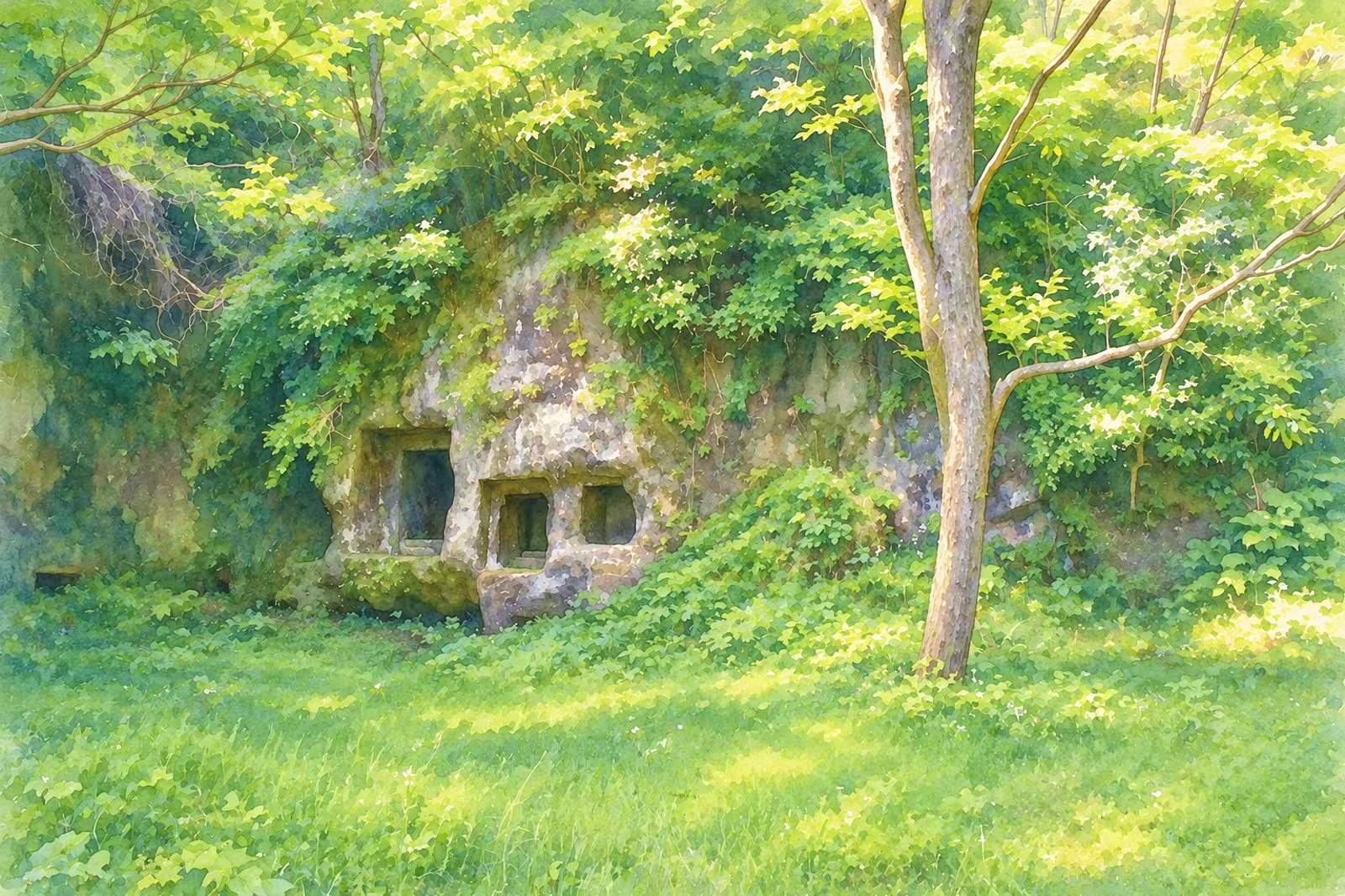
The Hōjō Clan Tokiwa Residence Ruins lie in the Tokiwa district on the western edge of Kamakura, Kanagawa Prefecture. The valleys here held residences of the Hōjō, the family that ran the Kamakura shogunate as regents, and the area is a nationally designated Historic Site. Set beside the Daibutsu Pass, one of the main routes into the city, the estate was both a home and a watch post over Kamakura’s western approach. It is one of the few places where the Hōjō presence around Kamakura can be seen through excavated evidence.
01A Hōjō valley estate
The residence is most often linked to Hōjō Masamura, a son of the second regent Hōjō Yoshitoki, who later served as the seventh regent. Medieval records refer to him by a title connected with Tokiwa, and his descendants came to be known as the Tokiwa line. No record gives a construction date, but the estate probably took shape in the first half to the middle of the 13th century. Local tradition once identified the site as the residence of Hōjō Yasutoki, but there is no firm evidence for this. The official designation uses the broader name "Hōjō Clan Tokiwa Residence," confirming a Hōjō household without naming a specific owner, and the documents cannot pin individual residences to particular spots on the ground.
Tokiwa consists of several deep valleys cut into the ridges. Builders leveled the valley floors and terraced the slopes for houses, with hills behind and the road into Kamakura in front, combining residence, traffic control and defense. During Nitta Yoshisada’s attack on Kamakura in 1333, the western passes at Kewaizaka, Gokurakuji-zaka and the Daibutsu Pass saw heavy fighting. Tokiwa lay close to this line, though what happened to the residences is not recorded.
02Excavation and the site today
Excavations carried out by Kamakura City around the 1970s in a valley called Gosho-no-uchi uncovered the foundations of a building set on base stones, postholes, ditches and a well. Finds included fine inkstones, a metal water dropper, seals, bone dice, and fragments of Chinese celadon and white porcelain, pointing to a literate, well-connected elite household involved in administrative work. The surrounding slopes hold a terrace known as Yakata-no-dai, rock-cut tomb chambers called yagura, and earthworks that may be dry moats; their dates and purposes are still debated.
The site was designated a national Historic Site around 1977. The excavated features have been reburied for protection, and no buildings have been reconstructed, so what remains visible is mainly the valley landscape and its terraces. Some finds are held and displayed by museums in Kamakura. As of 2026, access to the Yakata-no-dai area had been cut off by fallen trees and a collapsed path.