
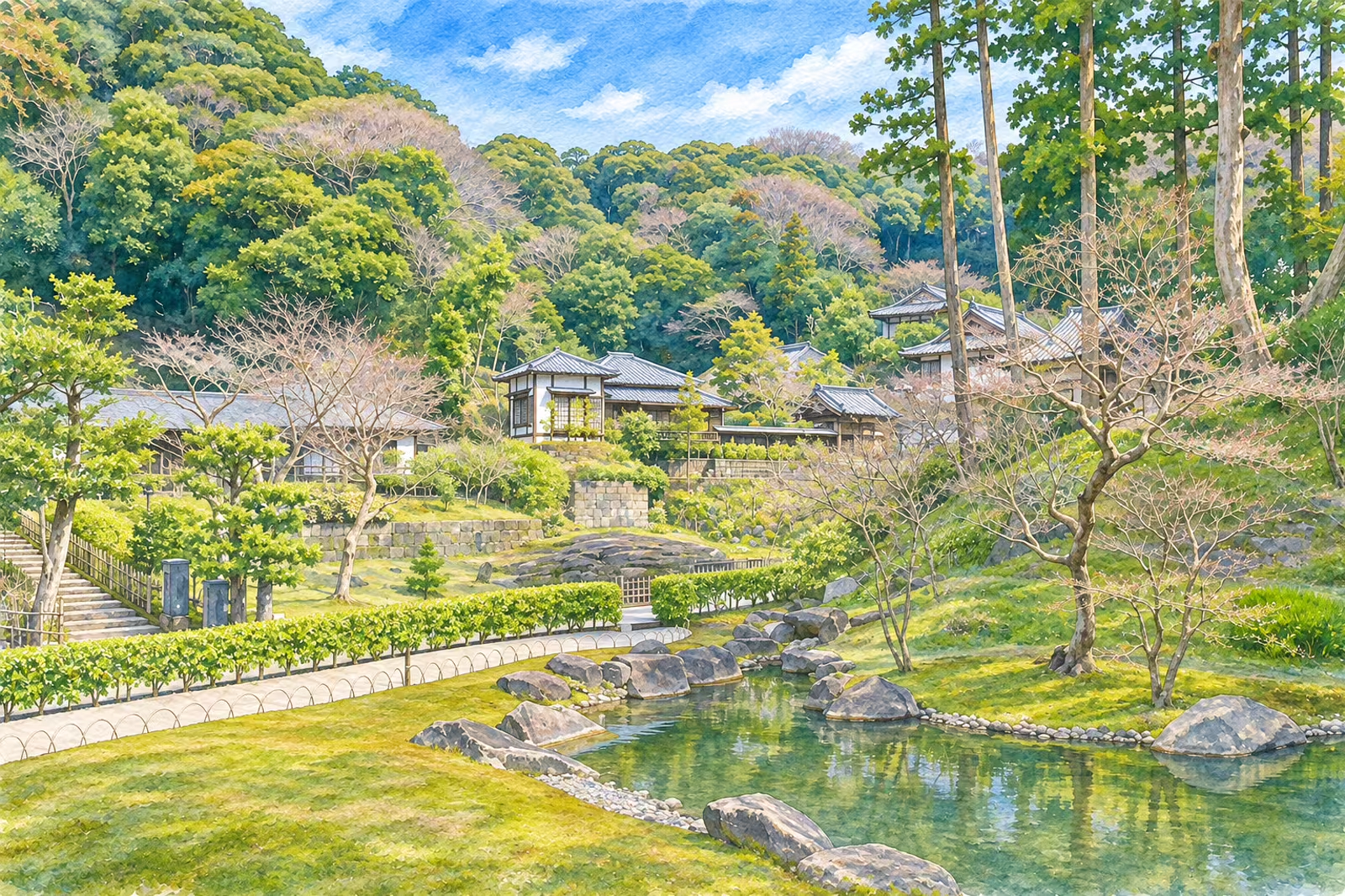
Engaku-ji is a Zen temple in Kita-Kamakura, in Kamakura, Kanagawa Prefecture. Formally known by the mountain name Zuirokusan, it is the head temple of the Engaku-ji branch of Rinzai Zen and ranked second among the Five Mountains of Kamakura. The regent Hōjō Tokimune founded it in 1282, with the Chinese monk Mugaku Sogen (Wuxue Zuyuan in Chinese) as its first abbot. Built in the wake of the two Mongol invasions to pray for the dead on both sides, it is one of the best places to see how Zen and continental contacts shaped the Kamakura period.
01Founding and the Kamakura Period
Tokimune was a committed Zen practitioner, and in 1279 he invited Mugaku Sogen from Song China. After the invasions of 1274 and 1281, he founded the temple in 1282 in a valley north of Kamakura, both to memorialize the fallen of both armies and to give his teacher a monastery. The name is said to come from a copy of the Sutra of Perfect Enlightenment (Engaku-kyō) dug up during construction. Tokimune died two years later and was buried at Butsunichi-an within the temple grounds. Later Hōjō regents continued to patronize Engaku-ji, and it kept its standing as a leading Zen monastery after the fall of the Kamakura shogunate. Fires struck it repeatedly in later centuries, and recovery came gradually in the later Edo period.
02Modern Zen
In the Meiji era, the abbots Imakita Kōsen and Shaku Sōen opened the temple to large numbers of lay practitioners. The novelist Natsume Sōseki came here to sit in meditation at the end of 1894, an experience he later used in his novel The Gate (Mon). Shaku Sōen spoke at the World’s Parliament of Religions in Chicago in 1893, and his student D. T. Suzuki went on to introduce Zen to Western readers. The Great Kantō Earthquake of 1923 brought down many of the temple’s buildings, and the Buddha hall was not rebuilt until 1964.
03What Can Be Seen Today
The temple climbs gently up a long, narrow valley: the outer gate, the main gate (Sanmon) rebuilt in 1785, the Buddha hall with its crowned Shaka Buddha, and the abbot’s quarters stand one behind another, with more than a dozen subtemples along the sides. The Shariden, a Muromachi-period hall in the Zen style said to enshrine a tooth relic of the Buddha, is a National Treasure and is usually closed to the public. The great bell, cast in 1301 and about 2.6 meters tall, is also a National Treasure and hangs on a rise on the east side of the grounds. The precinct is a designated National Historic Site, and the temple remains a working monastery that also holds meditation sessions for lay people.
Engaku-ji
01A Temple Cut by a Railway
Step off the train at Kita-Kamakura Station and you are, in a sense, already inside Engaku-ji. The pond beside the platform and the stone steps rising from the road belong to the temple’s original approach. When the Yokosuka Line was laid in 1889, the tracks were run straight through the lower end of the precinct, separating the pond, called Byakuro-ike, from the gate it once fronted. Few great Zen monasteries in Japan greet visitors with a level crossing.
Engaku-ji is a Rinzai Zen temple, the head temple of the Engaku-ji branch of the Rinzai school. Its full name is Zuirokusan Engaku Kōshō Zenji. In the medieval ranking of the Kamakura Gozan, the "Five Mountains," the five officially sponsored Zen monasteries of the city, it stood second, after its neighbor Kenchō-ji. The buildings run up a narrow valley from south to north, and the deeper you go, the quieter it gets. The temple’s story, though, begins with war.
02The Mongol Invasions
In 1274 and again in 1281, fleets of the Mongol Yuan dynasty and its Korean vassal Goryeo crossed the sea and attacked northern Kyūshū. In Japan these are called the Bun’ei and Kōan invasions, after the era names in which they fell. The man responsible for Japan’s defense was Hōjō Tokimune, the regent (shikken) who ran the Kamakura shogunate, the warrior government based in this city. He had refused Kublai Khan’s demands for submission, had Mongol envoys executed, and ordered a stone defensive wall built along Hakata Bay.
The second invasion was far larger than the first. After weeks of fighting along the coast, a storm wrecked much of the invading fleet, and the survivors withdrew. Later generations would call such storms kamikaze, "divine winds."
The killing had been heavy on both sides: Japanese warriors, and on the other side Mongol, Korean and southern Chinese soldiers, many of the last pressed into service from the recently conquered Song lands. The shogunate could not be sure there would not be a third invasion. Tokimune, who had practiced Zen meditation since his youth, resolved to build a great monastery. It would offer prayers for the souls of the dead of both armies and serve as a training hall for Zen. Engaku-ji was founded in 1282.
The idea of praying for friend and enemy alike rests on a Buddhist principle that the dead are to be treated equally regardless of which side they fought on. Engaku-ji has long presented this as its founding purpose, and it is the first thing many visitors are told about the temple.
03Hōjō Tokimune
Tokimune was born in 1251, the heir of Hōjō Tokiyori, the fifth regent. Tokiyori was a serious patron of Zen who had invited the Chinese monk Lanxi Daolong (Rankei Dōryū in Japanese) to found Kenchō-ji. Tokimune became regent in 1268, at seventeen (eighteen by the traditional count), just as the first Mongol letter reached Japan. He spent nearly his whole adult life preparing for or fighting the invasion.
The popular image of Tokimune is of a resolute young leader who stared down the world’s largest empire. The Zen tradition adds another layer: a man troubled by fear and doubt who leaned on his Chinese teachers. A well-known story holds that his teacher Wuxue Zuyuan once wrote him the words "Do not worry" (bakubonnō). This is a tradition preserved within the temple’s lore rather than a documented exchange, but it tells you how the two men have been remembered together.
Tokimune fell ill in 1284 and took monastic vows on his deathbed. He died at thirty-two by Western reckoning, only two years after Engaku-ji’s founding. His mortuary chapel, Butsunichi-an, stands within the temple grounds.
04Wuxue Zuyuan Crosses the Sea
The founding abbot of Engaku-ji was the Chinese monk Wuxue Zuyuan, known in Japan as Mugaku Sogen. He was a Rinzai (Linji) master from the region of Mingzhou, modern Ningbo, a disciple of the great abbot Wuzhun Shifan of Mount Jing. Wuzhun’s lineage produced a remarkable number of the monks who carried Chinese Zen to Japan in the thirteenth century.
The most famous story about Wuxue comes from the last years of the Song dynasty, as Mongol armies swept south. According to his biography, Yuan soldiers burst into his monastery in Wenzhou and held a sword to his neck. Unmoved, he recited a verse ending with the line that their blade would be like "cutting the spring breeze in a flash of lightning": there was nothing there for a sword to kill. The soldiers, the story goes, left him unharmed. The episode is told in Zen biography and carries a legendary coloring, but it gave Wuxue an aura that fit the moment of his arrival in Japan precisely: a man who had faced the Mongols with composure, invited by a ruler who was preparing to face them again.
After Lanxi Daolong died in 1278, Tokimune sent envoys to China to find a successor. Wuxue arrived in 1279, first serving at Kenchō-ji, and then became founding abbot of the new Engaku-ji. He lived in Japan only seven years, dying in 1286. The court granted him the posthumous title Bukkō Zenji, later raised to Enman Jōshō Kokushi; he is commonly called Bukkō Kokushi, "National Teacher of the Buddha’s Light." Through his disciple Kōhō Kennichi and Kōhō’s student Musō Soseki, the most influential Zen monk of the following century, Wuxue’s line shaped much of Japanese Zen. Musō himself served for a time as abbot of Engaku-ji.
05The Name and the Deer
The temple takes its name from the Sutra of Perfect Enlightenment (Engaku-kyō). According to the temple’s founding legend, workers digging the foundations unearthed a stone chest containing a copy of this sutra. The mountain name, Zuirokusan, "Auspicious Deer Mountain," comes from another legend: when Wuxue first preached at the temple, a herd of white deer came out of the hills to listen. Both are traditional founding stories, the sort told about many old temples.
06The Hōjō Family Temple
From the beginning Engaku-ji was the temple of the main Hōjō line. Tokimune’s son Hōjō Sadatoki continued to support it lavishly; his gift of the great bell is one of the temple’s two National Treasures. In the early fourteenth century the Five Mountains system took shape, and Engaku-ji was placed among the top-ranked Zen monasteries. At its height it had forty-two subtemples spread across the hills; fewer than twenty survive.
In 1333 the Kamakura shogunate fell, and the last Hōjō regent, Hōjō Takatoki, died with his family at Tōshō-ji in the city. Engaku-ji lost its founding patrons, but the Ashikaga shoguns and their deputies in Kamakura continued to protect it. What really hurt the temple in the following centuries was fire. Major fires struck in 1374, 1526 (when the Satomi warlords of Awa raided Kamakura) and 1563, and the great earthquake of 1703 did further damage. A late-Edo revival under the abbot Daiyō Kokushi (Seisetsu Shūcho) rebuilt the monks’ hall and main gate and laid the foundations of the temple you see now. Under the Tokugawa shogunate it was granted lands and survived, but on a far smaller scale than in its Kamakura prime.
07Zen Goes Abroad
In the modern era Engaku-ji became important in a completely different way. In the 1870s Imakita Kōsen, newly installed at Engaku-ji, revitalized its monastic training and opened Zen practice to laypeople. His successor, Shaku Sōen, head of the Engaku-ji branch from 1892, traveled to Chicago in 1893 to speak at the World’s Parliament of Religions, one of the first occasions on which a Japanese Zen master addressed a Western audience.
Sōen’s address was translated into English by a young lay disciple, Suzuki Daisetsu, better known in the West as D. T. Suzuki. Suzuki had practiced at Engaku-ji under both Kōsen and Sōen. Over the following decades, writing in English from America and Japan, he did more than anyone else to make "Zen" a word that Western readers recognized. He spent his last years near Engaku-ji, and his grave lies across the tracks at Tōkei-ji.
In the winter of 1894 to 1895, the twenty-seven-year-old Natsume Sōseki, later the most celebrated novelist of modern Japan, stayed at Kigen-in, one of Engaku-ji’s subtemples, and practiced under Shaku Sōen. He later used the experience in his novel The Gate (Mon), whose protagonist goes to a Kamakura Zen temple to resolve his inner distress and leaves without having passed through the gate of enlightenment. Many literary visitors think of that scene as they climb toward the temple’s main gate.
The film director Ozu Yasujirō is also buried at Engaku-ji. His gravestone carries a single character: mu, "nothingness."
08Earthquake and Reconstruction
The Great Kantō Earthquake of 1923 devastated Kamakura. At Engaku-ji the Buddha Hall collapsed and many other buildings were damaged. The Buddha Hall was not rebuilt until 1964, in reinforced concrete, designed to follow Kamakura-period Zen architecture.
The result is a temple whose buildings come from very different periods: a fifteenth-century Relic Hall, an eighteenth-century gate, a late-seventeenth-century meditation hall, a postwar Buddha Hall. The rest of this guide walks through them in order.
09The Main Gate
Climbing the steps from the station brings you first to the outer gate, and beyond it to the massive two-story Sanmon, the main gate. The current gate was rebuilt in 1785 by Daiyō Kokushi, marking the 500th anniversary of the founder’s death, and is a Kanagawa Prefecture Important Cultural Property. Its upper story, normally closed, enshrines an Eleven-headed Kannon, the Twelve Heavenly Generals and the Sixteen Arhats. The tablet bearing the temple’s name was granted by the retired emperor Fushimi in Sadatoki’s time. In autumn, when the maples around the gate turn, this is the most crowded spot in the temple.
The word sanmon is traditionally read as "three gates," standing for three gates of liberation in Buddhist thought. Passing through it symbolically means entering the realm of practice, which is one reason readers of Sōseki’s novel find the gate here so resonant.
10The Buddha Hall and Meditation Hall
Behind the gate stands the Butsuden, the Buddha Hall. Its main image is a crowned Shaka (Shakyamuni) Buddha, a type often found in Zen temples. The head of the statue is generally thought to date from the Kamakura period, the body from the Edo period. On the ceiling is a painting of a white dragon, painted for the 1964 reconstruction by Moriya Tadashi under the supervision of his teacher Maeda Seison.
To the west is the Senbutsujō, a thatched hall where monks meditate, built in 1699 with funds from Matsudaira Tadamitsu, lord of Nagashima in Ise, and originally also used to house a set of the Buddhist canon. Further up are the abbot’s quarters (Hōjō), used for ceremonies, lectures and meditation sessions, with an old juniper tree in front.
11The Relic Hall
Continuing north along the central axis brings you to Shōzoku-in, the monastery’s training hall and the memorial site of the founder. It is normally closed to visitors and opened only on a few occasions each year.
Inside stands the Shariden, the Relic Hall, a National Treasure and the only building in Kanagawa Prefecture with that designation. It is the finest surviving example in eastern Japan of the Zen style (zenshūyō), sometimes called the "Chinese style": a steep roof with sweeping upturned eaves, densely packed bracketing, and bell-shaped "cusped" windows. The building was not originally made for Engaku-ji. It was the Buddha hall of Taihei-ji, a Kamakura convent, and was moved here after Engaku-ji’s great fire of 1563, when Taihei-ji was in decline. On stylistic grounds it is generally dated to the early-to-mid Muromachi period, around the early fifteenth century. The hall enshrines a tooth relic of the Buddha, which tradition says the third shogun, Minamoto no Sanetomo, obtained from the Nengren Temple in Song China.
Behind it is the Founder’s Hall (Kaisandō), with a seated image of Wuxue Zuyuan, whose tomb is also here.
12Butsunichi-an and the Great Bell
East of the main axis lies Butsunichi-an, Tokimune’s mortuary chapel, where he is honored along with his son Sadatoki and grandson Takatoki. It has a small teahouse where visitors can sit with a bowl of matcha. Kawabata Yasunari set the opening tea ceremony of his novel Thousand Cranes at Engaku-ji, and readers sometimes come looking for its setting.
Finally, back near the main gate, a long flight of stone steps climbs the eastern hillside to the great bell, the Ōgane. Cast in 1301 by the caster Mononobe no Kunimitsu at the commission of Hōjō Sadatoki, with an inscription composed by the abbot Xijian Zitan, it stands 259.5 centimeters tall, the largest temple bell in the Kantō region, and it is a National Treasure. According to legend the first casting failed, and Sadatoki prayed to the goddess Benzaiten at Enoshima before a second attempt succeeded; a small Benten hall stands beside the bell in her honor. From the terrace there is a view across the valley of Kita-Kamakura toward Kenchō-ji’s hills.