

At a glance
From live benshi narrators and a century of samurai films to the 1950s studio boom and Ozu’s Tokyo Story, how Japan made and watches movies.
- Film reached Japan at the end of 1896 and early 1897; it was first called katsudō shashin, "moving photographs."
- In the silent era a benshi narrated beside the screen; an official count in 1926 found more than 7,500 of them.
- In 1958 Japanese cinemas sold more than 1.1 billion tickets, around a dozen visits a year per person.
- Rashomon won the Golden Lion at Venice in 1951, and the West began to take Japanese film seriously.
- In Sight and Sound’s 2012 directors’ poll, Ozu’s Tokyo Story (1953) came first.
Japan took to the movies almost as soon as they existed, and it did so in its own way. For three decades its silent films were performed with a live narrator beside the screen, a star in his own right. Its most popular genre was set in the age of the samurai, and it stayed popular for a century. In the 1950s its studios produced hundreds of features a year, and a handful of directors, Kurosawa Akira, Mizoguchi Kenji and Ozu Yasujirō, convinced the rest of the world that Asia had a cinema worth studying. This introduction follows that story from the first projectors to the multiplexes of today, with particular attention to the benshi narrators, the period film, and Tokyo Story, the quiet 1953 family drama that many filmmakers now rank above anything else ever made.
01The Voice Beside the Screen
Moving pictures reached Japan at the turn of 1896 and 1897. The first device was Edison’s Kinetoscope, a peep-show cabinet for one viewer at a time. Within months the Lumière brothers’ Cinématographe and Edison’s Vitascope were projecting films onto screens in Ōsaka and Tokyo. The Japanese called the new thing katsudō shashin, "moving photographs," and the phrase stayed in use until the 1920s, when eiga gradually replaced it.
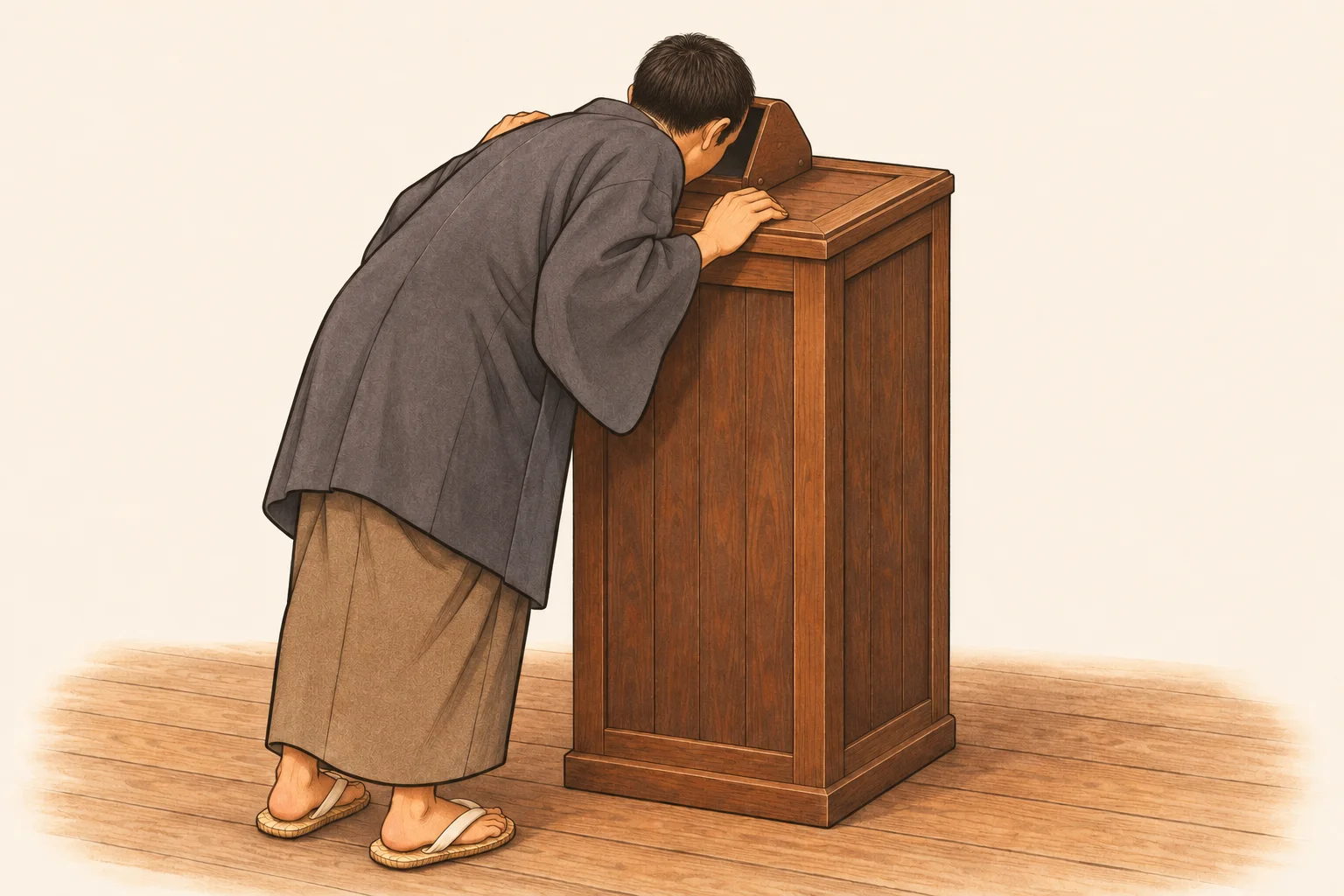
The Kinetoscope, the first moving-picture device to reach Japan, was a peep-show cabinet for one viewer at a time.
From the very first shows, someone stood beside the screen and talked. At first he explained the machine itself and introduced the scenes: a street in Paris, a train arriving, a foreign army on parade. As films grew longer and began to tell stories, the speaker began to tell the story with them. This figure became known as the katsudō benshi, usually shortened to benshi. Lecturers accompanied early films in Europe and America too, but they vanished within a few years. In Japan the benshi became a profession, a craft with schools of style and famous names, and lasted until the mid-1930s.
The reasons lay in Japanese theater. In bunraku puppet theater, the puppets are silent and a chanter, the tayū, sitting at the side of the stage, voices every character and narrates the action. Kabuki uses narrative singers and musicians alongside its actors, and the storytelling arts of kōdan and rakugo rest entirely on one performer’s voice. Japanese audiences were used to the idea that what you see and what you hear can come from different people. A flickering image that needed a voice was not strange to them. Foreign films, full of unfamiliar customs and intertitles in other languages, also simply needed explaining.
The benshi did far more than translate. Those who specialized in Western films cultivated a polished, slightly cosmopolitan manner. Those who performed Japanese films were closer to storytellers, voicing men and women alike, accompanied by shamisen or a small band, building the sword fights and the tearful partings to a climax. The same film could feel completely different depending on who performed it, and many people chose their cinema by its benshi rather than by its program. Top benshi earned more than the actors on screen and had their names printed on posters as large as the titles. The most celebrated of them, Tokugawa Musei, was known for a cool, precise delivery of foreign films and later became a beloved radio personality and essayist. At the height of the silent era, an official count in 1926 found more than 7,500 benshi, women among them, working across the country.
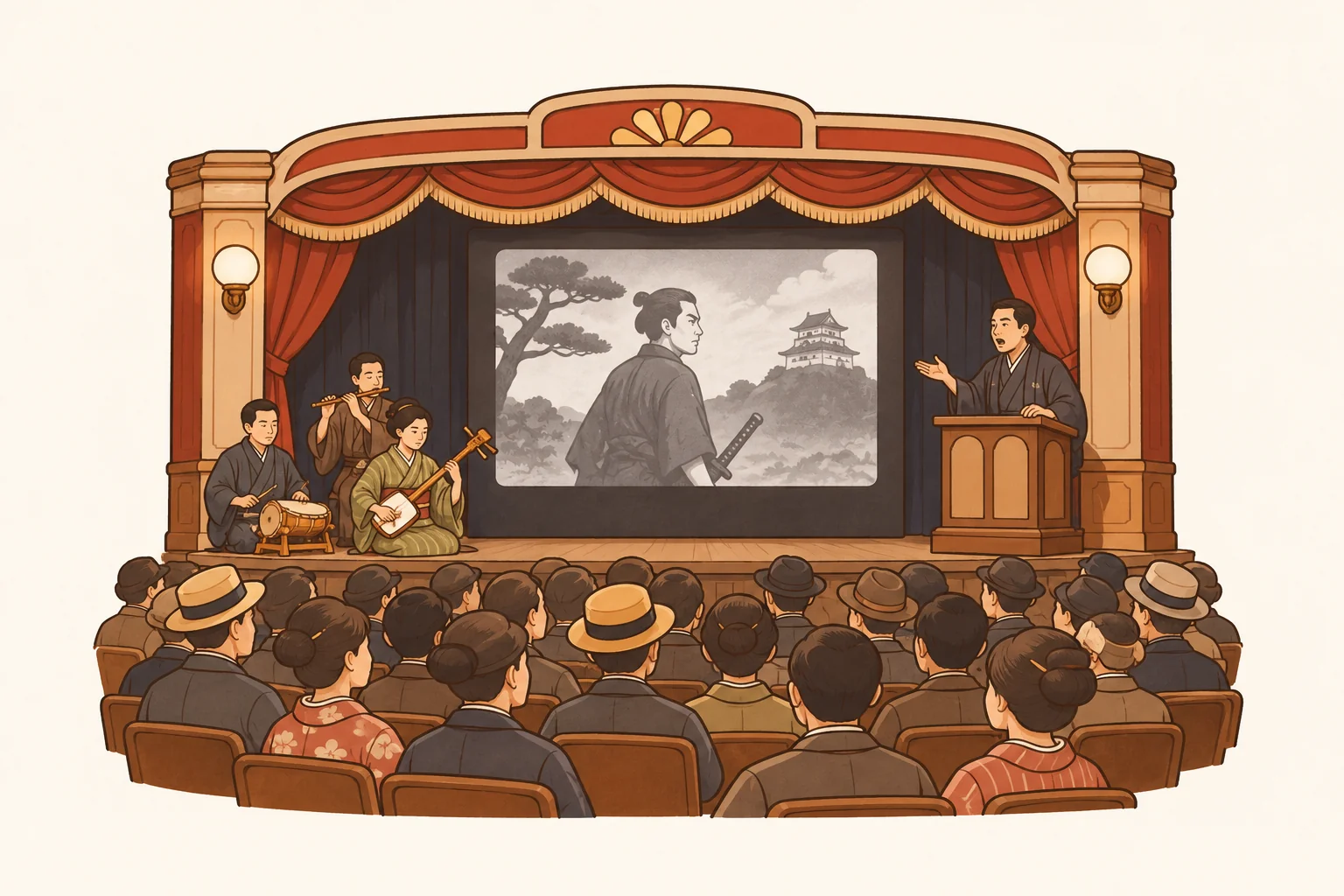
A 1920s cinema: a benshi narrates a silent film beside the screen, with shamisen or a small band (illustration).
The benshi shaped the films themselves. Because a narrator would fill in the gaps, Japanese silent films used relatively few intertitles, and directors could leave a great deal unexplained. Some filmmakers resented the benshi for taking over their work; others wrote scenes with a star narrator’s talents in mind.
Sound arrived late. The first widely successful Japanese talkie, Gosho Heinosuke’s comedy The Neighbor’s Wife and Mine, came out from the Shōchiku studio in 1931, and silent films went on being made and shown for several more years. Ozu himself held out until The Only Son in 1936. As the talkies spread, benshi lost their livelihoods; there were strikes in the early 1930s, but they could not stop the change. Some moved into mandan, the solo comic patter that former benshi had themselves invented, or into radio and stage work.
The art never quite died. A small group of performers keeps it alive today (some reports put the number of working benshi at only a dozen or so), among them Sawato Midori and Kataoka Ichirō, appearing at film festivals, archive screenings and repertory cinemas, usually with live piano or a Japanese ensemble. If you have the chance to attend one of these shows in Japan, take it. The image is black and white and a century old, but the voice is live, and no two performances are the same.
02Swords on Screen: The Period Film
The earliest Japanese fiction films borrowed their stories from kabuki and from the oral storytellers: tales of loyal retainers, wandering swordsmen and ghostly revenge. These were called kyūgeki, "old drama," in contrast to shinpa, "new school," melodramas of modern life. Around 1908 a Kyoto theater manager named Makino Shōzō began filming old-school pictures and found his star in Onoe Matsunosuke, an actor from a traveling kabuki troupe. Matsunosuke played ninja, chivalrous outlaws and the forty-seven loyal retainers of the Chūshingura story, turning out films at an astonishing rate; he is said to have appeared in about a thousand. Children nicknamed him "Medama no Matchan," Matchan of the Eyeballs, for the way he froze into a glaring kabuki pose. Makino is remembered as the father of Japanese film, and Kyoto became the home of the period picture, a role it has never entirely lost.
In the 1920s the old school was reinvented under a new name, jidaigeki, "period drama," set mostly in the Edo era (1603–1868). Younger directors and actors wanted something faster and more violent than kabuki’s stylized posing. In Orochi (1925), Bandō Tsumasaburō plays a decent young samurai who is misunderstood and pushed by an unjust world into outlawry; the film ends with a long, desperate fight against dozens of constables that still astonishes audiences. Itō Daisuke filmed chases and duels with a camera that seemed to run alongside his desperate heroes; people punned on his name and called him idō daisuki, "loves moving shots." Fans called these films chanbara, an onomatopoeic word for the clash of blades. Their heroes were often rebels and masterless men, rōnin, carrying a grudge against authority, which said something about the restless 1920s.
In the 1930s Yamanaka Sadao brought the period film down to street level. His Humanity and Paper Balloons (1937) is set in a poor Edo tenement, among unemployed samurai and small-time hustlers, with hardly a sword fight in it. Yamanaka was drafted into the army as soon as the film was finished (by one account, his call-up papers arrived on the day it opened) and died of illness in China the following year, at twenty-eight. Only three of his films survive complete, and Japanese critics still speak of him as one of the great losses of their cinema.
Why has the samurai film lasted so long? Partly because it is a stage for moral drama. Samurai society had clear rules about loyalty, obligation and honor, and stories set there can push the conflict between giri (duty) and ninjō (human feeling) to breaking point. Audiences do not watch for historical accuracy; they watch to see a person forced to choose. And partly for practical reasons: the Edo streetscape, the sword, the kimono, the wandering ronin form a visual language every viewer already knows. The jidaigeki is to Japan roughly what the Western is to the United States, a popular way for a nation to tell stories about its own past, and the two genres have borrowed from each other freely.
After 1945 the American occupation regarded tales of feudal loyalty and revenge as militarist, and restricted them; Chūshingura was off limits for a time. When the restrictions lifted in the early 1950s, the period film entered its richest decade. At its Uzumasa studios in Kyoto, the Tōei company mass-produced cheerful swashbucklers starring Kataoka Chiezō, Ichikawa Utaemon and the young Nakamura Kinnosuke. At the same time, the most ambitious Japanese films of the decade were also period pieces: Kurosawa’s Rashomon (1950) and Seven Samurai (1954), Mizoguchi’s Ugetsu (1953), Kinugasa Teinosuke’s Gate of Hell (1953).
The 1960s turned the genre darker. Kurosawa’s Yojimbo (1961) brought a new, brutal realism and a cynical humor to sword violence and was remade as Sergio Leone’s A Fistful of Dollars (1964) without the rights being secured, which led Kurosawa and Tōhō to sue; the case was settled. Katsu Shintarō began his long run as Zatōichi, the blind masseur and swordsman, in 1962. Kobayashi Masaki’s Harakiri (1962) took apart the samurai code with cold fury. Then television took over the genre’s everyday role. Mito Kōmon, about a retired lord who travels the country in disguise righting wrongs, ran from 1969 to 2011, and generations of Japanese families watched him produce his inrō, a small case bearing the Tokugawa crest, while the villains fell to their knees.
The period film is no longer mainstream, but it has never gone away. Yamada Yōji’s The Twilight Samurai (2002), about a low-ranking widower samurai struggling to pay his bills and care for his daughters, reminded many viewers how humane the genre can be; Miike Takashi remade 13 Assassins in 2010. Kyoto’s Uzumasa district still hosts period productions, and the industry there produced one of its most unusual stars in Fukumoto Seizō, a specialist kirareyaku, "one who gets cut down," who died on screen tens of thousands of times and became famous late in life after appearing in The Last Samurai.
03The Studio Age
The 1950s were Japanese cinema’s peak. Six studios, Shōchiku, Tōhō, Daiei, Shintōhō, Tōei and Nikkatsu, each had their own stars, directors and chains of theaters, and each had to supply new films week after week. In 1958 Japanese cinemas sold more than 1.1 billion tickets, around a dozen visits a year for every person in the country.
- 1896–1897Moving pictures reach Japan
- 1926More than 7,500 benshi
- 1931The Neighbor’s Wife and Mine: first widely successful talkie
- 1951Rashomon wins the Golden Lion
- 1953Tokyo Story
- 1954Godzilla
- 1958More than 1.1 billion tickets
- late 1950sTelevision arrives; attendance falls by more than half within ten years
- 2001Spirited Away
- 2018Shoplifters wins the Palme d’Or
Attendance peaked in 1958, around a dozen visits a year for every person in the country; television arrived at the end of the 1950s and attendance collapsed by more than half within ten years.
This was also when the West first took notice. In 1951 Rashomon, in which the participants in a killing in the woods give incompatible accounts of what happened, won the Golden Lion at the Venice Film Festival, a result that surprised its own studio. Mizoguchi’s The Life of Oharu, Ugetsu and Sansho the Bailiff won prizes at Venice in three consecutive years, and Gate of Hell took the top prize at Cannes and an honorary Oscar. European critics began to speak of Kurosawa, Mizoguchi and Ozu as a trio, and later added Naruse Mikio.
Kurosawa is the best known of them abroad (see also: Kurosawa Akira: The Director Who Filmed Weather, Mud and Conscience). Here it is enough to say that his weather (rain, wind, mud), his multiple cameras and his kinetic editing made Seven Samurai one of the most imitated films ever made. Hollywood remade it as The Magnificent Seven, and its basic plan of assembling a team for a dangerous job has become a template for action films everywhere.
Mizoguchi was a different kind of artist. His camera keeps its distance, moving slowly in long takes as it follows women, geisha, courtesans and daughters sold into servitude, through societies that consume them. Naruse, often overshadowed, made quiet, unsentimental films about ordinary women in postwar cities; in Floating Clouds (1955), a couple drift from wartime through years of failed reunions and no one is redeemed.
The same decade gave Japan its most famous monster. In 1954 Tōhō released Godzilla, directed by Honda Ishirō with special effects by Tsuburaya Eiji. That spring, a Japanese tuna boat, the Lucky Dragon No. 5, had been showered with fallout from an American hydrogen bomb test at Bikini Atoll, and its crew fell sick. In the film, a creature awakened by nuclear testing rises from the sea and flattens Tokyo. An actor in a heavy rubber suit trampled finely made miniature buildings, and this technique, tokusatsu or "special filming," went on to produce Ultraman and Kamen Rider and made kaijū, "strange beast," a word that English speakers now use.
Television arrived at the end of the 1950s, and within ten years cinema attendance had collapsed by more than half. The studios cut costs and gave young directors room to experiment. Ōshima Nagisa, starting at Shōchiku, made Cruel Story of Youth (1960) and later Death by Hanging (1968); Imamura Shōhei made The Insect Woman (1963). The press called them the Japanese New Wave. They made films about sex, violence, Japan’s Korean minority and the hypocrisy of postwar respectability, a deliberate revolt against the cinema of their elders. By the early 1970s Daiei had gone bankrupt and Nikkatsu had switched to low-budget erotic films, its "Roman Porno" line, and the old studio system was effectively over.
04Tokyo Story
Of all Japanese films, the one most watched, studied and argued over is probably Ozu Yasujirō’s Tokyo Story (1953). In 2012 the British Film Institute’s magazine Sight and Sound asked hundreds of directors around the world to name the greatest films ever made, and Tokyo Story came first.
The story is very simple. An elderly couple, Shūkichi and Tomi, live in the port town of Onomichi on the Inland Sea, with their youngest daughter, Kyōko, a schoolteacher. While they are still well enough to travel, they take the long train journey to Tokyo to visit their grown children. Their eldest son, Kōichi, is a doctor with a small practice in the city’s industrial outskirts; their eldest daughter, Shige, runs a beauty parlor. Both are busy, polite and quietly put out. Before long they pool their money and send their parents to a hot-spring resort at Atami, presenting it as a treat. At the inn, young guests play mahjong and sing late into the night, and the old couple come back early, only to find there is no room for them at Shige’s.
The one person who treats them with real warmth is their daughter-in-law Noriko, widow of their second son, Shōji, who went missing in the war and is presumed dead; according to the dialogue as quoted in one review, it has been eight years. She lives alone in a small apartment and works in an office, but she takes time off to show them the city, finds sake to serve her father-in-law (one review describes her borrowing it from a neighbor), and lets Tomi stay the night. The old couple understand perfectly that this woman, no longer related to them by blood, has been kinder than their own children.
On the way home Tomi falls ill on the train, and they break the journey with their youngest son in Ōsaka. Soon after reaching Onomichi she collapses and dies. The children gather for the funeral; as soon as it is over, Shige asks for some of her mother’s clothes as keepsakes (by one account, a kimono), and the elder children hurry back to Tokyo. Noriko stays on a little longer. Kyōko, angry at her siblings, says the world is a hateful place, and Noriko, without arguing and, as one review describes it, with a smile, agrees that there is a great deal in it that is hateful. Before Noriko leaves, Shūkichi gives her his wife’s watch and urges her to remarry. In the final scene he sits alone at home and remarks to a neighbor that, alone, the days will feel long; outside, a boat moves slowly along the strait.
There are no villains here. Kōichi and Shige are not cruel, only occupied, their lives already full. Ozu takes no side; he gives everyone their reasons, and so viewers recognize themselves, or their parents, in every character. The film describes something specific, the loosening of the Japanese extended family as people moved to the cities in the postwar years, but what moves people everywhere is the more general fact underneath: parents grow old, children grow away, and nobody escapes it.
Ozu’s style is as restrained as his story. His camera sits low, roughly at the height of a person kneeling on tatami, looking straight across at domestic life. It almost never moves. He uses no fades or dissolves; instead, between scenes, he inserts short shots of empty places, eaves, laundry on a line, factory chimneys, a boat in the harbor, which critics later called "pillow shots." In conversations, characters often face the camera almost directly, as if speaking to the audience, a breach of the Hollywood rules for matching eyelines that seems awkward at first and then becomes oddly intimate. Ryū Chishū, who plays the old father, was in his late forties and created Shūkichi’s age through posture and pace. Hara Setsuko, who plays Noriko, also played characters called Noriko in Ozu’s Late Spring (1949) and Early Summer (1951); the three films are often called the Noriko trilogy, although the characters are not the same woman.
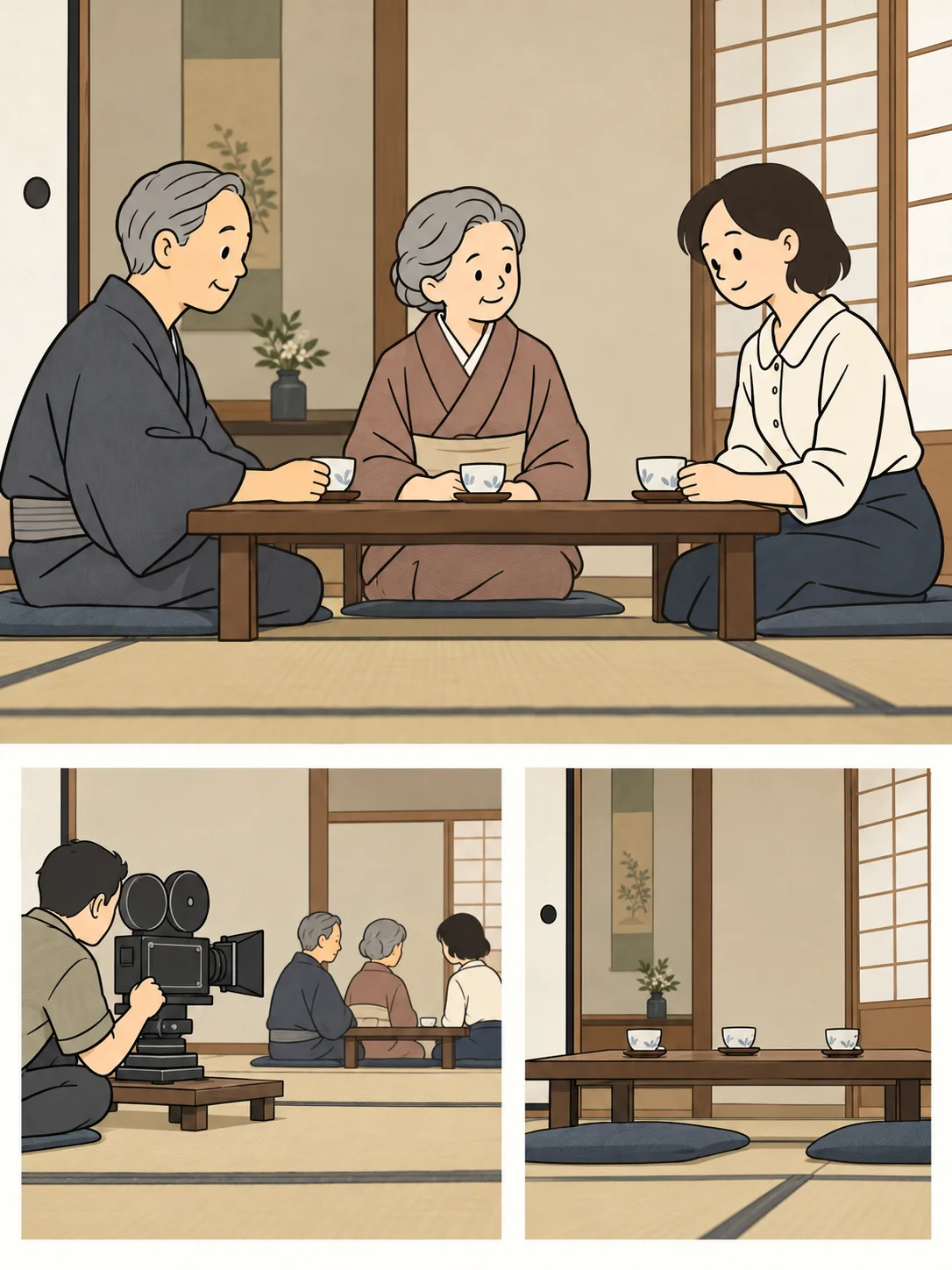
Illustration: the camera sits low, looking straight across at people on the tatami; shots of empty rooms fall between scenes. Not a film still.
Ozu wrote the script with his longtime collaborator Noda Kōgo, as was their habit, at the Chigasakikan, an inn on the coast at Chigasaki, south of Tokyo, where they spent months drinking and refining dialogue. The plot is generally thought to have been loosely inspired by Leo McCarey’s American film Make Way for Tomorrow (1937), in which an elderly couple are shuffled between their grown children. Ozu moved the idea into Japanese homes and landscapes: Onomichi’s temples, steep lanes and strait, and the chimneys and embankments of Tokyo’s edges.
In Japan the film did well on release, but distributors considered Ozu "too Japanese" to export, and he was discovered abroad only from the late 1950s and 1960s, through festivals and retrospectives. He died in 1963, on his sixtieth birthday, and is buried at Engaku-ji in Kamakura. His gravestone bears a single character: 無, mu, "nothingness."
05From the New Wave to Now
In 1969 Shōchiku released the first film in Yamada Yōji’s Tora-san series, known in Japan as Otoko wa Tsurai yo ("It’s Tough Being a Man"), starring Atsumi Kiyoshi as a wandering peddler from the old Tokyo neighborhood of Shibamata. In each film Tora-san comes home, causes chaos, falls for a woman, loses her and takes to the road again. The main run, forty-eight films with Atsumi, lasted from 1969 to 1995 and ended only with his death in 1996 (a special edition followed in 1997 and a fiftieth film in 2019); the films usually came out for the New Year and the summer Obon holidays, and the series is often cited as the longest-running film series with a single lead actor. It was the studio system’s last great comfort: a fixed street, a family shop and an eternal boy, offering city audiences the hometown they imagined they had left.
From the 1980s the energy in live-action film came increasingly from independents and outsiders. Itami Jūzō, an actor turned director, made The Funeral (1984) and Tampopo (1985), comedies that pick apart Japanese etiquette and Japanese food. Imamura Shōhei won the Palme d’Or at Cannes twice, for The Ballad of Narayama (1983) and The Eel (1997). In 1997 Kitano Takeshi, a television comedian, won the Golden Lion at Venice with Hana-bi, a still, laconic film punctuated by sudden violence. In 1998 Nakata Hideo’s Ringu launched the J-horror boom: the long-haired ghost Sadako crawling out of a television set became a global nightmare, and Hollywood remade the film in 2002.
Over the same decades animation became the backbone of the Japanese box office. Miyazaki Hayao’s Spirited Away (2001) won the Golden Bear in Berlin and the Academy Award for Best Animated Feature, and stood as Japan’s highest-grossing film for almost two decades, until Demon Slayer: Mugen Train overtook it in 2020. See also: Anime: How Japan Built an Art Form on a Weekly Deadline; Studio Ghibli and Miyazaki Hayao: Forests, Bathhouses and Flying Machines Drawn by Hand.
In live action, Kore-eda Hirokazu has carried Ozu’s subject, the family, into the present, in films such as Nobody Knows (2004), Still Walking (2008) and Shoplifters (2018), which won the Palme d’Or. Takita Yōjirō’s Departures (2008), about a cellist who becomes a ritual corpse dresser, won the Oscar for Best Foreign Language Film; Hamaguchi Ryūsuke’s Drive My Car (2021) won Best International Feature. And in 2024 Yamazaki Takashi’s Godzilla Minus One won the Oscar for Best Visual Effects, seventy years after the first Godzilla walked out of Tokyo Bay.
06Going to the Movies in Japan
Cinema tickets in Japan are expensive by international standards, but discounts are everywhere: the first day of each month is "Movie Day," chains have their own weekday discounts, late shows are often cheaper, and there are reductions for seniors and, at some cinemas, for couples where one partner is over fifty (some chains have since dropped it or opened it to any pair). Every seat is reserved.
Japanese audiences are notably quiet. People rarely talk or look at their phones, and most stay seated until the end credits have finished and the lights come up, partly out of courtesy and partly because they consider the credits part of the film. The exception is the special "cheering screening" (ōen jōei) for some anime and idol films, where audiences are invited to shout, sing along and wave glow sticks.
For classics and art films, look for the "mini theaters," small independent cinemas concentrated in Tokyo districts such as Shibuya, Shinjuku and Jinbōchō, which show restorations, documentaries and smaller new releases, often with beautifully designed programs. The National Film Archive of Japan in Kyōbashi, Tokyo, is the country’s national film institution. It runs retrospectives by director and theme, maintains a permanent exhibition on the history of Japanese film, and from time to time hosts silent screenings with live benshi and musicians.
For period film, Uzumasa Eigamura in Kyoto (renamed in March 2026, with the English name Uzumasa Kyoto Village; formerly Tōei Kyoto Studio Park) opens a set of Edo-period streets to visitors, with sword-fighting shows and the occasional real production at work. Ozu admirers go to Engaku-ji, just outside Kita-Kamakura station in the neighborhood where he spent his last years, to find the gravestone marked 無, or take the train west to Onomichi to walk the temple lanes above the strait from Tokyo Story. Tora-san fans head to Shibamata, in Tokyo’s Katsushika ward, where shops on the approach to the Taishakuten temple still sell kusa dango, mugwort rice dumplings, as the family did in the films, and where a Tora-san museum stands by the river.
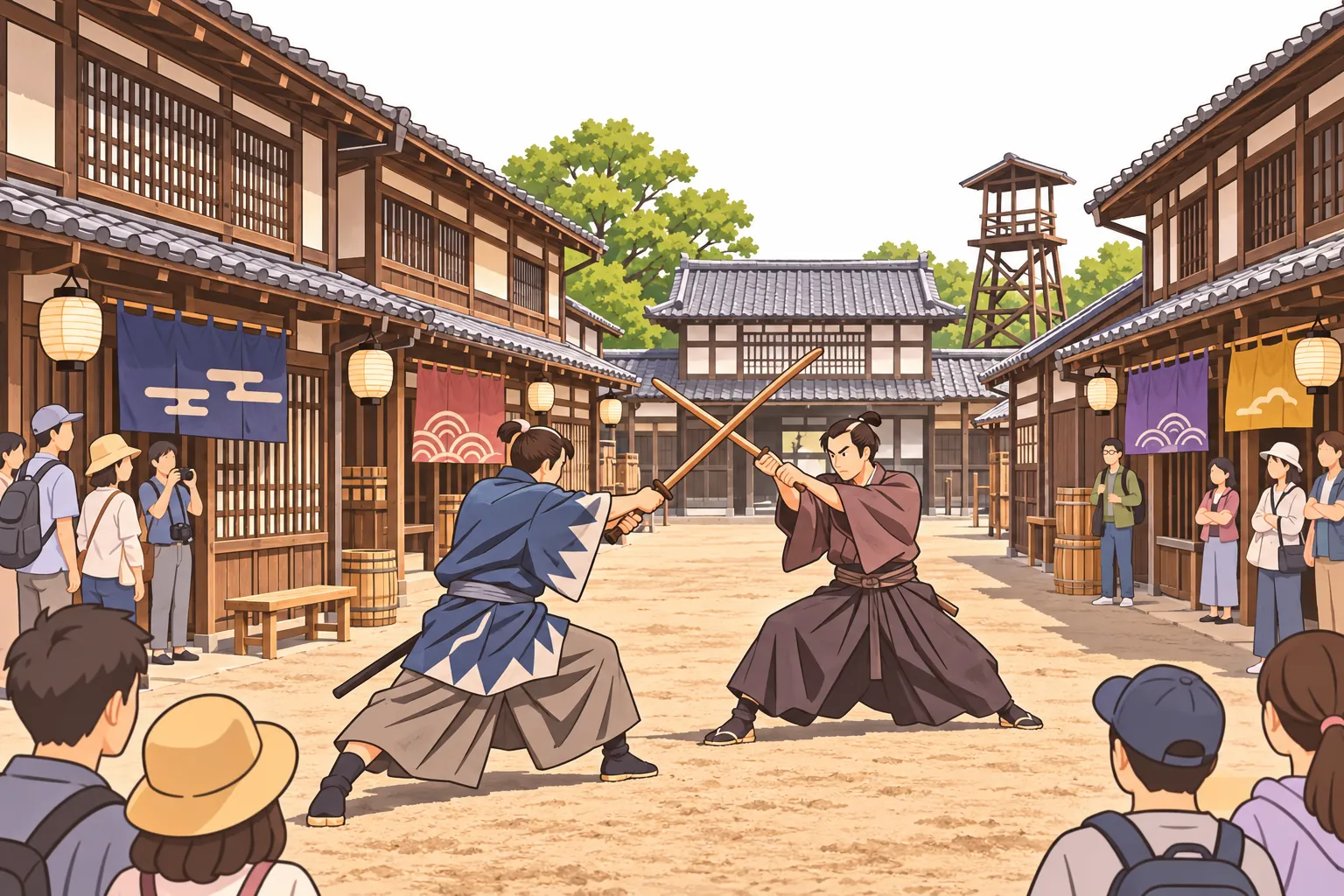
On Uzumasa Eigamura's Edo street set, two costumed actors stage a sword fight as visitors watch (illustration).