
At a glance
How Miyazaki Hayao became a director, how Studio Ghibli makes its films, what Totoro, Mononoke and Spirited Away are about, and where to find them in Japan.
- Studio Ghibli was founded in Tokyo in 1985 as an animation company financed by the publisher Tokuma Shoten.
- In four decades it has made only a little over twenty feature films, drawn by hand over two or three years each, with no TV series behind them.
- Spirited Away earned about 31.68 billion yen and held Japan’s all-time box-office record until December 2020.
- Spirited Away shared the Golden Bear in Berlin in 2002 and won the Oscar for Best Animated Feature in 2003.
- In Japan you can visit the Ghibli Museum in Mitaka (opened 2001) and Ghibli Park in Aichi (opened 2022).
A huge gray creature waits at a country bus stop in the rain, delighted by the sound of water drumming on a borrowed umbrella. A sulky ten-year-old scrubs the floors of a bathhouse for gods. A young prince rides a red elk into a fortress where women work the bellows of an iron furnace. These scenes come from Studio Ghibli, a modest animation studio in the western suburbs of Tokyo, and above all from its central director, Miyazaki Hayao (known in English as Hayao Miyazaki). This essay explains who Miyazaki is and how he got there, how Ghibli works and why it is unusual even in Japan, what My Neighbor Totoro, Princess Mononoke and Spirited Away are really about, and where in Japan you can step inside the films.
01A Small Studio with a Very Large Shadow
Studio Ghibli was founded in 1985 as a production company financed by the publisher Tokuma Shoten. Three people defined it: the directors Miyazaki Hayao and Takahata Isao, and the producer Suzuki Toshio. In four decades it has released only a little over twenty feature films. By the standards of the Japanese animation industry that is a tiny output, yet in Japan the films function as shared family property. My Neighbor Totoro is rerun on Nippon Television’s Friday night film slot every couple of years and still draws big ratings; Spirited Away was the highest-grossing film ever released in Japan for almost two decades.
Most Japanese animation, or anime, is made for television: weekly episodes, tight budgets, fast schedules and finely divided labor, with theatrical films usually spun off from a popular series. Ghibli did the opposite. It made feature films only, original stories or loose adaptations, each one taking two or three years and built from an enormous number of hand-drawn frames. In business terms this was a gamble, and the studio survived because Miyazaki’s films kept getting bigger at the box office.
For many viewers outside Japan, the turning point was the 1990s and early 2000s. Disney signed a distribution deal for Ghibli’s catalog in 1996, Princess Mononoke reached American cinemas in 1999 with an English script by Neil Gaiman, and Spirited Away won the Academy Award for Best Animated Feature in 2003. Since then the films have become a kind of gateway to Japan for people who otherwise know little about anime.
02Miyazaki Hayao: From Toei to Nausicaä
Miyazaki was born in Tokyo on January 5, 1941. His uncle owned Miyazaki Airplane, where his father was a director; during the Second World War the firm made parts, including rudders, for the Zero fighter, and the family moved to Utsunomiya and Kanuma in Tochigi Prefecture. Aircraft appear in almost every film he has made, and so does a deep revulsion at war; both have roots in a childhood spent comfortably on the profits of a war industry. His mother had spinal tuberculosis from 1947 to 1955 and spent years confined to bed and to hospital, an experience that lies behind the absent, convalescent mother in Totoro.
In his last year of high school he saw The Tale of the White Serpent (Hakujaden, 1958), Toei Dōga’s first color animated feature and the first in Japan, and later said he fell for its heroine and began to think seriously about animation. He went on to study political science and economics at Gakushūin University, and after graduating in 1963 he joined Toei Dōga, then Japan’s largest animation studio and openly ambitious to become the Disney of the East.
At Toei he met Takahata Isao, five years his senior. Both were active in the company’s labor union, and their friendship was forged in meetings and late nights. In 1968 Takahata directed The Little Norse Prince (Taiyō no Ōji Horusu no Daibōken), with Miyazaki as scene designer and key animator. It flopped, but it is remembered as the moment Japanese animation began to take on more serious, adult storytelling. Miyazaki also met a fellow animator, Ōta Akemi, at Toei; they married in 1965. Their son Gorō would later direct for Ghibli.
In 1971 Miyazaki and Takahata left Toei. A planned adaptation of Pippi Longstocking collapsed when they could not obtain the author’s permission (Astrid Lindgren herself is said to have declined), and they made the short feature Panda! Go, Panda! (1972) instead. They then worked on the prestigious literary adaptations broadcast on Sunday evenings, above all Heidi, Girl of the Alps (1974) and 3000 Leagues in Search of Mother (1976). For Heidi the team traveled to Switzerland to sketch the real landscape, a habit of location research that became a Ghibli tradition. Miyazaki directed for the first time with the NHK television series Future Boy Conan (1978), and made his first feature, Lupin III: The Castle of Cagliostro, in 1979. It did only moderate business but became a cult favorite among animators and fans.
The breakthrough came through a magazine. Suzuki Toshio, an editor at Tokuma’s anime magazine Animage, wanted Miyazaki to make an original film, but financiers would not back a project with no existing source. So Miyazaki began serializing a manga, Nausicaä of the Valley of the Wind, in Animage from 1982, working on it intermittently until 1994. The 1984 film, based on the early part of the story, was a hit, and its success led directly to the founding of Ghibli.
03How Ghibli Works
The studio’s name comes from the Italian ghibli, a hot wind off the Sahara, which was also the name of an Italian Caproni aircraft of the 1930s. Miyazaki loves Italian aviation, and the story goes that the name expressed the hope of blowing a new wind through Japanese animation. In Japanese it is pronounced "jiburi"; the Italian is closer to "ghee-blee".
The first Ghibli film was Castle in the Sky (Tenkū no Shiro Rapyuta, 1986). In 1988 the studio released Miyazaki’s My Neighbor Totoro and Takahata’s Grave of the Fireflies as a double bill: a gentle story of two sisters meeting a forest spirit in the countryside, shown alongside the story of a brother and sister starving to death in the ruins of wartime Kōbe. Audiences left in a daze. Kiki’s Delivery Service (1989), seen by 2.64 million people, became the year’s top-grossing Japanese film. Until then Ghibli had employed no permanent staff: it gathered about seventy people for each film and disbanded them when it was done. Around 1989 it did something rare in the industry, putting its animators on permanent salaries and hiring new graduates every year so that skills could be built up over time.
Miyazaki and Takahata were very different directors. Miyazaki is an animator first. He checks and corrects an extraordinary share of the drawings himself, and often begins drawing storyboards before the story is finished, letting the film grow as he goes, sometimes without knowing how it will end. Takahata barely drew. He was an intellectual, a demanding organizer and a realist, interested in ordinary life and society, and each of his films looks different: Only Yesterday (1991), Pom Poko (1994), The Tale of the Princess Kaguya (2013). The two worked together for half a century and were each other’s sharpest critics.

Each panel on a storyboard sheet is one shot. Miyazaki often starts storyboarding before the story is finished.
Suzuki made the machine run. He decided how films were promoted, which partners to bring in and what went on the posters, and he built the partnership with Nippon Television and the nationwide campaigns that turned each release into an event. Hisaishi Joe has composed the music for every Miyazaki feature since Nausicaä; songs from Castle in the Sky and Totoro are sung in Japanese primary schools. The art director Oga Kazuo painted the damp, saturated green countryside of Totoro, and the color designer Yasuda Michiyo chose the palettes for nearly all the studio’s films over several decades.
Ghibli began in one rented floor of a building in Kichijōji and moved into a purpose-built studio in Koganei, a western suburb of Tokyo, just after Porco Rosso opened in 1992. It was absorbed into Tokuma Shoten as an internal division in 1997 and split off again as an independent company in April 2005, with Suzuki as president.
04My Neighbor Totoro: Two Sisters and the Spirit Next Door
My Neighbor Totoro (Tonari no Totoro) opened in April 1988. It is set in the countryside on the edge of Tokyo in the 1950s. A university lecturer, Kusakabe Tatsuo, moves with his daughters Satsuki and Mei into a rickety old house to be near their mother, who is recovering in a hospital nearby. The house is full of soot sprites that scatter when you shout; behind it stands an immense camphor tree, and under the tree lives Totoro.
There is no villain and almost no danger until Mei goes missing near the end and the whole village turns out to search for her. The film is about how children absorb something frightening: their mother is ill and might not come home. Satsuki plays the responsible elder sister, making packed lunches and minding Mei, and only breaks down when a telegram suggests their mother’s condition has worsened. Totoro does not speak and solves nothing. He waits with the girls at the bus stop, makes seeds sprout overnight, and flies them over the fields; at the end he summons the Catbus to carry Satsuki to her sister. Children laugh at it; adults recognize the particular childhood feeling of being afraid and, at the same time, held by the world.
Even the name is a child’s invention: Mei announces that the creature told her it is called Totoro, and Satsuki wonders if she means the troll from her picture book. One account also links the name to the sound of Tokorozawa, the area where the film is set. The setting is usually linked to the Sayama Hills around Tokorozawa in Saitama, close to where Miyazaki lives. In 1990 local citizens launched the Totoro no Furusato Trust, which buys up patches of woodland with donations to keep them from development; the plots, called Totoro’s Forests, numbered 67 as of 2026. The film did unremarkable business on first release and became a national favorite through television broadcasts, video and plush toys. About two years after the film’s release, Totoro’s silhouette became the studio’s logo, now seen at the start of Ghibli films.
05Princess Mononoke: The Ironworks and the Forest
If Totoro is Ghibli at its gentlest, Princess Mononoke (Mononoke Hime, 1997) is Ghibli at its fiercest. Mononoke is an old word for vengeful spirits and the uncanny things of the mountains; here it refers to San, a human girl raised by a wolf goddess.
The film is set in the Muromachi period, roughly the fourteenth to sixteenth centuries. Ashitaka, a young prince of the Emishi people in the far north-east, kills a boar god who has been turned into a raging demon, and his right arm is cursed. Traveling west to find the cause, he arrives at Irontown (Tataraba), a fortified settlement that smelts iron from sand in great clay furnaces. Its leader, Lady Eboshi, clears the forest, mines the hills and manufactures firearms. Many of her workers are women she bought out of brothels; her guns are made by people with leprosy, outcasts she has taken in and treated with dignity. But the forest is retreating, the Forest Spirit is under threat, and the wolf goddess Moro and San want Eboshi dead.
The film refuses to choose sides. Eboshi destroys the forest and is also the most beloved person in Irontown. San hates humans and is one. Ashitaka moves between them not to make either side win but to keep both alive. The poster carried a single word, "Live" (ikiro), written by the copywriter Itoi Shigesato; some in the production worried it was too philosophical to bring in families, and Suzuki used it anyway. Miyazaki is generally thought to have drawn on the historian Amino Yoshihiko’s work on medieval Japanese who lived outside rice farming, such as smiths, carters and entertainers, and on the "laurel forest culture" theory about the evergreen broadleaf forests of western Japan. The Forest Spirit’s woods owe much to the ancient moss-covered forests of Yakushima, an island off Kagoshima, where the art staff are said to have gone to sketch.
Princess Mononoke sold about 14.2 million tickets and took about 19.3 billion yen, a Japanese box office record that stood only until Titanic, which opened at the end of the year, overtook it. It was also the studio’s first film to use digital ink and paint, alongside extensive digital compositing, though the drawings remained hand-made. Miyazaki said at the time that it would be his last feature. It was not.
06Spirited Away: A Girl at Work in the Spirit World
Spirited Away opened in July 2001. Its Japanese title, Sen to Chihiro no Kamikakushi, contains the word kamikakushi, "hidden by the gods", a folk explanation for children who vanished without trace.
Ten-year-old Ogino Chihiro and her parents, on their way to a new home, wander through a tunnel into what looks like an abandoned theme park. Her parents gorge themselves on food at an empty stall and turn into pigs. At dusk the lanterns come on, and spirits arrive by ferry to bathe at Aburaya, a vast bathhouse. To survive, Chihiro must get a job there. The witch who runs it, Yubaba, takes her name and leaves her only one character of it, "Sen". In this world, people whose names are taken forget who they are.
Miyazaki said the film began with the ten-year-old daughters of friends who came every summer to his mountain cabin. He wanted to make something he could honestly tell them was made for them. He is said to have leafed through the girls’ magazines they left at the cabin and found them full of nothing but romance, with no story that truly belonged to girls of that age. Getting the parents out of the way early, as pigs, lets Chihiro find her own strength without adult help, and Miyazaki has described the bathhouse world she enters as Japan itself. Chihiro starts out listless and whiny. In the bathhouse she learns to greet people, to say thank you, to scrub floors, to ask the six-armed boiler man Kamaji for work and not give up. In the end she saves the river spirit Haku and her parents. She defeats no one; she grows up inside a strange, rule-bound world of work.
The bathhouse is crowded with unforgettable figures: Lin, the older girl who shows Chihiro the ropes; No-Face, the masked, silent spirit who swells up as he eats; and the guest everyone takes for a "stink spirit". When Chihiro pulls a "thorn" from his side, out comes a bicycle and a stream of trash: he is the god of a polluted river. Haku, too, is a river god whose river was filled in and built over, which is why he has forgotten his name.
Spirited Away drew 23.8 million viewers and 30.8 billion yen on its first run, about 31.68 billion with later reissues. It held the national record from late 2001 until December 2020, when it was passed by Demon Slayer: Mugen Train. It shared the Golden Bear at the 2002 Berlin International Film Festival with Paul Greengrass’s Bloody Sunday, the first animated film to win that prize and, by most accounts, still the only one as of 2026, and won the Oscar for Best Animated Feature in 2003. Its closing song, "Always With Me" ("Itsumo Nando Demo"), was composed and sung by Kimura Youmi.
Princess Mononoke took about 19.3 billion yen; Spirited Away took 30.8 billion on its first run, about 31.68 billion with reissues, and set the national record.
07What Makes a Miyazaki Film
Watch a few Miyazaki films and certain things keep returning. The first is flight: Nausicaä’s glider, Kiki’s broom, Porco Rosso’s seaplane, Totoro soaring with the girls clinging to his fur. Miyazaki draws flight with weight and wind; hair whips across faces, clothes snap against bodies, and you feel the air. This comes from his family’s aircraft business and his lifelong love of planes, and also from his unease that planes are built to kill. The Wind Rises (2013) is a fictionalized life of Horikoshi Jirō, the engineer who designed the Zero.
The second is girls. Most of his protagonists are young women, but they are neither princesses waiting for rescue nor magical warriors. They cook, work, get frightened and make decisions: Nausicaä, Kiki, Chihiro, San.
The third is food. In Castle in the Sky Pazu shares bread topped with a fried egg; in Howl’s Moving Castle bacon and eggs sizzle in a pan over a fire demon; in Spirited Away Haku gives Chihiro rice balls and she sobs as she eats. Eating in these films is the moment characters return to their bodies, drawn slowly and with sound. Many Japanese fans cook the dishes at home.
The fourth is the hand. Ghibli’s images were drawn one by one, and Miyazaki has spent decades personally correcting key animation, reportedly still working in pencil at around eighty. His characters also do things with their hands: turning taps, sliding doors, shouldering bags, sweeping. That patience with everyday movement is what makes the fantasy believable.
Nature in these films is not a simple environmental message. Forests rage, gods fall ill, and people still need iron, timber and a living. Miyazaki rarely offers a resolution; he shows that both sides have a case and that life goes on anyway. That is why adults keep thinking about films their children enjoy.
08Retirements, Returns and Ghibli Today
In Japan, Miyazaki’s retirements have become a running joke. He announced one after Princess Mononoke and then made Spirited Away; after Howl’s Moving Castle (2004), Ponyo (2008) and The Wind Rises (2013) he held a formal press conference to say he was leaving feature films. In August 2014 Suzuki announced a pause in production, and the production department was wound up at the end of that year.
In 2017 Miyazaki withdrew his retirement and Ghibli began recruiting and training a new production team. Takahata Isao died of lung cancer on April 5, 2018, aged 82; by then Miyazaki’s new film was well under way. The Boy and the Heron opened in July 2023 under the Japanese title Kimitachi wa Dō Ikiru ka ("How Do You Live?"), borrowed from Yoshino Genzaburō’s 1937 novel for young readers. There were no trailers and no stills before release, only a single poster, reportedly at Suzuki’s insistence. The story of a boy who loses his mother during the war and enters another world is strongly autobiographical, and it won the Oscar for Best Animated Feature in March 2024.
In October 2023 Nippon Television acquired 42.3 percent of the voting rights in Ghibli, becoming its largest shareholder and making it a subsidiary; Miyazaki stayed on the board as honorary chairman and Suzuki as a representative director, while an NTV executive became president. Succession has long been the studio’s problem. Kondō Yoshifumi, seen as Miyazaki’s heir, directed Whisper of the Heart (1995), the first Ghibli feature directed by someone other than Miyazaki or Takahata, and died in 1998 at 47. Miyazaki Gorō directed Tales from Earthsea (2006) and From Up on Poppy Hill (2011); Yonebayashi Hiromasa directed Arrietty (2010) and When Marnie Was There (2014) before leaving.
Ghibli’s relationship with the rest of Japanese animation is complicated. It belongs to anime and yet stands apart from television series, fan culture and the merchandising of characters. Miyazaki has repeatedly criticized the cheap, limited-animation television model pioneered by Tezuka Osamu, and he has had sharp words for otaku culture. Even so, many of today’s leading anime directors say they grew up on Ghibli.
09Visiting Ghibli in Japan
The obvious first stop is the Ghibli Museum in Mitaka, on the western edge of Inokashira Park in Tokyo, which opened in 2001. From JR Mitaka Station it is a fifteen-minute walk along the Tamagawa Aqueduct, or a short ride on a yellow community bus. Miyazaki sketched the design himself, and there is no fixed route; the museum’s motto is "Let’s get lost together". Inside are recreated animators’ studios with pencils, paints and reference books scattered across the desks as if someone has just stepped out, a furry, scaled-down Catbus that children of elementary-school age and younger may climb on, and on the roof garden a five-meter robot soldier from Castle in the Sky. At the entrance you receive a ticket made from a strip of real 35mm film, a few frames from one of the films, different for everyone. The Saturn Theater in the basement, with about eighty seats, shows short films made only for the museum. Photography is not allowed inside; the roof garden is one of the few places where you can take pictures.
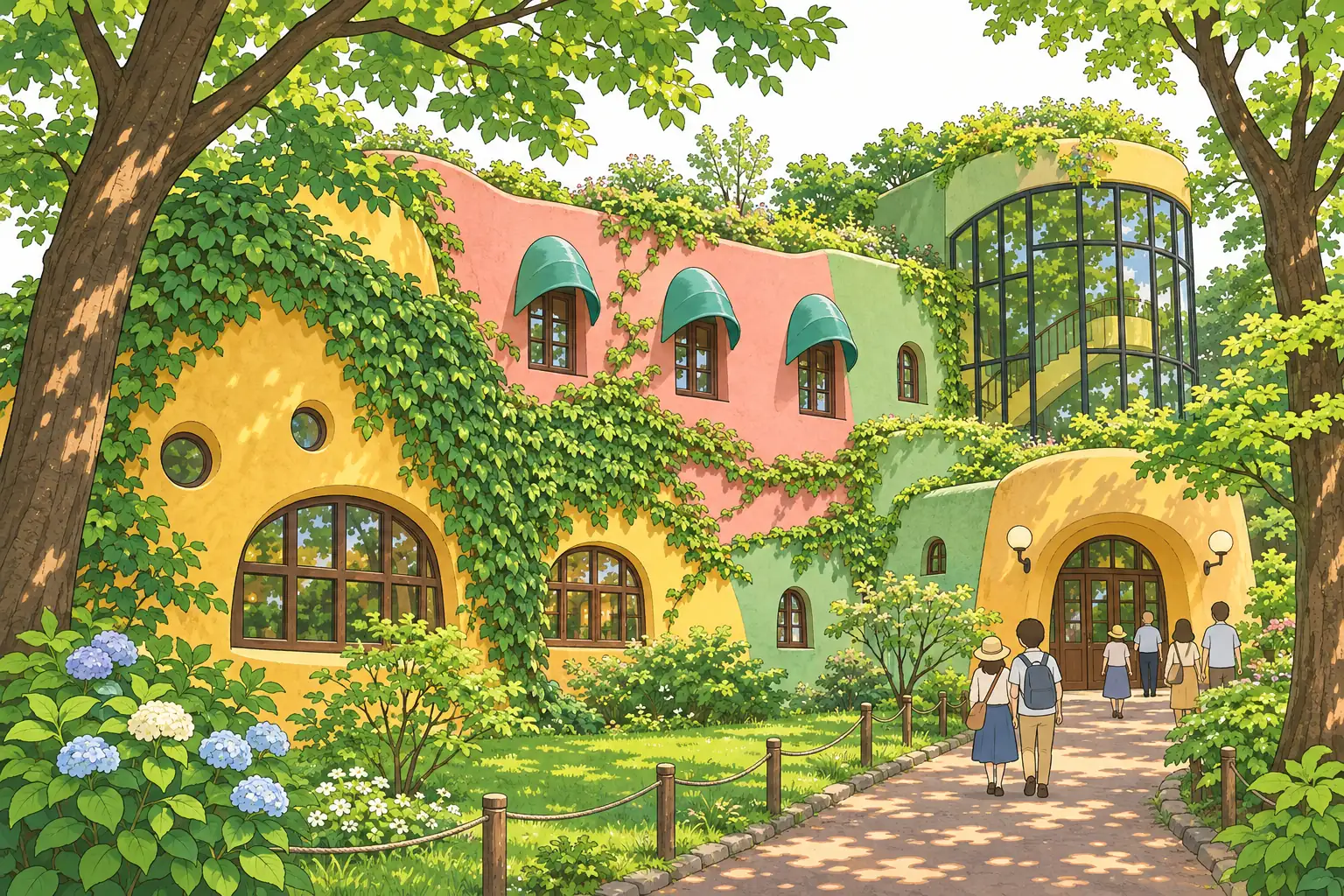
The Ghibli Museum west of Inokashira Park: curved, colourful ivy-covered walls among tall trees (illustration).
Ghibli Park opened in November 2022 in the Expo 2005 Aichi Commemorative Park in Nagakute, near Nagoya. It is not a theme park; there are no rides. Buildings and scenes from the films are built at full scale among the woods and hills. Hill of Youth has the Antique Shop from Whisper of the Heart. Dondoko Forest has Satsuki and Mei’s House, first built as a pavilion for the 2005 Expo; you take off your shoes, look at the kitchen hearth, the well and the iron bathtub, and open the drawers. Ghibli’s Grand Warehouse is a huge indoor exhibition hall. Mononoke Village opened in November 2023, and the Valley of Witches, with Howl’s castle and the bakery where Kiki lodges, in March 2024.

The kind of iron bathtub seen in Satsuki and Mei’s House: a tub over a wood fire, entered on a board.
To find the real places behind the films, go to the Edo-Tokyo Open Air Architectural Museum in Koganei, where historic buildings from the Edo period to the mid-twentieth century have been moved and reassembled. The Spirited Away team visited it for reference, and its old public bathhouse, Kodakara-yu, is often compared to Aburaya. Ghibli’s art staff have said a company trip to Dōgo Onsen Honkan in Matsuyama fed into the bathhouse’s exterior, though Miyazaki himself says Aburaya mixes many hot springs and has no single model. Jiufen in Taiwan is often called the original, but Ghibli has never endorsed that. In Tokorozawa and the Sayama Hills you can walk the woods protected by the Totoro trust, including an old farmhouse known as Kurosuke’s House. On Yakushima, the Shiratani Unsuikyō ravine has a moss forest nicknamed the Mononoke Forest, a few hours’ hike from the trailhead.
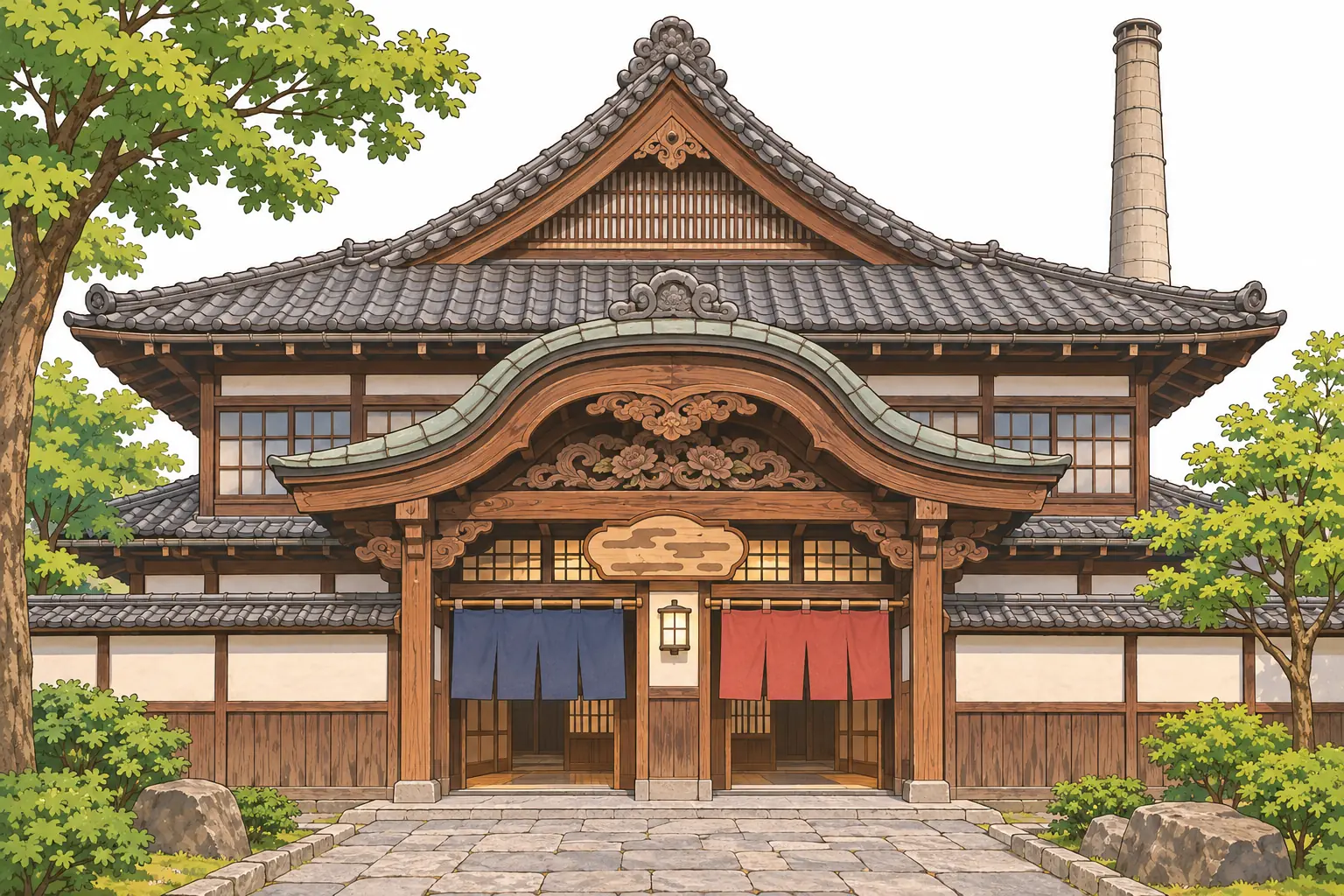
The old Kodakara-yu bathhouse at the Edo-Tokyo Open Air Architectural Museum: a grand karahafu gable over a curtained entrance (illustration).