
At a glance
From Pac-Man and Super Mario to Dragon Quest and Breath of the Wild, how Japanese designers shaped game design, and where to find it in Japan.
- Taito released Space Invaders in 1978 and Namco released Pac-Man in 1980; Japanese games began in the arcades.
- Guinness recognized Pac-Man, with nearly 294,000 units worldwide, as the most successful coin-operated arcade game.
- Super Mario Bros. (1985) has 8 worlds and 32 levels and sold about 40 million copies worldwide.
- Dragon Quest appeared in 1986; the term "JRPG" was coined by Western media and players.
- Breath of the Wild (2017) lets players choose their own routes and solutions; it had sold over 34 million copies by September 2026.
Ask almost anyone to picture a video game and the image that comes to mind is probably Japanese: a yellow circle chomping through a maze, a plumber in a red cap leaping at a flagpole, a party of heroes taking turns to strike a slime. For roughly two decades, from the late 1970s to the turn of the century, Japanese companies did not just make many of the world’s best games; they invented the grammar most games still speak. This piece looks at how that happened, at four landmark works and traditions in particular, at what Japanese designers have tended to care about, and at where a visitor to Japan can still walk into this history.
01Coins, Invaders and a Hungry Circle
The story starts in the arcade. In 1978 the Tokyo company Taito released Space Invaders, designed by Nishikado Tomohiro. Rows of aliens shuffle sideways and step down toward a cannon at the bottom of the screen, accompanied by a four-note bass march that speeds up as their numbers thin. The speed-up was partly a happy accident of the hardware, which could move fewer sprites faster, but it gave the game a heartbeat. Coffee shops swapped ordinary tables for cocktail-style cabinets, and dedicated "Invader houses" sprang up. A story still told in Japan says the craze caused a national shortage of 100-yen coins and forced the Bank of Japan to mint more; it is better read as folklore about how big the boom felt than as monetary history.
Two years later the rival firm Namco answered with something gentler. Iwatani Tōru, a young Namco employee, wanted a game that did not revolve around shooting, one that women and couples would happily play in arcades that were then dark, male spaces. He settled on eating as the theme. The best-known story is that he looked at a pizza with one slice missing and saw his hero; Iwatani later admitted it was partly a legend he had let run. According to secondhand accounts, he also said in a 1986 interview that the shape owed something to the kanji 口, "mouth." The name came from paku-paku, the Japanese sound for gobbling. The game went out for location testing on May 22, 1980, at a rooftop arcade in Shibuya, Tokyo, under the title Puck-Man; for the American market it became Pac-Man, reportedly to stop vandals from scratching one letter of "Puck" into something ruder.
The rules of Pac-Man fit in a sentence: eat every dot in the maze without being caught by a ghost. What made it last is the way three ideas interlock. The first is collection. Dots pave every corridor, so playing well means planning a route, almost like drawing a figure without lifting the pen. The second is pursuit, and here the ghosts are the stars. They are not random. The red ghost homes in on Pac-Man directly. The pink one aims at a point ahead of him, trying to cut him off. The blue one’s target depends on where both Pac-Man and the red ghost are, which makes it feel unpredictable. The orange one chases until it gets close, then wanders off. Their Japanese nicknames spell out the personalities: roughly "chaser," "ambusher," "fickle" and "feigning ignorance." At intervals the ghosts also break off and retreat to their own corners, giving the player a breath. Within a few games you realize you are facing not a swarm but a team with roles, and you start reading them.
The third idea is reversal. In each corner of the maze sits a large power pellet. Eat one and the ghosts turn blue and flee; for a few seconds the hunted becomes the hunter. The thrill is earned by all the pressure that came before, and skilled players lure the ghosts toward a pellet before biting it, turning an escape into an ambush. Pac-Man became a far bigger phenomenon in the United States than in Japan, spawning a cartoon, a hit novelty song and endless merchandise, and Guinness World Records later named it the most successful coin-operated arcade game, with some 293,822 machines. It had no guns and no explosions. It had rules you could read and enemies you could understand.
Arcades remained Japan’s laboratory for decades. Capcom’s Street Fighter II in 1991 put two players shoulder to shoulder at one cabinet, and dropping a coin into a machine someone else was playing became a challenge. Later came rhythm games, taiko drumming machines, crane games and photo-sticker booths, all of them shaped by the social space of the game center.
02The Famicom and Super Mario Bros.
On July 15, 1983, Nintendo released the Family Computer, universally shortened in Japan to "Famicom." It cost 14,800 yen, almost exactly the price of Sega’s SG-1000, launched the same day at 15,000 yen, and very cheap for what the hardware could do. Nintendo was an old Kyoto company that had made hanafuda playing cards since 1889, and its president Yamauchi Hiroshi had steered it into toys and then electronics. The console was designed by a team led by Uemura Masayuki, and its controller carried the cross-shaped directional pad that Yokoi Gunpei’s team had devised for the Game & Watch handhelds. That plus-shaped pad is now on virtually every controller in the world.
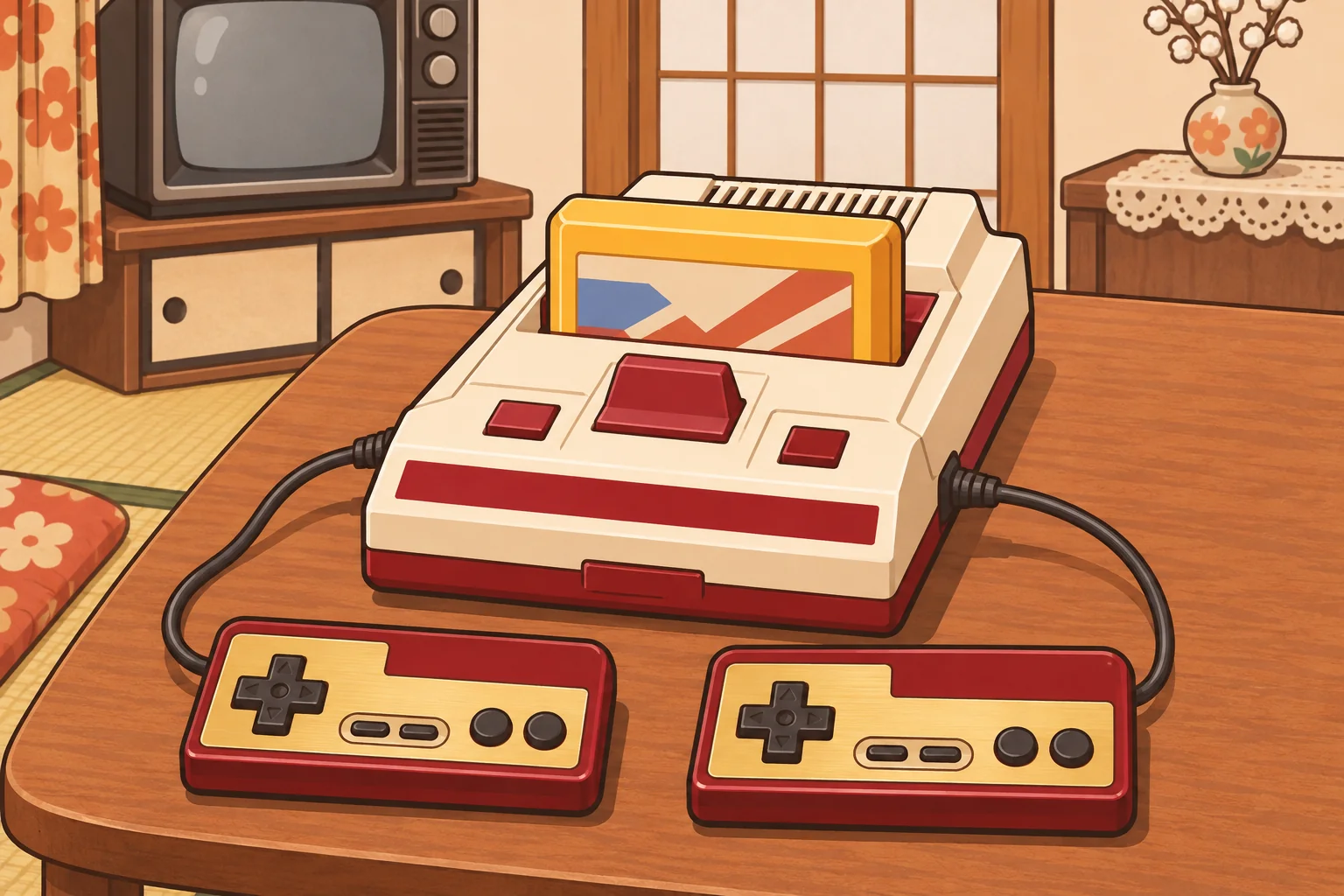
Nintendo's 1983 Family Computer on a table, with two wired controllers showing their cross-shaped D-pads (illustration).
Mario already existed. He first appeared in the 1981 arcade game Donkey Kong, designed by Miyamoto Shigeru, as a carpenter called Jumpman. Miyamoto has explained his look as a series of workarounds: a cap because hair was hard to draw in so few pixels, a mustache because a mouth was impossible, overalls so that the arm movements would read clearly. One of the most recognizable characters on earth was in large part a product of hardware limits.
Super Mario Bros. arrived on September 13, 1985, directed by Miyamoto with Tezuka Takashi and scored by Kondō Kōji. At its heart are running and jumping, tuned with obsessive care. Hold the dash button and Mario builds speed; release it and he skids a little before stopping. How high he jumps depends on how long you hold the button, and you can nudge him in mid-air. Japanese developers call this quality tegotae or tezawari, the "feel in the hands": the sense that the character answers your fingers exactly. Nobody needs a manual. After a few minutes your thumbs know what to do.
The first level, World 1-1, is often taught as a textbook of level design, and it rewards a slow look. Mario starts at the left edge with empty space to his right, so you walk right. A Goomba, a small mushroom-shaped enemy, ambles toward you. Either you collide with it and lose a life, or you jump and squash it, and either way you have learned that jumping deals with enemies. Above, a flashing question-mark block invites a bump from below. Out pops a mushroom, which slides right, bounces off a pipe and comes back toward you, so you are very likely to touch it, and you discover that mushrooms make Mario bigger. Not a word of instruction appears on screen. The game has eight worlds of four stages each, thirty-two in all; at the end of each castle stands Bowser, called Kuppa in Japan, and until the very end the rescued figure turns out to be a Mushroom Retainer with the famous news that the princess is in another castle.
- 1Start at the left edgeempty space to the right, so you walk right
- 2A Goomba ambles toward youjump on it: jumping deals with enemies
- 3A flashing question-mark blockbump it and out pops a mushroom
- 4The mushroom bounces off a pipeand comes back toward you
- 5Mushrooms make Mario bigger
Not a word of instruction appears on screen; the layout of the level does the teaching.
The game was built by revision. Miyamoto and his team sketched stages square by square on graph paper, handed them to programmers, played the result, and changed it. Kondō reworked his overworld theme after watching Mario run, adjusting it until the melody seemed to move with the jumps. Miyamoto has said many times since that you cannot judge whether a game is fun by thinking about it; you have to play it. That habit of polishing, adjusting a jump arc or the moment an enemy appears until the designer’s hand disappears, became the Nintendo house style.
- 1
 Levels were drawn square by square on graph paper.
- 2
 Programmers entered the paper designs into the game.
- 3
 The team played it by hand, then went back to the graph paper to revise.
Super Mario Bros. sold about 40 million copies, many of them bundled with the console, and helped revive home video games in North America after the market crash of 1983. Nintendo had redesigned the Famicom as a gray, toaster-like box called the Nintendo Entertainment System for its American launch in 1985, styled to look less like the video game machines blamed for the crash and, it is said, deliberately sold without the word "console." In 1996 Super Mario 64 carried the same running-and-jumping logic into three dimensions and set the basic template for camera control in 3D action games.
03Dragon Quest, Final Fantasy and the JRPG
If Mario stands for the hands of Japanese games, the role-playing game stands for their heart. On May 27, 1986, the publisher Enix released Dragon Quest for the Famicom. Horii Yūji, a former magazine writer, wrote the game; Toriyama Akira, creator of Dragon Ball, drew the characters and monsters; the composer Sugiyama Kōichi wrote the music. Horii loved American computer RPGs such as Wizardry and Ultima, and his insight was to strip away their intimidating complexity. Menus were simple, text was in friendly Japanese, and a schoolchild who had never touched such a game could follow it. Toriyama’s grinning, teardrop-shaped Slime became the best-known monster in Japan.
Dragon Quest III, released on February 10, 1988, turned the series into a social phenomenon. Lines formed outside electronics shops in Tokyo, some students skipped school, and newspapers reported muggings for copies. A popular legend says the government responded by banning weekday releases for the series. There was never such a law, but later Dragon Quest games did tend to launch on weekends or holidays, and the story stuck. The series is still called a "national game" in Japan, and Sugiyama’s overture turns up at school sports days and in brass band concerts.
Square’s Final Fantasy followed on December 18, 1987, led by Sakaguchi Hironobu. The title is often explained by a story that Square was struggling and Sakaguchi expected this to be his last game before leaving the industry. He has since said that what he really wanted was a title abbreviating to "FF," and the rest mattered less. With music by Uematsu Nobuo and illustrations by Amano Yoshitaka, the series had a lusher, more European-fantasy look than Dragon Quest from the start. Final Fantasy IV in 1991 introduced the Active Time Battle system, in which each combatant acts when their own gauge fills, giving turn-based fights a pulse. In 1997 Final Fantasy VII moved to Sony’s PlayStation, using CDs to hold its prerendered backgrounds and cinematic scenes, and the story of Cloud and Sephiroth persuaded a vast Western audience to take Japanese RPGs seriously.
"JRPG" is a Western term, coined by players and the press to distinguish these games from their own. The difference is a matter of emphasis rather than rule. The Western tradition tended to let you build your own character and roam a world with branching choices. The Japanese tradition usually hands you a hero with a name, a face and a past, gives them a party of distinct companions, and leads them along a carefully authored journey: villages, dungeons, a ship, eventually an airship, a cycle of partings and reunions, and a final confrontation with something larger than a single dark lord. Turn-based command menus, experience levels, random encounters and a tiny figure crossing a world map formed the skeleton.
The tradition never stood still. Chrono Trigger (1995) brought Horii, Sakaguchi and Toriyama together and let battles unfold on the map itself. Pokémon Red and Green (1996) turned collecting and trading into a social activity and grew into one of the largest media franchises on the planet (see also: Pokémon: The Pocket Monsters That Taught the World to Trade). Later, the Persona series wove high-school life together with dungeon crawling, Kingdom Hearts brought in Disney characters, and Xenoblade Chronicles opened up enormous landscapes. By Final Fantasy XVI in 2023 the combat had become fully real-time action. Some fans mourn this; others argue that what really survives is not a battle system but the feeling of walking a long road with a group of friends.
04Console Wars, Handhelds and the Golden Age
From the late 1980s into the early 2000s, Japanese companies dominated the global industry. Nintendo’s Super Famicom (sold abroad as the Super NES) arrived in 1990. Sega fought back with the Mega Drive, known in North America as the Genesis, and in 1991 with Sonic the Hedgehog, whose speed and attitude won it a huge American following. Sony entered with the PlayStation on December 3, 1994, just after Sega’s Saturn. CDs were cheap to press and held far more than cartridges, and third-party publishers drifted to Sony; the defection of Final Fantasy VII marked the shift.
Japanese studios of this era more or less defined genre after genre. Capcom’s Resident Evil (Biohazard in Japan, 1996) gave "survival horror" its name. Kojima Hideo’s Metal Gear Solid made hiding and avoiding sightlines the core of play. Konami’s Silent Hill built dread out of fog and radio static. Konami’s beatmania and Dance Dance Revolution made rhythm games an arcade fixture, and Namco’s Taiko no Tatsujin (2001), played on a real drum with two sticks, is still one of the busiest machines in any game center.
The other thread was portable play. Nintendo’s Game Boy launched in Japan on April 21, 1989, with a greenish monochrome screen and hardware weaker than its rivals. It was also cheap, tough and frugal with batteries. Its creator Yokoi Gunpei summed up his approach as "lateral thinking with withered technology": take mature, inexpensive parts and find a new way to play with them. With Tetris, released alongside it and bundled with the machine in North America, the Game Boy found its way into adult briefcases. Handhelds have always done especially well in Japan, where commutes are long, homes are small and the family television is often occupied. Capcom’s Monster Hunter, which began on PlayStation 2 in 2004 and became a sensation in its portable PSP versions in the late 2000s, had students and office workers sitting together in fast-food restaurants, linked wirelessly, hunting giant beasts as a team.
A Game Boy-style handheld: greenish monochrome screen and a cross-shaped D-pad, sturdy and power-saving.
By the late 2000s big-budget Western studios had overtaken Japan in scale and technology, and there was talk of Japanese games losing their way. Nintendo responded by sidestepping the arms race. The Wii (2006) had grandparents swinging motion controllers at virtual tennis balls. The Switch, released on March 3, 2017, merged home console and handheld: play on the television, then lift it out and take it on the train. As of September 2026 it had sold more than 150 million units, and its successor, the Switch 2, launched on June 5, 2025. Meanwhile Japan’s mobile market went its own way, built around free-to-play games such as Puzzle & Dragons, Monster Strike, Fate/Grand Order and Umamusume: Pretty Derby, which earn their money through gacha, a randomized draw for characters that takes its name from capsule-toy vending machines. A good share of the bowed heads on any Tokyo train belong to people playing them.
05Zelda: From a Boy’s Cave to Breath of the Wild
The Legend of Zelda was released on February 21, 1986, for the Famicom Disk System add-on. Miyamoto has traced it to his childhood in the countryside around Sonobe, near Kyoto, where he wandered hills and woods and once found a cave that he nervously explored with a lantern. The original game gives you almost nothing, a cave, an old man and a sword, and then lays the land of Hyrule before you to figure out for yourself. Later entries, especially Ocarina of Time (1998), the series’ leap into 3D, turned that sense of exploration into an intricate structure: dungeons, items and puzzles locked together, each new tool opening places that were closed before. It was brilliant, and it was also, increasingly, a path laid by the designers.
The Legend of Zelda: Breath of the Wild, released alongside the Switch on March 3, 2017, tore that path up. Director Fujibayashi Hidemaro and producer Aonuma Eiji described their goal as an "open-air" game, a deliberate return to the spirit of the first one. Link wakes in a chamber, walks out of a cave, and the camera pulls back to reveal the whole land below. The opening Great Plateau is a compact tutorial; once you earn the paraglider, you can go anywhere, including straight to Hyrule Castle to fight Calamity Ganon within the first hour.
Two sets of rules make that freedom work. The first is that anywhere you can see, you can reach: Link can climb almost any surface, limited only by a stamina meter, and with the paraglider every high point becomes a launch pad. The second is what the developers called a "chemistry engine." Fire spreads through grass; burning grass creates updrafts that lift the paraglider; metal attracts lightning in a storm; wood floats; ice melts; wind pushes a raft. Because these rules interact, problems have many answers. A camp of enemies can be attacked head-on, flattened by a boulder rolled from the hill above, struck by lightning after you toss a metal sword among them, or set ablaze while you ride the hot air away. The 120 shrines each hold a puzzle, and players found many solutions the designers never planned. The team’s attitude was that anything consistent with the rules counts as an answer.
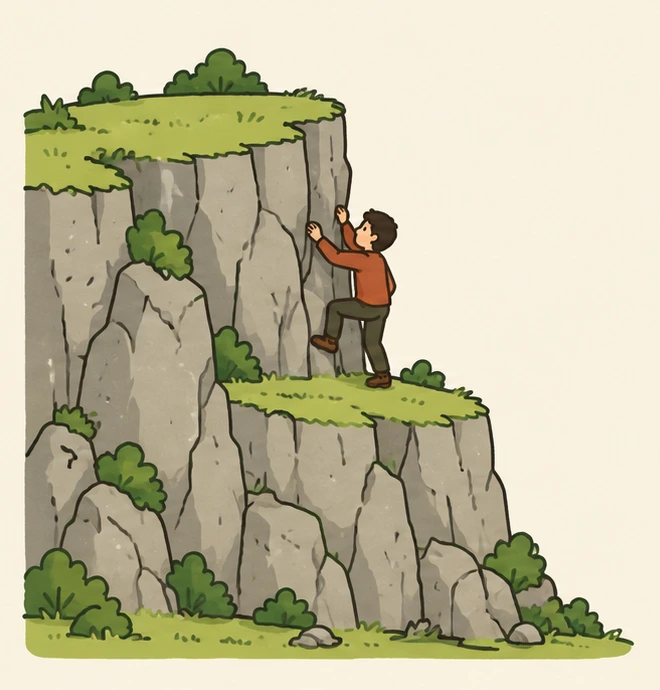
Almost any surface can be climbed, limited only by the stamina gauge.
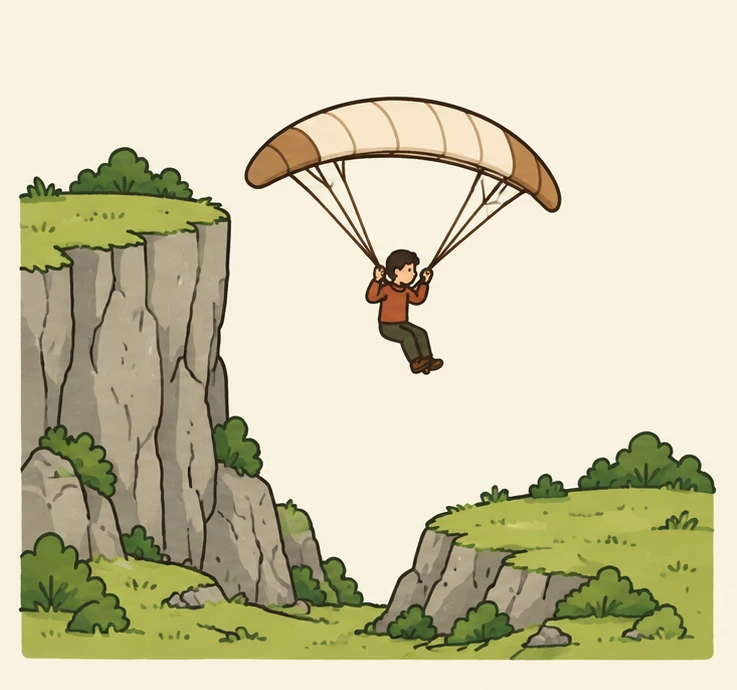
With the paraglider, any high point becomes a starting point.
The landscape is designed to tempt you into choosing. The developers have described a "triangle rule": a triangular hill offers a choice, over or around, and hides what lies beyond it, so that as you climb, the next landmark comes gradually into view and pulls you onward. Towers on the horizon, smoke from a stable, an oddly shaped mountain all issue silent invitations. Nine hundred Korok seeds, hidden under rocks and atop trees, make sure that almost any detour pays off with a small surprise. Breath of the Wild swept the major game-of-the-year awards of 2017 and had sold over 34 million copies as of September 2026. Its sequel, Tears of the Kingdom (May 12, 2023), let players glue objects together into rafts, cars and flying machines, handing even more of the solution to them.
Set World 1-1 of Super Mario Bros. next to the Great Plateau and you see the same Nintendo principle at both ends of thirty years: teach through the environment, without words, and then let go. The difference is that in 1985 the designers wanted every player to learn the same lesson, and by 2017 they wanted every player to find a different route.
06What Japanese Designers Care About
Several threads run through Japanese game design. One is the idea of the game as a toy. Nintendo came out of cards and toys; Yokoi Gunpei made an extending grabber arm and light-gun toys before he made handhelds; Miyamoto studied industrial design. Their first question was how a thing felt to handle, not how grand its story was. That fixation on response, on what happens in the instant a button is pressed, runs through Japanese action games, from Capcom’s fighting games to Nintendo’s platformers. By one account, hit-stop, the split-second freeze of the screen when a blow lands in fighting and action games, was a Japanese invention.
A second thread is character. Japan’s manga and anime industries gave game artists a deep visual vocabulary. Toriyama’s Slime, Amano’s watercolor heroes and Nomura Tetsuya’s designs for Final Fantasy and Kingdom Hearts all borrow from comics: clean silhouettes, readable expressions, a personality visible at a glance. Characters move freely between games, anime, manga and toys, a practice Japanese business calls the "media mix." For anime, manga, otaku culture and Akihabara, see also: Anime: How Japan Built an Art Form on a Weekly Deadline; Manga: How Japan Learned to Tell Every Kind of Story in Panels; Otaku Culture and Akihabara: Fandom, Self-Publishing and the Art of Devotion. Here it is enough to say that games grew up inside that ecosystem, and a walk through Akihabara shows it in a single street.
A third is continuity. Large Japanese companies long practiced lifetime employment, so core creators often spent their whole careers at one firm and series passed from one generation of staff to the next. Horii Yūji has been the game designer of every main Dragon Quest since 1986; Nintendo veterans train newcomers on the same series. That can make companies cautious, but it also lets craft knowledge accumulate, and details get finer with each entry. Alongside the big studios, a strong amateur scene grew around dōjin games, self-published works sold at fan conventions, of which the Touhou Project bullet-hell series is the best-known example. Some creators worked entirely alone: the usual example is Cave Story (Dōkutsu Monogatari), released free in 2004 and said to have been made single-handedly by Amaya Daisuke over about five years.
Finally, there is the place of games in everyday life. In Japan, gaming is not a niche. Office workers play on their phones during the commute, families gather around Mario Kart on weekend evenings, and retirees spend afternoons at the coin-pusher machines in game centers. Professional esports took off later in Japan than in South Korea or the West, held back, it is generally said, by Japanese legal limits on prize money, which by one account have only recently begun to loosen. The Tokyo Game Show, held most autumns at Makuhari Messe in Chiba, as it still was in 2026, draws enormous crowds, and the review scores in the weekly magazine Famitsu once had real power over sales.
07Playing Games in Japan
The easiest door into Japanese game culture is the game center, or gēsen. In Akihabara, Ikebukuro and Shinjuku in Tokyo, or the Nipponbashi district of Ōsaka, you will find arcades several stories tall. The ground floor is usually crane games, glass cases filled with anime figures and giant plush toys; staff will sometimes nudge a prize into a friendlier position if you ask. Higher floors hold photo-sticker booths, rhythm games, Taiko no Tatsujin, racing cabinets and fighting games. In the fighting game corner, machines are often set back to back, and the stranger on the other side may become your opponent the moment you insert a coin. Some machines need a store card or tokens bought on site, so read the signs first, and avoid hogging a popular cabinet for a long stretch.
For older games, Akihabara has several shops dealing in second-hand titles, with glass cases of Famicom cartridges, boxed Super Famicoms and vintage strategy guides at prices from a few hundred yen to many thousands (as of 2025). Some have play corners where you can try retro machines. Around them are electronics stores, trading card shops and anime goods stores, of which the game shops are just one layer.
Nintendo fans have three main pilgrimages. Nintendo’s official store, Nintendo Tokyo, is inside the Shibuya PARCO building. Universal Studios Japan in Ōsaka opened Super Nintendo World in 2021, where a wristband lets you punch question blocks to collect coins and a Mario Kart ride lets you throw virtual shells. And in October 2024 Nintendo opened the Nintendo Museum in Uji, south of Kyoto, on the site of its former Uji Ogura plant, where it once made hanafuda and playing cards and repaired game hardware. The exhibits run from Meiji-era playing cards to recent consoles, and several hands-on installations let you play with oversized versions of old Nintendo toys and controllers. Pokémon Centers in Tokyo, Ōsaka, Kyoto and other cities are another stop (see also: Pokémon: The Pocket Monsters That Taught the World to Trade).
If you have more time, buy a prepaid game card at a convenience store, try the demo units at a big electronics retailer, or go to Akihabara early on the morning of a major release to see the line outside the shops. Tokyo Game Show, held around September, sets aside days open to the general public (as of 2026), with demo queues stretching for hundreds of meters and cosplayers posing outside the halls. Walk through any of these places and the yellow circle and the plumber at the flagpole are still there, part of the ordinary furniture of a Japanese city.