
At a glance
How rubber suits and tabletop cities made Godzilla, Ultraman, Kamen Rider and Super Sentai, from the 1954 film to Godzilla Minus One, and where to meet them in Japan.
- Tokusatsu, short for "special filming," rests on two things: actors in rubber suits and scaled-down miniature cities.
- The first Godzilla opened on November 3, 1954, the same year the Lucky Dragon No. 5 was caught in fallout from a hydrogen-bomb test.
- In Ultraman, which began in 1966, the 40-meter hero can last only three minutes on Earth.
- Godzilla Minus One won the Academy Award for Best Visual Effects, the first Japanese film to do so.
- A near life-size Godzilla head looms from the terrace of Shinjuku’s Toho Building, about 52 meters above the street.
Japan’s giant monsters were not drawn or animated. They were men in heavy rubber suits, stomping through tabletop cities built from plaster and balsa wood, filmed from low angles so that a two-meter actor looked fifty meters tall. The Japanese call this craft tokusatsu, "special filming," and it produced two of the country’s most recognizable exports: Godzilla, who first came ashore in 1954, and Ultraman, the silver giant who arrived on television in 1966. This is a guide to what tokusatsu is, how the original Godzilla was put together, how masked heroes came to rule Sunday mornings, and where in Japan you can still meet them.
01What Tokusatsu Means
Tokusatsu is a contraction of tokushu satsuei, special-effects photography. Strictly it covers any effects work: miniatures, optical compositing, pyrotechnics, wirework. In everyday use it names a genre: live-action films and TV series built around giant monsters (kaijū) or transforming heroes, made largely with practical effects.
Two techniques sit at its heart. The first is suitmation, the Japanese-coined term for putting a performer inside a monster costume, known in Japanese as a kigurumi. The suits were made of latex and rubber over a frame, often weighing many tens of kilograms, and the actor inside could see only through a small slit, usually in the creature’s mouth or neck. Under studio lights, a take could leave him close to fainting. The second technique is the miniature set. Whole districts were built at reduced scale on raised platforms, so the camera could shoot upward at the monster from street level. Water and fire were filmed at high speed and slowed down, which gives them weight on screen.
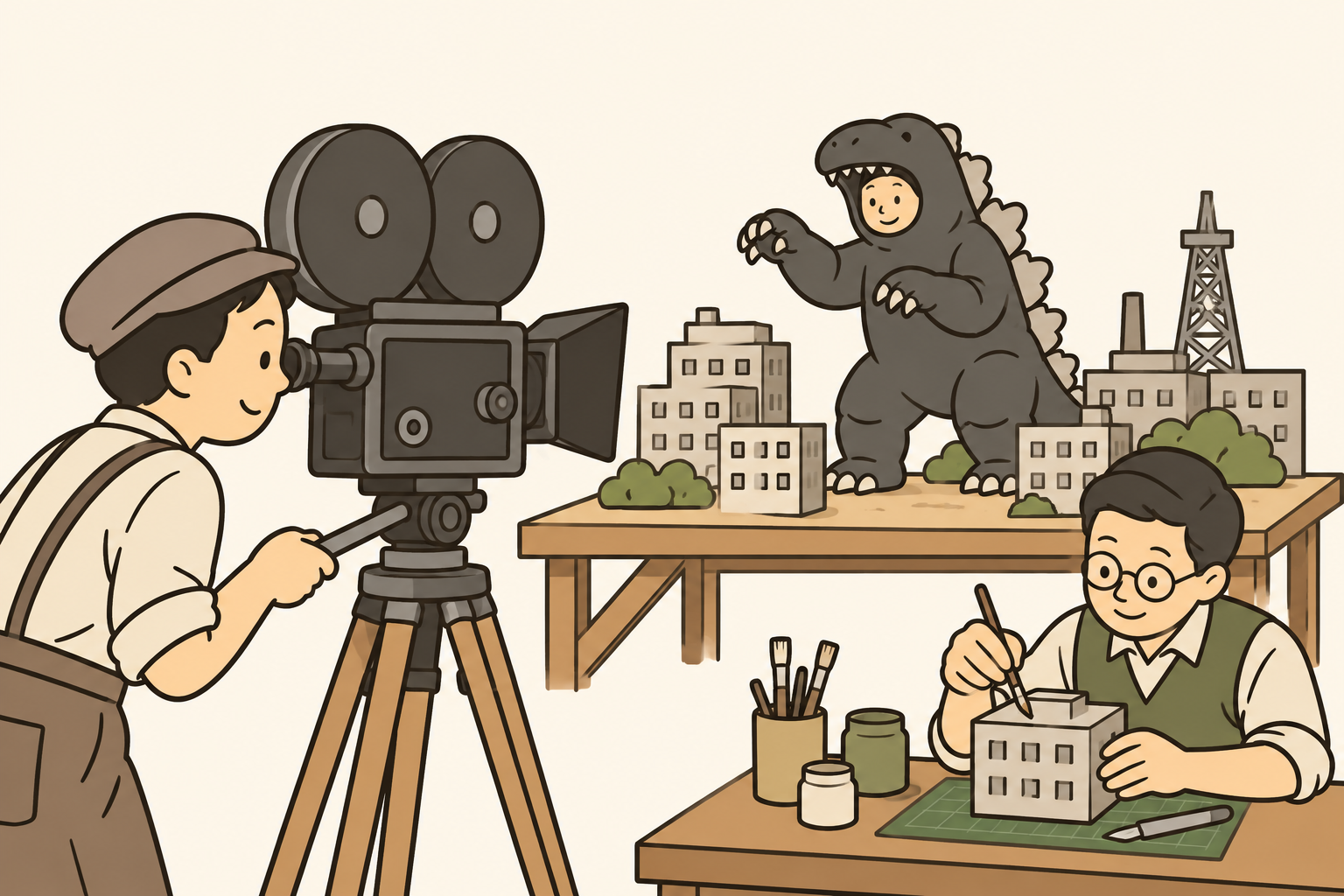
An actor in a monster suit stands in a tabletop miniature city as the camera rolls, while a model maker builds another building. A sketch of the method, not a reconstruction of the 1954 set.
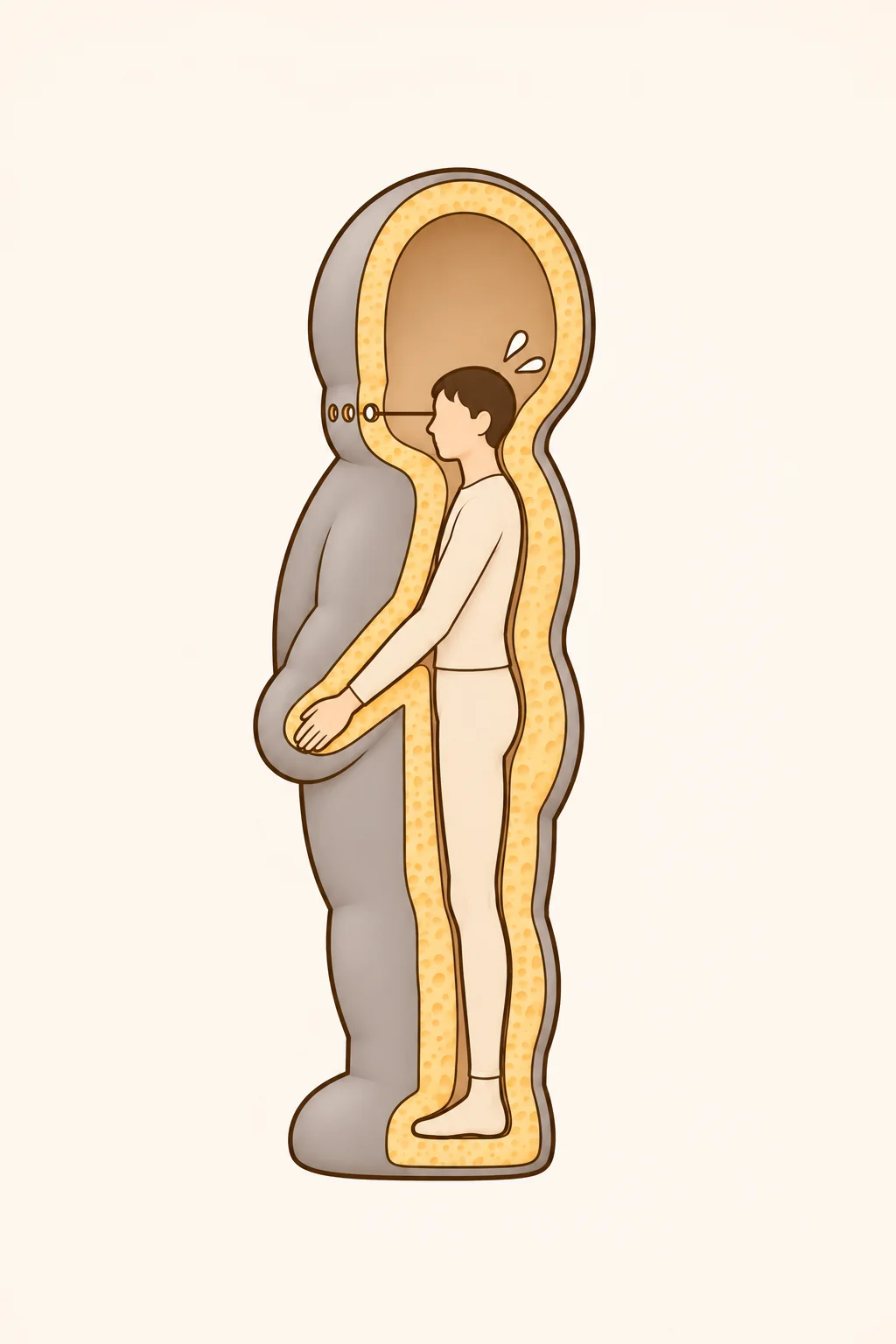
Cutaway of a monster suit: the actor inside the heavy shell can see only through a small slit.
Why suits rather than the stop-motion puppets Hollywood used for King Kong (1933)? Mostly time and money. Stop-motion is slow, and Japanese studios in the 1950s had neither the budgets nor the schedules for it. But the constraint created a style. A man in a suit moves with a real body’s balance and breath, and a model building that collapses throws real debris. Japanese audiences grew fond of that handmade texture, and many productions kept suits and miniatures long after computer graphics became available.
02Godzilla, 1954
The first Godzilla (Gojira) was produced by Toho and released on November 3, 1954. Four men are usually credited as its fathers: producer Tanaka Tomoyuki, director Honda Ishirō, special-effects director Tsuburaya Eiji, and composer Ifukube Akira.
The film is inseparable from its year. In March 1954 a Japanese tuna boat, the Daigo Fukuryū Maru (Lucky Dragon No. 5), was showered with radioactive ash from an American hydrogen-bomb test at Bikini Atoll. The whole crew fell ill, and the radio operator, Kuboyama Aikichi, died that September. Fish markets began testing catches with Geiger counters, and "radioactive tuna" became a national fear. Tanaka, according to the familiar story, came up with the idea on a flight home after another project collapsed: a prehistoric creature awakened and mutated by nuclear testing. The film opens with a fishing boat engulfed by a blinding flash at sea. Audiences in 1954 needed no explanation.
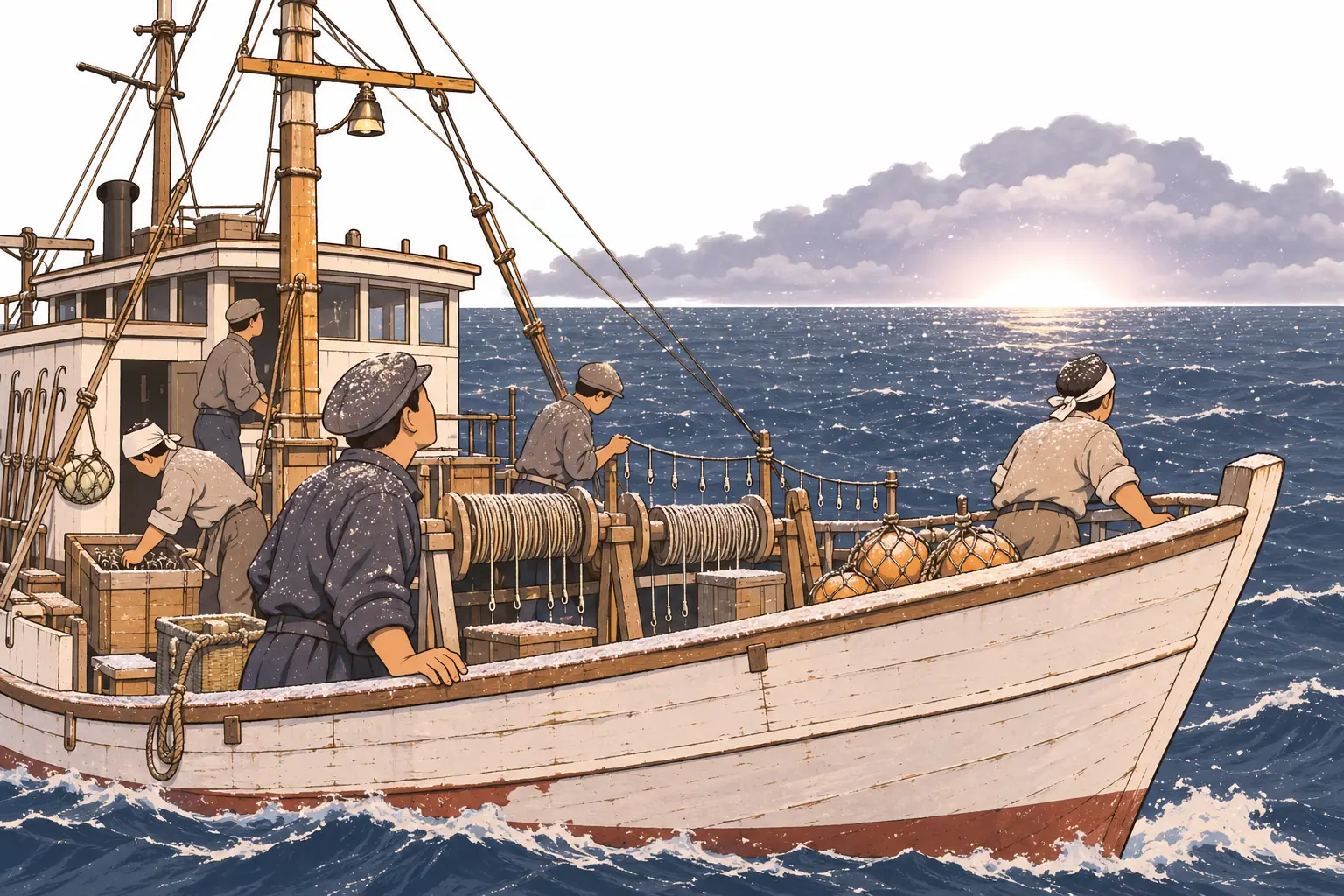
1954: the wooden fishing boat Daigo Fukuryū Maru in the Pacific as white light flares and pale ash falls (illustration).
The name Gojira is usually explained as a blend of gorira (gorilla) and kujira (whale), said to have been the nickname of a burly man at the studio. The monster was made 50 meters tall, just enough to loom over the Tokyo skyline of the day.
Tsuburaya had wanted to use stop-motion, but the schedule ruled it out, and he turned to a suit. The first Godzilla suit weighed around 100 kilograms and was worn mainly by Nakajima Haruo, who studied elephants and bears at Ueno Zoo to work out how something enormous should walk. He could last only a few minutes at a time inside it. At Toho’s studio lot in Kinuta, the effects team built Tokyo at about 1:25 scale: the Wakō clock tower in Ginza, the Nichigeki theater, the National Diet Building, Kachidoki Bridge. The moment Godzilla tears down the clock tower just as it chimes the hour remains one of the film’s most famous shots. The night scenes of Tokyo in flames were kept dark and smoky, which hid the roughness of the suit and also made the city look like it had in the firebombing of 1945, a memory less than ten years old for most of the audience.
Much of the film’s power comes through the ear. Ifukube’s main theme, a heavy, repeating figure in low strings and brass, is still the signal in Japan that Godzilla is coming. The roar, by Ifukube’s own account, was created by drawing a resin-coated leather glove along the strings of a double bass and slowing the recording down, though the film’s sound recordist later told it differently. The footsteps under the opening titles are said to have been taken from the start of an explosion sound in a wartime film and re-recorded with echo in a studio stairwell. Image, models and sound were made by different teams and fused in the edit, so that the audience rarely sees the whole monster clearly but feels its size in shaking buildings, fleeing crowds and that terrible cry.
The ending is not triumphant. Dr. Serizawa uses his invention, the Oxygen Destroyer, to kill Godzilla in Tokyo Bay, and dies with it so the weapon can never be used again. The paleontologist Dr. Yamane, played by Shimura Takashi (familiar to Western viewers from Kurosawa’s Seven Samurai), warns that if nuclear testing continues, another Godzilla may appear. Around 9.6 million tickets were sold. In 1956 an American company recut the film, added new scenes with Raymond Burr as a reporter, and released it as Godzilla, King of the Monsters! That version, with most of the nuclear politics softened, is how the world first met Godzilla.
03Tsuburaya and Ultraman
Tsuburaya Eiji, born in 1901 in Sukagawa, Fukushima, had spent decades experimenting with camera tricks before Godzilla. During the war he built the miniature Pearl Harbor for the propaganda epic The War at Sea from Hawaii to Malaya (1942), so convincing that, by a well-known story, the postwar occupation authorities took it for real combat footage. After Godzilla he was known simply as the god of tokusatsu. In 1963 he founded his own company, Tsuburaya Special Effects Productions, and set out to bring monsters to television.
Ultra Q aired on TBS in January 1966, a weekly anthology of strange events and creatures, and drew huge ratings. Its successor, Ultraman, began that July. The premise is simple. An alien from the Nebula M78 merges with Hayata, a member of the Science Patrol, a team that investigates monster attacks. When things look hopeless, Hayata raises a small device called the Beta Capsule and becomes a 40-meter giant. Ultraman can survive only three minutes in Earth’s atmosphere; the color timer on his chest turns from blue to red and starts to flash and beep as time runs out, and he finishes the monster with the Specium Ray, fired from crossed arms.
Much of this formula came from production limits. Effects scenes were expensive, so the fight had to be short, and the three-minute rule turned a budget constraint into suspense. Ultraman’s look came from the artist Narita Tōru, who with the sculptor Sasaki Akira gave him a smooth silver face with no visible expression, often likened to the archaic smile of ancient statuary. That faint, enigmatic smile is the most recognizable thing about him. Narita and the sculptor Takayama Ryōsaku also gave the series its monsters, including the clawed alien Baltan and the final foe, Zetton. The head writer, Kinjō Tetsuo, came from Okinawa, and in the follow-up Ultraseven (1967) a number of episodes ask uncomfortable questions about who exactly the invader is. Children who watched those episodes often find a different show when they revisit it as adults.
The Ultra series has hardly paused since. Ultraman Tiga (1996) relaunched it for a new generation, and it later became a childhood touchstone for millions of viewers in China as well.
04Masked Riders, Color-Coded Teams and Sunday Mornings
Ultraman is a "giant hero." The other great lineage is the "life-size hero," who fights human-sized villains in quarries and city streets. In 1971 the studio Toei and manga artist Ishinomori Shōtarō (then writing his name Ishimori) launched Kamen Rider: Hongō Takeshi, a young man rebuilt as a cyborg by an evil organization, escapes, puts on a grasshopper-like mask, rides a motorcycle and turns against his makers. When lead actor Fujioka Hiroshi was badly hurt in a motorcycle accident during filming, the producers brought in a second Rider, Ichimonji Hayato, and gave him a stylized pose-and-shout transformation sequence, the henshin. It set off a craze; schoolyards across Japan filled with children striking the pose.
In 1975 Toei followed with Himitsu Sentai Gorenger, five heroes in color-coded suits fighting as a team. This was the start of the Super Sentai series, which soon added giant robots that combine into a larger one, and toys that do the same. In 1993 the American producer Haim Saban cut Sentai fight footage together with new scenes of American teenagers and created Mighty Morphin Power Rangers, a huge hit in the United States.
For more than two decades this century, a new Super Sentai and a new Kamen Rider series started every year, broadcast back to back on TV Asahi on Sunday mornings in a block called Super Hero Time. Bandai’s transformation belts, weapons and robots change with each series, and the weeks before Christmas are the peak season. In February 2026 the 49th Super Sentai series ended its run and the franchise went on hiatus after half a century; Toei filled the slot with a new line, PROJECT R.E.D., while Kamen Rider, as of 2026, carries on with a new series each year. The block also launches careers. Odagiri Jō (Kamen Rider Kuuga), Satō Takeru (Kamen Rider Den-O) and Suda Masaki (Kamen Rider W) all started here, and the handsome young leads have drawn in a second audience of parents watching alongside their children.
05From Shōwa Monsters to Godzilla Minus One
Godzilla appeared in fifteen films in the Shōwa era. The early nuclear terror gradually gave way to a protector who wrestled space monsters like King Ghidorah, in films aimed squarely at children, and the series paused after 1975. It returned in 1984 as a menace again, and the Heisei-era films pitted it against Biollante, Mothra and Mechagodzilla. In the 1990s Daiei’s rival monster, the giant turtle Gamera, got a trilogy of remakes by director Kaneko Shūsuke that are still admired for their grounded, disaster-movie realism.
In 2016 Shin Godzilla, written and co-directed by Anno Hideaki with Higuchi Shinji, turned the monster back into an unstoppable disaster and spent much of its running time in government meeting rooms, where officials argue over procedure as the city burns. Many Japanese viewers read it as a portrait of the state’s response to the 2011 earthquake, tsunami and Fukushima nuclear accident. In 2023 Yamazaki Takashi’s Godzilla Minus One set its story in the ruins of postwar Tokyo, and in 2024 it won the Academy Award for Best Visual Effects, the first Japanese film to do so. It was made by a small team on a budget far below a typical Hollywood blockbuster, and in Japan the award felt like recognition for a craft that had started 70 years earlier with rubber and plaster.
Hollywood, meanwhile, has run its own Godzilla since 2014, in Legendary’s MonsterVerse films, where Godzilla shares the screen with King Kong. The Japanese films tend toward disaster and social allegory; the American ones toward spectacle between monsters.
06Where to Meet Them in Japan
The easiest place is Shinjuku. From an eighth-floor terrace of the Shinjuku Toho Building in Kabukichō, a near life-size Godzilla head peers over the street about 52 meters up, visible from Yasukuni-dōri. The Hotel Gracery, which occupies the upper floors, offers a Godzilla Room and Godzilla-view rooms. In Hibiya, near Toho’s headquarters, a 3-meter statue modeled on the Shin Godzilla creature stands in Hibiya Godzilla Square outside the Hibiya Chanter building, a short walk from the Ginza streets the monster flattened in 1954.
Ultraman’s home turf is Setagaya in western Tokyo, home to Toho’s Kinuta studios and, until 2005, Tsuburaya Productions (now in Shibuya). Outside Soshigaya-Ōkura station on the Odakyū line stands an Ultraman statue, and since 2005 the three shopping streets nearby have called themselves Ultraman Shopping Street, with Ultra-themed lampposts. Tsuburaya’s hometown, Sukagawa in Fukushima, became a sister city of the Land of Light in Nebula M78 in 2013 and lines its main street with more than a dozen statues of Ultra heroes and monsters; there is also a museum devoted to Tsuburaya in the city’s civic center.
To see suit performers live, go to Theater G-Rosso at Tokyo Dome City, next to the stadium, where the current season’s heroes perform in costume, with handshake sessions afterward. Every summer school holiday a big Ultraman exhibition and stage show (long called the Ultraman Festival, and as of 2026 Ultra Heroes EXPO) fills exhibition halls at Sunshine City in Ikebukuro. On Awaji Island, the Nijigen no Mori anime park lets visitors zip-line straight into a life-size Godzilla. At all of these you will notice Japanese adults as excited as the children, chasing the Sunday-morning television of their own childhood.
Tokusatsu also feeds directly into Japanese anime, manga and games. Ishinomori was a manga artist first; Anno came from anime, and the giant battles of Neon Genesis Evangelion owe an open debt to Ultraman. Many of the images of enormous things fighting in a city that run through Japanese pop culture began on a Toho or Tsuburaya soundstage, with a man in a rubber suit stepping carefully between model buildings.