
At a glance
How 'otaku' went from insult to self-description, how Akihabara turned from a radio-parts market into a fan district, and how dōjinshi and oshikatsu work.
- Otaku was originally a polite word for "you"; in 1983 Nakamori Akio used it, mockingly at first, to label anime fans.
- Akihabara grew from postwar radio-parts stalls into an appliance and then computer district, turning to anime around 1997.
- Dōjinshi are booklets that fans write, print at their own expense and sell directly to readers at fan fairs.
- The first Comiket in 1975 had 32 circles; recent ones have had 20,000 to 30,000 (as of summer 2026).
- Oshi, spread by AKB48, means the idol or character you publicly support over the long term.
In Japan the word otaku began as an insult, spent a decade as a byword for social menace, and ended up on government posters promoting Japanese culture abroad. Akihabara, the Tokyo district most closely tied to it, made a parallel journey: from a postwar black market for radio parts, to the country’s great appliance bazaar, to a neighborhood of anime shops, figure stores and maid cafés. This piece explains what otaku culture is and why it took the shape it did, looks at dōjinshi, the self-published fan comics that form its creative engine, follows the recent boom in oshikatsu, the everyday practice of supporting a favorite, and ends with a walk through Akihabara itself.
01A Word with a Past
Otaku (お宅) is, at root, a polite and slightly distant way of saying "your house" or "you." In the late 1970s and early 1980s, young fans meeting at science-fiction conventions and comic fairs noticed that many of them addressed one another this way, as if they were strangers trading formalities rather than friends. Outsiders found the habit funny, and the term stuck to the people who used it.
The columnist Nakamori Akio turned it into a label. Starting with the June 1983 issue, he wrote a series called "Otaku no kenkyū" ("A Study of Otaku") for the manga magazine Manga Burikko, describing the badly dressed young men he saw lining up at comic fairs, absorbed in anime and idols. The tone was mocking. The word spread quickly anyway, and over time its spelling shifted from hiragana (おたく) to the katakana (オタク) used today.
In 1989 the word acquired a much darker shadow. Miyazaki Tsutomu was arrested for the abduction and murder of four young girls in Tokyo and Saitama, and television news repeatedly showed his room, crammed with thousands of videotapes and manga. For years afterward, otaku suggested someone isolated, obsessive and possibly dangerous. Being an adult who watched anime was something many people kept to themselves.
The rehabilitation came largely from inside. In 1996 Okada Toshio, a co-founder of the anime studio Gainax, published Otakugaku nyūmon (Introduction to Otakuology), presenting otaku as discerning connoisseurs with a trained eye for the craft behind the screen; some accounts sum up his argument as casting otaku as a new kind of cultural elite. The same years saw the phenomenon of Neon Genesis Evangelion, which pulled many adults back into anime. In 2001 the critic Azuma Hiroki published Dōbutsuka suru posutomodan (translated as Otaku: Japan’s Database Animals), treating otaku consumption as a key to contemporary society. And from 2004 Densha Otoko (Train Man), a story that grew out of posts on the giant message board 2channel, became a book, a film and a television drama. Its hero, a shy Akihabara regular who gets a makeover to date a woman he rescued on a train, gave mainstream audiences an otaku they could root for.
By the late 2000s the word had softened considerably. Today otaku can describe a deep enthusiast of almost anything: railways (tetsudō otaku), military history, idols, even curry. A young Japanese person who says "I’m a bit of an otaku" usually just means "there’s something I’m really into."
02What Otaku Love, and How They Love It
The core territory of otaku culture is anime, manga and video games, surrounded by light novels, figures and model kits, idols, voice actors, tokusatsu (special-effects hero shows) and countless forms of collecting. Each of these has its own story. What defines otaku culture is less the subject matter than a particular way of engaging with it.
The first trait is depth. A casual viewer follows the plot; an otaku knows the director, the key animators, the voice cast and the animation director, and can tell you why one episode looks better than the others and which animator handled a particular sequence. Okada’s "connoisseurship" meant exactly this sensitivity to production.
The second is participation. Otaku do not simply consume. They draw fan comics, write fan fiction, sculpt figures, make costumes, compile reference guides and edit videos. Japan’s commercial anime and manga industries are deeply interwoven with this vast amateur layer, and a large share of professional artists started out in it.
The third is collecting. Merchandise is the lifeblood of the scene: acrylic stands, can badges, keychains, posters, limited-edition discs, capsule toys. These objects turn a fictional character into something you can hold, display on a desk, or carry around town.
The fourth is community. Much of the pleasure lies in sharing with fellow fans, from the fan clubs and magazine letter pages of the 1970s, through 2channel and the scrolling on-screen comments of the video site Niconico, to today’s X (formerly Twitter). Japanese viewers call live-posting during a broadcast jikkyō, "live commentary," and the half-hour when a popular series airs can feel like one enormous living room.
The word moe comes out of this world too. Literally the sprouting of a plant, it is generally thought to have been adopted on computer networks and early internet forums in the 1990s to describe the rush of affection a viewer feels toward a character. Where kawaii describes the object, moe describes what happens inside the person looking.
03Akihabara Before the Anime
The name Akihabara comes from a shrine. After a great fire swept the Kanda area in 1869, the authorities cleared a firebreak and in 1870 built a fire-pacifying shrine there. Locals took it to be a shrine to Akiba Gongen, the fire-protection deity of Mount Akiha in Tōtōmi province, called it fondly Akiba-sama, and began calling the open ground Akiba no hara or Akibappara, "Akiba’s field." When land was cleared for the railway in 1888 the shrine was moved to what is now Taitō Ward, and when a freight station opened in 1890 it was named Akihabara, a reading that gradually took over. The shrine was gone, but the name stayed, and Tokyoites still affectionately shorten it to "Akiba."
The electronics trade grew out of the ruins of war. After 1945, open-air stalls lined the main roads around Suda-chō and Ogawamachi in Kanda, and by 1950 close to half of them sold radios and electronic parts. Students at the nearby Denki Kōgyō Senmon Gakkō, today’s Tokyo Denki University, assembled and sold radios as a side job, which kept vacuum tubes in demand. Akihabara Radio Center opened under the railway girders beside Akihabara Station in 1949, and when the Allied occupation authorities ordered Tokyo’s street stalls removed in 1950 and 1951, the displaced dealers crowded into it and into similar buildings nearby, such as Tokyo Radio Department Store. Those booths, some no bigger than a pair of tatami mats, sold vacuum tubes, resistors, capacitors and wire, and many still operate today.
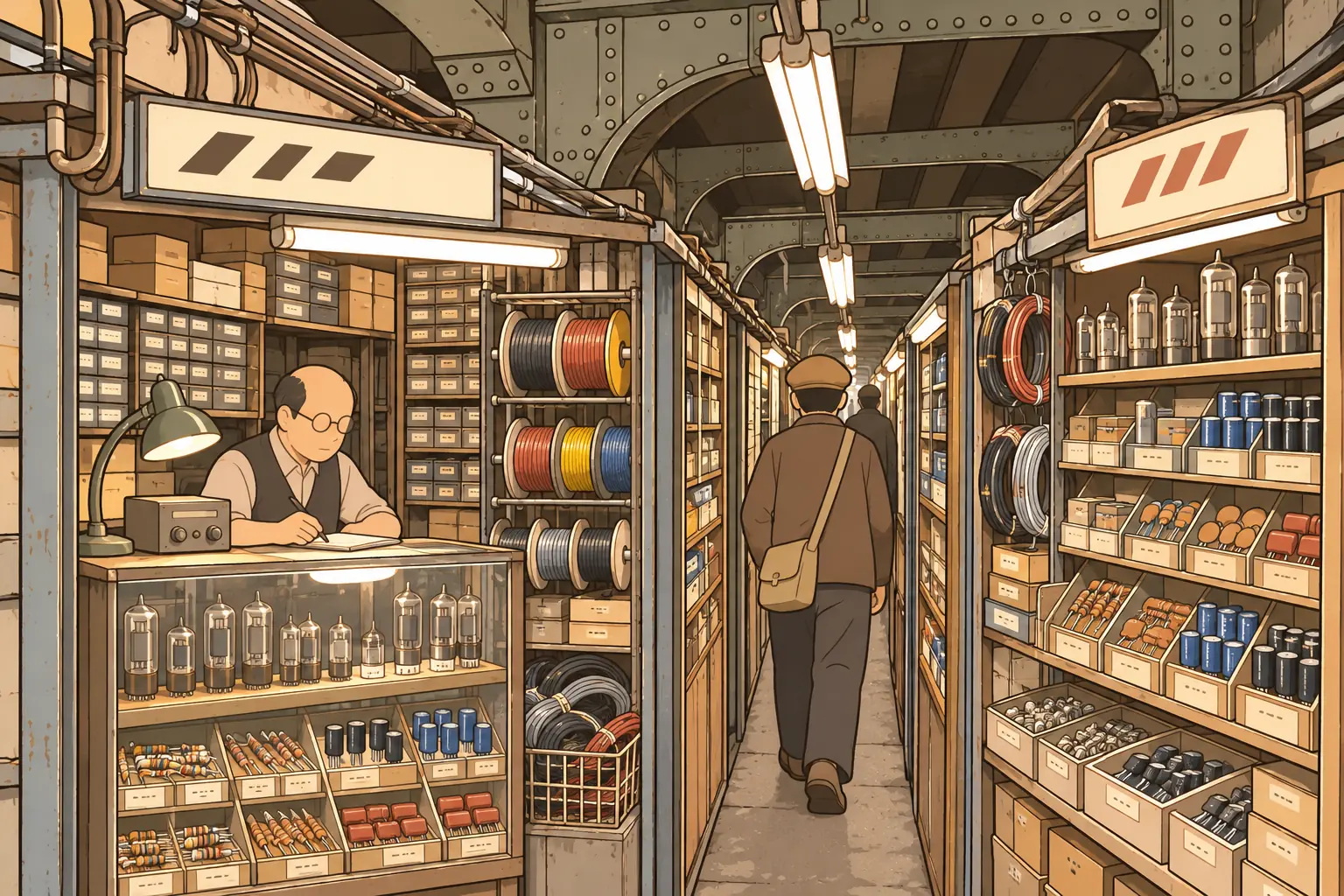
Akihabara Radio Center under the tracks: tiny stalls packed with electronic parts along a narrow aisle (illustration).
During the high-growth decades from the late 1950s, as households acquired the "three sacred treasures" of television, washing machine and refrigerator, Akihabara became the largest appliance market in Japan. Big stores such as Ishimaru Denki, Laox and Onoden lined Chūō-dōri, and families came in on weekends to haggle.
Then came the personal computer. NEC’s PC-8001 and PC-9801 lines made Akihabara the national hub for computer parts and software in the 1980s. The young people who came for motherboards and floppy disks were often the same ones who played computer games, and the overlap between computers, games and anime brought the otaku in. When the Japanese edition of Windows 95 went on sale at midnight in November 1995, the crowds that packed the streets, and the more than 200,000 copies sold nationwide in four days, marked the high point of Akihabara’s computer era.
04The Town of Hobbies
In the second half of the 1990s, Akihabara changed in ways anyone could see. Large suburban appliance chains drew family shoppers away, and computer sales were moving online. Into the empty storefronts came anime shops, figure stores, dōjinshi retailers and secondhand game dealers. In his 2003 book Shuto no tanjō (Learning from Akihabara: The Birth of a Personapolis), the architectural scholar Morikawa Kaichirō argued that the neighborhood had become a city shaped not by planners or corporations but by the aggregated personal tastes of its visitors. He dated the shift to around 1997, when shops selling character goods for anime, games and figures began moving in rapidly. Nobody planned it. The shops followed their customers, and the customers were already there for the computers.
The new mix included anime specialty chains such as Animate and Gamers, selling new manga, discs and official goods; Toranoana and Melonbooks, which sell dōjinshi on consignment; Mandarake and Lashinbang, which buy and resell used merchandise; and model and figure retailers like Kotobukiya. The parts shops never disappeared. They simply retreated to the side streets.
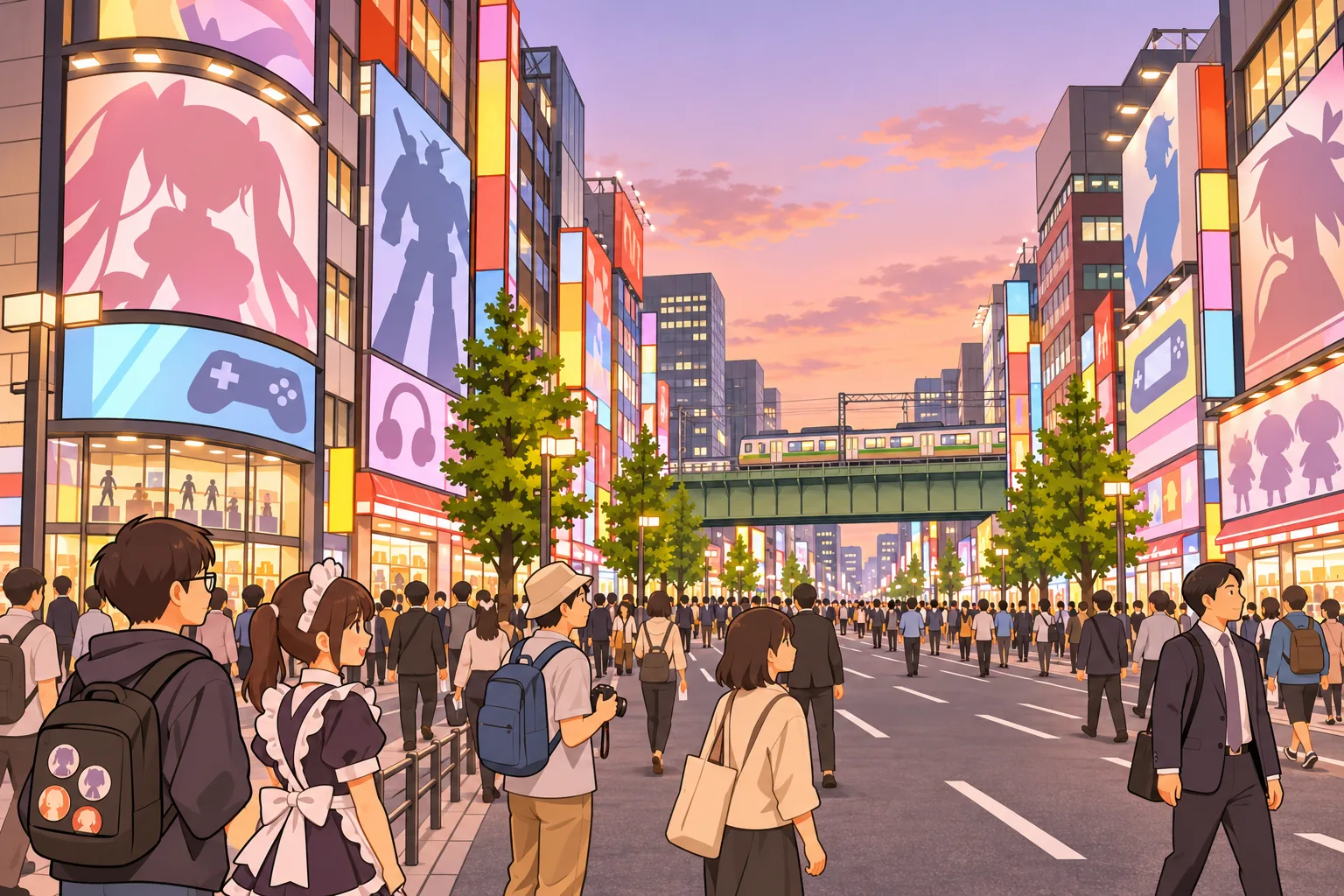
Two further developments in the 2000s gave Akihabara its current image. The first was the maid café. Cure Maid Café, generally considered the first permanent maid café, opened in 2001, serving tea and cake with waitresses in Victorian-style maid uniforms. It is still known for its tea. The format is generally traced to game promotions: around 1998 a game company ran a temporary restaurant at a trade show recreating the setting of one of its games, with costumed waitresses selling drinks and merchandise, and it proved a hit. Later shops such as @home café pushed the formula much further. Customers are greeted with "Okaerinasaimase, goshujin-sama" ("Welcome home, master"), as though they were returning home rather than visiting a business. The maids play simple games with guests, draw pictures in ketchup on omelet rice, and lead them in a little incantation to make the food taste better. Maid cafés quickly became the district’s calling card and a magnet for curious tourists.
The second was idols. In December 2005 the lyricist and producer Akimoto Yasushi launched AKB48, named for Akihabara, in a dedicated theater on the eighth floor of the Don Quijote building. On opening day, the story goes, only seven people bought tickets; the theater did not sell out until February 2006. Its motto was "idols you can go and meet." The group performed almost daily, fans could buy CDs that came with tickets to handshake events, and they could vote in annual "general elections" that ranked the members. The model was widely copied, and many habits of today’s fan culture trace back to it.
Akihabara was also becoming a more conventional city. The Tsukuba Express opened in 2005 with Akihabara as its Tokyo terminus, and the former freight yard and produce market north of the station gave way to the office towers of Akihabara Crossfield, Akihabara UDX and the Akihabara Daibiru, which drew corporate offices and university research facilities. On Sundays Chūō-dōri closed to traffic and filled with street performers and cosplayers.
On June 8, 2008, a young man drove a truck into the pedestrian zone and then attacked passersby with a knife, killing seven people and injuring ten. The Akihabara massacre shocked the country. The car-free Sundays were suspended and did not return until January 2011, under tighter rules. Street performance has been more restricted ever since, and the district’s street life is noticeably calmer than it was in the mid-2000s.
05Dōjinshi: Fans as Publishers
Dōjin means "people of the same mind." In the Meiji and Taishō eras, young writers pooled money to publish their own literary magazines, called dōjin zasshi; Shirakaba (White Birch) is a well-known example. In manga, the tradition goes back at least to the early 1950s. In about 1953 Ishinomori Shōtarō, then a high-school student in rural Miyagi Prefecture, gathered fellow contributors to the boys’ magazine Manga Shōnen into the East Japan Manga Research Society. Its members bound their hand-drawn pages into a single magazine, Bokujū itteki (A Drop of Ink), and mailed it from one member to the next. One of them was Akatsuka Fujio, later the creator of Tensai Bakabon.
Today dōjinshi usually means a booklet written and drawn by fans, printed at their own expense, and sold directly to readers at a fan event. Some are original work. Most are niji sōsaku, "secondary creation": stories that borrow characters from existing anime, manga and games and imagine what the original never showed. These range from gentle slice-of-life comedies to bold reimaginings of relationships between characters to explicitly adult work.
What made dōjinshi a culture rather than a hobby was the convention. In December 1975 a group around the manga critics’ circle Meikyū, including Yonezawa Yoshihiro and Harada Teruo, held the first Comic Market (Comiket, or Komike) at the Nihon Shōbō Kaikan in Toranomon, Tokyo. Thirty-two circles took part, counting the organizers’ own, and an estimated 700 people attended, by most accounts overwhelmingly junior-high and high-school girls who loved shōjo manga. The organizers’ idea was simple: there should be a place, outside the commercial magazines, where anyone could publish and exchange work.
Comiket has been held twice a year, in summer and winter, ever since, moving through several venues before settling in 1996 at Tokyo Big Sight on the Ariake waterfront. Recent events (as of the 108th, in summer 2026) have run two days, with some 20,000 to 30,000 exhibiting circles and 250,000 to 300,000 visits in total, making it one of the largest indoor gatherings in Japan. The summer event in mid-August and the winter event at the end of December are fixed points in many fans’ calendars.
Comiket’s etiquette says a great deal about the culture. There are no "customers": everyone, whether exhibitor, visitor or staff, is a "participant," and the staff are volunteers. Books are not "sold" but "distributed" (hanpu), because this is meant to be a place where fans share work, not a store. Lines are orderly and running is forbidden; queues for the most popular circles are routed outside the halls and can last hours.
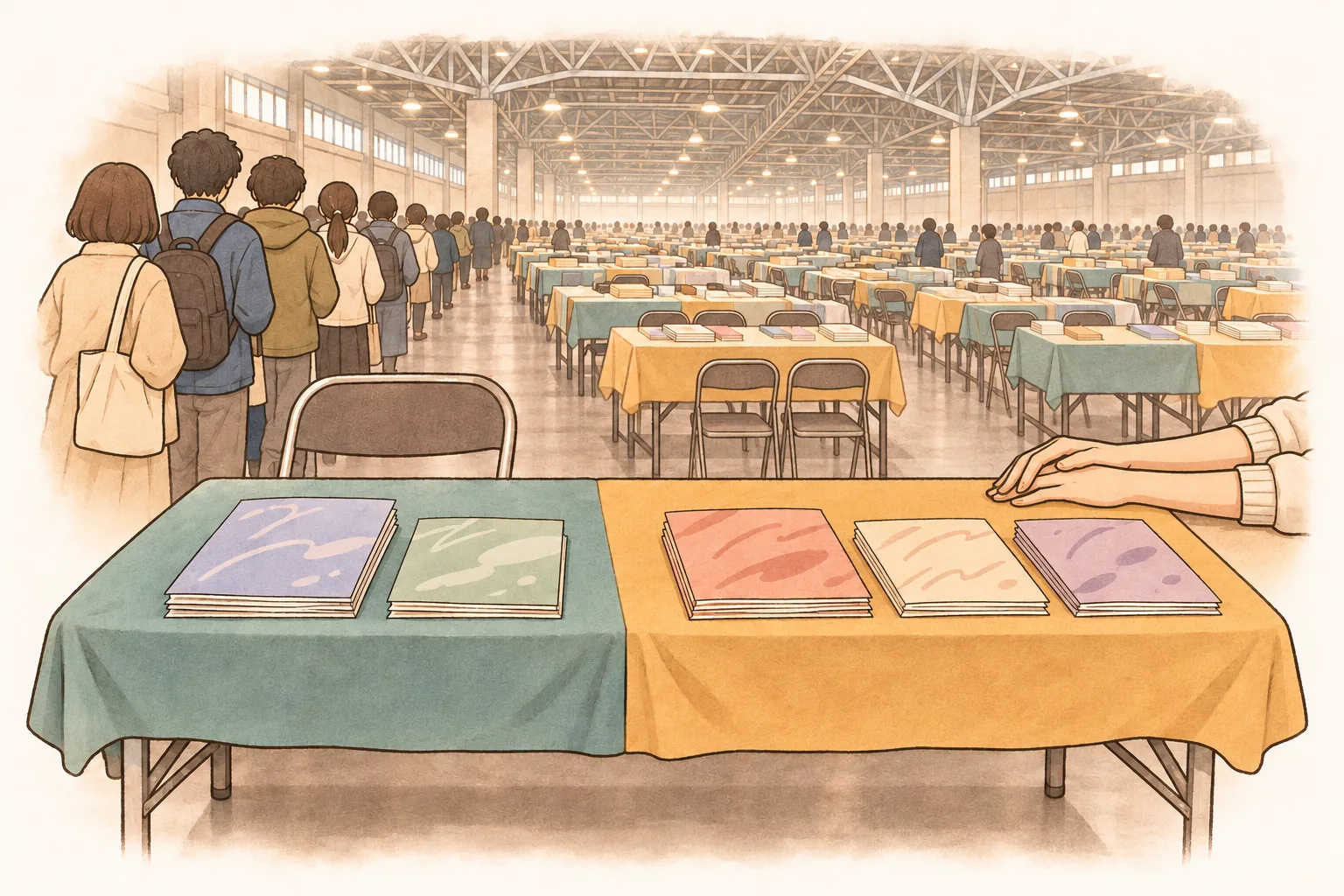
Rows of tables at a dōjinshi convention. A creator sets out self-printed copies on half a table, beside thousands of others.
Fan works that borrow characters sit in a legal gray zone, since they technically use copyrighted material. Japanese publishers and creators have mostly chosen to tolerate them, because the dōjin world is both their most devoted publicity network and a training ground for new talent. The four-woman manga group CLAMP began as a dōjin circle, and TYPE-MOON, the company behind the Fate franchise, first made its name with Tsukihime, a dōjin game. Takahashi Rumiko is said to have published work in a university manga club’s magazine as a student, and after The Melancholy of Haruhi Suzumiya took off, the series was reportedly for a time one of the most popular subjects at dōjin markets. In 2013 the manga artist Akamatsu Ken launched the "dōjin mark," a small symbol combining a pen nib and a circle. A creator who prints it on a work signals that fans may distribute derivative dōjinshi of it at conventions, turning the unspoken understanding into an explicit license. Most works still rely on tacit tolerance, and rights holders do occasionally step in, especially when fan works become adult or heavily commercial.
Beyond Comiket, Japan hosts dōjin events year round. Some focus on a single franchise, like Reitaisai for the Touhou Project games; others, like COMITIA, are for original work only. Readers who can’t make it to an event can buy consigned dōjinshi from the shops and websites of Toranoana and Melonbooks.
The real significance of dōjinshi is that they give the manga world a publishing system run by its readers. Planning, editing, layout, printing, pricing, distribution and promotion are all handled by one person or a few friends. A whole industry of small printers specializes in short runs timed to convention dates. A high-school student can print a hundred copies of her own comic and set them out on half a table, side by side with thousands of other creators.
06Oshikatsu: Devotion as a Daily Practice
Oshi comes from the verb osu, "to push" or "to recommend." The usage is generally traced to the late 2000s, when AKB48 fans began calling their favorite member their oshimen, "the member I push," which shortened to oshi. The term has since spread to anime characters, voice actors, stage actors, athletes, VTubers, and even a particular panda or train. Oshikatsu, literally "oshi activities," covers everything fans do for their oshi. In 2021 it was one of the thirty nominees for the annual U-Can New Words and Buzzwords awards. In January of that year Usami Rin won the Akutagawa Prize for Oshi, moyu (translated as Idol, Burning), a novel about a high-school girl whose life revolves around a pop idol, bringing the psychology of the oshi into serious literature.
To have an oshi is not quite the same as to like someone. It implies public, sustained, active support. It does not expect anything back, and it is not romance. Many people describe their oshi as the thing that gives each day something to look forward to.
Oshikatsu takes many forms. Going to concerts, stage shows, handshake events and fan meetings is the most direct. Anime films sometimes have ōen jōei, "cheering screenings," where audiences bring glow sticks and shout along. Collecting is another: acrylic stands and can badges are the staples, and many fans pin dozens of badges of the same character onto a clear tote, an ita-bag or "painful bag," which is a declaration in itself. Then there is the oshi’s color. Each idol or character has an assigned color, and fans wear it, carry it, and choose their stationery to match.
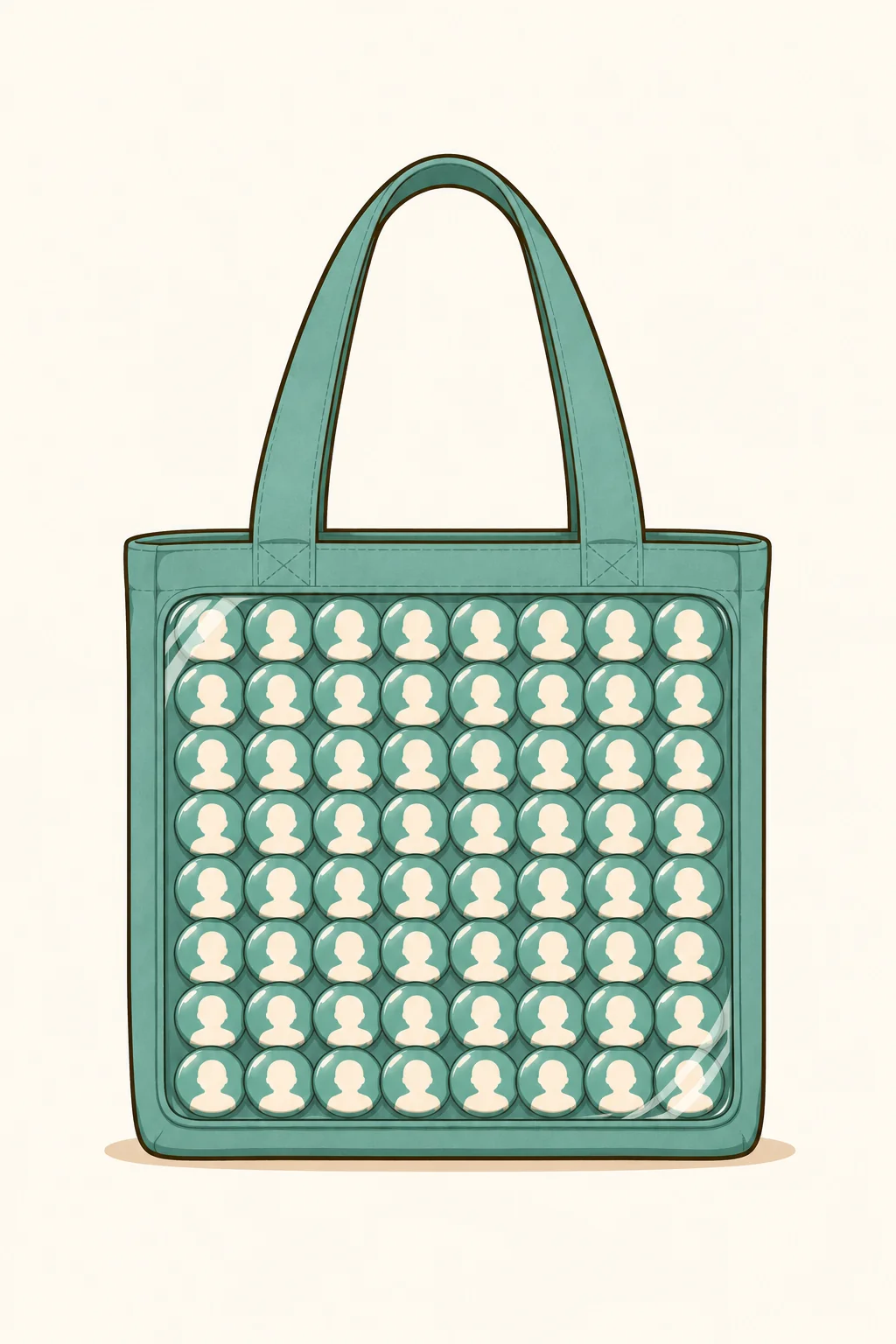
An ita-bag: dozens of badges of one character pinned onto a clear tote, a declaration in itself.
Some forms are quieter. On an oshi’s birthday, fans build a small display at home with photos, merchandise and a cake, called a saidan, or "altar," and photograph it. Fans take acrylic stands to cafés and photograph them with drinks. Fan-funded birthday billboards, a custom borrowed from Korean K-pop fandom, now appear in Shibuya, Shinjuku and Ikebukuro stations. Retailers caught on fast: stationery shops and department stores now have whole oshikatsu sections selling badge binders, display stands and goods in every member color.
There are reasons this flourished in Japan in particular. The anime and idol industries have long relied on merchandise and live events, not just the works themselves, for revenue. The "idols you can meet" model made support measurable: how many CDs, how many votes, how many shows. Social media made private passions visible and shareable. And there is a simpler reason: in a society with long working hours and heavy expectations, having one thing you can love wholeheartedly is steadying. Oshikatsu has its shadows too, and overspending, bulk-buying to boost rankings, and intrusions into idols’ private lives are all regularly debated.
Its spread has changed what otaku means. Being an otaku used to be a minority identity. Oshikatsu is something most young people do a little of. An office worker can check her oshi’s posts at lunch, see a stage show on the weekend, and never think of herself as an otaku at all.
07Visiting Akihabara
Leave JR Akihabara Station by the Electric Town exit and you are at the heart of the district. The Akihabara Radio Kaikan building opposite the station, rebuilt in 2014, is a good first stop: floor after floor of figures, trading cards, model kits and used merchandise. Walk west to Chūō-dōri, the main avenue, lined with electronics stores, game arcades and anime shops. On Sunday afternoons it closes to cars.
For the newest anime goods, try Animate or Gamers. For used and out-of-print treasures, head to Mandarake Complex, an eight-story black building packed with manga, figures and even original animation cels. Retro gamers should find Super Potato, crammed with Famicom and Super Famicom cartridges, with a corner of vintage arcade cabinets upstairs. The Akihabara Gachapon Kaikan has hundreds of capsule-toy machines at a few hundred yen a turn as of 2026, the cheapest souvenir in town.
If you want to see where it all began, slip into Akihabara Radio Center under the tracks: narrow aisles, tiny booths, trays of components sorted with great care. Akizuki Denshi and Sengoku Densho nearby are favorites of electronics hobbyists.
Under the railway viaducts there is a quieter Akihabara. Toward Okachimachi, the space beneath the JR tracks has become 2k540 Aki-Oka Artisan, a row of craft workshops and small shops. Toward Manseibashi, the brick viaduct of the long-closed Manseibashi Station now houses mAAch ecute Kanda Manseibashi, where you can sit at a café window and watch Chūō Line trains pass overhead. About ten minutes’ walk northwest is Kanda Myōjin, a shrine that enshrines Taira no Masakado and has collaborated with anime productions; its prayer plaques are often covered in drawings of anime characters.
- 1Electric Town exit, JR AkihabaraHeart of the district
- 2Akihabara Radio KaikanOpposite the station; first stop
- 3Chūō-dōriWalk west; closed to cars on Sunday afternoons
- 4Akihabara Radio CenterUnder the tracks
- 52k540 Aki-Oka ArtisanUnder the tracks toward Okachimachi
- 6mAAch ecute Kanda ManseibashiToward Manseibashi
- 7Kanda MyōjinAbout ten minutes’ walk northwest
Start at the Electric Town exit; Radio Kaikan opposite the station makes a good first stop. Directions are as given in the text.
At a maid café, food, drinks and a photo typically come to three or four thousand yen (as of 2026). Never photograph staff without permission, including the maids handing out flyers on the street. Many cafés have English menus.
Akihabara is not the only destination. Otome Road, near Ikebukuro Station’s east exit, is lined with anime and dōjinshi shops aimed at women. Nakano Broadway, a shopping complex by Nakano Station that opened in 1966, houses many Mandarake branches and tiny shops selling vintage toys and old manga. In Ōsaka, Nipponbashi’s Den Den Town is the Akihabara of the Kansai region. If your trip falls in mid-August or late December, consider a day at Comiket. The halls are extremely crowded and summer days are stifling; bring plenty of water and small change, and follow the staff’s directions when you queue.
08Otaku Culture Today
From the 2000s the Japanese government made anime, manga and games a pillar of its "Cool Japan" policy, and otaku culture moved from mocked subculture to national brand. The Ministry of Foreign Affairs even appointed Doraemon as an "anime ambassador." In Akihabara, a growing share of visitors come from abroad, and tax-free signs hang beside anime billboards.
Some longtime fans feel a sense of loss. Akihabara looks more like a tourist site every year, dōjinshi increasingly resemble commercial products, and otaku no longer carries the outsider edge it once had. But the basic activities continue. At Comiket, huge crowds still line up to receive something a stranger made simply out of love for a story. Under the tracks in Akihabara, someone is still choosing a resistor. And an office worker still has a small acrylic figure on her bag, which she looks at on the train home.