
At a glance
How to read a manga page, how weekly magazines produce series, what shōnen and shōjo really mean, with close looks at Doraemon and One Piece.
- Manga reads right to left: start with the top-right panel, then move left and down.
- In March 1959 Weekly Shōnen Magazine and Weekly Shōnen Sunday launched on the same day, opening the weekly era.
- Weekly Shōnen Jump’s combined 1995 No. 3–4 issue printed 6.53 million copies, still the Japanese record as of 2026.
- Shōnen and shōjo describe the readership a magazine targets, not a genre.
- By the Research Institute for Publications’ count, digital made up about 76% of the manga market in 2025.
On a Tokyo commuter train it is ordinary to see a salaryman in his fifties and a high-school girl both reading comics, and nobody finds this odd. In Japan, manga is not a children’s genre or a niche hobby. It is a mass medium on the scale of television, with its own weekly magazines, its own vast paperback market, and a reach that runs from cooking and baseball to medicine, history, and office politics. This introduction explains how a page of manga works and why it reads right to left, where the form came from, how the weekly magazine system turns out stories by the hundreds, and what the labels shōnen and shōjo actually mean. Along the way it looks closely at three things nearly every Japanese reader knows: the four-panel strip, Doraemon, and One Piece. It ends with how to find and read manga when you are in Japan.
01Reading a Page
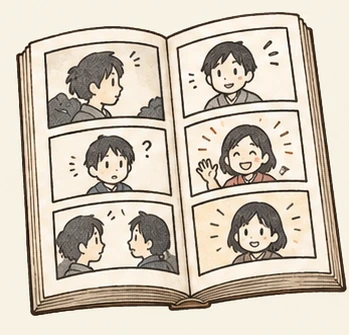
The first thing a newcomer notices is that the book seems to be backwards. Japanese is traditionally printed in vertical columns that run from right to left, so books open from what an English reader would call the back. Manga follows suit. You start at the top right of the page, move left and down, and read the speech balloons from top to bottom. Most English translations now keep this original orientation rather than flipping the artwork, and after a few pages the eye adjusts.
The panel is the basic unit. A film controls time with editing; a manga controls it with the size, shape, and order of its panels. A run of narrow strips hurries the eye along, which suits a chase or a fight. A single panel that fills the page, or spreads across two facing pages, makes you stop: a hero’s entrance, the moment a blow lands, a line of dialogue that changes everything. Japanese artists are generous with panels. They will break one movement into five or six images or give a single glance its own frame. The result is that a 200-page volume can be read in twenty or thirty minutes, yet it feels closer to watching an episode than to reading a book.
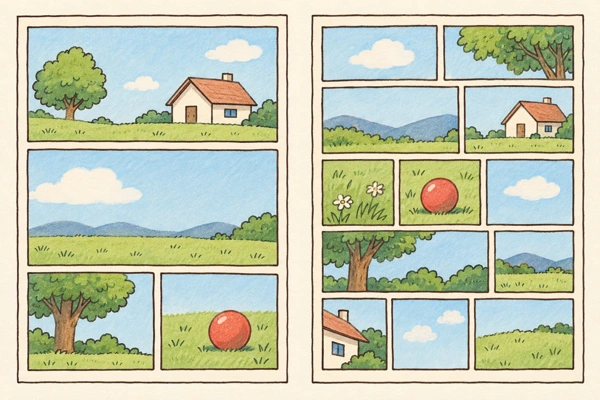
A few large panels slow the reader down; a run of small ones speeds the eye along.
Lettering carries a great deal of the meaning. The outline of a balloon tells you the tone of voice: smooth for ordinary speech, spiky for shouting, cloud-shaped for unspoken thought. Then there are sound effects drawn straight into the art. Japanese is unusually rich in onomatopoeia and in words that imitate not sounds but states. Dododo is the rumble of something menacing approaching; shiin is the "sound" of total silence; kirakira is sparkling. These are hand-drawn, slanted and weighted as part of the composition, and translators often leave them in place with a small gloss beside them.
Characters are drawn with a shared visual shorthand. Large eyes, a small nose, and a simplified mouth make a face easy to project yourself onto. A cross-shaped vein on the forehead means anger, a few diagonal lines on the cheeks mean blushing, a large drop of sweat beside the head means embarrassment, and a nosebleed means sudden attraction. Japanese readers no more need these explained than they need punctuation explained.
Most manga is printed in black and white on cheap, often recycled paper, with only a few color pages at the front of each magazine issue. Artists therefore became expert at producing gray tones, shadows, and textures with screentone, adhesive sheets of printed dot patterns cut and pasted onto the art. Much of this is now done digitally, but the look of a black-and-white page built from line and tone remains the core of the medium.
02Where Manga Came From
Histories of manga usually begin with the Chōjū-jinbutsu giga, the "Scrolls of Frolicking Animals," handscrolls from the twelfth and thirteenth centuries in which rabbits and frogs wrestle and a monkey dressed as a priest chants before a frog Buddha. The brushwork is lively and funny, and the scrolls are often called Japan’s oldest manga. There is no direct line from them to modern comics, but they show how old the habit is of telling an amusing story through a sequence of pictures. In the Edo period, illustrated popular books such as kibyōshi, cheap picture-heavy fiction for urban readers, combined text and image on every page.
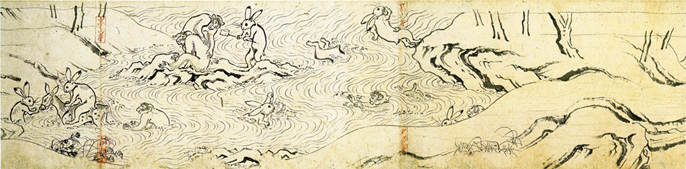
Detail of the Chōjū-jinbutsu-giga, scroll one (Kōzan-ji): rabbits and frogs at play by the water.
The word manga itself appears in the Edo period. Its most famous use is Hokusai manga, a series of volumes of sketches by Katsushika Hokusai published from 1814: people, animals, gods, landscapes, and everyday gestures, drawn as models for artists. Here manga meant something like "random sketches," not a story told in panels.
The modern form took shape after Japan opened to the West. In 1862 the British artist Charles Wirgman founded The Japan Punch in Yokohama, a satirical magazine modeled on London’s Punch, and Japanese began calling political cartoons ponchi-e, "Punch pictures." Around the turn of the twentieth century Kitazawa Rakuten drew satirical cartoons and comic strips for newspapers and in 1905 launched Tokyo Puck, a color cartoon magazine. Through his work and that of Okamoto Ippei, whose illustrated comic essays ran in the Asahi Shimbun in the 1910s and 1920s, the word manga settled into its present meaning. Children’s comics followed: Shō-chan no bōken (The Adventures of Little Shō), serialized from 1923, used speech balloons, and in the 1930s Tagawa Suihō’s Norakuro, about a stray dog who joins the army, became a bestseller in book form.
The decisive turn came after the war. In 1947 Tezuka Osamu, working from a story outline by Sakai Shichima, published Shin Takarajima (New Treasure Island), a long comic book in which a sports car races across the opening pages in a sequence of panels that read like film frames. It was sold as an akahon, a cheap "red book" from the Ōsaka publishing trade, and is said to have sold several hundred thousand copies, with figures of 400,000 and 800,000 both cited. A remarkable number of later artists remembered it as the book that made them want to draw. Tezuka went on to create Jungle Emperor (Kimba the White Lion in English), Astro Boy, Princess Knight, and Phoenix, opening up science fiction, historical epic, and girls’ comics almost single-handedly. See also: Tezuka Osamu: The Doctor Who Gave Japan Astro Boy and the Modern Manga.
A second current came from rental bookshops. In the 1950s Japan had thousands of kashihon-ya, shops that rented out books by the day, and a separate publishing trade produced hardcover comics for them. Many readers were young workers who had moved to the cities, and the artists who drew for them wanted something darker and more realistic than children’s comics. Around 1957 Tatsumi Yoshihiro coined the word gekiga, "dramatic pictures," for comics about crime, poverty, and urban alienation. Shirato Sanpei and Mizuki Shigeru, later famous for GeGeGe no Kitarō, also began in rental comics. When the rental shops declined in the 1960s, gekiga artists moved into new magazines for young adults, and manga gained a grown-up branch it has never lost.
03Yonkoma: A Story in Four Panels
Alongside the long serials, Japanese newspapers have always carried the shortest form of manga: the yonkoma, or four-panel strip. Four panels of equal size are stacked vertically and read from top to bottom, and in that space a complete little story has to be told.
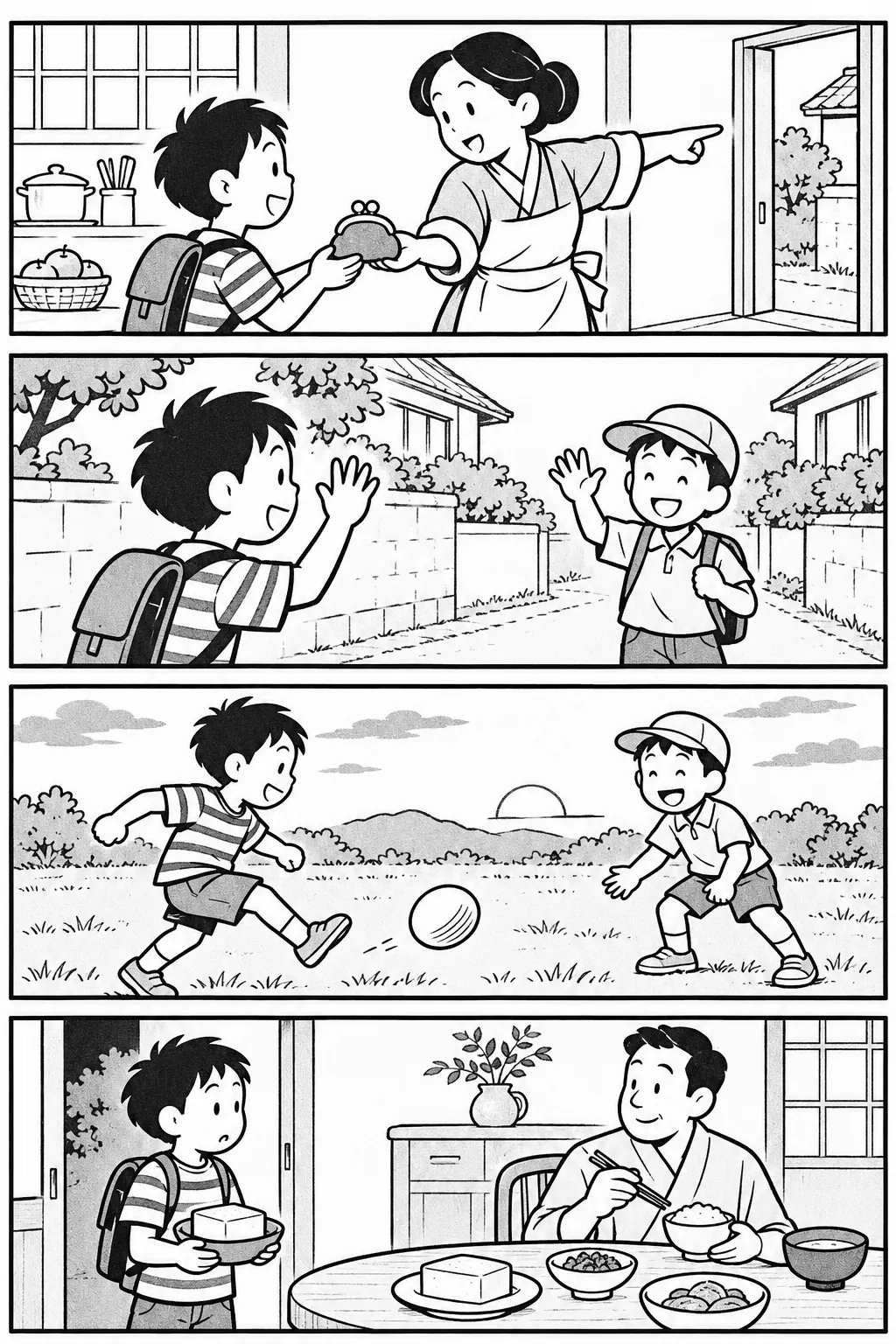
Four panels of equal size stacked in a column, read from top to bottom (illustration).
Japanese explain the shape of a yonkoma with kishōtenketsu, a four-part structure borrowed from classical Chinese poetry. The first panel (ki) sets the scene, the second (shō) develops it, the third (ten) brings a twist, and the fourth (ketsu) resolves it, usually with a gentle laugh. Unlike the Western joke structure of setup and punchline, the third panel often introduces something that seems unrelated, and the pleasure lies in how the fourth panel brings the two threads together. With so little room, characters must be recognizable at a glance and situations must be ones every reader knows, which is why the form is so good at family life, school, and the office.
- 1KiSets the scene
- 2ShōDevelops it
- 3TenBrings a twist
- 4KetsuResolves it, with a gentle laugh
The four panels read top to bottom; the twist in the third is the key, and the fourth resolves it.
The great example is Hasegawa Machiko’s Sazae-san. It began in 1946 in a local Fukuoka newspaper, moved to the Asahi Shimbun, and ran until 1974. Sazae, a cheerful, scatterbrained young wife, lives with her husband, her son, her parents, and her younger siblings in a single-story house in suburban Tokyo, and the strips are about meals, neighbors, commuting, and children getting into trouble. Read in sequence, they form a daily record of postwar urban life, from rationing to the arrival of the television and the refrigerator. The animated version, first broadcast in 1969, still airs every Sunday evening as of 2026 and holds the record as the world’s longest-running animated television series. Japanese even speak of "Sazae-san syndrome," the low feeling that sets in on Sunday evening when the show comes on and the working week looms. In Sakura-shinmachi in Setagaya, Tokyo, there is a Hasegawa Machiko Art Museum, and bronze statues of the Isono family line the shopping street from the station.
In the 1980s and 1990s four-panel manga found a second life in magazines. Some were salaryman comedies; then, from around 2000, magazines such as Manga Time Kirara, founded in 2002, specialized in four-panel strips about the everyday lives of schoolgirls. Azuma Kiyohiko’s Azumanga Daioh, Yoshimizu Kagami’s Lucky Star, and kakifly’s K-On! all belong to this vein (only K-On! actually ran in a Kirara magazine) and were later adapted as anime. These works turned the yonkoma from a newspaper gag into something you could read for hundreds of pages. Each strip still ends on its own small payoff, but over time the characters’ friendships and the passage of school years emerge, the way a story emerges from a diary. Fans call the genre nichijō-kei, "slice of life."
04The Weekly Magazine Machine
Modern manga is built around magazines. In March 1959 Kodansha launched Weekly Shōnen Magazine and Shogakukan launched Weekly Shōnen Sunday on the same day, moving boys’ comics from monthly to weekly publication. Shueisha’s Shōnen Jump followed in 1968, going weekly the next year, and Akita Shoten’s Shōnen Champion in 1969, weekly from 1970.
Weekly serialization means an artist delivers roughly twenty pages every week. The usual process starts with a meeting with the magazine’s editor, then a rough storyboard of the chapter called a name, showing panel layouts, dialogue, and stick-figure poses. Once the editor approves it, the artist draws the pencils and inks the main figures, while a team of assistants does backgrounds, screentone, and effects. Successful artists run small studios, and many assistants go on to debut as artists themselves. The editor’s role is unusually large: in Japan an editor may help shape a series from its premise and characters down to the pacing of each chapter, and the stories of famous series often include the editor who argued for them.
The magazines are tied closely to their readers. Weekly Shōnen Jump includes a reader questionnaire in every issue, and the postcard votes decide which series appear near the front of the magazine and which new series survive. A new title that fails to catch on may be canceled within ten or twenty weeks and wrapped up in a hurry. The system is harsh, but it lets a magazine learn quickly what readers want, and it helped Jump grow into a giant. The combined New Year issue dated 1995, on sale in December 1994, printed 6.53 million copies, a record no Japanese comic magazine had matched as of 2026.
Once enough chapters have run, the publisher collects them into a tankōbon, a paperback volume of about 200 pages with a color cover and black-and-white interior. The magazine is cheap and disposable, read on the train and left behind; the volumes are what readers keep, and they are where most of the money is made for publisher and artist alike. The life of a successful manga typically runs from magazine to collected volumes to a television anime, then films, games, and merchandise, with each adaptation pushing volume sales higher. A large share of Japan’s anime and many of its video games trace back to this pipeline; Pokémon ran the other way, beginning as a video game and only then becoming manga and anime. See also: Anime: How Japan Built an Art Form on a Weekly Deadline; Japanese Video Games: From Arcade Mazes to the Open Air of Hyrule; Pokémon: The Pocket Monsters That Taught the World to Trade.
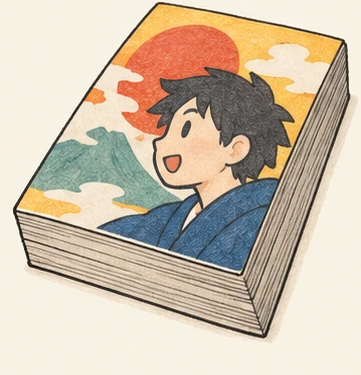
A weekly magazine: many series in one cheap issue, read and thrown away.
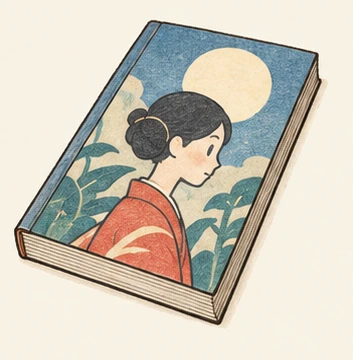
A collected volume (tankōbon): one series gathered into a book that readers keep.
05Shōnen Manga: A Readership, Not a Genre
The most important categories in manga are defined not by subject but by the intended readership of the magazine a work appears in. The main ones are shōnen (boys), shōjo (girls), seinen (young men), and josei (women), plus kodomo manga for young children. So shōnen manga is not a genre; it is simply "manga published in a magazine aimed at boys." A single issue of a shōnen magazine may hold a martial-arts epic, a sports story, a detective series, a romantic comedy, and a cooking manga side by side.
Still, a shared readership produces a shared spirit. Shōnen Jump’s editorial philosophy is often summed up in three words, yūjō, doryoku, shōri: friendship, effort, victory. The story goes that these came from early surveys of young readers asking what words mattered most to them. The typical hero is a flawed but good-hearted boy with an enormous goal, who gathers companions, meets ever stronger rivals, fails, and gets back up. Toriyama Akira’s Dragon Ball began as a comic quest for seven magic orbs and grew into an escalating series of tournaments and battles. Inoue Takehiko’s Slam Dunk takes a delinquent who joins the basketball team to impress a girl and turns him into a player. Kishimoto Masashi’s Naruto and Gotōge Koyoharu’s Demon Slayer follow the same arc of growth through combat.
But shōnen manga is much broader than fighting. Weekly Shōnen Sunday built a reputation for lighter, more urbane work: Takahashi Rumiko’s comedies Urusei Yatsura and Ranma ½, Adachi Mitsuru’s Touch, a baseball story about twin brothers and the girl next door, and Aoyama Gōshō’s Detective Conan, running since 1994 and still going as of 2026. Takahashi is a woman and one of the defining shōnen artists of her generation, which shows that the label describes the audience, not the author. The actual readership of shōnen magazines has long since spread far beyond boys. Demon Slayer became a phenomenon around 2020 precisely because women and adults read it as eagerly as schoolchildren.
Seinen manga, published in magazines such as Big Comic, Morning, and Young Jump, is aimed at older male readers and tends to be more realistic and more patient. Urasawa Naoki’s Monster and 20th Century Boys, Hirokane Kenshi’s corporate saga Section Chief Kōsaku Shima, and Inoue Takehiko’s Vagabond, a retelling of the life of the swordsman Miyamoto Musashi, all belong here. A reader who grew up on Jump can move to Morning in his twenties, and manga follows him from school into the office.
06One Piece: A Serial Built on the Sea
If one work stands for shōnen manga today, it is Oda Eiichirō’s One Piece. Serialized in Weekly Shōnen Jump since 1997, it has run for close to three decades and more than a hundred volumes, and in March 2026 its worldwide circulation passed 600 million copies. Guinness World Records has recognized it for the most copies published for the same comic book series by a single author.
The world of One Piece is mostly ocean, dotted with islands. Before his execution, the legendary pirate king Gol D. Roger announced that he had left all his treasure somewhere out there, setting off a great age of piracy. As a child, Monkey D. Luffy ate the Gum-Gum Fruit, one of the "Devil Fruits" that grant strange powers at the cost of the ability to swim, and now his body stretches like rubber. He sets out in a tiny boat to find the treasure, the One Piece, and become King of the Pirates. Along the way he gathers a crew: the swordsman Zoro, the navigator Nami, the sharpshooter Usopp, the cook Sanji, the reindeer doctor Chopper, and others. Together they are the Straw Hat Pirates, and they sail from the East Blue into the perilous Grand Line.
A sea voyage turns out to be an ideal shape for a story that may run for decades. Each island is a new arc: a new country with its own customs, a people suffering under some tyranny, and an enemy to be defeated. The crew lands, gets pulled into local trouble, wins, leaves friends behind, and sails on. The voyages between islands stitch the arcs together, and the map of the world slowly widens to take in the Marines and the World Government, the Seven Warlords, the Four Emperors, and the "Void Century" erased from history. Clues planted early often pay off hundreds of chapters later, and debating them chapter by chapter online has become part of the pleasure of following the series week to week.
The emotional engine is the crew. Before joining, almost every member carries a painful past. Nami has been forced to draw sea charts for the fish-man pirate who holds her home village hostage; Chopper was shunned by other reindeer for his blue nose. Luffy defeats the people who have trapped them and simply claims them as his friends. This is the Jump virtue of friendship in its plainest form. Since 2022 the series has been in what Oda has announced as its final saga, and its characters are everywhere in Japan, from themed shops to exhibitions; for several years there was even a One Piece theme park inside Tokyo Tower.
07Shōjo Manga: How a Readership Became a World
Shōjo manga is also defined by readership, but it has become a fully separate world, with its own magazines, its own artists, and a visual language that differs sharply from comics for boys.
Its roots lie in prewar girls’ magazines such as Shōjo no tomo and Shōjo Club, which mainly published stories and lyrical illustrations. Artists like Nakahara Jun’ichi drew wistful girls with huge eyes and long, slender limbs, an image that would shape shōjo characters for decades. After the war, Tezuka Osamu’s Princess Knight, serialized in Shōjo Club from 1953, told of a princess born with both a boy’s heart and a girl’s who disguises herself as a prince to fight for her kingdom. It is often treated as the starting point of modern shōjo manga. Kodansha’s Nakayoshi (1954) and Shueisha’s Ribon (1955) followed, and in 1962 and 1963 came the weeklies Shōjo Friend and Margaret.
Early shōjo manga was largely drawn by men. By the late 1960s women had taken over, and the 1970s became the genre’s golden age. A group of women artists born around 1949, the twenty-fourth year of the Shōwa era, came to be called the Year 24 Group: Hagio Moto, Takemiya Keiko, Ōshima Yumiko, Yamagishi Ryōko, and others. They brought science fiction, history, love between boys, and intense psychological interiority into girls’ comics. Hagio’s The Poe Clan follows vampires who remain forever adolescent; Takemiya’s Kaze to ki no uta is set in a nineteenth-century French boarding school. In the same years Ikeda Riyoko’s The Rose of Versailles, serialized in Margaret, told the story of the French Revolution through Oscar, a woman raised as a man who commands Marie Antoinette’s guard. It was a sensation, and in 1974 the all-female Takarazuka Revue staged it, creating one of the company’s most successful productions. Miuchi Suzue’s Glass Mask, begun in 1976, about an ordinary girl’s rise as a stage actress, is still unfinished as of 2026.
The visual language of shōjo manga grew out of the need to show feeling. Eyes became enormous, with layered highlights that glitter like stars. Backgrounds often vanish behind characters, replaced by drifting petals, points of light, or abstract fields of tone. Panels stop being neat rectangles: they overlap, are broken through by full-length figures, or lose their borders entirely. Long interior monologues float in the gutters between panels instead of sitting in balloons. If shōnen manga uses the panel to show the speed of action, shōjo manga uses it to show the flow of emotion, so that what you read is what a character is thinking and feeling.
In the 1990s Takeuchi Naoko’s Sailor Moon, in Nakayoshi, fused the magical transforming girl with team combat, and the anime carried it around the world. Around 2000 Yazawa Ai’s Nana, about two young women with the same name sharing an apartment in Tokyo, drew readers well into their twenties and thirties. Magazines for adult women, josei manga, multiplied from the 1980s on, so that a reader who outgrew Ribon could keep reading about love, marriage, work, and children. The publishers drew the boundary of the readership first; generations of women artists then filled that space with a way of drawing all their own.
08Doraemon: Gadgets from the Future in an Ordinary Neighborhood
Ask Japanese people which manga has kept them company the longest, and many will say Doraemon. Its creator, Fujimoto Hiroshi, worked for years with Abiko Motoo under the joint pen name Fujiko Fujio; when they separated, he became Fujiko F. Fujio and his partner Fujiko Fujio Ⓐ. Doraemon began at the end of 1969 in Shogakukan’s educational magazines, appearing at once in titles aimed at kindergarteners and at each grade of elementary school, with each version pitched to its readers’ age.
The premise is simple. Nobi Nobita is a Tokyo schoolboy who is bad at his studies and worse at sports, and is constantly bullied by the big kid Gian. His descendants in the twenty-second century send back a robot cat, Doraemon, to set his future right. From the four-dimensional pocket on his belly Doraemon pulls out gadgets: the Take-copter, a little propeller you stick on your head to fly; the Anywhere Door, which opens onto any place you name; Memory Bread, which lets you memorize whatever page you press it on once you eat it. The time machine is reached through the drawer of Nobita’s desk.
Most Doraemon stories are self-contained short episodes with an almost fixed structure. Nobita has a problem, begs Doraemon in tears, and gets a gadget. It solves the problem, until Nobita misuses it or tries to take a shortcut and makes things far worse. Fujiko F. Fujio described his work as "SF," but not science fiction: sukoshi fushigi, "a little bit strange." That is the secret of its charm. The setting never leaves the ordinary residential streets, the classroom, and the vacant lot with its three concrete pipes; the gadgets only tilt everyday life slightly off its axis. Readers see their own worries, tests, scoldings, bullies, a girl they like, combined with the daydream of having just the right tool.
Its reach in Japan is near universal. The anime that began on TV Asahi in 1979 made Doraemon every child’s friend for generation after generation, and the feature film released each spring became a family ritual. In 2008 Japan’s Ministry of Foreign Affairs named Doraemon its first "anime ambassador." Fujiko F. Fujio died in 1996 with the series unfinished, but the films and the anime have continued. The Fujiko F. Fujio Museum opened in Kawasaki, near Tokyo, in 2011 and displays a large collection of original drawings. According to the story, Doraemon will be built on September 3, 2112, and fans celebrate the date as his birthday.
09Manga Now
Print manga peaked in Japan around 1995, and magazine circulation has fallen steadily since; the great weeklies now sell a fraction of what they did. Readers have not disappeared, though; they have moved. With smartphones came digital manga, which overtook printed volumes in sales in 2017; by the Research Institute for Publications’ count, it made up about 76 percent of the manga market in 2025. Apps like Shueisha’s Shōnen Jump+ publish new chapters daily, commuters follow series on their phones, and web-first titles such as Spy × Family have become national hits. The vertically scrolling webtoon format, pioneered in Korea, has also found a large Japanese audience.
Since 2017 digital manga has outsold printed volumes.
Manga keeps widening its subject matter. Midnight Diner and Solitary Gourmet are about eating; Space Brothers is about astronauts; Black Jack is about a renegade surgeon. There are manga about sushi chefs, sake brewers, and go players, and for almost any job or hobby there is a series to match. School libraries stock multivolume histories of Japan in manga form, and government offices publish leaflets as comics. Meanwhile, dōjinshi, comics self-published by fans and amateurs, form an enormous parallel market. Comic Market, which began in 1975, is now held twice a year, in summer and winter, at Tokyo Big Sight, and draws hundreds of thousands of visitors over a few days. See also: Otaku Culture and Akihabara: Fandom, Self-Publishing and the Art of Devotion; Cosplay: Becoming Someone Else for a Day in Japan.
10Finding Manga in Japan
The easiest place to meet manga in Japan is the convenience store. The weekly magazines sit on the rack by the window, fat bricks of several hundred pages on rough recycled paper, for a little over 300 yen as of 2026. Large bookstores often give manga an entire floor, with new volumes stacked flat on tables and handwritten staff recommendations tucked beside them. Many shops shrink-wrap their volumes, so you cannot browse them; only a few sample copies are left open. The big Tokyo bookstores such as Kinokuniya and Sanseidō have large manga sections, and the anime and manga chain Animate has branches in every major city, with its flagship in Ikebukuro occupying a whole building.
For older and out-of-print titles, try secondhand shops. Book Off, a nationwide chain, sells used volumes cheaply. Mandarake specializes in manga and collectibles; in the Nakano Broadway shopping complex near Nakano Station in Tokyo it runs more than twenty separate shops, each devoted to one category, selling everything from old magazines to reproductions of original art. Akihabara’s stores lean toward new releases and merchandise.
If you simply want to sit and read, try a manga café, or manga kissa. You pay by the hour, take whatever you like from long rows of shelves, and read in a small private booth, with free refills from the drink bar; many also offer showers and overnight packages. It makes a good rest stop on a long day. Standing and browsing magazines in bookstores and convenience stores, tachiyomi, is common and tolerated, but never unwrap a shrink-wrapped book.
Several museums are worth a visit. The Kyoto International Manga Museum, run jointly by the city of Kyoto and Kyoto Seika University, opened in 2006 in the buildings of the former Tatsuike Elementary School. Tens of thousands of volumes line its corridors, free to take down and read, and on fine days visitors read on the old school lawn. The Osamu Tezuka Manga Museum is in Takarazuka, Hyōgo. In Sakaiminato, Tottori, the hometown of Mizuki Shigeru, Mizuki Shigeru Road is lined with more than a hundred bronze statues of the yōkai from his GeGeGe no Kitarō. In Ishinomaki, Miyagi, the Ishinomori Manga Museum honors Ishinomori Shōtarō, creator of Kamen Rider. Fans who visit real places that appear in manga and anime call it a "pilgrimage" (see also: Anime Pilgrimage: Visiting the Real Places Behind Japan’s Animated Worlds).
You do not need to read Japanese to enjoy any of this; translations of most major series are now easy to find. But if you want one original volume as a souvenir, choose Doraemon or a four-panel collection. The pictures tell the story, the dialogue is short, and all you have to remember is to start at the top right.