
At a glance
From the postwar American enclave to bamboo-shoot dancers, Ura-Harajuku and Lolita fashion, how one Tokyo neighborhood became a stage for young people’s clothes.
- After the war the US military built Washington Heights, a housing area for officers’ families, nearby, giving Harajuku its Western air.
- From 1977 the streets were closed on Sundays as a "pedestrian paradise," where the bamboo-shoot tribe danced in circles.
- In the 1990s, small Ura-Harajuku labels around Cat Street rose on limited runs and word of mouth, a model street brands worldwide copied.
- Lolita fashion uses petticoats to puff a knee-length skirt into a bell, and comes in sweet, classic, gothic and other strands.
- Takeshita Street runs about 350 meters, packed with accessory shops, cheap clothing and crêpe stands.
Step out of Harajuku Station on a Saturday and you face two worlds at once. To one side lies the dark forest of Meiji Shrine; to the other, the narrow, shrieking crush of Takeshita Street, where fourteen-year-olds queue for crêpes and girls in petticoated dresses and ribboned bonnets drift past shops selling neon socks. For more than half a century, Harajuku has been the place where young Japanese go to dress up as someone, and to be seen doing it. This is a guide to how that happened, to the waves of style that have washed through the neighborhood, to Lolita fashion, its most enduring and rule-bound tribe, and to how to read the streets when you visit.
01A Village Next to an Army Base
Harajuku was once an unremarkable patch of farmland and samurai residences on the western edge of Edo. The railway gave it a name on the map: a station on what became the Yamanote Line opened in 1906. In 1920 the Meiji Shrine was completed next door, dedicated to the emperor who had presided over Japan’s modernization, and the approach avenue to it was lined with zelkova trees. That avenue is Omotesandō, literally "the front approach," now one of Tokyo’s grandest shopping avenues. The half-timbered station building with its little spire, put up in 1924, survived the war and served commuters until 2020, when it was replaced by a modern glass station.
What really made Harajuku was the American occupation. After 1945 the former army parade ground at Yoyogi was taken over by U.S. forces and turned into Washington Heights, a sprawling housing compound for military families, complete with lawns, a school and a chapel. American wives shopped along Omotesandō, and stores sprang up to serve them: the Oriental Bazaar, selling kimono and antiques to foreigners (it closed in 2021), and Kiddy Land, a toy shop that is still on the avenue as of 2026. For Japanese teenagers growing up in a poor, rebuilding city, this was their first close look at American abundance: jeans, big cars, records.
The Tokyo Olympics of 1964 opened the area further. Washington Heights was handed back and became the athletes’ village, and later Yoyogi Park. Through the late 1960s a building at the corner of Omotesandō and Meiji-dōri called the Central Apartments filled with photographers, illustrators, copywriters and designers, and the coffee shop on its ground floor became a hangout for Tokyo’s creative class. In 1970 the magazine an·an launched, followed a year later by non-no; both sent young women to Harajuku with the magazine in hand, and the press dubbed them the an-non-zoku, the "an-non tribe." In 1978 Laforet Harajuku opened on the main crossing, a building packed with small boutiques and young designer labels. From then on the neighborhood had a fashion center of gravity.
02Tribes on the Pedestrian Paradise
Japanese media like to name youth subcultures as zoku, tribes, and Harajuku produced one for almost every decade.
From 1977, the streets around Yoyogi Park were closed to traffic on Sundays and holidays and turned into a hokoten, short for hokōsha tengoku, "pedestrian paradise." By around 1980 the hokoten had been taken over by the takenoko-zoku, the "bamboo-shoot tribe": teenagers in loose, gaudy outfits inspired by Chinese and Arabian costume, who formed circles around boom boxes and danced in synchronized steps to disco. Their name came from Boutique Takenoko on Takeshita Street, which sold the costumes. Alongside them were the rockabilly kids, with leather jackets and towering pompadours, twisting to 1950s American rock and roll. By the late 1980s the hokoten had become an open-air stage for amateur rock bands during Japan’s "band boom." The pedestrian paradise was abolished in 1998, but the idea that going to Harajuku on a weekend meant stepping onto a stage never went away.
The 1980s were also when Japanese designers became world famous. Kawakubo Rei of Comme des Garçons and Yamamoto Yohji shocked Paris with black, oversized, asymmetrical clothes, while back home a "DC brand" boom (designer and character brands) had young people lining up for designer sales.
In the 1990s the action moved into the back lanes behind Omotesandō, around the strip later known as Cat Street. This was Ura-Harajuku, "back Harajuku." A handful of tiny labels, above all Nigo’s A Bathing Ape and Takahashi Jun’s Undercover, sold T-shirts, hoodies and sneakers from cramped shops, in tiny quantities, never through department stores, spreading by word of mouth through music and magazines. Queues, limited drops and the sense that you could only get the thing in Harajuku: the playbook that global streetwear runs on today was largely written here.
At the same time, the main streets were producing the opposite of cool restraint. In 1997 the photographer Aoki Shoichi launched FRUiTS, a magazine that was little more than full-length street portraits of Harajuku kids, each captioned with their age, job and where every item came from. The people in its pages layered secondhand kimono, punk straps, handmade accessories, children’s toys and designer pieces, and none of it was bought as a complete look. The loudest of these styles was decora: heads covered in dozens of plastic hair clips, arms stacked with bracelets, faces dotted with stickers, the whole body as a walking toy box. The shop 6%DOKIDOKI, opened in 1995 by the artist Sebastian Masuda, became the home of this candy-colored maximalism, and Masuda later designed the look of the singer Kyary Pamyu Pamyu, whose 2011 debut "PONPONPON" sent the Harajuku kawaii aesthetic around the world. A few years earlier, from 2004, Gwen Stefani had appeared with four backup dancers she called the Harajuku Girls, which made the neighborhood’s name famous in the West, and drew criticism for treating Japanese women as props.
03Lolita: The Silhouette and the Rules
Of all the styles that passed through Harajuku, Lolita fashion has lasted longest and has the clearest rules. The name confuses Western readers. It has almost nothing to do with Nabokov’s novel; in Japan the word came to mean a girlish, modest elegance, and the clothes look back to children’s and women’s dress of the eighteenth-century Rococo and the Victorian era. Wearers are emphatic that the style is not about being sexy. Necklines are high, skirts cover the knees, and the ideal is something like a porcelain doll or a girl in a storybook.
The silhouette is the giveaway. The skirt falls to around the knee and is puffed into a bell or cupcake shape by a petticoat, or several, worn underneath. On top goes a blouse with ruffles, a high collar or puffed sleeves, usually under a jumper skirt (a pinafore-style dress, abbreviated JSK) or a one-piece dress (OP). The head gets a bow, a headdress or a bonnet; the legs, white or lace-trimmed socks or tights; the feet, round-toed Mary Janes or chunky platform "tea party" shoes. A shaped handbag or a parasol finishes it. What matters most is the "coordinate," the complete outfit, harmonized from head to toe in color, print and mood. Most pieces come from a small number of specialist brands, and a single printed dress can easily cost ¥30,000 to ¥40,000 (as of 2026).
- 1
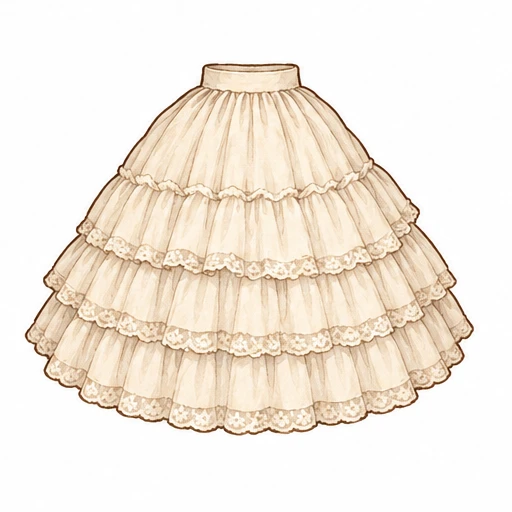 First the petticoat, its tiers of ruffles spreading the hem.
- 2
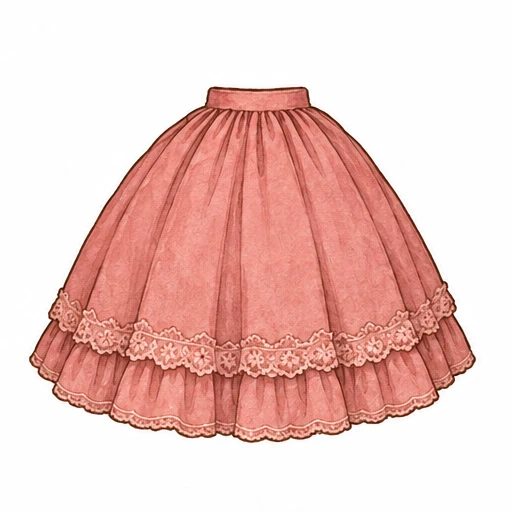 The skirt goes on top; from outside you see only the bell shape.
- 3
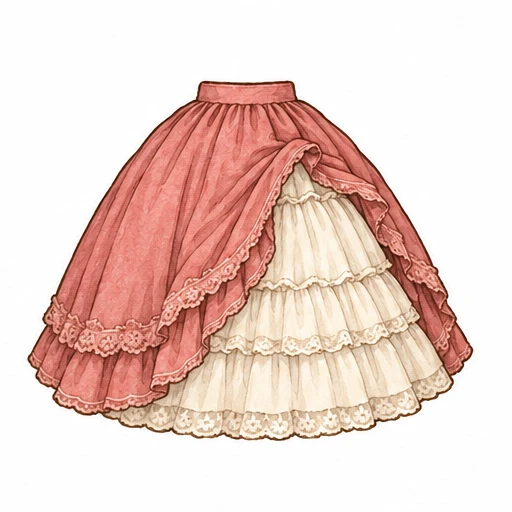 Lift the outer layer and the petticoat holding it up comes into view.
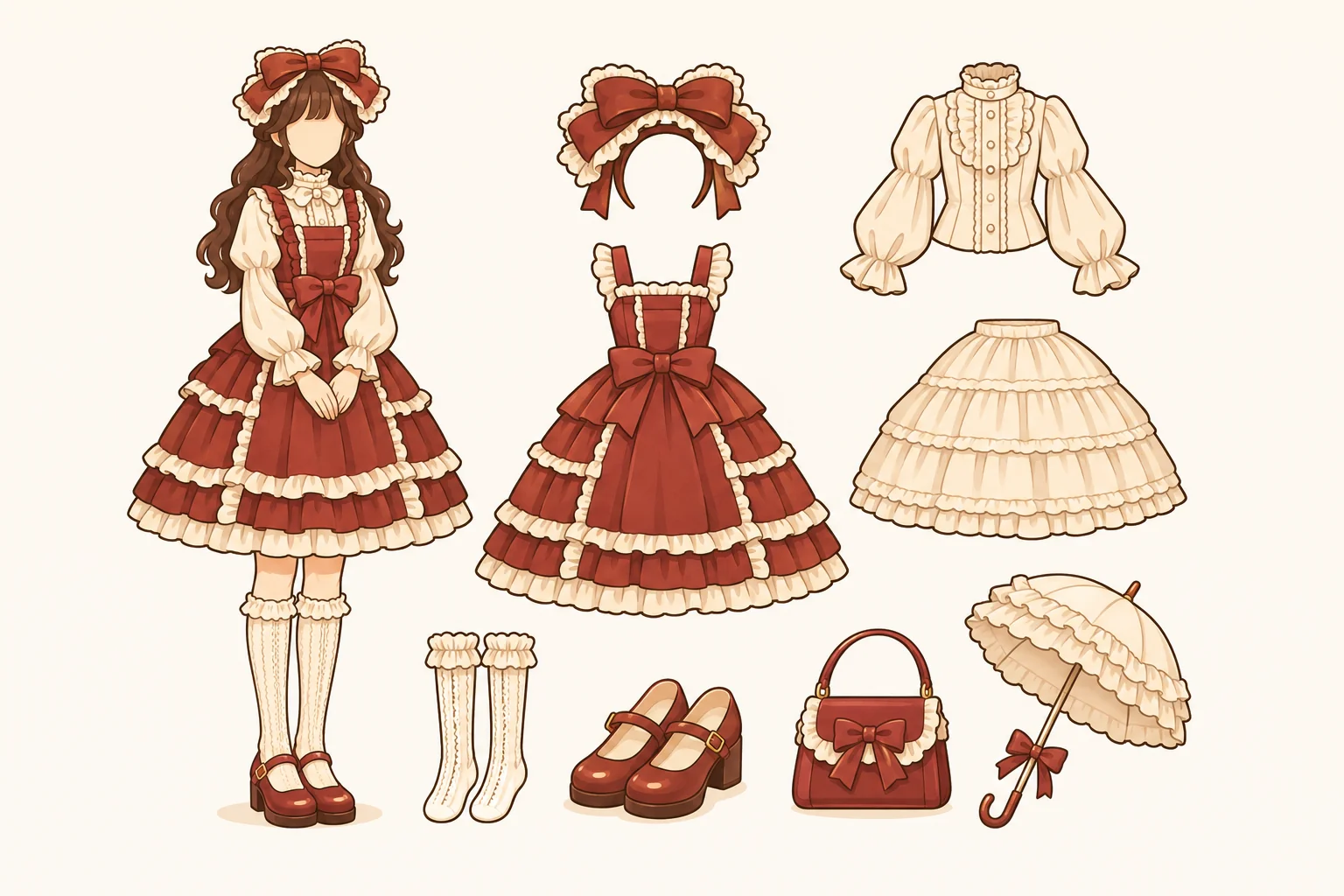
A complete Lolita coordinate: headdress, blouse, jumper skirt over a petticoat, socks and Mary Janes.
There are several main branches. Sweet Lolita favors pink, pale blue and prints of sweets, strawberries and rabbits. Classic Lolita uses muted tones, burgundy, forest green, small florals, and leans toward grown-up elegance. Gothic Lolita is mostly black, with crosses, lace and pale makeup, and a touch of the theatrical. Around these are variants such as wa-loli, which borrows kimono sleeves and obi, and ōji, the "prince" style of shorts, knee socks and waistcoats.
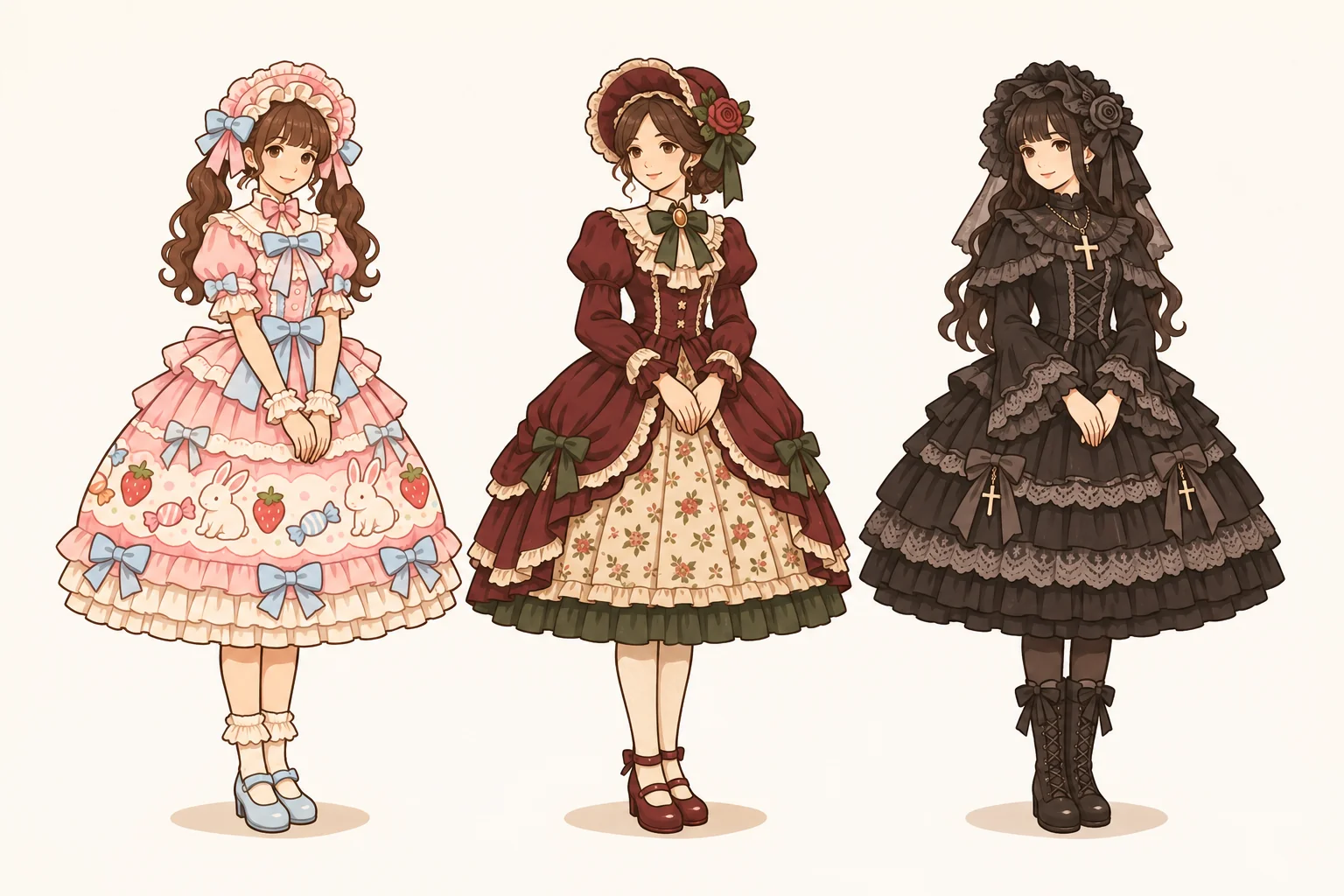
Three branches of Lolita fashion: Sweet, Classic and Gothic, each with a bell-shaped skirt.
The style’s roots are usually traced to the 1980s, when labels such as Baby, the Stars Shine Bright (founded in 1988), Angelic Pretty and Metamorphose temps de fille worked their girlish dresses toward this silhouette. It crystallized in the late 1990s under the influence of visual kei, the theatrical rock scene of heavy makeup and elaborate costume. Mana, guitarist of the band Malice Mizer, performed in gowns, and in 1999 he founded his own label, Moi-même-Moitié, coining the terms "Elegant Gothic Lolita" and "Elegant Gothic Aristocrat." From 2001 the Gothic & Lolita Bible published coordinates, sewing patterns and brand news, giving scattered fans a shared reference.
On Sundays through the late 1990s and 2000s, Lolitas and visual-kei fans gathered on Jingū Bridge, the short span between Harajuku Station and the entrance to Meiji Shrine and Yoyogi Park. They stood in full dress, posed for photographers and swapped news. In 2004 the film Kamikaze Girls (Shimotsuma Monogatari), adapted from a novel by Novala Takemoto, told the story of a Lolita girl in rural Ibaraki who would take the train all the way to Tokyo for a dress, and her friendship with a motorcycle-gang delinquent. It made the style familiar to ordinary Japanese audiences and to fans abroad.
Why has Lolita survived for three decades when other street trends burned out in a few years? Partly because it has rules. The silhouette, the length, the idea of a complete coordinate are shared knowledge, so newcomers can learn and veterans can refine, and it behaves more like a hobby than a fad. Partly because what it says is clear. Many wearers describe it as dressing for themselves rather than for men or for anyone’s approval, becoming the person they imagine. In a society that prizes fitting in, choosing an extravagant, unbending modesty takes nerve. Today the biggest Lolita communities are as likely to be in China, the United States or Europe as in Japan, and Japanese brands have at times opened stores in cities such as Shanghai.
04Why Harajuku?
Several things came together here. Japanese teenagers spend the school week in uniform, so weekend clothes are their one chance to say something about themselves. Harajuku is a short train ride from the suburbs, a stop from Shibuya and two from Shinjuku, with the open space of the shrine and the park beside it. And Japan’s magazine culture fed the street back to itself: a girl photographed in Harajuku one month would be copied by readers across the country the next.
There is also kawaii, the culture of cuteness. A wide social tolerance for cute lets adult women dress like storybook characters without being thought strange, and decora and Sweet Lolita grew straight out of it. Yet Harajuku style has often carried a note of defiance. The bamboo-shoot dancers and rockabillies looked like delinquents to their parents; Ura-Harajuku snubbed the department stores; decora rejected good taste altogether.
The 2000s changed the picture. H&M opened in Harajuku in 2008 and Forever 21 followed in 2009, and fast fashion made trend clothes cheap enough that the streets began to look more alike. In 2017 FRUiTS stopped publishing; Aoki said there were no longer enough cool kids on the street to photograph. The remark was quoted everywhere and argued over. Harajuku did not stop changing, though. Social media replaced the magazines as the place to show an outfit, and Lolita, decora, vintage and Korean-influenced styles still find their customers in the small shops off Takeshita Street.
05Visiting Harajuku Today
Go on a weekend afternoon. It is crowded, but that is when you see the most interesting clothes. The Takeshita exit of Harajuku Station puts you right at the top of Takeshita Street, roughly 350 meters of shops selling accessories, socks, idol merchandise and cheap clothes, and the street’s signature snack, the crêpe: a thin pancake rolled into a cone around whipped cream, strawberries and chocolate, sometimes with a whole slice of cheesecake tucked inside, eaten as you walk. At peak times you simply shuffle along with the crowd.
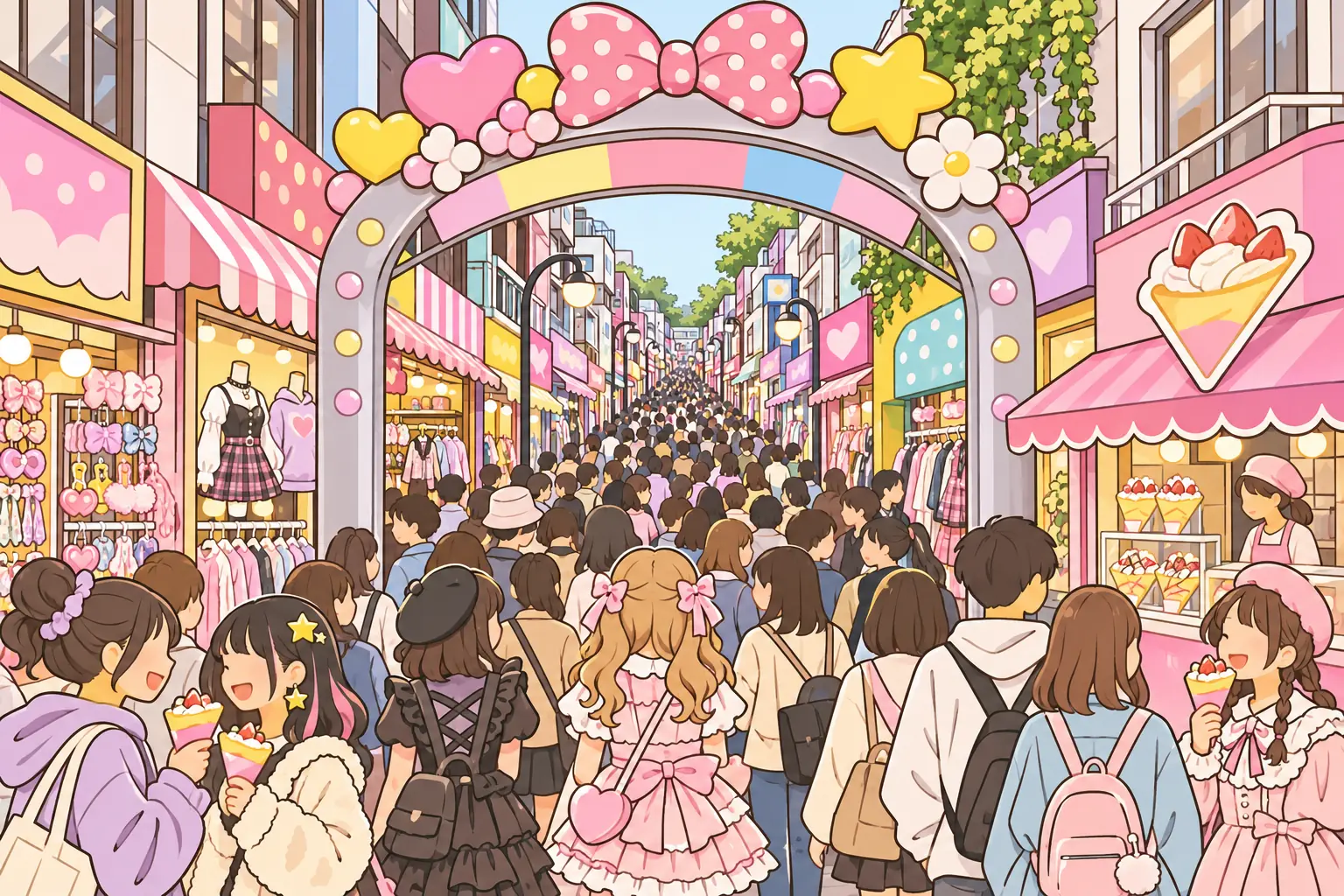
Takeshita Street on a weekend afternoon: a narrow 350-metre lane packed with small shops and crowds (illustration).
At the bottom of Takeshita Street, cross Meiji-dōri to Laforet Harajuku. It is still the easiest place to take the pulse of Harajuku fashion, with floors of small labels, and Lolita and Gothic brands have long kept shops in and around it. On weekends you will often see shoppers in full coordinate there.
Turn south along Meiji-dōri and into Cat Street, and you are in Ura-Harajuku territory: vintage stores, sneaker shops and streetwear labels tucked between houses, at a gentler pace than Takeshita Street. Head east and Omotesandō offers a different scene. Omotesando Hills, designed by Andō Tadao and opened in 2006, stands on the site of the Dōjunkai Aoyama Apartments, early concrete housing built after the 1923 Great Kantō Earthquake; one corner reproduces a slice of the old building as a memorial. Walk up the zelkova avenue toward Aoyama and the luxury flagships line both sides, many designed by celebrated architects.
One thing to remember: the people in remarkable outfits are almost all ordinary people out shopping, not performers hired for tourists. If you want a photo, ask first, and wait for a nod. Don’t follow anyone, and don’t push a lens into someone’s face. Asked politely, many Lolitas are happy to pose, and some will tell you which brand made the dress.
When you have had enough, cross back over the tracks and walk into the Meiji Shrine forest. Within a few minutes the candy-colored crowd is gone, and all you hear is gravel under your feet.