
At a glance
How the word cosplay was coined in Japan, why fans chase fidelity to a character, and the etiquette that keeps events orderly, from changing on site to asking before photographing.
- Cosplay (kosupure), from "costume" and "play", is a word coined in Japan in the 1980s.
- The word is usually credited to editor Takahashi Nobuyuki; it appeared in the June 1983 issue of My Anime.
- Kotani Mari’s costume at the 1978 Japanese SF convention is one of the earliest recorded cases in Japan.
- Comiket, founded in 1975, rooted cosplay in Japan and shifted its focus from sci-fi to anime, manga and games.
- The key rules: never travel in costume, change in the dressing rooms, and ask before taking a photo.
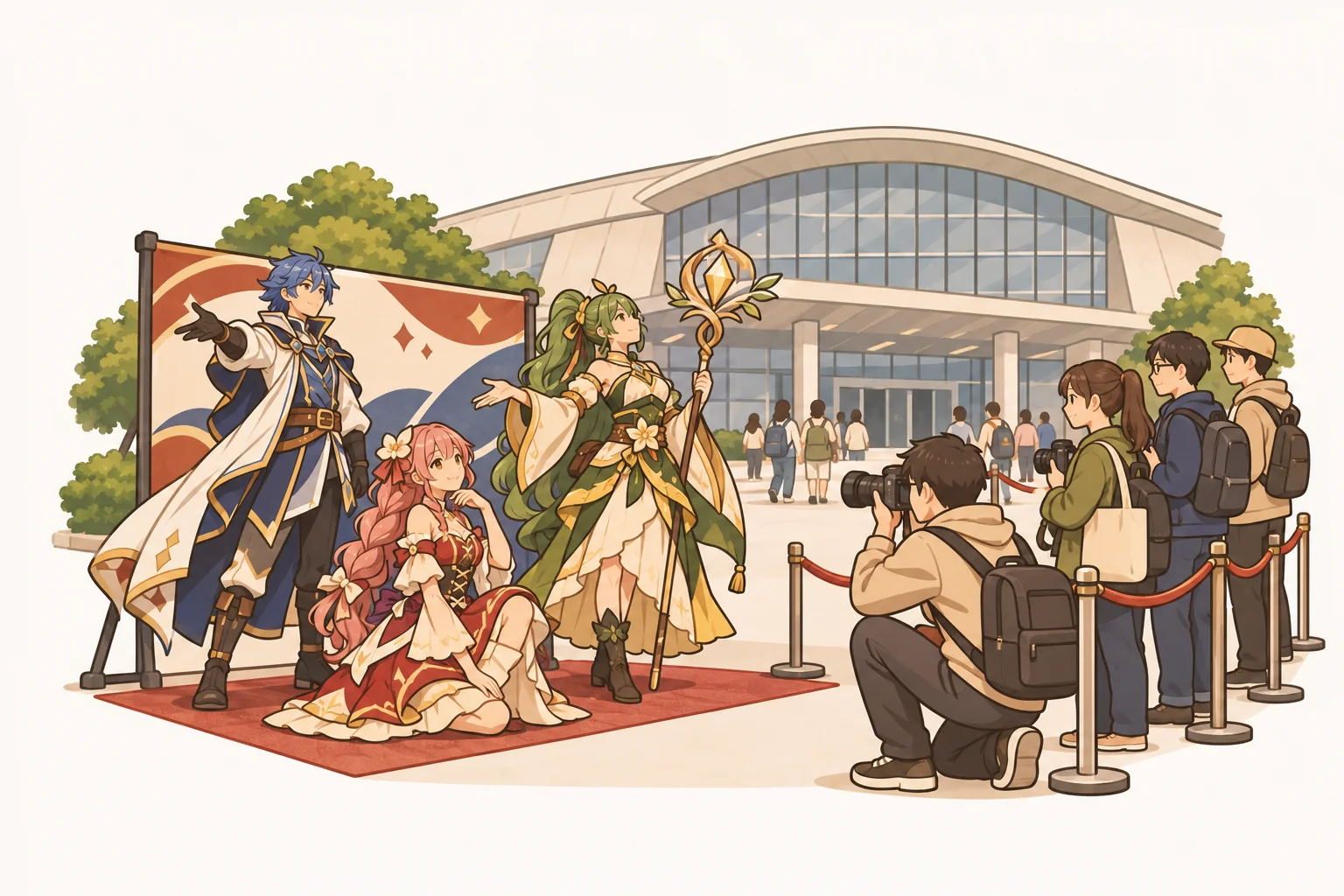
On a summer weekend at Tokyo Big Sight, the vast convention center on the Tokyo waterfront, thousands of people stand in the heat dressed as swordsmen, schoolgirls with magical powers, space pilots and video-game villains. Around each of them forms a quiet half-circle of photographers waiting their turn. This is cosplay, and although people around the world now dress up as fictional characters, the word itself was coined in Japan, and Japan still has the most developed and most carefully mannered cosplay culture anywhere. This piece explains where it came from, why Japanese cosplayers do it, the unwritten and written rules that hold it together, and how a visitor can watch or join in.
01A Japanese Word for an American Habit
Dressing up is old everywhere, and Japan is no exception. Festival processions have long included people in disguise, and in 1887 Prime Minister Itō Hirobumi hosted a notorious fancy-dress ball at his official residence, where members of the Meiji elite appeared as historical and mythological figures. None of this leads directly to modern cosplay, though.
The real ancestor is science-fiction fandom. At the first World Science Fiction Convention in New York in 1939, a couple of fans turned up in homemade futuristic outfits, and costumes became a fixture of American conventions. The "masquerade," a staged costume show with judges, grew out of that habit. Japanese fans who organized their own national SF convention from the 1960s brought the practice home, and Kotani Mari, later a well-known critic, is usually cited as one of the first people in Japan on record wearing a character costume at such an event: at the 1978 convention by Lake Ashi in Hakone, she dressed after the cover art of an Edgar Rice Burroughs novel.
The word arrived in the early 1980s. Takahashi Nobuyuki, an editor at the publishing and production house Studio Hard, wrote an article for the June 1983 issue of the anime magazine My Anime about fans dressing as anime and manga characters. He and his friends felt the English "masquerade" sounded too stiff and old-fashioned, and the article used both kosuchūmu purē ("costume play") and the contraction kosupure. A widely repeated version has him coining the word after visiting the 1984 Worldcon in Los Angeles, but the magazine usage is a year older. Japanese routinely clips borrowed English words into four-syllable compounds (a personal computer is a pasokon, a remote control a rimokon), so the new word sat comfortably in the language; it spread gradually among fans and was common knowledge in Japan by the 1990s. Decades later it traveled back into English as "cosplay."
What turned cosplay into a mass hobby in Japan was not science fiction but the dōjinshi scene. Comic Market, or Comiket, founded in 1975 as a fair for selling self-published manga (dōjinshi), had by the 1980s become a gathering place for anime and manga fans in huge numbers. A girl dressed as an anime character was already drawing attention there in 1977, and through the 1980s characters from Mobile Suit Gundam and Urusei Yatsura became a common sight in the halls. From that point Japanese cosplay was anchored in anime, manga and, later, video games, rather than in Western science fiction, and that still defines its look today.
02Why People Do It
Japanese cosplayers are called kosupureyā, usually shortened to reiyā, "layers." Ask one why they would spend months and tens of thousands of yen on a single outfit and the most common answer is simple: they love the character.
Japanese anime, manga and games are built around characters with strong visual signatures. A particular hair color, a uniform, a weapon or a pose is enough for fans to recognize who someone is meant to be. The affection fans feel for a favorite character has its own word, oshi, the one you "push" or champion. Cosplay is a way to give that affection a physical form. The cosplayer studies how the character stands, holds their head, smiles or scowls, and tries to embody it. A good cosplay is not only accurate in costume; it reads as the character the moment the person looks up at the camera.
That is why Japanese cosplay places so much weight on fidelity to the source. Wigs are cut and styled by hand and matched against official character sheets. Armor is shaped from sheets of EVA foam softened with a heat gun, sealed and painted to look like worn metal. Seams, buttons and the fall of a cape are checked against the original artwork. Many cosplayers would never buy a ready-made costume; drafting patterns and sewing are part of the pleasure and a craft in their own right. Others specialize in makeup, using tape, contouring and colored lenses to nudge a real face toward the proportions of a drawn one.
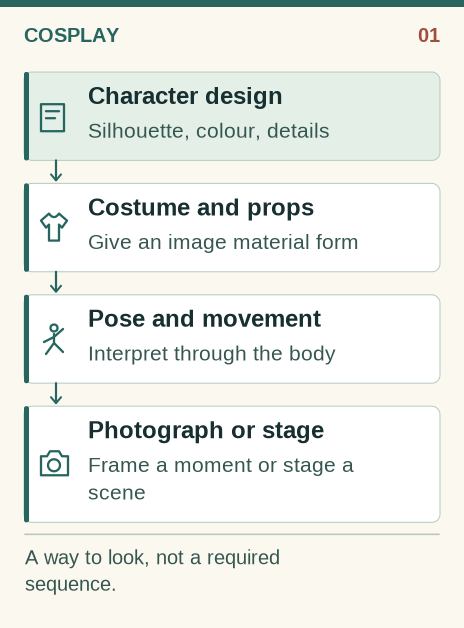
Read the character’s silhouette, colors and details, turn them into costume and props, then bring them to life through pose.
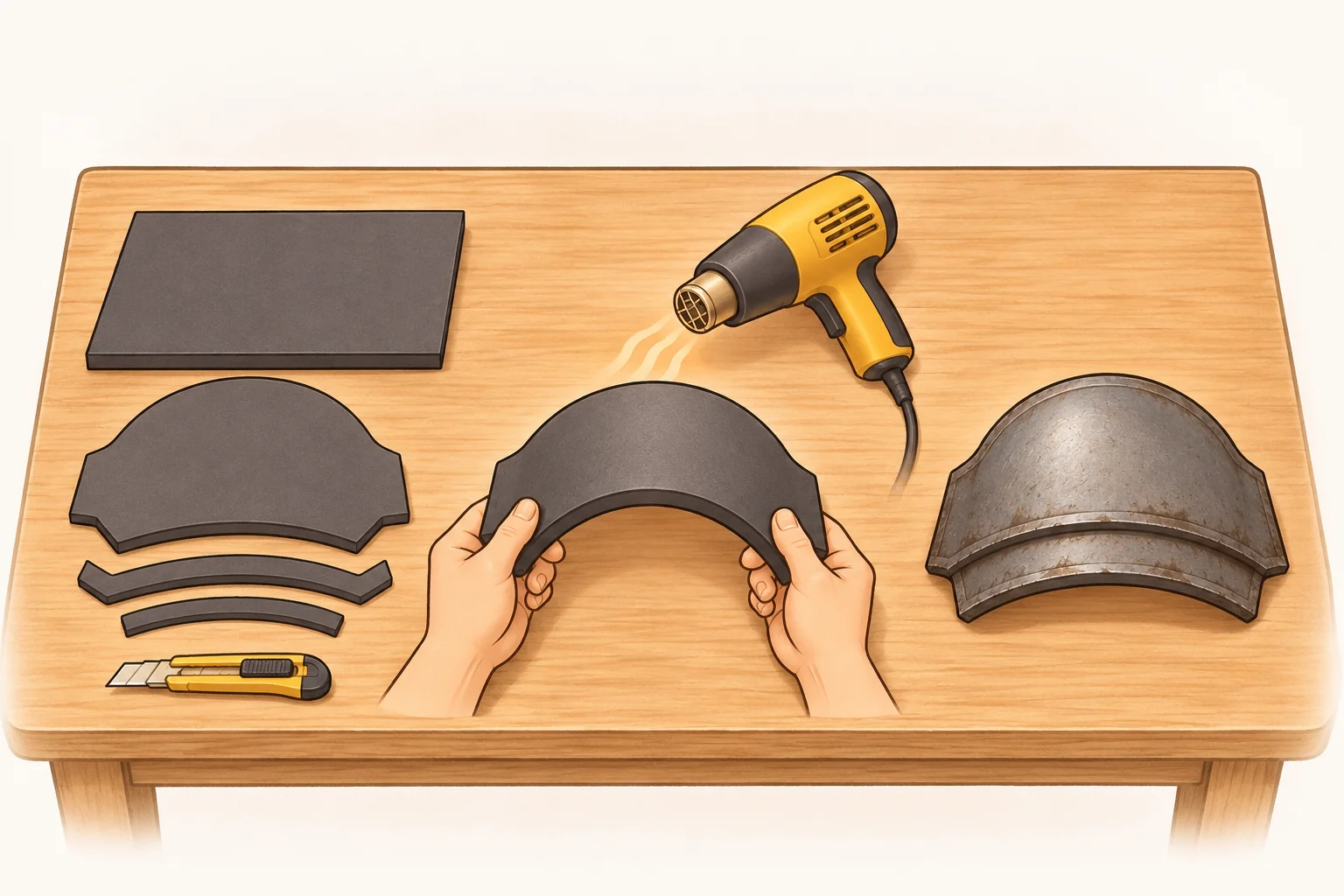
Armor is shaped from sheets of EVA foam softened with a heat gun, then painted to look like worn metal.
Cosplay also offers a release. Japanese public life asks people to blend in, to be the company employee or the student in uniform. An event hall is a space everyone has agreed to treat as an exception, where being loud, colorful and conspicuous is permitted and even expected. For a day, the office worker is a hero from a fantasy epic, and nobody finds that strange.
03The Rules That Hold It Together
Visitors to Japanese cosplay events are often struck by how orderly they are. The rules grew up over decades at large events like Comiket, and most Japanese cosplayers follow them without needing to be told.
The first and most important rule is that you do not travel in costume. Cosplayers arrive in ordinary clothes, carry their outfits in suitcases, change in dressing rooms provided by the organizers, and change back before they leave. Walking through a train station or riding the subway in full costume is considered bad manners in the Japanese scene, with very few exceptions for officially sanctioned parades. The reasons are practical: ordinary commuters may be alarmed, prop swords and guns can draw the police, and any trouble risks a venue refusing to host the event again. To use the dressing rooms, cosplayers first register with the organizers and receive a pass.
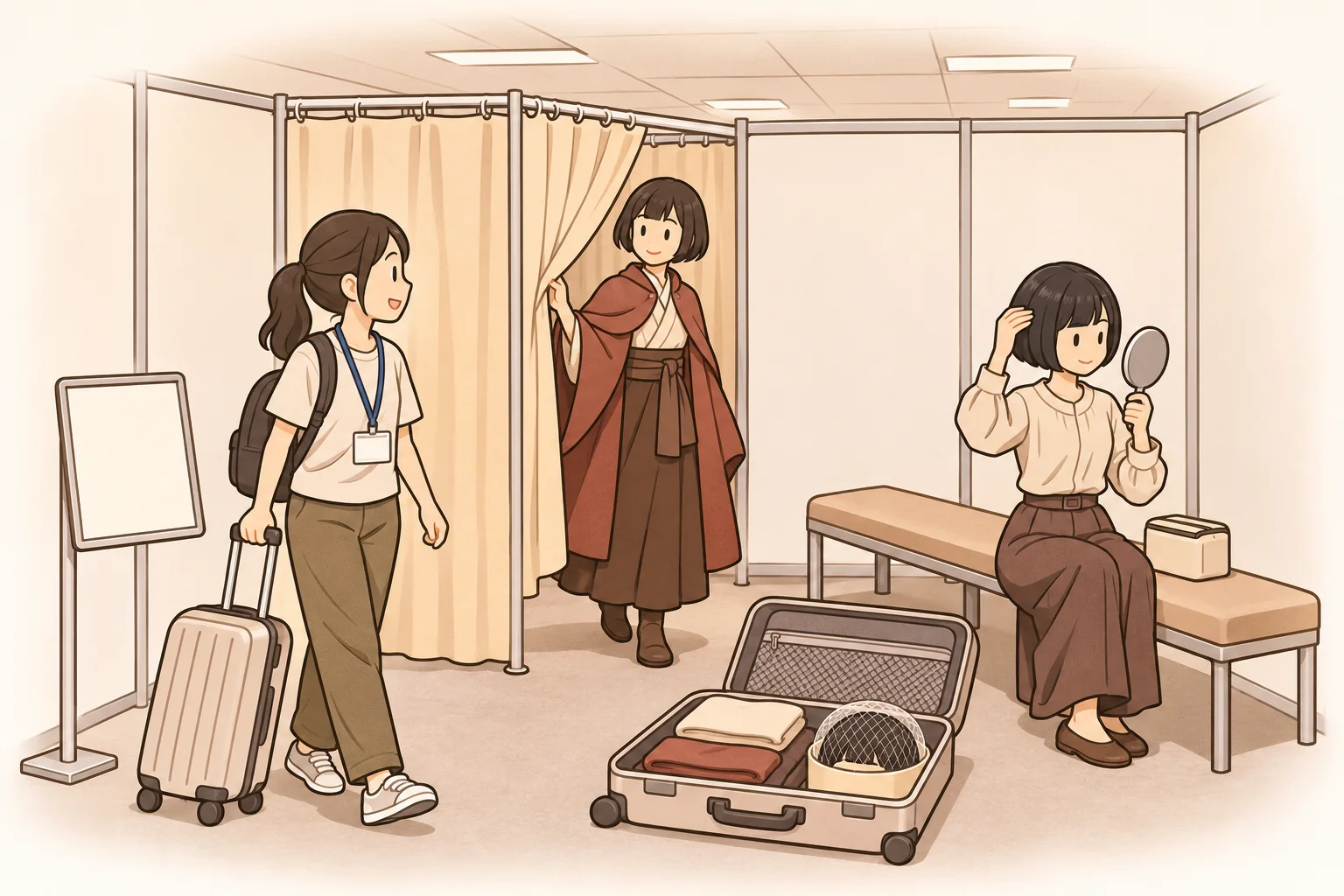
A dressing room at an event venue. Cosplayers arrive in ordinary clothes with their outfits in suitcases and change here.
- 1Register with the organizers, get a pass
- 2Arrive in ordinary clothes, costume packed
- 3Change in the dressing room
- 4Pose and shoot in designated areas
- 5Change back before leaving
The first rule: you do not travel in costume. Walking through a station or riding a train in costume is considered bad manners in the Japanese scene.
The second rule concerns photography. Large events attract many photographers who come specifically to shoot cosplayers; in Japanese slang they are kameko, roughly "camera kids." The etiquette is to approach, ask "Shashin yoroshii desu ka?" ("May I take a photo?"), and only raise the camera after the cosplayer agrees. Popular cosplayers draw a queue that fans out into a half-ring around them, and photographers take a few frames each and step aside. Shooting from low angles, photographing without permission and posting pictures carelessly online are among the things the community dislikes most. Cosplayers and photographers often swap cards or social-media handles so the photos can be shared afterward.
The third set of rules covers props and space. Events usually limit the size of swords and staffs, ban replicas that could fall foul of Japan’s weapons laws, require toy guns to be emptied of pellets and batteries, and sometimes inspect props at the entrance. Photography is steered toward designated spots; Comiket sets aside cosplay areas inside and outside the halls as gathering points, and shooting near the sales tables is allowed only when it does not block the aisles or the selling.
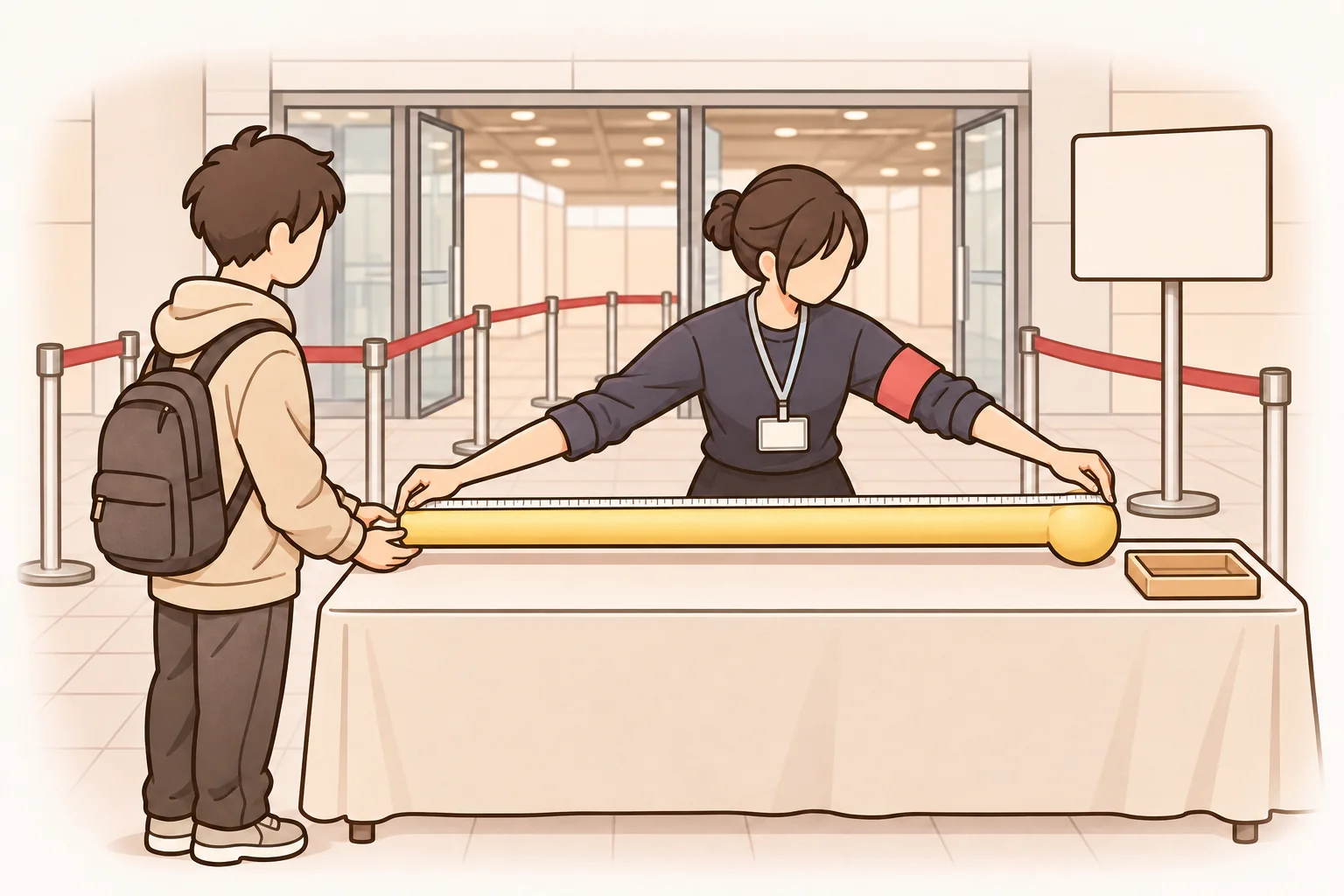
Measuring a foam staff. Events usually limit the size of long props and sometimes inspect them at the entrance.
These rules can look fussy, but they are the reason cosplay can happen openly in the middle of Japan’s biggest cities. Venues, organizers and participants keep an implicit bargain: if everyone behaves, the events go on.
04Where to See It
The biggest stage is still Comiket, held twice a year, in summer and in winter, at Tokyo Big Sight in the Ariake district. Since it resumed after the pandemic in 2021, each edition has run over two days (as of summer 2026) and drawn hundreds of thousands of visitors; the winter 2026 edition is scheduled for three days, because more circles applied and renovation work at the venue has reduced the halls available. In August the outdoor cosplay areas are packed under a fierce sun; in December some cosplayers stand in thin costumes in the cold wind off Tokyo Bay. Keep in mind that Comiket is first of all a market for self-published work, with cosplay as one part of it. The crowds are intense.
For an event centered on cosplay itself, Nagoya’s World Cosplay Summit is the one to know. It was launched in 2003 by the broadcaster TV Aichi and now brings national teams from dozens of countries each summer to compete in a championship. Alongside the contest there is a cosplay parade through the Ōsu shopping arcades, one of the rare occasions when cosplayers are welcomed onto the street, and local residents and tourists crowd the covered streets to watch.
In Tokyo, Ikebukuro is the other center of gravity. The area around the east exit and the Sunshine City complex is full of shops catering to female anime and manga fans, and hosts cosplay events through the year. Each autumn the Ikebukuro Halloween Cosplay Fest closes off sections of the neighborhood so participants can walk around in costume within set boundaries. This is quite different from Halloween in Shibuya, which has no organizer at all; in recent years the crowds and drinking there have become such a problem that, as of 2025, the ward has asked visitors year after year not to come for Halloween.
Much of a typical Japanese cosplayer’s year is spent somewhere quieter: rental photo studios. These studios, found across Tokyo and other cities, are fitted out as classrooms, tatami rooms, ruined buildings, gothic mansions or train carriages, and are rented by the hour for photo shoots. The big conventions are the highlights of the calendar, but the studios are where much of the actual work is done.
05Neighbors and Boundaries
Cosplay sits in the middle of Japanese popular culture. The characters come mainly from anime, manga and video games; Pokémon, Studio Ghibli films and tokusatsu heroes such as Ultraman all appear regularly at events. Akihabara’s maid cafés borrow some of the same pleasure in costume, but the maid outfit is a work uniform, not a fan’s tribute to a character. Harajuku street styles such as Lolita fashion are also a way of dressing as another self, but they are worn as everyday clothing and do not imitate a specific character.
Since the 2000s cosplay has moved well beyond a niche. Well-known cosplayers have large followings, publish photo books and appear on television and in advertising. The government’s "Cool Japan" promotion has treated cosplay as one of the country’s cultural calling cards, and the World Cosplay Summit has received official backing. Meanwhile "2.5-dimensional" musicals, stage adaptations of anime and manga with professional actors playing the characters, have become a large business; they can be seen as cosplay’s spirit transferred to the commercial stage.
Copyright is a gray area. Reproducing a character’s design could in principle infringe on it, but Japanese publishers and game companies generally treat fan cosplay as free promotion and leave it alone. The trouble starts when money is involved. A Tokyo company that rented go-karts to tourists for street tours, along with costumes of Mario and other Nintendo characters, was sued by Nintendo under Japan’s unfair competition law; the courts ordered it to stop lending the costumes and to pay damages, and the ruling became final in 2020.
06Watching and Joining In
For most visitors the easiest way to enjoy cosplay is to watch. At Comiket or one of the Ikebukuro events, as long as you ask before photographing and never touch someone’s costume or props, most cosplayers will happily strike a pose. A sincere "arigatō gozaimasu" afterward goes a long way.
If you want to try it yourself, a smaller event is a good start. There too you change in the organizers’ dressing room and spend the day in the designated areas. Think ahead about luggage: wigs need a box or a net to keep their shape, and props may run into airline rules. Specialty shops in Akihabara and Ikebukuro sell ready-made costumes, wigs and makeup, and some photo studios rent costumes too.
Above all, remember the first rule. Wearing your costume on the train or through the streets may be unremarkable at home, but in Japan it marks you as someone who does not understand the scene, and it can cause problems for the people who run the events. Change at the venue and change back before you leave, and you will be treated as a fellow fan.