
At a glance
How kawaii grew from Heian court writing and girls’ magazines into Hello Kitty, Kumamon and purikura, a public language that adults in Japan use freely.
- Kawaii goes back to the old word kaohayushi, "face burning," and shifted from "pitiable" to "cute."
- In The Pillow Book, Sei Shōnagon listed "cute things," starting with a child’s face drawn on a melon.
- The first Hello Kitty product was a clear coin purse priced at ¥240, released in March 1975.
- Kumamon was created in 2010 and won the national Yuru-kyara Grand Prix in 2011.
- The purikura photo-sticker booth appeared in July 1995; as of 2025 a session costs about ¥500.
Spend a day in Japan and you will be smiled at by dozens of cartoon faces. A round orange creature guards the door of a Tokyo police box, a bowing cartoon worker apologizes for roadworks, a bear with red cheeks sells you a box of sweets at a station kiosk, and a white cat with a red bow on her left ear looks out from pencil cases, rice crackers, and airport shops. The Japanese word for all of this is kawaii, usually translated as "cute," and it has become one of the country’s most recognizable exports. This piece looks at what the word actually means, where the aesthetic came from, how it moved from schoolgirls’ pencil cases into government offices, and why a photo-sticker booth invented in 1995 still fills whole floors of Tokyo game arcades. It ends with some suggestions for where to see it for yourself.
01What "kawaii" means
The English word "cute" doesn’t quite cover it. Kawaii descends from a classical word, kaohayushi, literally "face-flushing," which described the hot embarrassment of seeing something painful or pitiable. Later the form kawayushi came to mean something like "poor thing" — the pang you feel watching something small and helpless. That pang of pity softened into affection, and by the mid-sixteenth century people could use the word for the love a parent feels for a child. The usual written form today, 可愛い, is generally thought to use characters chosen for their sound and meaning after the fact.
That history still shows. When Japanese people call something kawaii they are often pointing to qualities of smallness, roundness, softness, clumsiness, or vulnerability — things that lower your guard and make you want to look after them. A tiny, slightly lopsided ceramic cat is kawaii. So, in the right circumstances, is an elderly man fumbling with a smartphone, or a sumo wrestler eating a parfait. The word expresses a feeling in the person looking as much as a quality in the thing seen.
Japanese writers like to point out that this sensibility is very old. Around the year 1000 the court lady Sei Shōnagon included in her Pillow Book a list of "adorable things." It begins with a child’s face drawn on a melon, then a baby sparrow that comes hopping when you squeak at it like a mouse, then a toddler crawling along who spots a speck of dust, picks it up with tiny fingers, and solemnly shows it to an adult. Her word, utsukushi, meant "dear" or "sweet" in classical Japanese rather than the modern sense of "beautiful." The things that charmed her — the small, the earnest, the endearingly awkward — are much the same things that sell character goods today.
People have offered many explanations for why this feeling took such public form in Japan. The ethologist Konrad Lorenz observed that large heads, big eyes, round cheeks, and short limbs trigger a protective response in humans everywhere; that part is universal. The psychiatrist Doi Takeo argued that Japanese social life places unusual value on amae, the wish to depend on others and be indulged by them, and many commentators have connected kawaii to this: a cute object invites care, and acting cute invites others to look after you. Whatever the deeper cause, what is distinctive about Japan is not that people find kittens adorable but that cuteness is a language adults use openly, in public, and for serious purposes.
02Girls’ magazines and the first cute shops
Kawaii as a style and a business took shape in the early twentieth century, with the rise of a new kind of reader. As schooling for girls expanded in the late Meiji and Taishō periods (roughly 1900–1926), cities filled with shōjo — girls who were at school, not yet married, and suddenly a market. Magazines such as Shōjo no Tomo (Girls’ Friend) published sentimental stories, illustrated poems, and free inserts of stationery and bookmarks. Novelists such as Yoshiya Nobuko wrote about intense friendships between schoolgirls. This in-between stage of life, protected from both childhood and adult duties, became the soil in which cute culture grew.
The painter Takehisa Yumeji was among the first to turn that sensibility into merchandise. Famous for languid, wide-eyed women, he opened a small shop in Nihonbashi, Tokyo, in October 1914, the Minatoya, selling decorated paper, letter paper, envelopes, hand towels, fans, and collar fabrics printed with his designs. The tiny shop was crowded with schoolgirls, and the shop is often treated as the ancestor of the Japanese "fancy goods" store.
In the 1930s the illustrator Nakahara Jun’ichi took over this role. He became the house artist of Shōjo no Tomo in 1932, and his covers for it from 1935 showed girls with enormous, sparkling eyes and long lashes, a look many people see as a forerunner of the eyes in later girls’ manga. After the war, in years of real scarcity, he founded magazines such as Soleil and Himawari (Sunflower), which taught readers how to remake old clothes and live gracefully in small rooms. His illustrations still appear on handkerchiefs, notebooks, and mugs.
In the 1960s the illustrator Naitō Rune, who had started out as an apprentice at Nakahara’s publishing house, pushed the style into cheap, mass-produced items: mugs, stickers, and little ornaments covered with pandas, strawberries, and wide-eyed animals. He is often credited as a pioneer of fanshī guzzu ("fancy goods"), the small, inexpensive cute objects girls could buy with pocket money. Kawaii was no longer just an image on a page. It was something you could own, collect, and give to a friend.
03Round handwriting and quiet rebellion
The moment kawaii became a national craze came in the 1970s, and the clearest sign of it was handwriting. In those years schoolgirls across Japan began writing in a new rounded script, sometimes called marumoji ("round letters"): strokes of even thickness, corners curved off, often written horizontally rather than in traditional vertical columns, and decorated with stars, hearts, and little faces. Teachers disliked it and some schools banned it in homework. The journalist Yamane Kazuma investigated and in 1986 published a study of what he called "deviant girls’ writing," tracing how the style had spread explosively from around 1978; by his account it had already appeared by 1974. It is usually linked to mechanical pencils, which make fine, even lines, and to the lettering used in girls’ manga and magazines.
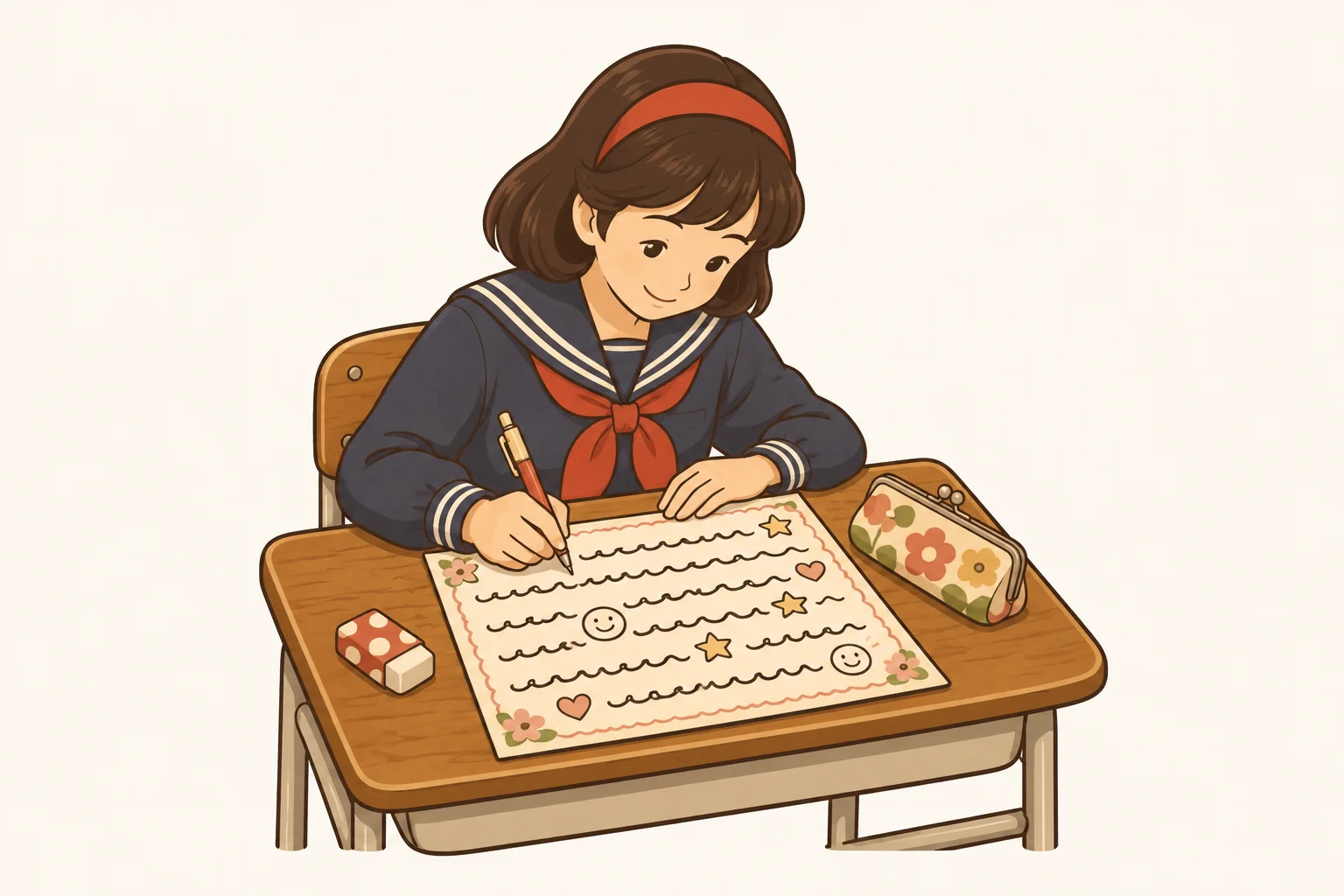
Marumoji, the 1970s schoolgirls' round handwriting, written horizontally and decorated with stars, hearts and little faces.
The British sociologist Sharon Kinsella, in an often-cited 1995 essay, "Cuties in Japan," set this trend against the background of postwar society. After the student protests of the late 1960s faded, she argued, young people stopped confronting adult society head-on and instead expressed their discomfort by refusing to grow into it. Childish handwriting, babyish speech, and little-girl clothes were ways of saying "I’m not ready to be an adult." Not every girl with a pink pencil case was making a statement, of course, but the argument captures something real: in Japan, cuteness has never been only about compliance. It can also be a soft form of resistance to the demands of work and marriage.
In the 1980s pop idols made cuteness into a performance. Matsuda Seiko, who debuted in 1980, became the model with her feathered hair, sweet voice, and air of wide-eyed innocence. She was labeled a burikko — a girl who plays cute — partly in mockery, but thousands of teenagers copied her anyway. Cuteness had moved from private stationery to prime-time television.
04Sanrio and Hello Kitty
No account of kawaii can avoid Sanrio. Its founder, Tsuji Shintarō, had been a civil servant in Yamanashi Prefecture before starting the Yamanashi Silk Center in 1960, which at first traded in silk goods and confectionery containers. As the story is usually told, the silk business struggled, and the first hit after the company turned to small goods was a pair of rubber sandals printed with flowers. In the mid-1960s the company began printing strawberries and other motifs on small goods, and they sold far better than plain ones. His conclusion shaped the company: people were not buying objects so much as a way of expressing feelings to someone else. The firm became Sanrio in 1973, and the next year began selling gifts with its own characters, which it called "social communication" gifts — small presents as a way of bringing people closer.
In 1974 the designer Shimizu Yūko drew a white kitten with a big round head, black oval eyes, a yellow nose, and a red bow over her left ear. She had no mouth. In March 1975 she appeared on a small clear vinyl coin purse priced at ¥240, the first Hello Kitty product. At first she had no name; "Kitty" was borrowed from the kitten in Lewis Carroll’s Through the Looking-Glass. Sanrio gave her a full biography: her name is Kitty White, she lives in the suburbs of London, her birthday is November 1, she is five apples tall and weighs three apples, and she has a twin sister named Mimmy, said to look so alike that even their parents cannot tell them apart, so Mimmy wears her bow on the right ear. After two earlier designers, Yamaguchi Yūko won an internal competition in 1980 and took charge of her look, and over four decades dressed her in everything from kimono to punk, always bringing her back to the same simple shape. In 2026 Sanrio announced that Yamaguchi would hand Kitty to a fourth designer within the year.
The missing mouth is the most discussed thing about her. Sanrio’s explanation is that Kitty has no fixed expression so that the person looking at her can supply one: she seems happy when you are happy and sad when you are sad. That is a basic rule of cute design. The fewer lines a face has, the more of yourself you can read into it. In 2014 the University of Hawaiʻi anthropologist Christine Yano, writing the text for a Hello Kitty exhibition at the Japanese American National Museum in Los Angeles, called her a cat and was firmly corrected by Sanrio: Kitty is not a cat but a little girl. The remark spread around the world and caused a minor uproar; Sanrio then clarified that she is a personification of a cat.
Kitty was followed by a long line of Sanrio characters: My Melody, the twin stars Little Twin Stars, Pompompurin the golden retriever, Cinnamoroll the puppy who flies with his ears, and Kuromi, My Melody’s mischievous rival in a black jester’s hood. Sanrio holds an annual popularity poll that is reported as news, and Kitty has not won it lately: Cinnamoroll took five titles in a row from 2020, and Pompompurin won in 2025 and 2026, while Kuromi’s "bad girl" charm has made her a favorite of teenagers. In December 1990 the company opened Sanrio Puroland, an indoor theme park in Tama, western Tokyo, and in April 1991 Harmonyland, an outdoor park in Ōita Prefecture on Kyūshū. Hello Kitty turned fifty in 2024.
Sanrio has a rival in San-X, a stationery maker that created Rilakkuma (2003, drawn by Kondō Aki, then a company employee), a lazy bear in a zip-up suit, and Sumikko Gurashi (2012), a gang of creatures who like to huddle in corners: a shy polar bear who fled the cold north, a penguin unsure whether it is really a penguin, and the end piece of a tonkatsu (breaded pork cutlet), 1 percent meat and 99 percent fat, left on the plate. Sanrio’s Gudetama, an egg yolk too lethargic to do anything, came second in a 2013 public vote for new food-themed characters and belongs to the same family. These characters are cute in a tired, self-deprecating way, and they speak to people who just want to find a quiet corner in a crowded society.
05Mascots everywhere: from police boxes to yuru-kyara
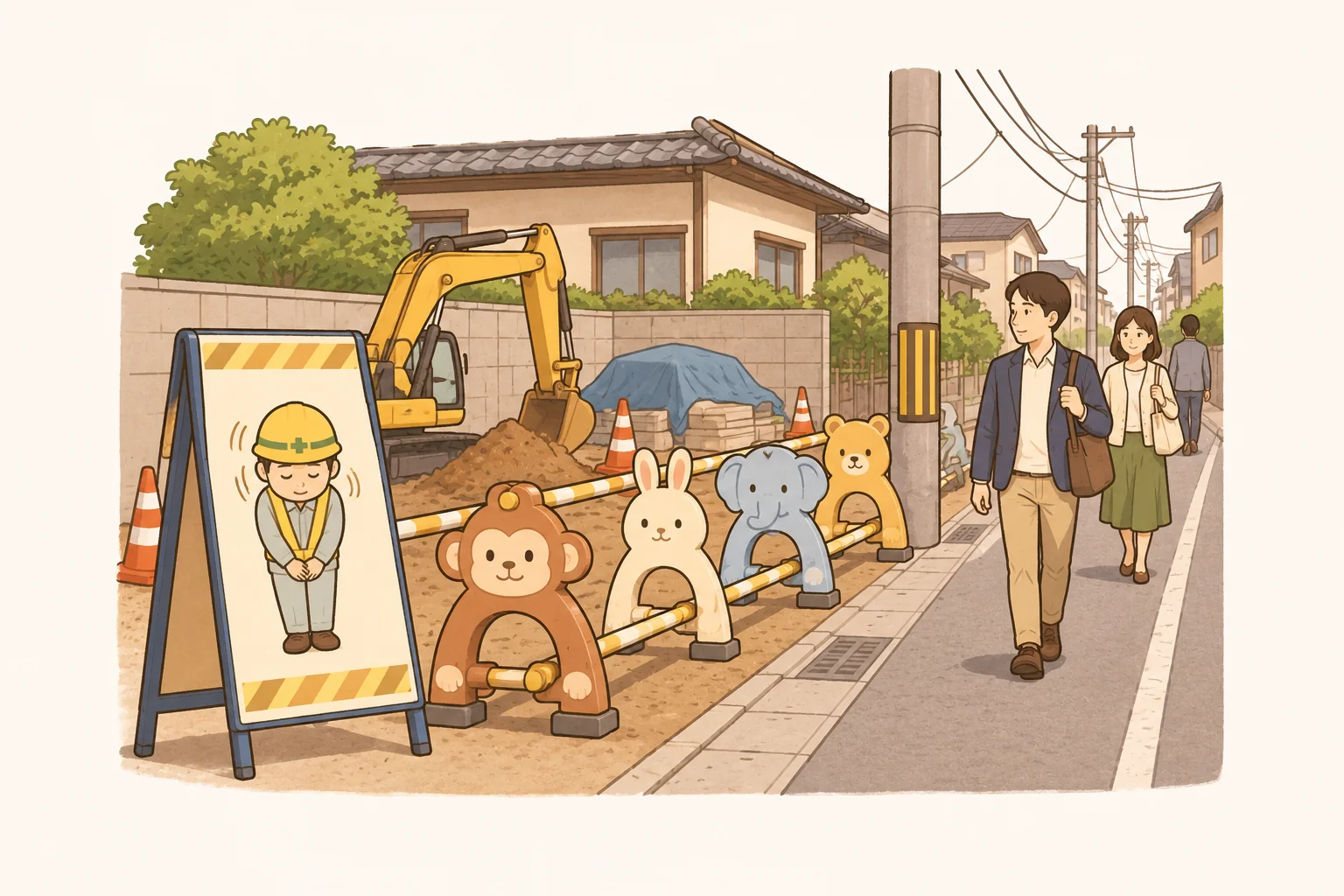
Walk around Japan and you will notice that almost every organization has a character. The Tokyo Metropolitan Police adopted Pīpo-kun, a creature with big ears and an antenna on his head, in 1987. According to the police, the ears are for listening to citizens and the antenna is for picking up quickly on what is happening in society; his name comes from "people" and "police," not from the sound of a siren. Post offices, banks, power companies, tax offices, the Self-Defense Forces, and even prisons have mascots. Construction barriers come shaped like monkeys and frogs, and the sign warning you of roadworks often shows a cartoon worker bowing deeply in apology.
These characters do a real job. Japanese social life puts great weight on avoiding direct confrontation, and a mascot softens an instruction. A sign that says "No entry" sounds like an order; the same sign held by a contrite rabbit sounds like a request. Cuteness lubricates relations between institutions and the public, making authority look approachable and sparing the person being told what to do from feeling scolded.
In the 2000s the illustrator and essayist Miura Jun gave a name to the clumsy, oddly designed regional mascots that towns and prefectures were producing: yuru-kyara, "loose characters" or "laid-back characters." The term caught on, and local governments started taking mascots seriously as a way to sell their areas. In 2007 the city of Hikone in Shiga Prefecture created Hikonyan, a white cat wearing a red samurai helmet, to mark the 400th anniversary of Hikone Castle. The cat comes from a legend that Ii Naotaka, the domain’s second lord, was beckoned into a temple by a cat and so escaped a thunderstorm; the helmet recalls the red armor that was the Ii army’s emblem. It was an unexpected hit and drew crowds of visitors.
The great success story is Kumamon, from Kumamoto Prefecture on Kyūshū. In March 2010, ahead of the full opening of the Kyūshū Shinkansen the following year, the prefecture asked the creative director Mizuno Manabu for a campaign logo, and along with it came a black bear with round eyes, two red circles for cheeks, and a permanently startled expression. His first mission was to pop up around Ōsaka and hand out 10,000 business cards. In November 2010, according to accounts of the campaign, the prefecture announced that he had grown fed up with the cards and gone missing in Ōsaka; the governor held an "emergency press conference," and a "find Kumamon in Ōsaka" campaign ran until early December. Later Kumamoto made him its "sales manager" and then also its "happiness manager." In 2011 he won the national Yuru-kyara Grand Prix. The prefecture lets companies use his image free of charge as long as they apply for permission and promote Kumamoto, so he appears on everything from biscuits to cars, and sales of Kumamon-related goods reached about ¥166 billion in 2023. After the April 2016 Kumamoto earthquakes he stopped appearing for about three weeks, then returned on May 5 with visits to evacuation centers, where children ran to hug him. When another strong earthquake struck Kumamoto in July 2026 he paused again, and on August 16 went first to shelters in Hikawa, one of the two municipalities, with Uki, that recorded the maximum intensity of 7 on the Japanese scale.
Not every star is official. Funassyi, a hyperactive pear fairy from Funabashi in Chiba Prefecture who "descended to earth" in 2012 to promote the local pears, has never been recognized by the city. He screams, leaps about, and became a television sensation around 2013 precisely because he was so unlike the well-behaved government mascots. The Yuru-kyara Grand Prix ended in 2020, but regional mascots have become standard equipment for Japanese local government.
All of this overlaps with Japanese animation, comics, and games, whose characters — Doraemon, Anpanman, Pokémon’s Pikachu — are masters of cute design. In 1998 All Nippon Airways began flying jets painted with Pokémon. See also: Anime: How Japan Built an Art Form on a Weekly Deadline; Manga: How Japan Learned to Tell Every Kind of Story in Panels; Pokémon: The Pocket Monsters That Taught the World to Trade; Otaku Culture and Akihabara: Fandom, Self-Publishing and the Art of Devotion.
06The many faces of cute
Kawaii in Japan is not only sweet. From the 1990s onward young people coined a series of compound words to describe its variations. Kimo-kawaii ("gross-cute") describes things that are a bit creepy but grow on you. Guro-kawaii ("grotesque-cute") mixes skulls, blood, and pink. Busa-kawaii ("ugly-cute") is for pugs and grumpy cats. In the 2010s came yume-kawaii ("dreamy-cute"), all pastel lilac and unicorns, and yami-kawaii ("sick-cute"), which turns bandages, pills, and tears into pastel motifs. The existence of these words shows that kawaii is less a single look than a way of seeing: anything that makes you feel tenderness can qualify.
Harajuku in Tokyo has long been the stage for these styles, with the crêpe stands of Takeshita Street, frilly Lolita dresses, and the layered plastic accessories of decora fashion. The artist Masuda Sebastian’s shop 6%DOKIDOKI and his art direction for Kyary Pamyu Pamyu’s 2011 video "PONPONPON" carried "Harajuku kawaii" around the world. See also: Harajuku and Street Fashion: How a Tokyo Neighborhood Became a Runway for Teenagers.
The Japanese government noticed. In 2008 the transport and tourism ministry named Hello Kitty a tourism ambassador to mainland China and Hong Kong. In 2009 the Ministry of Foreign Affairs appointed three young women as "pop culture envoys," representing Lolita fashion, school-uniform style, and Harajuku style; the press called them the "kawaii ambassadors."
Cuteness has its critics too. Some argue that expecting women to be kawaii keeps adult women in the role of children needing protection, and that this sits comfortably with their marginal place in many workplaces. Others find the endless mascots make serious matters seem trivial. Yet in Japan a businessman in a suit can hang a small bear charm from his briefcase, and a fifty-year-old civil servant can dance in a mascot costume at a festival, without anyone thinking less of them.
07Purikura: the photo-sticker booth
In July 1995 the game company Atlus, with Sega handling sales, put a machine called Print Club (Purinto Kurabu) into arcades. For a few hundred yen you posed in front of a camera, the machine combined your face with a decorative frame, and out came a sheet of tiny adhesive-backed photo stickers. The idea is usually credited to a young Atlus employee, Sasaki Miho, who had loved decorating her college notebooks with cute stickers. Sales were slow at first, but after the machine appeared on Ai Love SMAP!, a TV show starring the hugely popular boy band SMAP, it became a national craze. By 1997 purikura machines were taking more than ¥100 billion a year in Japan’s arcades. People shortened the name to purikura.
The point was never the photo itself but the swapping. In the late 1990s nearly every high-school girl carried a puri-chō, a purikura album, packed with tiny pictures of friends, classmates, and boyfriends. A sheet was cut into a dozen or more small frames, shared out on the spot among everyone in the booth, and then traded with other friends. A full album was proof of a wide social circle. Purikura, round handwriting, and hearts drawn on everything were all part of the same girls’ culture.
Over the following decades the machines evolved. After shooting you could write and draw on the photos with a stylus, a stage called rakugaki (doodling). Then the machines began to whiten skin, enlarge eyes, and narrow chins automatically, producing faces with manga-sized eyes; the effect is called mori, "heaping up." In the smartphone era you can download the images to your phone, and the printed sticker has become something of a souvenir. Today the market is dominated by FuRyu, which began in 1997 as a new venture inside the electronics maker Omron, became independent through a management buyout in 2007, and now holds around 90 percent of the market.
After shooting, you write and draw on the photos on screen with a stylus: rakugaki, or doodling.
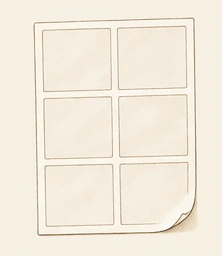
The printed sheet is divided into small frames, cut up on the spot and shared among the friends in the booth.
Walk into a big game arcade in Shibuya or Harajuku today and the purikura section may take up an entire floor: rows of curtained booths glowing pink, often with a sign at the entrance saying that men cannot enter unless accompanied by a woman, a rule meant to make girls feel safe. As of 2025, a session costs about ¥500. Two or three friends squeeze in and follow the machine’s cheerful voice prompts — peace sign, hands cupping the face, head tilted, cat paws. Then you move to the decorating booth next door to add text and stamps, and a minute or two later the sticker sheet drops out of a slot. Many people now come for the edited image on their phone, but you will still see girls cutting up the little stickers to tuck into a phone case or notebook.
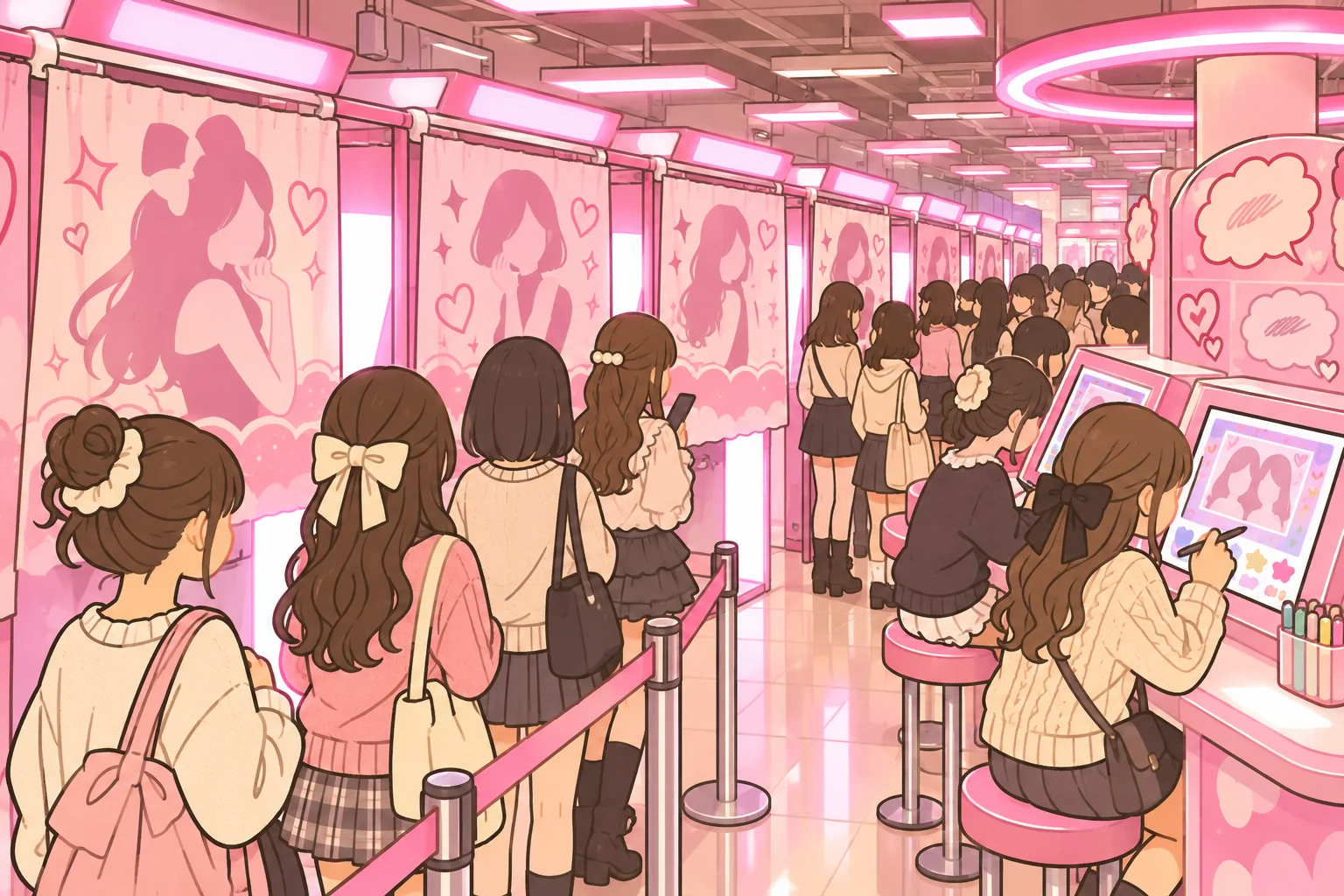
A game-centre purikura floor: rows of curtained booths glowing pink, girls queuing outside (illustration).
08Seeing kawaii in Japan
You don’t need to plan anything to see kawaii in Japan; it comes to you. Buy a box of sweets printed with a local mascot at a station shop, look at the character tie-ins next to the register in a convenience store, notice the bowing animals on the train’s safety posters. The gacha capsule-toy machines — often a whole wall of them, mostly ¥300 to ¥500 a turn as of 2026 — hold miniature sushi, tiny animals, and stranger things, like frogs in clothes or a little office worker who sits on the rim of your cup.
If you want to make a special trip, Sanrio Puroland in Tama is a large indoor park with parades and stage shows, and even if you are not a fan it is a striking look at how carefully a company builds a fantasy world. Kiddy Land on Omotesandō in Harajuku is an old toy store with character goods on every level from the basement to the fourth floor, including dedicated Rilakkuma, Snoopy, and Hello Kitty shops. Tokyo Character Street, in the basement of the First Avenue mall on the Yaesu side of Tokyo Station, gathers around thirty shops run by TV networks and character brands and is the easiest stop if you are changing trains.
In Kumamoto, Kumamon Square in the city center is the bear’s base, and on his scheduled days he comes out to dance, do exercises, and pose for photos. At Hikone Castle, Hikonyan makes regular appearances, wandering about slowly in his helmet.
The most direct way to join in is to take purikura. Game arcades in Shibuya and Harajuku all have booths. The instructions are usually only in Japanese, but between the on-screen pictures and watching other customers you will manage. Bring coins, plan a few poses in advance, and don’t rush off after shooting: the decorating stage is the best part.