
At a glance
Why Japanese anime sends fans to real streets, how towns like Washinomiya and Ōarai embraced them, and how to visit such places respectfully.
- "Seichi junrei" (pilgrimage) means fans visiting real places shown in anime and manga; the formal term is "butai tanbō".
- The 1991 video anime Ultimate Superman R is often cited as a starting point; a monument stands by Tagiri Station on the Iida Line.
- In 2016, the year Your Name. was released, "seichi junrei" made the top ten of Japan’s buzzword awards.
- After Lucky Star aired in 2007, New Year visits to Washinomiya Shrine rose from about 130,000 to about 300,000 in 2008.
- Since 2017 the Anime Tourism Association has named 88 Japanese anime spots each year.
A railway crossing by the sea in Kamakura, a flight of shrine steps in central Tokyo, a wooden school building in rural Shiga: none of these would draw a crowd on its own, yet each is visited by thousands of people a year. They come because the places appear, drawn almost line for line, in popular anime. Japanese fans call the practice seichi junrei, "pilgrimage to sacred places," and over the past two decades it has grown from a niche hobby into something towns plan around and tourism boards promote. This piece explains why Japanese animation sends people out looking for real streets, how a few small towns were transformed by it, and how to go on a pilgrimage of your own without becoming a nuisance.
01What Fans Mean by a "Sacred Place"
Seichi junrei is borrowed from religion. In ordinary Japanese it describes a journey to Jerusalem, Mecca, or the eighty-eight temples of the Shikoku pilgrimage. Anime and manga fans adopted the phrase with a wink: the "sacred place" (seichi) is wherever a beloved series is set, and the "pilgrimage" is the trip to see it. The joke carries some truth. To someone who has watched a story unfold on a particular hillside, that hillside does feel set apart. A more sober term, butai tanbō, "visiting the stage," is also used, especially by fans who like to document locations carefully.
Fans traced locations long before the phrase went mainstream. One case often cited as an early landmark is Ultimate Superman R (Kyūkyoku Chōjin Ā), a manga whose 1991 video adaptation followed its characters along the JR Iida Line through the mountains of Nagano; fans went looking for the stations, and a monument beside Tagiri Station now calls the line the birthplace of anime pilgrimage. Through the 1990s, viewers of Sailor Moon wandered the Azabu-Jūban neighborhood where the heroine lives. But these were word-of-mouth trips, shared in fanzines and on early personal websites.
The practice became a phenomenon in the late 2000s, when two things happened together. Studios increasingly built backgrounds from location photographs, so that scenes could be matched to real corners with uncanny precision. And blogs, video sites, and later social media meant that one fan’s discovery could be seen by thousands within days. By 2016, when Shinkai Makoto’s film Your Name. became a national hit, "seichi junrei" was familiar enough to make the top ten of Japan’s annual buzzword awards.
02Why Anime Makes People Want to Go There
Japanese animation has a long habit of pairing simple, flatly colored characters with backgrounds painted in close, realistic detail. In the digital era, background artists commonly scout a location, photograph it from many angles, and paint from those references. The result keeps the real utility poles, the real station signs, the real number of steps up to the shrine, but cleans up the clutter and pushes the light: skies a little bluer, evening a little more golden. The viewer sees a real place made slightly more beautiful than it is.
- 1
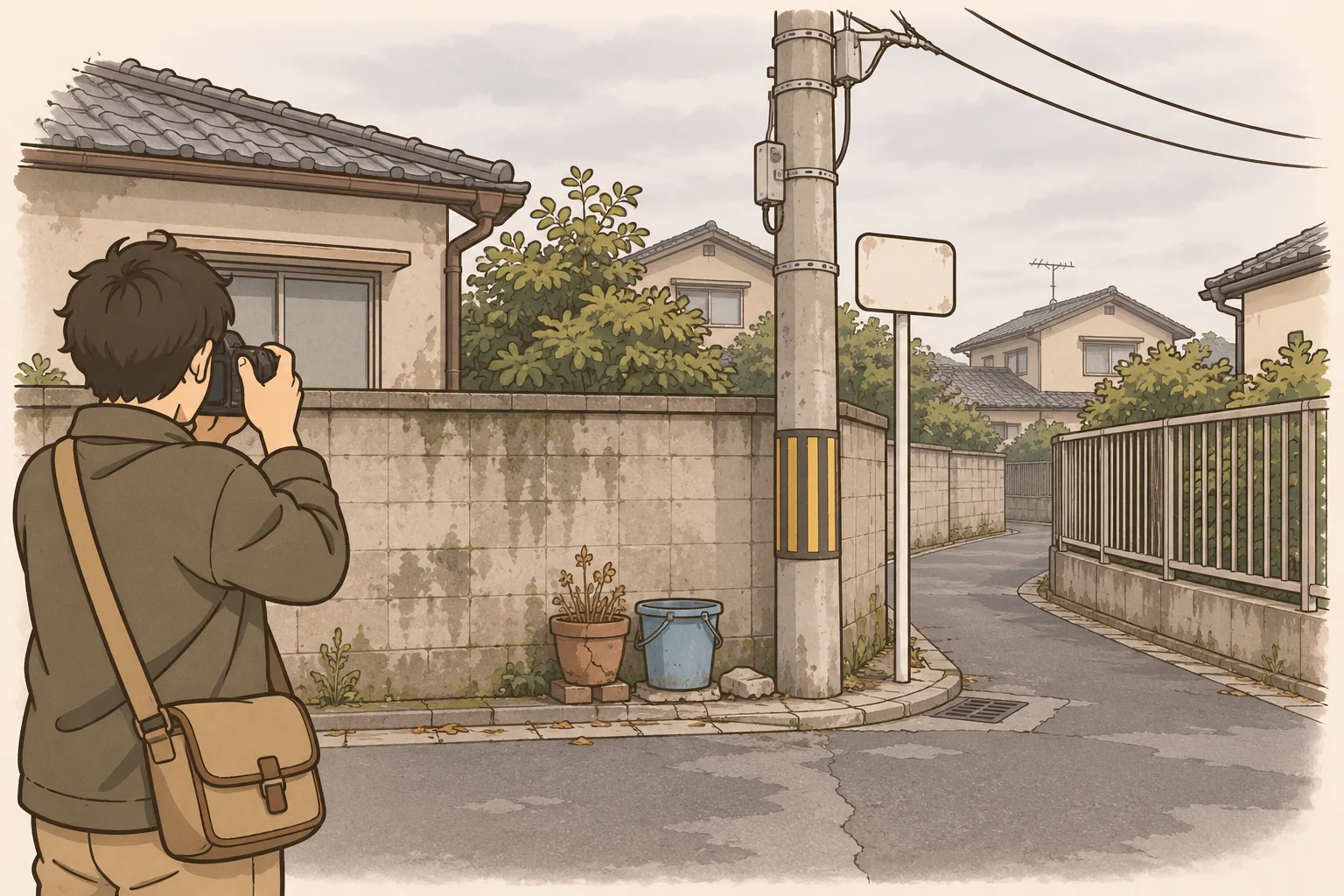 A background artist first scouts the real location and photographs it.
- 2
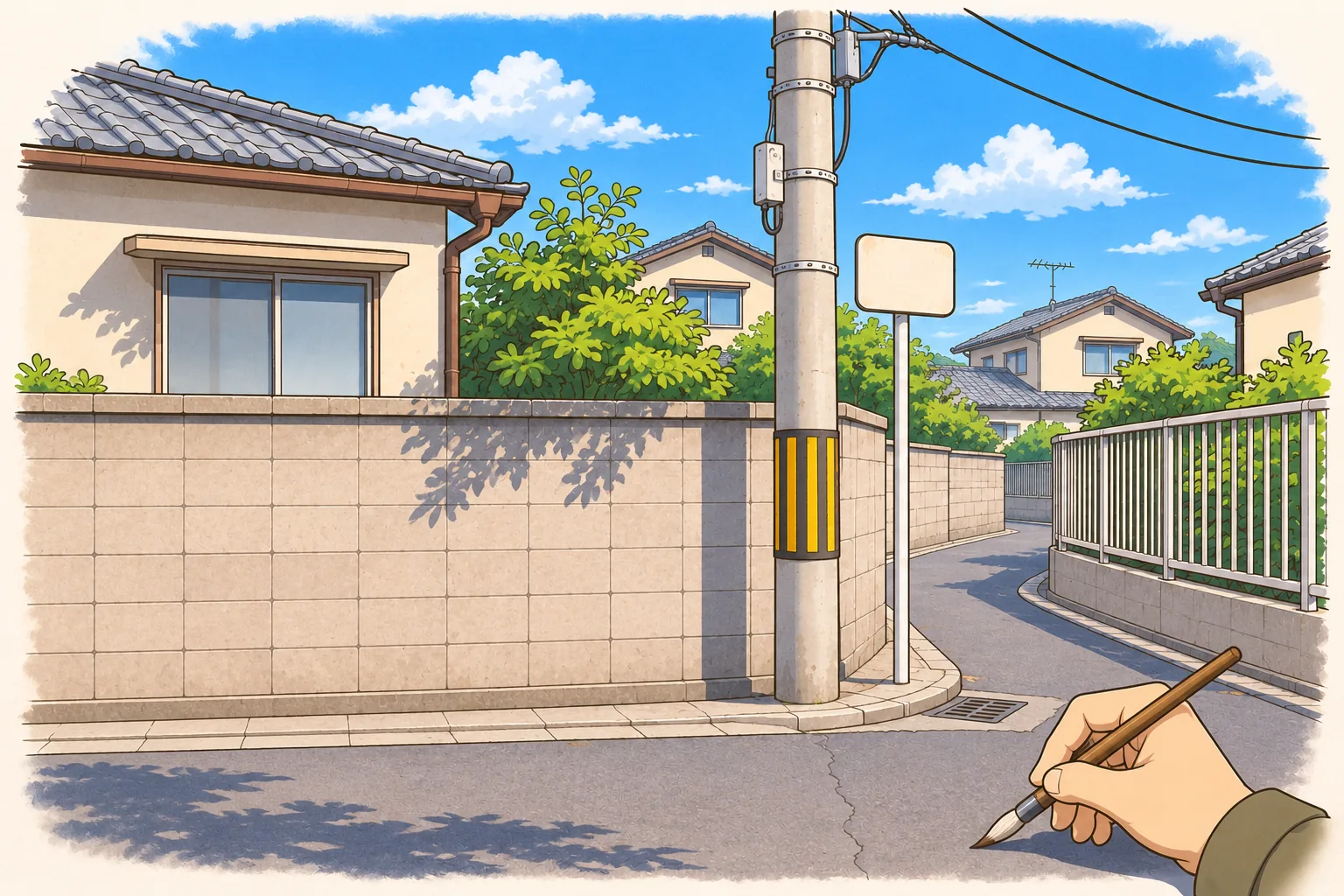 The painted version keeps the real utility pole but clears the clutter and makes the sky a little bluer.
This works best in what fans call slice-of-life series, in which very little happens. A group of high school students walks home, eats snacks by a river, waits on a platform. Over twelve or twenty-four episodes the camera returns to the same streets so often that viewers come to feel they know them, the way you know the neighborhood you grew up in. Studios with a reputation for meticulous backgrounds, such as Kyoto Animation and P.A. Works, have produced one pilgrimage site after another. Shinkai Makoto goes further, treating the setting almost as a character: his Tokyo of train windows, footbridges, and rain falling on Shinjuku Gyoen garden in The Garden of Words is instantly recognizable and somehow unfamiliar.
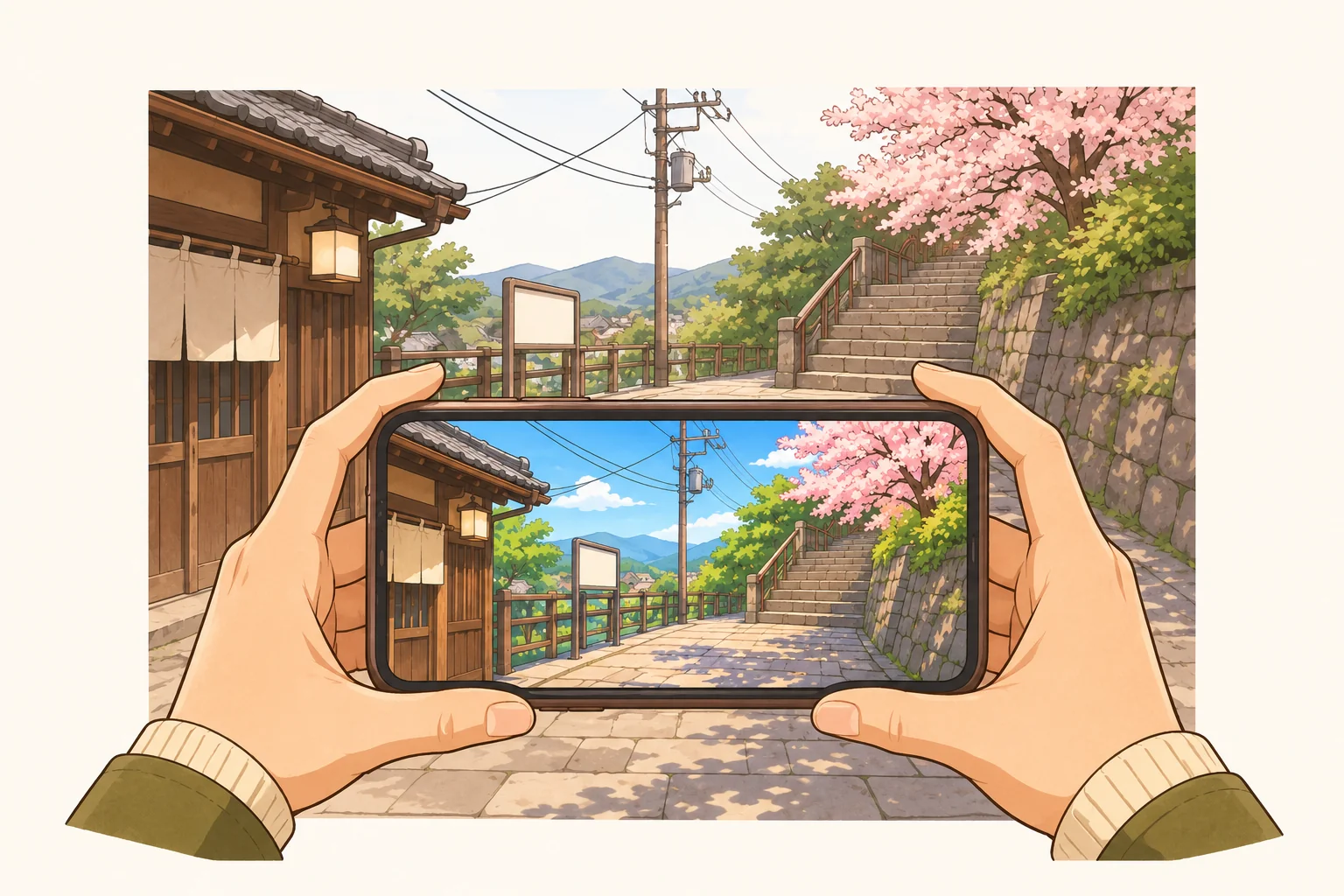
So the pleasure of the trip is recognition. You stand where the camera stood and the railing is really there, the shop sign is really there, and for a moment the frame and the world line up. Fans capture this by holding up a screenshot next to the real view or by composing photographs to match a scene exactly. Then there is the second pleasure, of taking part: eating at a café the characters visited, buying a souvenir, leaving a message for the next visitor. Many fans describe the trip as a way of thanking the work.
03Washinomiya: The Town That Showed What Was Possible
The story every account of anime pilgrimage returns to is that of Washinomiya Shrine in Saitama Prefecture. In spring 2007, Kyoto Animation’s Lucky Star (Raki☆Suta) began airing. Its opening sequence showed the shrine’s torii gate, and two of its main characters, the Hiiragi twins, were daughters of a family that keeps a shrine modeled on Washinomiya. The shrine is old and respected, but the small town around it, flat farmland north of Tokyo, was not a place outsiders traveled to.
Within months fans were arriving in groups. They hung ema, the wooden prayer plaques sold at shrines, covered in careful drawings of the characters; these decorated plaques came to be called ita-ema, roughly "cringe plaques," with the same self-mocking humor as the term itasha for cars plastered with anime art. Rather than treating the visitors as a problem, the local chamber of commerce contacted the rights holder, the publisher Kadokawa, arranged licensed goods and events, and made the fans feel welcome. New Year visits to the shrine, which had been roughly 130,000 before the series, rose to about 300,000 in 2008 and passed 400,000 in the following years.
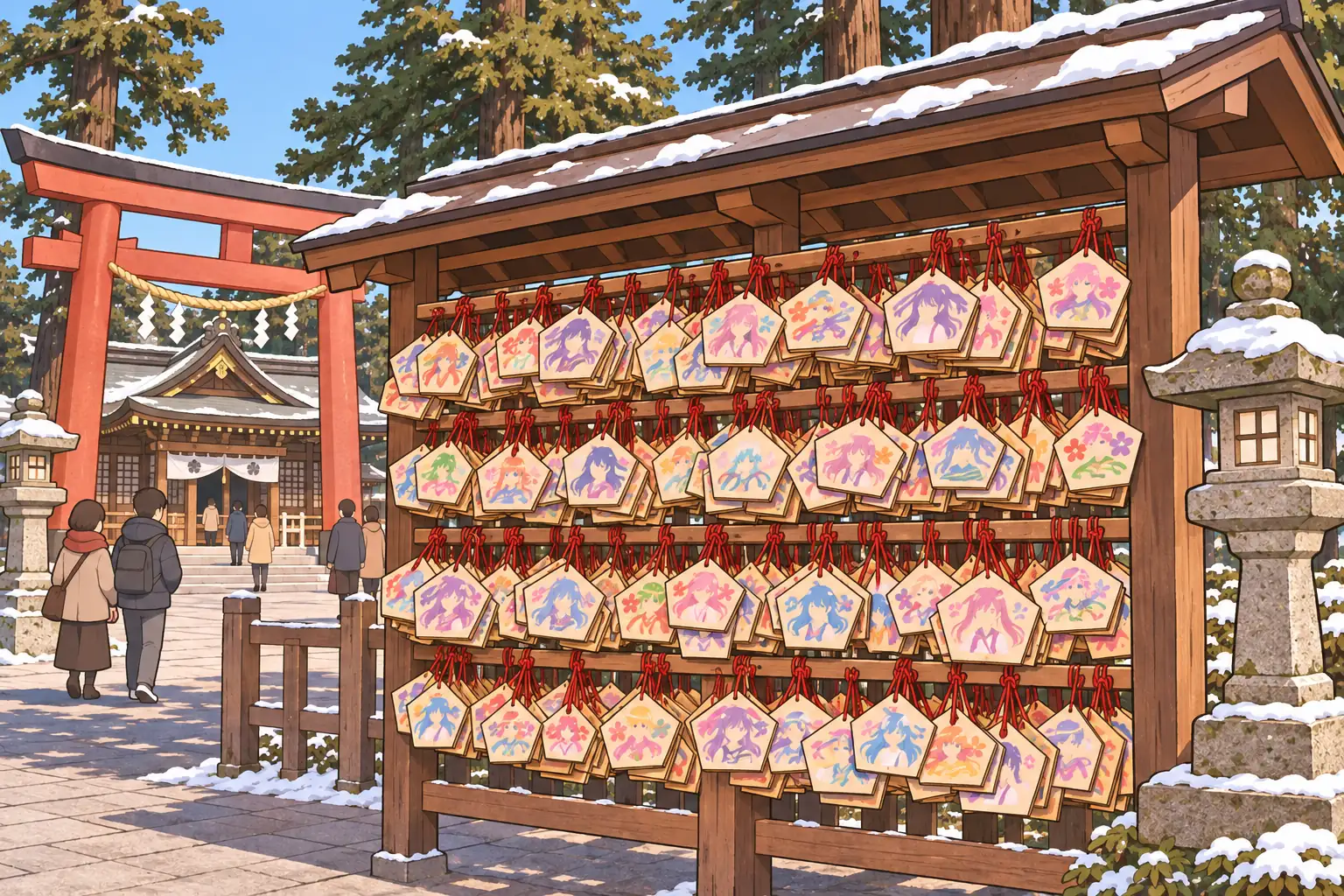
Washinomiya Shrine's ema racks crowded with character-drawn "ita-ema", torii and cedars behind (illustration).
The most famous result is a float. Since 2008 the town’s September Hajisai festival has included a portable shrine (mikoshi) decorated with Lucky Star imagery, carried through the streets by fans and residents together; according to press reports, fans from abroad later came to take part as well. The town even issued symbolic resident registrations to the fictional Hiiragi family. Washinomiya was merged into the city of Kuki in 2010, and the series had long since ended, but posters and visitor notebooks stayed in local shops for years.
What made Washinomiya a model was not just the numbers. It showed that fans who behaved well and spent money, residents who chose to welcome them, and rights holders willing to license their characters could build something that lasted. Officials elsewhere studied it closely.
04Towns That Built on the Idea
In Toyosato, a farming town in Shiga Prefecture, the old elementary school became another early landmark. The building, completed in 1937, was designed by the office of William Merrell Vories, an American architect who worked in Japan for decades. It is white and airy, with a grand staircase whose handrails carry small bronze figures of the tortoise and the hare. In the early 2000s the town fought bitterly over whether to tear it down; it survived. Then in 2009 Kyoto Animation’s K-On!, about a high school light-music club, used it as the model for the characters’ school. Fans began arriving with guitars. Volunteers set up a classroom as the club room, complete with the instruments and tea set seen on screen, and the old school became the busiest spot in town.
At Yuwaku Onsen, a hot-spring village in the hills above Kanazawa, a series added a tradition outright. P.A. Works’ Hanasaku Iroha (2011), set at a family-run inn, featured a fictional lantern festival. Yuwaku held a real one, the Bonbori Matsuri, in October that same year, and it has been held every October since, apart from 2020 and 2021 when the pandemic stopped it, with paper lanterns lit along the village street.
The coastal town of Ōarai in Ibaraki Prefecture is perhaps the best-known case of all. Ōarai was hit by the tsunami of March 2011, and visitor numbers fell. In 2012 Girls und Panzer, a series about schoolgirls who compete in tank battles as a traditional martial art, made Ōarai the home port of its school ship and sent its tanks rumbling past real shops, inns, and the seaside torii. Local merchants responded by placing life-size cutouts of the characters in their storefronts, each shop "adopting" one, and the town’s November anglerfish festival filled with fans. Ōarai is often cited as an example of a series helping a town recover its visitors after a disaster.
After this, cooperation became routine. Local tourism offices now court production teams, and many series launch with stamp rallies, pilgrimage maps, special menus, and limited goods sold only on site. In 2016 an industry body, the Anime Tourism Association, was founded with Tomino Yoshiyuki, creator of Mobile Suit Gundam, as its first chairman; as of 2026 the post is held by Kawamori Shōji. Since 2017 it has published an annual list of "88 Japanese Anime Spots" intended for domestic and overseas visitors alike.
05Where People Go Today
Most of today’s busiest sites trace back to a handful of very widely watched works. Your Name. turned the stone stairway beside Suga Shrine in Yotsuya, Tokyo, the spot where the two leads finally pass each other near the end of the film, into a place where people queue for a photograph. Hida-Furukawa, a quiet old town in Gifu Prefecture, drew visitors to its station and library, which appear in the film’s mountain town. Shinkai’s later films, Weathering with You and Suzume, sent fans to their own sets of locations across Tokyo and beyond.
In Kamakura, the level crossing beside Kamakura-Kōkōmae Station on the Enoden line is one of the best-known anime locations among visitors from China, Taiwan, and South Korea. It appears in the opening of the 1990s basketball series Slam Dunk: a green-and-cream train passing, the sea of the Shōnan coast behind it. On a busy day both sides of the road are lined with people waiting to catch a train in frame. Because some step into the road for the shot, the city has posted guards to manage the crowds, and in 2025 it trialed a designated photo area in a nearby park to draw people off the road.
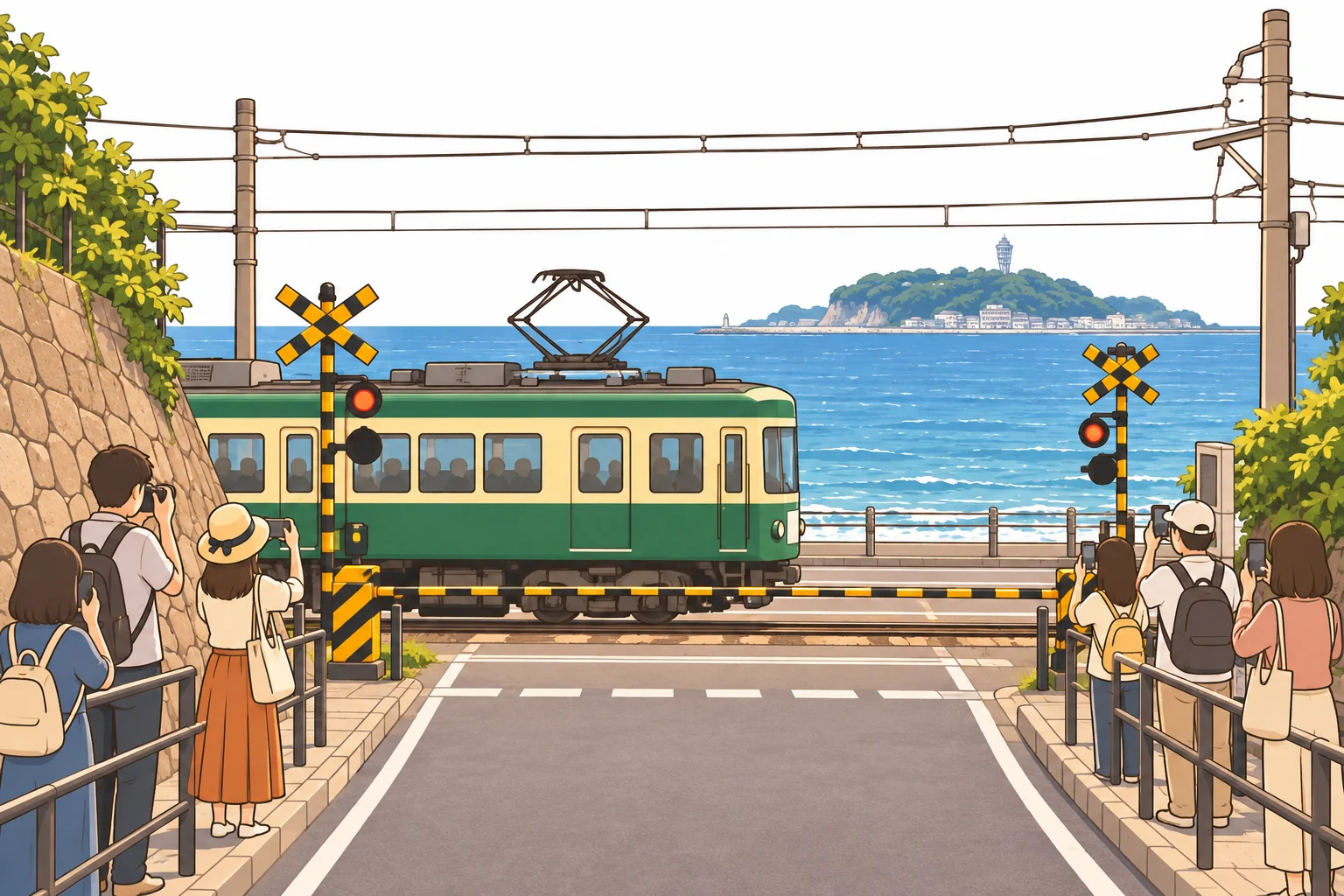
The crossing by Enoden's Kamakura-Kōkōmae Station: a green-and-cream train passes against the Shōnan sea (illustration).
Other sites are tied to recent hits. Laid-Back Camp (Yuru Camp△) sent campers to the lakes at the foot of Mount Fuji in Yamanashi, including Lake Motosu, whose view of the mountain is the one printed on the back of the 1,000-yen note issued from 2004. Bocchi the Rock! (2022), about a painfully shy guitarist, filled the Shimokitazawa neighborhood of Tokyo with young visitors carrying guitar cases; the fictional live house in the series is generally thought to be modeled on a well-known local venue.
Some "sacred places" were never settings at all. Hōmangū Kamado Shrine near Dazaifu in Fukuoka shares the name Kamado with Kamado Tanjirō, the hero of Demon Slayer, and during the series’ peak it drew crowds of fans who simply wanted to pray there. The old mining town of Jiufen in Taiwan is constantly described as the model for the bathhouse town in Spirited Away, a claim Studio Ghibli has denied; the red lanterns keep drawing visitors anyway. A more solid Ghibli connection is the Sayama Hills on the Tokyo–Saitama border, near Miyazaki Hayao’s home, where a trust known as the "Totoro’s Hometown" fund has spent years buying up woodland to protect it from development.
06Going on a Pilgrimage Yourself
Start by rewatching. Save screenshots of the scenes you want to find, along with the episode number and rough timestamp. Fans have mapped the exact locations of most popular series, and official websites and local tourist associations often publish pilgrimage routes. Even so, finding the precise spot can be harder than you expect, because animators shift perspective, combine several places into one view, and remove clutter. When you do find it, holding the screenshot up against the real thing is the core ritual of the whole trip.
Near many sites, a café, station office, or tourist information desk keeps a pilgrimage notebook (junrei nōto) in which visitors write where they came from and which character they love. Paging through one is a pleasure in itself, full of sketches and messages in several languages, and you can add your own page. At shrines with an anime connection you can buy a blank ema and draw on it. During official collaborations there may be stamp rallies, themed menus, and goods you can only buy locally. Eating, staying, and shopping in town is the clearest way to show residents that the visitors are worth having, which is the reason the custom has lasted as long as it has.
Most of the etiquette follows from one fact: these places are where other people live and work. The schools in anime are usually real, functioning schools; do not enter the grounds, and do not photograph students. On residential streets, keep your voice down and keep doorways and driveways clear. At crossings and stations, never step into the road or onto the platform edge for a better angle. Shrines are places of worship, so pay your respects before taking pictures, and check whether cosplay photography is allowed before you change into costume. Inside shops and on private land, ask first.
The pilgrimage sites that have lasted longest, from Washinomiya to Ōarai, are the ones where fans and residents left each other with a good impression. The anime gets you to a town you would never otherwise have visited. What you find there, from the actual evening light on a familiar street to a bowl of local noodles and a few words with the person who runs the shop, belongs to you.