

At a glance
The life of the god of manga, from a wartime boyhood in Takarazuka to Astro Boy, weekly TV animation and Phoenix, and what his legacy still means.
- Tezuka Osamu, the "god of manga," was born in Toyonaka, Ōsaka, in 1928 and grew up in Takarazuka.
- He drew around 150,000 pages; his best-known works include Astro Boy, Black Jack and Phoenix.
- New Treasure Island (1947) brought cinematic paneling into manga and inspired a postwar generation of artists.
- Astro Boy, first broadcast in 1963, was Japan’s first weekly domestically produced TV anime series and ran for 193 episodes.
- The Osamu Tezuka Manga Museum in Takarazuka opened in 1994; trains leave JR Takadanobaba Station to the Astro Boy theme.
Walk into any bookshop in Japan and you are standing, in some sense, inside the house Tezuka Osamu (known in English as Osamu Tezuka) built. He drew around 150,000 pages in a career of just over four decades, created Astro Boy, Kimba the White Lion, Black Jack and Phoenix, and launched the first weekly animated television series made in Japan. The Japanese call him manga no kamisama, the "god of manga," and the title is only partly affectionate exaggeration. This is an introduction to the man, to his most famous creation, and to the places in Japan where you can still find him.
01A Boy from Takarazuka
Tezuka was born on November 3, 1928, in Toyonaka, near Ōsaka, and grew up in Takarazuka, a resort town in Hyōgo Prefecture best known for the Takarazuka Revue, a theater company in which women play every role, including the dashing male leads. His mother took him to the shows. His father, an amateur photographer and film enthusiast, owned a home projector, and, by his own account, the young Tezuka watched Disney shorts and Chaplin comedies in the family living room. Revue spectacle and American animation were the two great visual educations of his childhood, and both are visible on almost every page he later drew.
His given name was Osamu (治). As a schoolboy obsessed with insects, he added the character for "bug" (虫, mushi) to his pen name, so that it reads "Osamu-mushi" while still being pronounced Osamu. He filled notebooks with careful drawings of beetles and butterflies collected in the hills around Takarazuka, and the fascination with bodies, metamorphosis and life cycles never left his work.
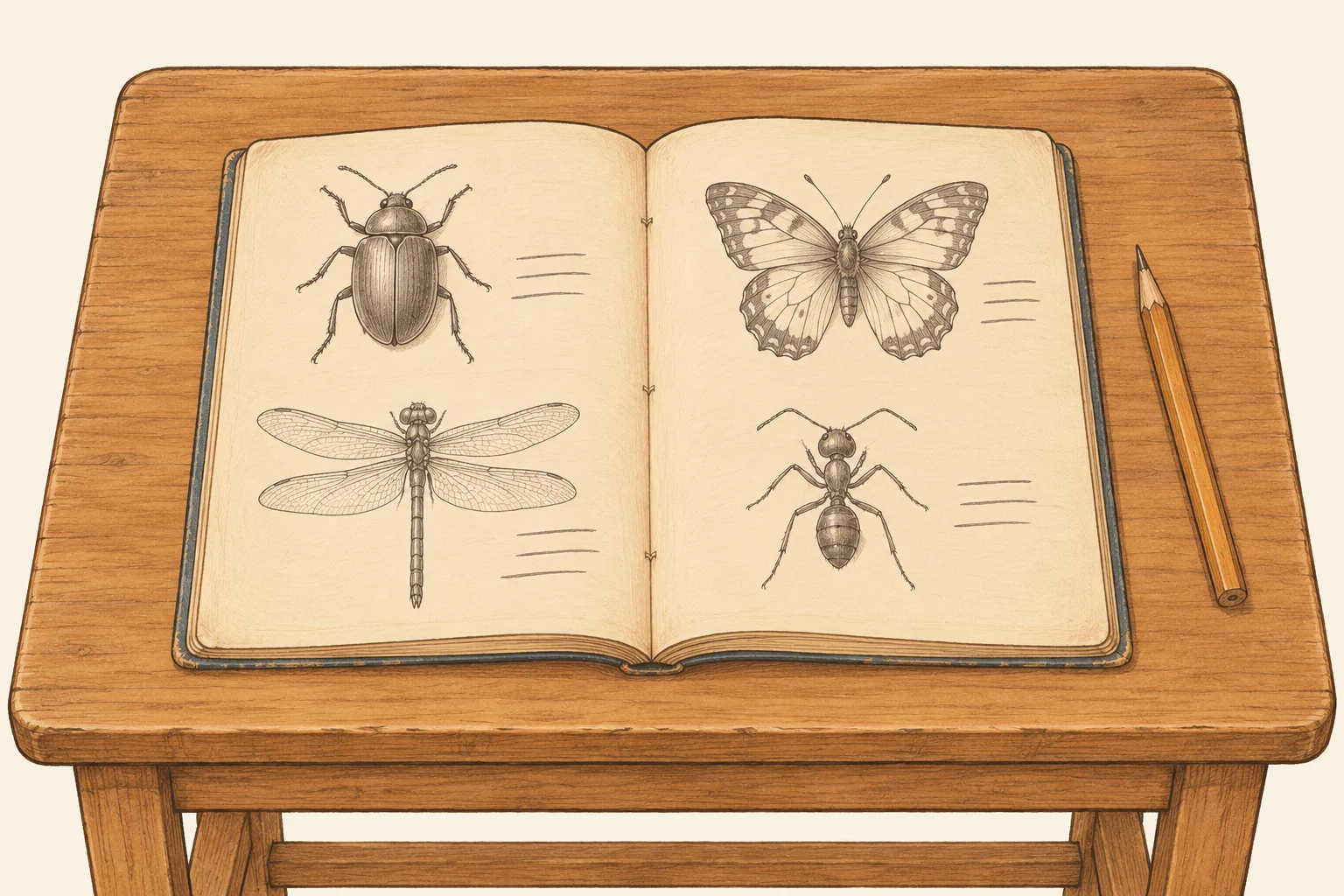
A notebook of careful insect drawings. As a schoolboy Tezuka filled notebooks like this with beetles and butterflies.
The war gave that fascination a darker edge. As a teenager he was mobilized for factory labor, and, by his own account, in June 1945 he narrowly survived an American air raid on Ōsaka and saw charred bodies in its aftermath. In later interviews he returned again and again to those scenes as the source of his lifelong theme: the value of life. In 1945, in the last months of the war, he entered the medical school attached to Osaka Imperial University; he kept drawing manga through his studies, graduated in 1951 and qualified as a physician in 1953. He later told the story that his mother settled his choice of career by asking which he truly loved more. He chose drawing, but medicine stayed with him, most obviously in Black Jack.
02Comics That Move Like Film
Tezuka debuted in 1946 with a four-panel strip in a children’s newspaper. His breakthrough came the next year with New Treasure Island (Shin Takarajima, 1947), a long book, reportedly close to 200 pages, produced with the cartoonist Sakai Shichima and published in Ōsaka as an akahon, a cheap "red book" sold straight to children without magazine serialization.
The opening pages became legendary. A boy races along a road in a sports car, and the panels follow him like a camera: the car approaches from the distance, grows larger, and seems almost to burst off the page. Japanese comics before the war tended to frame characters as if on a stage, seen from a fixed distance. Tezuka broke actions into sequences of shots, used close-ups and changing angles, and made readers feel time passing between panels. Tezuka later claimed sales of 400,000 copies; the real figure was probably far lower, but it was still a rare bestseller, and a generation of future artists, the duo Fujiko Fujio among them, later recalled it as the shock that made them want to draw; by some accounts Ishinomori Shōtarō did too.
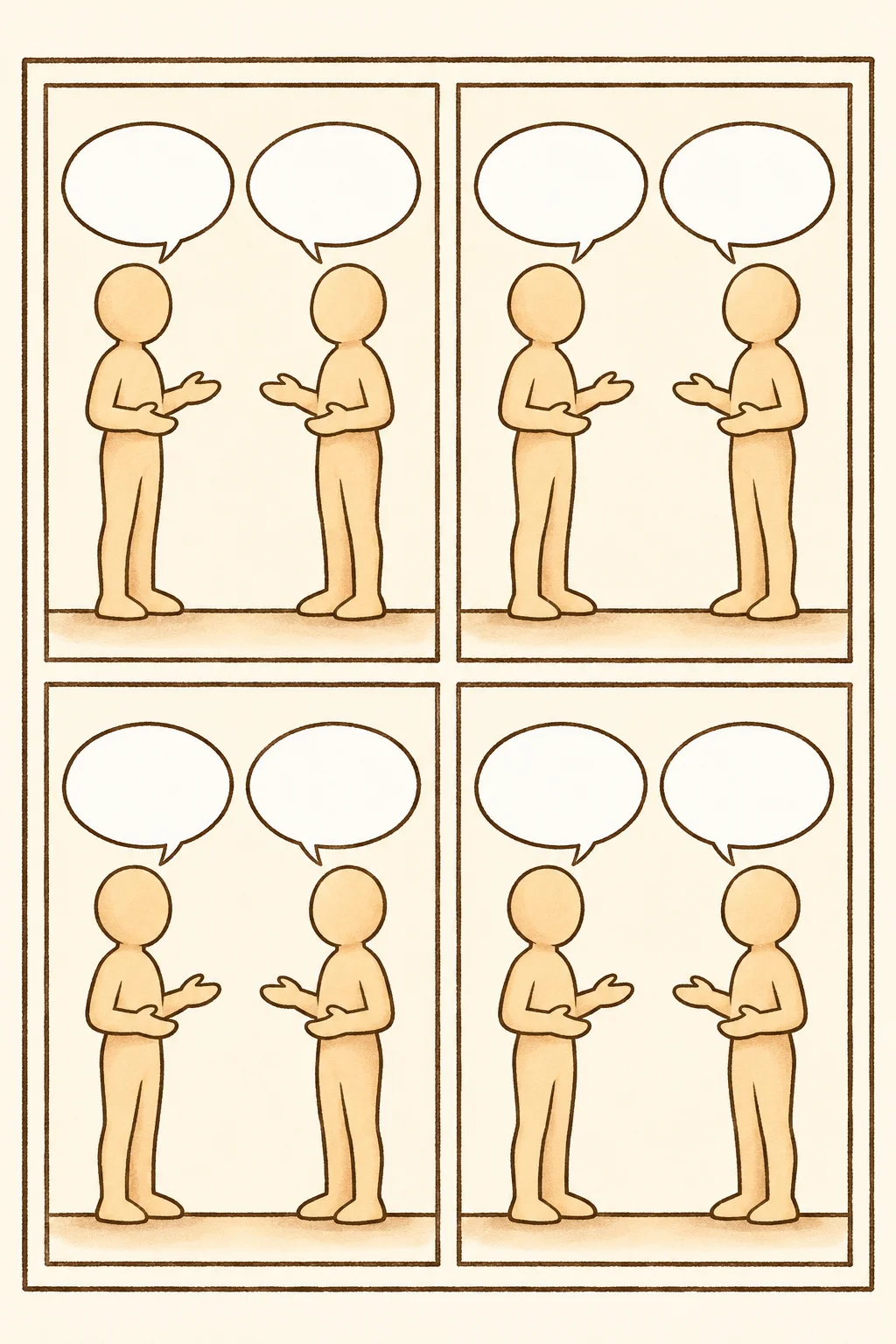
Earlier comics tended to frame characters as if on a stage, seen from a fixed distance.
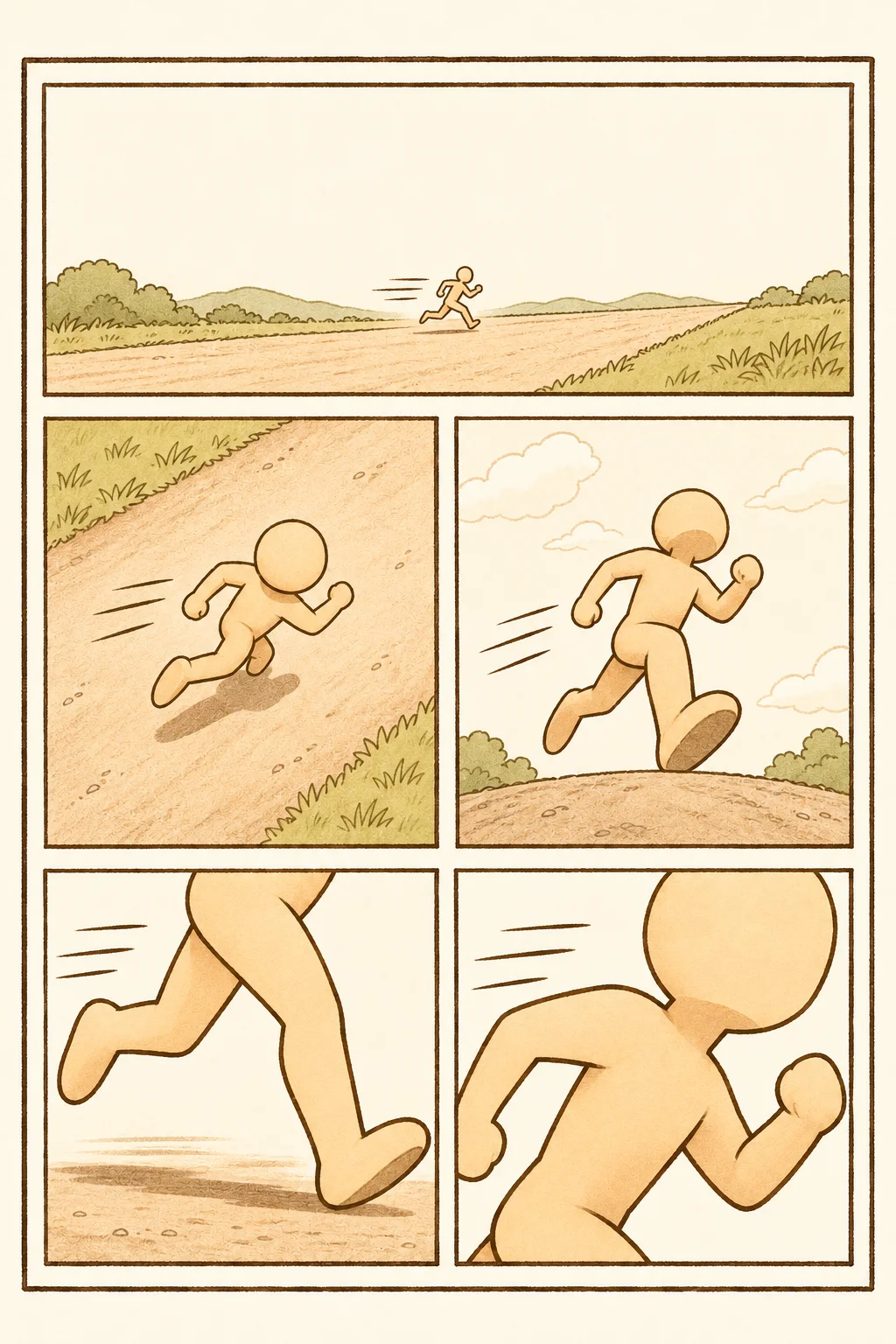
One action broken into a sequence of shots, with close-ups and changing angles.
Just as important was its length. A single book-length story showed that a comic could carry the weight of a novel. Tezuka followed with a run of science-fiction books from Ōsaka publishers, among them Lost World and Metropolis, and in 1950 moved into Tokyo magazines with Jungle Emperor (Janguru Taitei), the multigenerational saga of a white lion in Africa known in English as Kimba the White Lion. In 1953 came Princess Knight (Ribon no Kishi), about a princess raised as a prince to secure the throne. Its cross-dressing heroine owes an obvious debt to the Takarazuka stage, and its large, glittering eyes, flowing costumes and play with identity became founding elements of shōjo manga, comics for girls.
03Astro Boy and the Problem of Being Human
The character the world knows as Astro Boy first appeared in 1951 as a supporting player in Ambassador Atom, serialized in the boys’ magazine Shōnen. Readers liked the little robot so much that in 1952 he got his own series, Tetsuwan Atomu ("Mighty Atom"), which ran until 1968.
The setup is a sad one. In the twenty-first century, Dr. Tenma, head of the Ministry of Science, loses his son Tobio in a car accident and builds a robot in the boy’s image. But a robot cannot grow up, and Tenma, unable to bear the reminder, sells him to a circus. At the circus he is named Atom and made to perform. The kindly Dr. Ochanomizu, Tenma’s successor at the ministry, wins robots their rights, frees him, and later builds him a robot family. Atom has 100,000 horsepower, rocket jets in his feet, searchlight eyes, hearing he can amplify a thousandfold, and hidden machine guns (popular accounts place them in his hips, and some add a finger laser). He speaks sixty languages and can tell whether a person is good or bad. He is also, in temperament, an earnest primary-school boy.
What lifts the series above robot adventure is how persistently Tezuka writes about discrimination. Robots in Atom’s world have no rights. They are bought, sold and worked to destruction, and when something goes wrong they are the first suspects. The series has its own Robot Laws, which forbid robots to harm humans or to leave the country without permission, among other things, and Atom keeps running up against them, caught between the humans he protects and the robots whose cause he takes up, and trusted fully by neither. The robots’ plight is generally read as a stand-in for racial prejudice and social inequality, which makes the series far more than a simple celebration of technological optimism. Tezuka himself is reported to have said as much, and to have been uneasy at seeing Atom treated as a cheerful mascot of technological progress.
The best-known story arc, "The Greatest Robot on Earth," sends a powerful robot named Pluto to destroy the seven strongest robots in the world, one by one, with Atom on the list. Urasawa Naoki reimagined it as the long, adult thriller Pluto (2003–2009), which has introduced Atom to a new generation of readers.
For Japanese readers, Atom is tied up with the postwar story itself. His name is simply "atom," and he appeared barely six years after Hiroshima and Nagasaki, embodying the hope that nuclear power could be peaceful. Children of the high-growth decades grew up with him, and a striking number of Japanese roboticists have said he is the reason they chose their careers. The manga gives his birthday as April 7, 2003, and when that date arrived it was celebrated across the country. Atom’s fictional birthplace is the Ministry of Science in Tokyo’s Takadanobaba district, and since 2003 trains departing JR Takadanobaba Station have left to the Astro Boy theme.
04Inventing Television Anime
Tezuka had wanted to make animation since childhood. After working with Toei Animation on the feature Alakazam the Great (Saiyūki, 1960), in 1961 he set up his own animation department in Tokyo’s Nerima ward, reportedly starting out on the grounds of his own home; it was renamed Mushi Production the following year.
On January 1, 1963, Fuji TV broadcast the first episode of Astro Boy, the first weekly, half-hour animated series produced in Japan. It ran for 193 episodes and at its peak drew ratings above 40 percent. Producing a full episode every week was impossible with Disney-style full animation, so the studio cut the number of drawings per second drastically, reused libraries of stock movements such as mouth shapes and running cycles, and leaned on camera pans, still frames and sound to carry the drama. This "limited animation" approach became the basic grammar of Japanese TV anime. To win the slot, Tezuka also accepted a production fee far below the real cost, making up the gap with manga income and character merchandising. The decision made TV anime possible almost overnight, and critics still argue that it also set the industry’s long habit of low budgets and punishing schedules.
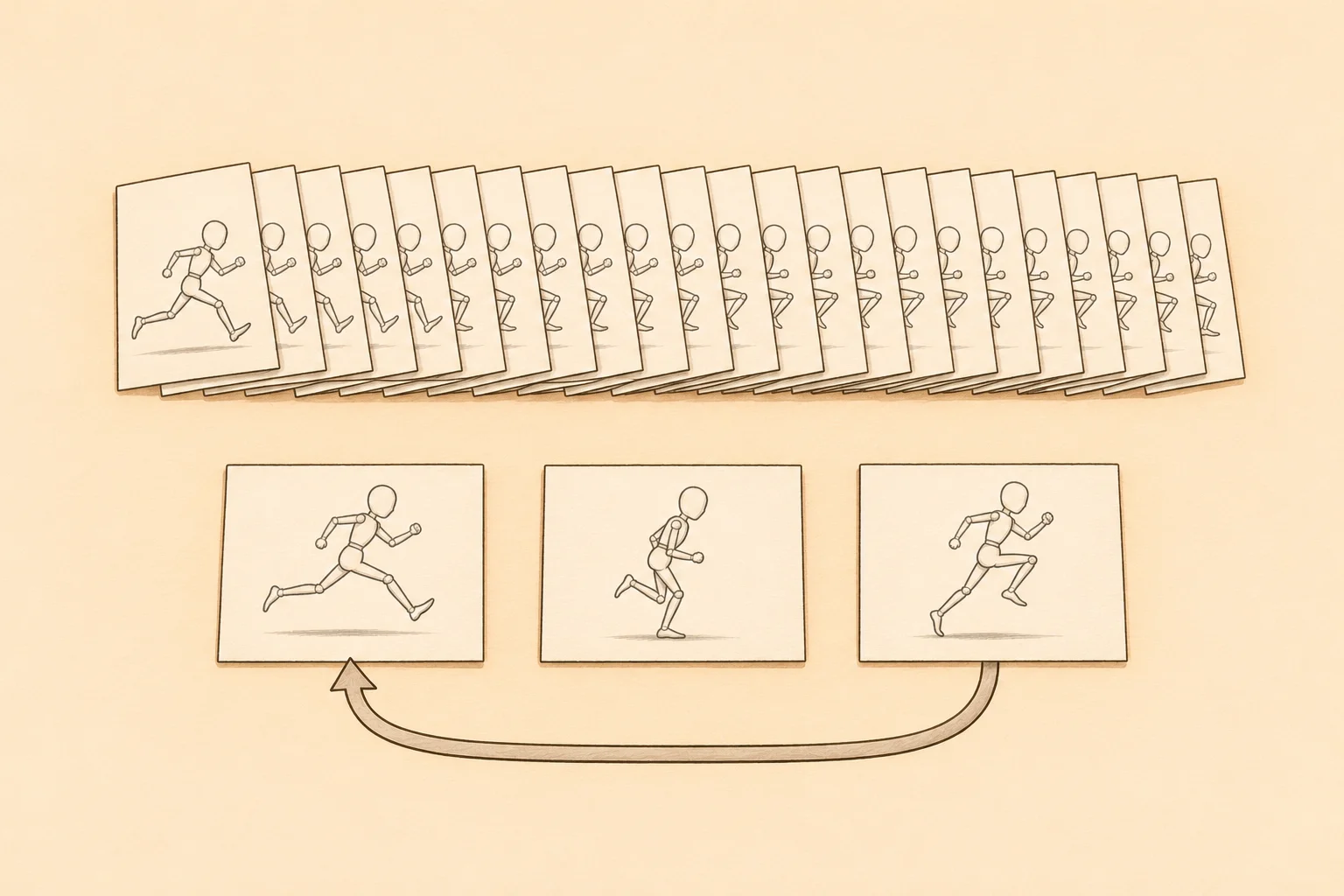
The same run drawn two ways: full animation needs many drawings per second, limited animation far fewer, reused in cycles.
Disney-style full animation
- Many drawings per second
- Impossible to finish an episode every week
Limited animation (Mushi Production)
- Far fewer drawings per second
- Reused stock movements: mouth shapes, running cycles
- Camera pans, still frames and sound carry the drama
Disney-style full animation could not deliver an episode a week; Mushi Production cut drawings, reused stock movements and leaned on camera and sound.
Astro Boy was sold to the United States, where NBC’s syndication arm distributed it in 1963, making it one of the first Japanese series broadcast abroad. In 1965 Mushi Production followed with Jungle Emperor, Japan’s first color TV anime series. Decades later, Disney’s The Lion King (1994) drew complaints about its resemblances to Tezuka’s lion, a controversy still remembered in Japan.
Running a studio while drawing several serials at once took its toll. Mushi Production went bankrupt in 1973, leaving Tezuka with heavy debts. At the same moment his manga seemed to be falling out of fashion, as readers turned to gekiga, a grittier, more realistic style that made his rounded, Disney-influenced characters look old.
05Black Jack, Phoenix and the Adult Tezuka
His comeback came in 1973 with Black Jack, serialized in Weekly Shōnen Champion. The editors, the story goes, thought of it as a possible farewell for a fading veteran. Its hero is an unlicensed surgical genius with a stitched scar across his face and two-toned hair, who charges outrageous fees and often operates on patients no one else will touch. Each chapter is a self-contained case, and each turns on a choice about life and death. Drawing on his medical training, Tezuka ran it weekly for five years and then irregularly until 1983, and it remains one of his most widely read works.
Alongside it he produced his most ambitious long works. Buddha (1972–1983) retells the life of the Buddha with a large cast of invented characters. Phoenix (Hi no Tori), which he regarded as his life’s work, began in the 1950s and took its definitive form from 1967 in the magazine COM. Each volume is linked by the phoenix, whose blood grants eternal life, and the volumes alternate between the distant past and the distant future, gradually closing in on the present. From the ancient kingdom of Yamatai to the death of the Earth, every volume asks whether immortality is worth wanting and what makes a single life precious. The series was never finished; the volume set in the present was still unwritten when he died.
In the 1980s, in the weekly news magazine Shūkan Bunshun, he serialized Message to Adolf (Adorufu ni Tsugu, 1983–1985), the story of three men named Adolf during the Second World War, one of them Hitler, moving between Kōbe and Germany. It was written for adults and is often counted among his finest work.
Tezuka’s workload was famous. He kept several serials going at once, with editors waiting in shifts outside his studio, and drew in taxis, on planes and in hotel rooms. He died of stomach cancer in Tokyo on February 9, 1989, at the age of 60. According to a story often told, his last words were a plea to be allowed to keep working.
06What the "God of Manga" Left Behind
In the early 1950s Tezuka lived for a time in Tokiwa-sō, a modest wooden apartment house in Tokyo’s Toshima ward. After he moved out, younger artists moved in, among them Fujiko Fujio, Ishinomori Shōtarō and Akatsuka Fujio, who would go on to create Doraemon, Cyborg 009 and Tensai Bakabon. Tezuka also ran his characters like a repertory company, a "star system" in which the same faces, such as the mustachioed Higeoyaji, reappear in different roles across different works. His large-eyed character design, borrowed from Disney and Betty Boop, became the most recognizable visual signature of manga and anime.
He was not beyond criticism. Besides the economics of limited animation, some of his early work contains racial caricatures that now look painful, and current Japanese editions usually carry a publisher’s note acknowledging them. He was also intensely competitive and openly jealous of younger rivals, as many anecdotes record. But because he tried almost everything, science fiction, girls’ romance, medical drama, history, religion, war and erotica, he widened the range of what manga could be.
In 1997 the Asahi Shimbun established the Tezuka Osamu Cultural Prize, now one of Japan’s most respected manga awards. His work keeps being remade: Astro Boy was reanimated in 1980 and 2003, Pluto became an animated series in 2023, and Black Jack has appeared as anime, live-action drama and film.
07Finding Tezuka in Japan
The essential stop is the Osamu Tezuka Manga Museum in Takarazuka, opened in 1994. It is about a ten-minute walk from Takarazuka Station along the Hananomichi promenade, past the Grand Theater of the Revue that shaped his childhood. The building looks like a small European castle, with a phoenix at the entrance and characters’ handprints and footprints set into the pavement outside. Inside are his manuscripts and other materials (mostly reproductions, by the museum’s account), his boyhood insect sketches and notebooks, and, on the basement level by most descriptions, an animation workshop where visitors can draw a few frames and watch them move.
In Tokyo, Takadanobaba is Astro Boy’s "hometown," with the station jingle and large murals of Tezuka characters near the station; Tezuka Productions has its offices in the area. In Toshima ward, the Tokiwa-sō Manga Museum is a faithful reconstruction of the old apartment house, opened in 2020, where the narrow corridors, shared kitchen and cramped rooms, said to be four and a half tatami mats each, show how little those young artists lived on.
To read him, any large Japanese bookstore stocks multiple editions, and English translations of Astro Boy, Black Jack, Phoenix, Buddha and Message to Adolf are widely available. Black Jack, with its stand-alone chapters, is the easiest way in. Phoenix, especially the volumes "Future" and "Karma," shows what he most wanted to say. And with Astro Boy, look for the stories in which Atom is mistrusted by the people he is trying to save, for that is where Tezuka’s real question lies: how a child stronger than anyone can go on believing in humans in a society that refuses to treat him as one of them.